

Thin TV speakers make dialogue disappear, bass sound hollow, and action scenes feel strangely flat. The right soundbar can fix those problems without turning the living room into a maze of speakers and cables. The Best sound bar for you depends on whether you want a compact speech booster, a wireless subwoofer, or convincing Dolby Atmos.
We compared 10 soundbars that cover simple TV upgrades, gaming and music, small rooms, and full home theater setups. Sonos Arc Ultra is the strongest all-around pick for spatial sound and dialogue, while the list also includes more compact options from Bose, Sony, Amazon, Samsung, TCL, Assistrust, and ULTIMEA.
Comparison table
| # | Product | Award | Channels | Subwoofer | Connectivity | Best for |
|---|---|---|---|---|---|---|
| 1 | Sonos Arc Ultra | Best overall | 9.1.4 spatial audio | Optional add-on | HDMI eARC, Wi-Fi, Bluetooth, AirPlay 2, Spotify Connect | Immersive home theater |
| 2 | ULTIMEA Poseidon M60 | Best surround package | 5.1 | Wired | HDMI eARC, Bluetooth 5.4 | Cinematic sound without rear speakers |
| 3 | TCL S55H | Best with wireless bass | 2.1 | Wireless | HDMI eARC/ARC, optical, Bluetooth, AUX | Small and medium rooms |
| 4 | Samsung HW-B550F | Best for punchy TV sound | 2.1 | Wireless | TV connection, wireless rear-speaker expansion | Movies and games |
| 5 | Bose TV Speaker | Best for dialogue | 2.0 | Optional add-on | HDMI ARC, optical, AUX, Bluetooth | Clearer speech in a compact setup |
| 6 | Amazon Fire TV Soundbar | Best for Fire TV | 2.0 | No | HDMI eARC/ARC, Bluetooth | Simple streaming setups |
| 7 | ULTIMEA Home Theater Soundbar | Best app-controlled 2.1 system | 2.1 | Wireless | Bluetooth 6.0, app control | Adjustable bass and EQ |
| 8 | Sony S100F | Best for small spaces | 2.0 | No | HDMI ARC, optical, Bluetooth | Bedrooms and home offices |
| 9 | Samsung HW-B400F | Best with built-in bass | 2.0 | Built in | TV wireless connection | Cable-light TV upgrades |
| 10 | Assistrust Sound Bar | Best detachable design | 2.0 | No | Bluetooth 5.0, ARC, optical, AUX | Flexible TV, PC, and projector use |
1. Sonos Arc Ultra: Best Overall

Pros
- Expansive 9.1.4 spatial audio
- Strong dialogue clarity with Speech Enhancement
- Trueplay room tuning
- Wi-Fi, Bluetooth, AirPlay 2, and Spotify Connect
- Expandable with Sonos Sub and Era 300 speakers
Cons
- Requires HDMI eARC for the full setup
- No included subwoofer
- Its 46.18-inch width needs a suitable TV stand
Best for: someone who wants the most capable single-bar home theater foundation.
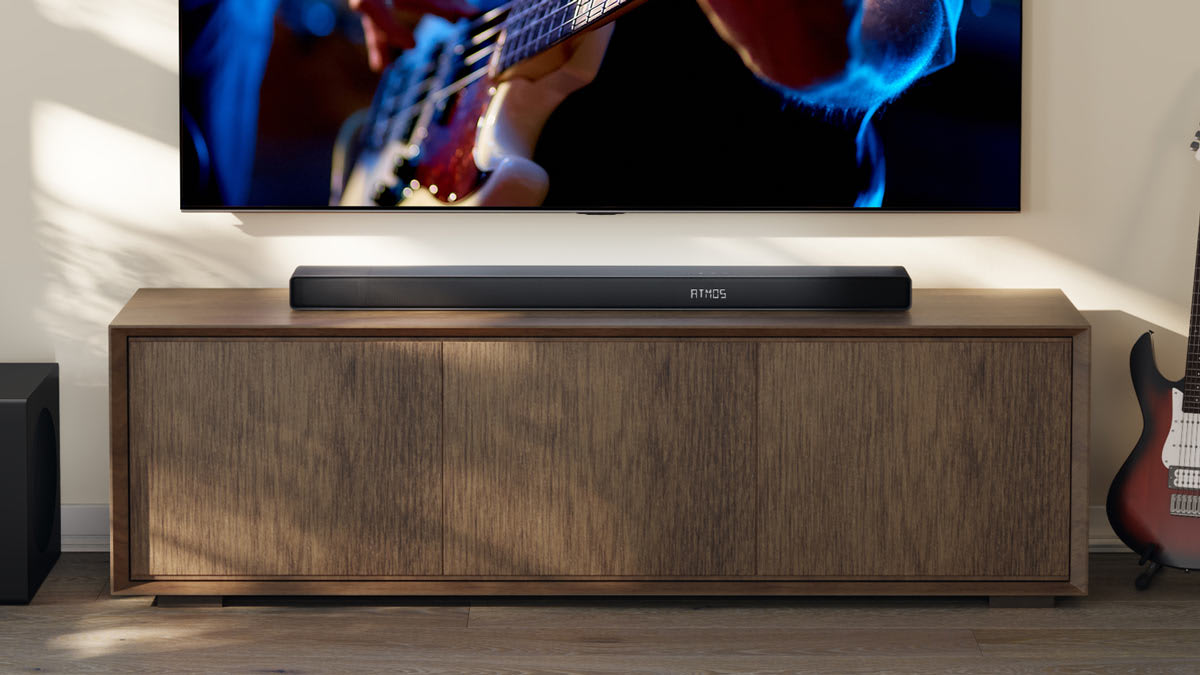
The Sonos Arc Ultra is the soundbar we'd choose when the goal is not merely to make a TV louder. It creates a broad, tall soundstage from one enclosure, placing effects around the room with a sense of height that compact two-channel bars cannot match. The presentation is more ambitious than the Bose TV Speaker or Amazon Fire TV Soundbar, both of which focus mainly on improving the sound directly in front of you.
Its 9.1.4 spatial audio layout and Dolby Atmos support give films and games room to breathe. Sonos says the acoustic architecture uses Sound Motion technology to fill the room and place sounds precisely. That does not turn the bar into a complete rear-speaker system by itself, but it gives the Arc Ultra a much more convincing sense of movement than the virtual surround modes on the Samsung HW-B550F and TCL S55H. Add Sonos Sub and Era 300 rear speakers later, and the system can grow into a genuine surround setup.
Dialogue is a particular strength. Speech Enhancement uses AI to detect human voices and make them easier to follow, which is useful when a soundtrack swings between quiet conversation and loud effects. Trueplay tuning then adjusts the sound for the room through the Sonos app. That combination gives the Arc Ultra more control over difficult rooms than a bar with only a few fixed sound modes. The single HDMI eARC connection keeps the physical setup tidy, though the TV needs compatible eARC hardware to unlock the most advanced audio formats.
This is also the most flexible music player here. Wi-Fi, Bluetooth, Apple AirPlay 2, Spotify Connect, Sonos Voice Control, and Amazon Alexa are all available, and touch controls sit on the bar itself. Its 46.18-inch width makes sense for a larger television, but it can overwhelm a small console. The 3.13-inch height is still low enough for many displays, yet placement deserves attention if the TV's bottom edge sits close to the stand.
The weakness is simple: the Arc Ultra is a premium ecosystem product, not a minimal TV accessory. It has no included subwoofer, and buyers who want deep bass immediately should look at the ULTIMEA Poseidon M60, Samsung HW-B550F, or TCL S55H. For someone building a polished home theater around one excellent soundbar, though, the Arc Ultra is the most complete choice in this group.
2. ULTIMEA Poseidon M60: Best Surround Package

Pros
- 5.1-channel audio with Dolby Atmos
- Five built-in speakers and side-firing drivers
- Wired wooden subwoofer
- 10-band EQ and 121 sound presets
- HDMI eARC and Bluetooth 5.4
Cons
- Subwoofer requires a wired connection
- No rear speakers included
- The 31.5-inch bar needs more room than compact models
Best for: movie fans who want a broad theater-style presentation without adding rear speakers.
The ULTIMEA Poseidon M60 takes a different route from the Sonos Arc Ultra. Instead of making one premium bar the center of a larger ecosystem, it packages five built-in speakers with a dedicated wired subwoofer. That makes it a more immediately cinematic system, particularly for someone who wants more physical bass and a wider front soundstage than a compact all-in-one bar can provide.
The five full-range drivers include two side-firing drivers, which help spread effects beyond the bar itself. ULTIMEA lists up to 300W of peak power, a frequency response of 45 Hz to 18 kHz, and a maximum SPL of 99 dB. Those figures describe a system built for a room-filling presentation, while the dedicated subwoofer handles the low-end weight that the Bose TV Speaker, Sony S100F, and Fire TV Soundbar cannot reproduce on their own.
Dolby Atmos support works through HDMI eARC, which provides the bandwidth needed for lossless Dolby Atmos 5.1-channel audio. The bar also has Bluetooth 5.4 for wireless listening. Setup is intended to take less than a minute, but the system still has more physical pieces than a single-bar solution. The subwoofer is wired, so its placement is constrained by the cable even though the bar itself can remain close to the TV.
VoiceMX processing focuses on speech by separating vocals from music and effects. That is useful in action films where dialogue can otherwise get buried. The app adds a 10-band graphic EQ, 121 presets, and 13 surround-level adjustments, giving the Poseidon M60 far more tuning control than the Bose or Sony. It is a good fit for listeners who enjoy shaping the sound rather than relying on one factory voicing.
The trade-off is refinement. The Sonos Arc Ultra produces a more sophisticated spatial presentation and supports a broader multiroom platform, while the TCL S55H is easier to place because its subwoofer is wireless. The Poseidon M60 makes the stronger case for a dedicated, impact-heavy movie system with no rear speakers, but buyers who want a clean cable layout should skip it. It suits a main TV in a small or medium room where bass and surround width matter most.
3. TCL S55H: Best With Wireless Bass

Pros
- Wireless subwoofer included
- Dolby Atmos and DTS Virtual:X
- AI Sonic auto room calibration
- HDMI eARC/ARC, optical, Bluetooth, and AUX
- Compact 2.36-inch bar height
Cons
- 2.1-channel design is less ambitious than the Poseidon M60
- Wireless subwoofer still needs its own power connection
- App calibration adds an extra setup step
Best for: someone who wants a low-profile soundbar with substantial bass and flexible placement.
The TCL S55H is a sensible middle ground. Its 2.1-channel design keeps the system straightforward, but the wireless subwoofer adds the low-frequency presence missing from compact two-channel bars. The bar measures 31.89 inches wide and 2.36 inches high, so it can sit under many TVs without blocking the screen or remote sensor.
TCL rates the system for up to 220W of power and includes both Dolby Atmos and DTS Virtual:X. Those formats create a larger sense of space than standard stereo, though the S55H does not have the dedicated speaker count of the ULTIMEA Poseidon M60 or the 9.1.4 architecture of the Sonos Arc Ultra. Its appeal is balance: you get a separate bass unit and virtual height effects without committing to a larger multi-speaker installation.
AI Sonic auto room calibration is the feature that separates it from several similarly shaped bars. Through the TCL app, the system adjusts its audio for the room and listening position. Calibration cannot correct every acoustic problem, but it is a useful starting point when the bar sits in an open living room or near reflective surfaces. The app also gives the system a more deliberate setup process than the plug-and-play Bose TV Speaker.
Connection options are generous. HDMI eARC/ARC, optical, Bluetooth, and AUX cover modern smart TVs, older displays, phones, and some projectors. A remote is included, along with an HDMI cable, power cord, batteries, and a wall-mount kit. The wireless subwoofer measures 7.68 inches wide, 12.60 inches high, and 7.68 inches deep, so it can be placed away from the bar, but it still needs a nearby outlet.
The S55H does not sound as enveloping as the Sonos Arc Ultra, and its 2.1 layout cannot create the same front-to-back illusion as the Poseidon M60. It does, however, offer easier furniture placement than the wired ULTIMEA system and more bass authority than the Bose, Sony, or Amazon bars. Readers comparing how much room a wireless subwoofer needs should measure both the TV console and the likely subwoofer position before choosing it.
4. Samsung HW-B550F: Best for Punchy TV Sound

Pros
- 2.1-channel sound with wireless subwoofer
- DTS Virtual:X spatial audio
- Voice Enhance and Adaptive Sound modes
- Bass Boost mode
- Optional wireless rear-speaker expansion
Cons
- No Dolby Atmos listed
- Larger subwoofer footprint
- Less connection detail than several rivals
Best for: viewers who want stronger bass, clearer voices, and a simple route to fuller TV sound.
The Samsung HW-B550F is built around the familiar strengths of a 2.1-channel arrangement: a slim bar for voices and a separate wireless subwoofer for impact. Explosions, music, and low rumbles have more weight than they do through the Bose TV Speaker or Amazon Fire TV Soundbar, while the bar remains less complicated than the Poseidon M60.
DTS Virtual:X adds a broader, more multidirectional presentation without requiring rear speakers. It cannot reproduce the same physical separation as a true surround package, but it gives movie soundtracks more room to spread across the front of the room. Samsung also includes Adaptive Sound, which recognizes the type of content and changes the audio profile, plus Bass Boost for listeners who want a heavier low end.
Voice Enhance mode addresses one of the most common reasons people replace their TV speaker. It automatically amplifies dialogue so voices stand out from music and effects. That makes the HW-B550F a stronger choice than a bass-focused bar for mixed viewing, although the Bose TV Speaker remains more narrowly focused on speech clarity.
The system can later expand with optional wireless rear speakers. That upgrade path is useful if the initial bar and subwoofer are enough for now but a more immersive setup is planned later. The listed dimensions are 33.81 inches wide, 2.3 inches high, and 3 inches deep for the soundbar, with a subwoofer measuring 13.5 inches high, 11.64 inches long, and 15 inches wide. The subwoofer is the part most likely to need careful furniture planning.
The limitation is format support. The data lists DTS Virtual:X rather than Dolby Atmos, so the TCL S55H and ULTIMEA Poseidon M60 are better fits for buyers specifically seeking Atmos playback. The HW-B550F is the more straightforward choice for Samsung households and anyone who wants a noticeable step up in bass and dialogue without a wide app-driven ecosystem.
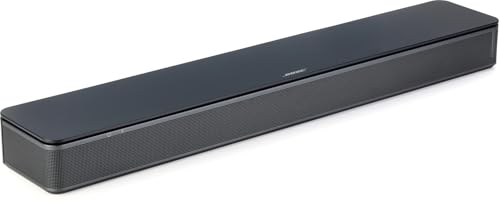
5. Bose TV Speaker: Best for Dialogue
Pros
- Clear focus on speech and pronunciation
- Two angled full-range drivers
- HDMI ARC, optical, AUX, and Bluetooth
- Compact 2.21-inch height
- Compatible with Bose Bass Module 500 and 700
Cons
- No included subwoofer
- No Dolby Atmos or virtual surround format listed
- HDMI cable is sold separately
Best for: someone who mainly wants to understand TV dialogue from a small, simple soundbar.
The Bose TV Speaker is the least theatrical pick here, and that is precisely why it works. It is designed to make a TV easier to hear rather than simulate a cinema. The two angled full-range drivers spread sound more naturally than many built-in TV speakers, while the dialogue mode puts extra attention on vocals and pronunciation.
At 23.38 inches wide, 4.02 inches deep, and just 2.21 inches high, it is easy to fit in front of a television or mount on a wall. The small enclosure will not produce the room-filling bass of the Samsung HW-B550F, TCL S55H, or either ULTIMEA system. It does provide a cleaner, more direct voice presentation, which matters more than surround effects for news, sitcoms, documentaries, and spoken-word programming.
Setup is simple. An optical cable is included, and the bar also supports HDMI ARC and AUX. Bluetooth lets it act as a basic music and podcast speaker, while up to three devices can connect through its inputs, with the first powered-on device connecting automatically. The included remote adds dialogue and bass-boost controls without requiring an app or a network account.
Bose gives the TV Speaker a clear expansion route through the Bass Module 500 or Bass Module 700. Those units require the Bose Bass Module Connection Cable or a standard 3.5-millimeter audio cable, so expansion is possible but not as seamless as adding wireless rear speakers to the Samsung HW-B550F. The bar itself weighs 8.2 pounds, which is manageable for wall mounting with the appropriate brackets.
Skip this model if Dolby Atmos, gaming effects, or powerful bass are central to your setup. The Sonos Arc Ultra and ULTIMEA Poseidon M60 are far more capable for immersive movies, while the Sony S100F offers a similarly simple small-room approach. For readers focused on making quiet voices easier to follow without adding a subwoofer, the Bose TV Speaker remains one of the clearest options.
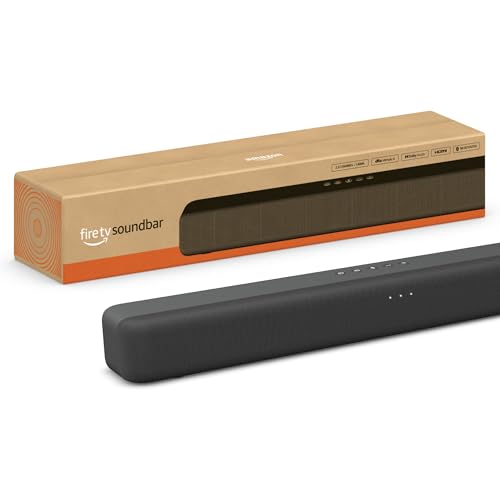
6. Amazon Fire TV Soundbar: Best for Fire TV
Pros
- Designed to work with Fire TV
- DTS Virtual:X and Dolby Audio
- HDMI eARC/ARC setup
- Bluetooth streaming
- Compact 24-inch width
Cons
- No separate subwoofer
- Power adapter and cable are not included
- Less adjustable than app-controlled systems
Best for: Fire TV owners who want one-remote control and a compact upgrade from built-in speakers.
The Amazon Fire TV Soundbar is aimed at reducing friction. It is a 2.0 speaker with dual drivers, Dolby Audio, and DTS Virtual:X, but its main selling point is how naturally it fits into a Fire TV setup. A compatible Fire TV device can control the television and soundbar with one remote, which is more convenient than juggling separate controls.
Its 23.98-inch width and 2.5-inch height make it a good match for smaller consoles and TV stands. The compact enclosure improves clarity and adds some bass compared with a built-in television speaker, but there is no dedicated subwoofer. The TCL S55H and Samsung HW-B550F are better choices for low-end impact, while the Bose TV Speaker has a more explicit dialogue-first design.
Connection is handled through HDMI eARC or ARC, and Amazon says the included HDMI cable can be used for a quick setup. Bluetooth supports audio from a phone or tablet. The bar is compatible with smart TVs and televisions connected to streaming media players, so Fire TV integration does not prevent it from working in a mixed-brand setup.
The listed weight is 3.97 pounds, keeping the unit easy to position. Amazon also says the device uses 18% recycled materials, covering the power adapter and cable, though those power accessories are not included in the package. That omission is important to account for before installation because the soundbar cannot be used without the appropriate power connection.
The Fire TV Soundbar is not the pick for a serious home theater. It lacks a separate bass unit, room calibration, and the app-based EQ controls found on the ULTIMEA systems. It is a clean answer for someone who wants clearer TV sound, virtual surround effects, Bluetooth, and simple Fire TV control in one compact bar.
7. ULTIMEA Home Theater Soundbar: Best App-Controlled 2.1 System

Pros
- Wireless subwoofer
- 10-band EQ and 121 preset matrices
- VoiceMX dialogue processing
- Bluetooth 6.0
- 2.1-channel system with strong bass focus
Cons
- No Dolby Atmos listed
- App is needed for the deepest sound customization
- Subwoofer still requires separate power
Best for: listeners who want to adjust dialogue, bass, and listening modes from a phone.
The ULTIMEA Home Theater Soundbar is a practical choice for someone who wants a separate subwoofer but does not want to stop at a handful of preset buttons. Its 2.1-channel layout pairs a soundbar with a wireless subwoofer, giving movies and games more low-frequency weight while keeping the audio cable run between the two units out of the room.
ULTIMEA lists up to 240W of peak output, a 45 Hz to 18 kHz frequency response, and a maximum SPL of 95 dB. The subwoofer uses an 18-millimeter high-excursion driver and a 6.5-liter tuned cabinet, with BassMX technology targeting the 45 Hz to 150 Hz range. Those details point to a system that is more concerned with bass authority than the Bose TV Speaker or Sony S100F.
VoiceMX processing dynamically boosts the 120 Hz to 6 kHz vocal range. That is a wide section of the speech spectrum, and the purpose is clear: keep dialogue present when effects or music become busy. The system also uses mica-reinforced diaphragms in its drivers, with the product description claiming greater rigidity and lower distortion. We would treat that as a design promise rather than a substitute for listening, but it is consistent with the bar's focus on cleaner mids.
The app is the main differentiator. A 10-band equalizer and 121 preset EQ matrices let listeners shape the sound for films, music, or games, while over-the-air updates can keep the system current. Bluetooth 6.0 handles wireless streaming from phones, tablets, and laptops. That makes this system more adjustable than the Samsung HW-B550F, though Samsung is simpler for people who prefer automatic sound modes and physical remote control.
The ULTIMEA does not list Dolby Atmos, so it cannot compete with the Sonos Arc Ultra, Poseidon M60, or TCL S55H on format support. The soundbar measures about 23.62 inches wide, 2.76 inches high, and 3.54 inches deep, which is easy to place, but the wireless subwoofer still needs an outlet. Choose it for tunable bass and flexible app control, not for a height-effect theater experience.
8. Sony S100F: Best for Small Spaces

Pros
- Compact 2.0-channel design
- Built-in tweeter and Bass Reflex speaker
- Voice enhancement mode
- HDMI ARC and Bluetooth
- Wall-mountable
Cons
- No separate subwoofer
- Older design with fewer modern features
- Limited sound customization
Best for: a bedroom, home office, or small living space that needs clearer TV and conference-call audio.
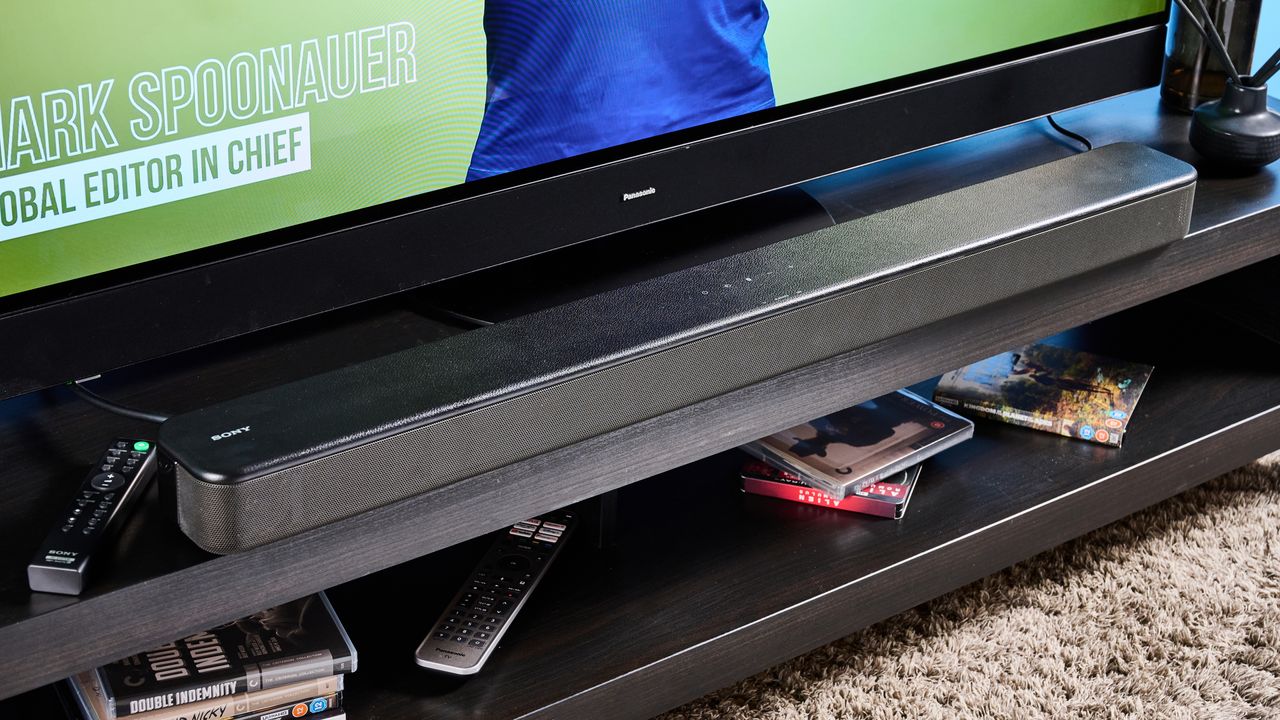
The Sony S100F is a straightforward small-room soundbar with a specific advantage: it is useful for both television and spoken audio from a computer or office setup. Its 2.0-channel configuration, built-in tweeter, and Bass Reflex speaker aim to add clarity and some low-end depth without requiring a separate subwoofer.
Sony includes a voice enhancement feature for hushed TV dialogue and conference-call participants. That makes the S100F more versatile than a soundbar designed only around movie effects. It also supports S-Force Pro Front Surround, which attempts to create a wider presentation from the front of the room. The effect is not equivalent to the Dolby Atmos experience from the Sonos Arc Ultra or TCL S55H, but it can make ordinary TV audio feel less narrow.
HDMI ARC makes TV setup simple, while Bluetooth handles music and other wireless audio. An optical cable, remote, batteries, AC cord, wall-mount template, and setup materials are listed in the box. The bar is wall-mountable, which helps when a desk or TV stand is shallow. Sony describes it as a slim design for small living spaces, although the product information also lists unusually large outer dimensions, so buyers should verify the placement measurements for the specific installation.
The S100F is less feature-rich than the Amazon Fire TV Soundbar. Amazon adds Dolby Audio and DTS Virtual:X, while Sony concentrates on voice enhancement, a tweeter, and easy physical setup. The Bose TV Speaker is the closer rival in spirit, with a stronger dialogue focus and a more compact listed height. Sony has the more office-friendly feature set, while Bose offers a more focused TV speech presentation.
Skip the S100F if you want deep bass or a convincing surround field. Its lack of a dedicated subwoofer is the central limitation, and there is no listed room calibration or app EQ. For a small TV, bedroom, or home office where intelligibility matters more than cinematic scale, it remains a sensible, uncomplicated pick.
9. Samsung HW-B400F: Best With Built-In Bass

Pros
- Built-in woofer avoids a separate subwoofer
- One Samsung remote can control key functions
- Voice Enhance mode
- Surround Sound Expansion
- Night mode lowers bass and volume impact
Cons
- Less bass extension than a separate-subwoofer system
- No Dolby Atmos listed
- Wireless TV connection may depend on compatible equipment
Best for: viewers who want fuller TV sound without placing another box beside the sofa.
The Samsung HW-B400F solves a common soundbar problem by keeping the woofer inside the main enclosure. That means no separate subwoofer to position, power, or hide. The result is a cleaner installation than the HW-B550F, TCL S55H, and ULTIMEA systems, though the trade-off is that a built-in woofer cannot move as much air as a dedicated wireless bass unit.
Samsung describes the B400F as a 2.0-channel soundbar with balanced sound and rich bass from the built-in woofer. Surround Sound Expansion spreads audio in multiple directions, giving the bar more presence than basic stereo. It does not offer the channel count or Atmos support of the Sonos Arc Ultra and Poseidon M60, but it is a more compact answer for everyday television.
Voice Enhance mode automatically amplifies dialogue, which is useful for news, drama, and late-night viewing. Night mode lowers volume and minimizes bass so the system is less disruptive when other people are sleeping. Those two modes make the B400F more considerate in a shared home than a bass-heavy system that always emphasizes impact.
The bar measures 25.23 inches wide, 2.62 inches high, and 4.21 inches deep, with a listed weight of 4.6 pounds. Samsung also supports one-remote control for power, volume, and sound effects on compatible Samsung TVs. The product description mentions connecting to the TV without cable clutter through pairing, but compatibility should be checked before assuming every television will support the same wireless arrangement.
Compared with the Bose TV Speaker, the B400F puts more emphasis on built-in bass and room coverage, while Bose has a clearer standalone dialogue identity and more detailed input list. Compared with the Samsung HW-B550F, the B400F is easier to place but lacks the separate subwoofer's impact. It is the right fit for a neat TV console and modest listening levels, not for a full cinema setup.
10. Assistrust Sound Bar: Best Detachable Design

Pros
- Detachable design supports multiple placements
- Four high-performance drivers
- Three equalizer modes
- Bluetooth 5.0, ARC, optical, and AUX
- Auto volume boost and extended support coverage
Cons
- No dedicated subwoofer
- No Dolby Atmos listed
- More basic than the app-controlled systems
Best for: someone who needs one flexible soundbar for a TV, PC, gaming setup, or projector.
The Assistrust Sound Bar stands out because it can be used in more than one physical arrangement. Its detachable design supports horizontal, vertical, tabletop, and wall-mounted placement. That flexibility is useful when the same speaker may move between a television, computer, projector, and gaming setup, although each arrangement will change how widely the sound spreads.
The product lists four drivers and up to 80W of output. It also includes three equalizer modes for movies, music, and news, so the sound can shift between more dramatic effects, fuller music, and clearer speech. Auto volume boost is intended to raise faint sounds, a useful feature for dialogue, though it is less sophisticated than the VoiceMX processing on the ULTIMEA systems or the AI Speech Enhancement in the Sonos Arc Ultra.
Connectivity covers Bluetooth 5.0, ARC, optical, and AUX. ARC allows compatible TV remotes to control the soundbar, while optical and AUX make it easier to connect older displays and other equipment. Those inputs give the Assistrust a wider range of possible uses than the Fire TV Soundbar, which is most naturally paired with HDMI ARC and Bluetooth.
The bar is listed as 31 inches in size, with product dimensions of 17 inches long, 2.5 inches high, and 3.5 inches wide for the listed item configuration. Its four placement options are the real feature here, not a surround format or separate bass module. The 6.55-pound listed weight should be manageable for repositioning, but wall mounting still needs appropriate hardware and a stable surface.
This is not the right pick for listeners chasing Atmos height effects, deep bass, or a refined multiroom system. The TCL S55H adds a wireless subwoofer and room calibration, while the Bose TV Speaker is more purpose-built for TV speech. The Assistrust makes sense when adaptability matters most, especially for a mixed TV and PC setup where a fixed bar would be awkward.

How to choose best sound bar
Start with the room, the TV connection, and the kind of sound you actually want. A compact two-channel bar can be the right answer for dialogue, while a subwoofer system or Atmos-equipped bar is better for films and games.
Channel layout and surround formats
A 2.0 soundbar uses two main channels and generally improves clarity and width over built-in TV speakers. A 2.1 system adds a subwoofer, either wireless or built in, for deeper bass. Systems such as the ULTIMEA Poseidon M60 use a 5.1 layout, while the Sonos Arc Ultra lists 9.1.4 spatial audio for a more expansive presentation.
Dolby Atmos and DTS Virtual:X can create height and surround effects, but virtual processing cannot fully replace speakers placed around the room. Look for a higher channel count when cinematic immersion is the priority. Choose a simpler 2.0 bar when the main goal is clearer speech and a less complicated installation.
A subwoofer changes the physical feel of a soundtrack, while extra processing mainly changes its sense of space.
Dialogue processing
Dialogue modes vary from simple vocal boosts to dedicated processing that isolates speech from music and effects. Bose focuses its TV Speaker on vocals and pronunciation, Sony includes voice enhancement, Samsung offers Voice Enhance modes, and ULTIMEA uses VoiceMX processing.
Dialogue clarity matters most for news, drama, documentaries, and shows with quiet conversations. Listen for a mode that makes voices clearer without making them thin or harsh. If the bar has only a general volume boost, it may raise sound effects along with speech.
Subwoofer design
A wireless subwoofer gives the bar more room for bass and lets you position low-frequency sound away from the TV. The TCL S55H, Samsung HW-B550F, and ULTIMEA Home Theater Soundbar use wireless subwoofers, while the Poseidon M60 uses a wired subwoofer. The Samsung HW-B400F keeps its woofer inside the soundbar for a cleaner installation.
A separate unit generally creates more impact, but it needs floor space and a power outlet. Measure the likely location before choosing a system. If you cannot place another box in the room, a built-in woofer is a reasonable compromise.
TV connections
HDMI ARC or eARC is usually the most convenient connection because it can carry TV audio and allow the television remote to control volume. eARC is especially important for higher-bandwidth formats such as lossless Dolby Atmos. Optical is useful for older TVs, while AUX supports compatible legacy equipment.
Bluetooth is helpful for music from a phone, but it should not be the only connection you consider for television. Check whether the bar includes the needed cable and whether your TV has ARC, eARC, optical, or only a headphone output.
Size and placement
Measure the width and height of the space in front of the TV. The Bose TV Speaker and Amazon Fire TV Soundbar are short and low, while the Sonos Arc Ultra is 46.18 inches wide and better suited to a larger display. A bar that is too tall may block the bottom edge or infrared sensor.
Wall mounting can solve console space problems, but the wall and mounting hardware need to support the unit securely. Detachable designs such as the Assistrust offer more placement flexibility, while a subwoofer system needs a second location to plan.
App and tuning controls
App control is useful when a room has reflective walls, an open floor plan, or seating that is not centered in front of the TV. Sonos Trueplay and TCL AI Sonic provide room-tuning tools, while ULTIMEA adds a 10-band EQ and a large set of presets.
A simple remote can be preferable if several people use the TV and do not want another app. More adjustment is not automatically better, but it gives experienced listeners more control over bass, dialogue, music, and surround intensity.
Frequently asked questions
Do soundbars improve dialogue?
Yes. Many soundbars use dedicated dialogue or voice-enhancement modes to make speech stand out from music and effects. Bose, Sony, Samsung, Sonos, and ULTIMEA all include features aimed at clearer voices, though their processing approaches differ.
Is a 2.1 soundbar better than a 2.0 soundbar?
A 2.1 system usually provides deeper and more physical bass because it includes a separate subwoofer. A 2.0 model can still be the better fit when space is limited or dialogue clarity matters more than movie impact.
Do I need Dolby Atmos in a soundbar?
No. Dolby Atmos is useful for height and spatial effects, but a soundbar without Atmos can still improve clarity, volume, and bass over built-in TV speakers. Consider Atmos when you watch many films or play games where directional effects matter.
Is a wireless subwoofer completely cable free?
No. A wireless subwoofer does not need an audio cable running back to the soundbar, but it still needs power. Plan for an outlet near the placement area.
Can I use a soundbar with a computer?
Many soundbars support Bluetooth, AUX, or optical connections that work with computers. The Assistrust Sound Bar specifically lists TV, PC, gaming, and projector use, while the Sony S100F includes a voice-enhancement feature that can help with conference calls.
Should a soundbar be wider than the TV?
It does not have to be. A wider bar can create a broader front soundstage, but a compact bar is easier to fit in a small room. Focus on keeping the bar clear of the TV screen and checking that its connection and control features match the display.
Can I add speakers later?
Some systems support expansion. The Sonos Arc Ultra can be paired with a Sonos Sub and Era 300 rear speakers, while the Samsung HW-B550F supports optional wireless rear speakers. Other models in this roundup are intended to remain standalone systems.
The bottom line
The Best sound bar in this group is the Sonos Arc Ultra for listeners who want wide, detailed spatial audio, excellent dialogue tools, room tuning, and a clear route to a larger home theater. The ULTIMEA Poseidon M60 is the stronger alternative for buyers who want a dedicated subwoofer and 5.1-channel presentation immediately, without adding rear speakers.
For smaller or simpler rooms, the Bose TV Speaker is the focused dialogue pick, while the TCL S55H gives you wireless bass, Atmos support, and room calibration in a more compact system. The Samsung HW-B400F is the neatest choice when a separate subwoofer would be inconvenient.
If you are undecided, choose the Sonos Arc Ultra for immersion, the Bose TV Speaker for speech, or the TCL S55H for a balanced mix of bass, connectivity, and easy placement.
As an Amazon Associate we earn from qualifying purchases.