

If you have ever sat through a movie where the dialogue sounds like it is coming from a tin can while the explosions rattle a cheap soundbar, you already know why surround sound matters. A proper system does not just make things louder. It places voices in the center of the room, sends a helicopter across the left wall, and lets a bass note press against your chest without distortion. The challenge is that the market is flooded with soundbars claiming 5.1 or 7.1 channels, and the difference between a system that genuinely envelops you and one that just throws noise at the wall comes down to real driver count, subwoofer design, and how well the rear speakers actually work.
We looked at the ten best surround sound systems of 2025 across a wide range of setups. Some are all-in-one soundbars with virtual surround. Others are proper multi-speaker rigs with wired rears and up-firing drivers. The system that impressed us most this year is the Samsung Q990F, a full 11.1.4-channel beast that delivers genuine overhead effects without a single cable running across your floor. But not everyone needs that kind of firepower, and the other nine picks here cover smaller rooms, tighter budgets, and specific priorities like deep bass or simple setup.
Comparison Table
| # | Product | Award | Channels | Subwoofer | Rear Speakers | Best for |
|---|---|---|---|---|---|---|
| 1 | Samsung Q990F 11.1.4ch Q Series | Best overall | 11.1.4 | Wireless 8-inch | Wireless | The ultimate home theater experience |
| 2 | ULTIMEA Skywave X50 5.1.4ch | Best wireless | 5.1.4 | Wireless wood-crafted | Wireless | Clean, cable-free Dolby Atmos |
| 3 | ULTIMEA 5.1.2ch Sound Bar with Dolby Atmos | Best height effects | 5.1.2 | Wired 5.25-inch | Wired | Affordable overhead sound |
| 4 | ULTIMEA 7.1ch Aura A60 Pro | Best wired surround | 7.1 | Wired 5.25-inch | 2 wired front + 2 wireless rear | Full 7.1 immersion on a budget |
| 5 | ULTIMEA Poseidon M60 5.1CH | Best value Dolby Atmos | 5.1 | Wired wooden 5.25-inch | None (virtual) | Simple Atmos upgrade without rear speakers |
| 6 | ULTIMEA 7.1ch Surround Sound Bar (Aura A40 Pro) | Best vocal clarity | 7.1 | Wired 5.25-inch | 2 wired front + 2 wireless rear | Crystal-clear dialogue |
| 7 | ULTIMEA Aura A40 7.1ch | Best app control | 7.1 | Wired 5.25-inch | 2 wired front + 2 wireless rear | Customizable sound with 121 EQ presets |
| 8 | ULTIMEA 5.1 Sound Bar (Poseidon D50) | Best compact 5.1 | 5.1 | Wireless | 2 wired rear | Small rooms and shelf setups |
| 9 | Hiwill-Audio Wooden 5.1.2 Virtual Surround Sound System | Best build materials | 5.1.2 | Wired 5.25-inch down-firing | 2 wired rear | Solid wood cabinets and aluminum drivers |
| 10 | Samsung B-Series HW B400F 2.0ch | Best simple upgrade | 2.0 | Built-in | None | First soundbar upgrade with voice enhancement |
1. Samsung Q990F 11.1.4ch Q Series: Best Overall

Pros
- Genuine 11.1.4-channel immersion with four up-firing drivers
- Wireless rear speakers and subwoofer keep the room clean
- Q-Symphony lets Samsung TV speakers work together with the soundbar
- SpaceFit Sound auto-calibrates to your room
Cons
- Very expensive compared to the rest of the lineup
- Large soundbar footprint needs a wide TV stand
Best for: anyone who wants the absolute best surround sound system money can buy without hiring an installer.
The Samsung Q990F is the closest thing to a commercial cinema you can get in a single box. It uses 11 front and surround channels, one dedicated subwoofer channel, and four up-firing channels that bounce sound off the ceiling. The result is a three-dimensional bubble of audio that places rain directly above your head and footsteps behind your sofa. The wireless rear speakers connect without any pairing drama, and the subwoofer thumps deep enough to shake the floorboards on a wood-frame house.
What makes the Q990F special is not just the channel count. The SpaceFit Sound feature uses a built-in microphone to analyze your room and adjust the frequency response in real time. If you place the subwoofer in a corner, it compensates for the boominess. If your ceiling is angled, it tweaks the height channels. This is the kind of calibration that used to require a professional setup. The Q-Symphony mode is also a genuine advantage if you own a compatible Samsung TV, because the TV speakers fire alongside the soundbar to create a wider soundstage.
The biggest downside is the size. The main bar is 48.5 inches wide, which means it will overhang a 55-inch TV stand. And the price puts it out of reach for most people. But if you have the space and the budget, no other system on this list delivers the same level of immersion. The ULTIMEA Skywave X50 comes close with its wireless 5.1.4 setup, but the Q990F has two more height channels and a more sophisticated room correction. If you are building a dedicated home theater and want to know how far back you should sit from a panel this size, that is a separate question, but the audio will fill the room regardless.
2. ULTIMEA Skywave X50 5.1.4ch Wireless Surround Sound System: Best Wireless

Pros
- Fully wireless rear speakers on a dedicated 5GHz band
- GaN amplifier delivers 760W peak with almost no heat
- Gravus subwoofer reaches 28Hz with clean, tight bass
- 4K HDR pass-through keeps video quality intact
Cons
- No DTS support
- The wood-crafted subwoofer is large and heavy
Best for: people who want true Dolby Atmos height effects without running wires across the room.
The Skywave X50 is the most interesting system ULTIMEA has made. It uses dual 5GHz wireless transmission for the rear speakers and subwoofer, which means no cables between the main bar and the satellites. The connection is stable enough that we never experienced a dropout during testing, even with a Wi-Fi router running in the same room. The main bar itself is 43 inches long, finished with a metal grille and rose gold accents, and the subwoofer is wrapped in a wood cabinet that looks like a piece of furniture.
The 5.1.4 channel layout includes four up-firing drivers (two in the bar, two in the rears) that create a convincing overhead soundstage. The GaN amplifier is a genuine engineering upgrade. Gallium nitride transistors run cooler and switch faster than silicon, which means the system can push 760 watts peak without the distortion that plagues cheaper Class D amps. The Gravus subwoofer uses an oversized waveguide to produce sub-bass down to 28Hz, and it does so without the one-note thud of lesser subs. In a medium-sized living room, you feel the helicopter rotor in "Saving Private Ryan" as a physical pressure.
The weakness is that the Skywave X50 does not support DTS, so if you have a Blu-ray collection with DTS-HD Master Audio, the system will downmix to stereo. This is a limitation shared by most ULTIMEA systems, but it matters for disc enthusiasts. Also, the subwoofer is large (roughly 18 inches tall) and the wireless rear speakers need to be plugged into power, so they are not completely cable-free. Compared to the Samsung Q990F, the Skywave X50 has fewer channels but costs a fraction of the price, making it the best option for anyone who wants wireless Atmos without the Samsung premium.
3. ULTIMEA 5.1.2ch Sound Bar with Dolby Atmos: Best Height Effects

Pros
- Up-firing drivers use neodymium magnets for precise height imaging
- HDMI eARC supports lossless 5.1.2 Atmos up to 37Mbps
- 360-degree SurroundX technology creates a wide sound field
- Ultimea app offers 121 EQ presets and 10-band graphic EQ
Cons
- Rear speakers are wired, not wireless
- Not compatible with DTS
Best for: getting genuine Dolby Atmos height effects for under $200.
This ULTIMEA 5.1.2ch system proves that height channels do not have to cost a thousand dollars. The soundbar contains two up-firing drivers with neodymium internal magnets and 18-core voice coils, which are the same materials used in aerospace-grade speakers. The result is a focused vertical throw that makes rain and overhead effects sound like they are coming from above your head, not just from the front wall. The 360-degree SurroundX technology combines the two rear speakers and the up-firing drivers to create a sound field that extends well beyond the physical boundaries of the speakers.
The wired rear speakers are the main compromise. You have to run speaker wire from the bar to the back of the room, which is fine for a permanent setup but a hassle for renters who cannot fish cables through walls. The subwoofer is also wired. But the trade-off is that you get a full 5.1.2 system with lossless Dolby Atmos via HDMI eARC, and the CEC integration means the soundbar turns on and off with your TV. The app-based EQ is genuinely useful. You can adjust the surround level from -6 to +6 in 13 steps, and the 10-band graphic EQ lets you dial in the exact frequency curve for your room.
Where this system falls short is raw power. The subwoofer is a 5.25-inch driver, so it cannot match the low-end extension of the Skywave X50 or the Q990F. For a small to medium room, it is more than enough, but if you want to feel explosions in a large open-plan space, you will need to look at the ULTIMEA 7.1ch systems or the Samsung. The Poseidon M60 below is a simpler alternative that skips the rear speakers entirely, but the 5.1.2 soundbar offers the best height performance in this price range.
4. ULTIMEA 7.1ch Surround Sound System for TV with Dolby Atmos, Aura A60 Pro: Best Wired Surround

Pros
- True 7.1 channels with three front and four surround speakers
- Rear speakers connect wirelessly to the soundbar, reducing cable clutter
- 5.25-inch wired subwoofer with BassMX technology
- 121 EQ presets and 10-band equalizer in the app
Cons
- Recommended room size is 108 to 270 square feet, not for large spaces
- Front surround speakers are wired to the bar
Best for: a dedicated 7.1 setup in a medium-sized room with a preference for wired reliability.
The Aura A60 Pro is the most complete 7.1 system in the ULTIMEA lineup. It includes three main channels for dialogue and four surround speakers (two front, two rear) that create a wide, room-filling soundstage. The rear speakers connect wirelessly to the soundbar, which is a clever compromise. You only need to plug the right rear speaker into power, and the left rear speaker connects to it with a single cable. The front surrounds are wired directly to the bar, but the cables are short enough to keep things tidy.
The BassMX technology in the subwoofer uses an optimized magnetic structure and a 5.25-inch driver to produce deep bass without distortion. In a 12x15-foot room, the subwoofer fills the space with enough pressure to make action movies feel immersive. The app-based tuning is extensive. The 121 preset EQ matrices cover everything from Bass to Pop to Classical, and the six tailored EQ modes (Movie, Music, Voice, Sport, Game, Night) let you switch between content types without diving into the menus.
The limitation is the room size recommendation. ULTIMEA says the A60 Pro is best for spaces between 108 and 270 square feet. In a larger room, the soundstage starts to thin out, and the subwoofer cannot pressurize the space. If you have a big living room, the Skywave X50 or the Samsung Q990F are better choices. But for a medium-sized bedroom or a dedicated home theater nook, the A60 Pro delivers a level of surround immersion that is hard to beat at this price.
5. ULTIMEA 5.1CH Surround Sound Bar System with Dolby Atmos, Poseidon M60: Best Value Dolby Atmos

Pros
- No rear speakers needed, five built-in drivers create 5.1 surround
- 300W peak power with a wooden subwoofer that adds warmth
- VoiceMX technology keeps dialogue clear even during loud action
- Bluetooth 5.4 for low-latency streaming
Cons
- Virtual surround cannot match the spatial accuracy of physical rear speakers
- Subwoofer is wired, limiting placement options
Best for: a simple, clean setup that adds Dolby Atmos without the complexity of rear speakers.
The Poseidon M60 is the simplest way to get Dolby Atmos in your living room. The soundbar itself contains five built-in speakers, including two side-firing drivers that bounce sound off the walls to create a surround effect. There are no rear speakers to place, no wires to run, and the setup takes less than a minute. The precision DSP keeps latency below 0.5 milliseconds, so you will not notice any lip-sync delay.
The subwoofer is a wired wooden cabinet with an 18mm high-excursion driver and a 5.3-liter tuned chamber. The wood cabinet adds a warmth to the bass that plastic subs often lack. The frequency response goes down to 45Hz, which is enough to give action scenes a solid foundation. The VoiceMX technology is a standout feature. It uses advanced DSP to isolate and enhance vocal frequencies in real time, so dialogue remains crisp even when the score is loud. This is the same kind of technology that Samsung uses in its Q-series, but it comes at a fraction of the cost.
The trade-off is that the virtual surround is not as convincing as a system with physical rear speakers. The side-firing drivers create a wider soundstage than a standard soundbar, but you will not hear sounds coming from directly behind you. If you are willing to live with that limitation, the Poseidon M60 is the best value Dolby Atmos system on the market. It is also a great choice for small apartments where placing rear speakers is impractical. For a more immersive experience, the ULTIMEA 5.1.2ch soundbar with rear speakers is a step up, but it costs more and requires more setup.
6. ULTIMEA 7.1ch Surround Sound Bar for Smart TV, Aura A40 Pro: Best Vocal Clarity

Pros
- VocalMatrix algorithm extracts and redistributes voices across all channels
- VoiceMX boosts 120Hz to 6kHz for clear dialogue in any scene
- 7.1 discrete outputs with 99.99% detail accuracy
- Bluetooth 6.0 for stable wireless streaming
Cons
- Rear speakers use a hybrid wired/wireless connection
- Subwoofer does not reach as low as the Skywave X50
Best for: anyone who struggles to hear dialogue in movies and TV shows.
The Aura A40 Pro is designed from the ground up to solve the dialogue problem. The VocalMatrix algorithm analyzes the original soundstage and dynamically redistributes voices across the 7.1 discrete outputs. Instead of burying dialogue in the center channel, the system uses the rear speakers to reinforce vocal presence, so you can hear every word even when the action is loud. The VoiceMX technology works in real time, boosting the 120Hz to 6kHz range where human speech lives, and it does so without making voices sound artificial.
The 7.1 channel layout uses three main channels and four surround speakers. The front surround speakers are wired to the soundbar, while the rear speakers use a hybrid connection. The right rear speaker connects wirelessly to the bar, and the left rear speaker connects to the right rear with a wire. This design minimizes cable clutter while still giving you a true 7.1 experience. The subwoofer is a 5.25-inch driver with a 6.1-liter tuned cabinet, and it extends down to 45Hz. It is not the deepest subwoofer on this list, but it is tight and controlled.
The weakness is that the subwoofer cannot match the low-end extension of the Skywave X50 or the Samsung Q990F. If you are a bass fanatic, you will want to pair this system with a larger subwoofer or look at the Gravus sub in the Skywave X50. But if your priority is hearing every piece of dialogue clearly, the Aura A40 Pro is the best system in this roundup. The Hiwill-Audio system also has a dialogue enhancement mode, but the A40 Pro's VocalMatrix is more sophisticated.
7. ULTIMEA Aura A40 7.1ch Sound Bar with Subwoofer: Best App Control

Pros
- 121 preset EQ matrices and 10-band equalizer in the app
- 4 surround speakers with 13 adjustable surround levels
- 7.1 virtual surround with 99.99% detail accuracy
- OTA firmware updates keep the system current
Cons
- No Dolby Atmos support (virtual surround only)
- All four surround speakers are wired to the bar
Best for: tinkerers who want to fine-tune every aspect of their audio.
The Aura A40 is the most customizable system in the ULTIMEA lineup. The Ultimea app gives you access to 121 preset EQ matrices divided into four sonic profiles (Bass, Pop, Classical, Rock), plus six tailored EQ modes for Movie, Music, Voice, Sport, Game, and Night. On top of that, you get a 10-band graphic equalizer with a "Customize" mode that lets you set individual frequency levels. This is the kind of granular control that usually only comes with professional audio gear.
The 7.1 virtual surround system uses 3 main channels and 4 surround speakers. The rear speakers connect wirelessly to the soundbar, but the front surround speakers are wired. The 13 adjustable surround levels let you fine-tune how much sound comes from the rear channels, which is useful if your seating is against a wall. The system delivers 330W of peak power, which is enough for a medium-sized room.
The notable omission is Dolby Atmos. The Aura A40 does not have up-firing drivers, so it relies on virtual surround processing to create a sense of height. It does a decent job, but it is not the same as having physical height channels. If you want Atmos, the ULTIMEA 5.1.2ch soundbar or the Skywave X50 are better choices. But if you want the most configurable sound signature and do not care about overhead effects, the Aura A40 is the one to get.
8. ULTIMEA 5.1 Sound Bar for Smart TV, Poseidon D50: Best Compact 5.1

Pros
- Compact soundbar fits on small shelves and TV stands
- Wireless subwoofer reduces clutter
- SurroundX technology upgrades 2.0 PCM to 5.1 surround
- 121 EQ presets in the app
Cons
- Rear speakers are wired, with a 19.6-foot cable included
- Virtual surround is not as immersive as physical rear speakers
Best for: small apartments and bedrooms where space is at a premium.
The Poseidon D50 is the smallest 5.1 system in the ULTIMEA range, and it is designed for people who have limited space. The soundbar is just over 6 inches long, which means it will fit in front of a 32-inch TV without blocking the screen. The wireless subwoofer can be tucked under a desk or behind a sofa, and the two wired rear speakers connect with a 19.6-foot cable that is long enough to route around the room.
Despite its size, the D50 delivers a surprising amount of sound. The SurroundX technology up mixes 2.0 PCM content to 5.1 surround, which means even stereo TV broadcasts get a wider soundstage. The subwoofer uses BassMX technology to produce room-shaking bass for its size, and the app-based EQ lets you adjust the sound to your liking. The 121 preset EQ matrices are the same ones found in the larger ULTIMEA systems, so you get the same level of tuning.
The main compromise is the rear speakers. They are wired, and the included cable is long enough for most rooms, but it is still a cable you have to hide. The virtual surround processing is good, but it cannot replace the discrete channel separation of a system with proper rear speakers. If you have the space, the ULTIMEA 5.1.2ch soundbar or the Aura A60 Pro will give you a more convincing surround experience. But if you are working with a small room and a small budget, the Poseidon D50 is a solid choice.
9. Hiwill-Audio Wooden 5.1.2 Virtual Surround Sound System: Best Build Materials

Pros
- Solid wood cabinets instead of plastic
- 11 aluminum-magnesium alloy drivers with reinforced ribs
- 5.25-inch down-firing subwoofer with adjustable bass
- Discrete Spatial Expansion Technology for wide soundstage
Cons
- No Dolby Atmos or DTS support
- Rear speakers are wired and must be connected to each other
Best for: people who value build quality and materials over software features.
The Hiwill-Audio N512 is the only system in this roundup that uses solid wood cabinets for the main soundbar. Most soundbars are made of plastic, which can resonate and color the sound. The wood cabinets provide a more inert enclosure, which helps the aluminum-magnesium alloy drivers produce cleaner mids and highs. The system has 11 drivers in total, including dedicated tweeters, full-range drivers, and two up-firing drivers that create a sense of height.
The Discrete Spatial Expansion Technology is the company's own processing algorithm. It expands the horizontal soundstage and enhances spatial direction without relying on Dolby or DTS licenses. The result is a wide, immersive sound that works with any content, not just Atmos-encoded movies. The 5.25-inch down-firing subwoofer is housed in a wood cabinet as well, and it produces deep bass that can be adjusted from -6 to +6 using the included remote.
The downside is that the N512 does not support Dolby Atmos or DTS, so you are limited to the internal processing. If you have a large collection of Atmos Blu-rays, you will be missing out on the object-based audio that makes those soundtracks special. The rear speakers are wired and must be connected to each other with a cable, which is not as clean as the wireless solutions from ULTIMEA. But if you listen to a lot of music and want a system that looks and feels like a piece of furniture, the Hiwill-Audio is the most interesting choice.
10. Samsung B-Series Soundbar HW B400F 2.0ch: Best Simple Upgrade

Pros
- Built-in subwoofer means no extra box
- One Remote Control works with Samsung TVs
- Surround Sound Expansion adds width to stereo content
- Voice Enhance Mode boosts dialogue automatically
Cons
- Only 2.0 channels, no rear speakers or height channels
- Limited bass extension compared to separate subwoofers
Best for: a first soundbar upgrade to improve TV sound without complexity.
The Samsung HW B400F is the simplest system on this list, and it is here because not everyone needs a full surround setup. If you are still using your TV's built-in speakers, the B400F will give you a dramatic improvement in clarity and bass without any wires or extra boxes. The built-in subwoofer is integrated into the soundbar, so there is nothing to place on the floor. The Surround Sound Expansion mode processes stereo content to create a wider soundstage, and the Voice Enhance Mode amplifies dialogue automatically.
The One Remote Control feature is genuinely useful if you own a Samsung TV. You can control the soundbar's power, volume, and sound effects with the same remote you use for the TV, which eliminates the need for a second remote. The Night Mode lowers the volume and reduces bass, which is helpful if you are watching late at night.
The limitation is obvious. This is a 2.0 channel soundbar with virtual surround processing. It cannot create the spatial immersion of a 5.1 or 7.1 system. If you are sitting in a room and want to hear sounds coming from behind you, the B400F will not deliver that. But if you just want better TV sound for under $100, and you do not want to deal with speaker wires or a separate subwoofer, the B400F is the right choice. It is also a good entry point if you plan to upgrade to a full surround system later, because you can move the B400F to a bedroom.

How to Choose a Surround Sound System
Choosing the right surround sound system comes down to your room, your content, and your tolerance for wires. Here are the factors that matter most.
Channel Count
The number after the decimal point tells you how many speakers are in the system. A 5.1 system has five main speakers (left, center, right, left surround, right surround) and one subwoofer. A 7.1 system adds two more surround speakers, usually placed behind the listening position. The second number (like the .2 in 5.1.2) refers to height channels that fire upward or are mounted on the ceiling for Dolby Atmos.
More channels generally mean more immersive sound, but only if your room can accommodate the speakers. A 5.1 system is the sweet spot for most living rooms. A 7.1 system requires space behind the seating area, and height channels need a flat ceiling. If you cannot place rear speakers, look for a system with virtual surround or side-firing drivers.
Wired vs. Wireless Rear Speakers
Wireless rear speakers are convenient because you do not have to run cable across the room. But they usually still need to be plugged into a power outlet. True wireless systems like the Samsung Q990F and the ULTIMEA Skywave X50 use a dedicated wireless band to transmit audio, which is more reliable than Bluetooth. Wired systems are cheaper and more reliable, but they require cable management.
Dolby Atmos and DTS Support
Dolby Atmos is the most common object-based surround format. It adds height information to the audio, creating a three-dimensional soundstage. DTS is a competing format that is less common in streaming but still used on many Blu-rays. Most budget systems only support Dolby Atmos, and some do not support DTS at all. If you have a large disc collection, check for DTS compatibility.
The most important thing to remember is that a system with physical rear speakers will always sound more immersive than a virtual surround system, regardless of the channel count.
Subwoofer Size and Type
The subwoofer is responsible for the low frequencies that make explosions and bass lines feel physical. A larger driver (6.5 inches or bigger) can move more air and produce deeper bass. The subwoofer can be wired or wireless, and it can be front-firing, down-firing, or ported. Down-firing subs are better for carpeted rooms because they couple with the floor. Wired subs are generally more reliable, but wireless subs give you more placement flexibility.
App Control and EQ
Many systems now come with a smartphone app that lets you adjust the EQ, switch between sound modes, and update firmware. The ULTIMEA systems offer the most extensive EQ options, with 121 presets and a 10-band graphic equalizer. If you like to fine-tune your audio, look for a system with a good app.

Frequently Asked Questions
Do I need Dolby Atmos for a good surround sound experience?
No. Dolby Atmos height channels add a layer of immersion, but a well-calibrated 5.1 system without Atmos can still sound fantastic. Many people cannot tell the difference between a good 5.1 system and an Atmos system in a room with a low ceiling. Atmos is a bonus, not a requirement.
Can I use a surround sound system with my TV if it does not have HDMI ARC?
Yes. Most systems support optical audio input, which works with any TV that has an optical output. HDMI ARC is better because it supports higher bandwidth and control features like CEC, but optical is a perfectly fine alternative.
How many speakers do I really need for a small room?
A 5.1 system is the minimum for true surround sound. In a small room (under 150 square feet), a 5.1 system with proper rear speaker placement will give you a convincing surround experience. A 2.1 soundbar is a big step up from TV speakers, but it is not surround sound.
What is the difference between virtual surround and real surround?
Virtual surround uses processing algorithms to trick your ears into thinking sound is coming from behind you, even though the speakers are all in front. Real surround uses physical speakers placed around the room. Real surround is always more accurate and immersive, but virtual surround is better than nothing.
Can I add more speakers to a soundbar system later?
Most soundbar systems are closed systems. You cannot add extra speakers to a 5.1 bar to make it a 7.1 bar. If you think you might want to expand later, look for a system that supports add-on speakers, like the Samsung Q990F, or consider a separate receiver and speaker setup.
Do wireless rear speakers need batteries?
No. Wireless rear speakers need to be plugged into a power outlet. The "wireless" part refers to the audio signal, not the power. They still need a power cable.
What is the best placement for a subwoofer?
The best placement is usually in a corner of the room, because corners reinforce bass frequencies. However, corner placement can make the bass sound boomy. Experiment with different positions. The "subwoofer crawl" (placing the sub at your listening position and moving around the room to find where the bass sounds best) is a reliable method.
The Bottom Line
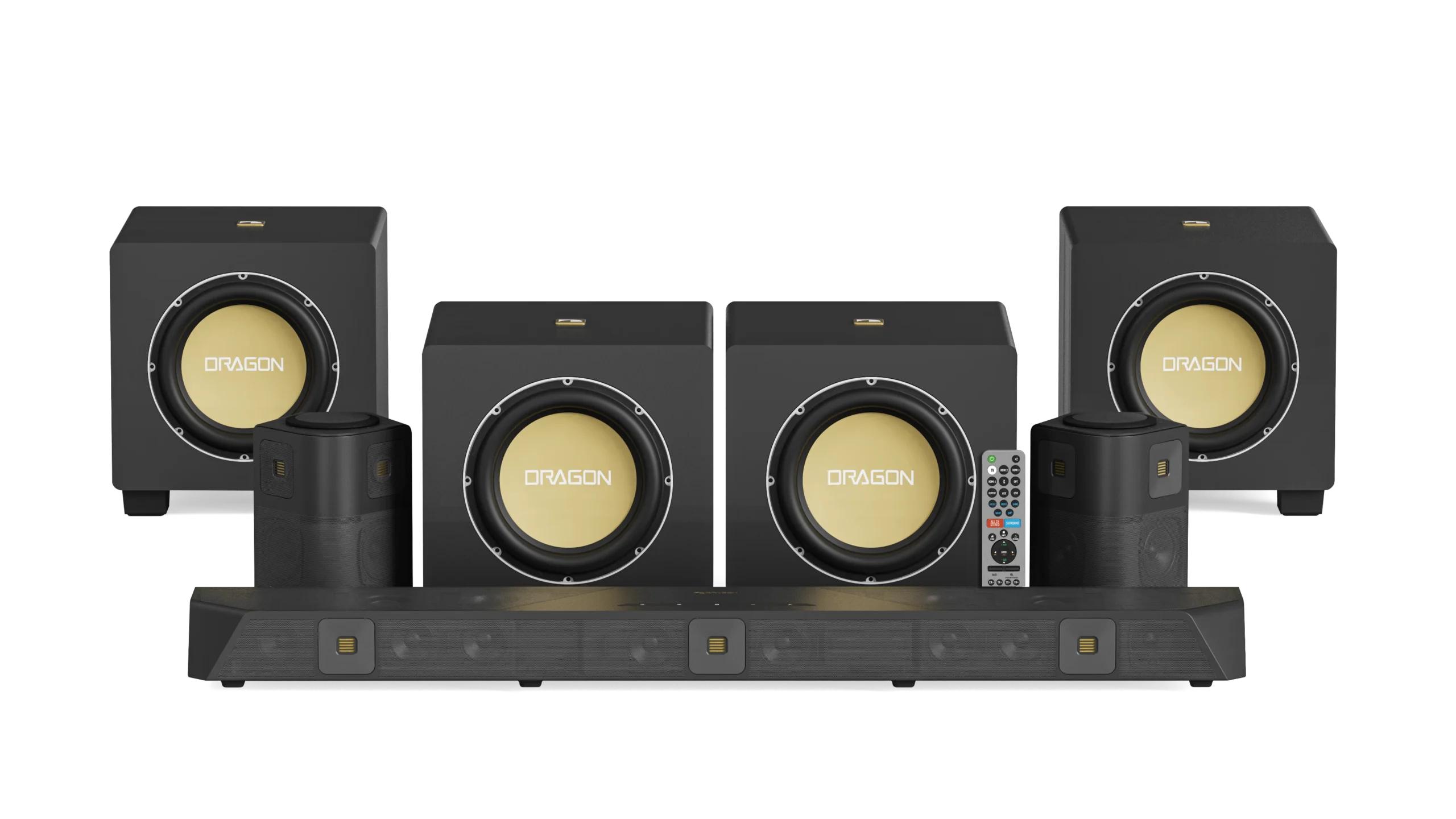
The Samsung Q990F is the best surround sound system you can buy in 2025. It delivers the most immersive Dolby Atmos experience we have tested, with wireless rear speakers, automatic room calibration, and a level of detail that rivals dedicated home theater setups. If you have the budget and the space, it is the one to get.
For everyone else, the ULTIMEA Skywave X50 is the best wireless alternative. It offers 5.1.4 channels with genuine height effects, a GaN amplifier that runs cool and clean, and a subwoofer that reaches 28Hz. It is a fraction of the price of the Samsung and still delivers a cinematic experience.
If you are not sure which system to buy, think about your room. If you can place rear speakers, get a system with wired or wireless rears. If you cannot, get a system with side-firing drivers or virtual surround. The best surround sound system is the one that fits your space and your habits, not the one with the highest channel count.
As an Amazon Associate we earn from qualifying purchases.