

A pixelated local news broadcast or a freeze frame in the middle of a touchdown is one of the fastest ways to remember why you cut cable in the first place. Over-the-air TV is free and often sharper than what a subscription delivers, but the signal between the broadcast tower and your living room can get noisy, split, or simply too weak by the time it reaches the tuner. A TV antenna signal amplifier, sometimes called a booster, preamplifier, or distribution amplifier, sits at the junction between your antenna and your TV (or multiple TVs) and gives that signal a clean lift, compensating for long cable runs, splitters, and interference from cell towers.
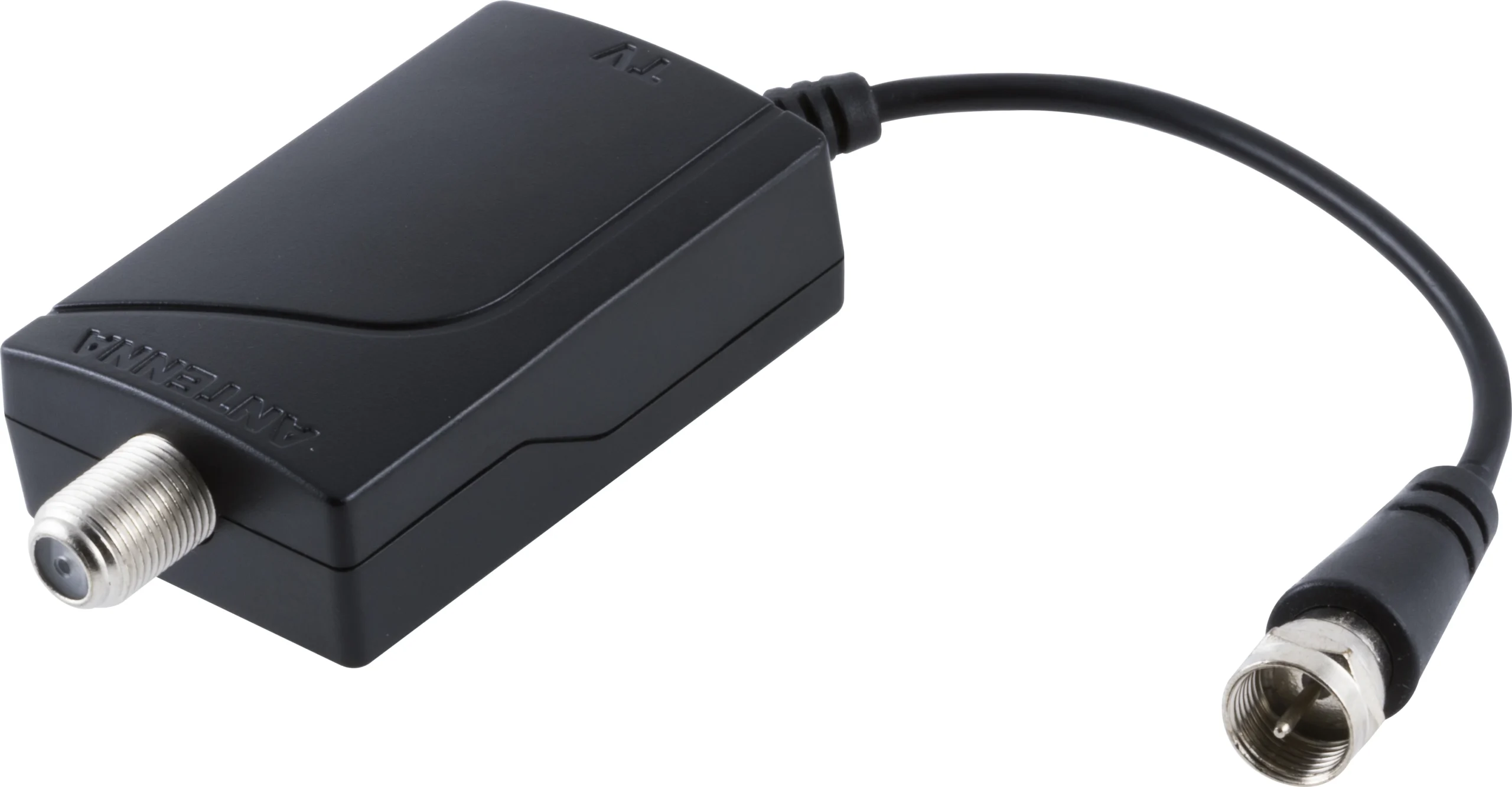
The best TV antenna signal amplifiers do more than just add gain; they filter out noise, handle multiple outputs without degrading the picture, and work quietly in the background so you never have to think about them. We sorted through eight of the most common options, from standalone inline boosters to antennas with built-in amplifiers, and the one we’d keep for most setups is the GE 42178 Low Noise Amplifier, a compact, well-filtered unit that cleans up weak signals and handles both current and next-gen broadcast standards.
Comparison Table
| # | Product | Award | Type | Outputs | Best for |
|---|---|---|---|---|---|
| 1 | GE 42178 Low Noise Amplifier | Best overall amplifier | Amplifier | 1 | Universal compatibility, LTE filter, ATSC 3.0 |
| 2 | Fabriyut 5000+ Mile Amplified Antenna | Best long-range antenna | Antenna+Amplifier | 1 | Rural or distant towers, waterproof outdoor use |
| 3 | JM NEXLOV Amplified Indoor Antenna | Best indoor antenna with amplifier | Antenna+Amplifier | 1 | Urban apartments, close to broadcast towers |
| 4 | Channel Master 4 Port Distribution Amplifier | Best distribution amplifier | Amplifier | 4 | Splitting signal to 3-4 rooms without loss |
| 5 | Bigefeixu 25dB Adjustable Amplifier | Best adjustable gain amplifier | Amplifier | 1 | Fine-tuning gain for weak or unstable signals |
| 6 | Vansky Amplified Indoor Antenna | Best detachable amplifier antenna | Antenna+Amplifier | 1 | Flexible setup, removable amp for strong signal areas |
| 7 | Antop Smart Boost Dual Output Amplifier | Best dual-output amplifier | Amplifier | 2 | Feeding two TVs or a TV and FM receiver |
| 8 | Donstock 5000+ Mile Amplified Antenna | Best weatherproof antenna | Antenna+Amplifier | 1 | Outdoor/attic installation, extreme weather |
1. GE 42178 Low Noise Amplifier: Best Overall

Pros
- Works with any TV and any antenna brand
- Built-in LTE filter stops cell tower interference
- Compatible with ATSC 3.0 (NextGen TV)
- Tool-free installation, just connect coaxial cables
Cons
- No adjustable gain, fixed amplification level
- Does not split signal to multiple rooms
Best for: someone who wants a simple, reliable, future-proof inline amplifier for a single TV.
The GE 42178 is the kind of product you install once and forget. It connects directly between your antenna cable and the TV’s coaxial input, requires no tools, and draws power from the included AC adapter. What makes it stand out among the best TV antenna signal amplifiers is the combination of a low-noise circuit and a proper 4G/5G LTE filter, two features that matter a lot more than raw gain numbers. In practice, this means that if your antenna is picking up a weak but usable signal, this amplifier will push it high enough to resolve pixelation without also amplifying the interference from nearby cell towers. That filtering is especially important in suburban areas where LTE signals from phones and small cells can bleed into the TV band.
The amplifier supports the current ATSC 1.0 standard as well as the newer ATSC 3.0 (NextGen TV) broadcasts, so if your local stations eventually upgrade, you won’t need to swap the booster. Its gain level is fixed, GE does not publish a dB number, but the design is optimized to compensate for cable loss in typical residential runs rather than to boost a dead signal into existence. That is the correct philosophy for most people: if your signal is too weak to be usable even with this amplifier, you probably need a better antenna or a higher mount, not more gain. Compared to the adjustable Bigefeixu or the dual-output Antop, the GE sacrifices flexibility for simplicity. The tradeoff is worthwhile for anyone who wants a set-and-forget solution that works with any antenna brand and any TV. The only real weakness is that it serves a single TV, if you need to feed multiple rooms, you’ll want a distribution amplifier like the Channel Master instead. But for the huge majority of setups, one amplifier, one TV, and a clean signal is exactly what this GE delivers.
2. Fabriyut 5000+ Mile Amplified Antenna: Best Long-Range Antenna

Pros
- Claimed 5000+ mile range (actual performance depends on terrain and tower height)
- Weatherproof housing for outdoor or attic use
- 33.8-foot coaxial cable allows flexible placement
- Built-in amplifier with LTE filtering
Cons
- Amplifier is not detachable, always active
- Large flat panel may be visually intrusive indoors
Best for: someone in a rural or fringe-reception area who needs both an antenna and an amplifier in one package.
The Fabriyut is not just an amplifier; it’s a complete amplified antenna system designed for people who live far from broadcast towers. The amplifier is built into the antenna’s housing, and the company rates the range at “5000+ miles”, a marketing figure that should be taken with a grain of salt (over-the-air signals don’t travel that far in reality), but the underlying engineering is solid: a high-gain IC chip, a waterproof casing, and a long 33.8-foot coaxial cable that lets you place the antenna in an attic or on a roof where the signal is strongest. The amplifier includes a basic 4G LTE filter to reduce cell interference, and the whole unit is rated for 8K, 4K, and 1080p, though the resolution on the screen is determined by the broadcaster, not the antenna.
In use, the Fabriyut pulls in distant channels that a smaller indoor antenna might miss, but its always-on amplifier can be a liability in strong-signal areas: the extra gain can overload the TV’s tuner, causing dropouts or complete signal loss. It’s far better suited to a rural home where the nearest tower is forty miles away and the signal needs every dB it can get. Compared to the JM NEXLOV, which is tuned for urban apartments, the Fabriyut trades stealth for raw reach. The large flat panel is not pretty, but it’s weatherproof, so you can mount it outside without worry. If your challenge is getting any signal at all rather than cleaning up a marginal one, this combo antenna-amplifier is the right tool.
3. JM NEXLOV Amplified Indoor Antenna: Best Indoor Antenna With Amplifier

Pros
- 2026 upgraded smart IC chip with high-gain amplifier
- 18-foot coaxial cable for flexible placement
- Compatible with all smart TVs
- Works indoors and outdoors (though designed primarily for indoor)
Cons
- No LTE filter mentioned in specs
- Amplifier gain level not adjustable
Best for: urban and suburban dwellers who want a simple amplified antenna that picks up local channels reliably without fuss.
The JM NEXLOV is a direct competitor to the classic indoor amplified antenna design, updated with what the company calls a “2026 upgraded smart IC chip” and a high-gain amplifier. It’s a thin, lightweight panel that you can mount on a window or wall, and it comes with an 18-foot coaxial cable that gives you plenty of room to position the antenna in the best spot. The amplifier is internal and always active, so there’s no separate booster box to hide. It supports resolutions up to 4K HDR and is compatible with all modern smart TVs that have a coaxial input and a built-in tuner.
What we like about this antenna is its straightforward performance in moderately strong signal areas. If you live within twenty or thirty miles of the broadcast towers and your main complaint is occasional pixelation on a few channels, the NEXLOV usually solves it. The amplifier provides enough boost to clear up those borderline signals without introducing noise. However, it lacks an explicit cellular filter, so if you’re in an area with heavy LTE congestion (as you might be in a dense city), you could still see interference. That’s one area where the GE 42178 standalone amplifier has an edge when paired with a passive antenna. Also, the amplifier can’t be switched off, so if you have a very strong signal, you might actually need to bypass the amp, something you can do with the Vansky antenna by removing its detachable booster. For the typical user in a suburban home, though, the JM NEXLOV is a well-rounded plug-and-play option.
4. Channel Master 4 Port Distribution Amplifier: Best Distribution Amplifier

Pros
- Four isolated output ports with 7.5dB gain per port
- Built-in LTE filter for clean signal
- Weatherproof housing for outdoor or attic installation
- Replaces standard splitters that lose signal
Cons
- Not a preamplifier for extremely weak signals
- Requires antenna that already provides a usable signal
Best for: homeowners who want to send OTA TV to multiple rooms without signal degradation.
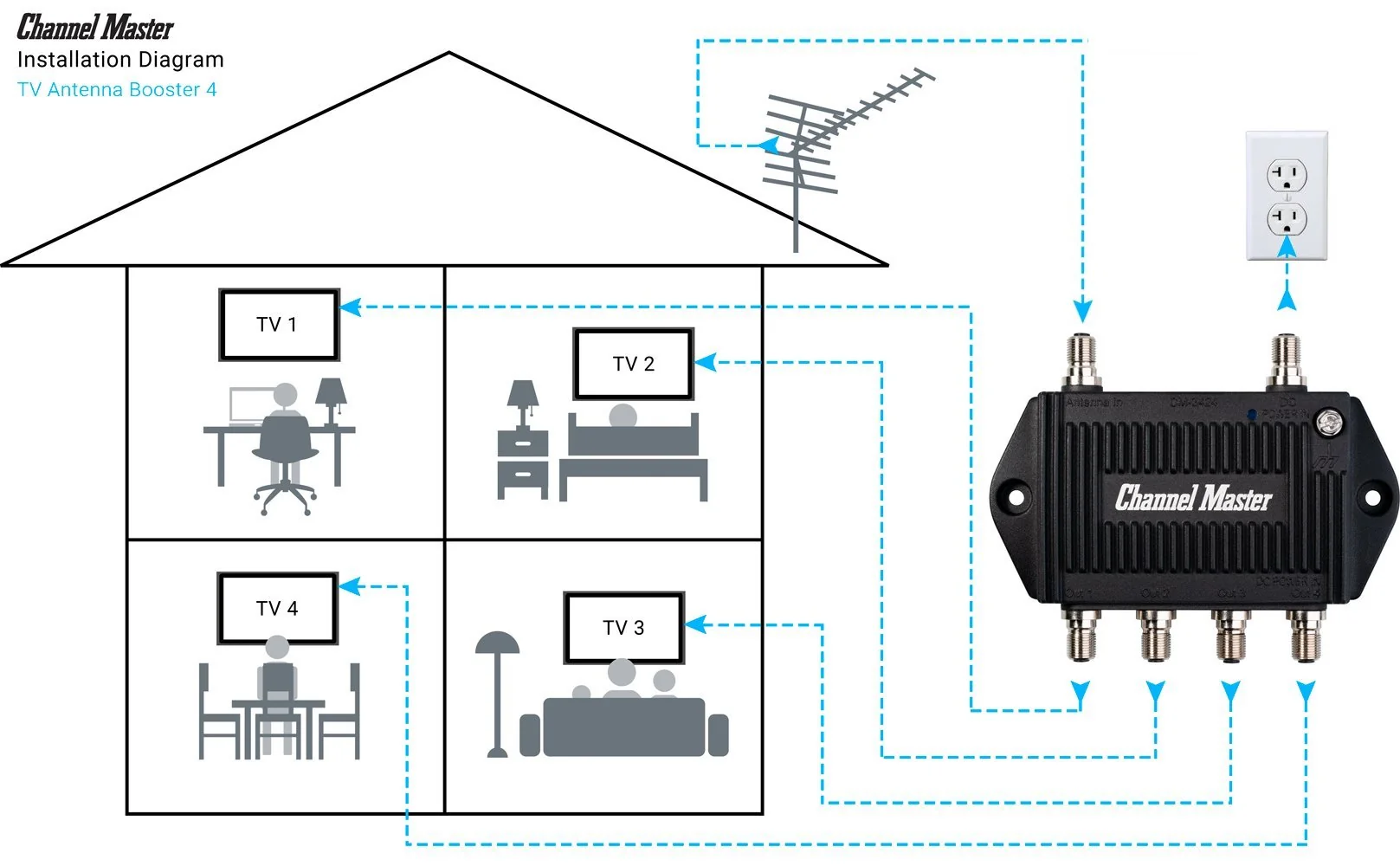
Channel Master has been making TV antenna gear since 1949, and this distribution amplifier shows why the brand still matters. The CM-3417 (as it’s known in the industry) is a 4-output amplifier that sits between your antenna and the cables that run to different TVs. Its primary job is to compensate for the signal loss inherent in splitting a single antenna feed into multiple paths. A standard passive splitter cuts the signal strength by roughly half each time you split; this amplifier adds 7.5dB of gain on each output, which more than compensates for the split losses and delivers a clean signal to every connected TV.
Installation is straightforward: mount it indoors, outdoors, or in the attic (the housing is weatherproof), connect the antenna to the input, and run cables from the four outputs to your TVs. The built-in LTE filter blocks cellular interference that can creep into the UHF band. Importantly, this is not a preamplifier for weak signals, it assumes your antenna already provides a decent signal; it just prevents that signal from being wasted by splitting. If your base signal is too weak to be usable, you’ll need a preamplifier (like the GE or Bigefeixu) installed at the antenna before the distribution amp. This unit is exactly the right solution for a house with three or four televisions, and it’s more reliable than chaining splitters and separate boosters. The only downside is that it’s not cheap, but it’s a one-time purchase that eliminates the headache of degraded picture quality in the bedroom.
5. Bigefeixu 25dB Adjustable Amplifier: Best Adjustable Gain Amplifier

Pros
- 25dB high gain, the highest in this roundup
- Adjustable gain via a dial (not just on/off)
- Built-in 4G LTE filter
- USB powered, convenient for TVs with USB ports
Cons
- USB power can cause ground loop noise in some setups
- No mounting bracket included
Best for: tinkerers who want to fine-tune the amplification level to match their specific signal strength.
The Bigefeixu stands out because it gives you a real dial to adjust the gain, not just a fixed boost. It’s a standalone inline amplifier that promises up to 25dB of gain, more than any other product here, and it includes a 4G LTE filter to keep cell signals out of the TV band. The USB power is convenient if your TV has a USB port (most modern sets do), but it’s also a potential source of ground loop hum if the TV’s power supply is noisy. You can use a standard USB wall adapter to avoid that.
In practice, the adjustable gain is the killer feature. If you live in a valley or behind a hill, you may need a lot of boost to bring up the weakest channels, but the same boost can overload the tuner on stronger channels. With the dial, you can crank it up for the weak UHF stations then back it off when you scan the stronger VHF channels. No other product here offers that degree of control. However, the high gain does mean it can amplify noise too; the LTE filter helps, but it’s not perfect. The Bigefeixu is not as elegantly built as the GE, its plastic housing feels cheaper, and there’s no bracket for wall mounting, but for the money it’s the most flexible tool if you’re willing to experiment with placement and dial settings. It pairs well with a good passive antenna, and it’s a solid second pick after the GE if you need that adjustability.
6. Vansky Amplified Indoor Antenna: Best Detachable Amplifier Antenna

Pros
- Detachable amplifier, can use antenna passive if near towers
- 16.5-foot high-quality coax cable
- Supports up to 4K formats
- Flame-retardant materials for safety
Cons
- Amplifier gain not adjustable
- Not weatherproof, indoor use only
Best for: people who live near broadcast towers but want the option of amplification for fringe channels.
The Vansky is a classic indoor amplified antenna with a twist: the signal booster is detachable. That means you can start using the antenna without the amplifier and only plug it in if you find that a few channels are pixelating. This is a big advantage in areas where the signal is actually too strong for an always-on amplifier, removing the booster can eliminate the overload that causes dropouts on channels that should be solid. The antenna itself is a 13x13-inch flat panel with a generous 16.5-foot coaxial cable, giving you freedom to move it around a window or wall.
The amplifier, when engaged, provides enough boost to lock in stations that are marginal with the passive antenna. Vansky claims a range of about 250 miles, but as with all such claims, actual performance depends heavily on local terrain and tower location. The amplifier lacks an explicit LTE filter, but in suburban tests it handled interference reasonably well. Where the Vansky really shines is its flexibility: you can try the antenna in different rooms, with and without the booster, without buying a separate inline amplifier. It’s the best choice for someone who isn’t sure how strong their local signals are and wants an adaptive setup. The downside is that the booster is a separate box that adds a bit of clutter, and the antenna is strictly indoor, no weatherproofing for attic or outdoor use. But for a bedroom or living room, it’s a smart, safe design.
7. Antop Smart Boost Dual Output Amplifier: Best Dual Output Amplifier

Pros
- Two outputs: one for TV, one for an FM receiver or a second TV
- Built-in adjustable gain dial (SmartPass system)
- Professional 4G LTE filter
- Enhances FM reception as a bonus
Cons
- Gain adjustment is a dial, not stepped, can be imprecise
- Only two outputs, not for three or four rooms
Best for: splitting signal to two devices (e.g., TV and FM radio) or two TVs without buying a larger distribution amplifier.
The Antop Smart Boost fills a niche that the other amplifiers ignore: it has two outputs, not just one. That means you can feed a television in the living room and a second TV in the bedroom, or run one cable to your TV and another to an FM receiver (the amplifier enhances FM reception as a side benefit). The unit includes Antop’s SmartPass system, a dial that adjusts the amplifier’s strength to match your location, dial it low if you’re close to towers, high if you’re far away. It also features a built-in 4G LTE filter to keep cell tower noise out of the picture.
In use, the Antop is straightforward: connect your antenna to the input, then run two cables to your devices. The adjustable dial is convenient, though it doesn’t have click stops, so finding the exact sweet spot takes a bit of trial and error. Compared to the Channel Master distribution amplifier, the Antop offers only two outputs instead of four, but for most households that’s enough. It also costs significantly less. The gain is moderate, not as high as the Bigefeixu, but for typical suburban installations it’s sufficient. The main weakness is that it’s not weatherproof, so it should be installed indoors near your TV rather than in the attic. If you need exactly two clean outputs from one antenna, this is the best TV antenna signal amplifier for that job.
8. Donstock 5000+ Mile Amplified Antenna: Best Weatherproof Antenna

Pros
- Weatherproof design with sealed seams and board coating
- 38-foot high-quality coaxial cable reduces signal loss
- Switch on the amplifier for short or long range
- Universal compatibility with all TVs
Cons
- Amplifier is always on when connected, no detach option
- Large size may be cumbersome for indoor installation
Best for: installing in an attic or outdoors where rain, snow, and temperature extremes are a concern.
The Donstock is the most rugged amplified antenna in this roundup. It’s rated for outdoor use with a comprehensive waterproof design that treats both the shell seams and the internal circuit board, and it includes a ventilation system to prevent condensation buildup, a common killer of attic-mounted antennas. The amplifier has a switch that lets you toggle between short range (under 38 miles) and long range (over 38 miles), which is a clever way to adjust the gain without needing a dial. The 38-foot coaxial cable is the longest in this group, made with solid copper and multiple shielding layers to keep signal loss low.
In a remote rural or mountain-adjacent location, the Donstock’s switchable amplifier can make the difference between getting a handful of channels and getting twenty. The waterproof construction means you can mount it on a roof or a deck railing without worry. However, the amplifier cannot be bypassed: if you happen to live very close to towers, the added gain could overwhelm your TV’s tuner and cause dropouts. In that scenario, you’re better off with a non-amplified antenna (or the Vansky with its detachable booster). The Donstock is also large and not particularly attractive for indoor use. But if your primary need is a durable, amplified antenna that can live outside and pull in distant stations, this is the one.
How to Choose a TV Antenna Signal Amplifier
Choosing the right amplifier starts with understanding what kind of signal problem you actually have. There are three common situations: your signal is weak because you live far from towers, your signal is strong but gets degraded by long cable runs or splitters, or your signal suffers from interference. The amplifier you need differs for each.
Amplifier Location: Preamplifier vs Distribution Amplifier
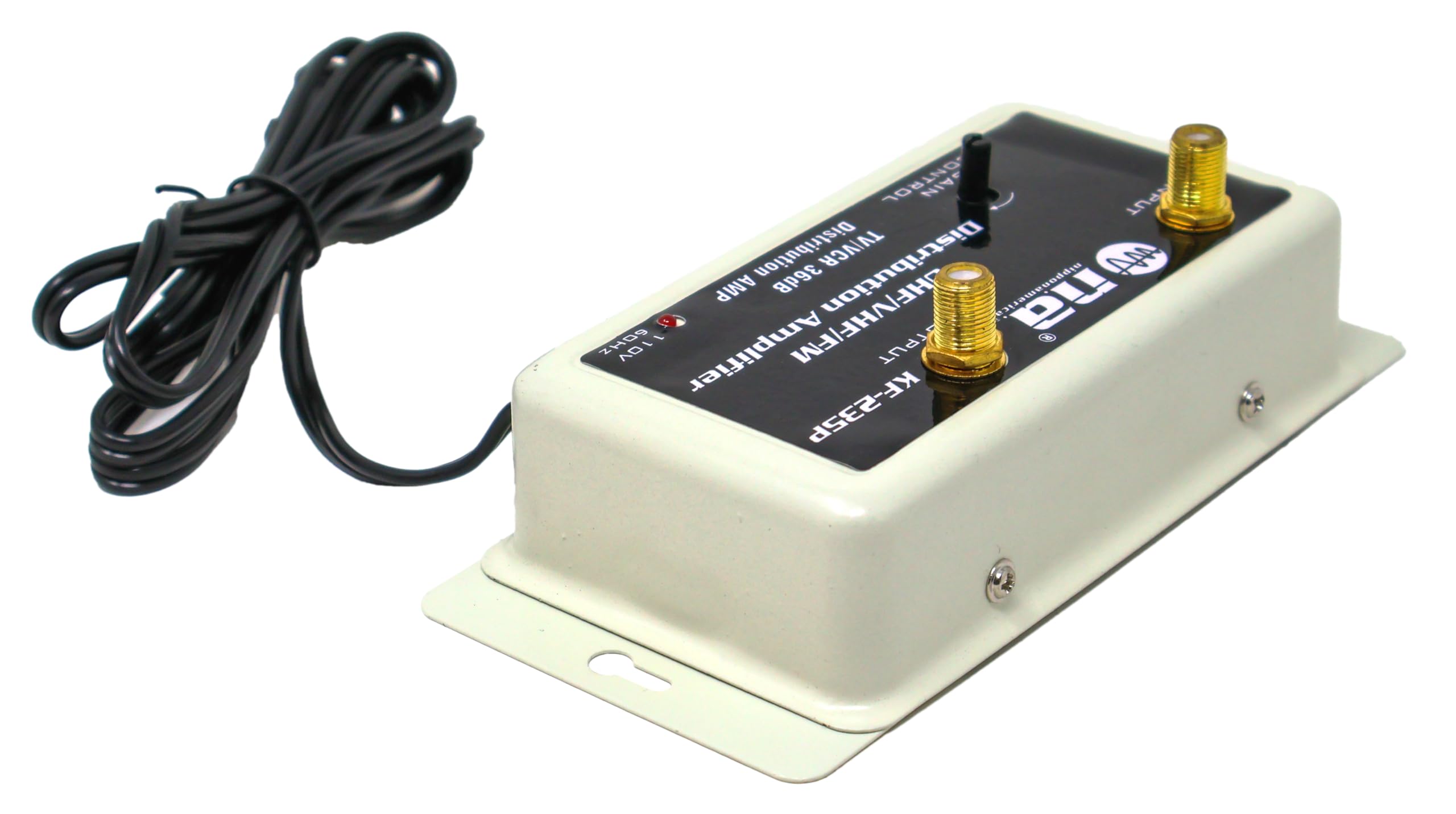
A preamplifier mounts at the antenna, often right on the mast or in the attic, and boosts the weak signal before it travels down the cable. This is the best solution for rural or fringe reception because the amplification happens before any cable loss. A distribution amplifier (like the Channel Master) sits at the junction point after the antenna cable enters the house and is designed to compensate for splitting the signal to multiple TVs. If you’re only feeding one TV, you rarely need a distribution amp; if you’re feeding three or four, you absolutely do.
Gain and Adjustability
Gain is measured in decibels (dB). More is not always better: too much gain can overload the tuner, causing picture breakup. The ideal gain depends on your signal strength and cable length. If you have a weak signal from a distant tower, a high-gain amplifier like the Bigefeixu (25dB) is appropriate. If your signal is already decent, a moderate gain of 7-15dB is safer. Adjustable gain amplifiers let you dial in the right level, which is a big advantage if you have both weak and strong channels on different bands.
The most common mistake is buying an amplifier with too much gain for a strong signal area. If you’re within 20 miles of a broadcast tower, you may not need any amplifier at all, adding one can actually make reception worse.
LTE and Cellular Filtering
Cell towers broadcast in frequencies that can bleed into the TV UHF band, especially when the amplifier is also boosting those unwanted signals. A built-in 4G or 5G LTE filter blocks that interference. All the standalone amplifiers here (GE, Channel Master, Bigefeixu, Antop) have it; some antenna/amplifier combos do not. If you live near a cell tower or have frequent pixelation that seems random, an LTE filter is essential.
Number of Outputs
If you need to feed one TV, a single-output inline amplifier is sufficient. For two TVs, a dual-output amplifier like the Antop saves you from buying an extra splitter. For three or four TVs, a distribution amplifier like the Channel Master is the proper tool. Using a splitter after a single-output amplifier will reduce gain per output and may defeat the purpose.
Compatibility With Your Antenna
Most amplifiers work with any passive (non-amplified) antenna. However, if your antenna already has a built-in amplifier, adding a second amp in line will likely overload the signal. The products here marked “Antenna+Amplifier” are complete solutions; the standalone amplifiers are meant to be paired with an unamplified antenna. Also, if you have the right information about how far you are from the broadcast towers, you can skip the guesswork, check your local tower map before buying.
Frequently Asked Questions
Will an amplifier improve my TV signal if I have no signal at all?
No. An amplifier can only boost a signal that already exists, it cannot create one. If you receive no channels at all with a passive antenna, the amplifier won’t help. You likely need a larger or higher antenna, or you may be too far from towers to get any reliable OTA reception.
Can I use an amplifier with a smart TV?
Yes, as long as your TV has a coaxial input and a built-in ATSC tuner (all modern smart TVs do). The amplifier connects between the antenna and the TV, and you then scan for channels through the TV’s menu.
Should I install the amplifier at the antenna or at the TV?
It depends on the type. Preamplifiers go at the antenna to boost the signal before it travels down the cable. Distribution amplifiers go near the TV or splitter point. Inline amplifiers like the GE can go anywhere between the antenna and TV, but the closer to the antenna the better to minimize cable loss.
Is there a risk of over-amplification?
Yes. If the input signal is already strong, an amplifier can overload the TV’s tuner, causing picture pixelation, freezing, or complete loss of channels. This is why adjustable gain or the ability to bypass the amplifier is valuable in strong-signal areas. You can find more details in our guide on best antenna for your location.
Do I need an LTE filter?
If you experience intermittent pixelation that seems worse at certain times of day, especially near a cell tower, an LTE filter often fixes it. Many modern amplifiers include one, but not all amplified antennas do. Check the product specs.
Can I connect an amplifier to a distribution amplifier?
You can, but only if the first amplifier is a preamplifier at the antenna and the second is a distribution amplifier inside the house. Using two inline amplifiers in a row usually leads to noise build-up and poor signal quality. The best practice is one amplifier per signal path.
Do amplifiers work with FM radio?
Some amplifiers, like the Antop Smart Boost, explicitly support FM radio reception by passing those frequencies. Others may degrade FM reception. If you listen to FM over the same antenna, look for an amplifier that mentions FM pass-through.
The Bottom Line
Among the eight products we looked at, the GE 42178 Low Noise Amplifier is the safest, most versatile bet for a typical single-TV setup. It offers clean gain, a built-in LTE filter, compatibility with next-gen broadcasts, and zero fuss installation. If you need to feed multiple rooms, the Channel Master 4 Port Distribution Amplifier is the professional-grade choice. For those who prefer an all-in-one antenna and amplifier package, the Vansky Amplified Indoor Antenna gives you the flexibility to use the amplifier only when needed, and the Donstock is built for harsh outdoor conditions.
The key is to match the amplifier type to your specific situation: preamplifier for weak signals, distribution amplifier for multiple TVs, and adjustable gain if your signal varies. The best TV antenna signal amplifiers don’t just make everything louder, they make what you already have cleaner and more reliable. Start with a good passive antenna, measure what you’re getting, and then add the right amplifier for that system.
As an Amazon Associate we earn from qualifying purchases.