

A television can be perfectly audible to one person and frustratingly quiet to another, especially when dialogue competes with music, effects, or a busy room. The right headset gives the viewer independent volume control without forcing everyone else to listen at the same level. It also needs to be simple enough that charging and reconnecting do not become a daily chore.
The Best TV headphones for seniors in this guide range from straightforward transmitter-and-dock systems to models with Bluetooth, HDMI ARC, volume boost, or personalized hearing profiles. We gave the top position to the SKYCOMET TV Headphones, while the other six cover longer battery life, easier pairing, stronger customization, and more established audio design.
Comparison table
| # | Product | Award | Battery | Connection and latency | Best for |
|---|---|---|---|---|---|
| 1 | SKYCOMET TV Headphones | Best overall | Up to 65 hours | Optical, AUX, RCA, under 40ms, up to 100 feet | Simple TV listening with broad compatibility |
| 2 | Swiitech TV Headphones | Best Bluetooth flexibility | Up to 45 hours | Optical, AUX, RCA, Bluetooth, under 40ms, up to 100 feet | TV and phone use |
| 3 | Mutbam TV Headphones | Best ready-paired system | Up to 65 hours | Optical, AUX, RCA, Bluetooth, up to 100 feet | Automatic reconnection |
| 4 | Avantree Crescendo Me | Best personalized sound | Up to 60 hours | HDMI ARC, Optical, AUX, under 75ms, up to 100 feet | Individual left and right hearing profiles |
| 5 | Avantree Opera Plus | Best for HDMI ARC TVs | Not specified | HDMI ARC, Optical, AUX, Bluetooth | Modern TVs and adjustable volume boost |
| 6 | Sennheiser RS 175-U | Best for sound modes | Not specified | Digital wireless | Bass boost and surround-style listening |
| 7 | Earbay TV Headphones | Best three-mode design | Up to 40 hours | Optical, AUX, RCA, Bluetooth 5.4, under 40ms, 30 meters | Easy private listening with multiple audio modes |
1. SKYCOMET TV Headphones: Best Overall

Pros
- Simple transmitter setup
- Optical, AUX, and RCA inputs
- Up to 65 hours of playtime
- Charging dock keeps the system organized
- Under 40ms audio latency
Cons
- Bluetooth is not listed as a direct-use option
- No personalized hearing profile
- Comfort details are limited to the supplied description
Best for: someone who wants a simple TV-only headset with long battery life and broad connection support.
The SKYCOMET TV Headphones get the fundamentals right. You connect the transmitter once, switch on the headset, and use the headphones without repeatedly searching through a television Bluetooth menu. That is a meaningful advantage for a parent or grandparent who wants to sit down and watch the news, rather than troubleshoot a wireless accessory first.
The connection choices are the strongest part of the design. Optical, 3.5mm AUX, and RCA inputs cover a wide range of televisions and other audio sources. The supplied description also specifies Bluetooth 5.2, a wireless range of up to 30 meters, or 100 feet, and latency under 40ms. That low delay matters during sports and conversation because voices should remain close to the movement on screen instead of sounding visibly out of sync.
Battery life is unusually generous for this group, with up to 65 hours of playtime. The charging base gives the headphones a fixed place to live and recharge, which is more useful than it sounds. A headset left on a side table with a loose cable is easy to forget. A dock makes the next viewing session more predictable, while the independent volume control lets the viewer listen at a comfortable level without raising the television for the room.
The limits are clear. The data does not list direct Bluetooth use with a phone or computer, so the SKYCOMET is better understood as a dedicated TV system than an all-purpose wireless headset. It also does not offer the personalized left and right sound adjustment found on the Avantree Crescendo Me. The soft protein leather cushions and adjustable lightweight headband should suit extended viewing, but people who need hearing-aid-level amplification should look carefully at more specialized solutions.
Compared with the Swiitech TV Headphones, the SKYCOMET offers longer stated battery life while giving up the other model's explicit standard Bluetooth headphone function. Compared with the Mutbam TV Headphones, it has a similar connection philosophy and endurance, but the Mutbam emphasizes ready-paired reconnection and 40mm drivers. Choose SKYCOMET when easy setup, long use between charges, and compatibility with older TV outputs matter most.
2. Swiitech TV Headphones: Best Bluetooth Flexibility
Pros
- Works with optical, AUX, RCA, or Bluetooth
- Can pair with phones and computers
- Under 40ms latency
- Up to 100 feet of wireless range
- Charging dock included
Cons
- Battery life is shorter than the top three dedicated systems
- Bluetooth TV use depends on TV compatibility
- No stated hearing-profile adjustment
Best for: a viewer who wants one headset for television and ordinary Bluetooth listening.
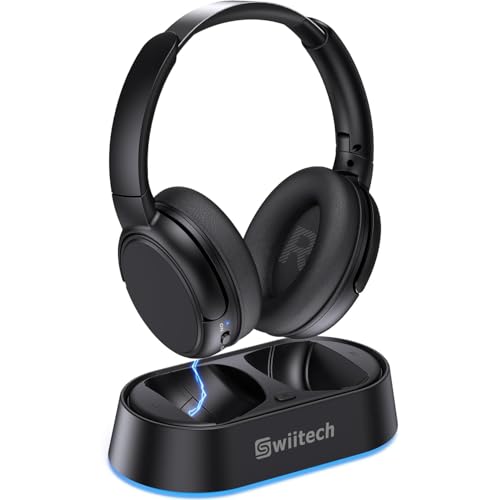
The Swiitech TV Headphones are the most flexible option for someone who does not want a TV headset to sit unused between programs. The transmitter handles the television connection, while the headphones can also be paired with a phone or computer when the base is not part of the setup. That makes the design more adaptable than a TV-only product.
For television, the connection process is deliberately conventional. Optical, AUX, and RCA cables are supported, and the product description says to connect one of those inputs and power on. If the television supports Bluetooth, the headphones can connect that way too. The important distinction is that Bluetooth TV compatibility belongs to the television, so buyers should check the set's audio output options before relying on it.
The stated wireless performance is strong for a living room. Audio latency is under 40ms, and the claimed range reaches 100 feet, or 30 meters, in a stable connection. That combination is useful for live broadcasts, where even a modest delay can make a commentator's voice arrive after the action. It also gives the wearer room to move around the home without treating the headset like a corded accessory.
Battery life reaches up to 45 hours, and the dock doubles as a storage point and charger. That is less than the SKYCOMET TV Headphones and Mutbam TV Headphones claim, but it remains enough for extended everyday viewing before a recharge is needed. The lightweight construction and soft, breathable earcups are aimed at reducing fatigue, although the supplied information does not give a weight figure or describe the control layout in detail.
Swiitech's main advantage over the SKYCOMET is its explicit ability to serve as standard Bluetooth headphones. The trade-off is shorter listed endurance and a little more dependence on what the television supports if you skip the transmitter. It is a sensible pick for households where the same listener moves between TV, phone, and computer audio, but it is not the strongest choice for someone who wants the least possible flexibility and the longest possible time between charges.
3. Mutbam TV Headphones: Best Ready-Paired System

Pros
- Headphones and transmitter arrive paired
- Up to 65 hours of listening
- 40mm drivers for clearer voices
- Optical, AUX, RCA, and Bluetooth support
- Up to 100 feet of range
Cons
- Optical output requires PCM or Stereo settings
- No stated personalized hearing profile
- Large fit may not suit every wearer
Best for: a senior who benefits from ready-paired equipment and easy return-to-use operation.
Mutbam's defining feature is the ready-paired transmitter and headset. Once the base is connected to a compatible TV output, the headphones are designed to reconnect automatically when both are turned on. That removes one of the most irritating parts of wireless TV listening: navigating a Bluetooth menu or trying to remember which device to select every evening.
The 40mm drivers are specifically mentioned as part of the dialogue-focused design. A driver size alone does not guarantee a particular sound signature, but the stated goal here is balanced audio with clearer voices, and the easy-to-reach headset controls allow the viewer to adjust personal volume. That combination makes more practical sense for television than a headset tuned only for dramatic bass or music playback.
Mutbam supports Optical, 3.5mm AUX, and RCA connections through the transmitter. With the base turned off, the headset can also connect directly to a compatible Bluetooth TV, phone, tablet, or computer. The optical connection has one extra requirement: the television should be set to PCM or Stereo. That is not difficult, but it is the sort of setting a helper may need to handle during installation.
The claimed range reaches 100 feet in an open area, and the system is described as low latency for natural speech and sports commentary. Battery life reaches up to 65 hours, matching the SKYCOMET TV Headphones on paper. The transmitter dock both receives TV audio and charges the headset, so it serves as the central home for the complete system rather than being merely an occasional charging stand.
The Mutbam is a particularly good alternative to the SKYCOMET when automatic reconnection is more important than a stripped-down setup. It also has a clearer case for occasional non-TV Bluetooth use than SKYCOMET. The weakness is that the product information gives no individual hearing compensation, no specific latency figure, and no weight. Anyone who needs tailored amplification should consider the Avantree Crescendo Me, while anyone who wants a known audio brand may prefer the Sennheiser RS 175-U.
For daily news, serials, and sports in a shared room, Mutbam's appeal is its routine. Place the headphones on the dock, pick them up when needed, and avoid repeating the pairing process. That is the buyer this system serves best.
4. Avantree Crescendo Me: Best Personalized Sound

Pros
- Creates separate left and right sound profiles
- Supports HDMI ARC, Optical, and AUX
- HDMI ARC, Optical, and AUX passthrough for shared listening
- Replaceable battery, ear pads, and headband pad
- Up to 60 hours with ANC off
Cons
- Personalization requires the Avantree app
- Latency is higher on paper than the sub-40ms systems
- Not necessary for viewers who only need simple volume control
Best for: someone who needs dialogue enhancement shaped around individual hearing differences.
The Crescendo Me takes a more individualized approach than the transmitter systems above it. Instead of only raising the volume, the Avantree app guides the listener through a hearing test and creates separate sound profiles for the left and right ears. That matters when one ear hears certain frequencies differently from the other, a situation a single global volume slider cannot address well.
Its Voice Clear tuning, personalized compensation, and stated output of up to 115.8 dB are aimed at bringing speech forward. The product description places latency under 75ms, which is not as aggressive as the under-40ms claims from SKYCOMET, Swiitech, Mutbam, and Earbay. For ordinary television dialogue it should still be designed to stay close to the picture, but viewers especially sensitive to lip-sync should prioritize the lower stated figure.
The connectivity is well suited to a shared television. HDMI ARC, Optical, and AUX are supported, with passthrough so the family can continue listening through a soundbar while the wearer uses the headphones. The system also supports Bluetooth for compatible sources and reaches up to 100 feet, or 30 meters. That gives it a more modern connection set than the basic optical, AUX, and RCA arrangements used by several lower-ranked picks.
Battery life is up to 60 hours with active noise cancellation off and up to 45 hours with ANC on. It can recharge by dock or USB-C, and the battery, ear pads, and headband pad are replaceable. Those serviceable parts are unusual in this group and make the Crescendo Me easier to maintain over a longer ownership period. The 40mm size listed in the product information also gives a useful sense of the over-ear design without pretending that driver size alone defines sound quality.
The app is both the reason to buy this model and its largest complication. A family member may need to help complete the guided test, and a listener who only wants a headset that works immediately may find the setup excessive. The Crescendo Me also does not claim the very lowest latency in this comparison. If the main requirement is simple nightly use, the Mutbam TV Headphones are more direct. If the main problem is uneven hearing between the ears, Crescendo Me is the more thoughtful design.
Readers comparing this model with other ways to make dialogue easier to hear should focus on the listening problem rather than the label on the box. Crescendo Me is for personalized correction, not simply louder television. It is the pick for a viewer who wants a tailored profile and a household that still wants to use its soundbar.
5. Avantree Opera Plus: Best for HDMI ARC TVs

Pros
- HDMI ARC, Optical, and AUX support
- Adjustable volume boost
- Optical soundbar passthrough
- Can work as Bluetooth headphones
- Designed around clear TV dialogue
Cons
- HDMI soundbar passthrough is not supported
- Requires a compatible TV output
- Not intended for severe hearing loss or hearing-aid-level amplification
Best for: viewers with a compatible HDMI ARC television who want volume boost and private listening.
The Opera Plus is built for the modern TV connection that many basic wireless headsets skip: HDMI ARC. That can make installation cleaner on a compatible television, but the product description is explicit that buyers should confirm the port exists and is not already occupied. Compatibility is not a minor detail here. A headset that cannot access the TV's audio output is of no use, regardless of its headphone design.
For listeners who struggle with television speech, the adjustable volume boost is more relevant than a generic claim of immersive sound. It is designed to make dialogue more comfortable without requiring the entire room to accept a louder TV setting. Avantree also says it is not suitable for severe hearing loss or people who need hearing-aid-level amplification, so this should be treated as a dialogue aid for TV watching, not a medical device.
The Opera Plus supports HDMI ARC, Optical, and AUX, and it can also function as independent Bluetooth headphones with a phone or tablet. With an Optical connection, its transmitter can pass audio through to a soundbar so the headphones and soundbar play together. The limitation is specific: HDMI soundbar passthrough is not supported. A household using HDMI ARC with a soundbar should map that setup before choosing this model.
The supplied information does not state battery life, latency, wireless range, or headphone weight. Those omissions make the Opera Plus harder to compare on endurance and movement around the home than the SKYCOMET TV Headphones or Swiitech TV Headphones. Its strengths are compatibility options, volume boost, and a clear explanation of the soundbar limitation, not a long list of published performance figures.
That makes the Opera Plus a narrower recommendation than the Crescendo Me. Crescendo Me adds individualized left and right profiles and replaceable wear parts, while Opera Plus is the simpler model for people who need volume boost and HDMI ARC. It is also a better fit than the Sennheiser RS 175-U for a buyer whose first concern is TV connection flexibility rather than bass or surround-style modes.
Pick Opera Plus after checking the television's ports, especially if a soundbar is already connected. Skip it if the viewer needs a hearing profile, medical-grade assistance, or a system with clearly stated battery and range figures.
6. Sennheiser RS 175-U: Best for Sound Modes

Pros
- Established over-ear audio design
- Bass boost and surround sound modes
- Digital wireless TV listening
- Listed weight of 0.68 pounds
Cons
- Few published details in the supplied product information
- No stated battery life or wireless range
- No dialogue personalization or hearing profile
Best for: listeners who want bass boost and surround-style modes from a dedicated digital wireless headset.
The Sennheiser RS 175-U stands apart from the newer senior-focused models because its published feature set is much more focused. It is an over-ear digital wireless headset with bass boost and surround sound modes. Those controls appeal to viewers who want to shape the character of movies and television rather than simply make voices louder.
The stated weight is 0.68 pounds, which gives prospective buyers a concrete reference for the headset itself. The product data does not provide battery duration, transmitter range, connection inputs, or latency, so we cannot promise the same plug-and-play compatibility or movement freedom described by the SKYCOMET, Mutbam, or Swiitech. Buyers should verify the included connection arrangement and television compatibility before ordering.
Its sound modes are more specialized than the dialogue-first tuning on the Avantree Opera Plus. Bass boost can add weight to film soundtracks, while a surround-style mode may make a spacious program feel more expansive. Those features can be enjoyable, but they do not substitute for personalized speech compensation. A listener who hears bass easily but struggles with particular voices may get more practical benefit from Crescendo Me's separate left and right profiles.
The RS 175-U is also less explicitly designed around seniors. There is no supplied claim of independent volume control, volume boost, a charging dock, or extended range. That does not make it unsuitable for older viewers, but it does mean the buying decision should start with the desired sound character and the user's comfort with the available controls.
Compared with Earbay TV Headphones, Sennheiser offers fewer stated connection and battery details but has a clearer emphasis on bass and surround modes. Compared with Opera Plus, it is less clearly focused on dialogue and HDMI ARC. The Sennheiser is the right direction for someone who values movie sound modes and a lighter listed weight more than a senior-specific setup.
The best reason to choose RS 175-U is not its age or brand recognition by itself. It is the specific sound-control approach. Choose it for bass boost and surround-style listening, and skip it when simple installation, a charging dock, or published long-range TV performance is the priority.
7. Earbay TV Headphones: Best Three-Mode Design

Pros
- Three audio modes
- Optical, AUX, RCA, and Bluetooth connections
- Bluetooth 5.4
- Under 40ms latency
- Charging transmitter and up to 40 hours of use
Cons
- Shorter stated battery life than SKYCOMET and Mutbam
- No personalized hearing profile
- Range is stated as 30 meters rather than 100 feet
Best for: a viewer who wants a dock-based TV system with multiple audio modes and direct Bluetooth support.
Earbay's appeal is straightforward: it combines a transmitter charging base with three audio modes in a headset aimed at private TV listening. The mode selection gives the listener more than one presentation to try, while the over-ear design uses soft protein leather and thick memory foam cushions. That should be comfortable for longer programs, though the supplied data does not explain what each of the three modes changes.
Setup follows the familiar dedicated-transmitter pattern. Optical, 3.5mm AUX, and RCA cables are included, and the product also supports Bluetooth for televisions without those outputs. Bluetooth 5.4 and latency under 40ms are stated, with a stable signal reaching 30 meters. Those figures put Earbay alongside the faster low-delay systems in this roundup for sports and dialogue, at least on paper.
The charging base handles both power and storage, and the headphones are rated for up to 40 hours of playback per charge. That is enough for regular daily viewing, but it trails the 65-hour claims of SKYCOMET TV Headphones and Mutbam TV Headphones. The base is still a useful part of the routine because it reduces the chance of misplacing the headset or leaving it uncharged.
Earbay also emphasizes independent volume tuning and clear stereo sound for people who want to hear programs without waking the household. The product description mentions users with hearing loss, but it does not provide a clinical amplification rating or personalized compensation. The three modes are therefore a listening preference feature, not a substitute for the left and right correction offered by Avantree Crescendo Me.
Compared with Swiitech TV Headphones, Earbay has the same broad connection idea and a similar low-latency claim, but Earbay adds three audio modes and uses Bluetooth 5.4. Swiitech states longer battery life and clearer use with phones and computers. Compared with the Mutbam, Earbay has shorter endurance but a more explicit mode-based listening approach.
This is a good fit for someone who wants to experiment with different TV sound presentations and prefers a complete dock-based system. It is not the first choice for maximum battery life or hearing personalization. If the viewer wants the simplest long-running setup, SKYCOMET remains stronger; if they want to tune the sound around individual hearing, Crescendo Me is the better answer.
How to choose best tv headphones for seniors
The right headset is less about maximum loudness than about connection reliability, speech clarity, comfort, and the amount of help needed to keep it working.
TV connection
Check the television before choosing a headset. Optical, 3.5mm AUX, and RCA inputs are useful because they support many older sets, while HDMI ARC can be especially convenient on newer televisions. Bluetooth can simplify a compatible TV, but it should not be assumed to work with every set.
A transmitter-based system is often the least confusing arrangement because the base remains connected to the TV. Look for a model that arrives paired or reconnects automatically if the wearer should not have to manage wireless menus.
A charging dock is only convenient when the TV headset returns to it every time.
Dialogue clarity
Television listening is dominated by speech, not just general loudness. Features such as dialogue tuning, volume boost, clear voice processing, or larger stated drivers can help, but they are not interchangeable. The Opera Plus offers volume boost, Mutbam calls out 40mm drivers and clearer voices, and Crescendo Me goes further with a personalized profile for each ear.
If one ear hears differently from the other, a single volume control may not solve the problem. If the issue is simply that voices disappear under soundtrack effects, a dialogue-focused model may be enough.
Latency
Latency is the delay between the picture and the sound. Under 40ms is the most aggressive stated figure in this group and appears on SKYCOMET, Swiitech, and Earbay, while Crescendo Me lists under 75ms. Lower delay is particularly important for sports, live broadcasts, and close-up conversations where lip movement makes synchronization easy to judge.
Do not confuse wireless range with latency. A headset may reach far across a home but still have distracting delay if its audio processing is slow.
Battery and charging
Long battery life reduces interruptions, but charging habits matter just as much. SKYCOMET and Mutbam list up to 65 hours, Crescendo Me lists up to 60 hours with ANC off, Swiitech lists up to 45 hours, and Earbay lists up to 40 hours. The Sennheiser RS 175-U and Opera Plus have no battery figure in the supplied information.
A dock is useful for two reasons: it charges the headset and gives it a visible storage location. USB-C charging, as found on Crescendo Me, can be helpful for households that prefer a common cable, while a fixed transmitter dock may be simpler for a dedicated TV chair.
Fit and hearing customization
Over-ear cushions and an adjustable headband matter during a long film. SKYCOMET specifies soft protein leather cushions and a lightweight adjustable headband. Mutbam lists soft over-ear cushions and a padded adjustable headband, while Earbay describes protein leather and memory foam.
For more complex hearing needs, personalization is the important distinction. Crescendo Me creates separate left and right profiles through the Avantree app. No model here should be treated as a hearing aid, and Opera Plus specifically says it is not intended for severe hearing loss or hearing-aid-level amplification.
Families also comparing the display itself may want to consider how a senior-friendly television handles menus and dialogue, since a headset cannot fix every accessibility problem created by the TV.
Shared listening
Some households want the wearer to use headphones while everyone else continues listening through the television or soundbar. Check for passthrough support before buying. Crescendo Me supports HDMI ARC, Optical, and AUX passthrough, while Opera Plus supports soundbar passthrough over Optical only and not through HDMI.
If shared listening is essential, the exact connection matters more than the presence of the word passthrough in a product title. A television with an occupied HDMI ARC port may need a different setup or a helper during installation.
Frequently asked questions
Do TV headphones work with older televisions?
Many do, provided the television has an Optical, AUX, or RCA audio output. SKYCOMET, Swiitech, Mutbam, and Earbay list those connection types through their transmitters. Check the actual ports on the TV before choosing a model.
Are wireless TV headphones suitable for seniors?
They can be, especially when the transmitter stays connected and the headset reconnects automatically. A charging dock also makes storage and recharging easier to remember. Mutbam specifically describes a ready-paired system, while the other dock-based models use a similarly simple routine.
Can other people still hear the TV?
That depends on the television's audio settings and whether the headphone system supports passthrough. Crescendo Me supports passthrough through HDMI ARC, Optical, and AUX, while Opera Plus supports Optical soundbar passthrough but not HDMI soundbar passthrough. Confirm the desired shared-listening arrangement before purchase.
Which headset has the longest stated battery life?
SKYCOMET TV Headphones and Mutbam TV Headphones both list up to 65 hours of playtime. Avantree Crescendo Me lists up to 60 hours with ANC off. Swiitech and Earbay list up to 45 hours and 40 hours respectively.
Do these headphones remove audio delay?
They are designed to reduce it rather than guarantee perfect synchronization with every television. SKYCOMET, Swiitech, and Earbay state latency under 40ms, while Crescendo Me states under 75ms. TV output settings and the connected source can still affect the result.
Can these headphones connect to a phone?
Swiitech, Mutbam, Crescendo Me, Opera Plus, and Earbay explicitly mention Bluetooth use with compatible phones, tablets, or computers. SKYCOMET's supplied information focuses on the transmitter and does not specify direct phone use. Sennheiser's supplied details do not specify Bluetooth phone connectivity.
Are these headphones hearing aids?
No. They are wireless TV listening products with features such as independent volume control, dialogue tuning, volume boost, or personalized sound profiles. Opera Plus specifically says it is not intended for severe hearing loss or hearing-aid-level amplification.

The bottom line
The Best TV headphones for seniors in this group are the SKYCOMET TV Headphones for most households. They combine Optical, AUX, and RCA support, under-40ms latency, a claimed 100-foot range, a charging dock, and up to 65 hours of listening without adding an app or a complicated hearing-profile process.
Choose the Avantree Crescendo Me when ordinary volume control is not enough and the listener needs separate left and right sound profiles. The Mutbam TV Headphones are the easier alternative for ready-paired everyday use, while the Swiitech TV Headphones make more sense when the same headset will move between a TV, phone, and computer.
If you are undecided, choose the model that matches the television's available output first, then prioritize dialogue clarity and a charging routine the viewer will actually follow.
As an Amazon Associate we earn from qualifying purchases.