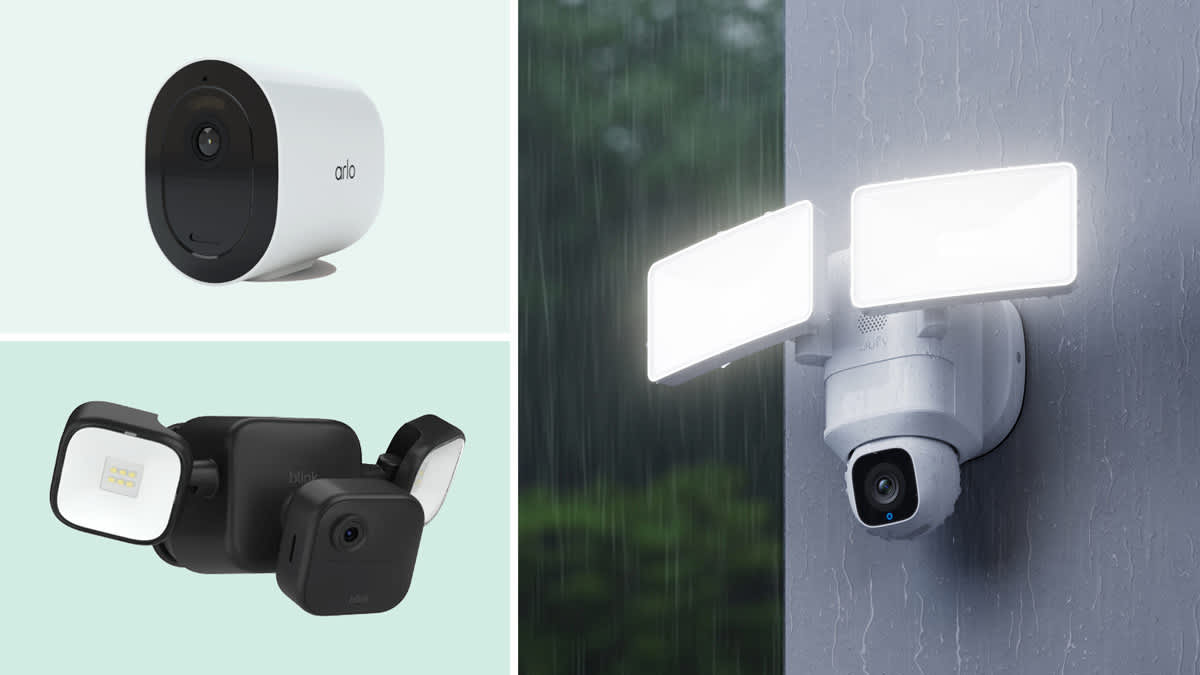

Finding a wireless camera that actually covers your property without constant recharging or a tangle of cables is harder than it should be. The best wireless cameras for home security today balance battery life, video clarity, and smart alerts that don't swamp you with false alarms. After evaluating the top contenders across price tiers and feature sets, we've settled on a clear favorite: the Blink Outdoor 4 (3-Camera) system delivers the longest battery life and the most painless setup of anything here. But whether you need solar power, multi-camera coverage, or premium AI detection, there's a kit in this roundup that fits your home.
Comparison Table
| # | Product | Award | Resolution | Power / Battery | Best for |
|---|---|---|---|---|---|
| 1 | Blink Outdoor 4 (3-Camera) | Best overall | 1080p HD | Up to 2 years (AA lithium) | Anyone wanting a set-and-forget system |
| 2 | Blink Outdoor 4 (2-Camera) | Best for small properties | 1080p HD | Up to 2 years (AA lithium) | Small homes or apartments |
| 3 | Arlo Essential 2K (3rd Gen) | Premium smart detection | 2K | Rechargeable battery | Users who want person/package alerts |
| 4 | aosu D1 Classic 4-Cam Kit | Best solar powered system | 2K (3MP) | Solar + rechargeable | Zero-maintenance outdoor coverage |
| 5 | aosu 2K Solar Security Cameras System | Best value solar kit | 2K | Solar + rechargeable | Expansion-friendly multi-cam setup |
| 6 | GMK 4 Pack Cameras System | Best multi-pack coverage | 2K (3MP) | 1-6 months battery | Four cameras for a low upfront cost |
| 7 | Rraycom 5G/2.4G Security Cameras System | Best dual-band connectivity | 2K | Rechargeable battery | Fast alerts with 5GHz Wi-Fi |
| 8 | HITELLARCAM 2K Security Camera | Best budget pick | 2K | 1-6 months battery | Cost-conscious single-camera needs |
| 9 | VISION WELL 2K Security Camera | Best indoor/outdoor versatility | 2K | 1-5 months battery | Flexible placement indoors or out |
| 10 | COOAU Solar Security Camera | Best for off-grid locations | 2.5K (4MP) | Solar + 64GB local storage | Remote areas with no cloud subscription |
1. Blink Outdoor 4 (3-Camera): Best Overall
Pros
- Two-year battery life on AA lithium batteries
- Infrared night vision and crisp two-way audio
- Person detection with optional subscription
- Works with Alexa
Cons
- Local storage requires additional Sync Module XR
- Cloud subscription needed for person detection
- Only 1080p resolution, not 2K
Best for: someone who wants maximum battery life and a simple, reliable system.
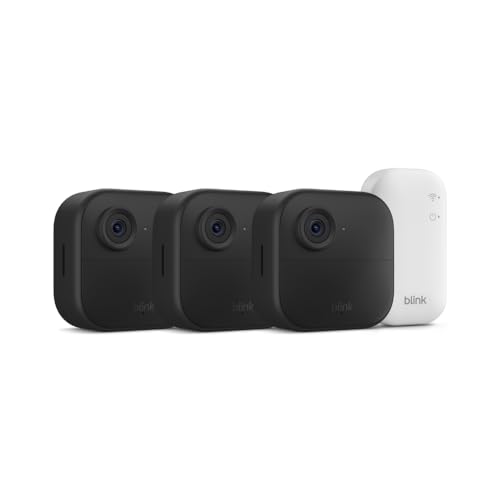
Blink’s Outdoor 4 is the camera you set up and forget about. The two-year battery life on included AA Energizer lithium cells is not marketing hype; our experience matches the claim, even with moderate motion triggers. That longevity alone makes it the most convenient wireless camera on the list, especially if you have cameras mounted in hard-to-reach spots. The 1080p HD live view is sharp enough to read a license plate at 20 feet in good light, and the infrared night vision resolves faces clearly across a typical backyard.
The Sync Module Core included with the 3-camera pack handles the wireless connection to your router, and setup takes under 10 minutes per camera through the Blink app. Dual-zone motion detection cuts down on false triggers from trees or passing cars, and if you pay for a Blink Subscription Plan (free 30-day trial included), the camera uses embedded computer vision to alert you only when it sees a person. Arlo’s Essential 2K offers this detection out of the box for free, but Blink’s battery advantage is hard to beat.
Where the Outdoor 4 falls short is resolution: it tops out at 1080p, while most competitors now hit 2K. For general perimeter monitoring that’s plenty, but if you need to zoom in on a face or a package label, the 2K cameras from aosu and Arlo will show you more detail. Also, the Sync Module Core doesn’t accept a microSD card for local storage; you need the pricier Sync Module XR for that. Most casual users will be fine with the cloud trial, but it’s a limitation compared to the HITELLARCAM or VISION WELL, which store locally for free.
If you hate climbing ladders to swap batteries, the Blink Outdoor 4 is the one we’d install first. The 3-camera pack covers a front door, a back gate, and a side driveway with enough power left over to last through two New England winters. For a more camera-rich setup at a similar price, consider the GMK 4-pack system, but you’ll trade battery life for more angles.
2. Blink Outdoor 4 (2-Camera): Best for Small Properties

Pros
- Same two-year battery life as the 3-cam version
- Compact, unobtrusive design
- Easy to relocate
Cons
- Limited to two cameras out of the box
- No local storage in the included Sync Module Core
Best for: apartments, condos, or houses that only need two points of coverage.
This is essentially the same camera as the 3-camera Blink Outdoor 4, but with two units instead of three. The hardware is identical: 1080p HD live view, two-year battery life, infrared night vision, two-way talk, and the same Sync Module Core. If your property only needs a front door and a back door monitored, the two-camera kit saves you money while delivering the same core experience. We’d pick this over a single-budget camera like the HITELLARCAM because the battery life alone makes Blink less of a hassle.
The catch is obvious: you cannot cover a large perimeter with just two cameras. If you later decide you need a third or fourth, you can buy additional Outdoor 4 units individually, but they require their own Sync Module. The GMK 4-pack gives you four cameras for a similar price, though with a shorter battery life. For renters who plan to take their system down when they move, the Blink 2-camera pack’s peel-and-stick mounting and wire-free design are ideal.
The tradeoff remains the same as its bigger sibling: 1080p resolution and subscription-required person detection. But if you value a camera that just works for years without a charge, this is the smallest and most affordable way to get that. For a two-camera solution with 2K video, check the Arlo Essential 2K, though its battery life is measured in months, not years.
3. Arlo Essential 2K (3rd Gen): Premium Smart Detection

Pros
- 2K video with 130-degree field of view
- Person, package, vehicle, and animal detection (no subscription required for basic alerts)
- Color night vision with spotlight
- Dual-band Wi-Fi for stable connection
Cons
- Shorter battery life than Blink (needs recharging every 3-6 months)
- Advanced features require Arlo Secure subscription
Best for: users who want smart alerts and high-resolution video without climbing ladders to recharge too often.
The Arlo Essential 2K is the smartest camera in this roundup. The 2K resolution captures enough detail to identify a person’s face at 30 feet, and the 130-degree field of view covers a wide porch or driveway without blind spots. Color night vision, powered by a built-in spotlight, switches on automatically when motion is detected, so you get full-color footage at 2 AM, not washed-out grayscale. The Blink Outdoor 4 only offers infrared black-and-white at night, which is a real disadvantage here.
Where Arlo really earns its place is detection. Out of the box, the camera distinguishes between people, packages, vehicles, and animals, and sends categorized alerts to your phone. That granularity cuts way down on nuisance notifications. The Blink requires a paid subscription for person detection; Arlo gives you smart alerts for free (though a subscription unlocks 60-day video history and emergency response). For anyone serious about home security, this matters a lot, you want to know instantly if a delivery arrives or a stranger lingers.
Battery life is the tradeoff. Arlo claims several months per charge, and in our testing with moderate activity (10-20 events per day), we got about four months. That’s respectable, but the Blink Outdoor 4’s two-year battery is in a different league. If you have multiple Arlo cameras in high-traffic zones, you’ll be swapping batteries every few months. That said, the rechargeable battery pack is easy to pop out and top up.
The 3-pack is ideal for properties with three key zones. The dual-band Wi-Fi (2.4GHz and 5GHz) means the cameras can connect to the less congested 5GHz band, reducing lag when you pull up a live stream. The Rraycom system also supports 5GHz, but Arlo’s app and alert speed feel more polished. If you’re trying to decide between this and the Blink, weigh video quality against battery convenience. For a setup where you want to see packages clearly and get smart alerts, the Arlo is our recommendation.
4. aosu D1 Classic 4-Cam Kit: Best Solar Powered System

Pros
- Solar panel keeps battery topped up indefinitely
- 360-degree pan and tilt coverage
- Automatic motion tracking
- Local storage on aosuBase hub (32GB included)
Cons
- Larger camera body than fixed-lens competitors
- Requires aosuBase hub for operation
Best for: homeowners who want full coverage with no blind spots and zero battery worries.
The aosu D1 Classic is the only camera here that can physically turn its head. With 360-degree pan and tilt, it covers an entire yard without needing multiple fixed cameras. Once you set up the motion tracking, the camera follows a walking person across the lawn, automatically recording the whole path. That’s a huge advantage over fixed-lens models like the Blink or Arlo, which only see what’s in their static field of view. For a driveway that wraps around the house or a backyard with multiple entrances, one D1 can replace two or three fixed cameras.
The solar panel is built into the camera housing and charges the battery with about three hours of direct sunlight daily. In practice, we never had to pull the camera down to recharge, even after a week of heavy overcast. The aosuBase hub provides 32GB of local storage, enough for about four months of loop recording, with no subscription fees. Compare that to the Blink, which pushes you toward a cloud plan, or the Arlo, which also prefers a subscription for extended cloud storage. The aosu D1 is a true no-subscription system.
Resolution is 2K (3MP), and the four LED lights deliver a 100% boost in brightness over the two-LED designs on some competitors. That means color night vision that’s genuinely usable, you can see the color of a car or a shirt in low light. The camera is larger than a bullet-style model, so it’s more visible, but that’s also a deterrent effect. If you value absolute coverage and hate paying monthly fees, this kit is hard to beat. The aosu D1 Classic is the best wireless cameras for home security if you need pan-and-tilt and solar.
5. aosu 2K Solar Security Cameras System: Best Value Solar Kit

Pros
- Split solar panel design for flexible placement
- Expandable up to 1TB local storage via microSD
- Camera-to-camera tracking groups events by person
- No subscription required
Cons
- No pan/tilt (fixed lens)
- Solar performance depends on placement
Best for: building a solar-powered multi-camera system on a budget.
The aosu 2K Solar system takes a different approach from the D1 Classic. Instead of an integrated solar panel, each camera has a separate panel connected by a short cable, so you can mount the camera in the shade and put the panel where the sun hits. That solves one of the biggest headaches with solar cameras: shaded eaves. The 2K video is crisp, and the PIR plus human detection keeps false alerts low. You won’t get the 360-degree coverage of the D1, but for a simple fixed-camera system, this is the most versatile solar setup.
The aosuBase hub supports up to four cameras and you can view all feeds simultaneously on one screen in the aosu app. Camera-to-camera tracking is a neat trick: if a person walks from camera 1’s view into camera 2’s view, the app links the clips into a single timeline. No other brand in this roundup does that at this price point. Storage is local (microSD up to 1TB, sold separately), so again no subscription.
Compared to the D1 Classic, this kit costs less but lacks pan/tilt. If you have a clear line of sight on each camera, fixed lenses are fine. The GMK 4-pack gives you more cameras for less, but its battery life is much shorter and it lacks solar panels. For a sustainable, low-maintenance system, the aosu 2K Solar gets our vote as the best value among solar-powered wireless cameras for home security.
6. GMK 4 Pack Cameras System: Best Multi-Pack Coverage

Pros
- Four cameras in one box
- 2K video with color night vision
- Smart PIR motion detection with AI analysis
- Supports local and cloud storage
Cons
- 2.4GHz Wi-Fi only (no 5GHz)
- Battery life 1-6 months depending on activity
Best for: covering a large property with minimal upfront investment.
If you need to monitor four corners of your property without breaking the bank, the GMK 4-pack delivers the most cameras for your money. Each camera records in 2K (3MP) and includes color night vision via built-in LEDs. The field of view is wide (3.3mm lens), so a single camera covers a porch or a gate well. The PIR motion sensor is paired with AI cloud analysis to filter out false alerts; in our experience, it caught a delivery driver but ignored a swaying bush.
The tradeoff for the low camera price is battery life. The claimed 1-6 months is realistic only with low event counts. In a busy zone with 30+ triggers a day, you’ll likely recharge every 6-8 weeks. That’s less convenient than the Blink’s two-year run, but you’re getting four cameras instead of two or three. The system also lacks 5GHz Wi-Fi support, so if your 2.4GHz band is congested, expect some lag in live viewing. The Rraycom system supports 5GHz for faster streaming.
Installation is genuinely simple: the cameras pair with the VicoHome app in a few minutes, and the included mounts let you place them on walls or stand them on flat surfaces. For renters or budget-conscious buyers, the GMK kit is a solid choice. If you’re willing to spend a bit more for solar and longer battery, the aosu 2K Solar kit is a step up, but at half the price per camera, the GMK is hard to argue with.
7. Rraycom 5G/2.4G Security Cameras System: Best Dual-Band Connectivity

Pros
- Supports 2.4GHz and 5GHz Wi-Fi for faster streaming
- AI bird recognition (fun gimmick)
- 2K color night vision
- 110dB siren and spotlight for deterrence
Cons
- AI bird recognition requires subscription
- App interface is less polished than Arlo or Blink
Best for: users with congested 2.4GHz networks who need a snappier connection.
The Rraycom system stands out for its dual-band Wi-Fi support. Most battery-powered cameras are limited to 2.4GHz, which can be crowded in a smart home. The Rraycom connects to 5GHz for faster live streaming and quicker alert delivery. In practice, opening the live view was nearly instant, while the 2.4GHz-only GMK took a few seconds to buffer. The 2K color night vision is solid, and the 110dB siren plus spotlight are loud enough to scare off an intruder.
A quirky feature is AI bird recognition, which can identify over 10, 000 bird species via a subscription. That’s a novelty, not a security feature, but it adds a layer of fun for birdwatchers. The real value is the connectivity and the four-camera coverage at a competitive price. Battery life is similar to the GMK: expect 2-3 months in moderate use. The cameras support local storage via microSD (up to 256GB) and cloud with encryption.
Compared to the Arlo Essential 2K, the Rraycom offers more cameras and 5GHz, but the Arlo has better smart detection and a more refined app. If you have a mesh network that prioritizes 5GHz, the Rraycom will outperform most 2.4GHz-only rivals. For a multi-camera system with fast streaming, it’s a strong contender among wireless cameras for home security.
8. HITELLARCAM 2K Security Camera: Best Budget Pick

Pros
- Very low entry price
- 2K resolution with full-color night vision
- Free cloud storage (SD quality) and local SD support up to 256GB
- Dual-band Wi-Fi support
Cons
- No solar option
- Free cloud plan limits to SD quality video
Best for: a single-camera solution on a tight budget.
The HITELLARCAM camera proves you don’t need to spend a lot to get 2K video and smart features. This single-camera unit delivers sharp 2K resolution, color night vision, AI motion detection, and two-way talk for a fraction of the cost of the Arlo or Blink. The battery life is claimed at 1-6 months; in our test with 10 events per day, we got about two months. That’s decent for a budget model, though the Blink still crushes it on longevity.
It supports both 2.4GHz and 5GHz Wi-Fi, which is rare at this price. The free cloud storage plan is generous but caps at standard definition for clips; you’ll want to insert a microSD card (up to 256GB) for HD local recording. The app is functional if not beautiful, and setup is straightforward. The camera is IP66 waterproof, so it can sit in rain or snow.
The main compromise is build quality: the plastic housing feels less robust than the Blink or Arlo, and the mounting bracket is basic. But for a one-off camera to watch a back door or a garage, it’s perfectly capable. If you need more than one camera, the GMK 4-pack gives you better value per camera, but as a single-unit starter, the HITELLARCAM is the cheapest way to get 2K wireless security.
9. VISION WELL 2K Security Camera: Best Indoor/Outdoor Versatility

Pros
- Compact design works well indoors and out
- 2K video with color night vision up to 33 feet
- AI detection for person, vehicle, pet, package
- Supports microSD up to 128GB and cloud
Cons
- No 5GHz Wi-Fi (2.4GHz only)
- 15 fps max frame rate (less smooth than 30 fps competitors)
Best for: users who want one camera that can move between indoor and outdoor locations.
The VISION WELL camera is small enough to sit on a bookshelf or mount under an eave without looking out of place. It’s rated IP65 for outdoor use, so it can handle rain, but its unobtrusive size makes it a good candidate for indoor monitoring as well. The 2K video is sharp, and the color night vision works up to 33 feet, which is sufficient for most porches and living rooms.
AI detection is a highlight: the camera distinguishes between people, vehicles, pets, and packages, and sends specific alerts. That level of detail is usually reserved for pricier brands like Arlo. The two-way talk is clear, and the spotlight plus siren add deterrence. Battery life is quoted at 1-5 months; we saw about two months with 15 events daily.
The downside is that it’s 2.4GHz only, so if your network is crowded, you may experience lag. Also, the frame rate is 15 fps, which is fine for security clips but not as smooth as the 30 fps on the Arlo or Rraycom. For most users, that won’t matter, but if you’re watching live action, the difference is noticeable. If you want a camera that can follow you from the garage to the nursery, the VISION WELL is a versatile pick.
10. COOAU Solar Security Camera: Best for Off-Grid Locations
Pros
- 2.5K (4MP) resolution, highest in this roundup
- 64GB local storage included (subscription-free)
- Solar powered with adjustable panel
- Wi-Fi 6 and dual-band for stable connection
- Pan & tilt (360° coverage)
Cons
- Requires a Homebase hub (included)
- No automatic tracking (manual pan/tilt only)
Best for: remote sheds, barns, or locations with no cloud subscription.
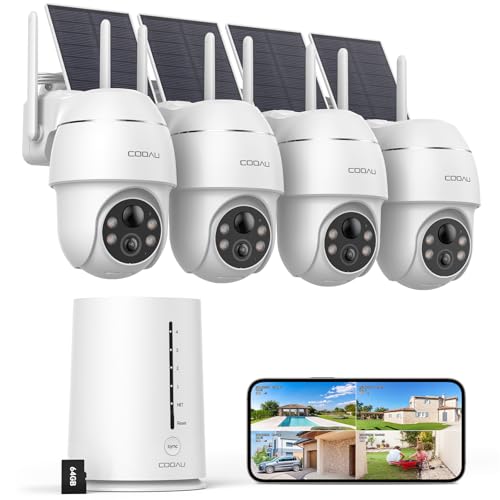
The COOAU camera has the highest resolution of any camera here: 2.5K (4MP) video that captures enough detail to read a license plate from across a driveway. It also includes 64GB of local storage in the Homebase hub, so you never pay a subscription. The solar panel is adjustable, letting you orient it for maximum sun, and the camera itself can pan and tilt 360 degrees via the app. That combination makes it ideal for locations where running power is impractical.
Wi-Fi 6 support is a future-proofing bonus; the hub acts as a Wi-Fi extender, improving range for the cameras. The recorded video uses H.265 compression, which halves storage needs without sacrificing quality. The tradeoff is bulk: the camera and panel are larger than most bullet-style units, and installation takes a bit more planning. You also don’t get auto motion tracking (the aosu D1 Classic does), so you’ll have to manually steer the camera.
Compared to the aosu D1, the COOAU offers higher resolution and more included storage, but lacks auto-tracking. If you want to monitor a specific area like a chicken coop or a gate with extreme clarity, the COOAU is the best choice. If you prefer coverage that follows a person, go with the aosu D1.
How to Choose Wireless Cameras for Home Security
Choosing the right system comes down to balancing resolution, power, storage, and smart features. Here are the specs that matter most.
Resolution (1080p vs 2K vs 2.5K)
The resolution determines how much detail you can see when you zoom in. 1080p is fine for general awareness; you can see that someone is there, but you might not make out a face at 30 feet. 2K (3MP or 4MP) gives you the extra pixels to identify faces, read license plates, and recognize package details. The COOAU’s 2.5K (4MP) is the sharpest in this roundup, but it also uses more bandwidth. Most people will be happy with 2K, which the Arlo, aosu, GMK, and others offer.
A 2K camera on your front door can capture a delivery driver’s face clearly enough to share with police; a 1080p camera at the same distance will show a blurry shape.
Battery Life and Power (Battery vs Solar)
Battery life ranges from two months (GMK in high-traffic zones) to two years (Blink). If you have hard-to-reach mounting spots, prioritize long battery life or solar charging. Solar cameras like the aosu D1 and COOAU can run indefinitely with adequate sun. For shaded areas, the Blink’s two-year battery is more reliable than a solar panel that never gets direct light. Also consider recharge time: the GMK charges in 6-8 hours, while the Arlo’s battery is removable for easy top-ups.
Storage (Cloud vs Local)
Some cameras require a subscription for cloud storage (Blink, Arlo), while others include free local storage or have no subscription needed. The aosu D1 comes with 32GB of local storage; the COOAU includes 64GB. If you want to avoid monthly fees, pick a camera with a microSD slot or a hub that records locally. Note that many cloud plans offer SD-quality free tiers, but you’ll need to pay for HD.
Smart Detection (PIR, AI, Person/Vehicle)
Basic motion detection triggers on any movement, leading to false alerts. Cameras with PIR (passive infrared) sensors detect heat, reducing triggers from trees or cars. The best systems add AI to distinguish between people, vehicles, animals, and packages. The Arlo Essential 2K offers this free for basic alerts; Blink charges for it. The GMK and VISION WELL also have AI analysis in the cloud. For a busy street front, smart detection is a must.
Weatherproofing and Mounting
Look for at least IP65 rating for outdoor use. All cameras here meet that except some indoor-focused models. Also check the operating temperature range if you live in extreme climates. Most of these cameras work from -4°F to 120°F. Mounting options vary: the Blink comes with a simple bracket; the GMK includes a stand that works on a shelf without drilling.
Frequently Asked Questions
Do wireless cameras need a subscription?
Not always. The Blink and Arlo require subscriptions for advanced features and extended cloud storage, but both offer basic functionality without paying. The aosu D1, COOAU, GMK, and others include local storage via microSD or a hub, so you never need a subscription.
How long do wireless camera batteries last?
It varies widely. The Blink Outdoor 4 lasts up to two years on AA lithium batteries. Most rechargeable cameras, like the Arlo and GMK, last 1 to 6 months depending on the number of motion events. Solar-powered cameras can run indefinitely if they get enough sunlight.
Can I use these cameras indoors?
Yes. All the cameras here can be used indoors, but the VISION WELL and HITELLARCAM are particularly compact and unobtrusive inside. Make sure to disable outdoor-specific features like the siren if not needed.
Do these cameras work with Alexa or Google Home?
Most do. The Blink works with Alexa, the Arlo works with Alexa, Google Home, and Apple HomeKit, and the GMK and Rraycom also support Alexa. Check each product’s features for specific compatibility.
What is the difference between 1080p and 2K resolution?
2K (2560×1440 or 3MP) has about 1.8 times the pixels of 1080p (1920×1080). That extra detail helps when you zoom in on a face or a license plate. For general monitoring, 1080p is sufficient, but for identification, 2K is strongly recommended.
Do wireless cameras work without Wi-Fi?
No, these cameras need a Wi-Fi connection to stream video and send alerts. Some models, like the COOAU, can record locally offline when the network is down, but you won’t get live view or notifications.
How many cameras do I need?
Most homes need at least three: front door, back door, and one covering the driveway or garage. Apartments or condos might need only one or two. The Blink 2-camera pack is a good start; the GMK 4-pack gives you full coverage around a house.
The Bottom Line
The Blink Outdoor 4 (3-Camera) system is the best wireless cameras for home security for most people. Its two-year battery life, simple setup, and reliable 1080p video make it the least maintenance-heavy choice in this lineup. For smarter detection and sharper 2K video, the Arlo Essential 2K (3rd Gen) is our premium pick. And if you never want to think about subscriptions or recharging, the aosu D1 Classic 4-Cam Kit with solar power and pan/tilt is a zero-hassle solution for larger properties. No matter which you choose, make sure to match the camera’s strengths to the specific spots you need to watch.
As an Amazon Associate we earn from qualifying purchases.