

A dry guitar can sound strangely flat once it leaves the room, but adding too much ambience can push chords behind the band. The right reverb pedal gives you a controllable sense of space, from a short studio room to a long, shimmering wash, without forcing every song into the same sound.
Our Best reverb pedal picks range from simple compact pedals to stereo units with presets, expression control, freeze functions, or a second effect built in. BOSS RV-6 Reverb is the single best all-rounder here, while the rest cover specific needs such as creative soundscapes, compact boards, straightforward controls, and delay-reverb combinations.
Comparison table
| # | Product | Award | Modes | Key features | Best for |
|---|---|---|---|---|---|
| 1 | BOSS RV-6 Reverb | Best overall | 8 sound modes | Mono or stereo, expression input | Players wanting broad, polished reverb options |
| 2 | TC Electronic Hall of Fame 2 | Best for customization | Shimmer and TonePrint effects | MASH footswitch, stereo I/O | Players who like shaping and expanding presets |
| 3 | JHS Pedals 3 Series Reverb | Best simple controls | Room to ambient washes | EQ and pre-delay controls | Guitarists who want hands-on tone shaping |
| 4 | Klowra Limbo Reverb | Best for soundscapes | 9 algorithms | Freeze, Infinity, Ramp, stereo I/O | Shoegaze, worship, and cinematic textures |
| 5 | FLAMMA FS02 Reverb | Best for presets | 7 effects | 7 save slots, stereo I/O, trails | Players who need repeatable live settings |
| 6 | SONICAKE Delay Reverb | Best two-in-one | Plate reverb and delay | Up to 2000ms delay, tap tempo, trails | Small boards that need both effects |
| 7 | M-VAVE Mini Universe | Best for creative modes | 9 reverb effects | USB-C or 9V power, compact metal housing | Players exploring unusual ambience |
| 8 | Donner Verb Square | Best compact classic | 7 modes | True bypass, aluminum-alloy case | Basic room, hall, spring, and plate sounds |
| 9 | FLAMMA FC02 Reverb | Best minimalist pedal | Studio, Church, Plate | Three parameter controls, true bypass | Players who prefer a small, focused setup |
| 10 | MEDIORAYS Mini Reverb | Best for USB-C power | 9 modes | Dry/Wet, Time, Level, USB-C power | Home players needing flexible power options |
1. BOSS RV-6 Reverb: Best Overall

Pros
- Eight distinct reverb sound modes
- Mono or stereo operation
- Expression pedal input
- Shimmer and Delay plus Reverb expand its range
Cons
- Larger and heavier than the mini pedals here
- The wide feature set takes longer to explore
Best for: guitarists who want one dependable pedal covering conventional and expansive reverb sounds.
The RV-6 is the pedal we would put in front of the widest range of players. Its controls are approachable enough for a quick room or plate sound, but the eight modes give it much more headroom than a basic three-mode unit. It feels like a practical centerpiece rather than a specialist effect.
The useful distinction is not simply the number of modes. BOSS includes shimmer, Dynamic, and Delay plus Reverb alongside more familiar spaces, so the pedal can move from subtle sustain to a deliberately larger texture. Mono or stereo operation makes it suitable for a single amplifier or a broader stereo rig, and the expression input lets you control reverb level without reaching down to the pedal.
Compared with the Donner Verb Square, the RV-6 offers a more ambitious set of sounds and a clearer path into modern atmospheric effects. The TC Electronic Hall of Fame 2 goes further for players who want extensive customization, while the BOSS is easier to understand without additional setup. That balance is why it outranks the more specialized options.
Its weakness is the footprint and weight. At 5.95 inches long, 3.8 inches wide, and about 0.99 pounds, it takes more board space than the small FLAMMA, M-VAVE, and Donner options. Players who only need a subtle spring or room effect should skip it. For everyone else, the RV-6 is the safest single-pedal recommendation.
2. TC Electronic Hall of Fame 2: Best for Customization

Pros
- MASH footswitch adds pressure-sensitive control
- TonePrint access expands the sound palette
- Stereo input and output
- Analog dry-through and true bypass
Cons
- Its deeper customization is more involved
- It may be more pedal than a simple rig needs
Best for: players who want to shape, save, and perform evolving reverb textures.
The Hall of Fame 2 is built around the idea that reverb should be more than a fixed wash behind the guitar. Its MASH footswitch responds to pressure, giving the player another way to interact with the effect during a part. That makes it especially interesting for players who want the pedal itself to become part of the performance.
The headline features are stereo input and output, a shimmer effect, and TonePrint support. TonePrint provides access to custom pedal tweaks, while analog dry-through keeps the dry guitar path intact. True bypass is also included, so the pedal can sit in a signal chain without requiring the effect to remain active.
This is the more customization-focused alternative to the BOSS RV-6. The BOSS is the easier recommendation when you want a polished selection of ready-to-use modes, but the Hall of Fame 2 rewards players prepared to explore its deeper options. It also offers a more interactive performance approach than the JHS Pedals 3 Series Reverb, whose strength is its direct, hands-on layout.
The drawback is that its flexibility can slow down a quick setup. A player who wants to turn two knobs and find a familiar room sound may prefer the FLAMMA FC02 Reverb or Donner. The Hall of Fame 2 belongs on a board where experimentation, stereo routing, and expressive control matter.
3. JHS Pedals 3 Series Reverb: Best Simple Controls

Pros
- EQ controls the brightness of the reverb
- Pre-delay adds useful separation
- Covers small rooms through long ambience
- Compact 4 by 3-inch enclosure
Cons
- Fewer named modes than several digital competitors
- Requires a 9V DC negative-center supply
Best for: guitarists who want to shape one reverb sound directly from the enclosure.
The 3 Series Reverb is refreshingly direct. Rather than making you choose among a long list of algorithms, it gives you controls that determine how the ambience sits around the note. That approach is particularly useful when your concern is not collecting effects, but making one reverb sound fit a guitar, amplifier, and song.
Its EQ control lets you make the reverb brighter or darker, which is a meaningful adjustment in a busy mix. The pre-delay control creates a pause before the reverb blooms. Short settings can suggest a tighter, more immediate space, while longer settings separate the original note from the ambience and make the effect feel more spacious.
The JHS is more tactile than the TC Electronic Hall of Fame 2, and less mode-driven than the BOSS RV-6. It does not offer the BOSS's dedicated shimmer or the Hall of Fame 2's MASH footswitch, but its layout is easier to read at a glance. It also occupies a manageable 4 by 3 inches and weighs about 0.46 pounds.
The limitation is breadth. Players seeking seven or nine distinctly labeled effects may find the M-VAVE Mini Universe or FLAMMA FS02 Reverb more immediately varied. The JHS is for the player who values useful control over a long menu, especially someone building a focused board around guitar and amplifier tone.
4. Klowra Limbo Reverb: Best for Soundscapes

Pros
- Nine studio-grade reverb algorithms
- Freeze and Infinity functions sustain the tail
- Ramp function supports evolving textures
- Stereo I/O and analog dry-through
- External expression support
Cons
- Requires a 9V supply rated at 250mA or higher
- Its atmospheric focus is not for every traditional rig
- Power supply is not included
Best for: players building sustained, cinematic, shoegaze, worship, or synth-friendly textures.
The Limbo is the most obviously experimental pedal in this group. Its nine algorithms include the company's Tide effect as well as Shimmer, and the feature set is aimed at creating a large sonic field rather than just adding a little room around a dry guitar. If your idea of reverb includes drones, swells, and long transitions, this pedal starts with the right vocabulary.
Freeze and Infinity are the standout functions. They sustain the reverb tail so a solo performer can create a bed of sound and play over it. The Ramp function adds another layer of movement, and external TS or TRS support allows expression-based control. Those features make the Limbo a more active instrument than the simpler Donner or FLAMMA FC02.
Its 32-bit floating-point WildSeed DSP engine, plus claimed headroom of +10dBu, is specified for clean handling of guitar and desktop synth signals. Analog dry-through preserves the original path, while stereo I/O gives it a place in a wider setup. True and buffered bypass options add flexibility for different signal-chain preferences.
The Limbo is not the obvious pick for a player who only needs spring, plate, or church ambience. The BOSS RV-6 is easier to recommend as a universal pedal, and the JHS Pedals 3 Series Reverb is more focused for basic tone shaping. Choose Klowra when the reverb needs to become a sustained, moving part of the arrangement.
5. FLAMMA FS02 Reverb: Best for Presets

Pros
- Seven reverb effects
- Seven storable preset slots
- Stereo input and output
- Trail On lets the effect fade naturally
- Hi-cut, lo-cut, decay, and pre-delay controls
Cons
- Needs a 9V supply with more than 300mA
- Preset operation adds complexity over a basic pedal
Best for: performers who need several repeatable reverb settings in one compact enclosure.
The FS02 makes the strongest case for a preset-based workflow. It offers seven reverb types, including Room, Hall, Church, Cave, Plate, Spring, and Mod, then lets you save edited sounds to seven slots. That matters when a set moves between a tight room sound, a long hall, and a more unusual modulation effect.
The controls are more substantial than the compact three-mode pedals. Hi-cut and lo-cut help keep the effect from crowding the guitar, while decay and pre-delay determine the length and timing of the space. Trail On allows the reverb to fade after switching off instead of stopping abruptly, which is a small feature with a real effect on transitions.
Stereo input and output make the FS02 a better match for a two-amplifier or stereo recording setup than the SONICAKE Delay Reverb. It also gives live players a more repeatable workflow than the JHS Pedals 3 Series Reverb, which is designed around immediate knob adjustments rather than stored settings.
The main catch is the power requirement. FLAMMA specifies a 9V DC supply with more than 300mA, and the supply is not included. That is a detail to confirm before fitting it to a board. If you need several consistent sounds and stereo routing, the FS02 is the more practical choice. If you want fewer decisions, the Donner is simpler.
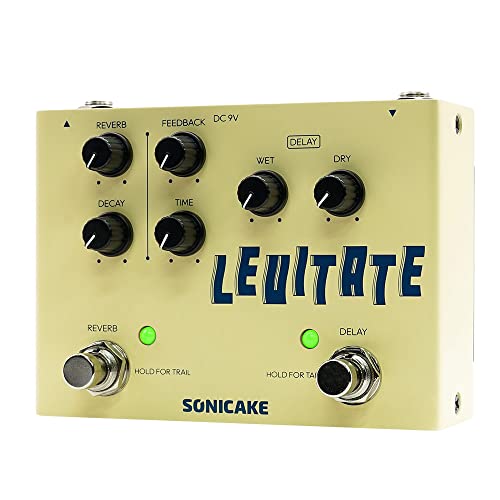
6. SONICAKE Delay Reverb: Best Two-in-One
Pros
- Combines delay and plate reverb
- Delay time reaches 2000ms
- Tap tempo and trails support live use
- Compact enclosure
- Buffer bypass circuit preserves the signal path
Cons
- Reverb choices are more limited than on dedicated units
- 9V center-negative power supply is not included
Best for: players who need delay and plate reverb without adding two separate pedals.
The SONICAKE makes sense when board space matters more than a long list of reverb algorithms. It puts digital delay and plate reverb in one enclosure, so a player can add two foundational effects without giving up room for another pedal. That combination is more useful than the title might suggest, especially for lead tones and rhythmic parts that need both repeat and depth.
The delay section reaches 2000ms, giving it enough range for short slapback, rhythmic repeats, and longer ambient trails. Tap tempo is useful when the repeats need to follow a song, while the trail function helps the effect decay more smoothly when bypassed. The reverb has a large adjustable decay parameter, so it can move from restrained plate ambience toward a more obvious wash.
Compared with the Donner Verb Square, the SONICAKE gives up several reverb modes but adds a fully separate delay function. The FLAMMA FC02 Reverb is more focused if you only need studio, church, or plate ambience, while the SONICAKE is the better fit for a small board that needs both effect families.
It is not the right choice for someone seeking spring, shimmer, or freeze textures. Its enclosure measures about 4.88 by 3.54 inches and weighs roughly 0.97 pounds, so it is compact but not the lightest pedal here. Choose it when the delay-reverb pairing solves a real gap in the signal chain.
7. M-VAVE Mini Universe: Best for Creative Modes

Pros
- Nine reverb effects
- Includes Shimmer, Cloud, Bloom, Swell, and Lo-Fi
- USB-C or 9V power options
- Works with electric guitar, acoustic guitar, and bass
- Small metal enclosure
Cons
- The more unusual modes will not suit every arrangement
- The power guidance is more specific than a standard 9V-only pedal
Best for: musicians who want unusual ambient colors in a small pedal format.
The Mini Universe is aimed at curiosity. Its nine modes move beyond the standard room, hall, plate, and spring set with Shimmer, Cloud, Bloom, Swell, and Lo-Fi. That gives it a broader creative range than the compact Donner, even though both are intended to fit easily on a crowded board.
The USB-C power option is the unusual practical feature. M-VAVE says the pedal can use USB-C or a 9V center-negative adapter, and it specifically describes use with a power bank or a mobile phone charger above 5V 1A. That could be convenient for home recording or a portable setup, though players should follow the stated power requirements rather than assume every USB source will work.
The pedal has a clear control layout and a compact metal design measuring about 5 by 3 inches. It is also described as compatible with bass and acoustic guitar, not only electric guitar. The Klowra Limbo Reverb offers more specialized performance functions such as Freeze and Ramp, but the M-VAVE is easier to justify when variety in the modes matters most.
The weakness is that nine effects do not automatically mean nine sounds you will use. Players wanting classic, predictable ambience may prefer the JHS Pedals 3 Series Reverb or the FLAMMA FC02. The Mini Universe is for experimentation, home creation, and musicians who want a small enclosure to produce more unusual spaces.
8. Donner Verb Square: Best Compact Classic

Pros
- Seven familiar reverb modes
- True bypass
- Aluminum-alloy construction
- Small pedalboard-friendly enclosure
- Clear LED status indicator
Cons
- Power supply is not included
- No stereo operation or expression input is specified
Best for: guitarists who want common reverb types in a small, uncomplicated enclosure.
The Donner Verb Square is a straightforward pedal with a useful set of familiar sounds. Room, Hall, Church, Spring, Plate, Studio, and Mod cover the basic spaces most guitarists reach for, without the more specialized controls found on the FS02 or the performance functions in the Limbo.
Its aluminum-alloy case is designed for regular pedalboard use, and the mini format is easy to place around larger effects. Donner lists the pedal at about 0.55 pounds, with dimensions of roughly 2.4 by 2.4 inches across the enclosure footprint. The LED indicator provides a quick visual check of its status, which is helpful on a dim stage.
The true-bypass design is the main signal-chain feature. When the effect is off, the pedal is intended to pass the guitar signal transparently. Compared with the MEDIORAYS Mini Reverb, the Donner has fewer modes but a more familiar set of reverb names. The M-VAVE Mini Universe offers more adventurous textures, though Donner is easier to understand at a glance.
The trade-off is limited integration. No stereo operation or expression input is specified, and the 9V power supply is not included. Players needing a complex stereo setup should look at the BOSS RV-6 or FLAMMA FS02. For a compact board and conventional reverb duties, the Verb Square remains a clean, sensible option.
9. FLAMMA FC02 Reverb: Best Minimalist Pedal

Pros
- Studio, Church, and Plate effects
- Three intuitive parameter controls
- True bypass
- Full metal case
- Lightweight 153g design
Cons
- Only three reverb effects
- Requires a 9V supply rated at least 210mA
- Power supply is not included
Best for: players who want a tiny pedal focused on three useful reverb sounds.
The FC02 is the simplest dedicated reverb here. It does not attempt to cover every atmospheric style. Instead, it offers Studio, Church, and Plate, then puts three parameter controls within easy reach. That makes it a natural fit for a first effects board or a secondary board where the job is simply to add space.
The three modes are sensibly chosen. Studio can provide a more contained room character, Church gives a deeper and larger ambience, and Plate offers the familiar artificial reverb sound that can help a lead or clean part stand out. The control layout is intended to make those sounds easy to adjust without navigating presets or specialized functions.
At 153g, the FC02 is notably light, and its full metal case gives it a more reassuring physical design than a lightweight plastic unit. True bypass keeps the pedal from coloring the signal when it is off. The Donner Verb Square offers four more modes in a similarly compact concept, but FLAMMA's smaller menu can be an advantage when speed matters.
Three modes will feel restrictive to players who want shimmer, spring, or modulated textures. The pedal also needs a 9V DC supply with at least 210mA, and that supply is not included. Choose it for a focused setup, not as a replacement for the more expansive BOSS or Klowra options.
10. MEDIORAYS Mini Reverb: Best for USB-C Power

Pros
- Nine reverb modes
- USB-C and 9V DC power options
- Dry/Wet, Time, and Level controls
- Aluminum-alloy case
- Bright LED status indicator
Cons
- Power-supply compatibility needs attention
- No stereo operation is specified
- The compact enclosure leaves less room for advanced controls
Best for: home players and compact-board owners who want several modes and USB-C power.
The MEDIORAYS Mini Reverb stands out because it combines a small enclosure with nine named modes and two power paths. The list includes Room, Hall, Chorus, Duck, Plate, Studio, Echo, and Lo-Fi, while the product description also highlights spring reverb. That is a broad set for a pedal designed around three main controls.
Dry/Wet controls the blend between the guitar and the effect, Time adjusts the duration or size of the ambience, and Level helps set the output presence in the mix. This is a more immediate approach than a preset-based pedal. The bright LED makes the on or off state easy to see, and the aluminum-alloy case is intended for regular pedalboard handling.
USB-C support separates it from the FLAMMA FC02 and Donner Verb Square, which are more conventional 9V pedal choices. It may be useful at home, in a portable recording setup, or anywhere a player already has a suitable USB-C power source. The pedal also accepts a standard 9V DC adapter, though the product notes emphasize using a compatible supply.
The limitation is the amount of information provided about advanced routing. Stereo operation, expression input, and preset storage are not specified, so the MEDIORAYS is less suitable for a complex live rig than the FLAMMA FS02 Reverb. Pick it when USB-C power and a varied mode selection matter more than deep performance control.

How to choose the best reverb pedal
The right reverb pedal depends on how much control you need, how it will connect to the rest of the rig, and whether the effect should stay subtle or become part of the performance.
Reverb modes
A pedal with Room, Hall, Plate, and Spring covers the core spaces most players use. Room and Studio sounds usually keep the guitar closer and clearer, while Hall, Church, Cave, and other long-decay settings create a larger backdrop. Shimmer, Cloud, Bloom, Swell, Mod, and Lo-Fi are more specialized, but they can be valuable for ambient, experimental, and cinematic parts.
Do not choose by mode count alone. The FLAMMA FC02 Reverb has only three modes, but they are practical and easy to shape. The M-VAVE Mini Universe has nine, which makes more sense for someone who wants unusual textures rather than only conventional ambience.
Decay and pre-delay
Decay determines how long the reverb continues after the note. Short decay keeps picking articulate, while a long decay can fill gaps between phrases or create a sustained wash. Pre-delay inserts a short pause before the reverb blooms, helping the original guitar note remain clear when the ambience is large.
The JHS pedal makes pre-delay a central part of its design, while the FLAMMA FS02 combines pre-delay with decay, hi-cut, and lo-cut. Those controls are more useful than extra modes when your main challenge is making reverb sit correctly in a mix.
A long decay sounds impressive alone, but pre-delay and filtering often matter more once the full band starts playing.
Stereo and expression connections
Mono operation is enough for a standard guitar-to-amplifier chain. Stereo input and output become important with two amplifiers, stereo recording, or a signal chain that already uses spatial effects. Expression input is useful when you want to change reverb level or another parameter without bending down.
The BOSS RV-6, Hall of Fame 2, Klowra Limbo, and FLAMMA FS02 offer more advanced connection options than the mini pedals. Before choosing one, map the actual signal path. A compact mono pedal can be the cleaner solution if the rest of the rig is mono.
Bypass and trails
True bypass is designed to pass the signal without the effect circuit when the pedal is off. Analog dry-through keeps the dry guitar path analog while the wet effect is processed digitally. Trail functions let the reverb fade after bypass, which avoids a hard cutoff at the end of a chord.
The SONICAKE includes trails, and the FLAMMA FS02 has a Trail On function. These details matter most for live transitions. A player who switches reverb off between songs may not need them, but a player who changes sounds in the middle of a phrase probably will.
Power and pedalboard fit
Most pedals here require a 9V DC supply, but the current requirement differs. The FLAMMA FC02 specifies at least 210mA, the Klowra Limbo requires at least 250mA, and the FLAMMA FS02 requires more than 300mA. The M-VAVE Mini Universe and MEDIORAYS Mini Reverb also support USB-C, while the SONICAKE and Donner list standard 9V arrangements.
Physical size matters on a crowded board. The Donner, FC02, M-VAVE, and MEDIORAYS use compact formats, while the BOSS and Hall of Fame 2 occupy more conventional pedal space. For broader advice on building a signal chain, the roles different effects play in a guitar rig is a useful place to continue.
Presets and live control
Preset storage is valuable when the same pedal needs to produce several carefully adjusted sounds during a set. The FLAMMA FS02 provides seven storable slots, while the Hall of Fame 2 uses TonePrint support and a MASH footswitch for deeper interaction. The Klowra adds Freeze, Infinity, Ramp, and external control for evolving parts.
If you prefer to make one adjustment with your foot and keep playing, a simpler pedal may be better. For players learning how effects interact, a straightforward way to build a first pedalboard can help keep the setup manageable.

Frequently asked questions
What does a reverb pedal do?
A reverb pedal adds an electronic simulation of reflected sound around the guitar signal. Short settings can make a dry guitar seem like it is in a small room, while longer settings create larger halls, churches, or ambient washes.
Should reverb go before or after delay?
There is no single correct placement, but putting reverb after delay usually lets the repeats share the same sense of space. Placing reverb before delay can produce more pronounced, sometimes more experimental repeats.
Is true bypass important on a reverb pedal?
True bypass can help the guitar signal pass through without the effect circuit when the pedal is off. It is useful, but it is only one part of the signal-chain decision. Analog dry-through, buffer behavior, cable length, and the rest of the board also influence how a rig behaves.
Do I need stereo inputs and outputs?
You need stereo connections when your setup uses two amplifiers, stereo recording, or another stereo effect before or after the reverb. A mono rig does not need stereo I/O, so a mono pedal can be the more direct choice.
What is the difference between shimmer and standard reverb?
Standard reverb recreates a sense of space around the original signal. Shimmer adds a higher-pitched, more overtone-like layer to the reverb tail, creating a brighter and more synthetic effect.
Are presets useful on a reverb pedal?
Presets are useful when you need different carefully adjusted sounds during a performance. The FLAMMA FS02 has seven storable slots, while simpler pedals such as the JHS 3 Series are better suited to manual adjustments.
Can a reverb pedal work with bass?
Several models are described as compatible with bass, including the M-VAVE Mini Universe and Klowra Limbo. Bass players should still listen for low-frequency buildup, since long or heavily blended reverb can reduce the definition of the bass line.
The bottom line
The Best reverb pedal here is the BOSS RV-6 Reverb because it covers conventional spaces, shimmer, Dynamic, and Delay plus Reverb while supporting mono, stereo, and expression control. It is the most balanced recommendation for a player who wants one pedal that can remain useful as the rest of the rig changes.
The TC Electronic Hall of Fame 2 is the better fit for players who want TonePrint customization and MASH control, while the JHS Pedals 3 Series Reverb is the cleaner choice for direct EQ and pre-delay adjustments. For large evolving textures, the Klowra Limbo Reverb is the specialist pick, and the FLAMMA FS02 makes the most sense when stored presets are central to a live setup.
If you are undecided, choose the BOSS for broad capability, the JHS for simple hands-on control, or the Klowra when reverb needs to become part of the composition.
As an Amazon Associate we earn from qualifying purchases.