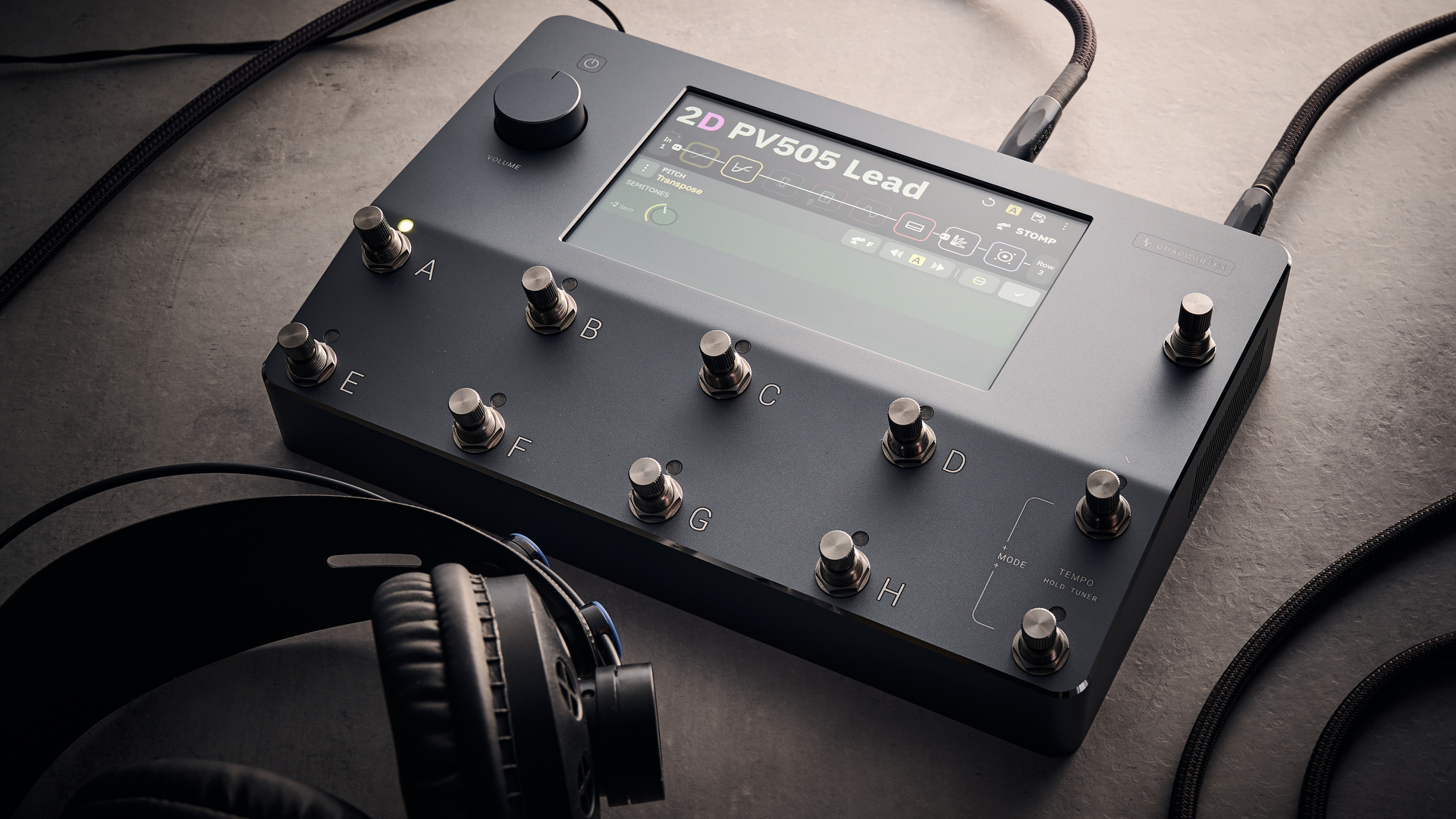

A pedalboard can become confusing fast. One box adds distortion, another adds delay, and a multi-effects unit can put dozens of virtual amps and effects under one expression pedal. The challenge is finding the unit that matches how you actually play, rather than buying a long list of sounds you never use.
Our Best guitar effects pedals picks range from compact single effects to full multi-effects processors, with one guitar effects book included for players who need to understand signal chains before building a board. MOOER GE100 is the best all-round pick, while the rest cover heavy distortion, modulation, delay, silent practice, and deeper editing.
Comparison table
| # | Product | Award | Effects or modes | Key feature | Best for |
|---|---|---|---|---|---|
| 1 | MOOER GE100 | Best overall | 66 effects | 80 presets, 180-second looper | Players wanting one versatile floor unit |
| 2 | Zoom G1X Four | Best for practice | 71 effects | 30-second looper, 68 rhythms | Practice and songwriting |
| 3 | MOOER GE150 Pro | Best for deep editing | 170 effects | 55 amp models, 26 cab simulations | Recording and live patch control |
| 4 | Flatsons KMF-1 | Best beginner multi-effects | 77 effects | 18 amps, 18 cabinets | Players learning effects |
| 5 | AFOT Heavy Metal Distortion | Best for metal EQ control | Distortion | Three-section EQ, boost control | Metal, rock, and punk |
| 6 | Donner Yellow Fall | Best compact delay | Analog delay | 20ms to 620ms delay time | Vintage-style repeats |
| 7 | LEKATO Cube Baby | Best for silent practice | Multi-effects | 9 amps, 8 IR cabinets | Headphones and mobile recording |
| 8 | FLAMMA FC05 | Best modulation variety | 11 effects | Chorus, flanger, phaser, tremolo | Expanding a compact board |
| 9 | Guitar Pedals Mastering Guide | Best learning companion | Guitar effects guide | Signal-chain instruction | New pedalboard owners |
| 10 | IOppWin Holy War | Best mini metal pedal | Three distortion modes | Low and high boost | Tight pedalboards |
1. MOOER GE100: Best Overall

Pros
- 66 effect types cover the main sounds most players need
- 80 factory presets and 80 user patches
- 180-second looper and built-in drum machine
- Assignable expression pedal control
Cons
- Smaller preset and amp-model library than the GE150 Pro
- The standard unit is not described as battery powered
- Its many options can take time to organize
Best for: guitarists who want one approachable unit for practice, experimentation, and basic performance.
The MOOER GE100 is the pedal we would hand to the widest range of guitarists. It gives you enough room to explore without immediately turning the experience into a software-management project. The controls are arranged around a screen and physical knobs, and saving a tone is a straightforward matter of choosing a patch and pressing the save control.
Its 66 effect types are arranged across eight effect modules, so the GE100 can cover the usual clean, drive, modulation, delay, and ambience duties in a single floor unit. The 80 factory patches provide a starting point, while 80 user patches leave space for sounds you shape yourself. That split matters because a multi-effects pedal is most useful once the factory sounds become raw material rather than a permanent menu.
The built-in expression pedal supports six assignable parameters. That gives the GE100 more movement than a collection of static presets, especially for volume changes or a parameter that needs to shift while you play. Its 180-second looper and drum machine also make it a practical practice station. The scale and chord learning functions are an unusual extra for a floor processor and may help newer players spend more time playing than searching for another app.
The Zoom G1X Four offers more listed effects and rhythm patterns, while the MOOER GE150 Pro is the clear step up for amp modeling, cabinet simulation, and live control. The GE100 wins by staying less intimidating and still offering substantial control. Its weakness is that players chasing modern impulse-response workflows or a larger amp library will outgrow it. For everyone else, it is the most balanced entry into multi-effects.
2. Zoom G1X Four: Best for Practice

Pros
- 71 effects and 13 amp models
- 68 built-in rhythm patterns
- 30-second looper for short ideas
- Aux input and headphone monitoring
- Guitar Lab editing support
Cons
- Its looper is shorter than the GE100's
- Fewer amp models than the GE150 Pro
- The feature set is aimed more at practice than deep live routing
Best for: players who want rhythms, looping, and headphone practice in one familiar floor processor.
The Zoom G1X Four feels purpose-built for the player who wants to pick up a guitar and start working on a part. The expression pedal is already part of the design, and the pedal includes an aux connection for external audio. That makes it easy to play along with a backing track while monitoring through headphones or an amplifier.
Zoom gives the G1X Four 71 effects and 13 amp models. The number is useful because it covers a broad range of sounds, but the more important feature is how the unit supports practice around those sounds. Its 68 rhythm patterns can keep timing honest, and the 30-second looper is enough for a riff, chord progression, or short soloing exercise.
The G1X Four also works with Zoom Guitar Lab on Mac and Windows. That lets you edit patches and build tones with a computer instead of doing every adjustment from the floor. The tradeoff is focus. Compared with the MOOER GE100, the Zoom has a shorter looper, though it brings a larger listed effects count and more rhythm patterns. The MOOER GE150 Pro is the better fit for complex performance control and recording connections.
This is not the pick for someone who wants extensive cabinet and impulse-response management. It is better for a guitarist who values a quick practice setup, repeatable rhythm support, and a built-in expression pedal. If that sounds like your routine, the G1X Four keeps the useful parts close at hand.
3. MOOER GE150 Pro: Best for Deep Editing
Pros
- 170 effects and 200 factory presets
- 55 amp models and 26 cabinet simulations
- 20 amp sample slots and 20 cabinet slots
- Four multi-purpose footswitches
- USB-C, OTG, aux, headphone, and stereo output connections
Cons
- Larger and heavier than the compact pedals here
- More complicated than the GE100
- The standard version is mains powered
Best for: players who need broad amp modeling, detailed patch control, and practical recording connections.
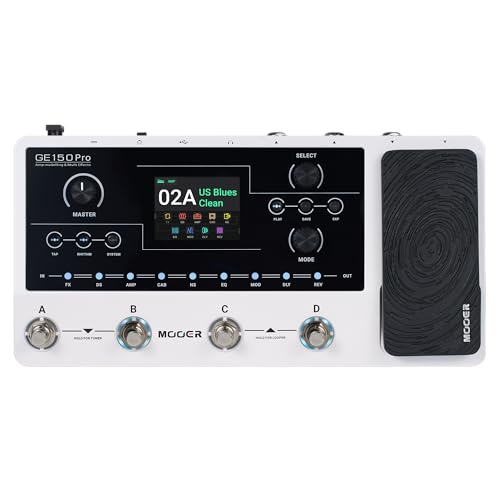
The MOOER GE150 Pro is the serious multi-effects option in this group. It has four multi-purpose footswitches rather than asking you to navigate everything through a small control layout, and the expression pedal can handle effect parameters or output volume. That makes it more suitable for a set where switching and control need to happen without stopping the song.
The numbers tell you where this unit separates itself. There are 200 factory presets, 170 effects, 55 amp preamps, and 26 cabinet simulations. The amp and cabinet sections support MNRS sample files, with 20 slots available for each area described in the product information. For players who already know the kind of amp response they want, that flexibility is more useful than simply having another page of generic effects.
The GE150 Pro also works as a compact practice and recording hub. Its 80-second stereo looper, 40 drum rhythms, and 10 metronome modes are controlled through the footswitches. USB-C handles computer editing, data management, and firmware updates, while OTG connectivity supports recording and playback with a phone. Stereo quarter-inch outputs, an auxiliary input, and a headphone output round out the connection set.
The MOOER GE100 is easier to approach, and the Zoom G1X Four is a simpler practice companion. The GE150 Pro beats both for patch depth and foot control, but its larger 12.2-inch by 12.2-inch footprint and 2.43-pound weight make it less appealing for a tiny board. Choose it when modeling, live switching, or phone recording matters more than compactness.
4. Flatsons KMF-1: Best Beginner Multi-Effects

Pros
- 77 effects across eight modules
- 18 amp models and 18 cabinet simulators
- Stomp Mode with five independent effect blocks
- 30-second looper and 42 drum rhythms
- Battery compartment supports up to 2.5 hours of use
Cons
- Six AA batteries are a relatively old-fashioned power option
- Smaller preset library than the GE100 and GE150 Pro
- The 2.56-pound body is not especially light
Best for: newer guitarists who want to learn individual effect blocks as well as complete presets.
The Flatsons KMF-1 makes a strong case for players who want to understand what a multi-effects pedal is doing. Its Stomp Mode presents five independent effect blocks that can be enabled and sequenced, which is closer to working with separate pedals than simply scrolling through finished patches. The clear 128 by 32 LCD is also intended to give more immediate feedback while editing.
There are 77 effects across amplifier, cabinet, drive, modulation, delay, dynamics, reverb, and filter modules. The KMF-1 lists 18 amp models and 18 cabinet simulators, giving it a useful middle position between the GE100 and the GE150 Pro. Its 50 preset patches are enough to get started, and Edit Mode allows the player to adjust individual parameters rather than accepting a preset as fixed.
Practice features are well covered. The 30-second looper pairs with 42 drum rhythms, and an aux input lets you play along with a phone. The expression pedal supports six assignable effects. The product information also calls out 32-bit signal processing, TSAC analog-circuit simulation, and 512-point IR sampling, though the unit is still less expansive in its loading and connection options than the GE150 Pro.
The unusual compromise is power. The battery compartment uses six AA batteries and is described as providing up to 2.5 hours of use. That can be useful away from an outlet, but it is not as convenient as a rechargeable design. The LEKATO Cube Baby is a better silent-practice choice, while the KMF-1 is better for someone who wants to learn how patches are built.
5. AFOT Heavy Metal Distortion: Best for Metal EQ Control

Pros
- Separate treble, mid, and bass controls
- Boost and distortion controls
- Designed for metal, rock, and punk tones
- True bypass switching
- Earphone-compatible output is identified in the product title
Cons
- Power adapter is not included
- It is a specialist distortion pedal, not a general effects unit
- The available information does not specify a battery option
Best for: guitarists who want hands-on high-gain shaping rather than a multi-effects menu.
The AFOT Heavy Metal Distortion is aimed at one job and gives that job more control than its simple format might suggest. Six rotary controls cover treble, mid, bass, boost, volume, and distortion. That three-section EQ is the main reason to consider it over a basic one-knob-heavy distortion pedal.
The separate mid control matters for metal and hard rock because it lets you decide whether the guitar sits forward in a mix or takes on a more scooped character. The boost control adds another way to shape the attack and level before the distortion does its work. AFOT describes the unit as covering tones from heavy blues and hard rock through high-gain metal and punk, so it is not limited to one extreme setting.
True bypass is intended to keep the signal path transparent when the effect is off. The title also identifies an earphone-usable output, which may appeal to players looking for a more private setup. There is no power adapter included, so the pedalboard needs a suitable power arrangement before it is ready to use.
The AFOT is more direct than the MOOER GE100, but it cannot replace the GE100's delay, modulation, looping, and amp-modeling functions. The IOppWin Holy War is smaller and offers three distortion modes, while AFOT gives you more direct EQ control. Skip this one if you need several effect types. Choose it when high-gain tone shaping is the center of your board.
6. Donner Yellow Fall: Best Compact Delay

Pros
- Warm analog-style delay character
- Delay time from 20ms to 620ms
- Adjustable delay level and feedback
- Compact aluminum-alloy housing
- True bypass
Cons
- Power supply is not included
- It provides delay only
- Less flexible than a digital multi-effects processor
Best for: players who want a small, straightforward delay with vintage-style repeats.
The Donner Yellow Fall is refreshingly clear about its purpose. It is an analog delay pedal with three useful controls: delay time, delay level, and feedback. You do not need to browse patches or learn a new editing system. Set the repeat time, decide how prominent it should be, and adjust how long the echoes continue.
Its delay range runs from 20ms to 620ms. The short end can add a tight slapback feel, while the longer settings are suited to spacious lead lines and rhythmic repeats. Donner describes the sound as warm and natural, which makes this a better match for players who want delay to blend into the guitar rather than sound clinically separate.
The mini format measures 3.7 inches long, 1.7 inches wide, and 2 inches high in the supplied product information. Its aluminum-alloy housing is designed for pedalboard use, and true bypass keeps the effect out of the signal path when switched off. A 9V DC power supply is required and is not included.
This pedal is far less versatile than the FLAMMA FC05 or any of the multi-effects units here, but that is also its strength. The controls make sense immediately, and the compact enclosure leaves room for other effects. If your board already has distortion and modulation but lacks a dependable echo, the Yellow Fall is the focused choice.
7. LEKATO Cube Baby: Best for Silent Practice

Pros
- Nine amp models and eight IR cabinets
- Loads or deletes third-party IR files
- Built-in rechargeable battery
- Six to eight hours of stated operating time
- Bluetooth 5.0 and 3.5mm headphone output
Cons
- Only three presets can be switched in Preset mode
- Its effect selection is narrower than the GE100 and GE150 Pro
- IR software is downloaded separately from LEKATO
Best for: guitarists who want headphones, backing tracks, and mobile recording in a small rechargeable unit.
The LEKATO Cube Baby is the most convenient pick for quiet practice. Its built-in battery is described as taking two hours to charge and running for six to eight hours. It can charge from a power bank or phone adapter, and it supports charging while working, so the unit does not have to be treated like a disposable practice accessory.
Its core modeling system includes nine amp preamps and eight IR cabinets. LEKATO also supports importing or deleting third-party IR files, with eight third-party IR slots described in the product information. The required Cube-Suite software comes from LEKATO's official website, which adds a computer step but gives the pedal more room to grow than its small body suggests.
The Cube Baby supports Preset, Edit, and Live modes. It arrives with Lead, Rhythm, and Clean preset modes, and those can be replaced with user-created sounds. Bluetooth 5.0 handles music playback for accompaniment, while the 3.5mm headphone output supports quiet monitoring. PC and phone recording are also supported with the included cable.
The Zoom G1X Four is the better practice pick for rhythm patterns and a longer effects list, but the LEKATO is more convenient when silence and portability matter. Its limitation is live control, since the Preset mode switches among three presets. If you are building a larger stage board, choose a unit with more footswitch control. For home practice and quick phone recordings, the Cube Baby is unusually well suited.
8. FLAMMA FC05: Best Modulation Variety

Pros
- 11 modulation effects in one compact pedal
- Includes chorus, flanger, tremolo, phaser, and vibrato
- Adds rotary, auto wah, stutter, ring, and low-bit effects
- Full metal shell
- Small pedalboard footprint
Cons
- Power supply is not included
- It does not include delay, distortion, or reverb
- The product information does not describe preset storage
Best for: players who want to add several modulation colors without filling a board with individual pedals.
The FLAMMA FC05 is the specialist pedal for the guitarist who already has the basics and wants more movement in the sound. It puts 11 modulation effects into one compact enclosure, from familiar chorus and phaser to less routine choices such as ring, low-bit, stutter, and rotary effects.
That selection makes the FC05 more interesting than a standard chorus pedal. Chorus and vibrato can add width and motion to clean parts, while tremolo handles rhythmic volume pulses. Flanger and phaser create more pronounced sweeps. The auto wah, ring, and low-bit settings move into more stylized territory, which is useful for experimental parts and occasional texture.
The full metal shell should stand up better to regular pedalboard use than a lightweight plastic enclosure. The supplied dimensions are 3.2 inches wide, 1.9 inches long, and 2 inches high, with a listed weight of about 0.42 pounds. It requires a 9V, 150mA power supply, and that supply is not included.
The FC05 does not try to replace the Donner Yellow Fall or AFOT Heavy Metal Distortion. It complements them. If you need one first pedal, a multi-effects unit will cover more fundamental sounds. If your board already has drive and delay, the FC05 is a tidy way to explore a much wider modulation palette.
9. Guitar Pedals Mastering Guide: Best Learning Companion

Pros
- Focuses on using pedals and chaining effects
- Useful alongside a first pedalboard
- Covers tone-building concepts rather than one hardware platform
- Compact book format
Cons
- It is a book, not a guitar pedal
- The supplied product data does not list chapter details
- It cannot create or process an effect on its own
Best for: players who need help understanding pedal order, combinations, and guitar tone.
The Guitar Pedals Mastering Guide is the outlier in this roundup, but it addresses a problem that hardware alone cannot solve. A player can own distortion, delay, modulation, and reverb and still struggle to make them work together. A guide focused on using pedals and chaining effects can provide the missing framework.
That makes it a natural companion to the MOOER GE100 or Zoom G1X Four, especially for someone who keeps changing patches without understanding why one combination feels crowded or dull. The book's title identifies its focus as mastering guitar effects, using pedals, and arranging chains to develop a desired tone.
There are no hardware features to compare here, and the supplied data does not provide a chapter list or technical contents. Its role is educational rather than performative. It cannot replace a delay pedal, distortion unit, or multi-effects processor, but it can make those purchases more useful by giving the player a clearer way to think about signal order and tone shaping.
Players who want a physical pedal should skip this listing and choose one of the nine hardware products. Players who already have a few pedals but use them mostly by trial and error may get more from this guide than another effect with an unfamiliar control layout. It also pairs well with ways to arrange effects for a more usable signal chain.
10. IOppWin Holy War: Best Mini Metal Pedal

Pros
- Three distortion modes
- Low boost, high boost, and bypass options
- True bypass
- Metal casing
- Small footprint and low 20mA draw
Cons
- Power adapter is not included
- It offers less EQ control than the AFOT
- It is dedicated to distortion
Best for: guitarists who want a small high-gain pedal with selectable boost character.
The IOppWin Holy War takes a compact approach to metal distortion. Rather than offering the AFOT's six control knobs, it uses three modes: low boost, high boost, and bypass. That makes it faster to switch between tonal directions, though it gives you less opportunity to fine-tune the midrange and overall EQ.
True bypass is intended to preserve the guitar's natural tone when the pedal is off. The metal casing is designed for touring use, and the listed 20mA draw should be easy to account for on a powered pedalboard. Its compact format is useful when the board has room for one more specialized effect but not for a full-size enclosure.
The Holy War requires 9V power, and the adapter is not included. Its dimensions are listed as 3.6 inches high, 1.9 inches long, and 1.25 inches wide, with a weight of about 0.44 pounds. Those measurements make it one of the easier choices here to fit around larger switches and power connections.
The AFOT Heavy Metal Distortion is the stronger option when EQ shaping and a broad range from blues to metal matter. The Holy War is better when you want a simpler three-mode design and a small metal pedal. It should not be your only effect unless distortion is all you need, but it is a sensible focused addition for a compact high-gain board.
How to choose best guitar effects pedals
Start with the kind of control you want under your foot. A single-effect pedal is faster to understand, while a multi-effects processor can replace several boxes but asks more from its editing system.
Effect coverage
Decide whether you need one sound or a complete rig. The Donner Yellow Fall handles delay alone, and the FLAMMA FC05 concentrates on modulation. Multi-effects units such as the GE100, G1X Four, KMF-1, and GE150 Pro cover several modules in one enclosure.
A broad effect count is useful only when the navigation and editing make sense to you. Look for the specific effects you use most, not just the largest number printed in a product title.
Amp and cabinet modeling
Amp models shape the basic character of a multi-effects patch, while cabinet simulations affect how that modeled sound reaches headphones, recording equipment, or a full-range speaker. The GE150 Pro has 55 amp models and 26 cabinet simulations, while the KMF-1 lists 18 of each and the LEKATO lists nine amp models with eight IR cabinets.
Cabinet simulation is especially important when connecting directly to headphones or recording gear. A real guitar cabinet and a modeled cabinet are not interchangeable in the signal chain, so check how the pedal is intended to connect before choosing a patch.
Looper and rhythm tools
A looper is valuable for chord practice, songwriting, and soloing over a repeated part. The GE100 provides a 180-second looper, the GE150 Pro provides an 80-second stereo looper, and the Zoom and KMF-1 provide 30-second loopers.
Rhythm support changes the practice experience. The Zoom has 68 rhythm patterns, the KMF-1 has 42, and the GE150 Pro includes 40 rhythms plus 10 metronome modes. Choose based on whether you need quick practice accompaniment or a longer layer for developing arrangements.
The most useful pedal is the one whose core sound you can reach before the idea disappears.
Foot control and expression
Expression pedals can control volume, wah-like effects, or another assignable parameter while both hands stay on the guitar. The GE100 offers six assignable expression parameters, the KMF-1 supports six assignable effects, and the GE150 Pro adds four multi-purpose footswitches with expression and volume control.
For live playing, look beyond the effect count. More footswitches and clearer preset switching can matter more than another page of sounds.
Power and connections
Power requirements affect how easily a pedal fits into a board. The Donner Yellow Fall, FLAMMA FC05, AFOT, and Holy War do not include their required power adapters. The LEKATO uses a rechargeable battery and can run while charging, while the KMF-1 uses six AA batteries for up to 2.5 hours as described in its listing.
Check connections too. Headphone outputs favor quiet practice, aux inputs allow backing tracks, and USB or OTG connections help with recording and editing. The right amplifier setup for a pedalboard can matter just as much as the pedal itself, especially when deciding between cabinet simulation and a traditional guitar amp.
Frequently asked questions
Should I buy a multi-effects pedal or individual pedals?
Choose a multi-effects pedal if you want several sounds, built-in practice tools, or amp and cabinet modeling in one unit. Individual pedals are easier to understand and can make sense when you already know the exact delay, distortion, or modulation sound you want.
Which pedal is easiest for a beginner?
The MOOER GE100 is the most balanced beginner choice because it includes 66 effects, 80 factory patches, 80 user patches, a looper, and a drum machine without reaching the GE150 Pro's level of complexity. The Flatsons KMF-1 is also useful for beginners who want to learn how separate effect blocks work.
Which pick is best for silent guitar practice?
The LEKATO Cube Baby is the clearest fit because it has a 3.5mm headphone output, Bluetooth playback, a rechargeable battery, and phone or computer recording support. The Zoom G1X Four is another strong option with aux input and headphone monitoring.
Do these pedals include a power adapter?
Not all of them. The AFOT Heavy Metal Distortion, Donner Yellow Fall, FLAMMA FC05, and IOppWin Holy War listings specifically state that a power adapter is not included. The LEKATO has a built-in rechargeable battery, while the Flatsons KMF-1 lists a six-AA battery compartment.
What is the difference between delay and modulation?
Delay repeats the guitar signal after a set time, creating echoes or slapback. Modulation changes a property of the sound over time, producing effects such as chorus, flanger, tremolo, phaser, or vibrato.
Can I use a multi-effects pedal with headphones?
Several picks support headphone practice. The Zoom G1X Four, MOOER GE150 Pro, Flatsons KMF-1, and LEKATO Cube Baby list headphone or monitoring connections, though the exact connection type differs by product.
Do I need cabinet simulation for recording?
Cabinet simulation is useful when a modeled amp is sent directly to headphones, recording equipment, or a full-range speaker. If the pedal feeds a real guitar cabinet through an appropriate amplifier setup, cabinet simulation may need to be disabled to avoid layering two cabinet responses.
The bottom line
The Best guitar effects pedals choice for most players is the MOOER GE100. Its 66 effects, 80 factory patches, 80 user patches, expression control, looper, and drum machine cover practice and everyday experimentation without the deeper setup demands of the GE150 Pro.
Choose the MOOER GE150 Pro when amp modeling, cabinet simulation, four-switch control, USB-C editing, OTG recording, and a larger preset library are central to your setup. For a focused board, the Donner Yellow Fall handles delay cleanly, the FLAMMA FC05 expands modulation, and the AFOT or IOppWin pedals cover metal distortion.
If you are undecided, choose the GE100 for broad use, or choose the LEKATO Cube Baby when headphones and rechargeable practice matter most.
As an Amazon Associate we earn from qualifying purchases.