

A fish finder has one job: turn an unhelpful patch of water into something you can interpret. The hard part is choosing the right kind of information. A compact screen with traditional CHIRP sonar may be perfect for a small boat, while a larger display with side imaging or live sonar can show structure and fish movement in much greater detail.
We compared ten Garmin, Humminbird, and Lowrance units, looking at sonar coverage, mapping, screen controls, and the practical differences between their included transducers. The Garmin Striker 4 is our top pick for straightforward fishing electronics, while the rest of the lineup covers larger displays, richer imaging, and live sonar.
Comparison table
| # | Product | Award | Screen | Sonar and mapping | Best for |
|---|---|---|---|---|---|
| 1 | Garmin Striker 4 | Best overall | 3.5-inch | CHIRP, ClearVü, GPS waypoint map | Small boats and simple setups |
| 2 | Garmin Striker Vivid 4cv | Best compact color unit | 4-inch | CHIRP, ClearVü, Quickdraw Contours | Easy scanning sonar |
| 3 | Garmin Striker Vivid 7cv | Best large Garmin value | 7-inch | CHIRP, ClearVü, GPS, Wi-Fi | Bigger screen and navigation |
| 4 | Humminbird Helix 5 G3 | Best for mapping | 5-inch | Dual Spectrum CHIRP, AutoChart Live | Lake anglers building maps |
| 5 | Humminbird XPLORE 9 | Best touchscreen | 9-inch | MEGA Side Imaging+, Down Imaging+, GPS | Detailed charting and imaging |
| 6 | Garmin Striker Vivid 7sv | Best Garmin imaging | 7-inch | CHIRP, ClearVü, SideVü, GPS | Side-scanning from a Garmin |
| 7 | Humminbird Helix 7 G4 | Best keypad-controlled imaging | 7-inch | MEGA Side and Down Imaging, CHIRP | All-weather controls |
| 8 | Humminbird XPLORE 10 | Best large-screen Humminbird | 10-inch | MEGA Side Imaging+, Down Imaging+, GPS | Maximum viewing area |
| 9 | Humminbird Helix 5 G3 Down Imaging | Best compact down imaging | 5-inch | Dual Spectrum CHIRP, Down Imaging | Clearer views beneath the boat |
| 10 | Lowrance Eagle Eye 9 | Best live sonar | 9-inch IPS | Live Forward, Live Down, CHIRP, DownScan | Watching fish react to a lure |
1. Garmin Striker 4: Best Overall

Pros
- Dedicated buttons are easy to operate
- CHIRP improves fish-arch separation
- GPS waypoint map marks productive locations
- Built-in flasher supports ice fishing and jigging
Cons
- Small 3.5-inch screen
- Less imaging coverage than larger units
Best for: anglers who want dependable sonar and GPS in a compact, uncomplicated unit.
The Garmin Striker 4 is the unit we would choose when the goal is useful sonar without turning the console into a technology project. Its 3.5-inch display is small, but the keyed interface keeps the important functions close at hand. You can move through sonar, waypoint, and flasher views without relying on a touchscreen that may be awkward with wet fingers.
Its CHIRP sonar sends a continuous sweep of frequencies rather than relying on one narrow signal. In practical use, that helps separate nearby targets and makes fish arches easier to distinguish from clutter. ClearVü scanning sonar adds a more detailed view of objects, structure, and fish around the boat. The unit also reports depth as far as 1, 600 feet in freshwater and 750 feet in saltwater, according to the listed specifications.
GPS is the feature that makes this more than a basic depth finder. The waypoint map lets you mark brush piles, stumps, docks, and other locations, then return to them later. A built-in flasher view is useful for vertical jigging and ice fishing because it shows sonar activity in the classic real-time format. That combination gives the Striker 4 a wider range of uses than its small display suggests.
The limitation is obvious when placed beside the Garmin Striker Vivid 7cv or Humminbird Helix 7 G4. Their larger screens make split views and detailed structure easier to read, while the Striker 4 asks you to work with a much smaller image. It also lacks the broader side-scanning capability of the Garmin Striker Vivid 7sv. Skip it if you need a large chartplotter or advanced imaging, but choose it if compact controls and clear fundamentals matter most.
2. Garmin Striker Vivid 4cv: Best Compact Color Unit

Pros
- Bright color palettes make fish and structure easier to distinguish
- Includes CHIRP and ClearVü sonar
- GPS supports waypoints, routes, and speed
- Quickdraw Contours mapping is built in
Cons
- Four-inch display still limits split-screen readability
- Not suited to anglers who need side imaging
Best for: small craft owners who want a compact color display with modern Garmin navigation features.
The Striker Vivid 4cv is the compact Garmin to pick when the Striker 4 feels too basic but a seven-inch display would be excessive. The four-inch color screen gives sonar returns more visual separation, and Garmin's vivid scanning palettes are designed to make fish and structure easier to tell apart. It remains a button-driven unit, so the learning curve is pleasantly short.
The included GT20 transducer provides traditional Garmin CHIRP sonar and CHIRP ClearVü scanning sonar. Traditional sonar is the useful general-purpose view for depth and fish arches, while ClearVü focuses on a more detailed picture of what sits below and around the boat. The difference is meaningful when you are trying to identify cover instead of merely confirming that the bottom is there.
Its high-sensitivity GPS records waypoints, creates routes, and shows boat speed. Quickdraw Contours mapping lets the unit build a map as you fish, which can turn repeated trips over an unfamiliar lake into a more informed search. The tilt and swivel bail mount also makes it easier to aim the screen at the helm or another viewing position.
Compared with the Garmin Striker 4, this model gives you a slightly larger color interface and a more polished scanning-sonar presentation. The Garmin Striker Vivid 7cv is much easier to read when several views share the screen, though, and the Striker Vivid 7sv adds SideVü support with a compatible transducer. The 4cv is the better fit for a cramped console and a buyer who wants straightforward color sonar, not a command center.
3. Garmin Striker Vivid 7cv: Best Large Garmin Value

Pros
- Seven-inch color display is easy to read
- CHIRP and ClearVü come with the GT20 transducer
- GPS and Quickdraw Contours support repeatable navigation
- Wi-Fi connects to the ActiveCaptain app
Cons
- No SideVü scanning
- Larger body needs more console space
Best for: boat owners who want a readable Garmin screen and GPS mapping without moving into the Striker 7sv.
The Striker Vivid 7cv is a substantial step up from Garmin's compact models because the seven-inch display gives sonar and map views room to breathe. A larger screen matters most when you want to watch depth, fish returns, and navigation information without squinting or constantly changing pages. The interface stays intentionally simple, with a tilt and swivel bail mount for positioning at the helm.
The GT20 transducer supplies Garmin CHIRP traditional sonar and CHIRP ClearVü scanning sonar. The first is the dependable view for water depth and fish targets, while ClearVü gives structure a more recognizable shape. Garmin's vivid color palettes are useful here because the extra screen area makes differences in the returns easier to inspect.
The high-sensitivity GPS supports waypoints, routes, and boat-speed information. Built-in Quickdraw Contours mapping can record the contours of the water you fish. Wi-Fi adds a connection to the ActiveCaptain app, where compatible phones can transfer waypoints, receive smart notifications, and access the Garmin Quickdraw Community. That makes this more flexible than the smaller Striker Vivid 4cv.
The trade-off is that the 7cv does not provide SideVü scanning. The Garmin Striker Vivid 7sv is the obvious upgrade if finding structure to the sides of the boat is central to your approach. The Humminbird Helix 7 G4 also offers side and down imaging, but its keypad-focused workflow feels more traditional. Pick the 7cv for a clear, easy Garmin system, and skip it only if side coverage is a priority.
4. Humminbird Helix 5 G3: Best for Mapping

Pros
- Dual Spectrum CHIRP has wide and narrow modes
- Basemap covers more than 10, 000 lakes
- AutoChart Live records contours, hardness, and vegetation
- Keypad works well in changing weather
Cons
- Five-inch screen is less spacious than the larger models
- Does not include side or down imaging in this version
Best for: freshwater anglers who care about mapping and precise CHIRP target separation.
The Helix 5 G3 has a different personality from the Garmin Striker models. It is built around methodical sonar interpretation and mapping rather than an especially minimal interface. The five-inch display is a sensible middle ground, and the softkey controls give you physical access to settings when the boat is moving or conditions are wet.
Humminbird's Dual Spectrum CHIRP sonar offers Wide Mode for maximum coverage and Narrow Mode for more detailed scanning. The included Low-Q transducer is designed for precise target separation, which helps when fish and structure appear close together on the screen. It is a strong fit for anglers who want to study fish arches and bottom features rather than simply check depth.
The mapping features are the standout. Humminbird Basemap includes coverage of more than 10, 000 lakes and continental U.S. coastlines, and the unit is compatible with LakeMaster, CoastMaster, and Navionics charts. AutoChart Live can create maps of depth contours, bottom hardness, and vegetation while you move, with eight hours of built-in recording time. For anglers who return to the same water repeatedly, that information can be more useful than a larger screen.
The Helix 5 G3 loses ground to the Helix 5 G3 Down Imaging when you want a clearer picture directly beneath the boat. The Garmin Striker Vivid 7cv is easier to read from a distance, but it does not match this Humminbird's mapping emphasis. If navigation and custom lake knowledge are central to your fishing, this is the Helix to choose. For a broader look at boat-specific setups, the equipment choices that matter on a fishing boat are worth considering before installation.
5. Humminbird XPLORE 9: Best Touchscreen

Pros
- Nine-inch HD touchscreen has 1280 by 720 resolution
- MEGA Side Imaging+ reaches 200 feet on each side
- Dual control uses touchscreen and keypad input
- Includes LakeMaster and CoastMaster VX map card
Cons
- Larger unit demands more mounting space
- Advanced functions take longer to learn
Best for: anglers who want detailed side imaging, charting, and flexible screen control in one unit.
The XPLORE 9 is the first model here that feels like a serious information hub rather than a compact sonar display. Its nine-inch HD screen has a 1280 by 720 resolution, giving maps and imaging views enough room to remain useful when displayed together. The touchscreen is convenient for navigation and adjustments, while the physical keypad provides a reliable alternative when the boat is moving.
MEGA Side Imaging+ covers 200 feet on each side of the boat, and MEGA Down Imaging+ reaches 200 feet below it. Those ranges give you a much wider search area than the Garmin Striker Vivid 7cv, which is limited to traditional CHIRP and ClearVü with its included GT20 transducer. Dual Spectrum CHIRP remains available for conventional fish detection, with Wide and Narrow modes for coverage or detail.
GPS navigation is backed by Humminbird Basemap, plus a LakeMaster and CoastMaster VX map card covering U.S. and Canadian regions. AutoChart Live creates maps of contours, bottom hardness, and vegetation, and the unit has eight hours of built-in recording time. Ethernet, Bluetooth, and NMEA 2000 compatibility make it a more natural fit for a boat with other connected equipment.
The XPLORE 10 offers the same core imaging and mapping features with a ten-inch screen, so the XPLORE 9 is the more manageable choice when console space is limited. The Lowrance Eagle Eye 9 is more compelling for live forward and down views, but its sonar approach is different. Choose the XPLORE 9 if side imaging and charting are your main tools, and avoid it if you prefer simple buttons and a small learning curve.
6. Garmin Striker Vivid 7sv: Best Garmin Imaging

Pros
- Seven-inch display is easy to use at the helm
- Supports CHIRP, ClearVü, and SideVü
- Includes the GT52HW-TM transducer
- Wi-Fi and ActiveCaptain add connected features
Cons
- SideVü requires the compatible transducer included here
- Less expansive mapping hardware than the XPLORE units
Best for: Garmin users who want side imaging without giving up a simple keyed interface.
The Striker Vivid 7sv is the Garmin model to buy when the difference between seeing below the boat and searching beside it matters. Its seven-inch color display is large enough for useful imaging views, but the controls remain approachable. This is not a unit that forces you into a touch-first workflow, which many anglers will appreciate when operating it from a moving boat.
The included GT52HW-TM transducer supports Garmin CHIRP traditional sonar, CHIRP ClearVü, and CHIRP SideVü. Traditional sonar handles fish arches and depth, ClearVü provides a more detailed downward view, and SideVü expands the search area to either side. Garmin's vivid palettes help distinguish fish and structure across these scanning views.
GPS marks waypoints, builds routes, and reports boat speed. Quickdraw Contours mapping records the shape of the water as you fish, and Wi-Fi connects the unit to the ActiveCaptain app for waypoint transfers, smart notifications, software updates, and access to the Quickdraw Community. It is a well-rounded combination for anglers already using Garmin navigation tools.
The Garmin Striker Vivid 7cv is simpler and may be preferable if you do not need side coverage. The Humminbird Helix 7 G4 provides its own side and down imaging, along with a mapping ecosystem that some lake anglers may prefer. The 7sv's weakness is that it does not have the larger, more advanced presentation of the Humminbird XPLORE 9. Pick it for accessible Garmin imaging, not for the deepest chartplotter feature set.
7. Humminbird Helix 7 G4: Best Keypad-Controlled Imaging

Pros
- MEGA Side and Down Imaging cover 125 feet
- Seven-inch display gives imaging room to breathe
- Dual Spectrum CHIRP supports wide and narrow searches
- Keypad control works in poor weather
Cons
- No touchscreen interface
- More involved than a basic Garmin fish finder
Best for: anglers who want detailed side and down imaging with physical controls.
The Helix 7 G4 is a good reminder that a touchscreen is not the only path to a modern fish finder. Its seven-inch display pairs with softkey controls, giving you a physical way to work through menus and preloaded views. That is particularly useful when glare, spray, or gloves make touch controls less appealing.
MEGA Side and Down Imaging shows fish, structure, and contours up to 125 feet on either side and directly beneath the boat. Humminbird says the MEGA system provides three times more detail than standard imaging sonar. The practical advantage is a more informative view when you are searching for cover or trying to understand what sits beneath a particular waypoint.
Dual Spectrum CHIRP adds a conventional sonar view with Wide Mode for coverage and Narrow Mode for detail. The Low-Q transducer is intended to improve target separation, so this is not just an imaging unit. Humminbird Basemap covers more than 10, 000 lakes and continental U.S. coastlines, while AutoChart Live records contours, bottom hardness, and vegetation with eight hours of built-in recording.
Compared with the Garmin Striker Vivid 7sv, the Helix 7 G4 offers a more mapping-centered Humminbird experience and a different control layout. The XPLORE 9 has a sharper HD touchscreen and 200-foot side-imaging range, but it is physically larger and more elaborate. The Helix 7 G4 is the better fit for someone who wants substantial imaging without depending on touch controls.
8. Humminbird XPLORE 10: Best Large-Screen Humminbird

Pros
- Ten-inch HD screen provides the largest view here
- MEGA Side Imaging+ reaches 200 feet per side
- Touchscreen and keypad controls work together
- Ethernet, Bluetooth, and NMEA 2000 support
Cons
- Requires a generous mounting area
- More system than casual anglers may need
Best for: boat owners who want maximum screen space for sonar, charts, and connected marine equipment.
The XPLORE 10 is for the angler who dislikes choosing between sonar and a map view. Its ten-inch screen gives both a generous canvas, and the 1280 by 720 HD resolution keeps the presentation detailed. The touchscreen makes panning and menu navigation quick, while keypad controls provide a physical fallback when conditions are rough.
Its MEGA Side Imaging+ reaches 200 feet on each side, and MEGA Down Imaging+ reaches 200 feet below. That makes the XPLORE 10 particularly useful for scanning broad areas around the boat before committing to a spot. Dual Spectrum CHIRP with Wide and Narrow modes remains available for conventional target finding and more focused searches.
Mapping is equally strong. Humminbird Basemap covers more than 10, 000 lakes, and the included LakeMaster and CoastMaster VX map card covers U.S. and Canadian regions. AutoChart Live maps depth contours, bottom hardness, and vegetation with eight hours of built-in recording. Ethernet, Bluetooth, and NMEA 2000 compatibility allow it to fit into a larger marine electronics setup, including compatible Minn Kota and Cannon products.
The ten-inch screen is the XPLORE 10's defining strength and its practical weakness. It needs more room than the XPLORE 9, and the feature set can feel excessive if you mostly want depth and basic fish arches. The Lowrance Eagle Eye 9 is the more interesting alternative for live lure tracking, while the Garmin Striker 4 is far easier to install and understand. Choose this Humminbird for a large boat console and information-heavy fishing.
9. Humminbird Helix 5 G3 Down Imaging: Best Compact Down Imaging

Pros
- Down Imaging filters visual clutter below the boat
- Dual Spectrum CHIRP offers wide and narrow modes
- Basemap and AutoChart Live support navigation
- Physical controls suit wet conditions
Cons
- Five-inch display limits detailed split views
- No side imaging
Best for: anglers who want clearer views beneath a compact boat without moving to a larger display.
This Helix 5 G3 shares its basic platform with the mapping-focused Helix 5, but the addition of Down Imaging changes where it makes sense. It is aimed at anglers who want a cleaner picture directly under the boat, especially when ordinary sonar returns become visually busy. The five-inch screen keeps the unit compact while still leaving enough room for a readable sonar view.
CHIRP Down Imaging filters visual noise and clutter, while CHIRP digital sonar processing provides a more detailed image below the boat. Dual Spectrum CHIRP gives you Wide Mode for searching and Narrow Mode for a closer look at targets. That combination is more informative beneath the boat than the standard Helix 5 G3, though it does not provide the wide lateral view of the Helix 7 G4.
The navigation features remain useful. Humminbird Basemap includes coverage of more than 10, 000 lakes and continental U.S. coastlines, and the unit works with LakeMaster, CoastMaster, and Navionics charts. AutoChart Live can record depth contours, bottom hardness, and vegetation for up to eight hours of built-in recording. Keypad controls make it practical to operate without reaching for a touchscreen.
Compared with the Garmin Striker Vivid 4cv, this model is more focused on detailed downward interpretation and Humminbird mapping. The Garmin is a little more immediately approachable, while the Helix gives you more sonar modes to learn. Skip this version if side imaging is important, and step up to the Helix 7 G4 or an XPLORE model instead. For a wider look at what to carry and install around a boat, the practical gear that supports a day of fishing can help complete the setup.
10. Lowrance Eagle Eye 9: Best Live Sonar

Pros
- Live Forward and Live Down show fish reactions in real time
- One transducer provides four sonar modes
- Nine-inch IPS screen has wide viewing angles
- Preloaded C-MAP charts cover more than 17, 000 U.S. lakes
Cons
- Live sonar is more specialized than traditional scanning
- Larger display needs appropriate mounting space
Best for: anglers who want to watch fish respond to a lure rather than rely only on historical sonar trails.
The Eagle Eye 9 stands apart from the rest of this list because its headline feature is live sonar. Live Forward and Live Down views let you watch fish react to a lure in real time, which can change how you position the boat and work a presentation. This is a different style of fishing from studying a traditional sonar trail after the boat has passed over a target.
The included transducer combines four modes: Live Forward, Live Down, CHIRP sonar, and DownScan Imaging with FishReveal. That range means the Eagle Eye 9 is not limited to live views. CHIRP remains useful for conventional depth and fish information, while DownScan Imaging can provide a more recognizable picture of structure.
The nine-inch IPS display has a 1280 by 720 resolution and wide viewing angles. The listed features also emphasize visibility in bright sunlight and through polarized sunglasses, an important detail for an exposed helm. Preloaded C-MAP Inland charts cover more than 17, 000 U.S. lakes, and Genesis Live supports custom contour mapping. Autotuning sonar adjusts settings automatically, which helps keep setup from becoming a distraction.
The main weakness is specialization. The Humminbird XPLORE 9 and XPLORE 10 offer broader MEGA side-imaging and mapping ecosystems, while the Garmin Striker 4 is much simpler for basic sonar work. Choose the Eagle Eye 9 when watching lure and fish movement is the reason you are upgrading. If you primarily want to mark structure and return to mapped locations, one of the Humminbird units may suit your habits better. Anglers considering a Lowrance-centered electronics setup can also compare the navigation features that separate modern sonar units.
How to choose the best fish finder
The right fish finder depends less on the brand name than on the water you fish, the size of your boat, and how much sonar information you can usefully interpret.
Display size and controls
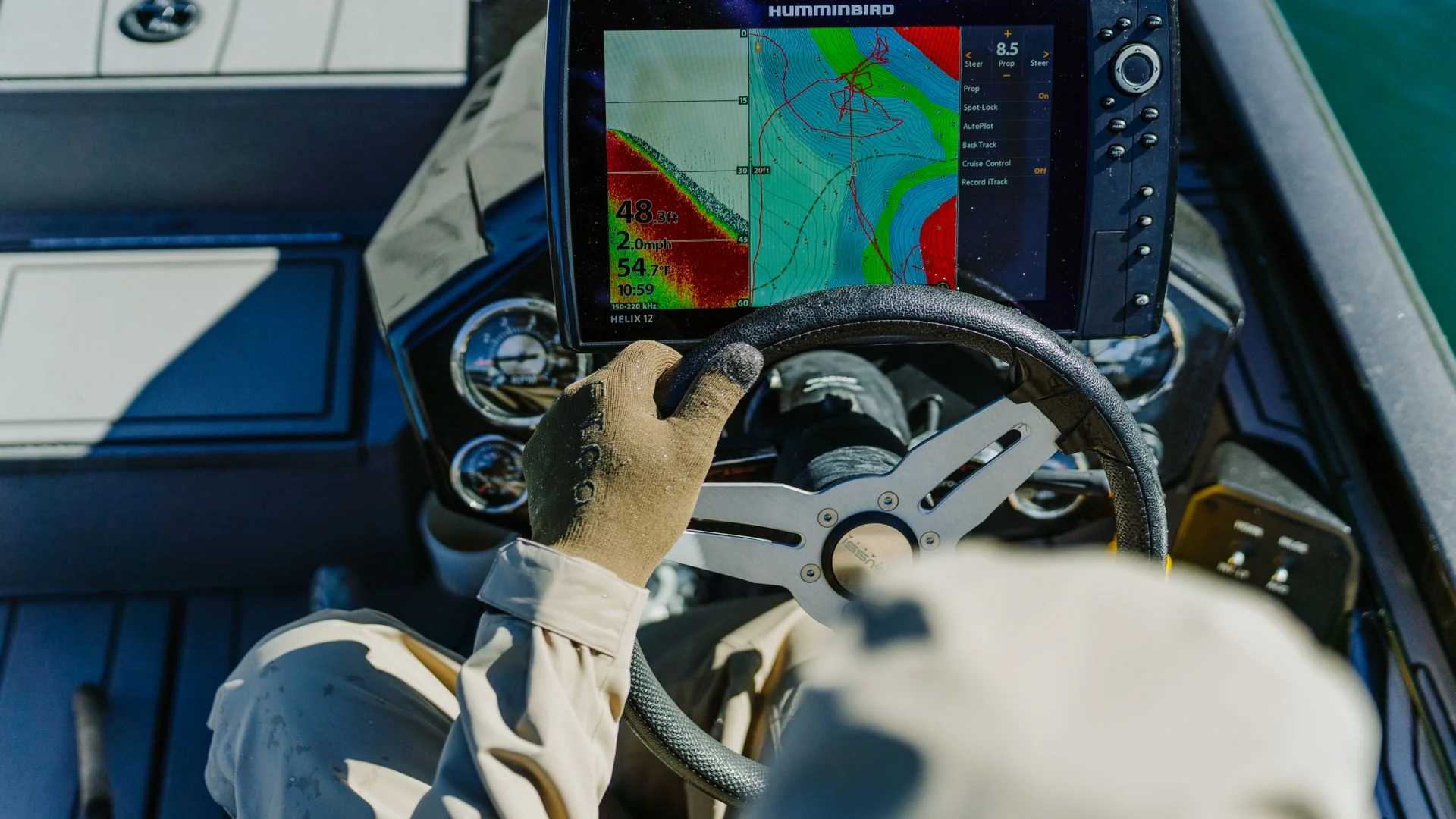
A three-and-a-half-inch or four-inch screen keeps a console compact, but it leaves little room for maps and sonar at the same time. Five inches is a workable middle ground, while seven inches and above make split views easier to read. Touchscreens are quick for panning and selecting views, but keypads remain dependable with wet hands, gloves, and spray.
Sonar type
Traditional CHIRP sonar is the foundation for reading depth, fish arches, and bottom contours. ClearVü and Down Imaging create more detailed views beneath the boat, while SideVü and MEGA Side Imaging widen the search area to either side. Live sonar is different again because it shows fish and lure movement in real time instead of primarily displaying what the boat has already passed.
Choose the sonar view that answers your fishing question, not the one with the longest feature list.
Transducer coverage
The included transducer determines which sonar modes are available. The Garmin Striker Vivid 4cv and 7cv include GT20 transducers for CHIRP and ClearVü, while the Striker Vivid 7sv includes the GT52HW-TM for SideVü as well. Humminbird and Lowrance models also pair their displays with transducers that define their imaging capabilities, so check the bundle before assuming a display supports every mode in the brand's lineup.
GPS and mapping
GPS lets you mark productive spots, create routes, and return to structure without guessing. Garmin's Quickdraw Contours and Humminbird's AutoChart Live create custom depth maps as you travel, while the Humminbird XPLORE models include LakeMaster and CoastMaster VX mapping. The Lowrance Eagle Eye 9 includes C-MAP Inland charts and Genesis Live custom contour mapping.
Installation and boat space
Measure the mounting area before choosing a display. A compact Garmin can fit where a seven-inch unit cannot, while the XPLORE 10 needs a generous console and a suitable power and network setup. Also check how the transducer will mount to the hull, transom, or trolling motor. The most capable unit is not useful if its transducer cannot sit in clean water or its screen blocks other controls.
Frequently asked questions
What is the best fish finder for a small boat?
The Garmin Striker 4 is the easiest fit for a small boat because its 3.5-inch display and keyed interface keep the installation compact. It still includes CHIRP, ClearVü, GPS waypoints, and a flasher view. Choose the Garmin Striker Vivid 4cv if you want a slightly larger color interface and Quickdraw Contours mapping.
Is CHIRP sonar better than standard sonar?
CHIRP sonar sends a continuous sweep of frequencies, which can improve target separation and produce clearer fish arches. It is useful for distinguishing nearby fish and structure, but the right transducer and display still matter. CHIRP does not replace the wider search area provided by side imaging or the real-time perspective of live sonar.
Do I need side imaging?
Side imaging is useful when you want to search structure beyond the narrow area directly beneath the boat. It can help locate cover, drop-offs, and other features before you position over them. If you mostly fish vertically or want the simplest setup, traditional CHIRP and down imaging may be enough.
Are touchscreen fish finders easier to use?
Touchscreens can make panning maps and selecting options fast, especially on the Humminbird XPLORE models. Keypad units such as the Garmin Striker 4 and Humminbird Helix series are often easier to operate when the screen is wet or your hands are gloved. The better control method is the one you can use confidently from your actual helm.
What does GPS add to a fish finder?
GPS lets you mark waypoints, create routes, track speed, and return to productive locations. Mapping features can also show existing contours or build custom maps while you travel. A fish finder with GPS is more useful for repeat trips because it preserves information about where you found structure and fish.
Is live sonar useful for every type of fishing?
Live sonar is especially useful when you want to see fish react to a lure in real time. The Lowrance Eagle Eye 9 provides Live Forward and Live Down views alongside CHIRP and DownScan Imaging. Anglers who mainly want broad charting or side imaging may prefer a Humminbird XPLORE or Helix model instead.

The bottom line
The best fish finder for most anglers is the Garmin Striker 4. It keeps the controls simple, includes useful CHIRP and ClearVü sonar, adds GPS waypoint marking, and even offers a flasher view for vertical jigging or ice fishing. Its small screen is the clear compromise, but that is easier to accept than paying for capabilities you will not use.
For larger boats and more demanding sonar work, the Humminbird XPLORE 9 is the stronger choice, with a nine-inch HD touchscreen, 200-foot MEGA side imaging, down imaging, extensive mapping, and dual touchscreen and keypad controls. The Lowrance Eagle Eye 9 is the more specialized pick for live forward and down sonar.
If you are undecided, choose the Garmin Striker 4 for simplicity, or move to the Humminbird XPLORE 9 when imaging and mapping matter more than compact installation.
As an Amazon Associate we earn from qualifying purchases.