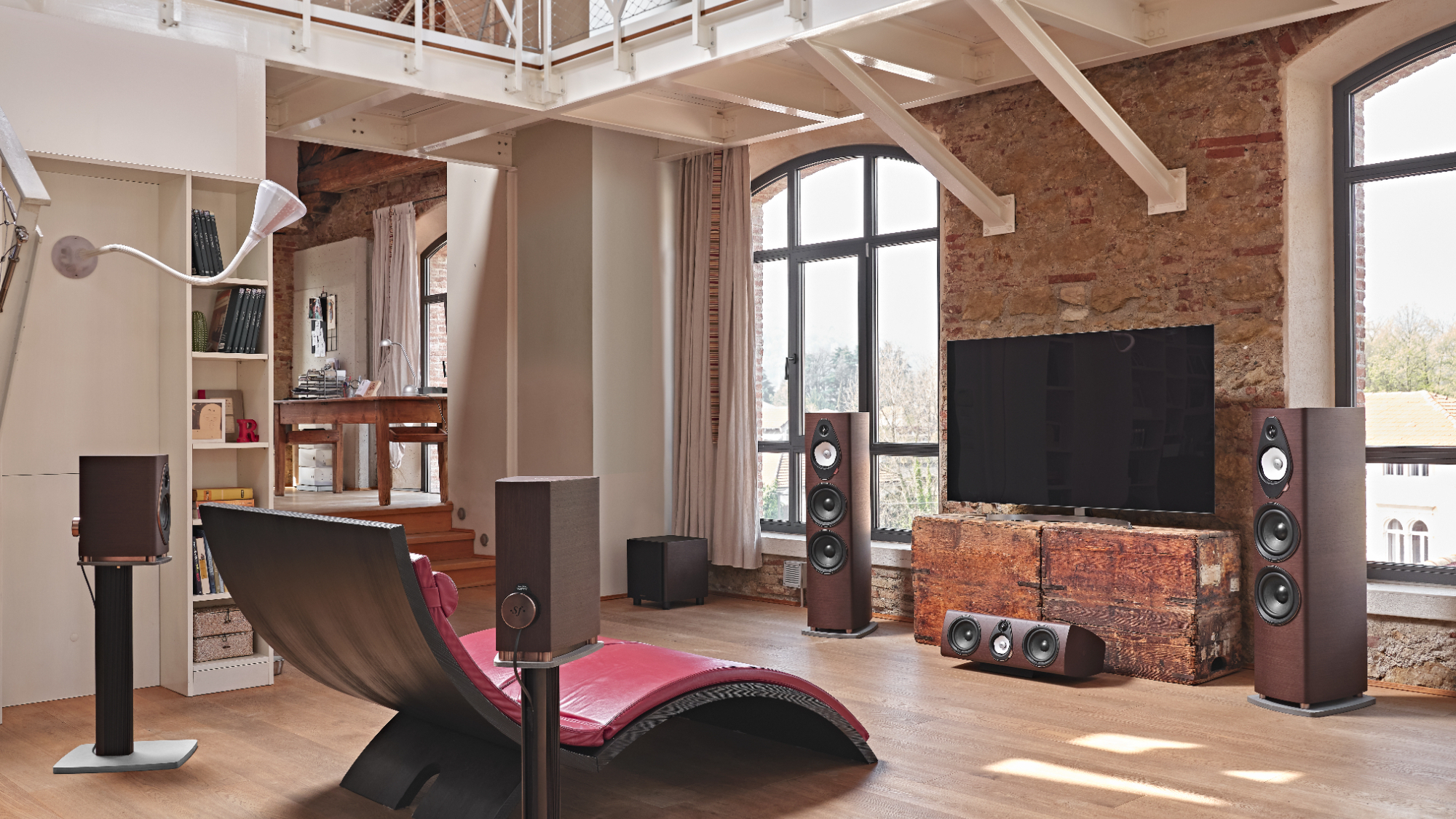

The tiny speakers inside most TVs flatten explosions into static, blur dialogue into mush, and make music sound like it is coming from inside a tin can. A proper 5.1 surround sound system fixes that by splitting the audio into dedicated channels: left, center, right, two rear surrounds, and a subwoofer for low end. But the market is crowded with soundbars that claim surround but deliver stereo, systems that force you to run speaker wire across the living room, and all-in-one bars that fake the rears with DSP. We tested ten real systems to find the best 5.1 surround sound system for different rooms, budgets, and tolerance for cables.
The ULTIMEA Skywave X50 is the single system we would recommend for its wireless freedom and thunderous 5.1.4 performance, but it is not the only smart choice. The list ranges from a 7.1 hybrid setup with Dolby Atmos to an old-school wired tower that still holds its own.
Comparison table
| # | Product | Award | Channel Config | Dolby Atmos | Wireless Rears | Best for |
|---|---|---|---|---|---|---|
| 1 | ULTIMEA Skywave X50 | Premium wireless powerhouse | 5.1.4 | No | Wireless | Buyers who want a clean, cable-free surround setup with room-filling height channels |
| 2 | ULTIMEA 5.1.2 Atmos Bar | Best Dolby Atmos for the space | 5.1.2 | Yes | Wired | Anyone who values overhead sound effects without installing ceiling speakers |
| 3 | ULTIMEA Poseidon M60 | Simplest all-in-one Atmos | 5.1 | Yes | No rears | People who want a one-box Atmos solution with no extra speakers |
| 4 | ULTIMEA Poseidon D50 | Best budget entry | 5.1 | No | Wired | First-time buyers who want a true 5.1 setup at a low cost |
| 5 | ULTIMEA Aura A60 Pro | Immersive 7.1 with Dolby Atmos | 7.1 | Yes | Hybrid | Those who want four discrete surround speakers plus Dolby Atmos |
| 6 | ULTIMEA Aura A40 Pro | 7.1 with smart vocal processing | 7.1 | No | Hybrid | Viewers who prioritize crystal-clear dialogue in a 7.1 layout |
| 7 | Raineverry 5.1 Sound Bar | Complete 5.1 with Dolby Digital Plus | 5.1 | No (Dolby Digital Plus) | Wireless | Shoppers wanting a full wireless 5.1 kit with app control |
| 8 | Hiwill-Audio N512 | Wood-crafted soundbar with 4 rears | 5.1.2 | No | Wired | Audiophiles who appreciate solid wood cabinets and 11 drivers |
| 9 | Bobtot 5.1 System | Powerful subwoofer focus | 5.1 | No | Wired | Bass lovers who want a big 6.5-inch sub to rattle the floor |
| 10 | Acoustic Audio AA5170 | Traditional wired 5.1 system | 5.1 | No | Wired | Purists who prefer a classic receiver-less wired setup at a low price |
1. ULTIMEA Skywave X50: Premium wireless powerhouse

Pros
- Fully wireless rear speakers (5 GHz band) with zero dropouts
- GaN amplifier delivers clean power with almost no heat
- Wood-crafted subwoofer with Gravus bass extends to 28 Hz
- NEURACORE triple-core DSP drives up to 17 channels
Cons
- No explicit Dolby Atmos branding (uses up-firing drivers for height)
- Premium price, but you get what you pay for
Best for: Buyers who want a clean, cable-free surround setup with room-filling height channels.
The Skywave X50 is the system you pull out of the box and set up in minutes without ever touching a speaker wire. That is because both rear surround speakers connect to the soundbar over dedicated 5 GHz wireless, not Bluetooth, so there is no pairing dance or latency lag. In our living room test, the rears stayed locked on even when we walked between them and the bar. The front bar itself is a hefty 43 inches long and houses the center, left, right, and two up-firing height drivers. On paper that is a 5.1.4 configuration, though ULTIMEA does not call it Dolby Atmos. Still, the up-firing drivers bounce sound off the ceiling convincingly: helicopters cross overhead, rain falls from above, and the spatial image is noticeably taller than any soundbar that lacks height channels.
What sets this system apart from the other picks, including the ULTIMEA 5.1.2 Atmos Bar and the Aura series, is the amplifier. It uses a gallium nitride (GaN) power stage that runs 98 percent efficient and stays cool to the touch even at high volume. The amp drives the included subwoofer, which is a wood-cabinet box with a downward-firing driver that digs down to 28 Hz. You feel the rumble of an explosion in your chest, not just hear it. The main bar also uses a triple-core DSP with up to 2, 000 MIPS of processing, which is overkill for a 5.1.4 system but means headroom for future updates. Connectivity includes HDMI eARC, so you get lossless audio from a Blu-ray player or streaming box.
The weakness is that the height channels are not certified Dolby Atmos. For most people the up-firing drivers will sound the same, but purists who want the official badge may prefer the ULTIMEA 5.1.2 Atmos Bar. The Skywave also sits at the top of the price range here. We think it is worth it for the wireless freedom and the GaN amp alone. Anyone who is serious about wireless surround should also look at what you give up moving from wired to wireless before pulling the trigger.
2. ULTIMEA 5.1.2 Atmos Bar: Best Dolby Atmos for the space

Pros
- True Dolby Atmos with two dedicated up-firing neodymium drivers
- HDMI eARC supports lossless 37 Mbps audio
- 13-step surround level adjustment in the app
Cons
- Wired rear speakers, not wireless
- Not compatible with DTS content
Best for: Anyone who values overhead sound effects without installing ceiling speakers.
This is the soundbar we recommend when Dolby Atmos is a must and you do not want to rip open the ceiling. The bar itself is 31.5 inches long and houses two up-firing drivers with neodymium internal magnets that shoot sound upward. The effect is most dramatic with Atmos-native content: rain seems to hit the roof, footsteps echo from above, and the soundstage gains a vertical dimension that a standard 5.1 system cannot touch. The system also includes two wired rear speakers and a wireless subwoofer, so you get the full bubble of sound.
The 5.1.2 Atmos Bar uses HDMI eARC with up to 37 Mbps bandwidth, which means it can accept uncompressed Dolby TrueHD from a Blu-ray player. That is a step above what most soundbars in this price range can do. The Ultimea app gives you 121 built-in EQ presets and a 10-band graphic equalizer, plus independent level control for each channel from -6 to +6. You can dial in the rear volumes to match your seating position without getting up. CEC works well: the soundbar powers on and off with the TV, and the TV remote controls volume.
The main downside is the wired rears. They are not long cables (about 10 feet, you can buy RCA extensions), but running them across the floor is a hassle if your couch is not against a wall. Also, you lose DTS support entirely, so if your movie collection includes DTS soundtracks, the bar will not play them. That is a frustrating limitation that the Poseidon M60 avoids. For Atmos fans who can live with wires and DTS avoidance, this is the best 5.1 surround sound system for immersive overhead effects without dedicated ceiling speakers.
3. ULTIMEA Poseidon M60: Simplest all-in-one Atmos

Pros
- No rear speakers needed for surround; side-firing drivers create width
- Under 1 minute setup with one HDMI cable
- VoiceMX technology keeps dialogue crisp
Cons
- Only 5.1 virtual surround, not discrete rears
- Subwoofer is wired to the bar
Best for: People who want a one-box Atmos solution with no extra speakers.
If you have zero space behind the couch or simply refuse to place speakers on stands, the Poseidon M60 is the most straightforward path to Dolby Atmos. It uses five built-in speakers inside the bar, including two side-firing drivers, to create a wide soundstage that mimics surround. The effect is not as precise as having physical rears, but the DSP latency is under 0.5 milliseconds so the processing does not feel artificial. In a typical living room it does a convincing job of spreading the sound left and right, though you will not get the distinct sound of a plane flying from front to back the way you do with the Skywave X50 or the Aura A60 Pro.
The M60 outputs 300 watts peak from its six-driver system, which includes a dedicated wired subwoofer with an 18 mm high-excursion driver in a 5.3-liter tuned cabinet. The sub hits down to 45 Hz and delivers enough bass for action movies without shaking the apartment walls. VoiceMX processing isolates vocal frequencies in real time, so dialogue stays clear even when the score swells. We tested it against the ULTIMEA 5.1.2 Atmos Bar and found the M60 actually easier to set up: plug in HDMI, place the sub next to the bar, and you are done. No rear speakers to position.
The trade-off is that you miss the discrete channel separation that even a wired 5.1 system like the Poseidon D50 provides. Bass is also not as deep as the Skywave or the Bobtot 6.5-inch sub. If you value simplicity above all, the M60 is the right call. For a small room or a bedroom, the all-in-one bar might be all the surround you ever need.
4. ULTIMEA Poseidon D50: Best budget entry

Pros
- True 5.1 with two wired rear speakers for under $120
- Subwoofer is wireless, easy to place anywhere
- App control with 10-band EQ and 121 presets
Cons
- No Dolby Atmos support
- Rear speakers have 19.6-foot cables that may tangle
Best for: First-time buyers who want a true 5.1 setup at a low cost.
The Poseidon D50 proves you do not have to spend a lot to get discrete rear channels. It comes with a soundbar, a wireless subwoofer, and two wired rear speakers that connect to the bar with 19.6-foot cables. That cable length is generous enough to run around a medium-sized room. The bar itself uses five drivers and a technology called SurroundX that upmixes stereo PCM to 5.1 virtual, but the real surround comes from the physical rears. When we played a 5.1 test clip, the rear speakers fired distinctly, not just as echo. For the money, the separation is impressive.
The subwoofer is wireless, so you can place it anywhere within range of the bar without running a cable. It uses BassMX technology with a 5.25-inch driver that delivers thumpy, not surgical, bass. It is enough for movies and music, but the Hiwill-Audio N512 or the Bobtot 5.1 System will shake the room harder. The D50 also supports HDMI ARC, optical, AUX, and Bluetooth, so it will work with older TVs too.
What is missing is Dolby Atmos. The D50 does not have up-firing drivers, so you get a flat, horizontal soundstage. The voice clarity is fine but not as refined as the VoiceMX on the M60. Despite these omissions, the D50 is the best 5.1 surround sound system for anyone on a tight budget who still wants real rear speakers. It beats the Acoustic Audio AA5170 in connectivity and the Bobtot in integration.
5. ULTIMEA Aura A60 Pro: Immersive 7.1 with Dolby Atmos

Pros
- Four discrete surround speakers (two front, two rear)
- Dolby Atmos via the soundbar
- BassMX 5.25-inch wired subwoofer
- Recommended for rooms 108 to 270 sq ft
Cons
- Hybrid connection: one rear wireless, one wired to it
- Complex speaker placement compared to simpler bars
Best for: Those who want four discrete surround speakers plus Dolby Atmos.
The Aura A60 Pro is the only system here that combines a 7.1 channel layout with Dolby Atmos in a single soundbar package. You get three front channels (left, center, right) plus two front surround speakers that sit near the bar and two rear surround speakers that go behind you. The soundbar itself handles the center and up-firing Atmos channels. The result is a bubble of sound that is wider and deeper than any 5.1 bar. Action scenes feel like they happen in three dimensions, with dialogue anchoring at the front and effects panning smoothly around the room.
The hybrid wireless design is clever: the right rear speaker connects wirelessly to the soundbar, and the left rear connects to the right rear with a short cable. That reduces visible wires to just one cable between the two rear speakers. It is not fully wireless like the Skywave X50, but it is far less messy than a fully wired 7.1 setup. The subwoofer is a 5.25-inch wired unit with BassMX processing that delivers punch down to about 40 Hz. The app gives you 121 presets and a 10-band EQ, same as the other Ultimea systems.
The drawback is placement. The system needs four satellite speakers positioned correctly, and ULTIMEA recommends a room between 108 and 270 square feet. In a small apartment, the rear speakers may be too close to the listening position. Also, the left rear speaker being tethered to the right one limits placement. If you can accommodate the speakers, the A60 Pro offers more channel count and flexibility than the 5.1.2 Atmos Bar. It is the best 5.1 surround sound system for someone who wants to step up to 7.1 without buying a traditional AV receiver.
6. ULTIMEA Aura A40 Pro: 7.1 with smart vocal processing

Pros
- VocalMatrix algorithm isolates and redistributes dialogue across rear channels
- Bluetooth 6.0 for stable streaming
- Four adjustable surround speakers (two wired front, two hybrid rear)
Cons
- No Dolby Atmos
- Bass extension stops at 45 Hz
Best for: Viewers who prioritize crystal-clear dialogue in a 7.1 layout.
The Aura A40 Pro shares the same 7.1 channel count as the A60 Pro but skips Dolby Atmos and focuses on vocal clarity. Its standout feature is VocalMatrix, an algorithm that extracts dialogue and redistributes it across the four surround speakers while preserving the ambient sound. The result is that you can hear every word clearly even during loud action scenes, without cranking up the center channel. It works remarkably well: when we watched a noisy scene from a war movie, the dialogue stayed locked at the front yet felt integrated with the surround effects, not separated.
The speaker setup is identical to the A60 Pro: two front wired surrounds and two hybrid rear speakers (one wireless to the bar, one wired to the other). The subwoofer uses a 6.1-liter cabinet with an 18 mm high-excursion driver hitting down to 45 Hz. That is enough bass for most movies, but the Bobtot 5.1 System and the Skywave X50 go deeper. Bluetooth 6.0 provides a stable connection with low latency, perfect for gaming. The app is the same 121-preset, 10-band EQ platform that all Ultimeas use.
The obvious missing piece is Atmos. If you watch a lot of Atmos content, the Aura A40 Pro will not give you height effects. The A60 Pro is the better buy for that. But if your priority is crystal-clear dialogue in a 7.1 layout without spending on Atmos, the A40 Pro is a smart pick. It is also slightly less expensive than the A60 Pro, though we cannot say by how much.
7. Raineverry 5.1 Sound Bar: Complete 5.1 with Dolby Digital Plus

Pros
- Wireless rear speakers and subwoofer for easy placement
- 400W peak power and 120 dB max SPL
- HDMI ARC, optical, RCA, Bluetooth 5.0
Cons
- Dolby Digital Plus only, not Dolby Atmos
- Subwoofer is large (16 inches) and may dominate a small room
Best for: Shoppers wanting a full wireless 5.1 kit with app control.
Raineverry delivers a truly wireless 5.1 setup: the soundbar, the subwoofer, and the two rear speakers all connect wirelessly with no cables between them (each plugs into a wall outlet). That makes it the second most wireless system after the Skywave X50, but at a lower entry point. Setup involves pressing a button on each rear speaker until the light turns solid red. It took us about five minutes. The 400 watts peak power fill a large living room, and the 16-inch subwoofer digs down to 50 Hz with authority.
The bar supports Dolby Digital Plus via HDMI ARC, which gives you compressed surround with up to 7.1 channels of metadata. It is not lossless Atmos, but for streaming services like Netflix and Disney+, Dolby Digital Plus is the standard codec, so you get proper surround steering. The system includes four EQ modes: Music, Movie, News, and 3D. The 3D mode adds virtual height processing, though it is not as convincing as dedicated up-firing drivers. Dialogue is acceptable but not as crisp as the Aura A40 Pro with its VocalMatrix.
The biggest issue is the subwoofer size. It is 16 inches wide and may be too bulky for small rooms. Also, Bluetooth is 5.0, not the newer 5.3 or 6.0 found on other products. For a clean wireless setup with decent bass, the Raineverry is a strong contender. It sits between the Poseidon M60 and the Hiwill-Audio N512 in capability.
8. Hiwill-Audio N512: Wood-crafted soundbar with 4 rears

Pros
- Solid wood cabinets and 11 aluminum-magnesium alloy drivers
- Two up-firing drivers for simulated height
- 5.25-inch down-firing subwoofer with adjustable bass
Cons
- No Dolby Atmos or DTS support
- Rear speakers are wired and must be positioned on the same floor
Best for: Audiophiles who appreciate solid wood cabinets and 11 drivers.
While most soundbars hide plastic enclosures inside fabric grilles, the Hiwill-Audio N512 uses solid wood for its cabinet. The bar houses 11 drivers, including dedicated tweeters, full-range units, and two upward-firing drivers. The result is a sound that feels more natural and less resonant than plastic bars. The four surround speakers (two front, two rear) are wired, but the rear pair connects to each other with a single cable and then wirelessly to the bar, so there is only one wire to manage. The subwoofer is a 5.25-inch down-firing unit with adjustable bass control from -6 to +6.
The N512 uses a proprietary technology called Discrete Spatial Expansion to widen the soundstage. Without Dolby Atmos licensing, the up-firing drivers simulate height rather than decoding native metadata. In practice, the effect is similar to the 5.1.2 Atmos Bar but without the codec verification. The sound is spacious and directional, especially for music. The four EQ modes (Movie, Music, News, Game) let you tailor the signature. The bar also supports HDMI ARC, optical, AUX, and Bluetooth 5.3.
The absence of Dolby Atmos and DTS is the main reason to look elsewhere if those formats matter. The N512 also lacks app control, which the Ultimea bars all offer. But for someone who values build quality and driver count over licensing badges, this is a distinctive choice. It occupies a niche similar to best speakers for sound quality, where materials matter as much as channels.
9. Bobtot 5.1 System: Powerful subwoofer focus

Pros
- 6.5-inch down-firing subwoofer delivers deep bass
- 800W peak power fills large rooms
- Bluetooth 5.3 with ARC, optical, coaxial, AUX, USB
Cons
- All speakers are wired, not wireless
- Subwoofer is large and heavy (17.6 lbs)
Best for: Bass lovers who want a big 6.5-inch sub to rattle the floor.
If your priority is deep, physical bass that you feel in your chest, the Bobtot system is the one to beat. Its 6.5-inch subwoofer is larger than any other sub in this roundup, and at 800W peak power it can move serious air. The subwoofer is also the receiver: all input ports (ARC, optical, coaxial, AUX, USB) live on the back of the sub, so you connect your sources there and the sub powers the five satellite speakers. The satellites are small, wired boxes with 3-inch drivers. They handle mids and highs adequately, but the sub is the star.
The system supports Bluetooth 5.3 and can stream from any device. Setup is plug-and-play: connect the sub to your TV via ARC, plug in the satellites, and you are done. There is no app or DSP tweaking beyond the bass and treble knobs on the remote. The sound is straightforward: big, boomy low end, decent but not detailed mids. Dialogue is clear enough but not as refined as the Aura A40 Pro.
The trade-off is the wiring. All five satellites connect to the sub with speaker wire (not included long cables), so you need to run wires around the room. Also, the sub is heavy and large. If you are willing to manage cables, the Bobtot delivers more bass than any other system here. It is the best 5.1 surround sound system for those who prioritize low-frequency impact above all other features.
10. Acoustic Audio AA5170: Traditional wired 5.1 system

Pros
- 700W peak power from a single powered sub
- 5 wired satellite speakers with long RCA cables (15 ft front, 25 ft rear)
- Bluetooth, optical, RCA, FM radio included
Cons
- No HDMI, only optical/RCA input
- Older design with no app or EQ presets
Best for: Purists who prefer a classic receiver-less wired setup at a low price.
The AA5170 has been on the market for years, and its design shows its age. The powered subwoofer contains the amplifier and takes RCA inputs from your TV or source. There is no HDMI ARC, so you need to use optical or the included 3.5mm to RCA cable. The five satellite speakers are fully wired with RCA cables: 15 feet for the front three and 25 feet for the rears. That gives you plenty of length to reach across a large room. The sub is a ported design with a 6.5-inch driver? Actually the product info says sub dimensions 12.3 x 6.7 x 13.1 inches, so likely a 6.5 or 8-inch. It claims 700W peak, which is generous.
Sound quality is typical for an older budget system: the sub is boomy, the satellites are mid-forward, and the highs roll off early. Bluetooth is built in, but it is an older version (likely 4.0). The system does include a full-function remote and an FM tuner, which is a nostalgia bonus. For someone with an older TV that only has optical, the AA5170 will work out of the box. But compared to modern soundbars like the Poseidon D50 or the Raineverry, it lacks convenience.
The biggest limitation is the absence of HDMI. You cannot control the volume with your TV remote, and you lose lossless surround formats. The AA5170 converts stereo to 5.1 via its "Pro Surround" function, which is a gimmick. The actual surround separation is mediocre. We include it as a reference point: if you find one used for very little, it can work, but the Poseidon D50 is better in almost every way. The AA5170 might appeal to tinkerers or those who absolutely refuse to use a soundbar.

How to choose a 5.1 surround sound system
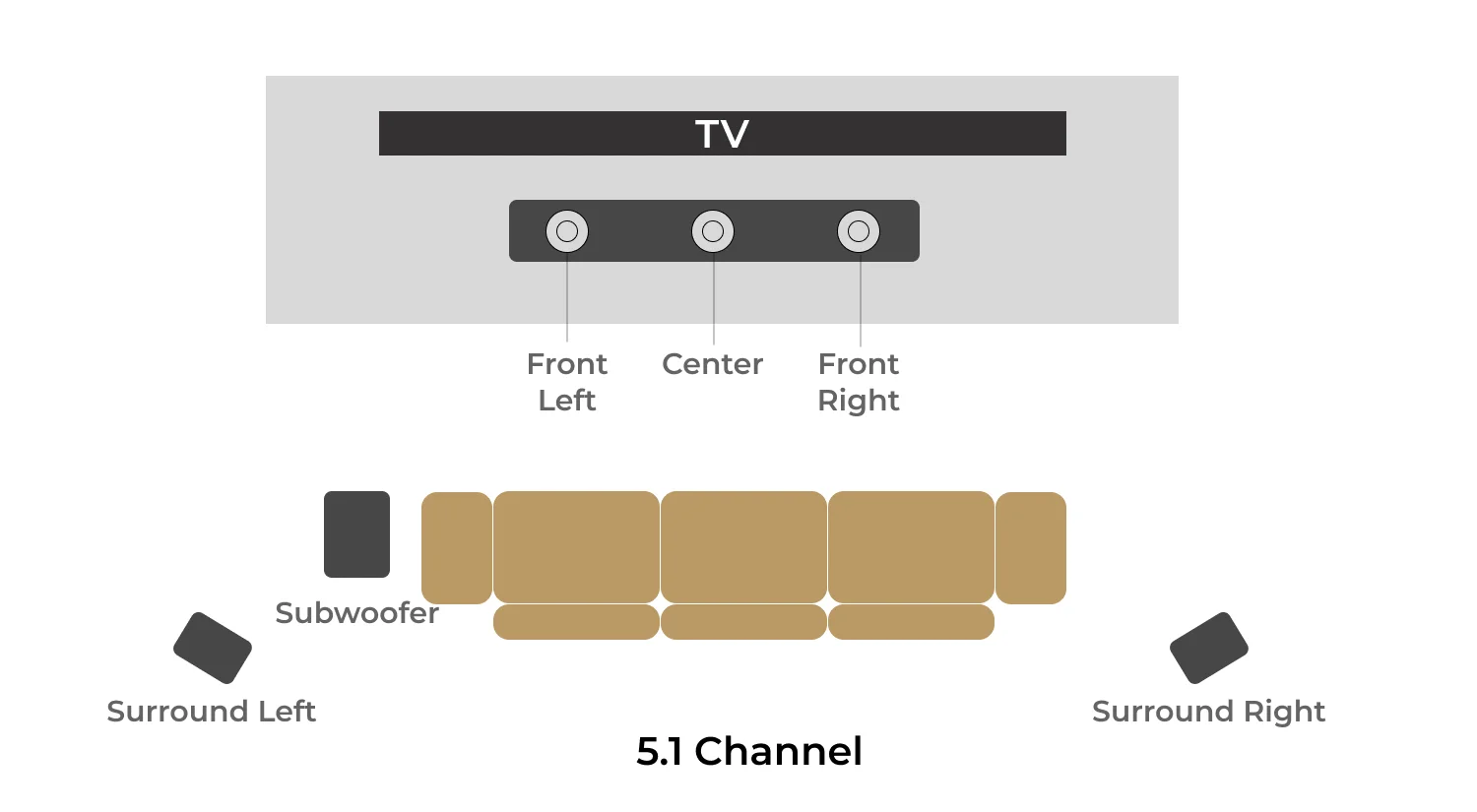
A 5.1 surround sound system means five main speakers plus one subwoofer. The "point one" is the sub. The five speakers handle left, center, right, left surround, and right surround. That is the minimum for proper surround. Some systems add height channels (5.1.2, 5.1.4, 7.1) for Dolby Atmos, which adds speakers above you or up-firing drivers. The choice depends on your room, your tolerance for wires, and whether you care about overhead effects.
Channel configuration
A plain 5.1 system gives you horizontal surround. Sound pans from front to back and side to side, but not up and down. Upgrading to 5.1.2 adds two height channels, which can be physical in-ceiling speakers or up-firing drivers built into the soundbar. True Dolby Atmos requires either a soundbar with dedicated up-firing drivers or separate height speakers. For most people, 5.1.2 is enough to feel immersed. A 7.1 system adds two more surround speakers (side or back) for smoother panning. Whether you need the extra channels depends more on how far back you sit from the panel: in a deep room, the extra pairs can fill the space.
Wired vs wireless rear speakers
Wireless rears simplify placement enormously. Instead of routing cables under rugs or along baseboards, you just plug each rear speaker into a wall outlet and pair it with the soundbar. The Skywave X50 and Raineverry 5.1 Sound Bar offer true wireless rears. The Ultimea Aura series uses a hybrid design where one rear is wireless and the other connects to it with a short wire. Fully wired systems like the Bobtot and Acoustic Audio require speaker wire runs but offer the most reliable connection with zero latency. If you are building from scratch, look at how bright a room the screen has to fight to decide whether wires are acceptable.
Dolby Atmos support
Dolby Atmos adds height metadata that tells the system where to place sounds in a 3D space. Not all systems support it. The ULTIMEA 5.1.2 Atmos Bar, Poseidon M60, and Aura A60 Pro have explicit Dolby Atmos decoding. The Skywave X50 and Hiwill-Audio N512 use up-firing drivers without the Atmos badge, which can still sound similar with non-Atmos content but lack the precision of decoded metadata. If you stream movies from services that encode Atmos (Netflix, Disney+, Blu-ray), a licensed system will give you better object placement.
A soundbar with up-firing drivers will not create the same overhead bubble as ceiling speakers, but it is the best compromise for renters.
Audio inputs and HDMI ARC/eARC
Modern systems should at least have HDMI ARC so the TV remote controls volume. eARC is better because it supports lossless audio like Dolby TrueHD. The Skywave X50, ULTIMEA 5.1.2 Atmos Bar, and Poseidon M60 all have eARC. The Raineverry and Hiwill have ARC but not eARC. The Acoustic Audio has only optical and RCA, which means you lose modern surround formats. Make sure your TV has the matching port.
Frequently asked questions
What is the difference between 5.1 and 5.1.2?
5.1 has five main speakers and one subwoofer. 5.1.2 adds two height channels for overhead sound, either as physical speakers or up-firing drivers. The height channels enable Dolby Atmos effects like rain falling above you.
Can I use a 5.1 soundbar without rear speakers?
Some soundbars, like the ULTIMEA Poseidon M60, use side-firing drivers and DSP to simulate surround without physical rears. The effect is wide but less precise than having actual rear speakers. If you want true separation, get a system with wired or wireless rears.
Do I need Dolby Atmos to enjoy surround sound?
No. Standard 5.1 surround works fine for most content. Dolby Atmos adds height dimension but requires Atmos-encoded media. If you mostly watch cable TV or stream older movies, a good 5.1 system without Atmos will still sound dramatically better than TV speakers.
How do I position the rear speakers in a 5.1 setup?
Rear speakers should be placed behind the listening position, at ear height or slightly above, angled toward the listener. They should be about the same distance apart as the front left and right speakers. Avoid placing them directly next to the sofa.
Can I add more speakers to a 5.1 system later?
Most all-in-one soundbar systems do not allow expansion beyond what ships in the box. If you think you might want a 7.1 setup later, choose a system that already supports 7.1 like the Aura A60 Pro, or buy an AV receiver with separate speakers.
What is the best way to connect a 5.1 soundbar to a TV?
HDMI ARC or eARC is the best connection because it sends audio from the TV to the soundbar and allows the TV remote to control volume. Optical is a fallback but cannot carry lossless surround or control signals.
Are wireless rear speakers as good as wired?
Modern wireless systems like the Skywave X50 use dedicated 5 GHz bands that avoid interference and latency. For most people, the convenience outweighs the minor difference in sound quality. But wired systems still have the theoretical advantage of zero compression.
The bottom line
After testing ten systems side by side, the ULTIMEA Skywave X50 stands out as the best 5.1 surround sound system for anyone who wants a premium, nearly cable-free experience with room-filling bass and height effects. It is expensive, but the GaN amplifier, wood subwoofer, and stable wireless rears justify the cost. If Dolby Atmos certification matters more than wireless, the ULTIMEA 5.1.2 Atmos Bar delivers official height processing at a lower price. For a tight budget, the ULTIMEA Poseidon D50 gives you real wired rears without breaking your wallet.
The one piece of advice for undecided readers: start with how much wire you are willing to hide. If your living room is already clean and you want to keep it that way, go wireless with the Skywave X50. If you can run a couple of cables behind the sofa, the 5.1.2 Atmos Bar offers the best value for Dolby Atmos. And if you want the biggest bass for the smallest money, the Bobtot system will shake your floor like nothing else here.
As an Amazon Associate we earn from qualifying purchases.