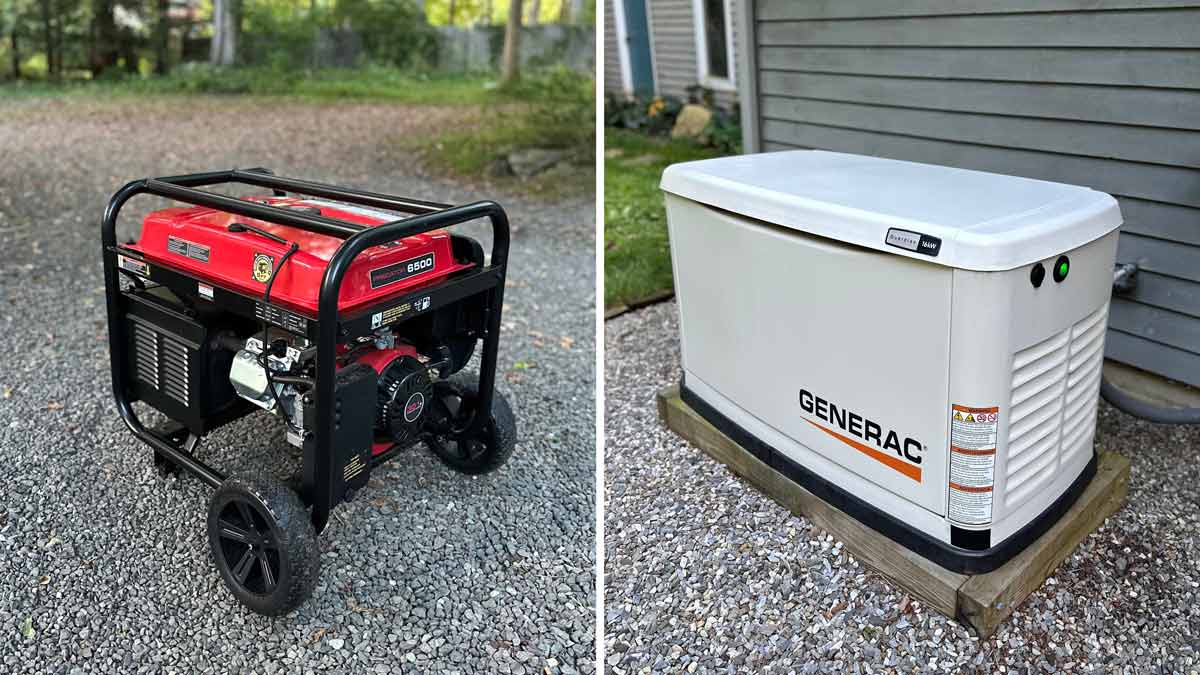

A power outage changes the meaning of “enough power” quickly. A refrigerator, furnace, sump pump, internet equipment, and a few lights may need far more capacity than a small camping generator can provide. The right choice also depends on fuel availability, transfer-switch wiring, noise, portability, and whether you want to start the machine yourself.
Our Best home generators consumer reports roundup covers compact inverter models, mid-size dual-fuel machines, high-output portable generators, and one automatic standby system. The strongest portable pick is the DuroStar DS13000MX, while the Generac 26kW Whole Home Generator is the more complete answer for homeowners who want automatic backup.
Comparison table
| # | Product | Award | Output | Fuel options | Best for |
|---|---|---|---|---|---|
| 1 | DuroStar DS13000MX | Best overall | 13, 000 watts | Gasoline, propane | Whole-home portable backup |
| 2 | Westinghouse WGen9500DF | Best controls | 12, 500 peak watts | Gasoline, propane | Remote starting and monitoring |
| 3 | DuroMax XP13000EH | Best heavy-duty build | 13, 000 watts | Gasoline, propane | Demanding home and jobsite use |
| 4 | Oxseryn 4400W Inverter | Best portable inverter | 4, 400 peak watts | Gasoline | RVs and lighter backup loads |
| 5 | Generac 26kW Whole Home Generator | Best automatic standby | 26kW | Not specified | Automatic whole-home protection |
| 6 | DuroStar DS13000MXT | Best fuel flexibility | 13, 000 watts | Gasoline, propane, natural gas | Homes with natural-gas access |
| 7 | Westinghouse 12500W CO Sensor | Best safety package | 12, 500 peak watts | Gasoline, propane | Portable backup with CO shutdown |
| 8 | Oxseryn 2800W Inverter | Best compact inverter | 2, 800 peak watts | Gasoline | Quiet essential-device backup |
| 9 | WEN DF475T | Best mid-size option | 4, 750 surge watts | Gasoline, propane | Smaller transfer-switch setups |
| 10 | Westinghouse 14500W Tri-Fuel | Best large-capacity tri-fuel | 14, 500 peak watts | Gasoline, propane, natural gas | Larger homes and long outages |
1. DuroStar DS13000MX: Best Overall

Pros
- 13, 000 watts for substantial home backup
- Gasoline and propane operation
- Remote electric start and front fuel selector
- 50-amp transfer-switch-ready outlet
- CO Alert automatic shutdown
Cons
- 220 pounds is difficult to move without help
- Not an inverter generator
- Natural gas is not supported
Best for: homeowners who want a powerful portable generator with flexible dual-fuel operation.
The DuroStar DS13000MX is the portable generator we'd put at the top of the list for a typical home that needs serious outage coverage without moving to a permanently installed system. It has the output to handle a larger mix of household circuits, yet it remains a portable unit that can also serve an RV or jobsite. The most useful ownership detail is the front-facing layout: the push-button start and fuel selector are easy concepts to understand when the power is already out.
Its 13, 000-watt output puts it in the same broad class as the DuroMax XP13000EH and DuroStar DS13000MXT. The difference is fuel choice. This model runs on gasoline or propane, so the owner can use gasoline when maximum output matters and propane when stored fuel and cleaner operation are priorities. The 50-amp outlet is transfer-switch ready, but connecting a generator to a home still requires the correct equipment and a qualified installation.
The metal frame and reinforced power panel suit a machine that may spend much of its life stored outdoors or in a garage and then be rolled out during severe weather. Its dimensions are 29.75 by 27.5 by 25.75 inches, and its 220-pound weight makes this a two-person positioning job rather than a casual carry. The CO Alert system is an important safeguard that automatically shuts the unit down when dangerous carbon monoxide levels are detected, but it does not make indoor operation safe. Portable generators must stay outside and well away from doors, windows, and vents.
The weakness is the lack of natural-gas operation. The DS13000MXT adds that option without giving up the 13, 000-watt class, while the Westinghouse 14500W Tri-Fuel offers more output still. The DuroMax XP13000EH has a similarly rugged approach, but it is heavier. Choose the DS13000MX when gasoline and propane are enough and you want a strong balance of output, controls, safety, and portability.
2. Westinghouse WGen9500DF: Best Controls
Pros
- Remote, electric, and recoil starting
- VFT display shows voltage, frequency, and hours
- 50-amp RV-ready outlet
- Up to 12 hours of runtime on its fuel tank
- Rubber-covered outlets
Cons
- Gasoline and propane output are different
- Nearly 210 pounds
- Conventional portable-generator design is not the quietest option
Best for: homeowners who want clear operating information and several ways to start the generator.
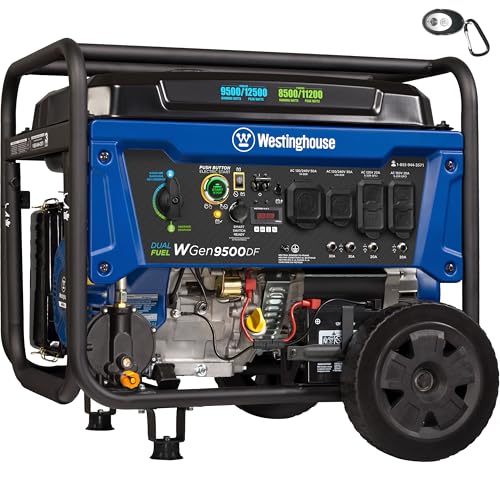
The Westinghouse WGen9500DF is the most approachable high-output machine here from a controls perspective. Its remote key fob lets you start it without walking out to the generator, while electric and recoil starting provide backups if the battery is unavailable. During an outage, that flexibility is more useful than a long list of decorative features.
Gasoline output is 9, 500 running watts and 12, 500 peak watts. Propane output falls to 8, 500 running watts and 11, 200 peak watts. That distinction matters when several motor-driven appliances start at the same time. The generator has two 120V household receptacles, a 30-amp transfer-switch-ready outlet, and a 50-amp 120/240V RV-ready receptacle, giving it a practical spread for both household circuits and larger equipment.
The VFT display is a standout feature. It shows voltage output, frequency, and lifetime hours, giving the owner a quick way to see whether the machine is operating normally and how much use it has accumulated. The 457cc four-stroke OHV engine has a cast iron sleeve, automatic low-oil shutdown, and a fuel gauge. Westinghouse also includes a battery charger, oil, funnel, tool kit, and manual, which reduces the amount of setup before the first emergency.
The Westinghouse 12500W CO Sensor is the closest alternative, with a carbon monoxide shutdown feature explicitly included in its product description. The WGen9500DF instead makes its case with the display and remote-start system. It is also slightly lighter than the DuroMax XP13000EH, though neither is a lightweight machine. Pick this model if operating information and start-up convenience matter as much as raw capacity.
3. DuroMax XP13000EH: Best Heavy-Duty Build

Pros
- 13, 000-watt class output
- All-metal frame and power panel
- 50-amp transfer-switch-ready outlet
- Copper windings
- No-flat tires
Cons
- 234-pound weight
- Large footprint
- No natural-gas option listed
Best for: users who prioritize a tough portable chassis and broad utility over easy handling.
The DuroMax XP13000EH feels designed for owners who expect their generator to do more than sit ready for a once-a-year outage. Its all-metal frame and power panel avoid plastic parts, and the no-flat tires are intended to make movement easier across rough ground. That does not make the machine light, but it does make the rolling hardware more useful around a driveway, workshop, or jobsite.
The generator provides 13, 000 watts and supports gasoline or propane. Its push-button start and front-facing interface make switching fuel types straightforward. A 50-amp outlet supports transfer-switch connections, and the other outlets broaden its usefulness for RVs and tools. The data does not specify separate gasoline and propane running figures, so buyers should consult the current manual for the exact load limits for each fuel.
At 30 by 29 by 26 inches and 234 pounds, the XP13000EH is the heaviest portable model among the main 13, 000-watt choices here. Its 100 percent copper windings are described as helping heat conduction and service life. That is a meaningful construction detail for a generator intended to run hard, though it does not change the need for ventilation, maintenance, and proper storage.
The DuroStar DS13000MX is lighter and adds CO Alert, while the DuroStar DS13000MXT adds natural-gas support. The DuroMax answers with a more overtly rugged build and no-flat tires. Skip it if one person must frequently reposition the generator. For a homeowner who has a fixed outdoor operating spot and wants a substantial metal-framed workhorse, this is the better fit.
4. Oxseryn 4400W Inverter: Best Portable Inverter

Pros
- 4, 400 peak and 3, 400 running watts
- ECO mode
- 56-pound portable design
- RV outlet and 12V DC output
- Up to 14 hours at 25 percent load
Cons
- Gasoline only
- Not sized for whole-home loads
- Open-frame design is less enclosed than compact inverter models
Best for: RV owners and households that need selected circuits rather than whole-home coverage.
The Oxseryn 4400W Inverter occupies a useful middle ground. It is far more portable than the 200-pound-plus home-backup machines, but it has enough capacity for an RV, refrigerator, lights, networking equipment, and other carefully selected loads. At 56 pounds, it is still a substantial object, but one adult can realistically move it without the logistical planning required by the larger models.
Its 4, 400 peak watts and 3, 400 running watts tell the practical story. This is not a transfer-switch replacement for a large house. It is a generator for managing priorities. The two 120V AC ports, 12V DC port, and RV port support a mix of household and camping equipment, while ECO mode can help extend operation when the connected load is modest.
The two-gallon tank is rated for up to 14 hours at 25 percent load. That figure is tied to light use, so a refrigerator compressor, heater, or power tool will change the result. The listed sound level is under 72 dBA from 23 feet, which is not silent, but the open-frame format and higher output make that figure understandable. Its 19 by 15.6 by 19.1-inch dimensions are far easier to store than those of the DuroMax or Westinghouse high-output units.
The Oxseryn 2800W Inverter is lighter and quieter, but it gives up meaningful running capacity. The WEN DF475T provides 120/240V operation and dual-fuel capability, though it weighs considerably more. Buyers who want cleaner inverter power in a manageable package should choose this Oxseryn, while anyone expecting to run central heating or multiple large appliances should move up to a high-output model.
When a generator will also power a television, laptop, or antenna setup, it helps to plan the rest of the outage kit around the load. Our guide to keeping essential home electronics running during an outage covers that broader decision.
5. Generac 26kW Whole Home Generator: Best Automatic Standby

Pros
- Automatic outage detection
- 26kW whole-home capacity
- Built-in cellular connectivity
- Mobile monitoring and control
- Five-year limited warranty
Cons
- 524-pound permanent-style unit
- Installation is not a portable setup
- Mobile Link premium features require a subscription
Best for: homeowners who want backup power to start automatically while they are away.
The Generac 26kW Whole Home Generator is a different proposition from every portable model in this roundup. It is intended to protect the entire home automatically, detecting an outage and delivering backup power without someone wheeling a machine into position, connecting cables, or starting an engine in bad weather. That distinction is the reason to choose it, not portability.
The 26kW rating is aimed at whole-home coverage, including refrigeration, heating or cooling, lights, and connected devices. The supplied information does not specify a fuel type, transfer-switch model, or outlet layout, so those installation details should be confirmed before purchase. A standby generator also needs an appropriate installation location and professional electrical and fuel work. It is not a drop-in substitute for the DuroStar or Westinghouse units.
Built-in cellular connectivity supports Mobile Link monitoring and control, with real-time updates and maintenance alerts. The premium version of Mobile Link requires a subscription, an important detail for anyone expecting every remote feature to remain included. Oil-level sensors help monitor readiness, and the design includes cold-start support plus a sloped roof and rear intake intended to reduce ice or snow intrusion.
At 46.4 by 26.3 by 30.7 inches and 524 pounds, this is a fixed installation product. Its five-year limited warranty and 24/7/365 customer support add reassurance for a system that is expected to remain ready between outages. The trade-off is complexity: a portable generator can be stored and moved, while this unit needs a properly planned installation and ongoing service.
The DuroStar DS13000MX is the better choice for occasional portable use, and the Westinghouse 14500W Tri-Fuel offers more fuel flexibility in a portable format. Choose Generac when automatic response, remote status information, and whole-home continuity matter more than mobility.
6. DuroStar DS13000MXT: Best Fuel Flexibility

Pros
- Gasoline, propane, and natural-gas operation
- 13, 000-watt class output
- Push-button start
- 50-amp transfer-switch-ready outlet
- CO Alert shutdown
Cons
- No listed dimensions for weight
- Natural-gas output figures are not provided
- Conventional portable generator noise and exhaust remain considerations
Best for: homes that have access to natural gas and want a portable generator with three fuel choices.
The DuroStar DS13000MXT solves the fuel-storage problem better than the dual-fuel machines. It can run on gasoline, propane, or natural gas, giving the owner more options when an outage lasts longer than expected. Gasoline may be convenient for maximum portable output, propane is easy to store, and a natural-gas connection can reduce the need to keep liquid fuel on hand.
Its 13, 000-watt capacity places it beside the DS13000MX and XP13000EH for substantial portable backup. The control panel includes push-button start, a fuel-selection knob, and a 50-amp outlet ready for transfer-switch use. That combination is well matched to a home where selected circuits or a professionally installed connection need more capacity than a small inverter can provide.
CO Alert automatically shuts the generator down when harmful fumes are detected. It is a useful layer of protection, but it is not permission to operate the generator in a garage, basement, shed, or other enclosed location. The product information lists a 26-inch height, 30.5-inch length, and 27.3-inch width, but does not provide a weight. That missing number makes it harder to plan storage and movement compared with the fully specified DuroStar DS13000MX.
The main limitation is that the data does not give separate running and peak output figures for each fuel. Buyers with a natural-gas connection should verify those figures and the installation requirements before committing. The Westinghouse 14500W Tri-Fuel lists distinct output figures for gasoline, propane, and natural gas, while the DS13000MXT keeps the emphasis on fuel choice and a simpler control layout. This DuroStar is the logical pick for anyone who values fuel availability above detailed output reporting.
7. Westinghouse 12500W CO Sensor: Best Safety Package

Pros
- Carbon monoxide and low-oil shutdown
- Remote, electric, and recoil starting
- Up to 12 hours on the fuel tank
- 50-amp RV-ready outlet
- Digital hour meter
Cons
- Dual-fuel output is lower on propane
- 212-pound weight
- No natural-gas support
Best for: households that want high portable output with explicit carbon monoxide shutdown protection.
The Westinghouse 12500W CO Sensor is closely related to the WGen9500DF, but its standout reason to exist is the named carbon monoxide shutdown system. The generator automatically shuts down when dangerous CO levels are detected, alongside automatic low-oil shutdown. Those protections do not replace safe placement, yet they are valuable safeguards on a machine intended for emergency use.
Gasoline output is 9, 500 running watts and 12, 500 peak watts. On propane, the figures are 8, 500 running watts and 11, 200 peak watts. The difference is enough to affect which appliances can run together, so planning the load around the fuel being used is important. The generator includes two GFCI household outlets, a 30-amp transfer-switch-ready outlet, and a 50-amp 120/240V RV-ready outlet.
Remote start, electric start, and recoil start give the owner three ways to get the engine running. The digital hour meter helps track use and maintenance, while the 457cc four-stroke OHV engine uses a cast iron sleeve. A six-gallon tank is rated for up to 12 hours, though that figure depends on load. Rubber outlet covers are a sensible touch when the generator is operating outdoors in unsettled weather.
The WGen9500DF has the more informative VFT display, showing voltage and frequency as well as hours. The DuroStar DS13000MX offers 13, 000 watts and a rugged metal build. This Westinghouse is the better fit when CO shutdown and the included starting options take priority over the last bit of output. Its 212-pound body still makes permanent positioning preferable to frequent carrying.
8. Oxseryn 2800W Inverter: Best Compact Inverter

Pros
- Under 58 dBA from 23 feet
- 40-pound weight
- Less than 3 percent THD
- USB and USB-C outputs
- ECO mode and fuel shutoff
Cons
- 2, 000 running watts limits appliance selection
- Gasoline only
- High-altitude kit is not included
Best for: quiet emergency power for electronics, lights, small appliances, and camping equipment.
The Oxseryn 2800W Inverter is the easiest generator here to store and carry. At 40 pounds, with a built-in handle and dimensions of 17.9 by 11.2 by 17.35 inches, it can live in a utility closet or vehicle without taking over the space. That compact format makes it a credible emergency companion for essentials, not a whole-home power plant.
It produces 2, 800 peak watts and 2, 000 running watts from a 79.8cc four-stroke OHV engine. The output supports two 120V AC ports, a 12V DC port, one USB port, and one USB-C port. Less than 3 percent THD is specified, which makes the unit suitable for sensitive electronics such as laptops, phones, cameras, and televisions when the generator is operated correctly.
Noise is its strongest practical advantage. The listed level is under 58 dBA from 23 feet, and ECO mode can reduce fuel use when the load is light. The 1.1-gallon tank is rated for up to nine hours at 25 percent load. A fuel indicator and fuel shutoff are useful for storage and routine operation, though the owner still needs to follow the manual's maintenance instructions.
The capacity is the obvious boundary. A refrigerator may be manageable, but adding heating equipment, pumps, or several motor-driven appliances can exceed its running output. The Oxseryn 4400W Inverter carries more load but weighs 56 pounds and is louder. The WEN DF475T supplies 120/240V output and dual-fuel operation but is much heavier. Pick this Oxseryn when quiet, clean power and easy carrying are more important than running a large household.
If you are also trying to keep news and entertainment available during an outage, choosing an antenna for difficult indoor reception can reduce the number of devices competing for generator capacity.
9. WEN DF475T: Best Mid-Size Option

Pros
- Gasoline and propane operation
- Switchable 120V and 240V output
- Electric start
- Wheel and handle kit included
- Up to 11 hours at half load
Cons
- 105.8-pound weight
- Lower output than the large home-backup models
- No remote start listed
Best for: smaller homes that need a transfer-switch-compatible generator without the bulk of a 13, 000-watt machine.
The WEN DF475T is a sensible step between a compact inverter and a large portable home generator. Its 105.8-pound weight is not light, but the wheel and handle kit make it more manageable than the 200-pound-plus models. This is the kind of generator that can serve a defined group of circuits without pretending to power every appliance in a large home at once.
On gasoline, it produces 4, 750 surge watts and 3, 800 running watts. Propane output is 4, 350 surge watts and 3, 500 running watts. The simple fuel-selection dial makes switching straightforward, and electric start powers the 224cc four-stroke OHV engine. The ability to switch between 120V and 240V is particularly important for transfer-switch installations and equipment that requires 240V.
The four-gallon tank is rated for up to 11 hours at half load. That is a more demanding rating than the light-load claims used by the Oxseryn inverters, although real runtime will still depend on connected appliances. Two 120V GFCI outlets, a 120/240V NEMA 30A twist-lock outlet, and a 12V DC outlet cover common emergency and workshop uses. The included LPG hose, oil, wheel kit, and handle kit make the package more usable from the start.
The limitation is capacity. The DuroStar DS13000MX and Westinghouse WGen9500DF are much better for whole-home ambitions, while the Oxseryn 2800W is quieter and easier to carry. The WEN makes sense when 120/240V flexibility and dual-fuel operation matter, but the home's essential circuits can be kept within its 3, 800-watt gasoline running limit.
10. Westinghouse 14500W Tri-Fuel: Best Large-Capacity Tri-Fuel

Pros
- Highest portable peak output in this group
- Gasoline, propane, and natural-gas operation
- 11, 500 gasoline running watts
- Up to 19 hours on a full tank
- Low THD and copper windings
Cons
- 230-pound weight
- Large fuel tank adds bulk
- No remote-control details are specified beyond remote electric start
Best for: larger homes that need substantial portable capacity and three fuel choices.
The Westinghouse 14500W Tri-Fuel is the portable option for homeowners who do not want to compromise much on load capacity. It produces 14, 500 peak watts and 11, 500 running watts on gasoline, 13, 500 peak watts and 10, 500 running watts on propane, and 12, 000 peak watts and 9, 500 running watts on natural gas. Those separate figures make it easier to plan around the fuel that will actually be available.
The tri-fuel setup is the central feature. Gasoline offers the highest listed output, propane offers a practical stored-fuel alternative, and natural gas can be useful for a home with an appropriate connection. A 550cc four-stroke OHV engine with a cast iron sleeve supports the machine, while the built-in fuel gauge helps monitor the 9.5-gallon tank. The listed runtime reaches up to 19 hours on gasoline and up to seven hours on a 20-pound propane tank.
Westinghouse describes the output as low THD, suitable for phones, computers, televisions, and other sensitive electronics. Copper windings are intended to help the generator run cooler and last longer. Remote electric start and transfer-switch readiness add the controls expected of a serious home-backup unit, though the supplied information does not detail the exact outlet selection or a display like the WGen9500DF's VFT system.
At 27.2 by 26.1 by 26.5 inches and 230 pounds, it is not a casual carry. The DuroStar DS13000MXT is smaller in output but offers the same three fuel categories, while the Generac 26kW provides automatic whole-home backup without manual deployment. The Westinghouse is the right choice for a homeowner who wants maximum portable capacity, long gasoline runtime, and fuel flexibility, and who already has a safe operating and transfer-switch plan.
How to choose best home generators consumer reports
The right generator starts with the circuits you must keep running, then works backward through output, fuel, connection method, noise, and safety.
Running and starting watts
Running watts describe the sustained load a generator can support. Peak or surge watts cover the short burst required when motors in refrigerators, pumps, furnaces, and tools start. A generator rated for 2, 000 running watts is suited to selected essentials, while the 9, 000 to 11, 500 running-watt class can support a much broader household load.
Make a list of essential appliances and check their nameplates or manuals. Do not add only the running figures. Account for starting demand, especially for pumps and compressors. The Westinghouse 14500W Tri-Fuel and the three 13, 000-watt-class models are aimed at substantially larger loads than the Oxseryn inverters.
Fuel flexibility
Gasoline is widely available and often provides the highest output on portable models. Propane stores more conveniently for many households, but output can be lower. Natural gas avoids liquid-fuel storage when a suitable connection exists, which is why the DuroStar DS13000MXT and Westinghouse 14500W Tri-Fuel stand apart from the dual-fuel models.
Check the output figures for each fuel rather than assuming the headline rating applies everywhere. Also plan where fuel will be stored and how the generator will be connected. A tri-fuel model is not automatically the right choice if natural-gas installation is unavailable.
Transfer-switch connections
A transfer switch routes generator power to selected household circuits and helps prevent dangerous backfeeding into utility lines. A 30-amp or 50-amp outlet can make a portable generator compatible with an appropriate setup, but the outlet alone does not create a safe home connection.
The WEN DF475T offers 120V and 240V operation, while several larger models include 50-amp outlets. Have the home wiring assessed by a qualified electrician. Never connect a portable generator to a wall outlet with a makeshift cord.
Inverter output and noise
Inverter generators are attractive for electronics, camping, and close neighbors because they can provide cleaner output and often use ECO mode to reduce fuel consumption. The Oxseryn 2800W lists less than 3 percent THD and under 58 dBA from 23 feet. The Oxseryn 4400W offers more output but lists under 72 dBA from the same distance.
Large conventional portable generators generally offer far more capacity, but they need a greater separation from occupied spaces. A quiet compact model is not a substitute for a high-output unit if the home's essential loads exceed its running-watt rating.
Choose the generator by the hardest appliance to start, not by the easiest light to keep on.
Safety and installation
Carbon monoxide is a major hazard. The DuroStar models with CO Alert and the Westinghouse 12500W CO Sensor include automatic shutdown features, but every portable generator still belongs outdoors, away from doors, windows, and vents. Keep the exhaust pointed away from the home and follow the manual's clearance instructions.
A standby system such as the Generac 26kW requires planned installation, while a portable unit needs safe storage, fuel handling, oil checks, and a suitable operating surface. Wheels make movement easier, but they do not remove the need to position a heavy generator securely.
Frequently asked questions
What size generator is needed for a whole house?
The answer depends on the home's appliances, heating system, pumps, and electrical service. The 13, 000-watt-class portable generators can cover substantial selected loads, but automatic whole-home coverage is a different installation question. An electrician can calculate starting and running demand more accurately than a headline wattage.
Are dual-fuel generators better than gasoline-only models?
Dual-fuel models provide more flexibility because they can use gasoline or propane. Gasoline and propane may produce different output levels, so compare the figures for the fuel you expect to use. Tri-fuel models add natural gas for homes with an appropriate connection.
Can a portable generator power a house through an outlet?
No. A portable generator should not be connected to a household wall outlet with a makeshift cable. A properly installed transfer switch or approved interlock system is the safe way to connect selected circuits, and the installation should be handled by a qualified professional.
Are inverter generators suitable for emergency home backup?
They can be excellent for essential loads such as lights, refrigeration, networking equipment, phones, and computers. Compact models in this roundup do not have enough running output for every major appliance in a home. They are best when the load is deliberately limited.
How far from the house should a generator operate?
Follow the generator's manual and local safety rules for exact clearance. The generator must operate outdoors in a well-ventilated location, with exhaust directed away from doors, windows, and vents. Never operate it in a garage, basement, shed, or other enclosed space.
Does a generator's peak wattage show what it can run continuously?
No. Running watts are the sustained capacity. Peak watts cover a temporary starting surge, so both numbers matter when an appliance has a motor or compressor.
Is an automatic standby generator easier to use?
It is easier during an outage because it can detect lost utility power and start automatically. The Generac 26kW is designed for that role and also supports remote monitoring through cellular connectivity. It is a permanent-style installation rather than a portable product that can be moved between locations.
The bottom line
The Best home generators consumer reports pick for most homeowners seeking powerful portable backup is the DuroStar DS13000MX. It combines 13, 000-watt-class capacity, gasoline and propane operation, electric start, a 50-amp outlet, metal construction, and CO Alert without the extra fuel-system complexity of a tri-fuel model.
Choose the Generac 26kW Whole Home Generator when automatic whole-home protection matters more than portability. For a larger portable generator with three fuel choices, the Westinghouse 14500W Tri-Fuel is the stronger fit, while the Oxseryn 2800W Inverter is the better answer for quiet, lightweight essential-device power.
If you are undecided, list the appliances that must stay on, calculate their starting demand, and choose the smallest generator that safely covers that real load.
As an Amazon Associate we earn from qualifying purchases.