
A power outage changes the generator question quickly. It is not just about keeping a refrigerator cold. You may need to start a sump pump, run a furnace blower, keep medical equipment operating, or power several household circuits at once. The right generator has to match those starting surges, your available fuel, and the way you plan to connect it.
The Best generators for home use range from a 56-pound inverter model to large dual-fuel and tri-fuel machines with transfer-switch-ready outlets. We prioritized usable output, fuel flexibility, outlet selection, runtime, transport, and safety features.
Westinghouse WGen9500DF is our top pick, with the smaller Westinghouse 6500W Dual Fuel, the compact Oxseryn 4400W Inverter, and several high-output tri-fuel options covering the rest of the range.
Quick comparison
| # | Product | Award | Output | Fuel | Best for |
|---|---|---|---|---|---|
| 1 | Westinghouse WGen9500DF | Best overall | 9, 500 running, 12, 500 peak watts on gas | Gas, propane | Broad home backup |
| 2 | Oxseryn 4400W Inverter | Best compact inverter | 3, 400 running, 4, 400 peak watts | Gas | Portable emergency power |
| 3 | DuroStar DS13000MX | Best rugged dual fuel | 13, 000 watts | Gas, propane | Heavy-duty home backup |
| 4 | Westinghouse WGen14500TF | Best high-output tri-fuel | 14, 500 peak, 11, 500 running watts on gas | Gas, propane, natural gas | Larger homes |
| 5 | DuroMax XP13000EH | Best all-metal build | 13, 000 watts | Gas, propane | Severe-weather backup |
| 6 | Westinghouse WGen9500DF CO | Best safety-focused large generator | 9, 500 running, 12, 500 peak watts on gas | Gas, propane | Remote-start backup with CO shutdown |
| 7 | Westinghouse 4650W | Best simple portable option | 3, 600 running, 4, 650 peak watts | Gas | RVs and essential circuits |
| 8 | Westinghouse 6500W Dual Fuel | Best midrange dual fuel | 5, 300 running, 6, 500 peak watts on gas | Gas, propane | Essential home circuits |
| 9 | Westinghouse 13500W Tri-Fuel | Best tri-fuel balance | 10, 500 running, 13, 500 peak watts on gas | Gas, propane, natural gas | Flexible whole-home backup |
| 10 | Generac 12500W Tri-Fuel | Best voltage regulation | 9, 500 running, 12, 500 starting watts | Gas, propane, natural gas | Stable power for mixed loads |
1. Westinghouse WGen9500DF: Best Overall
Pros
- Remote, electric, and recoil starting
- Gasoline output reaches 9, 500 running watts
- Transfer-switch-ready and RV-ready outlets
- Digital display shows voltage, frequency, and hours
Cons
- Weighs about 210 pounds
- Runs at lower output on propane
- Large frame needs a dedicated storage spot
Best for: households that want strong dual-fuel backup without moving to a tri-fuel system.
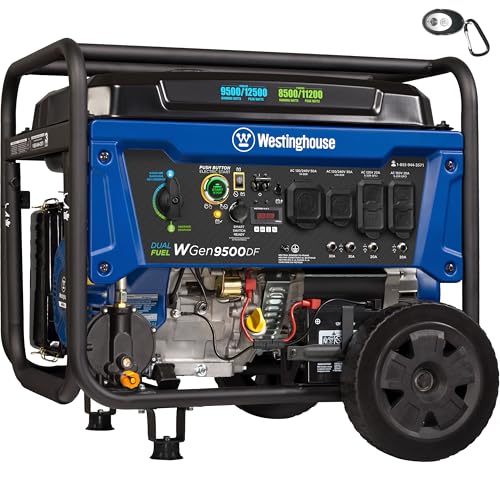
The Westinghouse WGen9500DF gets the important decisions right. It has enough output to handle a substantial group of household loads, but it does not go as far into the oversized territory as the DuroMax XP13000EH or Westinghouse WGen14500TF. Remote starting is especially useful when the generator is stored outside and the weather is unpleasant.
On gasoline, it provides 9, 500 running watts and 12, 500 peak watts. That distinction matters because motors such as pumps and compressors need a temporary surge when they start. Propane output drops to 8, 500 running watts and 11, 200 peak watts, but the ability to switch fuel is valuable when gasoline storage is limited. The 6.6-gallon tank is rated for up to 12 hours of runtime, and the fuel gauge makes checks easier.
The outlet layout is unusually practical. Two GFCI household receptacles cover ordinary appliances, the L14-30R outlet is ready for a transfer-switch connection, and the 14-50R outlet supports RV use and larger connections. Its VFT display reports voltage, frequency, and lifetime hours, while the 457cc four-stroke OHV engine adds automatic low-oil shutdown and a cast-iron sleeve.
The weakness is simple: this is not a light machine. At about 210 pounds, it is better rolled into position than carried, and the open frame will be audible around a home. The Westinghouse WGen9500DF CO adds carbon monoxide shutdown, so safety-conscious buyers may prefer that version. Choose this model when you want a capable dual-fuel generator with useful monitoring and several connection options.
2. Oxseryn 4400W Inverter: Best Compact Inverter

Pros
- 56-pound portable design
- Inverter output with ECO mode
- Up to 14 hours at 25 percent load
- RV port and 12V DC output
Cons
- Gasoline only
- Less running power than every large backup model here
- Open-frame design is not silent
Best for: buyers who need movable power for essentials, camping, or a smaller emergency setup.
The Oxseryn 4400W Inverter is the outlier in this group, and that is its appeal. It is small enough to move without the wheel-and-handle choreography required by the large Westinghouse and DuroMax machines. At 56 pounds, it can serve as an emergency generator for selected appliances rather than a device intended to power an entire house.
Its 3, 400 running watts and 4, 400 peak watts are suitable for a refrigerator, lights, chargers, and some smaller appliances, provided you manage simultaneous loads. ECO mode can reduce fuel use when demand is low, with up to 14 hours of runtime at 25 percent load from its 2-gallon tank. That light-load figure is more useful for overnight essentials than for running several high-draw devices.
The inverter design is the reason to consider it over the Westinghouse 4650W. Inverter generators are generally chosen for cleaner, more controlled power and flexible portable use, while the Oxseryn also includes two 120V AC ports, a 12V DC port, and an RV port. The fuel gauge gives a quick visual check, and the listed sound level is under 72 dBA from 23 feet away.
It does not have the output or fuel flexibility of the Westinghouse WGen9500DF, and gasoline is the only listed fuel. It also lacks the large generator's transfer-switch-ready arrangement. Buyers should skip it if the plan is to support central air conditioning, a well pump, or many circuits together. For a lighter emergency kit, RV setup, or carefully selected essential loads, its portability is the defining advantage.
3. DuroStar DS13000MX: Best Rugged Dual Fuel

Pros
- 13, 000-watt output
- Gasoline and propane operation
- 50-amp transfer-switch-ready outlet
- Carbon monoxide alert with automatic shutdown
Cons
- About 220 pounds
- No natural gas option
- Large footprint for a portable machine
Best for: homeowners who want a sturdy dual-fuel generator with substantial output and a 50-amp connection.
The DuroStar DS13000MX feels designed for the hard end of home backup. Its all-metal construction and reinforced power panel are more compelling here than decorative features. This is the type of generator to position, connect, and leave ready rather than routinely haul around.
The headline output is 13, 000 watts, with gasoline providing the maximum listed performance. That gives it more headroom than the Westinghouse WGen9500DF when several large loads may start close together. Dual-fuel operation adds propane as a second option, and the front-facing selector keeps the changeover accessible. The trade-off is that there is no natural gas capability, unlike the tri-fuel models from Westinghouse and Generac.
A 50-amp outlet makes the DS13000MX a serious candidate for transfer-switch installations, although that connection should be handled with the appropriate equipment and professional guidance. The control panel includes push-button electric starting, and the CO Alert system is designed to shut the generator down if dangerous carbon monoxide levels are detected. Its 500cc engine is matched to the demanding output class.
The 220-pound weight and roughly 30-inch length make transport a two-person or wheel-based task. The smaller Westinghouse 6500W Dual Fuel is easier to place, but it cannot offer this level of output. Choose the DS13000MX when rugged construction, dual-fuel flexibility, and high-demand backup matter more than compact storage.
4. Westinghouse WGen14500TF: Best High-Output Tri-Fuel

Pros
- Highest peak and running output here
- Gasoline, propane, and natural gas support
- Up to 19 hours on its fuel tank
- Low THD output for sensitive electronics
Cons
- About 230 pounds
- Very large footprint
- Propane and natural gas reduce output
Best for: larger homes that need maximum output and want three fuel choices.
The Westinghouse WGen14500TF is the heavy hitter in this roundup. It is meant for a home where the generator may need to support several demanding appliances rather than just a few essentials. The size is not incidental. At about 230 pounds and more than 27 inches long, it requires a clear, stable operating area and a realistic plan for moving it.
Gasoline output is 11, 500 running watts and 14, 500 peak watts. Propane drops to 10, 500 running watts and 13, 500 peak watts, while natural gas provides 9, 500 running watts and 12, 000 peak watts. Those figures give a useful picture of how fuel choice affects available headroom. The 9.5-gallon tank can run for up to 19 hours, though actual runtime depends on load.
Westinghouse specifies low total harmonic distortion, which is a welcome feature when the generator will power phones, computers, televisions, and other sensitive electronics. The 550cc four-stroke OHV engine uses a cast-iron sleeve, and the built-in fuel gauge reduces guesswork during a long outage. Tri-fuel support is the biggest practical advantage, especially for homes with a suitable natural gas connection.
The price of that flexibility is bulk. The Westinghouse 13500W Tri-Fuel is smaller in output but similar in general footprint, while the Oxseryn 4400W Inverter is dramatically easier to move. Skip the WGen14500TF if your likely load is limited to a refrigerator, lights, and chargers. For a larger property and a prepared transfer-switch setup, this is the most capable generator in the group.
5. DuroMax XP13000EH: Best All-Metal Build

Pros
- 13, 000-watt whole-home backup output
- Heavy-duty all-metal frame and panel
- 50-amp transfer-switch-ready outlet
- No-flat tires and folding handle
Cons
- Heaviest model in the roundup
- Dual fuel, not tri-fuel
- Requires substantial storage space
Best for: buyers who want a highly rugged dual-fuel machine for repeated outdoor use.
The DuroMax XP13000EH is built around durability rather than minimum size. Its all-metal frame and power panel avoid plastic parts, and the machine is clearly intended to tolerate demanding outdoor work and severe weather. That makes it a natural fit for homeowners who also expect to use a generator at a jobsite or on an RV trip.
The XP13000EH supplies 13, 000 watts and can run on gasoline or propane. Its push-button start and front-facing fuel selector simplify the two tasks people are most likely to need during an outage. The transfer-switch-ready 50-amp outlet supports a properly installed home connection, while the broader outlet selection keeps it useful when powering individual devices.
The construction is backed up by details that improve handling. No-flat tires are useful on uneven ground, and the folding handle helps with positioning. Copper windings are designed to conduct heat efficiently, which is relevant during sustained operation. At 234 pounds, though, this remains a rollable generator, not a liftable one.
Compared with the DuroStar DS13000MX, the XP13000EH emphasizes transport hardware and an all-metal build. The Westinghouse WGen14500TF offers more output and a third fuel option. Choose the DuroMax when the generator will see rough handling and you want a durable dual-fuel platform. People with limited storage or only modest backup needs should choose something smaller.
6. Westinghouse WGen9500DF CO: Best Safety-Focused Large Generator

Pros
- Carbon monoxide and low-oil shutdown
- Remote, electric, and recoil starting
- 9, 500 running watts on gasoline
- Transfer-switch-ready and RV-ready outlets
Cons
- Large and heavy
- Lower propane output
- Still requires careful outdoor placement
Best for: households that want the WGen9500DF format with an added CO safety system.
The Westinghouse WGen9500DF CO is closely related to our top pick, but the distinction matters. It includes automatic carbon monoxide shutdown alongside automatic low-oil shutdown, giving it a stronger safety feature set for home backup. That does not replace correct outdoor placement, ventilation, or safe fuel handling, but it adds an important layer of protection.
Its gasoline figures are 9, 500 running watts and 12, 500 peak watts, with propane output at 8, 500 running watts and 11, 200 peak watts. The 6.6-gallon tank is rated for up to 12 hours, and a fuel gauge helps monitor the remaining supply. Remote start, electric start, and recoil start provide several ways to get the engine running.
The connection choices are well suited to a home setup. There are two GFCI household receptacles, a 30-amp L14-30R outlet for a transfer switch, and a 50-amp RV-ready 14-50R outlet. The 457cc engine has a cast-iron sleeve, and the digital hour meter helps track use for maintenance.
The WGen9500DF has a VFT display with voltage and frequency information, which this CO-equipped model does not list in its supplied features. That makes the two versions a genuine choice rather than simple duplicates. Pick the CO model when carbon monoxide shutdown is the priority. Skip both large models if you cannot store or operate a 212-pound generator safely outdoors.
7. Westinghouse 4650W: Best Simple Portable Option

Pros
- 100-pound portable design
- Up to 14 hours per tank
- RV-ready 30-amp outlet
- Carbon monoxide and low-oil shutdown
Cons
- Recoil start only
- Gasoline only
- Not intended for high-demand whole-home loads
Best for: essential circuits, RV use, and buyers who want a straightforward portable generator.
The Westinghouse 4650W is refreshingly uncomplicated. It weighs about 100 pounds, occupies less space than the large backup machines, and avoids the complexity of remote starting or multiple fuel systems. That makes it easier to store and more realistic to move when an outage starts.
It produces 3, 600 running watts and 4, 650 peak watts from gasoline. That is enough for selected essentials, but users must account for startup demands from refrigerators, pumps, and other motor-driven equipment. The 4-gallon tank is rated for up to 14 hours, and the fuel gauge lets you see when a refill is approaching.
The panel includes two household duplex receptacles, an RV-ready TT-30R 30-amp outlet, and an L5-30R 30-amp outlet. Rubber covers protect the receptacles when they are not in use. An automatic low-oil and carbon monoxide shutdown system is included, and the 212cc four-stroke OHV engine uses a cast-iron sleeve.
The limitation is capacity. The Westinghouse 6500W Dual Fuel gives a home more running headroom and adds propane, while the Oxseryn 4400W Inverter is lighter and offers ECO mode. The 4650W makes sense for a smaller load plan, RV users, or anyone who values manageable equipment over whole-home ambitions.
8. Westinghouse 6500W Dual Fuel: Best Midrange Dual Fuel

Pros
- Gasoline and propane operation
- 30-amp transfer-switch-ready outlet
- RV-ready 30-amp outlet
- Up to 14.5 hours of runtime
Cons
- No remote or electric start listed
- Less output than the large backup models
- About 136 pounds
Best for: essential home circuits where dual-fuel flexibility matters more than maximum output.
The Westinghouse 6500W Dual Fuel occupies the useful middle ground in this list. It is more capable than the 4650W without becoming one of the 200-plus-pound machines. For a home that plans to power a refrigerator, lights, internet equipment, and selected appliances, this output class can be easier to live with than a full-size whole-home generator.
On gasoline, it provides 5, 300 running watts and 6, 500 peak watts. Propane output is 4, 800 running watts and 5, 800 peak watts. The 4.7-gallon tank supports up to 14.5 hours of runtime, and a 120/240V selector gives the user more control over how the output is configured.
Its outlet selection is strong for the size. There is a household duplex receptacle, an RV-ready TT-30R outlet, and an L14-30R outlet ready for a transfer-switch connection. The package includes a propane hose, wheel kit, oil, funnel, and tools. The 274cc engine has automatic low-oil and CO shutdown.
Unlike the WGen9500DF, this model does not list remote or electric starting, so starting it is less convenient. It also cannot match the output of the DuroStar DS13000MX. Choose it when your load plan is moderate and you want gasoline or propane flexibility in a machine that is easier to position.
9. Westinghouse 13500W Tri-Fuel: Best Tri-Fuel Balance

Pros
- Gasoline, propane, and natural gas support
- Remote, electric, and recoil starting
- 50-amp RV-ready outlet
- Up to 19 hours on gasoline
Cons
- About 230 pounds
- Natural gas output is lower
- Large storage footprint
Best for: homeowners who want broad fuel flexibility without choosing the largest model here.
The Westinghouse 13500W Tri-Fuel is the practical alternative to the WGen14500TF. It keeps the three-fuel concept, remote starting, and home connection options, while giving up some peak output. For many homes, that is a sensible trade because natural gas availability can matter more during a long outage than the last increment of gasoline output.
Gasoline produces 10, 500 running watts and 13, 500 peak watts. Propane provides 9, 500 running watts and 12, 500 peak watts, while natural gas provides 8, 500 running watts and 10, 000 peak watts. The 9.5-gallon tank is rated for up to 19 hours. The numbers make clear that fuel choice changes the load ceiling, so users should plan around the figures for the fuel they expect to use.
The 500cc four-stroke OHV engine includes a cast-iron sleeve, digital hour meter, and automatic low-oil and CO shutdown. Remote, electric, and recoil starting give it useful redundancy. Its two GFCI household outlets, 30-amp transfer-switch-ready outlet, and 50-amp RV-ready outlet cover a broad range of connections.
The Westinghouse WGen14500TF has more output and a longer list of high-demand capabilities, while the Generac 12500W Tri-Fuel adds automatic voltage regulation. The 13500W model is the better fit for a buyer who wants natural gas, remote starting, and strong output in one package. It is still too large for anyone without secure outdoor storage.
10. Generac 12500W Tri-Fuel: Best Voltage Regulation

Pros
- Gasoline, propane, and natural gas operation
- Automatic voltage regulation
- COsense shutdown system
- Electric start and 50-amp outlet
Cons
- Gasoline runtime is lower at 50 percent load
- About 219 pounds
- Natural gas connection is required for its longest runtime
Best for: mixed household loads where controlled voltage and tri-fuel flexibility are priorities.
The Generac 12500W Tri-Fuel takes a slightly different approach from the Westinghouse machines. Its automatic voltage regulation is the headline feature, continuously stabilizing output voltage for connected equipment. That is useful when the generator will run a mix of electronics, appliances, pumps, and tools rather than only simple resistive loads.
The 500cc OHV engine produces 9, 500 running watts and 12, 500 starting watts on gasoline. Generac specifically positions the starting capacity for high-surge loads such as air conditioners, sump pumps, and power tools. It can run up to 9.5 hours at 50 percent load or 14 hours at 25 percent load on its 7.5-gallon tank. Natural gas offers the possibility of much longer operation when the connection is available.
The control panel includes two 120V 20A GFCI duplex outlets, a 120/240V 30A twist-lock outlet, and a 120/240V 50A outlet. COsense automatically shuts down the generator when carbon monoxide rises toward dangerous levels. Electric start, a fuel gauge, a digital hour meter, 9.5-inch never-flat wheels, and a folding handle make the 219-pound frame more manageable.
The Westinghouse 13500W Tri-Fuel offers more running output on gasoline, and the WGen14500TF goes further still. The Generac is the more interesting choice when voltage stability is central to the buying decision. People who need the most output per fuel type or a smaller machine should look elsewhere.
How to choose best generators for home use
The Best generators for home use should be selected around the loads you need to start and sustain, not the largest number on the box. These are the factors that separate a manageable backup plan from an overloaded machine.
Running and starting watts
Running watts describe the continuous electrical load a generator can support. Starting watts cover the short surge required by motors, compressors, pumps, and air conditioners. Add the running watts of the appliances you expect to use, then account for the largest starting surge that may overlap.
A generator with a high peak figure but insufficient running output can still disappoint during a long outage. The WGen9500DF, for example, has 9, 500 running watts on gasoline, while the Oxseryn has 3, 400. Those are very different load plans.
Fuel flexibility
Gasoline usually provides the highest listed output for these models, while propane often produces less. Tri-fuel generators add natural gas, which can be useful when a home connection is available and stored fuel is limited. Dual-fuel models are simpler, but they still give you a fallback when one fuel is inconvenient.
Choose the fuel mode first, then size the generator around that mode's running watts.
Outlets and transfer-switch compatibility
Household receptacles are useful for extension cords, but a transfer-switch-ready L14-30R or 50-amp outlet supports a cleaner home backup installation. RV-ready outlets help campers and owners of recreational vehicles. Check the outlet types against your intended setup instead of assuming every large generator connects the same way.
A transfer switch should be installed and used according to electrical code. It prevents unsafe backfeeding and lets selected home circuits run from the generator.
Runtime and tank size
Runtime figures depend heavily on load. A generator that runs 14 hours at 25 percent load will run for less time when powering heating equipment, pumps, or several appliances. Fuel gauges are helpful during an outage because they reduce the need to interrupt operation just to inspect the tank.
Large tanks can extend operating time, but they also add to the machine's size and handling demands. The Westinghouse tri-fuel models with 9.5-gallon tanks are built for extended operation, while the Oxseryn's 2-gallon tank supports a lighter load strategy.
Safety and output quality
Carbon monoxide shutdown is a valuable feature, but it does not make indoor operation safe. Portable fuel generators must be operated outdoors, away from doors, windows, and vents. Automatic low-oil shutdown can help protect the engine when oil levels fall.
Low THD and automatic voltage regulation are useful when sensitive electronics are part of the load. If your outage plan includes computers, televisions, networking gear, or other electronics, consider output quality alongside wattage. You may also want to measure electrical problems before choosing backup equipment, particularly if an existing circuit behaves unpredictably.
Size, weight, and storage
The Oxseryn weighs 56 pounds, the Westinghouse 4650W weighs about 101 pounds, and the largest models weigh roughly 210 to 234 pounds. Wheels and handles help with movement, but they do not eliminate the need for a dry, secure storage area and a clear operating location.
Think through the route from storage to the running position. A generator that cannot be positioned safely when the ground is wet or obstructed is not a practical backup device.
Frequently asked questions
How many watts do I need for home backup?
That depends on the appliances and circuits you plan to operate together. A smaller generator can handle selected essentials, while a 9, 500-watt or larger model offers more room for pumps, refrigerators, heating equipment, and several household circuits. Add continuous loads and account for motor startup surges before choosing.
Can these generators power an entire house?
Several models are described for whole-home backup and include transfer-switch-ready outlets. That does not mean every appliance can run simultaneously at maximum demand. A qualified electrician should determine which circuits your transfer switch can support and how the generator connects safely.
Is dual fuel or tri-fuel better?
Dual fuel gives you gasoline and propane. Tri-fuel adds natural gas, which can extend operation when a suitable home connection is available. Tri-fuel models are attractive for long outages, but their output changes by fuel, so compare the running watts for the fuel you expect to use.
Can I run a portable generator indoors or in a garage?
No. Carbon monoxide can build up quickly in enclosed or partially enclosed spaces. Operate the generator outdoors in a location that keeps exhaust away from doors, windows, and ventilation openings, following the manufacturer's safety instructions.
What is the difference between peak watts and running watts?
Running watts are the continuous output available during normal operation. Peak or starting watts are temporary capacity for starting motors and compressors. A generator needs enough of both, since a high starting figure does not compensate for too little continuous output.
Are inverter generators better for home use?
An inverter generator can be attractive for lighter loads, portable use, and electronics. The Oxseryn 4400W Inverter adds ECO mode and weighs 56 pounds, but its output is far below the large backup models. For home circuits with high startup demands, a conventional high-output generator may be more suitable.
What maintenance should a portable generator receive?
Follow the included manual for oil changes, inspection, storage, and fuel handling. The Generac model lists an initial oil change at 20 hours and later changes every 100 hours. Every generator should be checked periodically rather than left untouched until an outage begins.
The bottom line
The Best generators for home use should match the home's actual load plan. The Westinghouse WGen9500DF is the strongest all-round choice because it combines substantial gasoline output, propane flexibility, remote starting, useful monitoring, and practical household and RV outlets.
Choose the Oxseryn 4400W Inverter when portability and lighter essential loads matter most. For larger homes, the Westinghouse WGen14500TF provides the most output and three fuel options, while the Generac 12500W Tri-Fuel is compelling for buyers who prioritize automatic voltage regulation.
If you are undecided, list the appliances you must keep running, identify their starting demands, and choose the smallest generator that safely covers that plan.
As an Amazon Associate we earn from qualifying purchases.