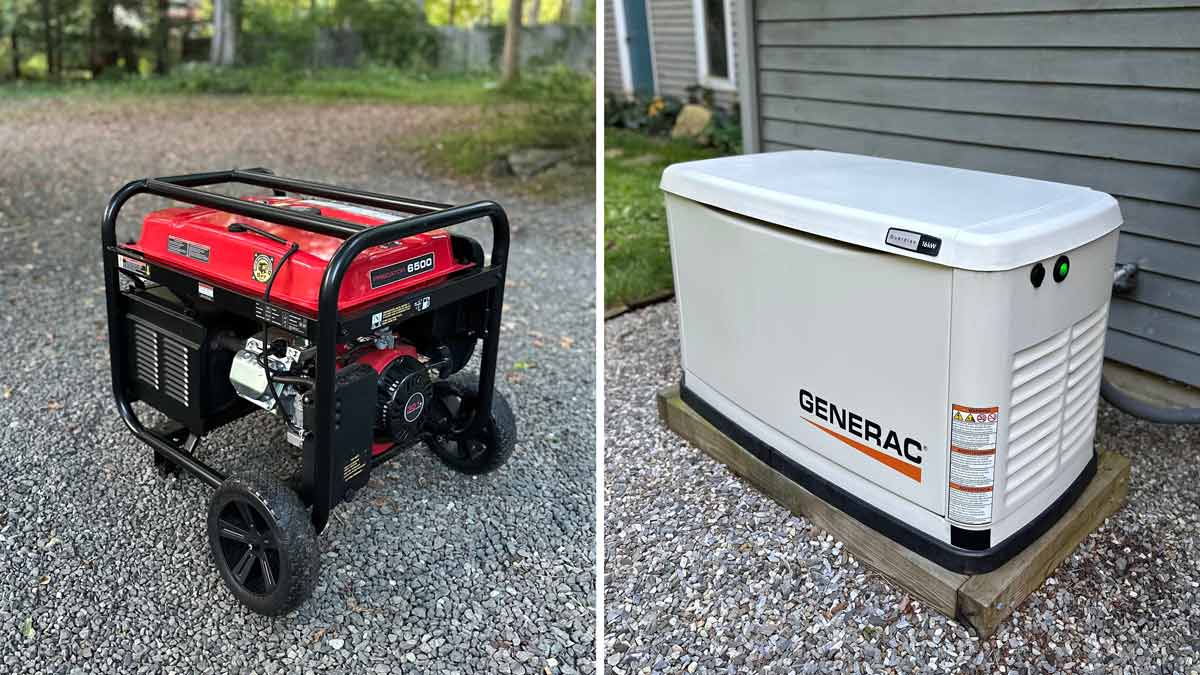

A short outage calls for a very different machine than a storm that can shut down a whole house. A phone, router, CPAP machine, and a few lights can run from a compact battery station, while a well pump, refrigerator, or central home circuits need the output and fuel flexibility of a full-size generator. The Best emergency backup power generators are not interchangeable, and choosing by wattage alone is an easy way to end up with the wrong kind of backup.
We compared nine products across those two camps, looking at output, battery capacity or fuel options, charging, portability, safety features, and the connections that matter during an outage. Jackery HomePower 3600 Plus is our top pick for broad home backup, while the list also includes compact stations and conventional generators for more specific needs.
Comparison table
| # | Product | Award | Output | Battery or fuel | Best for |
|---|---|---|---|---|---|
| 1 | Jackery HomePower 3600 Plus | Best overall | 3, 600W AC, 7, 200W in parallel | 3, 584Wh LFP | Whole home essentials without engine noise |
| 2 | DuroStar DS13000MXT | Best fuel flexibility | 13, 000W | Gas, propane, natural gas | High-demand home backup |
| 3 | DuroStar DS13000MX | Best dual-fuel powerhouse | 13, 000W | Gas, propane | Transfer-switch-ready backup |
| 4 | LIBRIDS 640Wh Power Station | Best UPS battery station | 600W, 1, 200W surge | 640Wh LiFePO4 | Routers, CPAP machines, and essentials |
| 5 | Oxseryn 4400W Inverter Generator | Best portable fuel generator | 3, 400W running, 4, 400W peak | Gas | RV and outage essentials |
| 6 | EnginStar 300W Power Station | Best CPAP companion | 300W AC | 296Wh lithium ion | Small electronics and medical equipment |
| 7 | ALLWEI 300W Power Station | Best compact LiFePO4 station | 300W, 600W peak | 256Wh LiFePO4 | Portable emergency charging |
| 8 | DaranEner Portable Power Station | Best lightweight station | 300W, 600W peak | 192Wh LiFePO4 | Grab and go power |
| 9 | Oxseryn 4400W RV Generator | Best basic RV setup | 3, 400W running, 4, 400W peak | Gas | RV users who need a 30A outlet |
1. Jackery HomePower 3600 Plus: Best Overall
Pros
- 3, 600W output handles demanding household essentials
- 3, 584Wh LFP battery provides substantial stored energy
- Expandable capacity up to 21kWh per unit
- Wheels and telescoping handle make relocation manageable
- Supports 120V and 240V operation in parallel
Cons
- 77.16-pound body is not a lift and carry solution
- Solar panels are optional
- Whole home connection requires a compatible transfer setup
Best for: households that want quiet, expandable backup for several essential circuits.
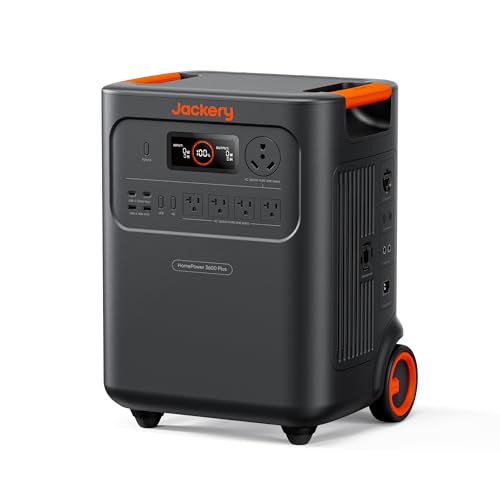
The Jackery HomePower 3600 Plus is the closest product here to a quiet home backup system rather than a camping battery with an inverter. It has enough output to run pumps, heaters, and dryers according to its product information, and its 3, 584Wh LFP battery gives it meaningful reserve capacity for an outage. That combination puts it well ahead of the smaller battery stations when the goal is to keep several household essentials available for more than a short interruption.
Its 3, 600W AC output is the key figure. That is a substantial step beyond the 600W output of the LIBRIDS 640Wh Power Station and the 300W class represented by ALLWEI, EnginStar, and DaranEner. The Jackery can also provide 7, 200W in parallel, with 120V and 240V support in that configuration. Those capabilities make it more suitable for serious home planning, though they should not be mistaken for permission to connect it directly to house wiring without the appropriate transfer equipment.
The battery chemistry is LFP, and the listed capacity is expandable to 21kWh per unit or 43kWh with multiple units. Jackery also lists 6, 000 cycles and a 10-year lifespan, along with battery cells tested at 302 degrees Fahrenheit and operation in conditions as cold as minus 4 degrees Fahrenheit. Those details matter for a backup product that may sit unused for long periods, then be called on during a difficult season.
Charging is flexible. The unit can reach full charge in 2 hours through hybrid AC and DC charging, 2.5 hours through AC, 4 hours through solar, or 2.5 hours from a gas generator. Its luggage-style design, wheels, and telescoping handle are sensible touches, but 77.16 pounds still makes stairs and uneven ground difficult. Compared with the DuroStar DS13000MXT, the Jackery is quieter and produces no exhaust at the point of use. Compared with LIBRIDS, it offers far more output and storage, but it is much larger and less convenient for a quick trip outside.
The main weakness is its role in a whole home setup. A transfer arrangement is still part of the installation, and the station is not a small appliance you casually move from room to room. It also lacks the unlimited runtime that a fuel generator can provide while fuel is available. Choose it if quiet operation, stored energy, and expansion matter more than engine runtime. It is the strongest all-purpose choice for readers who want substantial backup without running an engine beside the house.
2. DuroStar DS13000MXT: Best Fuel Flexibility

Pros
- Runs on gasoline, propane, or natural gas
- 13, 000 watts supports demanding home loads
- Push button start simplifies operation
- 50 amp outlet is ready for transfer switch use
- CO Alert automatically shuts the generator down when dangerous fumes are detected
Cons
- Large footprint requires dedicated storage space
- Fuel operation produces engine noise and exhaust
- The product information does not list a runtime figure
Best for: homeowners who want maximum fuel choice and high output during extended outages.
The DuroStar DS13000MXT is the most flexible conventional generator in this group. It accepts gasoline, propane, or natural gas, so the right fuel can depend on what is available after a storm. That is a meaningful advantage over the dual fuel DuroStar DS13000MX and the gas-only Oxseryn models, especially for a home with a natural gas connection.
Its headline output is 13, 000 watts, a large margin over every other fuel generator here and far beyond the battery stations. The product has a 50 amp transfer switch-ready outlet, which makes it a candidate for a properly installed whole home backup arrangement. It also has a push button start and a fuel selection knob on the front-facing panel. Those controls are more useful during a stressful outage than a complicated sequence of manual steps.
DuroStar includes CO Alert, which automatically shuts the generator down when harmful carbon monoxide levels are detected. That is an important safety layer, not a substitute for placing the machine outdoors and well away from doors, windows, and vents. The generator is physically substantial, with listed dimensions of 30.5 inches long, 27.3 inches wide, and 26 inches high. No one should plan to carry it into position without treating it as a wheeled, dedicated appliance.
The DS13000MXT has the advantage over the Jackery HomePower 3600 Plus when an outage lasts as long as fuel supplies do, and it is the better fit for appliances that demand sustained high output. Jackery is the more pleasant neighbor because it is quiet and produces no local exhaust. The DS13000MXT also beats the DS13000MX on fuel options, but both DuroStar models share the basic tradeoff of engine maintenance, outdoor operation, and storage requirements.
The missing runtime figure makes fuel planning less precise from the information provided. The unit is also far too large for someone who only needs to keep a router, phone, and a light running. Readers who want a high-output generator and already have a plan for fuel storage, ventilation, and transfer equipment should choose this model. It is the most capable pick when natural gas access matters as much as raw output.
3. DuroStar DS13000MX: Best Dual-Fuel Powerhouse

Pros
- 13, 000 watts of listed power
- Gasoline and propane flexibility
- Remote electric start
- CO Alert adds automatic shutdown protection
- 50 amp outlet supports transfer switch installation
Cons
- 220-pound weight limits mobility
- No natural gas option
- Large outdoor footprint is excessive for small loads
Best for: whole home backup where gasoline and propane are the preferred fuel options.
The DuroStar DS13000MX is built for the reader who does not want to make a small battery station carry a whole house. Its 13, 000 watts of listed output and 500cc engine put it in a different class from the portable power stations. This is a serious piece of equipment for storms, job sites, RV use, and home backup, with the physical size to match.
Its dual fuel system lets the owner choose gasoline or propane. Gasoline offers the familiar fueling route, while propane can be useful when stored fuel is part of the emergency plan. The front panel includes a fuel selector and push button electric start, so switching from planning mode to operation should be straightforward. DuroStar also lists a 50 amp outlet that is ready for a transfer switch, which is the connection that matters if the intention is to power selected home circuits rather than run extension cords through doors.
The metal construction and reinforced power panel suit a generator that will live outside during use and may see repeated handling. The unit weighs 220 pounds and measures 29.75 inches long, 27.5 inches wide, and 25.75 inches high. That is not portable in the everyday sense. It needs a level location, a clear operating area, and a storage plan that does not depend on lifting it into a vehicle.
Compared with the DuroStar DS13000MXT, this model gives up natural gas but keeps the same basic high-output approach. The Jackery HomePower 3600 Plus is much easier to use indoors because it has no engine exhaust, and LIBRIDS is much easier to place beside a router or CPAP machine. The DS13000MX wins when the priority is sustained high demand from gasoline or propane, especially when a transfer switch is already part of the home setup.
Its main weakness is the lack of a third fuel option and the sheer burden of moving it. A buyer who only needs electronics or overnight medical equipment should skip it in favor of a battery station. For a household that wants a large dual-fuel generator and can accommodate the installation, the DS13000MX is a straightforward, powerful choice. Readers comparing fuel systems may also want to consider how switching between gasoline and propane changes generator planning before deciding.
4. LIBRIDS 640Wh Power Station: Best UPS Battery Station

Pros
- 10ms UPS switching supports routers and CPAP machines
- 640Wh capacity is generous for a compact station
- Four AC outlets and eight total output ports
- 1.5 hour AC recharge
- LiFePO4 battery rated for 4, 000 or more cycles
Cons
- 600W output cannot replace a full home generator
- Indoor use only warning limits wet-weather placement
- No solar panel is included in the listed features
Best for: keeping networking, medical, and small household electronics running through brief outages.
The LIBRIDS 640Wh Power Station has one feature that makes it particularly useful in an outage: a built-in UPS with a listed 10ms transfer time. That allows a router, CPAP machine, or other essential device to switch to battery power automatically when utility power drops. For many homes, that immediate handoff matters more than a very high peak wattage figure.
The station provides 600W of output with 1, 200W surge capability. That is enough for everyday electronics and some small appliances, but not enough to take over for a furnace, electric range, or whole home electrical panel. Its 640Wh battery is substantially larger than the 192Wh DaranEner and the 256Wh ALLWEI, giving connected low draw devices more room to run before a recharge is needed.
There are four AC outlets and enough USB connections to power up to eight devices at once. The pure sine wave inverter is intended for sensitive electronics, and the LCD reports battery percentage plus input and output power. That display makes it easier to see whether a device is consuming a modest trickle or using the station quickly. The LiFePO4 battery is rated for 4, 000 or more cycles, and LIBRIDS lists a 1.5 hour full recharge through AC.
The metal enclosure should help with heat dissipation, but the product carries an indoor use only warning. It can be used in a dry, well-ventilated setting, yet it should not be exposed to rain, humidity, or precipitation. That caveat makes the Jackery HomePower 3600 Plus more adaptable for larger backup plans, while EnginStar is easier to carry for one or two devices. LIBRIDS makes the most sense when automatic switching is the priority.
The limitation is output, not battery design. Someone expecting to run high draw appliances will need a larger station or a fuel generator. Someone who needs uninterrupted power for a router, CPAP machine, or several small electronics should take the UPS feature seriously. This is the most focused pick in the group for short interruptions where a manual plug change would be inconvenient or risky.
5. Oxseryn 4400W Inverter Generator: Best Portable Fuel Generator

Pros
- 3, 400 running watts and 4, 400 peak watts
- ECO mode supports a listed 14 hour runtime at 25 percent load
- RV outlet and two 120V AC ports
- Fuel gauge makes the two gallon tank easier to monitor
- 56 pound body is manageable for a fuel generator
Cons
- Under 72 dBA at 23 feet is not silent
- Gasoline operation requires outdoor placement and maintenance
- Output is far below the two DuroStar home backup models
Best for: RV trips and essential home loads that need more output than a battery station can provide.
The Oxseryn 4400W Inverter Generator is the practical middle ground between a small battery station and a large whole home generator. At 56 pounds, it is heavy but movable, and its open frame gives it the familiar shape of equipment intended for an RV, campsite, or outdoor outage setup. It provides enough output for more demanding essentials without asking the owner to manage a 200-pound machine.
The generator is rated at 3, 400 running watts and 4, 400 peak watts. It has two 120V AC ports, a 12V DC port, and an RV port. That collection is more useful for mixed loads than a simple household outlet arrangement, especially for RV users. The distinction between running and peak output matters here. Starting loads can briefly require more power, but a device that continuously needs more than 3, 400 watts is outside the listed running capacity.
Oxseryn lists up to 14 hours of runtime at 25 percent load with ECO mode and a two gallon fuel tank. That is a light load scenario rather than a promise for heavy appliances, but it gives the buyer a useful picture of how load changes fuel use. The fuel gauge is another small but worthwhile detail because checking the tank at a glance is easier than guessing during a nighttime outage.
Noise is the compromise. The listing says under 72 dBA from 23 feet away, which is quieter than some open-frame designs may be, but it remains plainly audible. The Jackery HomePower 3600 Plus avoids that problem entirely, while the DuroStar DS13000MX provides much more output if portability is secondary. The Oxseryn wins when the generator needs to travel and the owner still wants substantially more power than the 300W stations.
The product information notes that factory testing can leave a slight gasoline smell on arrival. That is not a performance feature, but it reinforces the need to treat this as fuel equipment from the first day. Skip it if the generator must run inside or close to occupied spaces, or if silent operation is important. For an RV, campsite, or outdoor emergency kit, it is the most balanced conventional generator here.
6. EnginStar 300W Power Station: Best CPAP Companion
Pros
- 296Wh capacity in a 6.5 pound body
- Two 110V pure sine wave AC outlets
- Regulated 12V and 24V DC outputs
- Eight output ports support several devices
- AC, car, and compatible solar charging
Cons
- 300W AC output limits appliance choice
- 18W USB C is slower than the DaranEner USB C port
- Lithium ion battery has a shorter listed cycle life than the LiFePO4 stations
Best for: CPAP users and campers who need a light station for low draw electronics.
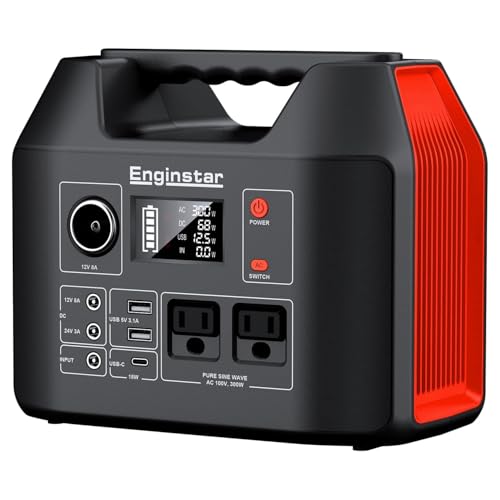
The EnginStar 300W Power Station is small enough to become part of a regular emergency kit rather than something stored in a garage and forgotten. It weighs 6.5 pounds and measures 9 by 5.5 by 7.5 inches according to the product features. That makes it a sensible companion for a CPAP machine, laptop, camera, phone, or small light when the goal is reliable access to a few essentials.
Its 296Wh capacity and 300W AC output place it close to ALLWEI and DaranEner, but its connection layout is distinct. EnginStar provides two 110V pure sine wave AC outlets, two regulated DC outputs at 12V and 24V, a USB port rated at 5V and 3.1A, and USB C at 18W. Pure sine wave output is a useful fit for sensitive electronics, while regulated DC can be preferable for compatible DC equipment.
The station supports three charging routes: a wall outlet, a 12V car socket, or a compatible solar panel. Its maximum charging speed is 65W, and the product information says it can reach 80 percent in 2 hours. The solar panel is not included. EnginStar also lists a battery management system with voltage and temperature control, plus protection against short circuits, overcharging, and overload.
Compared with the ALLWEI 300W Power Station, EnginStar offers a little more battery capacity and two AC outlets instead of one. ALLWEI has a LiFePO4 battery rated for 3, 000 charge and discharge cycles, while EnginStar uses lithium ion cells listed for more than 1, 000 cycles. DaranEner is lighter and has a 60W USB C port, but its battery capacity is smaller. These differences point to distinct buyers rather than a single winner.
The limitation is that 300W remains 300W. It can support a CPAP machine and small electronics, but it is not intended for hair dryers, heaters, or kitchen appliances. Battery care also matters, with a recommendation to recharge it every 2 to 3 months. Choose EnginStar when low weight, multiple output types, and medical equipment support matter more than long-term cycle count.
7. ALLWEI 300W Power Station: Best Compact LiFePO4 Station

Pros
- LiFePO4 battery rated for 3, 000 cycles
- 300W output with 600W pure sine wave peak
- USB C PD provides up to 60W
- Six output ports and pass-through charging
- Compact 6.4 pound design with SOS light
Cons
- Only one AC outlet
- 256Wh capacity is not suited to long appliance use
- Solar panel is sold separately
Best for: a compact, durable battery station for phones, laptops, and small emergency loads.
The ALLWEI 300W Power Station gets the basics right in a small package. It weighs 6.4 pounds and measures 9 inches long, 4.7 inches wide, and 7.8 inches high. That is close enough to the EnginStar for car storage or a closet shelf, but the LiFePO4 battery gives it a different ownership profile from the lithium ion alternative.
ALLWEI lists 256Wh of capacity, 300W continuous output, and 600W peak output through a pure sine wave inverter. The output is intended for laptops, mini fridges, CPAP machines, drones, and similar small devices, not large heating elements or motor loads that exceed the station's limits. The one AC outlet is joined by two DC5521 ports, a car socket, an 18W USB A fast charge port, and a 60W USB C PD port.
That 60W USB C connection is particularly useful for a laptop or a fast phone charge without using the AC inverter. Pass-through charging allows the station and connected devices to charge at the same time. ALLWEI also lists six-layer battery management protection, covering problems such as short circuit, over-current, and over-voltage conditions.
Recharge options include AC wall charging in 3.5 to 4 hours, car charging in the same range, and solar charging in 4 to 5 hours with a 100W panel. AC and solar can be used together for a listed 2 to 2.5 hour recharge. The station also includes a three-level LED light with SOS mode. Readers building an emergency kit around small electronics may find how much battery capacity travel devices really need useful when deciding how much equipment to keep charged.
The weak spot is the single AC outlet. EnginStar is easier when two AC devices must run at once, while DaranEner offers two AC outlets in a lighter station. ALLWEI counters with longer-life LiFePO4 cells, 60W USB C, and flexible dual charging. Choose it for repeated portable use and small electronics, not as a substitute for a generator that can run household appliances.
8. DaranEner Portable Power Station: Best Lightweight Station

Pros
- 5.73 pound body is the lightest here
- Two 300W AC outlets
- USB C PD supports 60W charging
- LiFePO4 battery rated for more than 3, 500 cycles
- Four-mode LED light includes SOS
Cons
- 192Wh capacity is the smallest in the group
- 60W maximum solar input is limited
- Not suitable for high power appliances
Best for: grab and go charging for phones, laptops, lights, and other low draw devices.
The DaranEner Portable Power Station is the one to reach for when portability matters most. Its listed weight is 5.73 pounds, and its compact 8.66 by 7.09 by 5.12 inch dimensions make it easy to keep in a vehicle, carry to a campsite, or move from a bedroom to a living room during an outage. It is not trying to be a home generator. It is a small reserve for essentials.
The station has a 192Wh LiFePO4 battery and 300W pure sine wave output, with a 600W surge figure. It provides two AC outlets, a 60W USB C PD port, two USB A ports with 18W QC3.0 support, and a 12V DC output. Six devices can be charged at once according to the listing, giving it a more useful layout than its small capacity might suggest.
DaranEner supports AC wall charging at up to 100W, car charging, and solar charging through a compatible panel at up to 60W DC input. The built-in MPPT controller is intended to improve solar charging efficiency. Neither the solar panel nor car charging cables are included in the listed package details, so the owner should confirm what accessories are needed before an emergency.
The 60W USB C port is a clear advantage over the EnginStar's 18W USB C connection, and the two AC outlets are more flexible than ALLWEI's single AC outlet. ALLWEI has more stored energy, while EnginStar offers a larger 296Wh capacity and additional regulated DC outputs. DaranEner wins on weight and cycle rating, with more than 3, 500 cycles listed for its LiFePO4 battery.
Its weakness is endurance. The 192Wh capacity can disappear quickly when an AC device draws heavily, and the product specifically excludes appliances such as rice cookers, hair dryers, and mini fridges that exceed its limits or have high startup surges. The integrated LED light has four brightness modes, including SOS, which is useful when an outage also means darkness. Choose DaranEner for the smallest practical emergency kit, not for multi-day home power.
9. Oxseryn 4400W RV Generator: Best Basic RV Setup

Pros
- 3, 400 running watts and 4, 400 peak watts
- 30A RV outlet
- ECO mode and listed 14 hour runtime at 25 percent load
- Low oil shutdown and overload protection
- 56 pound portable frame
Cons
- Gasoline only
- No electric start feature is listed
- Slightly heavier than the closely related Oxseryn model
Best for: RV owners who specifically need a 30A connection and portable fuel power.
The Oxseryn 4400W RV Generator is closely related to the other Oxseryn generator in this roundup, but its connection details make it a distinct pick. It is aimed squarely at RV use and home emergency backup, with 3, 400 running watts, 4, 400 peak watts, and a 30A RV outlet. For a camper with a matching connection, that can be more useful than a collection of small battery outputs.
The generator has two 120V AC ports, a 12V DC port, and the 30A RV port. Its inverter technology is paired with ECO mode, and the listing gives a runtime of up to 14 hours at 25 percent load. That figure describes a relatively light demand, so an RV owner running multiple high draw appliances should plan for shorter operation.
The two gallon fuel tank includes a fuel gauge, and the feature list includes overload protection, low oil shutdown, and cold start technology. These safeguards help with routine operation, although they do not remove the need for outdoor placement, fuel maintenance, and proper ventilation. The product is listed as EPA compliment, using the wording in its product information.
At 56 pounds, the generator is portable by fuel generator standards. The listed dimensions are 19.4 inches long, 15.2 inches wide, and 19.2 inches high, with a 57 pound product weight in the specifications. The Oxseryn 4400W Inverter Generator has a similar output and runtime claim, while its listing highlights a fuel gauge and an RV port without the same 30A wording. The DuroStar DS13000MXT is a much stronger home backup tool, but it is far less practical for an RV owner who needs a smaller generator.
The main drawback is that gasoline is the only listed fuel, and the data does not identify an electric start feature. The generator is also not a quiet battery station, despite its inverter design. It suits RV users who understand those tradeoffs and want a dedicated 30A connection. For household electronics, LIBRIDS is easier to live with, but for an RV hookup and outdoor operation, this Oxseryn is the more direct fit.
How to choose best emergency backup power generators
Start by deciding whether the backup needs to run silently from stored battery energy or continuously from fuel. The right choice then depends on output, stored capacity, connection type, safety, and how the equipment will be moved and maintained.
Continuous and peak output
Continuous output is the amount a generator can sustain, while peak or surge output covers a brief startup demand. A 300W battery station can handle phones, laptops, lights, and some CPAP machines, but it cannot replace a 3, 400W fuel generator for larger loads. List the appliances you actually need, add their running demands, and pay special attention to motors that start with a temporary surge.
Battery capacity and runtime
Battery capacity is expressed in watt hours, while generator runtime depends on fuel and load. A 192Wh station is useful for short, light tasks, whereas a 640Wh station gives low draw devices more reserve. The 3, 584Wh Jackery is in a different category again. Capacity does not guarantee a specific runtime because inverter losses and device demand affect how quickly energy is used.
Fuel options and recharging
Fuel generators can keep operating as long as suitable fuel is available, but they need outdoor placement and regular care. Dual fuel models provide gasoline and propane, while the DuroStar DS13000MXT adds natural gas. Battery stations can recharge from a wall outlet, car socket, or compatible solar panel. Check whether panels and cables are included before relying on solar recharging.
Outlets and transfer connections
A 30A RV outlet matters to an RV owner, while a 50 amp transfer switch-ready outlet matters to someone planning selected home circuits. Battery stations are more likely to provide AC outlets, USB ports, and DC connections for individual devices. Never connect a generator directly to home wiring without an appropriate transfer arrangement installed according to local requirements.
Safety and placement
Fuel generators produce carbon monoxide and must remain outdoors, away from openings and occupied areas. CO Alert is a helpful automatic shutdown feature on the DuroStar models, but it does not make indoor operation safe. Battery stations avoid engine exhaust, although the LIBRIDS listing specifically warns against wet and rainy conditions.
The most useful emergency generator is the one that matches your largest essential load without forcing you to ignore safe placement.
Portability and storage
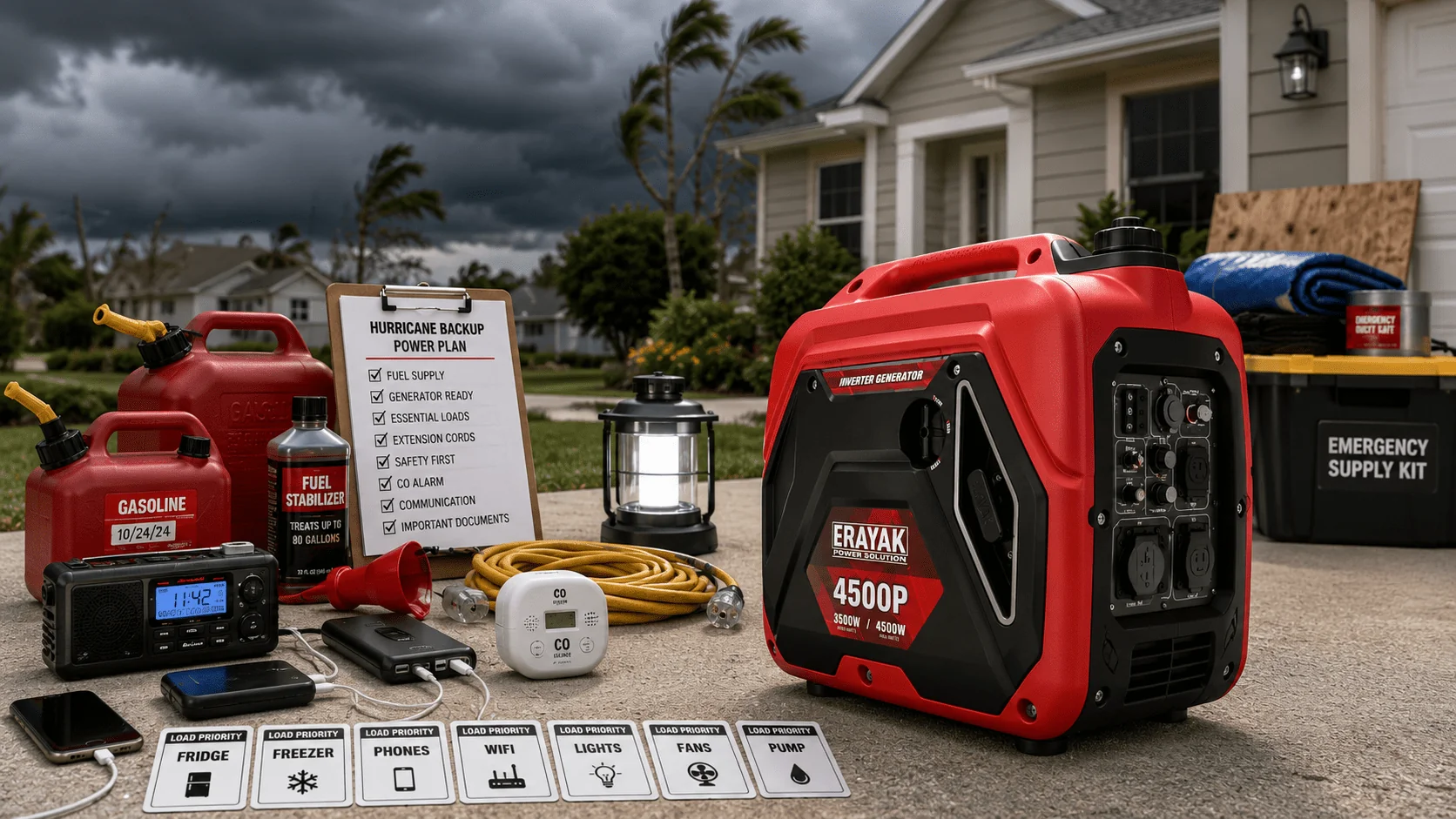
A 5.73 pound battery station can live in a closet or car, while the 220 pound DuroStar DS13000MX needs a dedicated storage and movement plan. Wheels and handles help with large battery stations, but stairs and uneven ground remain difficult. Fuel, cables, charging adapters, and maintenance supplies should all be stored where they can be found during an outage.
Frequently asked questions
Can a portable power station run a refrigerator during an outage?
Some can, but the refrigerator's startup surge and running demand must remain within the station's limits. The ALLWEI listing mentions mini fridges, while DaranEner specifically warns against mini fridges that exceed its output or have high startup surges. Check the refrigerator's electrical label and compare it with continuous and peak output.
Which generator is suitable for CPAP equipment?
The LIBRIDS 640Wh Power Station, EnginStar 300W Power Station, and the smaller battery stations are designed for low draw electronics and list CPAP use among their intended applications. A CPAP's runtime depends on humidification, heated tubing, pressure settings, and whether the machine uses its AC adapter. A larger battery capacity generally provides more reserve, but the machine's actual draw remains the deciding factor.
Are battery power stations safe to use indoors?
Battery stations do not produce the carbon monoxide exhaust associated with fuel generators, but indoor use still depends on the product's instructions and surroundings. LIBRIDS carries an indoor use only warning and should be kept dry and well ventilated. Never operate a gasoline or propane generator inside a home, garage, shed, or enclosed porch.
Is a 300W station enough for an emergency kit?
A 300W station is suitable for phones, tablets, laptops, lights, cameras, and some medical equipment. It is not suitable for high draw heaters, hair dryers, rice cookers, or similar appliances. For a small emergency kit, the connection layout and battery capacity can matter more than a large surge number.
What is the advantage of a tri fuel generator?
A tri fuel generator can use gasoline, propane, or natural gas. That gives the owner more options if one fuel is unavailable or difficult to store after a storm. The DuroStar DS13000MXT is the only product here with all three listed fuel choices.
Can these generators power an entire house?
The DuroStar DS13000MX and DS13000MXT are designed around high output and transfer switch-ready 50 amp connections. The Jackery HomePower 3600 Plus supports substantial essential loads and can provide 120V and 240V in parallel. Whole home operation depends on the home's electrical design, the selected loads, and a correctly installed transfer arrangement.
How often should a battery power station be recharged?
The recommendations vary by product. DaranEner advises recharging every 1 to 2 months, while EnginStar recommends charging every 2 to 3 months. Regular maintenance charging helps ensure the station is ready when needed, and it should be stored in the conditions specified by the manufacturer.
The bottom line
The Best emergency backup power generators split into two clear winners. Jackery HomePower 3600 Plus is the top choice for quiet, expandable backup with enough output and capacity for serious household essentials. DuroStar DS13000MXT is the better choice when long runtime, 13, 000 watts, and access to gasoline, propane, or natural gas matter more than noise and exhaust.
For smaller needs, LIBRIDS 640Wh Power Station is the most useful UPS-focused option, while DaranEner Portable Power Station is the easiest to keep ready for lightweight emergency charging. The Oxseryn models suit RV and portable fuel use, and EnginStar or ALLWEI make more sense for small electronics and medical equipment.
If you are undecided, write down the largest essential appliance you need to run, then choose the smallest generator that safely exceeds its running and startup demands.