

A thermal scope has one job after dark: turn a vague warm shape in the brush into something you can identify and track. The challenge is choosing between wide-field scanners, higher-magnification rifle scopes, and compact devices that make very different compromises.
Our Best night hunting thermal scope picks range from long-runtime AGM models to feature-heavy GOYOJO scopes and lighter options for close-range use. The AGM Rattler V2 25-256 is our top pick, with a strong mix of magnification, field practicality, recording features, and weather resistance.
Comparison table
| # | Product | Award | Resolution | Magnification | Runtime | Best for |
|---|---|---|---|---|---|---|
| 1 | AGM Rattler V2 25-256 | Best overall | 256 x 192 | 3.5x base, up to 8x digital | Up to 11.5 hours | Longer-range hunting |
| 2 | GOYOJO G210 Monocular | Best handheld monocular | 256 x 192 | Up to 4x digital | Over 6 hours | Scouting and observation |
| 3 | GOYOJO GRS225 | Best smooth tracking | 256 x 192 | 1x to 8x | 7 to 9 hours | Moving targets |
| 4 | AGM Rattler V2 19-256 | Best wide field of view | 256 x 192 | 2.5x base, up to 8x digital | Up to 11.5 hours | Brush and close to mid-range work |
| 5 | GOYOJO GRS225-RF | Best ranging tools | 256 x 192 | 1x to 8x | 7 to 9 hours | Hunters needing ballistic assistance |
| 6 | RIX Storm S2 | Best lightweight rifle scope | 256 x 192 | 3.5x to 14x | Not specified | Long-distance setups |
| 7 | Bansainong 384-288 | Best resolution on paper | 384 x 288 | 4x thermal, 7x night vision | 1.5 to 5 hours | Dual-mode viewing |
| 8 | Husk Masida 320-240 | Best compact option | 320 x 240 | 3x digital | Over 8 hours | Lightweight close-range use |
| 9 | AGM Rattler V2 19-256 Kit | Best ready-to-zero kit | 256 x 192 | 2.5x base, up to 8x digital | Up to 11.5 hours | Buyers who need setup accessories |
1. AGM Rattler V2 25-256: Best Overall

Pros
- 25mm Germanium lens and 3.5x base magnification
- Up to 11.5 hours of runtime
- Shot-activated video with audio
- IP67 protection and cold-weather operation
- Rangefinder and multiple reticle options
Cons
- Narrower view than the 19-256 model
- Digital zoom cannot replace additional native detail
- The listed specifications do not include a sensor resolution above 256 x 192
Best for: hunters who want a capable rifle-mounted thermal scope for longer sits and more distant targets.
The AGM Rattler V2 25-256 is the scope we'd put on a hunting rifle when the night may run long and the shooting lanes are not limited to close brush. Its 3.5x base magnification gives a more zoomed-in starting view than the AGM Rattler V2 19-256, while the 25mm Germanium lens is aimed at longer-range heat detection. The listed detection distance reaches 1, 250 yards, though detection is not the same thing as confidently identifying a target or placing a shot.
The 256 x 192 thermal sensor is paired with digital zoom up to 8x. That range is useful when a heat signature needs closer inspection, but the most dependable image work happens before pushing digital magnification to its maximum. Ten reticle options and four color options give the shooter room to tailor the view, and the stadiametric rangefinder can estimate distance without requiring a separate handheld tool.
Battery planning is a notable strength. The removable power system is rated for up to 11.5 hours, and two rechargeable batteries are included. Shot-activated recording with audio saves footage when the rifle fires, which is more practical than trying to press a button during a fast opportunity. The scope also includes IP67 waterproofing, shock resistance, and operation down to -22°F, so wet weather and cold are not immediate reasons to leave it behind.
The weakness is the trade-off for that 3.5x starting view. It gives up some of the wider situational awareness offered by the 19-256 model, especially in thick cover or when animals move quickly across the frame. This is also not a lightweight handheld monocular. The listed weight is 0.39625 pounds, but a rifle setup adds its own mounting and firearm considerations. Choose it for deliberate, longer-range observation, not for scanning every corner of dense brush.
2. GOYOJO G210 Monocular: Best Handheld Monocular

Pros
- 256 x 192 sensor with 12μm infrared detector
- Six selectable color palettes
- Up to 4x zoom and 16GB storage
- Replaceable batteries with over 6 hours of use
- App support for real-time image sharing
Cons
- Not a rifle-mounted scope
- IP65 protection is below the IP67 rating of several rifle scopes
- Its listed weight is 2.2046 pounds
Best for: hunters and outdoor users who need a separate thermal viewer for scouting, locating, and observing.
The GOYOJO G210 Monocular makes sense for the person who wants to scan an area before bringing a rifle-mounted optic into the decision. It is a handheld thermal viewer rather than a conventional riflescope, so it does not compete directly with the AGM or GOYOJO GRS225 models for aiming. Its role is broader: locate heat, watch movement, and share what the device sees with another person.
Its 256 x 192 thermal imaging sensor uses a 12μm infrared detector, and the device offers six palettes: White-Hot, Black-Hot, Red-Hot, Rainbow, Iron-Red, and Glimmer. The choice is not merely cosmetic. A palette that makes a warm animal stand out from the background can be easier to read than one that emphasizes a different part of the scene. Up to 4x zoom helps with inspection, while 16GB of image storage provides room for captured stills.
The G210 also brings a dedicated app for real-time thermal image sharing. That can be useful when one person is observing and another needs to understand the same scene, although the scope itself remains the more appropriate tool for a mounted aiming system. Replaceable batteries are rated for more than six hours of continuous use, and the IP65 weather-resistant design is suited to ordinary outdoor exposure.
There is a physical cost to the G210's versatility. The listed weight is 2.2046 pounds, which is substantial for a handheld device during a long walk or extended glassing session. Its IP65 rating also provides less water protection than the IP67 scopes here. If the priority is a rifle optic with reticles and shot recording, the AGM Rattler V2 25-256 is the clearer fit. Pick the G210 when scouting and shared observation matter more than mounting it to a firearm.
3. GOYOJO GRS225: Best Smooth Tracking

Pros
- 50Hz refresh rate for smoother movement
- 25mm objective lens and 256 x 192 sensor
- 1x to 8x adjustable magnification
- Recoil-activated video and 32GB storage
- IP67 waterproofing
Cons
- No integrated rangefinder or ballistic calculator
- 25mm optics are less suited to very close scanning than a lower-base-magnification scope
- The feature set may take time to configure
Best for: hunters who want fluid thermal motion, broad magnification control, and automatic shot recording.
The GOYOJO GRS225 stands out because its 50Hz refresh rate is directly relevant to tracking. A warm target moving through brush can be harder to follow when the view feels choppy, so a faster refresh rate is more useful here than a long list of decorative features. The scope starts with a 25mm objective lens and a 256 x 192 thermal sensor, then gives the shooter adjustable magnification from 1x to 8x.
The low end of that range is important. While the 25mm optics suit longer viewing, 1x lets the user keep a broader perspective before increasing magnification. The high-resolution 1440 x 1080 OLED display should make the scope's output easier to inspect, and the advertised thermal detection distance reaches 1, 224 yards. That figure describes finding a heat source, not identifying every detail at that distance.
Seven image modes and ten reticle options allow substantial setup flexibility. Auto AI Image Enhancement is intended to refine edge detail and thermal contrast in difficult terrain. RAV, or recoil-activated video, records when a shot is fired, and the built-in 32GB storage means the user does not need to manage a card for basic recording. Mobile app support adds real-time sharing for people nearby.
The GRS225 lacks the integrated rangefinder and ballistic assistance found in the GRS225-RF. That is the key reason to choose the RF version instead if holdover calculations are central to the hunt. The scope is also listed at 1.61 pounds, so it is not a featherweight addition to a rifle. Compared with the AGM Rattler V2 25-256, it offers a smoother 50Hz view and more flexible 1x starting magnification, while the AGM has longer stated battery life and a built-in stadiametric rangefinder.
4. AGM Rattler V2 19-256: Best Wide Field of View

Pros
- 2.5x base magnification for a wider view
- Up to 11.5 hours of runtime
- Two rechargeable batteries included
- Ten reticles, four color options, and 8x digital zoom
- IP67 protection and operation down to -22°F
Cons
- Less reach at the starting magnification than the 25-256 model
- 256 x 192 resolution limits fine detail at heavy digital zoom
- No stated high refresh rate
Best for: close to mid-range hunting in brush where finding a moving target quickly matters.
The AGM Rattler V2 19-256 is the more immediately useful AGM when the landscape is crowded with trees, grass, and short shooting lanes. Its 2.5x base magnification is lower than the 25-256's 3.5x, creating a wider field of view for scanning and keeping moving animals in sight. That difference can matter more than extra magnification when a target appears suddenly at close or medium distance.
It uses a 256 x 192 thermal sensor and offers up to 8x digital zoom. The stadiametric rangefinder helps estimate distance, while ten reticle styles and four color options let the user adapt the display to the surroundings. The scope also includes shot-activated recording with audio, so a firing event can be captured without interrupting the sight picture to operate a control.
Battery endurance is one of its strongest practical traits. AGM states up to 11.5 hours on a charge, and two rechargeable batteries are included. IP67 waterproofing, recoil resistance, and an operating range from -22°F to 131°F give it a broad environmental envelope. Those details make more difference on a long, wet stand than another menu option would.
The trade-off is straightforward: the 19-256 gives up some of the 25-256's reach. Digital zoom can enlarge a distant heat signature, but it cannot create the same native view as a more suitable optical setup. The Rattler V2 25-256 is the better fit for longer-range observation, while the GOYOJO GRS225 is more compelling for users who specifically want a 50Hz image. For dense cover, fast target acquisition, and long battery life, the 19-256 is the easier AGM to live with.
A thermal optic is only part of a nighttime setup. If daylight scouting and animal identification are also part of the plan, choosing a camera that handles movement in wooded terrain can fill a different role without asking the thermal scope to do everything.
5. GOYOJO GRS225-RF: Best Ranging Tools

Pros
- Integrated rangefinding and ballistic assistance
- 25mm objective lens with 256 x 192 sensor
- 50Hz refresh rate
- 1x to 8x magnification
- RAV recording, app sharing, and 32GB storage
Cons
- Heavier than the non-RF GRS225
- Battery life is stated as 7 to 9 hours, below the AGM models' maximum
- A rangefinder does not remove the need for a properly confirmed zero
Best for: experienced users who want ranging and holdover assistance built into the thermal scope.
The GOYOJO GRS225-RF is the specialized version of the GRS225. The core optical platform remains familiar, with a 25mm objective lens, 256 x 192 thermal sensor, 1440 x 1080 OLED display, and 1x to 8x adjustable magnification. Its defining addition is integrated rangefinding with ballistic assistance, intended to calculate holdover for shots where distance is difficult to judge by eye.
That feature changes the workflow more than a new color palette does. Instead of estimating range separately and then translating it into a holdover, the user can work through the scope's ranging and ballistic tools. The system still depends on a proper zero and appropriate setup, and no electronic aid can make an uncertain target identification safe. Used correctly, though, it reduces the number of separate steps between locating a target and making a considered shot.
The 50Hz refresh rate is shared with the regular GRS225, which helps preserve a smooth view when tracking movement. Seven image modes, ten reticle options, and Auto AI Image Enhancement provide ways to tune the display. RAV records the shot automatically, 32GB of internal storage holds footage, and the mobile app can share the view in real time.
The RF model is listed at 1.6755 pounds, slightly heavier than the non-RF GRS225, and its stated runtime is 7 to 9 hours rather than the AGM Rattler V2 models' maximum of 11.5 hours. That makes the decision clear. Choose the regular GRS225 if smooth motion and simpler operation are enough. Choose the GRS225-RF if integrated distance and ballistic tools are worth carrying the extra weight and managing the added setup.
6. RIX Storm S2: Best Lightweight Rifle Scope

Pros
- Approximately 0.97 pounds listed weight
- 3.5x base magnification and up to 14x magnification
- 25mm lens with 256 x 192 sensor
- NETD below 25mK
- Wi-Fi app support and 32GB storage
Cons
- Narrow 7.0-degree horizontal field of view
- No stated battery runtime
- Higher magnification can make close scanning more difficult
Best for: rifle setups where low optic weight and distant viewing matter more than a wide field of view.
The RIX Storm S2 takes a different route from the wide-view AGM Rattler V2 19-256. It is built around a 3.5x base magnification, a 25mm objective lens, and a listed weight of approximately 0.97 pounds. That makes it attractive for a rifle that needs to stay comparatively light, especially when the scope will be carried for long periods rather than used from a fixed position.
The 256 x 192 sensor is specified with NETD below 25mK, a sensitivity figure intended to describe how well the detector can distinguish small temperature differences. RIX also lists a 7.0-degree horizontal field of view and a detection distance of up to 1, 422 yards. The narrow view and higher base magnification work together: distant targets are the focus, but fast scanning in dense cover is less natural than with the AGM 19-256.
Magnification runs from 3.5x to 14x, giving the user plenty of room to enlarge a distant scene. RIX's RET image enhancement is designed to improve the appearance of the 256 detector output, and five image modes let the user tailor the view. The scope includes Wi-Fi integration with the RIX+ app, video and snapshot recording, and 32GB of built-in EMMC storage.
The missing piece is battery information. The product data does not specify a runtime, so anyone planning a full-night hunt should investigate the power system before committing. The simple button and bin-cover design is intended for dark, gloved operation, and the aluminum construction supports the compact approach. Pick the Storm S2 for its low listed weight and long-range orientation. Skip it if a wide field of view or clearly stated all-night battery endurance is more important.
For people who also glass during the day, the practical difference between a thermal rifle scope and a handheld optic becomes significant. A separate viewer can keep the rifle pointed safely while another person scans, much like a comfortable handheld optic helps with extended wildlife observation.
7. Bansainong 384-288: Best Resolution on Paper

Pros
- 384 x 288 thermal resolution
- 25mK sensitivity and 60Hz frame rate
- Thermal and night vision modes
- Eleven pseudo-color palettes
- Adjustable diopter and manual focus
Cons
- Shorter stated runtime than the AGM scopes
- Heavy at 2.2046 pounds
- Fixed 4x thermal and 7x night vision focal lengths
Best for: users who specifically want one device that combines thermal imaging with conventional night vision.
The Bansainong 384-288 is the most unusual rifle scope in this group because it combines thermal imaging and night vision rather than relying on thermal alone. Its thermal mode uses a 384 x 288 resolution and a 12μm sensor, while the product also lists 25mK sensitivity and a 60Hz frame rate. Those are appealing numbers for a scope intended to show smooth movement and subtle temperature differences.
The optical design is less flexible than the zoom systems on the AGM and GOYOJO models. Thermal viewing uses a fixed 4x focal length, while night vision uses a fixed 7x focal length. Manual focus and an adjustable diopter give the user control over clarity, including for nearsightedness, farsightedness, or presbyopia. The thermal field of view is listed at 35 degrees, and the night vision mode narrows to 25 degrees for more detailed viewing.
Eleven pseudo-color palettes make it easier to change how temperature differences appear. The listed thermal recognition range is 50 to 150 meters, while the night vision recognition range is also listed as 50 to 150 meters. A 35mm night vision detection objective lens is specified with detection up to 546 yards, but the separate detection and recognition figures are the more useful way to understand what the device can actually do.
Battery life is the main concern. The 2550mAh lithium-ion battery is rated for 3 to 5 hours of light use and approximately 1.5 to 2 hours under heavy operation. The listed weight is 2.2046 pounds, making it heavier than the other dedicated rifle scopes here. The Bansainong is worth considering for someone who genuinely needs both modes and accepts the battery burden. For a long thermal-only hunt, the AGM Rattler V2 25-256 is more practical.
8. Husk Masida 320-240: Best Compact Option

Pros
- 320 x 240 thermal resolution
- 3x digital zoom and 50Hz refresh rate
- Integrated crosshair and red laser
- Over 8 hours of battery life
- Very light listed weight
Cons
- Detection distance is listed at up to 100 meters
- IP66 protection is below IP67
- Red laser use requires careful attention to local rules and safe handling
Best for: close-range users who want a very light thermal aiming device with simple controls.
The Husk Masida 320-240 is the compact outlier. Its listed weight is only 120 grams, making it dramatically easier to carry than the full-size rifle scopes and the Bansainong. The scope uses a 320 x 240 thermal camera, a 2-inch display, 50Hz refresh, and 3x digital zoom. Those features point toward close-range use rather than the long-distance role of the RIX Storm S2.
The product lists target detection up to 100 meters. That is a much more modest envelope than the long-range claims attached to several other scopes here, but it can be the more honest fit for short lanes, small properties, or users who do not want a bulky optic. The crosshair and integrated red laser offer two aiming references, although the laser should be handled with the same care as any visible aiming device and checked against applicable rules.
Its aluminum alloy housing is rated IP66 for water and dust protection, and the scope is specified to operate from -30C to 55C. USB-C charging is a welcome practical detail, especially for a built-in battery, and the stated runtime is over eight hours. The 21mm rail compatibility and included mounting hardware are also called out, though the user should confirm rail fit and zero after installation.
The small size comes with clear limits. Three times digital zoom is useful for framing, but it is not the same as a longer optical system, and the 100-meter detection claim puts this scope in a different class from the AGM 25-256. The Husk Masida is the sensible pick for low weight and short-range simplicity. It is not the one to buy for distant target observation or the broadest environmental protection.
9. AGM Rattler V2 19-256 Kit: Best Ready-to-Zero Kit

Pros
- Same wide-view 2.5x AGM platform
- Up to 11.5 hours of runtime
- Two rechargeable batteries
- Thermal targets included for zeroing
- Limited 5-year manufacturer warranty
Cons
- The scope itself shares the 256 x 192 resolution limit
- The package is listed at 1 pound
- The included accessories do not change the scope's base magnification
Best for: buyers who want the AGM 19-256 platform with thermal zeroing targets and a cleaning cloth included.
The AGM Rattler V2 19-256 Kit is not a different optical design from the AGM Rattler V2 19-256 above. Its distinction is the package. It includes five AGM thermal targets for zeroing and a microfiber optics cleaning cloth, alongside the Rattler V2 19-256 scope. That makes it the more convenient listing for someone setting up a thermal rifle scope and wanting purpose-made targets on hand.
The underlying performance is familiar. A 2.5x base magnification provides the wide field of view that makes the standard 19-256 useful in brush, while 8x digital zoom supports closer inspection. The 256 x 192 thermal sensor, ten reticle styles, four color options, and stadiametric rangefinder form the same core aiming toolkit. Shot-activated recording with audio is also included.
Battery endurance reaches up to 11.5 hours, and two rechargeable batteries are supplied. IP67 waterproofing, recoil resistance, and an operating range from -22°F to 131°F give the scope useful protection for changing conditions. AGM also lists a limited 5-year manufacturer warranty for this package, which may matter to buyers who plan to keep the optic for several seasons.
The kit does not solve the 19-256's main limitation: it remains a 2.5x, 256 x 192 scope rather than a higher-magnification or higher-resolution model. The thermal targets make initial zeroing more orderly, but they do not add reach or detail. Compared with the standard AGM Rattler V2 19-256, choose this listing when the targets, cleaning cloth, and stated warranty are useful. Choose the AGM Rattler V2 25-256 when longer-range framing is the priority.
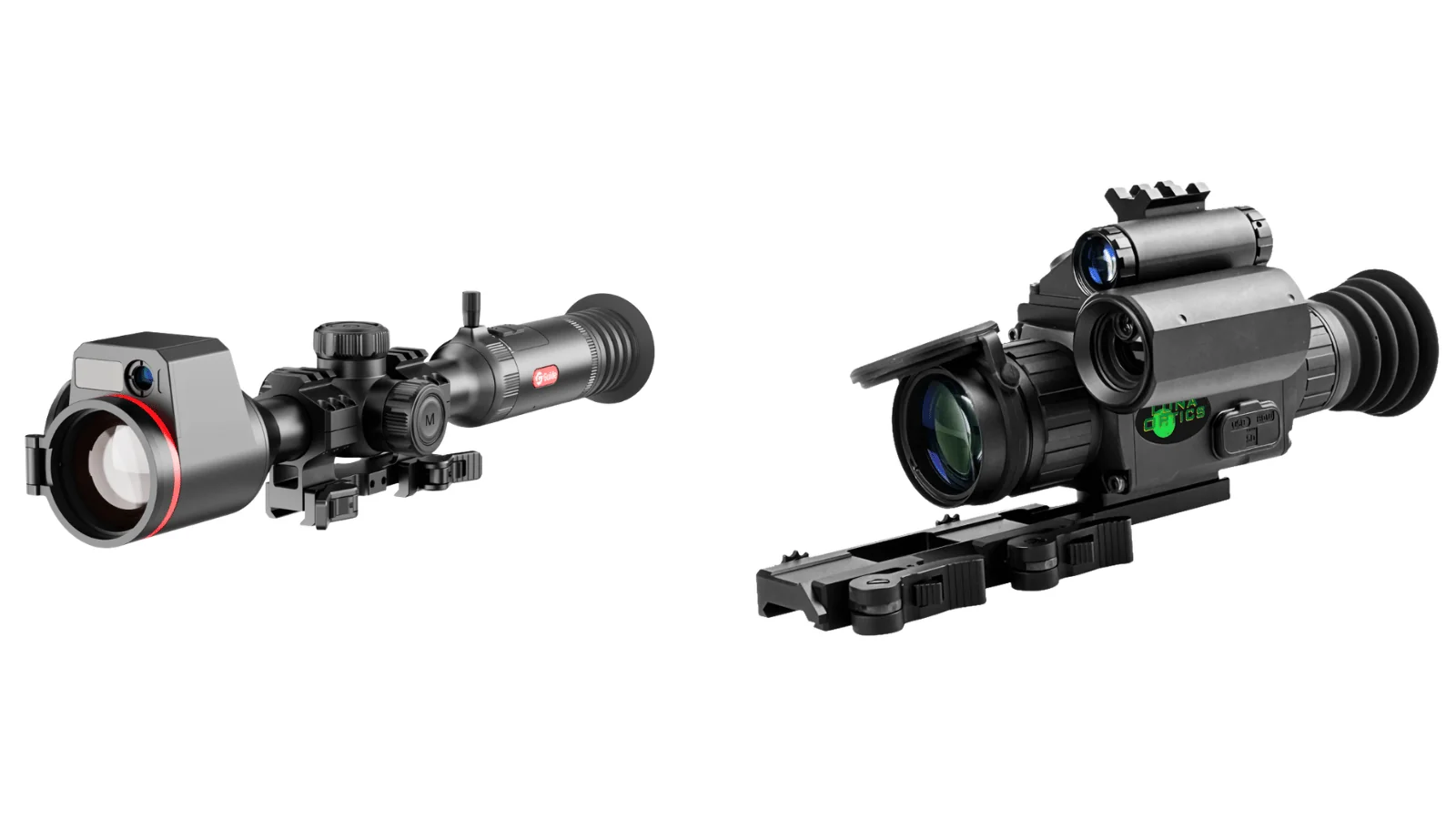
How to choose best night hunting thermal scope
The right thermal scope depends less on the longest detection claim than on how the optic frames movement, manages power, and supports a properly confirmed shot.
Sensor resolution and sensitivity
Resolution describes how many pixels form the thermal image. The 256 x 192 models here are capable of showing heat signatures, while the Bansainong's 384 x 288 sensor provides more image information. More pixels can help with separation and inspection, but lens choice, sensitivity, field of view, and software also affect what the user can actually distinguish.
Sensitivity figures such as 25mK or below 35mK describe the detector's ability to distinguish small temperature differences. A lower NETD figure is generally more capable of showing subtle contrasts, but it should not be treated as a guarantee of identification at a particular distance.
Magnification and field of view
A lower base magnification makes scanning easier and helps keep moving animals in view. The AGM Rattler V2 19-256 starts at 2.5x, while the 25-256 and RIX Storm S2 start at 3.5x. The GOYOJO GRS225 models offer a 1x to 8x range, giving them more flexibility before the user commits to a tighter view.
High digital magnification enlarges the image but does not add native sensor detail. For thick brush and quick movement, prioritize a usable field of view. For open terrain and distant observation, a higher base magnification and suitable objective lens may be more helpful.
Refresh rate
Refresh rate affects how smoothly motion appears. The GOYOJO GRS225, RIX Storm S2, Bansainong, and Husk Masida list 50Hz or 60Hz operation. That can make tracking movement more comfortable, particularly when an animal crosses the frame quickly.
A slower view is not automatically unusable, but it may feel less fluid during fast pans. A high refresh rate matters most when the user regularly tracks moving targets instead of observing a stationary heat source.
A long detection claim is useful only if the scope still gives you enough field of view and detail to identify what you are seeing.
Battery and power system
Long nighttime sessions reward clear battery planning. The AGM Rattler V2 models list up to 11.5 hours and include two rechargeable batteries. GOYOJO's rifle scopes list 7 to 9 hours, while the G210 monocular lists over six hours with replaceable batteries.
The Bansainong is the outlier, with approximately 1.5 to 2 hours under heavy use. The RIX product data does not specify runtime, so that omission should be resolved before a full-night trip. USB-C charging, removable batteries, and included spares each suit a different field routine.
Ruggedness and handling
IP ratings indicate resistance to dust and water, but they do not describe every aspect of recoil or physical durability. IP67 appears on the AGM and GOYOJO rifle scopes, IP66 on the Husk Masida, and IP65 on the G210 monocular. The RIX Storm S2 uses aluminum construction and is described as compact and lightweight.
Weight also changes how a rifle carries and balances. The RIX is listed at approximately 0.97 pounds, the Husk Masida at 120 grams, and the Bansainong at 2.2046 pounds. A heavier scope may offer more controls or a larger housing, but it can make a long walk more tiring.

Frequently asked questions
Is a thermal scope better than traditional night vision for hunting?
Thermal scopes detect heat rather than relying on visible light, so they can reveal warm animals against a dark background. Traditional night vision can show more conventional visual detail in suitable conditions. The Bansainong combines both modes, while the other products here are primarily thermal devices.
What resolution should a hunting thermal scope have?
The products in this roundup use resolutions from 256 x 192 to 384 x 288. Higher resolution can provide more image information, but lens size, sensitivity, magnification, and field of view also matter. A well-matched 256 x 192 scope may be more useful than a higher-resolution model with poor battery life or an unsuitable viewing angle.
How much magnification is useful at night?
It depends on distance and terrain. A 2.5x starting view is useful for scanning brush, while 3.5x or 4x can suit more distant targets. Adjustable systems such as the GOYOJO GRS225 models provide more control, but digital zoom should not be mistaken for additional native detail.
Do thermal scopes work in complete darkness?
Thermal scopes do not need visible light to detect heat signatures. Their performance can still be affected by weather, vegetation, distance, background temperature, and the contrast between the target and its surroundings. A detection specification does not guarantee positive identification at the same distance.
Is a rangefinder necessary on a thermal scope?
A rangefinder can simplify distance estimation, especially across open ground. The AGM Rattler V2 models list a stadiametric rangefinder, and the GOYOJO GRS225-RF adds integrated rangefinding and ballistic assistance. It is still necessary to confirm zero and use appropriate settings before relying on any electronic calculation.
How long should a thermal scope battery last?
For a full-night hunt, a stated runtime near eight to 11.5 hours provides more breathing room than a short battery. The AGM models list up to 11.5 hours, while the GOYOJO rifle scopes list 7 to 9 hours. Heavy use, cold temperatures, recording, and frequent display changes can reduce practical runtime.
Can a thermal monocular replace a thermal rifle scope?
A monocular such as the GOYOJO G210 is useful for scouting and observing, but it is not a direct replacement for a rifle-mounted optic with reticles and aiming controls. A separate monocular can help locate animals before the rifle is brought into position. Choose a dedicated riflescope when aiming and shot recording are the priority.
The bottom line
The AGM Rattler V2 25-256 is the strongest all-purpose choice in this group for hunters who want longer-range framing, a stadiametric rangefinder, automatic shot recording, and up to 11.5 hours of stated runtime. The AGM Rattler V2 19-256 is the better fit for thick cover, where its 2.5x base magnification gives a more useful scanning view.
For smoother motion and integrated ballistic assistance, the GOYOJO GRS225-RF is the more specialized alternative. The RIX Storm S2 is appealing when low weight and higher magnification matter most, while the Husk Masida makes sense for close-range users who value a compact design above long-distance reach.
If you are still undecided, choose the Best night hunting thermal scope by matching its field of view and battery plan to the terrain you actually hunt, not by chasing the largest detection number.
As an Amazon Associate we earn from qualifying purchases.