
A speaker for a living room has a very different job from one facing a noisy audience. The wrong choice can leave vocals buried, bass thin, or a simple music session dependent on a tangle of extra equipment. The Best powered speakers make the amplifier part of the speaker, so you can connect a source directly and get to the listening.
This group includes compact bookshelf pairs, TV-friendly stereo systems, and single PA cabinets built for microphones, live music, and larger rooms. The Alto TX410 is our top pick for its combination of output, portability, controls, and useful wireless features. The rest range from the smaller Alto TX408 and refined Yamaha DBR10 to complete party systems and polished home audio pairs.
Comparison table
| # | Product | Award | Driver or power | Inputs and features | Best for |
|---|---|---|---|---|---|
| 1 | Alto TX410 | Best overall | 10-inch LF driver, 350W | Bluetooth, two-channel mixer, TWS | Small events and PA use |
| 2 | Alto TX408 | Best compact PA | 8-inch LF driver, 350W | Bluetooth, two-channel mixer, TWS | Monitoring and intimate venues |
| 3 | Yamaha DBR10 | Best for clean output | 10-inch driver, 700W digital power | Main or monitor use | Musicians and presenters |
| 4 | JBL EON715 | Best control system | 15-inch woofer, 300W | Bluetooth, app, LCD, XLR and combo inputs | Flexible event setups |
| 5 | Pyle PPHP849KT | Best complete PA kit | Dual 8-inch speakers | Bluetooth, USB, SD, AUX, microphone, stands | Karaoke and casual gatherings |
| 6 | Edifier R1280T | Best small desktop pair | 4-inch full-range units, 42W RMS | Dual AUX, remote, bass and treble controls | Desks and near-field listening |
| 7 | PRORECK Party 12 | Best party bundle | 12-inch bass unit, 1800W peak | Bluetooth, USB, SD, FM, microphone, stands | Parties and mobile DJ use |
| 8 | Klipsch R-50PM | Best lively bookshelf pair | 5.25-inch woofers, 1-inch tweeters | Bluetooth and wired source support | Music in a small room |
| 9 | ULTIMEA BS-3 | Best TV connectivity | 5.25-inch woofer, three-way design, 70W RMS | HDMI ARC, RCA, optical, USB, Bluetooth 6.0 | TV, vinyl, and everyday audio |
| 10 | Klipsch The Sevens | Best premium home pair | 6.5-inch high-excursion driver | HDMI ARC, phono, optical, Bluetooth, sub out | Room-filling home listening |
1. Alto TX410: Best Overall

Pros
- Strong 10-inch PA format without excessive bulk
- Two-channel mixer handles microphone, line, and Bluetooth sources
- True Wireless Stereo can create a cable-free stereo setup
- Metal grille, handles, pole socket, and monitor positioning
- Wide 90° by 60° horn coverage
Cons
- Larger than the TX408 for small rooms
- Single-speaker configuration does not create stereo by itself
- Built for PA duties rather than subtle near-field listening
Best for: anyone who needs one adaptable powered PA cabinet for music, speech, rehearsal, or small performances.
The Alto TX410 is the speaker we would put in the back of a car when the assignment is unclear. It can cover a rehearsal, a speech, a small venue, or background music at a gathering without forcing you to decide in advance which type of source you will use. The 10-inch low-frequency driver gives it a useful balance between portability and room coverage, while the metal grille and integrated handles make the cabinet feel ready for regular movement.
Its 350W bi-amplified design is split between a 250W low-frequency section and a 100W high-frequency section. That arrangement matters because the woofer and compression driver get dedicated amplification rather than sharing a single undifferentiated channel. The 1-inch titanium diaphragm high-frequency compression driver works with the 90° by 60° horn to spread sound across a broad area, helping speech and music reach listeners away from the center line.
The controls are more useful than a basic volume knob. The built-in two-channel mixer accepts microphone, line-level, and Bluetooth sources, and the mix output can link another speaker. Bluetooth supports streaming and True Wireless Stereo, so two compatible TX cabinets can be used together without a conventional audio cable between them. The 36mm pole socket gives you a straightforward way to raise the cabinet above a crowd, while floor-monitor positioning covers stage use.
Compared with the smaller Alto TX408, the TX410 gives the low end more physical presence and should be the easier choice when the room or audience starts to grow. The Yamaha DBR10 offers a more established pro-speaker design and higher stated digital power, while the JBL EON715 brings deeper control through its app and DSP system. The TX410 sits between those approaches, with controls that are easy to understand and enough flexibility for most ordinary PA jobs.
The limitation is its single-cabinet format. Bluetooth TWS can address stereo use, but one TX410 remains a mono PA source until you add another speaker. It is also not the right shape or voicing for a desk, and listeners seeking a relaxed home stereo system should look to the Klipsch R-50PM or Klipsch The Sevens instead. For the buyer who wants one powered speaker that can handle a microphone one day and music playback the next, the TX410 is the most balanced pick here.
2. Alto TX408: Best Compact PA

Pros
- Compact 8-inch cabinet with 350W bi-amplified power
- Bluetooth and True Wireless Stereo
- Two-channel mixer with microphone, line, and Bluetooth inputs
- 36mm pole socket and floor-monitor positioning
- Lighter than the TX410
Cons
- Less low-frequency authority than the TX410
- One cabinet does not provide conventional stereo
- Controls are aimed at PA work, not home cinema
Best for: performers, presenters, and home studios that need a portable PA cabinet for smaller spaces.
The Alto TX408 is the sensible compact alternative to a full-size PA box. At 16.61 inches high and about 13 pounds, it is easier to carry and place than the TX410, yet it retains the same basic operating idea. This is an active speaker for a microphone, line source, or wireless playback, not a passive cabinet waiting for a separate amplifier.
The 8-inch low-frequency driver is paired with a 1-inch titanium diaphragm high-frequency compression driver and a 90° by 60° wide-dispersion horn. Alto gives the cabinet 350W of Class-D amplification, divided into 250W for low frequencies and 100W for high frequencies. Those details point to a speaker designed to keep vocals intelligible and music energetic in a rehearsal room, gym, intimate venue, or as an on-stage monitor.
The two-channel mixer is the practical highlight. A microphone and background music source can run at the same time, and the mix output allows another speaker to be linked. Bluetooth handles ordinary streaming, while TWS allows two compatible speakers to work as a wireless stereo pair. The integrated 36mm pole socket, rugged metal grille, and ergonomic handles make the TX408 easy to deploy in either elevated PA or floor-monitor duty.
The Alto TX410 is the better choice when bass weight and wider physical scale matter, but the TX408 is less awkward when one person has to move and set up the system. It is also a more natural fit for a home studio or smaller performance space than the larger JBL EON715. The Edifier R1280T takes up less room still, but it lacks the TX408's PA mixer, pole mount, and high-output design.
The compromise is predictable. An 8-inch cabinet cannot create the same low-end impact as a 10-inch or 12-inch model, and the TX408 remains a mono cabinet unless paired. It is not the pick for a large outdoor audience or bass-heavy dance music. Choose it when portability and clear, flexible reinforcement matter more than maximum scale.
3. Yamaha DBR10: Best for Clean Output

Pros
- Bi-amplified 10-inch format
- Stated 700W of clean digital power
- 129dB SPL capability
- 55Hz to 20kHz stated frequency range
- Suitable as a main or monitor speaker
- Seven-year warranty listed in the product details
Cons
- Heavier and bulkier than the Alto TX408
- Less source flexibility listed than newer feature-rich models
- A single cabinet is not a complete stereo system
Best for: musicians and presenters who prioritize controlled PA output over lifestyle features.
The Yamaha DBR10 is the straightforward professional tool in this group. It does not lead with a long list of playback modes or consumer conveniences. Instead, its appeal is a familiar 10-inch bi-amped cabinet intended to work as either a main speaker or a monitor, with enough output headroom for demanding live use.
Yamaha lists 700W of clean digital power and a maximum SPL of 129dB. Those figures describe the speaker's ability to produce loud sound, but the more telling detail is the stated 55Hz to 20kHz frequency range at minus 10dB. A 10-inch cabinet reaching down to 55Hz can provide body to vocals, guitars, and recorded music, though it is not a replacement for a dedicated subwoofer when the program depends on very deep bass.
FIR-X tuning is included to shape the response and keep the cabinet's output coherent. The 21-pound enclosure is not featherlight, and its listed dimensions are larger than the Alto models, so transport and placement deserve some thought. That extra physical presence is a trade-off for a speaker intended to remain composed when used as a main cabinet or turned toward a performer as a monitor.
The Alto TX410 is easier to recommend when Bluetooth, TWS, and a built-in two-channel mixer are central to the job. The JBL EON715 goes further with app control, an LCD screen, automatic feedback suppression, and delay functions. The DBR10 makes more sense for someone who already has a source mixer or microphone setup and wants the speaker itself to concentrate on amplification and coverage.
Its weakness is connectivity information that feels less expansive than the newer feature sets around it. Buyers looking for direct USB playback, a remote, or extensive phone control should consider the PRORECK Party 12 or JBL instead. For a band, presenter, or venue operator who wants a serious main or monitor cabinet and does not need lifestyle extras, the DBR10 remains a focused option.
4. JBL EON715: Best Control System

Pros
- 15-inch woofer for broad, substantial output
- JBL Pro Connect app and backlit color LCD
- DSP includes EQ, limiters, delay, feedback suppression, and ducking
- Bluetooth streaming and multiple professional inputs
- Pole mounting, stacking, and suspension options
Cons
- About 37 pounds before adding accessories
- More system than a casual home listener needs
- One cabinet is not a stereo pair
Best for: event operators and performers who want detailed control over a flexible PA system.
The JBL EON715 is the most configurable single PA speaker here. Its 15-inch woofer gives it a substantially larger physical format than the Alto TX410 and TX408, and JBL positions it for use as a main PA, stage monitor, or floor monitor. This is a cabinet for people who expect to change the setup from event to event and want the processing to follow along.
The speaker uses 300W of discrete Class-D amplification. That figure should not be compared directly with every peak or combined system claim in this list, because manufacturers describe amplifier output differently. The useful point is that the EON715 combines its amplifier with DSP that includes EQ, limiters, delay, dbx Automatic Feedback Suppression, and ducking. These tools can make a real difference when a speaker must handle speech, music, and microphones in the same room.
Control is available directly from the backlit color LCD or remotely through the free JBL Pro Connect app. Bluetooth handles wireless streaming, while four XLR and 1/4-inch combo jacks and an XLR male through output accommodate a more conventional PA rig. The advanced waveguide and transducer are designed for uniform coverage, and the cabinet can be pole mounted, stacked, or suspended using the available mounting points.
The Yamaha DBR10 is smaller and more focused, while the Alto TX410 offers a simpler hands-on mixer and a lighter package. The EON715 is the stronger pick when the operator needs delay, feedback control, or remote adjustments rather than just source selection and volume. It also gives you a path to more low-frequency output with the optional EON718S subwoofer, though that is an additional component.
The main drawback is size. At 28.2 inches high and 37.3 pounds, it demands more storage and more effort than the compact PA picks. It is also excessive for a desk or ordinary living room listening. If you manage events, lead a live act, or need a speaker that can adapt to a complicated venue, the EON715's control system justifies its bulk.
5. Pyle PPHP849KT: Best Complete PA Kit

Pros
- Dual 8-inch speaker arrangement
- Bluetooth playback with USB, SD, and AUX support
- Includes microphone and speaker stands
- High-frequency 1-inch tweeters
- Titanium diaphragm compression driver
- Rugged enclosure design
Cons
- Considerably heavier than a single compact cabinet
- Less detailed processing than the JBL EON715
- Product information does not provide a detailed frequency range
Best for: karaoke, announcements, and casual gatherings where a ready-made kit matters.
The Pyle PPHP849KT takes a different approach from the single-cabinet PA speakers. It is a dual 8-inch system intended to give the buyer a broader setup in one package, with a microphone and speaker stands included. That makes it a natural fit for karaoke, announcements, family gatherings, and occasional events where assembling a separate mixer and stand system would add unnecessary friction.
Each speaker uses an 8-inch driver, high-frequency 1-inch tweeters, and a compression driver with a titanium diaphragm. Pyle describes the system as rugged and durable, while the listed package weight is about 32.65 pounds. That is not especially light, but it represents a complete two-speaker arrangement rather than a single box. The system should be easier to spread across a room than a lone PA cabinet.
Wireless streaming is only part of its source flexibility. Bluetooth is joined by MP3, USB, SD, and AUX playback, which is useful when the event's music lives on a flash drive or memory card rather than a phone. The included microphone helps with immediate vocal use, but the data does not provide the kind of detailed DSP, delay, or feedback-control feature set found in the JBL EON715.
The Alto TX408 is the cleaner choice for a musician who wants one compact, professional-style cabinet with a two-channel mixer. The Pyle is more appealing when the goal is a complete two-speaker package with accessories and several simple playback methods. The PRORECK Party 12 offers a larger 12-inch format, wheels, FM radio, and more accessories, but it is also a much larger system to store.
This is not the kit for someone who needs precise control over a complex live mix. The product details do not specify a frequency range or extensive signal processing, so buyers should keep expectations centered on accessible event audio rather than studio-style refinement. Choose it for practical all-in-one setup, particularly when karaoke and announcements are more important than fine system tuning.
6. Edifier R1280T: Best Small Desktop Pair

Pros
- Compact stereo pair with a wood-effect MDF enclosure
- 4-inch full-range units and 13mm silk dome tweeters
- Two AUX inputs for simultaneous wired sources
- Remote control included
- Side-panel bass and treble controls
Cons
- No Bluetooth listed
- Not designed for large rooms or PA duties
- Less bass scale than larger powered pairs
Best for: desktop listeners, small offices, and near-field music playback.
The Edifier R1280T is the clear reminder that powered speakers do not all need to be stage cabinets. This compact pair is designed to sit near the listener, with a wood-effect MDF enclosure that looks more at home beside a desk or shelf than on a speaker stand. Its 5.8-inch height and 10.8-pound listed weight make it one of the easiest systems here to place in a tight workspace.
The 2.0 arrangement uses a 4-inch full-range unit and a 13mm silk dome tweeter in each speaker. Edifier lists 42W RMS power for the system, which is appropriate for near-field listening rather than trying to fill a hall. At a desk, the shorter listening distance means you can hear detail and stereo separation without asking the speakers to produce the physical scale needed by a 10-inch PA cabinet.
Two AUX inputs allow two wired devices to stay connected at once, avoiding repeated cable swapping. The remote handles volume from a distance, while bass and treble knobs on the side of the powered speaker allow basic tonal adjustment. These are modest controls, but they are exactly the features that make a small system pleasant to live with. For a computer setup, a speaker arrangement that keeps the desk clear and the listening position centered can matter as much as maximum output.
The ULTIMEA BS-3 is a much more capable home hub, with HDMI ARC, optical, USB, Bluetooth, and a subwoofer output. The Klipsch R-50PM has a larger 5.25-inch woofer and a livelier presentation for room listening. The Edifier wins on simplicity and compactness, and its dual AUX layout is more convenient than a system that assumes one primary digital source.
The obvious limitation is the lack of Bluetooth in the listed features. You will need a wired connection, and the 4-inch units are not intended to supply deep, room-shaking bass. Skip it for parties, large rooms, or a TV system that needs HDMI control. Keep it in mind for a desk, bedroom, or small listening position where clean stereo sound and uncomplicated controls are the real priorities.
7. PRORECK Party 12: Best Party Bundle

Pros
- 12-inch bass unit and 1-inch tweeter
- 1800W peak power claim
- Bluetooth, USB, SD, and FM radio playback
- Includes two stands, remote, wired microphone, and power cord
- Wheels for easier movement
- Microphone, RCA, and Speakon connections
Cons
- 60-pound listed weight makes transport a two-person consideration
- Large footprint for casual indoor listening
- Peak power figure does not describe continuous output
Best for: parties, karaoke, mobile DJ use, and gatherings that need a broad accessory bundle.
The PRORECK Party 12 is built around convenience and spectacle. This is a two-way active and passive system with a 12-inch bass unit, a 1-inch tweeter, two stands, a remote control, a wired microphone, and a power cord. The pair is substantial, with a listed weight of 60 pounds and transport wheels at the bottom, so it is not a casual shelf speaker. It is a portable event system in the literal sense.
PRORECK states an 1800W peak power figure. Peak numbers are not the same as continuous amplifier output, so they should not be used as a direct comparison with the Yamaha DBR10 or Alto's bi-amplified figures. The more tangible hardware is the 12-inch low-frequency driver, titanium diaphragm compression driver, and 1-inch tweeter. That combination is aimed at room-filling music with punchier bass than the 8-inch systems can typically provide.
Playback options are extensive. Bluetooth covers phones, tablets, and PCs, while USB and SD card readers allow direct file playback. FM radio is built in, and an LCD screen shows the active mode. The rear control section provides master, microphone, treble, and bass adjustment, while XLR and 1/4-inch microphone input, RCA line input and output, and a Speakon output support a wider system. A 35mm stand mount is included.
The Pyle PPHP849KT is smaller and simpler, but it includes its own microphone and stands while offering a dual 8-inch setup. The PRORECK goes bigger and adds wheels, FM, a remote, and a Speakon connection for the passive speaker. The JBL EON715 is the more serious choice for DSP, app control, and venue management, but the PRORECK is more immediately geared toward a party host who wants the accessories in the box.
The weakness is the physical burden. A 60-pound system with a wide listed footprint takes planning, and the product's peak power description does not tell you how much continuous clean output to expect. It is a poor fit for a desk or refined living-room system. Choose it when karaoke, outdoor gatherings, and direct playback from removable media matter more than subtle tonal balance.
8. Klipsch R-50PM: Best Lively Bookshelf Pair
Pros
- Stereo pair with 5.25-inch woofers
- 1-inch LTS aluminum tweeters
- Tractrix horns for a wide soundstage
- Bluetooth streaming and simple plug-and-play setup
- Copper-spun TCP woofer design
- Magnetic grilles
Cons
- Nearly 30 pounds listed for the pair
- More prominent and energetic presentation may not suit every listener
- No HDMI ARC listed
Best for: listeners who want an engaging stereo pair without a separate receiver.
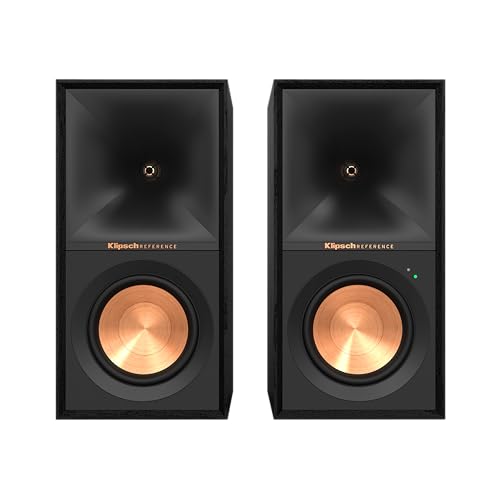
The Klipsch R-50PM is a home stereo system with enough personality to avoid sounding anonymous. It uses a pair of powered bookshelf speakers, so there is no separate AVR or amplifier to find. Plug the two speakers into each other, connect a source, and the system is ready for music. Bluetooth makes the simplest setup wireless, while wired lines are available for other sources.
Klipsch pairs its 5.25-inch copper-spun TCP woofers with 1-inch aluminum Linear Travel Suspension tweeters. The tweeter uses a Kapton suspension and is intended to minimize distortion, while the enlarged edge-to-edge Tractrix horns spread high frequencies across a wider listening area. In practice, that design emphasis points toward crisp attacks, prominent vocals, and a strong sense of projection rather than a soft, background presentation.
The R-50PM is more compact than a PA cabinet, but the pair's listed weight is nearly 30 pounds and the speakers still need shelf or stand space. The low-profile magnetic grilles can be removed to show the copper-colored cones or left in place for a quieter visual presentation. It is an easy system to operate, though the listed features do not mention HDMI ARC, a phono input, or the more extensive source switching found on the larger Klipsch model.
The Edifier R1280T is smaller and better suited to close desktop listening, while the ULTIMEA BS-3 is more useful for a TV because it includes HDMI ARC and dialogue modes. The Klipsch The Sevens goes further in resolution, connectivity, cabinet materials, and low-frequency scale. The R-50PM occupies the middle ground for someone who wants lively stereo music without moving into a full component system.
Its limitation is flexibility. It can stream and accept wired sources, but the information supplied does not show the TV-oriented control or source range of the ULTIMEA and Sevens. Listeners who prefer a restrained, neutral balance may also find the horn-loaded presentation too forward. For energetic music in a small or medium room, it is a convincing, uncomplicated pair.
9. ULTIMEA BS-3: Best TV Connectivity

Pros
- Three-way design with 5.25-inch woofer, midrange, and tweeter
- 70W RMS output
- HDMI ARC, optical, RCA, USB, and subwoofer output
- Bluetooth 6.0 and Auracast support
- App EQ with music, movie, and game modes
- Clear Dialogue feature
Cons
- Turntable needs a built-in preamp or external phono preamp
- External subwoofer is not included
- Larger and less desk-friendly than the Edifier R1280T
Best for: TV viewers who also want music and record-player connectivity in one powered stereo system.
The ULTIMEA BS-3 is the most versatile home entertainment pair in the list below the premium Klipsch option. Its central advantage is not simply that it is powered. It is that the speaker system can sit between a TV, a record player, a phone, and a future subwoofer without requiring a separate receiver. That makes it a practical choice for a mixed-use room.
The three-way design uses a 5.25-inch woofer, a dedicated midrange driver, and a tweeter. ULTIMEA lists 70W RMS output and says the arrangement is intended to provide clearer highs, fuller mids, and deeper bass than a standard two-way bookshelf speaker. The 5.25-inch woofer gives voices and music more physical weight than the Edifier R1280T, while the dedicated midrange driver is useful for dialogue and vocal presence.
HDMI ARC is the key TV feature. A compatible television can send audio to the speakers through one HDMI connection, and the TV remote can control the system through ARC. Optical, RCA, USB, and Bluetooth 6.0 expand the source options, while a SUB OUT port allows an external powered subwoofer to be added later. The app provides EQ customization and modes for music, movies, games, and everyday listening, with a Clear Dialogue setting for speech.
This is where the BS-3 differs from both Klipsch pairs. The Klipsch R-50PM is more focused on lively music and does not list HDMI ARC, while Klipsch The Sevens combines similarly broad home connectivity with more premium materials and high-resolution decoding. The ULTIMEA is also more adaptable than the Edifier R1280T, which has two AUX inputs but no listed wireless or TV-specific connection.
The turntable requirement deserves attention. A record player without a built-in preamp needs an external phono preamp before connecting to the RCA input. The subwoofer is also an optional addition, not part of the system. Buyers who want a compact desktop pair should choose the Edifier instead, but for a living room that needs TV audio, vinyl, wireless music, and room to expand, the BS-3 is the most flexible middle-size option.
10. Klipsch The Sevens: Best Premium Home Pair
Pros
- 6.5-inch high-excursion drivers
- 90° by 90° Tractrix horns
- 192kHz / 24-bit decoding
- HDMI ARC with TV remote control
- Phono, RCA, optical, 3.5mm, Bluetooth, and subwoofer output
- Real wood finishes, metal controls, fabric grilles, and cork pads
Cons
- Heavy 22-pound listed weight
- Larger cabinets need deliberate placement
- More than a basic desktop system requires
Best for: home listeners who want high-resolution stereo sound and broad source support without a receiver.
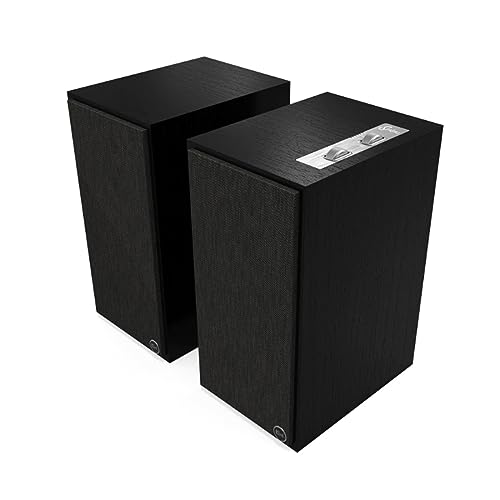
The Klipsch The Sevens are the most complete traditional stereo pair in this selection. They look like furniture rather than stage equipment, but the built-in amplification means you do not need an AV receiver or integrated amplifier. The pair is substantial, with a listed 22-pound weight and 16.38-inch height, so these are speakers to place carefully on a console, sturdy shelf, or dedicated stands.
Klipsch uses a 6.5-inch high-excursion driver and a large 90° by 90° Tractrix horn. The larger driver gives the pair a stronger foundation than the R-50PM's 5.25-inch woofer, while the broad horn is designed to transfer high-frequency energy efficiently into the listening area. The result should suit listeners who want a larger soundstage and more authority from a stereo pair without adding a separate amplifier.
The Sevens support 192kHz / 24-bit decoding, though the audible result will depend on the source and the rest of the system. Connectivity is the real day-to-day strength: HDMI ARC, digital optical, 3.5mm analog, RCA and phono inputs, Bluetooth, and a subwoofer output are all listed. HDMI ARC lets an existing TV remote control speaker volume, and the phono input is a more direct fit for a turntable than the BS-3's RCA input when the source needs phono compatibility.
The ULTIMEA BS-3 is more compact and still offers HDMI ARC, Bluetooth 6.0, app EQ, and subwoofer expansion. The Sevens answer with higher-resolution decoding, larger drivers, a more substantial cabinet, and premium details such as real wood finishes, metal controls, fabric grilles, and cork pads. The Klipsch R-50PM is the more compact Klipsch choice, but it does not offer the same breadth of TV and turntable connectivity in the listed features.
The trade-off is physical scale and setup discipline. These are not small desktop speakers, and a 6.5-inch driver in a larger cabinet needs room to breathe. They also lack the PA-specific mixer and mounting options of the Alto TX410, so they are not the right tool for microphones or live reinforcement. For a home listener who wants one polished stereo pair for TV, vinyl, streaming, and serious music listening, The Sevens are the most capable lifestyle system here.
How to choose best powered speakers
Start with the room and the job. A speaker for a microphone and audience needs coverage and input control, while a TV or desktop pair needs stereo placement, source switching, and convenient volume control.
Speaker format and driver size
PA speakers usually use a single cabinet with a low-frequency driver and a high-frequency compression driver. An 8-inch model such as the Alto TX408 is easier to carry and suits smaller spaces, while 10-inch and 12-inch models add more low-frequency weight. A 15-inch cabinet such as the JBL EON715 is physically larger and better suited to broader coverage, but it needs more storage and transport planning.
Bookshelf systems use a stereo pair, which creates left-to-right separation for music and television. The Edifier R1280T's 4-inch units suit near-field listening, while the Klipsch The Sevens use 6.5-inch drivers for a larger room presentation.
Bigger drivers can add scale, but the right speaker is the one whose coverage matches the room rather than simply the one with the largest number.
Amplifier output
Power figures need context. Yamaha lists 700W of clean digital power for the DBR10, Alto divides its 350W between low and high-frequency sections, and PRORECK states 1800W peak power. Peak, continuous, and combined amplifier descriptions are not interchangeable.
Look for a system whose output is appropriate for the listening distance and audience. Desktop speakers need modest power because they sit close to you. A PA speaker intended to project over a crowd needs more headroom, especially if vocals must remain clear when the volume rises.
Inputs and source switching
Think through every source you expect to use. PA buyers may need microphone and line-level inputs, a mix output, or a connection for another cabinet. The Alto TX410 and TX408 include two-channel mixers, while the JBL EON715 adds multiple XLR and 1/4-inch combo connections.
Home listeners should check for HDMI ARC, optical, RCA, phono, USB, and Bluetooth. The ULTIMEA BS-3 is unusually flexible for TV and vinyl, while The Sevens add a dedicated phono input and subwoofer output. A turntable without a built-in preamp requires suitable phono amplification before the speaker input.
Coverage and placement
A PA horn's dispersion tells you how widely high frequencies spread. The Alto speakers specify 90° by 60° coverage, and The Sevens use a 90° by 90° horn. Wider dispersion can help listeners seated away from the center, though placement and room reflections still matter.
For stereo bookshelf speakers, keep the left and right cabinets separated and aimed toward the listening position. On a desk, compact dimensions can be more useful than raw output. If you are planning a computer-based system, the connection choices that simplify a crowded workstation are worth considering before choosing the largest pair.
Controls and expansion
A basic speaker may only need volume and source selection, but event systems often benefit from EQ, feedback suppression, delay, or remote management. JBL's Pro Connect app and DSP package are the most advanced here. The PRORECK and Pyle systems emphasize direct playback and included accessories instead.
For home audio, a subwoofer output gives the system an upgrade path without replacing the speakers. The ULTIMEA BS-3 and Klipsch The Sevens both provide one. If your goal is focused music listening, how different speaker designs affect musical detail and room impact can help refine the choice.
Frequently asked questions
Are powered speakers the same as active speakers?
The terms are often used interchangeably for speakers with built-in amplification. Some products use separate amplifier sections for different drivers, as with the bi-amplified Alto models. The important distinction for buyers is that powered speakers do not require a separate power amplifier or receiver for ordinary operation.
Can a powered PA speaker be used at home?
Yes, but its size and voicing may be excessive for a small room. The Alto TX408 is easier to manage indoors than the JBL EON715 or PRORECK Party 12. A bookshelf pair such as the Edifier R1280T or ULTIMEA BS-3 is usually more natural for television, desktop, and close-range listening.
Do I need two powered speakers for stereo sound?
A single PA cabinet can work well for speech or event music, but it normally produces a mono presentation. Two compatible speakers can create stereo, and the Alto TX410 and TX408 support True Wireless Stereo. Home bookshelf systems such as the Edifier, Klipsch R-50PM, ULTIMEA BS-3, and The Sevens already come as stereo pairs.
Can I connect a turntable directly to powered speakers?
Only if the turntable has a built-in phono preamp or the speakers provide suitable phono input circuitry. ULTIMEA says the BS-3 requires an external phono preamp when the record player lacks one. Klipsch The Sevens list a phono input, making them the more direct option for compatible turntable setups.
What size powered speaker is suitable for a small event?
An 8-inch or 10-inch PA cabinet is a sensible starting point for smaller rooms, rehearsals, and intimate venues. The Alto TX408 prioritizes portability, while the TX410 adds more low-frequency scale. Audience size, room acoustics, microphone use, and how far the speaker must project matter more than driver size alone.
Do powered speakers need a mixer?
Not always. The Alto TX410 and TX408 include two-channel mixers, and many home pairs accept sources directly. A mixer becomes useful when you need several microphones, instruments, separate EQ control, or more complex routing than the speaker's built-in inputs support.
Can powered speakers connect to a TV?
Look for HDMI ARC, optical, or an appropriate analog input. The ULTIMEA BS-3 and Klipsch The Sevens both list HDMI ARC, which can also allow TV remote volume control. Speakers without HDMI may still work through optical or analog connections, but the control experience can be less integrated.
The bottom line
The Best powered speakers choice for most mixed PA duties is the Alto TX410. Its 10-inch driver, 350W bi-amplified design, two-channel mixer, Bluetooth, TWS, pole socket, and monitor placement cover more real situations than any other single cabinet here. Choose the Alto TX408 instead when the speaker must be lighter and the venue is smaller.
For home listening, the decision changes. The ULTIMEA BS-3 is the practical TV and multi-source pick, while Klipsch The Sevens are the stronger choice for a more substantial stereo system with phono input, HDMI ARC, high-resolution decoding, and premium construction. The Edifier R1280T remains the right answer for a compact desk.
If you are undecided, choose the speaker format first: PA cabinet for projection, compact bookshelf pair for close listening, or full home stereo pair for TV and music.
As an Amazon Associate we earn from qualifying purchases.