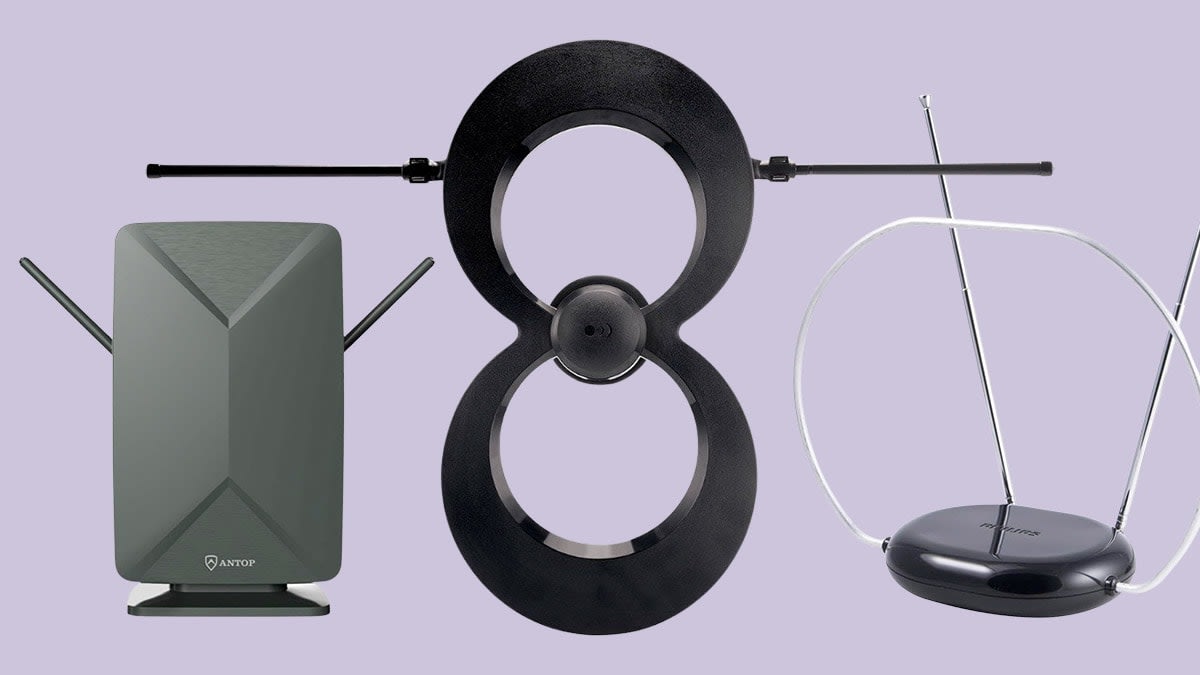

A weak indoor antenna can turn a local news broadcast into a frozen mosaic, especially when it is hidden behind a television or pushed into a dead corner. The Best indoor tv antenna for your home depends less on the biggest range claim and more on placement, cable length, signal direction, and nearby obstructions.
We ranked these nine models by their useful features, installation flexibility, and the kind of home setup each one suits. The Channel Master FLATenna is our top pick, while the list also includes discreet TV-top designs, long-cable options, and antennas suited to indoor or outdoor placement.
Comparison table
| # | Product | Award | Range | Cable | Design | Best for |
|---|---|---|---|---|---|---|
| 1 | Channel Master FLATenna | Best overall | 35 miles | 12 feet | Reversible flat panel | Reliable everyday reception |
| 2 | UltraPro Hover Antenna | Best TV-top design | 40 miles | Not specified | Swivel hover mount | Clean entertainment centers |
| 3 | HIDB Compact Antenna | Best compact base | Not specified | Not specified | Magnetic base | Small rooms and apartments |
| 4 | DAANT Long Range Antenna | Best cable reach | Not specified | 16 feet | Flexible indoor placement | Window-side installations |
| 5 | intelbras Smart IC Antenna | Best adjustable amplifier | Long range | Not specified | Interchangeable accents | Homes near or far from towers |
| 6 | Fabriyut 33.8-Foot Antenna | Best indoor or outdoor option | 5000+ miles claimed | 33.8 feet | Weather-resistant housing | Flexible antenna placement |
| 7 | Aquario 360-Degree Antenna | Best magnetic mount | Not specified | Long cable | 360-degree reception | RVs and metal surfaces |
| 8 | JM NEXLOV Amplified Antenna | Best signal booster | Long range | 18 feet | Indoor or outdoor use | Weak-signal locations |
| 9 | Donstock 38-Foot Antenna | Best extra-long cable | 5000+ miles claimed | 38 feet | Weatherproof housing | Distant window or outdoor placement |
1. Channel Master FLATenna: Best Overall

Pros
- Realistic 35-mile reception specification
- Reversible black and white panel
- Supports ATSC 3.0 and 4K broadcasts
- Includes a shielded 12-foot RG6 cable
Cons
- Flat panel still needs careful positioning
- Not intended as a long-distance outdoor antenna
Best for: viewers who want a sensible, established indoor antenna with flexible mounting.
The Channel Master FLATenna is the least gimmicky antenna in this group. Its 35-mile range is presented as a realistic figure that accounts for obstructions and interference, which is more useful than a huge distance claim that says little about a particular home. It is the model we would start with when the main goal is dependable local TV rather than a dramatic marketing number.
The thin panel can sit on a tabletop, wall, or window, and its reversible black and white sides make it easier to blend into a room. At 13 inches wide and 9 inches tall, it is not invisible, but it is far tidier than a traditional set of exposed antenna elements. The panel weighs about a quarter pound, so mounting it does not require heavy hardware.
The included 12-foot RG6 coaxial cable is a meaningful advantage. Better shielding can help limit interference along the cable run, and the extra length gives you room to move the antenna toward a window instead of leaving it beside the TV. It supports HD and digital signals, 4K broadcasts, and ATSC 3.0 NextGen TV where those broadcasts are available. That does not create channels that are absent in your area, but it makes the antenna a more forward-looking choice.
The FLATenna is a better fit for ordinary urban and suburban rooms than the Fabriyut 33.8-Foot Antenna or Donstock 38-Foot Antenna, both of which are designed around much longer cable runs and indoor or outdoor flexibility. Its weakness is simple: a 35-mile specification may not be enough for a home far from the towers, and the flat panel still needs experimentation with height and orientation. Choose it if you want a well-defined, restrained design and a clear setup path.
2. UltraPro Hover Antenna: Best TV-Top Design

Pros
- Mounts directly on top of the TV
- Swivels horizontally for positioning
- Supports VHF and UHF signals
- ATSC 3.0 compatible
- Includes wall mounting tape
Cons
- TV-top placement is not ideal in every room
- Cable length is not specified
Best for: viewers who want the antenna hidden in plain sight above the television.
The UltraPro Hover solves the most visible problem with many flat indoor antennas: where to put the thing. Its hover-style body attaches to the top of the TV, creating a compact installation that does not compete with a soundbar, plant, or media console. It can also sit on a flat surface or attach to a wall with the included tape.
The antenna is rated to capture VHF and UHF signals up to 40 miles. Those bands matter because local broadcasts can use different portions of the TV spectrum, and a model that supports both is more versatile than one optimized for a narrow signal type. The horizontal swivel is particularly useful because small changes in orientation can affect reception even when the antenna stays in the same room.
It supports 1080p HDTV signals, 4K and 8K TVs, and ATSC 3.0 broadcasts where available. The television's screen resolution does not determine what the antenna receives, but compatibility with newer sets removes one common concern for owners of modern displays. The push-on coax connector also keeps setup quick and tool-free.
The UltraPro is more discreet than the Channel Master FLATenna and more purpose-built for a tidy TV stand than the HIDB Compact Antenna. Its limitation is placement. A TV mounted against an interior wall may be a poor signal location, and the product data does not specify the cable length. Skip it if your best reception comes from a distant window. For a nearby broadcast area and a clean entertainment center, it is the easiest design to live with.
3. HIDB Compact Antenna: Best Compact Base

Pros
- Compact 5 by 2.44 by 2.44-inch body
- Magnetic base supports flexible placement
- Omnidirectional reception design
- Moisture-resistant dual PC material
Cons
- No range or cable length is specified
- Placement still affects reception
Best for: apartment dwellers and anyone who needs a small antenna on a shelf or TV stand.
The HIDB is unusually easy to hide. Its listed dimensions are roughly 5 inches high and 2.44 inches across and deep, so it takes up much less visual space than a broad flat panel. The magnetic base lets it stand on a compatible metal surface, while the compact shape makes moving it around a shelf or table straightforward.
Its omnidirectional reception design is intended to reduce the need to point the unit directly at a tower. That is convenient in a room where the TV cannot face the broadcast direction, although omnidirectional does not mean immune to walls, metal, concrete, or distance. The product specifically recommends testing both vertical and horizontal placement, mounting higher, and trying a window-facing position.
The housing uses dual PC soft material described as flame-retardant, moisture-resistant, and protected against lightning for indoor use. Those material claims are more relevant to durability than picture quality. The important setup step remains the same: connect the antenna, run a channel scan, move the antenna if needed, and scan again.
Unlike the Channel Master FLATenna and UltraPro Hover Antenna, the HIDB does not provide a stated reception range or cable length. That makes it harder to plan a difficult installation, but it also keeps the product focused on simple indoor use. Choose it when a small footprint matters most. Skip it if you need to place the antenna far from the TV or are dealing with a weak signal at the edge of coverage.
4. DAANT Long Range Antenna: Best Cable Reach

Pros
- Includes a 16-foot coaxial cable
- Three-layer aluminum cable shielding
- Supports smart and digital TVs
- Vertical and horizontal placement options
Cons
- Not suitable for older analog televisions
- No numeric reception range is specified
Best for: homes where the strongest signal is near a window or exterior wall.
The DAANT's strongest practical feature is its 16-foot cable. That is enough to move an antenna away from a TV cabinet and test a window, higher wall, or less obstructed corner. With indoor antennas, that freedom can matter more than a vague long-range label because the signal can change dramatically across a single room.
The cable is described as using a solid center conductor, dielectric insulation, three aluminum shielding layers, and a durable outer layer. More shielding can help protect the signal during a longer run, though it cannot compensate for a poor antenna position or a location far outside the broadcast area. The product supports smart TVs and digital TVs, but not older analog televisions.
Setup is conventional. Connect the coaxial cable to the television's ANT/IN port, position the antenna, and run a channel scan. DAANT recommends trying both vertical and horizontal orientations and checking the direction of local towers. That advice is worth following rather than treating the first scan as a final result.
The DAANT is easier to position than the HIDB Compact Antenna and less specialized than the UltraPro Hover Antenna. Its weakness is the missing numeric range specification, which makes it a less certain pick for distant rural homes. It makes sense for viewers who have a plausible local signal but need extra cable to find it.
5. intelbras Smart IC Antenna: Best Adjustable Amplifier

Pros
- Smart IC chip filters cellular and FM signals
- Adjustable short-range setting
- Supports 4K, UHD, and 1080 HDTV broadcasts
- Interchangeable orange and blue accents
Cons
- Range is described only as long range
- Amplification does not replace good placement
Best for: households that need to tune the antenna for different distances from broadcast towers.
The intelbras stands out because it gives the amplifier a useful control rather than treating amplification as a one-size-fits-all feature. Its instructions say to use the short-range setting when the home is within 35 miles of a broadcast tower. That matters because adding amplification near a strong signal can be counterproductive, while a weaker location may benefit from the longer-range setting.
Its smart IC chip is described as filtering cellular and FM signals while improving gain, range, and frequency performance. Those claims should be viewed as interference management, not a guarantee of more channels. The antenna still needs to be placed near a window or on a wall and rescanned after moving.
The intelbras supports 4K, UHD, and 1080 HDTV broadcasts, and the package includes interchangeable orange or blue accessories. That small styling option is unusual among these mostly black antennas. It is a medium-sized design, so it is not as easy to conceal as the HIDB Compact Antenna.
The adjustable control gives it a more thoughtful setup process than the basic Aquario 360-Degree Antenna, but the unspecified range makes it less predictable than the Channel Master FLATenna. It is a good match for someone willing to adjust the signal mode and test locations. Skip it if you want a completely passive, set-it-and-forget-it installation.
6. Fabriyut 33.8-Foot Antenna: Best Indoor or Outdoor Option

Pros
- Includes a 33.8-foot coaxial cable
- Built-in amplifier and signal booster
- Waterproof, windproof, and anti-thunder design
- Works indoors or outdoors
- Supports smart and older TVs with an HDTV tuner
Cons
- 5000+ mile range claim is not realistic for terrestrial TV
- Outdoor installation adds placement and weather considerations
Best for: viewers who need to position the antenna well away from the television.
The Fabriyut is built around placement flexibility. Its 33.8-foot coaxial cable is long enough to reach a window, upper wall, or an outdoor location that would be impossible with a short lead. It also includes a built-in amplifier and requires USB power, so setup involves connecting the coaxial cable, supplying power, and then scanning for channels.
The product is described as waterproof, windproof, and anti-thunder, with indoor and outdoor use supported. That makes it more adaptable than the strictly indoor Channel Master FLATenna, but outdoor use should still be treated as a real installation rather than a casual upgrade. Cable routing, exposure, and a secure mounting location all become more important.
Fabriyut advertises reception up to 5000+ miles and support for 8K, 4K, and 1080p. The distance claim is not a sensible way to predict terrestrial TV reception, since broadcast coverage depends on tower power, terrain, obstructions, and local conditions. The useful part of the package is the long cable and weather-resistant design, not the headline number.
Compared with the Donstock 38-Foot Antenna, the Fabriyut gives up a little cable length but makes a similarly flexible indoor or outdoor case. The JM NEXLOV Amplified Antenna is another option for weak signals, though its cable is shorter. Choose Fabriyut when distance from the TV is the central problem, and skip it if you only need a small indoor antenna beside a window.
7. Aquario 360-Degree Antenna: Best Magnetic Mount

Pros
- 360-degree reception design
- Strong magnetic base
- Compact form
- Weather-resistant construction
- Long coaxial cable for flexible placement
Cons
- Cable length is not specified
- No numeric reception range is provided
Best for: RVs, campers, and rooms where a magnetic mounting point is useful.
The Aquario is a flexible little antenna with a 360-degree reception design and a magnetic base. That combination is useful in an RV, camper, truck, or any room with a convenient metal surface. It can also sit near a window or on a wall, so the mounting method does not lock you into one arrangement.
Aquario says the antenna supports 4K, 1080p, and digital broadcasts and works with most smart TVs and digital televisions. Those formats describe the broadcasts and television compatibility, not a promise that every local channel will arrive in 4K. Local availability remains dependent on the towers serving your area.
The weather-resistant construction gives it more placement flexibility than a basic indoor-only panel. Its setup is still simple: connect to ANT IN, position it in an open area, scan for channels, and rescan after repositioning. The long coaxial cable is useful, although the available data does not state its exact length.
The Aquario is more adaptable than the HIDB Compact Antenna when magnetic mounting or occasional outdoor use matters. The Channel Master FLATenna is the safer pick when you want a stated 35-mile range and a precisely described cable. Choose Aquario for mobile or unconventional setups. Skip it if you need a clearly documented range for a challenging fixed installation.
8. JM NEXLOV Amplified Antenna: Best Signal Booster

Pros
- High-gain amplifier and smart IC chip
- 18-foot coaxial cable
- Supports 720p through 4K HDR broadcasts
- Indoor or outdoor installation
- Customer support response promise
Cons
- Amplification requires a suitable power setup
- Reception still varies by terrain and location
Best for: homes where the antenna needs signal assistance and extra placement distance.
The JM NEXLOV takes a more active approach to reception than the small passive-looking antennas in this roundup. It uses a high-gain amplifier and upgraded smart IC chip intended to strengthen weak broadcast signals and reduce cellular and radio-frequency interference. That can be useful in a difficult room, though an amplifier cannot restore a signal that never reaches the antenna.
Its 18-foot coaxial cable gives you meaningful freedom to move the unit toward a better location. The product supports broadcasts from 720p, 1080i, and 1080p through 2K and 4K HDR, and it is intended for smart TVs. It can also be installed outdoors, which broadens the possible placement options.
The setup instructions emphasize scanning after moving the antenna. That is important because the amplifier and antenna position work together, and the first scan may not reflect the strongest available location. Homes surrounded by dense construction or located far from towers should use a local broadcast map before deciding that a booster has solved the problem.
The JM NEXLOV offers more cable reach than the DAANT Long Range Antenna and more active signal assistance than the UltraPro Hover Antenna. It is not as compact, and its range is described as long rather than given as a useful numeric figure. Choose it when weak-signal support matters more than discreet styling.
9. Donstock 38-Foot Antenna: Best Extra-Long Cable

Pros
- Longest cable in this roundup at 38 feet
- Switchable short and long range amplifier modes
- Weatherproof housing
- Indoor and outdoor placement
- Designed for smart and older TVs
Cons
- 5000+ mile range claim should not guide expectations
- Longer cable runs require careful routing
Best for: installations where the antenna must be placed far from the TV or high on a wall.
The Donstock's defining feature is the 38-foot coaxial cable. That is the longest included lead here, making it practical for a television on one side of a room and a stronger reception spot on the other. It can also support a higher wall position, a window installation, or a carefully routed outdoor setup.
A switchable amplifier offers short-range and long-range modes, with the instructions distinguishing locations within 38 miles from those farther away. That control is more useful than leaving amplification permanently fixed, especially when a nearby tower produces a strong signal. The cable uses a solid copper center conductor and three layers of aluminum shielding according to the product information.
The housing is described as weatherproof, with waterproof treatment around the seams and internal circuit board and ventilation intended to limit condensation. It is designed for indoor and outdoor use and is compatible with smart TVs and older televisions. Outdoor placement still requires sensible mounting and cable protection, regardless of the housing claims.
Donstock is more installation-oriented than the Aquario 360-Degree Antenna and provides slightly more reach than the Fabriyut 33.8-Foot Antenna. Its stated 5000+ mile range should not be taken literally for broadcast reception, and a long cable can be awkward to conceal. Pick it when cable distance is the deciding factor, not because of the headline range.
How to choose the best indoor tv antenna
The right antenna is the one that can reach a usable signal position in your room and match the broadcasts available in your area.
Reception range
Range figures are useful only when they are realistic and tied to local conditions. The Channel Master FLATenna lists a 35-mile range that accounts for obstructions and interference, while UltraPro lists up to 40 miles. Claims such as 5000+ miles should be treated as marketing rather than a reliable planning measurement.
Check local tower locations before choosing an antenna. A nearby apartment with a clear window may perform better than a rural home with hills or dense trees between it and the transmitter. For more detail on how signal distance changes antenna placement, start with the broadcast map rather than the largest number on the box.
Cable length
Cable length determines where the antenna can live. A 12-foot cable is enough for many living rooms, while the DAANT's 16 feet, JM NEXLOV's 18 feet, Fabriyut's 33.8 feet, and Donstock's 38 feet support more ambitious placement.
Longer is not automatically better. Extra cable should be routed cleanly, and a poor-quality or badly damaged run can introduce problems. Choose the shortest cable that reaches a genuinely better position.
Antenna placement
Height, windows, walls, and orientation all affect reception. Flat panels can mount to walls or windows, while the HIDB and Aquario use compact bases and the UltraPro can sit directly on top of the TV.
Run a channel scan after every meaningful move. If the antenna supports different orientations, test vertical and horizontal positions. Finding a stable position inside a room is often more useful than adding another amplifier.
A modest antenna beside the right window usually beats a powerful antenna trapped behind the TV.
Amplification
An amplifier can help compensate for signal loss through a cable run or split, but it cannot manufacture unavailable channels. The intelbras allows a short-range setting for homes near towers, while the Donstock also offers switchable modes. Fabriyut and JM NEXLOV use built-in amplification.
Amplification is most useful when the antenna has a reasonable signal to work with. If channels vanish because of terrain or heavy building materials, try a new position first. An unamplified model such as the Channel Master FLATenna may be the cleaner choice in a strong-signal room.
Broadcast compatibility
Look for support for digital HDTV broadcasts and the signal bands used by local stations. Several picks support 4K broadcasts, but the antenna does not upgrade an ordinary broadcast to 4K. ATSC 3.0 support, included on the Channel Master and UltraPro, matters only where NextGen TV transmissions are available.
Older televisions may need a compatible digital tuner. The Fabriyut and Donstock listings specifically mention compatibility with older TVs, while DAANT says it is not suitable for analog televisions.
Frequently asked questions
Do indoor TV antennas work with smart TVs?
Yes. Smart TVs generally include a coaxial ANT IN connection and a digital tuner, so they can receive over-the-air broadcasts from a compatible antenna. Connect the antenna, select the TV's channel-scan function, and rescan after changing its position.
Does an indoor antenna receive every local channel?
No. Reception depends on tower distance, terrain, walls, windows, interference, and the antenna's position. Check which stations serve your address before choosing a model, and do not assume that a large range claim guarantees every channel.
Is an amplified antenna always better?
No. Amplification can help with a weak signal or a long cable run, but it can be unnecessary near a strong transmitter. The intelbras and Donstock are useful because they provide range controls rather than relying on one fixed setting.
Can these antennas receive 4K channels?
Several products advertise support for 4K broadcasts, including the Channel Master FLATenna, UltraPro Hover Antenna, and JM NEXLOV Amplified Antenna. The antenna can pass an available broadcast, but your local stations must transmit in that format and your TV must support it.
Should an indoor antenna face the broadcast tower?
Usually, directional placement toward local towers is a useful starting point, but indoor reflections and obstructions can change the result. Test multiple positions and scan channels after each move. Omnidirectional designs such as the HIDB and Aquario are more forgiving when the best direction is unclear.
Can I use an indoor antenna outside?
Some models in this roundup are described for indoor and outdoor use, including the Fabriyut, JM NEXLOV, Aquario, and Donstock. Outdoor placement requires attention to weather exposure, mounting, cable routing, and electrical safety. An indoor-only model should remain indoors.
The bottom line
The Best indoor tv antenna here is the Channel Master FLATenna because its 35-mile range is clearly stated, its 12-foot shielded cable is practical, and its reversible flat design is easy to place. It also supports ATSC 3.0 and 4K broadcasts without leaning on an implausible distance claim.
Choose the UltraPro Hover Antenna if keeping the antenna discreet on top of the TV matters most. For a distant window or outdoor position, the Fabriyut 33.8-Foot Antenna and Donstock 38-Foot Antenna offer the cable reach the compact models lack.
If you are undecided, start with the Channel Master and spend more time finding the right window or wall position than chasing the biggest range number.
As an Amazon Associate we earn from qualifying purchases.