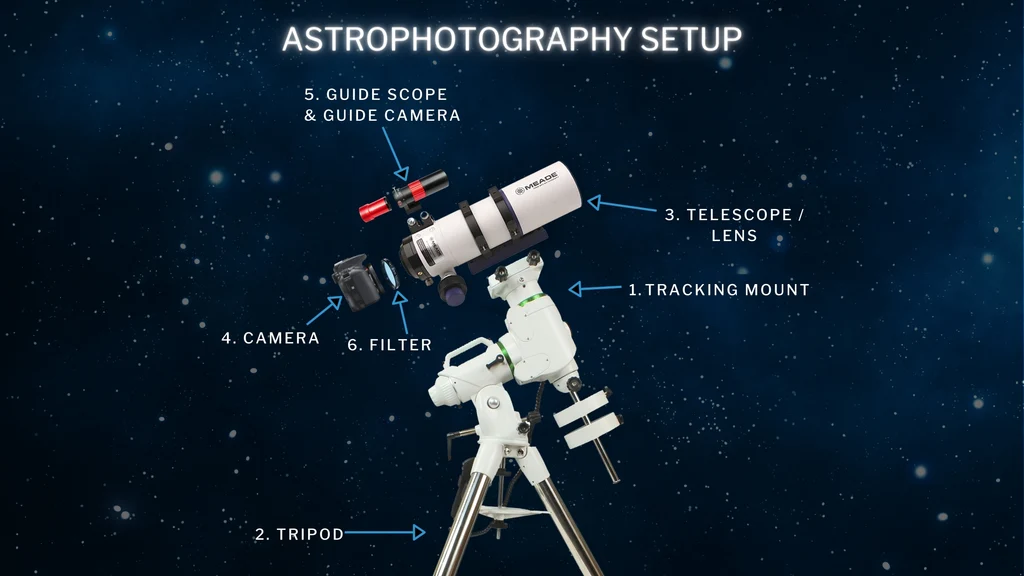

Finding a telescope that can actually produce good astrophotos is harder than finding one with impressive magnification on the box. You need dependable tracking, enough light-gathering ability, sensible focusing controls, and a camera system that matches the objects you want to photograph.
Our Best telescopes for astrophotography picks range from compact smart telescopes that handle alignment and processing for you to traditional optical tubes that reward a more involved setup. The DWARFLAB Dwarf 3 is our top pick because it makes deep-sky imaging unusually approachable without giving up useful flexibility.
Comparison table
| # | Product | Award | Optics | Imaging | Weight | Best for |
|---|---|---|---|---|---|---|
| 1 | DWARFLAB Dwarf 3 | Best overall | Telephoto and wide-angle lenses | 4K, auto-tracking | 3 lb claimed | Beginners wanting easy imaging |
| 2 | ZWO Seestar S30 Pro | Best smart telescope | 4-element apochromatic lens | 4K and 8K mosaic modes | 3.64 lb | Automated deep-sky imaging |
| 3 | DWARFLAB Dwarf Mini | Best ultra-portable | Sony IMX662 sensor system | Up to 90-second exposure | 1.85 lb | Travel and dark-sky trips |
| 4 | FASHIONARI Refractor Smart Telescope | Best dual-screen refractor | 80mm aperture, 300mm focal length | 4K capture | Not provided | Live viewing and imaging |
| 5 | YOTOMIGUO Smart Telescope | Best for families | 78mm aperture, 300mm focal length | 4K capture | Not provided | Kids and beginners |
| 6 | Springer Astrophotography Targets | Best target guide | Monthly target reference | CCD imaging guidance | 1.4 lb | Planning imaging sessions |
| 7 | SVBONY SV105 Camera | Best starter camera | 1.25-inch eyepiece format | 1080p at up to 30 fps | 0.64 lb | Lunar and planetary video |
| 8 | Celestron NexStar 8SE | Best classic telescope | 8-inch Schmidt-Cassegrain | Computerized GoTo tracking | 23.99 lb | Visual observing and upgrades |
| 9 | SVBONY SV503 102mm ED | Best optical tube | 102mm, 714mm, f/7 ED | Camera-ready focuser | 8.71 lb | Dedicated deep-sky setups |
| 10 | Celestron Origin | Best premium smart observatory | 6-inch RASA, f/2.2 | Automated AI stacking | 42 lb | Hands-off home observatories |
1. DWARFLAB Dwarf 3: Best Overall

Pros
- Combines telephoto and wide-angle imaging
- Automatic tracking makes setup approachable
- Cloud processing avoids a complicated computer workflow
- Compact 3 lb design fits travel use
Cons
- The product information also lists a 5.03 lb shipping or item weight
- App and cloud processing are central to the experience
- Not a traditional eyepiece-first telescope
Best for: beginners who want to capture deep-sky and wide-field images with minimal setup.
The DWARFLAB Dwarf 3 is the easiest telescope here to recommend to someone who wants photographs more than a traditional observing ritual. It is designed around app control, automatic tracking, and built-in processing, so the first useful image does not depend on learning a computerized mount, balancing a tube, or manually locating a faint object. The system claims a three-pound body, with listed dimensions of 8.74 by 5.59 by 2.56 inches, making it a realistic companion for a trip away from city lights.
Its dual imaging system is the feature that separates it from most compact smart scopes. The telephoto lens is intended for wildlife, landscapes, and deep-space objects, while the wide-angle lens handles the Milky Way and star trails. That gives the Dwarf 3 more to do during daylight and lets it approach astrophotography from both ends: tighter targets when you want detail and broad sky scenes when you want context.
The 4K auto-tracking system is aimed at keeping stars, planets, and moving daytime subjects in frame. The dedicated DWARFLAB app then uses cloud computing to process images with a one-touch workflow. That is a meaningful advantage over the SVBONY SV105 Camera, which requires a compatible computer and capture software, and over the SVBONY SV503 102mm ED, whose optical quality is more promising for a custom imaging rig but whose setup is much less automatic.
There are a couple of details to keep in mind. The headline weight is three pounds, but the product information lists 5.03 pounds, so buyers who are packing strictly by weight should treat the lighter figure cautiously. The camera-first design also means this is not the pick for someone who wants a conventional eyepiece experience or full control over every part of the imaging chain. Its strongest features depend on the app and cloud processing.
The Dwarf 3 is the one we'd keep for casual astrophotography, family use, and travel. It offers more creative range than the Dwarf Mini while remaining much simpler than a traditional telescope and camera combination. If the goal is to start making recognizable images quickly, this is the most balanced system in the group.
2. ZWO Seestar S30 Pro: Best Smart Telescope

Pros
- Automatic GoTo targeting and tracking
- Dual cameras cover detailed and wide-field views
- Apochromatic lens is designed to reduce color fringing
- Built-in filters and anti-dew protection
- 128GB storage and scheduled imaging
Cons
- App-based operation leaves little room for traditional manual control
- Larger and heavier than the Dwarf Mini
- Advanced imaging modes may take time to learn
Best for: beginners who want a polished smart telescope with room for more ambitious automated imaging.
The ZWO Seestar S30 Pro is the most complete smart-telescope package in this list. It takes the familiar compact camera approach and adds a four-element apochromatic lens, dual imaging sensors, filters, scheduled imaging, and 128GB of storage. At 8.3 by 5.5 by 3.1 inches and 3.64 pounds, it remains portable, though it is not as easy to disappear into a bag as the Dwarf Mini.
The optical system pairs a telephoto IMX585 sensor with a wide-angle IMX586 camera. The first is suited to detailed views of deep-sky objects, while the second is built for broader scenes such as the Milky Way. The four-element apochromatic lens is intended to reduce chromatic aberration, which matters because color fringing around bright stars can distract from an otherwise sharp image. Built-in filters are also intended to reduce the effects of light pollution and unwanted infrared light.
ZWO gives the S30 Pro several automated imaging modes. It can photograph planets, galaxies, star trails, and the Milky Way, while mosaic stitching combines multiple frames into an ultra-wide image described as 8K. Automatic noise reduction and scene recognition take some of the editing burden away, and the system can separate sky from foreground in night landscapes. Those tools make it a more ambitious imaging device than the YOTOMIGUO Smart Telescope, whose strengths are its accessible screens and family-friendly operation.
The S30 Pro is also better equipped for long sessions. Anti-dew protection, scheduled imaging, and the large internal storage are practical features when the telescope is left working through the night. The trade-off is that it asks the user to accept an app-centered workflow. Someone who wants to choose a separate camera, capture program, and processing route may prefer the Celestron NexStar 8SE or SVBONY SV503 102mm ED, although both require more equipment and more decisions.
This is the smart scope for someone who wants automation without settling for a very basic feature set. It is more capable and more structured than the Dwarf 3, but the Dwarf 3 remains easier to recommend for spontaneous travel and daytime use. Choose the S30 Pro when scheduled sessions, filters, storage, and wide-field mosaics matter more than absolute simplicity.
3. DWARFLAB Dwarf Mini: Best Ultra-Portable

Pros
- Very light 1.85 lb body
- Built-in sky atlas and automatic GoTo
- 360-degree pivot freedom
- Equatorial mode supports exposures up to 90 seconds
- Cloud processing and light-pollution filter included
Cons
- Smaller sensor than the Dwarf 3 and Seestar S30 Pro
- Single-frame exposure limit is not aimed at every target
- Compact design gives up some imaging flexibility
Best for: hikers, campers, and travelers who need the smallest practical automated imaging setup.
The DWARFLAB Dwarf Mini earns its place by making portability the priority without turning astrophotography into a novelty. Its 1.85 lb weight and roughly 7.23 by 3.94 by 2.39 inch dimensions are dramatically easier to carry than the traditional Celestron models. This is the telescope to consider when the best observing location is a campsite, hiking trail, or dark-sky site that requires carrying equipment beyond the car.
The app includes an interactive sky map, and the automatic GoTo system can locate selected targets. A full 360-degree pivot gives the Mini useful freedom when framing the sky. Its Sony IMX662 sensor has a 1/2.8-inch format and 2.9μm pixels, specifications that point to a compact imaging system designed for low-noise detail rather than a wide, traditional optical tube.
For deeper imaging, the Mini has an equatorial mode and supports single-frame exposures up to 90 seconds. Its built-in light-pollution filters are helpful for users who cannot reach truly dark skies, while cloud processing can turn raw captures into more finished images without requiring a desktop workflow. Those features give it more serious imaging intent than a simple electronic spotting scope.
The limitation is scale. The Dwarf 3 and ZWO Seestar S30 Pro offer broader dual-camera systems and, on paper, more expansive processing features. The Mini's attraction is not maximum capture flexibility. It is the fact that a 90-second exposure mode and automated tracking can travel with a device that weighs less than two pounds.
Buy this if carrying convenience determines whether you will use the telescope at all. Skip it if you expect the larger sensors, wide-field options, or extended workflow of the top two smart scopes. For a traveler who wants a genuinely compact route into deep-sky imaging, the Dwarf Mini is the clearest choice.
4. FASHIONARI Refractor Smart Telescope: Best Dual-Screen Refractor

Pros
- 80mm aperture and 300mm focal length
- Foldable external display plus adjustable eyepiece
- 4K photo and video capture
- 4500mAh battery claims up to six hours
- Supports external storage up to 512GB
Cons
- Product dimensions appear unusually small for the stated optical format
- Up to 350X magnification claim should be treated cautiously
- Less established imaging workflow than the leading smart scopes
Best for: families who want a shared screen and simple photo controls for moon and landscape viewing.
The FASHIONARI Refractor Smart Telescope takes a different approach from the app-driven Dwarf and Seestar models. It combines an 80mm aperture with a 300mm focal length and gives viewers two ways to see the target: an eyepiece with diopter adjustment and a foldable external display. That makes it more suitable for a group gathered around the telescope, especially when passing an eyepiece from person to person is inconvenient.
Its f/8.89 optical ratio is relatively slow compared with the Celestron Origin's f/2.2 design, so it is not the obvious choice for rapidly collecting faint deep-sky images. The listed 4K photo and video capture, however, gives beginners a direct way to record views without adding a separate camera. One-touch switching between photo and video modes keeps the basic operation understandable.
The built-in 4500mAh battery is listed for up to six hours of operation, and the telescope supports external storage up to 512GB. The adjustable auto-power-off choices of one, three, five, or ten minutes are small but useful when the device is being used casually. These controls make it more like an electronic viewing station than a conventional astrophotography rig.
There are reasons to be careful. The stated magnification of up to 350X is not enough by itself to predict useful image quality, and the listed physical dimensions are inconsistent with the apparent scale of an 80mm refractor. The FASHIONARI also lacks the clearly described automated sky atlas and mature processing workflow found on the DWARFLAB Dwarf 3 and ZWO Seestar S30 Pro.
Choose this model when live viewing is as important as saving images. It is a more social design than the compact smart scopes, but dedicated astrophotographers should look to the SVBONY SV503 102mm ED for a more conventional camera-ready platform.
5. YOTOMIGUO Smart Telescope: Best for Families

Pros
- 3-inch foldable external screen
- 78mm aperture and 300mm focal length
- 4K photo and video capture
- Includes a 64GB memory card
- Eyepiece offers diopter adjustment
Cons
- Marketed toward children and beginners rather than advanced imaging
- No automated tracking or app workflow is described
- The stated 350X magnification does not explain practical image quality
Best for: families and first-time users who want an uncomplicated telescope with a shared display.
The YOTOMIGUO Smart Telescope is built around the social side of astronomy. Its foldable three-inch external screen lets several people view the same target, while the eyepiece provides a more familiar way to look through the telescope. That arrangement is useful for children and beginners who may struggle to position an eye correctly or who want to see the image without waiting for a turn.
The optical details are a 78mm aperture and 300mm focal length, with fully coated glass optics and high-transmission coatings. Those numbers suit moon viewing, bright planets, and general terrestrial observation. The telescope also claims up to 350X magnification, but magnification alone is not a reliable measure of astrophotography performance, so this should not be confused with the light-gathering and tracking capabilities of the Celestron NexStar 8SE.
Photo and video capture use a one-touch control, and the system supports storage up to 512GB. A 64GB memory card is included. That makes the YOTOMIGUO more immediately usable than a traditional optical tube that needs a separate camera and accessories, although the data does not describe an app, GoTo alignment system, or automatic celestial tracking.
Its biggest weakness is the lack of a detailed advanced imaging workflow. The product is positioned as a beginner and kids' telescope, and the feature set supports that purpose. Someone planning long exposures of nebulae or galaxies should move up to the ZWO Seestar S30 Pro or consider a camera-ready refractor instead.
This is a sensible family telescope when shared viewing and easy recording matter more than serious deep-sky work. It should be skipped by buyers who want automated target finding, scheduled imaging, or extensive control over capture settings.
6. Springer Astrophotography Targets: Best Target Guide

Pros
- Organizes 100 astrophotography targets
- Arranged as a monthly guide
- Focused on CCD imaging with amateur telescopes
- Compact 1.4 lb reference book
Cons
- A guidebook, not a telescope or camera
- Listed condition is used and in good condition
- Published information may not match newer smart-telescope workflows
Best for: telescope owners who need help choosing what to photograph throughout the year.
The Springer Astrophotography Targets book is the outlier in this roundup, but it addresses a real problem: owning imaging equipment does not tell you what is worth pointing it at tonight. The book presents 100 targets in a monthly guide, giving amateur astrophotographers a more structured way to plan sessions instead of repeatedly returning to the brightest objects.
Its focus is CCD imaging with amateur telescopes, so it is more useful as a planning reference than as a manual for the fully automated processing found in the Celestron Origin. The subject matter also predates many current app-controlled telescopes. Readers using the Dwarf 3 or Seestar S30 Pro may need to translate traditional target advice into the controls and imaging modes provided by their device.
The compact book measures 9.25 by 6.1 by 0.87 inches and weighs about 1.4 pounds. Those dimensions make it easy to keep beside a telescope or take outside during a session. The listing identifies it as a used book in good condition, which is relevant for anyone expecting a new reference copy.
This is not a substitute for an optical system, and it cannot improve tracking, focus, or image quality. It belongs here because target selection is part of successful astrophotography, particularly for owners of traditional telescopes who are still learning which objects suit their equipment and the time of year.
Pair it with the SVBONY SV503 102mm ED or another camera-ready telescope if you want a more deliberate imaging routine. It is a useful companion, not a standalone purchase for someone shopping specifically for hardware.
7. SVBONY SV105 Camera: Best Starter Camera

Pros
- Standard 1.25-inch telescope format
- Sony IMX307 color sensor
- 1920 by 1080 capture at up to 30 frames per second
- Plug-and-play operation with supported software
- Suitable for lunar and planetary video
Cons
- Requires a separate telescope
- Not compatible with iPhones or iPads
- Better suited to bright targets than faint deep-sky objects
Best for: beginners adding a simple planetary camera to an existing compatible telescope.
The SVBONY SV105 Camera is not a telescope, but it is a credible entry point for someone who already owns one and wants to start recording the Moon and planets. Its standard 1.25-inch format fits directly into compatible telescope accessories, and the camera weighs about 0.64 pounds. The design is straightforward: insert it like an electronic eyepiece, connect it to a computer, and view the telescope feed in real time.
The camera uses a 1/2.8-inch Sony IMX307 color sensor and records at 1920 by 1080 resolution at up to 30 frames per second. That combination is useful for lunar and planetary video, where capturing many frames can provide material for selecting or processing the sharpest moments. The product also describes 2K video at high speed, although the listed 1920 by 1080 capture specification is the clearer reference point.
Software compatibility is a central consideration. Windows users need SharpCap Capture, Linux users need AstroDMx Capture, and Android users can use USB Camera. It can work with Apple laptops running macOS, but it is not compatible with Apple phones or tablets. That makes it less self-contained than the DWARFLAB Dwarf Mini, which includes its own app and sky atlas.
The SV105 is not aimed at the dim, long-exposure deep-sky work that makes a system such as the Celestron Origin attractive. Its dark-light compensation can improve clarity in low-light conditions, but the camera still depends on the telescope, mount, computer, and software connected to it. Buyers should also remember that a camera like this does not provide automatic pointing or tracking on its own.
Choose it if you already have a 1.25-inch telescope and want an affordable way to experiment with planetary imaging. Skip it if you want a complete astrophotography system in one box or if your main targets are faint galaxies and nebulae.
8. Celestron NexStar 8SE: Best Classic Telescope

Pros
- Large 8-inch Schmidt-Cassegrain optics
- Computerized GoTo mount
- Database of more than 40, 000 objects
- SkyAlign simplifies alignment
- Strong platform for future accessories
Cons
- Much heavier and less portable than smart scopes
- Imaging setup requires additional camera and accessories
- Traditional workflow is less immediate than an all-in-one system
Best for: observers who want a substantial optical telescope that can grow into a more advanced imaging setup.
The Celestron NexStar 8SE is the classic telescope in this group, and its appeal is easy to understand. An eight-inch Schmidt-Cassegrain optical system gathers substantially more light than the compact smart scopes, while the computerized GoTo mount can locate and track targets from a database of more than 40, 000 objects. It is a serious observing instrument first, with astrophotography potential that grows as the owner adds the right camera and accessories.
SkyAlign is designed to make setup less intimidating. The user centers three bright stars or planets, even without knowing their names, and the system calculates the alignment. That is a more involved process than the self-starting Celestron Origin, but it gives the owner a clearer connection to how the mount works. It also leaves more room to change the camera, software, and accessories later.
The large aperture is useful for observing lunar detail, Jupiter's cloud bands, galaxies, and globular clusters. The listing gives a product weight of about 23.99 pounds and dimensions of 52 by 34 by 32 inches, so this is not a grab-and-go telescope. It is better suited to a permanent observing spot or a careful setup where the extra bulk is acceptable.
For astrophotography, the NexStar 8SE's main weakness is that it is not an all-in-one imaging solution. The Dwarf 3 and Seestar S30 Pro can capture and process images within their own app ecosystems, while the 8SE asks the buyer to assemble a more traditional system. That can be rewarding, but it also introduces compatibility, balance, focus, and tracking decisions.
Choose the NexStar 8SE when visual astronomy matters just as much as image making. It is the better long-term optical platform for someone who wants to learn the equipment rather than simply operate an automated camera. For an immediate deep-sky photograph with minimal setup, the smart telescopes are easier.
9. SVBONY SV503 102mm ED: Best Optical Tube

Pros
- 102mm aperture and 714mm focal length
- f/7 ED optical design
- S-FPL51 glass reduces chromatic aberration
- Dual-speed 1:10 focuser
- 360-degree field rotator and 90mm focus travel
Cons
- Optical tube requires a mount and imaging accessories
- 8.71 lb weight before a complete setup is assembled
- Less convenient for beginners than an all-in-one smart telescope
Best for: astrophotographers building a traditional camera and mount system around a capable refractor.
The SVBONY SV503 102mm ED is the most obvious choice here for an enthusiast who wants an optical tube rather than a closed smart-telescope system. Its 102mm aperture and 714mm focal length produce an f/7 refractor designed for both visual observing and astrophotography. The tube weighs about 8.71 pounds, before adding the mount, camera, and other equipment needed for a working imaging rig.
The S-FPL51 ED glass is intended to reduce chromatic aberration, which helps keep bright stars and high-contrast edges from developing distracting color fringes. Fully multi-coated optics improve light transmission and reduce internal reflections. These are the kinds of details that matter when the owner is choosing a separate camera and processing workflow rather than relying on automatic enhancement.
The focuser is one of the strongest practical features. Its dual-speed 1:10 adjustment makes fine focus easier, while 90mm of focus travel leaves room for accessories such as filter wheels and field flatteners. The 360-degree field rotator lets the camera be aligned without rotating the whole tube. That flexibility is missing from more self-contained products such as the YOTOMIGUO Smart Telescope.
The cost of that flexibility is complexity. The data does not include a mount, camera, or field flattener, and none of those omissions should be quietly filled in. A buyer moving from a phone-controlled smart scope will need to understand how the tube, mount, camera, and focus accessories work together. The 133mm retractable hood helps block stray light and resist dew, but it does not turn the tube into a complete observatory.
This is the right pick for a deliberate, upgradeable imaging setup. It is not the right pick for a child, a casual traveler, or anyone who wants the telescope to find targets and process images automatically. Pair it with a suitable camera and mount, and it offers a more open-ended path than the integrated smart scopes.
10. Celestron Origin: Best Premium Smart Observatory

Pros
- Fast 6-inch RASA optical design
- f/2.2 focal ratio gathers light quickly
- Automatic focusing, alignment, and GoTo
- AI stacks and processes frames in real time
- iOS and Android app support
Cons
- 42 lb listed weight makes it a home observatory product
- Large 48 by 26 by 24 inch dimensions
- Automated system offers less traditional hands-on control
- More setup commitment than compact smart telescopes
Best for: home users who want automated deep-sky imaging with very little manual intervention.
The Celestron Origin is the most ambitious product in this roundup and the clearest example of a telescope designed around the finished image rather than the traditional observing process. It combines a six-inch RASA optical system, a fully automated GoTo mount, and an app for iOS and Android. Once assembled, the system uses StarSense to scan the sky, focus, and align itself, with the product claiming that the user can be ready to observe in two minutes.
Its f/2.2 focal ratio is the headline optical advantage. A fast system can collect light with shorter exposures than a slower optical design, which is particularly useful for nebulae and galaxies. Compared with the f/7 SVBONY SV503 102mm ED, the Origin is built for a much more automated and rapid deep-sky workflow. The SV503 offers finer control and upgrade flexibility, while the Origin removes many of the decisions between setup and image.
The built-in processing is equally important. The Origin automatically stacks frames as it captures them, and its AI algorithms process the results in real time. The stated goal is to make detailed, colorful views of galaxies and nebulae appear without manual intervention. The app provides a planetarium interface, so users can navigate the sky from a phone or tablet instead of using a traditional hand controller.
This convenience comes with a physical commitment. The listed dimensions are 48 by 26 by 24 inches, and the weight is 42 pounds. That places the Origin firmly in home-observatory territory. It is not a sensible choice for a backpack, a quick camping trip, or a buyer who wants to carry a telescope between multiple observing sites.
The Origin is also less transparent as a learning platform than the NexStar 8SE or SV503. Its automation is the point, but a user who wants to control the camera, mount, and processing independently may find the system restrictive. For readers comparing equipment beyond this roundup, the trade-off between automated imaging and a more traditional setup is a useful question to settle early.
Buy the Origin for a fixed home setup where speed and automation matter more than portability or manual control. It is overqualified for casual moon viewing, but it is the most compelling choice here for someone who wants the telescope to handle alignment, focusing, tracking, stacking, and processing.
How to choose best telescopes for astrophotography
The right telescope depends on the targets you want to photograph and how much of the setup you want to control yourself. These are the specifications and design choices that matter most.
Tracking and alignment
Long-exposure astrophotography requires the telescope to keep a celestial target in the same place in the frame. Smart models such as the DWARFLAB Dwarf Mini, ZWO Seestar S30 Pro, and Celestron Origin automate target finding and tracking, while the NexStar 8SE uses GoTo and SkyAlign with a more traditional setup.
Weak tracking creates elongated stars and forces the camera to use shorter exposures. Look for automatic tracking if you want a fast path to imaging. Choose a traditional computerized mount when you want to learn alignment and retain more control over future cameras and accessories.
Aperture and focal ratio
Aperture determines how much light the telescope can collect, while focal ratio gives a useful indication of how quickly it can gather that light relative to focal length. The 102mm f/7 SV503 is a conventional refractor, while the six-inch f/2.2 Origin is designed to collect deep-sky light much faster.
Larger aperture can reveal more detail, but it usually brings more weight and a bigger mount. A fast focal ratio helps with exposure time, though it may come with a narrower or more specialized field of view. Do not judge a telescope by magnification alone.
Camera and sensor
Some products include the camera as part of the telescope. The Dwarf 3, Seestar S30 Pro, Dwarf Mini, FASHIONARI, YOTOMIGUO, and Origin are integrated imaging systems. The SV503 is an optical tube, and the SV105 is a separate 1.25-inch camera that needs a compatible telescope and computer.
Sensor size, pixel size, resolution, and frame rate affect what the system can record. Lunar and planetary work benefits from fast video capture, while faint deep-sky targets need light-gathering ability, tracking, and longer imaging sessions.
The best telescope is the one whose tracking and camera workflow match your target, not the one with the largest magnification claim.
Portability and setup
The Dwarf Mini weighs 1.85 pounds, while the Origin lists 42 pounds. That difference changes how often you will use the equipment and whether you can reach darker skies. Compact smart telescopes are convenient for travel, while the NexStar 8SE, SV503, and Origin need a more deliberate setup.
Check the complete system weight rather than the optical tube alone. A telescope that requires a mount, camera, filters, and computer may be far heavier and more involved than its product title suggests.
Processing and control
Integrated processing can make astrophotography much easier. The Dwarf 3 uses cloud processing, the Seestar S30 Pro offers automatic noise reduction and scene recognition, and the Origin stacks and processes frames in real time. Traditional systems leave more decisions to the user.
If you want to learn capture and editing, the SV503 or NexStar 8SE offers a more open path. If you want an image with minimal computer work, an integrated smart telescope is the better fit. Readers also comparing general observing equipment may find that the equipment needed for a broader astronomy setup changes the answer.
Frequently asked questions
Can a smart telescope be used for serious astrophotography?
Smart telescopes can produce useful images of the Moon, planets, nebulae, galaxies, and wide-field scenes, depending on the model. The Dwarf 3, Seestar S30 Pro, and Celestron Origin include automated tracking and image-processing features that make deep-sky work accessible. They provide less control than a separate telescope, camera, mount, and computer system.
Is the Celestron Origin portable?
The Origin is intended for a home setup rather than frequent travel. Its listed dimensions are 48 by 26 by 24 inches and its listed weight is 42 pounds. The Dwarf Mini, Dwarf 3, and Seestar S30 Pro are much more practical for carrying to a dark-sky location.
Is the SVBONY SV105 a complete telescope?
No. The SV105 is a 1.25-inch telescope camera that connects to a compatible telescope and computer. It is intended mainly for lunar, planetary, and terrestrial imaging, with software requirements that vary by operating system.
What is better for astrophotography, the NexStar 8SE or SV503?
The NexStar 8SE provides a larger eight-inch Schmidt-Cassegrain optical system and a computerized GoTo mount in one telescope package. The SV503 is a 102mm ED refractor optical tube with a dual-speed focuser, field rotator, and focus travel designed for a custom imaging system. Choose the NexStar for a substantial visual and computerized telescope, or the SV503 when camera integration and optical-tube flexibility matter more.
Do I need a computer for the Dwarf 3 or Seestar S30 Pro?
Their listed features center on app control and integrated processing, so they are designed to work without the computer-heavy workflow required by a separate planetary camera. The exact app and processing requirements can vary by feature. The SV105 explicitly depends on capture software and a connected computer, making it a different kind of product.
Is the Dwarf Mini good for travel astrophotography?
Yes, portability is its defining strength. It weighs 1.85 pounds, includes app control and a sky atlas, and offers equatorial mode with single-frame exposures up to 90 seconds. Its smaller design is less flexible than the Dwarf 3 or Seestar S30 Pro, but it is easier to carry to dark skies.
Can these telescopes photograph planets?
Several can. The Dwarf 3, Seestar S30 Pro, FASHIONARI telescope, YOTOMIGUO telescope, and NexStar 8SE list planetary or moon viewing and imaging features. The SV105 is specifically suited to lunar and planetary video when paired with a compatible telescope. Readers focused mainly on planetary targets should also consider how focal length and tracking affect planetary detail.
The bottom line
The DWARFLAB Dwarf 3 is our top choice among the Best telescopes for astrophotography because it balances automatic tracking, dual imaging, portability, and cloud processing. The ZWO Seestar S30 Pro is the stronger alternative for users who want scheduled imaging, built-in filters, larger storage, and a more developed set of automated modes.
For a traditional optical setup, choose the SVBONY SV503 102mm ED when you are ready to add a mount and camera, or the Celestron NexStar 8SE when visual observing and a larger aperture matter just as much as imaging. The Celestron Origin is the premium home option for fully automated deep-sky work.
If you are undecided, choose the Dwarf 3 for simplicity, the SV503 for control, and the Origin only if it will remain set up at home.
As an Amazon Associate we earn from qualifying purchases.