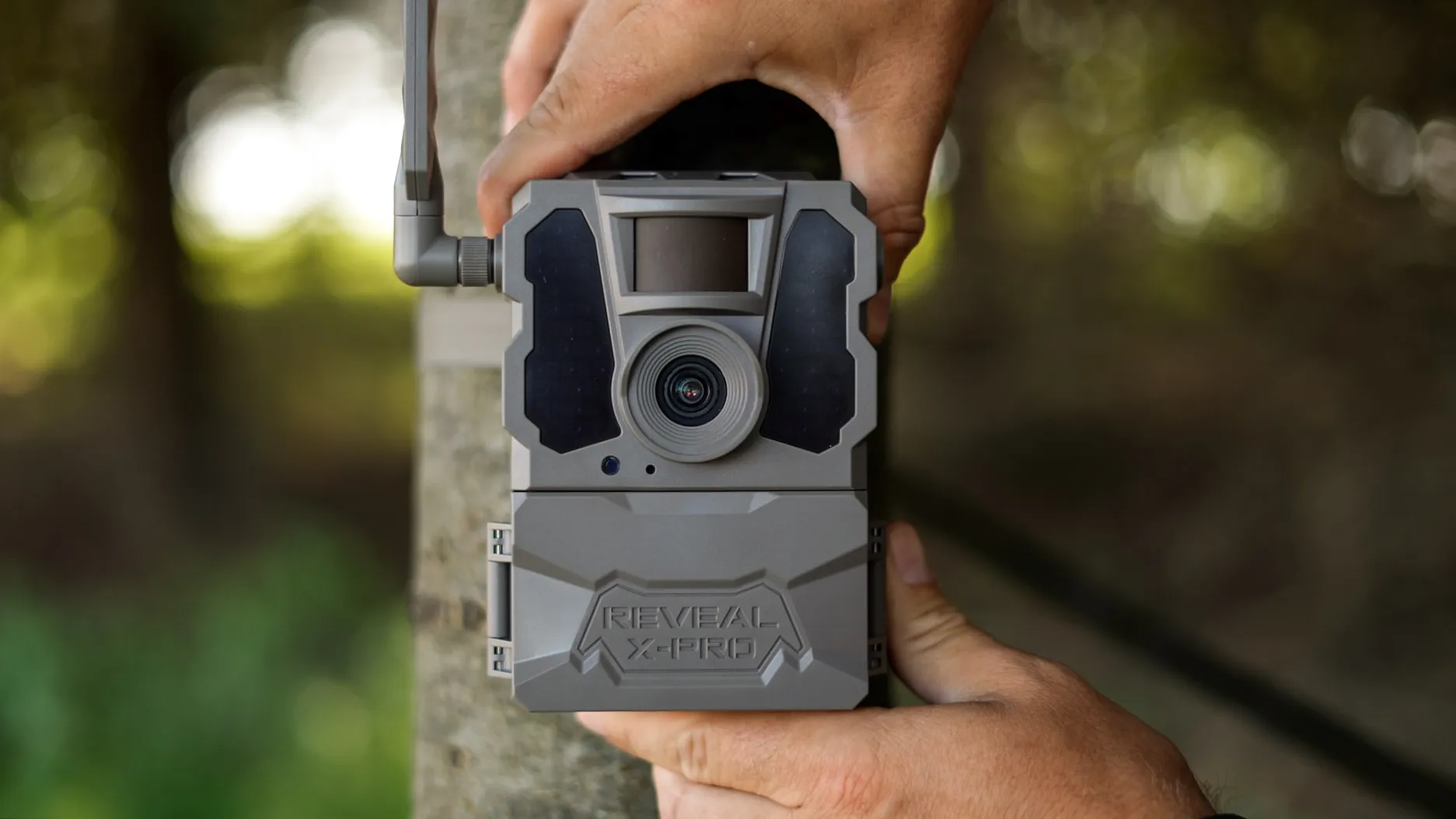

A trail camera that only stores photos on a card can leave you guessing for weeks. Cellular models send activity to your phone, but they also introduce decisions about carrier coverage, power, storage, night illumination, and how many cameras you need in the field.
We compared 10 real options, including multi-camera packs, integrated solar models, and cameras built for live viewing. The best cellular trail camera for most people is the TACTACAM Reveal X 3.0, though the Moultrie Edge Solar and SEHMUA 3rd Gen make stronger cases for hands-off power and live streaming.
Comparison table
| # | Product | Award | Photo and video | Connectivity and power | Best for |
|---|---|---|---|---|---|
| 1 | TACTACAM Reveal X 3.0 | Best overall | 3-shot burst | Multi-carrier LTE, built-in GPS, up to 6+ months | Remote property monitoring |
| 2 | Moultrie Edge 3 2-Pack | Best two-camera setup | 40MP, 1080p HD | Four-carrier auto-connect, rechargeable options | Covering two locations |
| 3 | SPYPOINT Flex-M Twin Pack | Best multi-location kit | 28MP, 720p with sound | Dual-SIM LTE, microSD storage | Wildlife and property scouting |
| 4 | Moultrie Edge Solar | Best solar integration | 40MP, 1080p with audio | Integrated solar, four-carrier auto-connect | Long deployments |
| 5 | TACTACAM Reveal Pro 3.0 | Best advanced controls | Night vision, burst mode | Auto-connect 4G LTE, GPS, solar compatible | Experienced trail-camera users |
| 6 | SPYPOINT Flex-M Solar | Best solar bundle | 28MP, 720p with sound | Cellular camera and solar panel | A ready-to-mount solar system |
| 7 | SPYPOINT Flex-S-Dark | Best no-glow solar camera | 40MP, 1080p with sound | Built-in solar, cross-carrier connection | Discreet night monitoring |
| 8 | SPYPOINT Flex-M 3-Pack | Best three-camera setup | 28MP, 720p with sound | Dual-SIM LTE, solar compatible | Monitoring several trails |
| 9 | SEHMUA 3rd Gen | Best live streaming | 48MP, 2K live feed | 4G LTE, 4W solar panel | Remote live wildlife viewing |
| 10 | Moultrie Edge 3 | Best straightforward Moultrie | 40MP, 1080p HD | Four-carrier auto-connect, GPS | A single camera with app controls |
1. TACTACAM Reveal X 3.0: Best Overall

Pros
- Auto-connects between AT&T and Verizon
- Built-in GPS and storage
- Sub-half-second trigger with three-shot burst
- Setup is designed to take only a few minutes
Cons
- No local SD card backup
- Its strongest battery claim depends on deployment conditions
Best for: remote scouting and property monitoring without frequent site visits.
The Reveal X 3.0 is the camera we would put on a distant gate, feeder, or game trail when the main goal is dependable alerts with minimal fuss. Its integrated SIM automatically selects between AT&T and Verizon, so you do not have to decide which carrier will behave better before mounting the camera. That matters on rural land, where a signal that looks fine at the road can disappear a few yards into the trees.
TACTACAM claims up to 6+ months of battery life, and the camera can be paired with a lithium cartridge, solar panel, folding solar panel, or battery belt for longer deployments. The practical advantage is not just the number of months. It is the ability to choose a power setup around the location rather than redesigning the location around the camera. The 11.9-inch-high body is substantial, but it gives the unit a familiar trail-camera shape and enough room for the pre-installed antenna.
The capture features are well suited to moving animals. A sub-half-second trigger helps catch an animal before it leaves the frame, while three-shot burst mode increases the odds of getting a useful image instead of one awkward blur. Built-in GPS keeps the camera visible in the REVEAL app, and built-in storage sends photos to your phone without requiring an SD card. That last point makes setup simpler than the SPYPOINT Flex-M models, which require a microSD card for operation, though some users will prefer having a removable local backup.
The weakness is the storage design. If you want to pull a card and browse a complete local archive, the Reveal X 3.0 is not the right fit. The Pro 3.0 adds SD card support, a two-inch LCD, live Wi-Fi aiming, and on-demand video, so it is the better TACTACAM for users who want hands-on control. The X 3.0 remains the cleaner choice for someone who wants to mount a camera, confirm the connection, and let cellular alerts do the work.
For a wider look at non-cellular and cellular options, the features that matter when watching a remote trail are useful to sort out before you choose a mounting location. The Reveal X 3.0 is the best cellular trail camera here for buyers who value straightforward deployment, flexible carrier access, GPS, and a fast trigger more than local media storage.
2. Moultrie Edge 3 2-Pack: Best Two-Camera Setup
Pros
- Two cameras cover separate locations
- 40MP photos and 1080p HD video
- Four-carrier auto-connect
- AI buck detection and instant alerts
- Live Aim helps with placement
Cons
- The cameras still need a suitable power setup for long deployment
- Feeder controls are relevant only to compatible Moultrie equipment
Best for: hunters who want matching cameras at two active locations.
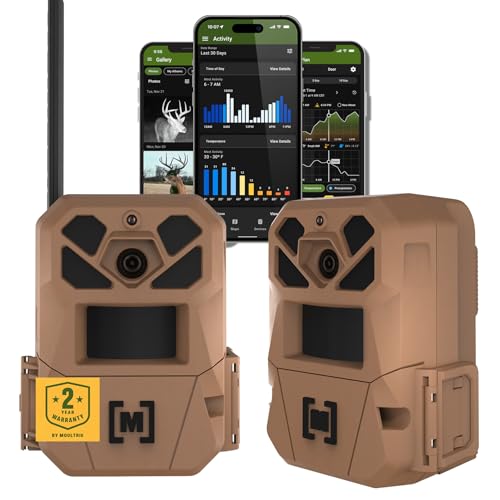
The Edge 3 2-Pack changes the calculation for anyone trying to watch both sides of a property or compare two travel routes. A single camera can tell you what happened at one spot. Two matching cameras give you a much better view of movement between spots, especially when one is placed near a feeder and another covers a trail or crossing.
Each camera captures 40MP photos and 1080p HD video. Those figures are useful because they give you enough image detail to inspect an animal after the alert arrives, while the video mode adds movement and context that a still frame cannot provide. Moultrie uses low-glow infrared for nighttime images, so the cameras are designed to illuminate the scene without an obvious visible flash. The 0.5-second trigger and 100-foot detection range are a sensible pairing for open approaches where an animal can cross the frame quickly.
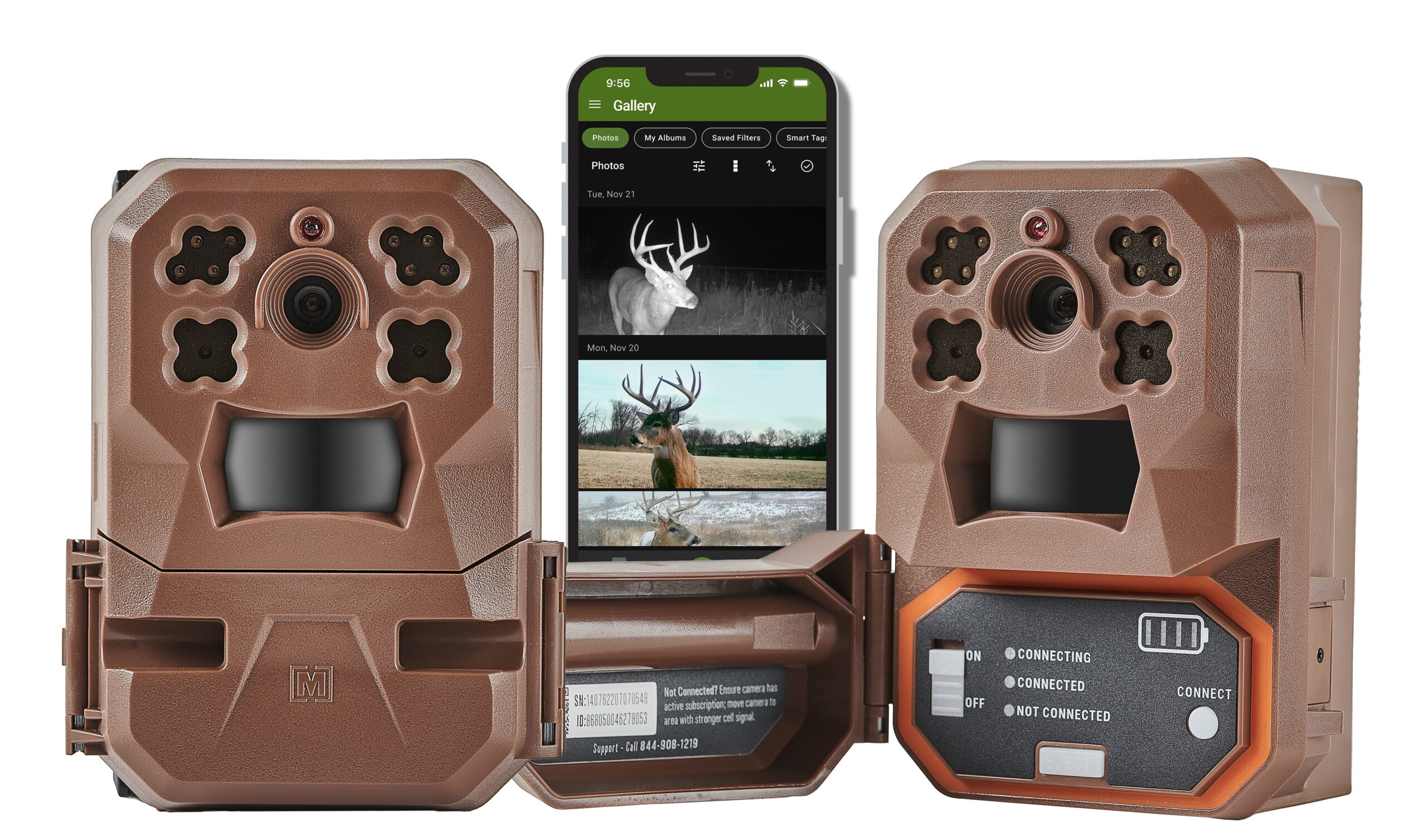
Connectivity is one of the stronger reasons to choose this kit. The Edge 3 automatically selects the strongest of four major US networks, with no manual SIM selection. Built-in GPS maps each camera in the Moultrie app, and Live Aim lets you preview the camera view while positioning it. That can save several trips to correct a camera that is pointed too high, too low, or at an inconvenient angle. The app also supports battery checks, settings changes, and compatible feeder controls from a distance.
The integrated AI buck detection is useful when alerts are frequent and you mainly care about deer activity. It is not a replacement for judging the whole scene yourself, but it can reduce the number of irrelevant notifications. The cameras support EDGE lithium battery packs and solar panels, so the kit can grow into a longer-term setup. Moultrie also backs the cameras with a two-year warranty from activation in the Moultrie Mobile app.
The limitation is simple: this is a two-camera kit, not a single compact unit for a casual observer. You need two good mounting positions, two power arrangements, and a cellular plan for each active camera. The SPYPOINT Flex-M Twin Pack offers more capture modes and 720p video with sound, while the Edge 3 gives you higher listed photo and video resolution plus Moultrie's four-carrier connection. Pick the Moultrie when image detail, live aiming, and buck-focused alerts matter more than audio capture.
3. SPYPOINT Flex-M Twin Pack: Best Multi-Location Kit

Pros
- Two cameras in one kit
- Dual-SIM LTE with automatic carrier monitoring
- Photo, video, time-lapse, and Time-Lapse+ modes
- 720p video includes sound
- SPYPOINT app includes maps and remote settings
Cons
- A microSD card is required and not included
- The listed video resolution is lower than the Moultrie Edge models
Best for: scouting two areas with the same flexible SPYPOINT workflow.
The Flex-M Twin Pack is built around coverage rather than a single standout specification. Two cameras let you watch separate trails, a property entrance and a food plot, or two sides of a wildlife corridor. The cameras are small enough to place without making every setup feel like a major installation, and the app gives you one place to activate them, view photos, update firmware, and manage settings.
SPYPOINT lists 28MP photos and 720p video with sound. The still images should give you useful detail for identifying activity, while the audio-equipped video mode can add information about movement and the surrounding environment. Photo, video, time-lapse, and Time-Lapse+ modes make this pair more adaptable than a camera that only reacts to motion. Time-Lapse+ is especially useful when you want interval coverage but still want the detection sensor involved.
Dual-SIM LTE and automatic network monitoring are the connectivity features to pay attention to. The Flex-M does not require Wi-Fi, and it can move between available carrier signals rather than relying on a single manually selected network. The app supports personalized maps, weather information, remote settings, and BUCK TRACKER AI species filtering. Those tools are more useful when you have two cameras generating activity from different parts of the property.
The practical catch is storage. A microSD card is required for operation and is not included, so setup is not quite as immediate as the Reveal X 3.0. The camera is also rated IP65 water-resistant, which is reassuring for normal outdoor exposure, but it is not a reason to ignore careful placement under branches or a small overhang. Pairing the camera with a compatible solar panel can extend autonomy, but this twin pack does not include one.
Compared with the Moultrie Edge 3 2-Pack, the Flex-M Twin Pack trades 40MP photos and 1080p video for more flexible capture modes and sound. Compared with the three-camera Flex-M pack below, it is easier to deploy when you only need two viewpoints. This is the right package for a user who wants broad scouting coverage and a capable app without moving into the more specialized solar designs.
4. Moultrie Edge Solar: Best Solar Integration

Pros
- Integrated solar panel and rechargeable battery
- Adjustable panel angle
- 40MP photos and 1080p video with audio
- 0.4-second trigger and 100-foot detection range
- Cloud storage and on-demand video
Cons
- Larger and heavier than several single-camera alternatives
- Solar performance depends on placement and available sunlight
Best for: a semi-permanent camera position with reliable sun exposure.
The Edge Solar is the most convincing fit for a camera that should stay in place for a season and require as few visits as possible. Its integrated solar panel charges a built-in rechargeable battery pack, so there is no separate panel to mount or cable to route. The panel angle can be adjusted to improve sun exposure, which is important because a solar camera is only as useful as its access to consistent light.
Moultrie combines that power design with 40MP stills, 1080p HD video with audio, and low-glow infrared coverage reaching up to 100 feet at night. The 0.4-second trigger is slightly faster than the 0.5-second figure on the standard Edge 3 models. That difference will not transform every trail, but it can help when animals move across the detection zone rather than toward the camera. Audio adds context to video, particularly for property monitoring where you may want to hear activity near a gate or outbuilding.
The camera uses four-carrier auto-connect and does not require manual SIM selection. Its Easy Aim mount supports real-time preview for positioning, while the Moultrie app handles remote settings, on-demand video requests, and cloud photo storage. The result is a system that makes more sense for a fixed observation point than for a camera you move every few days. Built-in GPS also helps keep track of its location in the app.
At 14.125 inches high and 2.45 pounds, the Edge Solar is notably larger and heavier than the TACTACAM Reveal X 3.0. That is not automatically a disadvantage, but it does make the mounting hardware and tree choice more important. A shaded trail, dense canopy, or northern-facing position will also limit what the integrated panel can do. The weather-resistant housing is designed for outdoor exposure, but solar should be treated as a power aid, not a guarantee of unlimited operation in every season.
The standard Moultrie Edge 3 is easier to choose when you want a conventional body and separate power options. The Edge Solar is the better answer when the installation has clear sunlight and you want 1080p video with audio, cloud access, and a built-in charging system in one unit. It is one of the strongest choices in this guide for a camera that should quietly stay deployed.
5. TACTACAM Reveal Pro 3.0: Best Advanced Controls

Pros
- Built-in GPS and on-demand video
- Optional SD card backup
- Two-inch LCD and live Wi-Fi aiming
- Burst mode and improved sensors
- Compatible with a REVEAL solar panel
Cons
- More controls than a simple alert-only camera needs
- It does not include integrated solar power
Best for: users who want to fine-tune placement and retain local media backup.
The Reveal Pro 3.0 is the TACTACAM to choose when setup and review matter as much as receiving alerts. It has a two-inch LCD, live Wi-Fi aiming, burst mode, built-in memory, and support for an SD card. Those features make it easier to check the camera at the tree, frame the trail accurately, and preserve a local copy of the images rather than depending entirely on cellular delivery.
Its night vision uses no-glow infrared, and motion activates the camera without drawing attention to the setup. TACTACAM also includes built-in GPS, on-demand video through the REVEAL app, and automatic 4G LTE connection to available networks. The combination is useful for a camera that may be placed in a hard-to-reach location, where knowing its mapped position and being able to request a video remotely can save a trip.
The Pro 3.0 supports a REVEAL solar panel for extended deployment and is designed for long battery stretches. Its 11.9-inch height and 1.7-pound listed weight put it close to the Reveal X 3.0 in physical size, but the Pro adds more ways to interact with the camera. That extra control is valuable when the camera is aimed at a narrow trail or when you are experimenting with detection settings. It is less important if you simply want to scan a wide clearing and receive occasional photos.
The most important comparison is with the Reveal X 3.0. The X is simpler, has built-in storage, and emphasizes rapid setup. The Pro is more flexible because it accepts an SD card and provides a local screen and aiming tools. The Moultrie Edge Solar has stronger integrated-power credentials and higher listed capture resolution, but it does not offer the same TACTACAM combination of LCD control and optional local backup.
Skip the Pro if every visit to the woods is an inconvenience and you have no interest in adjusting settings on site. Choose it if you are particular about framing, want a backup card, or need on-demand video. For experienced users, those controls make the Reveal Pro 3.0 a more capable field instrument than the simpler X.
6. SPYPOINT Flex-M Solar: Best Solar Bundle

Pros
- Camera, solar panel, strap, and mounting arm included
- 28MP photos and 720p video with sound
- Multiple capture modes
- Dual-carrier connectivity and app control
- Solar panel supports low-maintenance deployment
Cons
- A 32GB microSD card is required
- The bundle is less useful where sunlight is limited
Best for: buyers who want the camera and solar mounting pieces together.
The Flex-M Solar Bundle solves a common trail-camera problem: buying a cellular camera and then discovering that the solar panel, mounting arm, or strap is still missing. This package includes the Flex-M camera, an SPLB-10 compact solar panel, an installation strap, and a heavy-duty mounting arm. That makes it easier to plan a single installation, especially when you want the panel positioned separately from the camera for better light.
The camera captures 28MP photos and 720p video with sound. It supports photo, video, time-lapse, and Time-Lapse+ modes, so it can function as more than a motion-triggered still camera. Constant Capture technology lets it capture and transmit at the same time, while the SPYPOINT app provides remote settings, maps, weather information, firmware updates, and BUCK TRACKER AI filtering.
The Flex-M automatically monitors network performance and connects across available carrier coverage. No Wi-Fi is needed, which is the whole point of this category, but the installation still depends on cellular coverage at the chosen location. For power, the bundle is compatible with the optional LIT-22 rechargeable battery pack and uses a required 32GB microSD card. The card requirement is easy to overlook, so it should be part of your setup checklist.
This bundle is closely related to the Flex-M Twin Pack, but the intended use is different. The twin pack gives you two viewpoints. The Solar Bundle gives you one camera with a more complete power and mounting system. The Moultrie Edge Solar has a cleaner all-in-one body with an integrated panel, 40MP photos, and 1080p video with audio, while the SPYPOINT bundle gives you more flexibility in how the camera and panel are arranged.
The weakness is dependence on sunlight and a separate storage card. A wooded, shaded trail may not keep the panel productive enough, and a camera mounted beneath dense cover can make the solar hardware less effective. For an open property entrance, field edge, or sunny food plot, the included hardware makes this one of the easier solar setups to deploy.
7. SPYPOINT Flex-S-Dark: Best No-Glow Solar Camera

Pros
- Built-in solar panel and internal battery
- 40MP photos and 1080p video with sound
- No-glow night vision
- Live video streaming and remote viewing
- Cross-carrier connection
Cons
- The taller body needs careful mounting
- Solar performance varies with exposure and weather
Best for: discreet monitoring where night illumination must remain invisible.
The Flex-S-Dark has a clear purpose: keep the camera running for long stretches while avoiding a visible nighttime flash. Its built-in solar panel works with an internal battery, and SPYPOINT says the system can replace up to 1, 000 standard AA batteries. That is a manufacturer claim rather than a promise for every installation, since trigger activity, weather, and available sunlight all affect runtime, but the design is well suited to a camera that should stay in the field.
The capture hardware is stronger than the standard Flex-M. It records 40MP photos and 1080p video with sound, and it can send on-demand photos and videos through the SPYPOINT app. The no-glow LEDs are designed to emit no visible light in darkness, while the camera can switch between no-glow and low-glow settings remotely. That gives you a choice between maximum discretion and a different illumination mode when conditions call for it.
Live video streaming is the feature that separates this camera from most of the list. Remote viewing lets you check the surroundings and animal movement without walking into the area. Multi-shot, Time-Lapse+, scheduling, and in-app maps add useful control for a camera that may be watching a property over many months. Automatic connection to the strongest carrier signal helps, though no cellular camera can overcome a location with no usable coverage.
The housing is built for outdoor use, with a reinforced casing, a semi-flexible antenna, brass fittings, and a latch designed to remain manageable in cold weather. Its 11.22-inch height and 1-pound listed weight make it tall rather than bulky. Positioning matters because the solar panel needs light and the lens needs a clean view. A shaded, heavily enclosed trail is a poor match for any integrated solar design.
The Moultrie Edge Solar is a better fit if you want 40MP stills, 1080p video with audio, and a four-carrier system in a more conventional Moultrie setup. The Flex-S-Dark wins for invisible night illumination and live remote viewing. If discretion is the main concern, it is the most specialized pick here.
8. SPYPOINT Flex-M 3-Pack: Best Three-Camera Setup

Pros
- Three matching Flex-M cameras
- Photo, video, time-lapse, and Time-Lapse+ modes
- 28MP photos and 720p video with sound
- Dual-SIM LTE and app-based management
- BUCK TRACKER AI filtering
Cons
- Three microSD cards are required
- The pack needs three suitable power arrangements
- 720p video is less detailed than the Moultrie Edge line
Best for: monitoring several trails, property boundaries, or wildlife zones.
The Flex-M 3-Pack is for a property that cannot be understood from one or two viewpoints. Three cameras can cover an approach, a crossing, and a destination area, or create a perimeter around a gate, barn, and trail. Using the same model across all three positions also keeps the app workflow consistent, which matters when alerts arrive from different parts of the property.
Each Flex-M offers 28MP photos and 720p video with sound, along with photo, video, time-lapse, and Time-Lapse+ capture. Time-Lapse+ is useful for open areas where activity may happen outside the exact motion sensor zone. Constant Capture allows the camera to capture and transmit simultaneously, helping it continue recording while an earlier image is being sent.
SPYPOINT's dual-SIM LTE system monitors network performance and automatically handles carrier connection. The app provides instant delivery to a phone, tablet, or computer, along with maps, weather updates, remote settings, firmware updates, and BUCK TRACKER AI species filtering. Those features become more useful as the number of cameras grows because they reduce the need to visit each unit just to change a setting.
The storage requirement is the main operational drawback. Every camera needs a microSD card, and the cards are not included. Three cameras also mean three mounting locations and three power plans. The Flex-M is compatible with SPYPOINT solar panels and the LIT-22 rechargeable battery pack, but this package does not include a solar system. The listed dimensions and weight also differ for this pack, with the product information listing a 2.28-pound weight and a wider overall package.
The Flex-M Twin Pack is easier to manage if two locations are enough, while the Moultrie Edge 3 2-Pack produces higher-resolution photos and 1080p video. The three-camera SPYPOINT pack makes sense when coverage matters more than maximum image resolution. It is the most practical choice here for a user who wants a coordinated cellular network across a larger property.
9. SEHMUA 3rd Gen: Best Live Streaming

Pros
- 48MP photos and 2K video
- 2K live feed through the mobile app
- 0.1-second response time and 65-foot detection range
- 120-degree wide-angle lens
- 4W solar panel and IP66 protection
- 940nm no-glow infrared
Cons
- A subscription is needed after the trial period
- Detection range is shorter than the Moultrie Edge models
- Live streaming and solar use can increase power demands
Best for: wildlife observers who want to check a scene live from a phone.
The SEHMUA 3rd Gen is the most interesting camera here for someone who wants to see what is happening now, not simply receive the next uploaded photo. It supports 2K live streaming through its mobile app, along with remote viewing of photos and video. That makes it a stronger fit for observing a nesting area, property entrance, or active wildlife spot where a current view is more useful than a sequence of still alerts.
Its listed capture specifications are ambitious. The camera produces 48MP photos and 2K video, uses a 120-degree wide-angle lens, and claims a 0.1-second response time. A wide lens can cover more of a clearing, while a fast response helps reduce the chance that a moving animal exits the frame before capture. The detection range is listed at up to 65 feet, which is shorter than the 100-foot figure on the Moultrie Edge models, so placement needs to be closer to the expected activity.
Power comes from a 4W solar panel, intended to support long-term operation in an appropriately sunny position. The camera has IP66 protection against water and dust, and its 940nm no-glow infrared LEDs are designed to avoid disturbing animals at night. SEHMUA also describes color night images when natural light is present, with black-and-white night vision in complete darkness. That combination can make dawn, dusk, and moonlit scenes more informative than a basic monochrome capture.
The main compromise is the cellular service arrangement. The camera arrives with a pre-installed SIM and supports Verizon, AT&T, and T-Mobile networks in the United States, but a subscription is required after the seven-day unlimited data trial. Live streaming also places greater demands on connectivity and power than occasional photo transmission. A weak signal or shaded solar installation will undercut the camera's most appealing features.
The SPYPOINT Flex-S-Dark is a better choice for no-glow operation combined with a built-in solar panel and 1080p video with sound. The SEHMUA is the one to choose when 2K live viewing, a 120-degree lens, and a very fast listed response time matter more than a longer detection range. It is a specialized camera, but its live feed gives it a role none of the simpler alert-first models quite match.
10. Moultrie Edge 3: Best Straightforward Moultrie

Pros
- 40MP photos and 1080p HD video
- Four-carrier auto-connect
- 0.5-second trigger and 100-foot range
- Built-in GPS and Live Aim
- AI buck detection and instant alerts
Cons
- No integrated solar panel
- Does not include the second camera from the bundle
- Long deployments need a separate power strategy
Best for: a single Moultrie camera with strong app-based scouting tools.
The single-camera Edge 3 is the uncomplicated version of Moultrie's current formula. It gives you high-resolution photos, 1080p HD video, cellular delivery, GPS, and Live Aim without adding an integrated solar panel or a second camera. For one trail, one feeder, or one property entrance, that focused setup is easier to plan than a larger system.
Moultrie lists 40MP photos and 1080p HD video, with low-glow infrared for nighttime scenes. The 0.5-second trigger and 100-foot detection range suit a trail where animals may cross the frame quickly or approach from a distance. AI buck detection can identify bucks and send alerts, while the app lets you view activity and adjust settings remotely.
The Edge 3 automatically connects to the strongest of four major US networks, so there is no manual SIM selection. Built-in GPS maps the camera in the Moultrie app, and Live Aim helps you preview the field of view during placement. The app can also monitor battery status and control compatible feeders, which makes this camera more useful for a managed hunting property than for occasional backyard observation.
The weakness is power flexibility compared with the Edge Solar. This model is compatible with EDGE lithium battery packs and solar panels, but those are separate additions. It also lacks the 1080p video with audio listed for the Edge Solar. If you need two viewpoints, the Edge 3 2-Pack is the more natural choice, while the solar version makes more sense for a sunlit installation that should run with fewer visits.
Choose the single Edge 3 when one position is all you need and you want Moultrie's combination of four-carrier connection, Live Aim, GPS, and buck alerts. It is less specialized than the TACTACAM Pro 3.0 and less self-contained than the Edge Solar, but its core feature set is easy to understand and well matched to standard trail scouting.
How to choose the best cellular trail camera
The right camera depends less on the biggest number in its title than on how well its connection, power system, capture modes, and mounting position fit the property.
Cellular coverage
Cellular trail cameras need a usable signal at the exact mounting location, not just somewhere nearby. Multi-carrier systems such as the TACTACAM Reveal X 3.0, Moultrie Edge models, and SPYPOINT Flex cameras can automatically work across more than one network, which reduces the chance that a single carrier becomes a hard limit.
No auto-connect feature can create service where the terrain blocks every supported network. Check coverage around the actual trail, then consider whether the camera can be mounted a little higher or moved toward an opening without losing the view.
Power system
Standard battery compartments are simple, but they require field visits. Solar models such as the Moultrie Edge Solar, SPYPOINT Flex-S-Dark, SPYPOINT Flex-M Solar, and SEHMUA 3rd Gen are better suited to long deployments when the panel can receive direct or consistent sunlight.
An integrated panel is tidier, while a separate panel can be positioned for better exposure than the camera itself. High activity, frequent video, live streaming, and weak signal conditions can all increase power use. Treat claimed runtimes as deployment-dependent rather than guaranteed.
A solar panel only helps when the camera location gives it enough light to recharge.
Trigger and detection range
A fast trigger helps capture an animal before it moves out of the frame. The Moultrie Edge Solar lists a 0.4-second trigger, the Moultrie Edge 3 models list 0.5 seconds, and SEHMUA lists a 0.1-second response time. Those numbers are useful comparisons, but placement and detection-zone alignment matter just as much.
A longer detection range is helpful across an open field, while a shorter range may be perfectly adequate on a narrow trail. The Moultrie models list a 100-foot range, SEHMUA lists up to 65 feet, and the camera should be aimed so that an animal crosses the detection area rather than moving directly toward it.
Image and video modes
Higher photo resolution can preserve more detail for identification, but it does not automatically produce better images in darkness or poor weather. The Moultrie Edge models and SPYPOINT Flex-S-Dark list 40MP photos, SEHMUA lists 48MP, and SPYPOINT Flex-M cameras list 28MP.
Video adds movement and context. The Moultrie Edge models and Flex-S-Dark record 1080p video, SEHMUA supports 2K video and live streaming, and the Flex-M records 720p video with sound. Time-lapse and Time-Lapse+ modes are useful when you want to monitor an area beyond the exact motion-triggered moment.
Night illumination
No-glow infrared is the discreet option because it avoids a visible red flash. The TACTACAM models, SEHMUA, and SPYPOINT Flex-S-Dark all emphasize night vision or no-glow operation. Low-glow systems can still be effective and may produce a different balance of illumination and discretion.
Think about the animals and the location. A camera near a frequently visited trail, gate, or observation area benefits from a less conspicuous nighttime system. For more help weighing detection, night images, and remote alerts, the trade-offs between wildlife monitoring features provide useful context.
Storage and app controls
Some cameras rely on built-in storage or cloud delivery, while others require a microSD card. The Reveal X 3.0 avoids an SD card, the Reveal Pro 3.0 supports one as a backup, and SPYPOINT Flex-M models require a microSD card for operation. Check this before installation so a missing card does not turn into a wasted trip.
App features vary too. Moultrie offers Live Aim, GPS mapping, buck detection, and remote controls for compatible feeders. SPYPOINT offers maps, weather, remote settings, firmware updates, and BUCK TRACKER AI. TACTACAM adds GPS, on-demand video, and live Wi-Fi aiming on the Pro 3.0.

Frequently asked questions
Do cellular trail cameras need Wi-Fi?
No. These cameras use cellular networks to send photos and video to an app, so they can work on remote land without a local Wi-Fi router. They still need usable cellular coverage at the camera location.
Do cellular trail cameras require a subscription?
Cellular transmission generally requires an active service plan, although the details vary by camera and provider. The SPYPOINT models advertise a free photo transmission option with limits, while the SEHMUA listing states that a subscription is needed after its seven-day data trial. Check the current service terms before deployment.
Is a solar trail camera better than a battery model?
A solar model can reduce visits when it receives consistent sunlight and has a suitable internal battery. It is not automatically better in a shaded forest, under dense canopy, or during long periods of poor weather. A conventional camera with a suitable rechargeable or extended battery setup may be easier to place in those conditions.
What does no-glow night vision mean?
No-glow infrared illumination is designed to avoid visible light when the camera captures nighttime activity. It is useful when you want the camera to remain discreet around wildlife or property. It does not mean the camera is invisible in every respect, since the housing, antenna, and mounting position can still be noticed.
Is 40MP better than 28MP for a trail camera?
A higher listed photo resolution can preserve more detail, particularly when you need to inspect a still image. It does not guarantee better night exposure, focus, or motion handling. Trigger behavior, lens placement, infrared performance, and the distance to the animal all affect the result.
Do I need an SD card?
That depends on the model. The TACTACAM Reveal X 3.0 uses built-in storage and does not require an SD card, while the Reveal Pro 3.0 supports an SD card for local backup. SPYPOINT Flex-M cameras require a microSD card, and the Solar Bundle listing specifies a 32GB card.
Can I use one camera to monitor several locations?
A single camera can watch one field of view at a time, so several locations usually require several cameras. The SPYPOINT Flex-M Twin Pack and 3-Pack are designed for this kind of coverage, while the Moultrie Edge 3 2-Pack gives you two matching cameras with the same app and feature set.

The bottom line
The best cellular trail camera for most remote scouting jobs is the TACTACAM Reveal X 3.0. Its multi-carrier LTE connection, GPS, built-in storage, fast trigger, and flexible power options make it the easiest all-around camera to place and leave in the field. Choose the Moultrie Edge Solar instead when integrated solar power, 40MP photos, 1080p video with audio, and cloud controls matter more than a smaller installation.
For multiple locations, the Moultrie Edge 3 2-Pack and SPYPOINT Flex-M Twin Pack are the sensible choices. The Flex-S-Dark stands out when no-glow night operation and live viewing are priorities, while the SEHMUA 3rd Gen is the specialist pick for 2K live streaming.
If you are undecided, choose the Reveal X 3.0 for one dependable remote camera, or choose a two-camera pack when the property has more than one route worth watching.
As an Amazon Associate we earn from qualifying purchases.