

A camera strap has one job that matters more than style: keeping a camera close, secure, and ready without turning every walk into a neck workout. The wrong design slips off a shoulder, tangles around a tripod, or makes a quick shot awkward.
Our Best camera strap picks cover simple neck straps, crossbody systems, a wrist strap, and a dedicated sling. Peak Design Slide is the strongest all-around choice, while the other nine make better sense for specific shooting habits.
Comparison
| # | Product | Award | Width or adjustment | Attachment | Best for |
|---|---|---|---|---|---|
| 1 | Peak Design Slide | Best overall | 39 to 57 inches | Anchor Link | Photographers who want one adaptable strap |
| 2 | PGYTECH Wide Padded Strap | Best wide strap | 1.8 inches wide | Arca-type QR plate | Heavy camera setups |
| 3 | Altura Photo Sling Strap | Best tripod-friendly sling | Adjustable | Metal quick-release plate | Switching between handheld and tripod work |
| 4 | BLACKRAPID Sport X | Best dedicated sling | Adjustable underarm stabilizer | Cam-Lock system | Fast-moving right-handed shooters |
| 5 | waka Rapid Strap | Best safety features | 20.8 to 31.5 inches | Quick plate and tether | DSLR owners who want backup protection |
| 6 | Peak Design Cuff | Best wrist strap | Wrist loop | Anchor Link | Compact cameras and controlled shooting |
| 7 | JJC Neoprene Strap | Best convertible neck strap | Adjustable | Two quick-release clips | Neck or hand carry |
| 8 | K&F CONCEPT Neoprene Strap | Best pocketed strap | Not specified | UTX safety buckle | Shooters who carry small accessories |
| 9 | WANBY Canvas Strap | Best canvas design | 28 inches, adjustable | Quick-release buckles | Casual DSLR carrying |
| 10 | K&F CONCEPT 100cm Strap | Best lightweight strap | 100cm | Metal connecting rings | Street photographers who pack light |
1. Peak Design Slide: Best Overall

Pros
- Converts between sling, neck, and shoulder carry
- Smooth and grippy sides suit different clothing and positions
- One-finger length adjustment
- Anchor Link connections are quick to remove
Cons
- More strap than a compact camera usually needs
- The very long adjustment range can feel bulky when shortened
Best for: photographers who want one strap that can change with the shoot.
The Peak Design Slide is the strap we would hand to someone who has not yet settled on a carrying style. It does not force the camera into a fixed neck or shoulder position. Wear it as a sling when walking, shift it to a shoulder strap when working in a crowded space, or use it around the neck when you want the camera centered and ready.
Its 39 to 57 inch adjustment range is unusually useful because the right length changes with clothing, lens size, and whether the camera sits at your side or in front. The dual quick-adjusters can be operated with one finger, so changing the position does not require taking the camera off. The internally padded nylon webbing adds cushioning without making the strap feel excessively thick.
The two sides of the webbing have distinct jobs. One is smooth enough to glide across clothing when you raise the camera, while the other is grippy and helps keep the strap in place on a shoulder. That gives Slide a more considered feel than the fixed neoprene straps here. Its Anchor Link system is also compatible with all camera systems, binoculars, and rangefinders, and each anchor is rated to hold over 200 pounds.
The weakness is that flexibility brings extra hardware and length. A small mirrorless body can look overdressed on it, and photographers who always shoot with a camera in hand may prefer the much smaller Peak Design Cuff. The Slide is also not the most specialized option. BLACKRAPID Sport X is better for a dedicated crossbody workflow, while PGYTECH Wide Padded Strap makes more sense when broad padding is the priority.
For the photographer who wants one dependable strap rather than a collection of specialized options, Slide is the clearest starting point. It is especially well suited to travel, events, and outdoor shooting where the carrying position changes repeatedly. If you are also organizing lenses and accessories, consider how a camera bag should separate bodies from smaller gear before choosing the rest of your carry setup.
2. PGYTECH Wide Padded Strap: Best Wide Strap
Pros
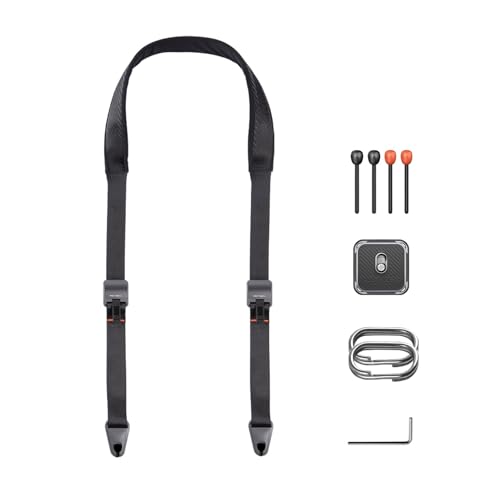
- Broad 1.8 inch strap spreads camera weight
- EPDM-lined shoulder pads are soft and elastic
- Quick adjusters sit at both ends
- Dead-center locking quick connector
- Includes an Arca-type quick-release plate
Cons
- The wider construction is less discreet
- The stated 90 kg load capacity exceeds what most users need
Best for: photographers who prefer broad support and a quick-release plate.
The PGYTECH Wide Padded Strap takes the opposite approach to Peak Design Cuff. It is meant to support a full-size DSLR or SLR with a strap that feels substantial across the shoulder. Its 1.8 inch width gives it a planted feel, particularly when a camera and larger lens stay attached for long stretches.
The strap uses UHMWPE construction, which PGYTECH says can carry up to 90 kg. That number is far beyond a normal camera load, but the practical point is that the material is designed around strength rather than a thin fashion strap. Its three-layer structure also provides a replacement warning, giving the owner a visual reason to retire the lanyard before wear becomes a safety concern.
The original quick connector uses a center locking mechanism. Once the quick bead is locked, the connector is designed not to release from force applied at different angles. It can be installed or removed with one hand by pressing the upper part of the connector. Quick adjusters at both ends make it easier to contour the strap to the photographer instead of leaving all adjustment at one point.
The included Arca-type QR plate is a meaningful advantage for photographers whose tripod head already uses that format. It also creates a more integrated system than the standard screw plate on waka Rapid Strap. The tradeoff is bulk. Slide is easier to reposition as a neck, shoulder, or sling strap, and JJC Neoprene Strap feels less specialized around a smaller body.
Skip this one if you want a barely noticeable strap or use a compact camera most of the time. The padding and width are justified for heavier equipment, not for minimizing what you carry. For DSLR users who want broad support, strong materials, and quick access to a compatible tripod plate, it is the most convincing alternative to Slide.
3. Altura Photo Sling Strap: Best Tripod-Friendly Sling

Pros
- Solid metal mounting plate
- Safety tether adds backup protection
- Camera can move from strap to tripod without removing the plate
- Padded, non-slip shoulder section
- Zippered pouch holds small accessories
Cons
- Plate and hardware add noticeable bulk
- Its 40 lb load rating is lower than some headline figures here
- Crossbody design may not suit left-shoulder users
Best for: photographers who alternate between a sling and tripod.
The Altura Photo Sling Strap solves a specific annoyance: removing the strap plate every time you put the camera on a tripod. The plate stays attached to the camera, letting you move between shoulder carrying and tripod mounting without the usual unscrewing and fumbling. That makes it a practical tool for landscape, event, and travel photographers who change setups often.
Its mounting plate is metal rather than plastic and has a rubber anti-slip base intended to protect the camera and prevent movement. The plate and quick-release clip are load-rated to 40 pounds, and the system includes a safety tether as a second connection. Those details matter because a sling puts the camera below the shoulder, where a loose connection can turn into a sudden drop.
The strap is fully adjustable and uses a non-slip shoulder pad to distribute the camera's weight. A built-in zippered pouch keeps batteries, memory cards, and other small accessories close at hand. That pouch is a useful distinction from Peak Design Slide, which is cleaner and more adaptable but does not provide integrated storage.
Altura Photo is not as refined as Slide when the camera must move between several carry positions. Its hardware is also more conspicuous, and the crossbody arrangement is designed for the camera to sit at the side. BLACKRAPID Sport X is the more purpose-built choice for a fast right-handed sling, while Altura Photo is the better fit for someone who values tripod continuity.
The strap supports DSLR and mirrorless cameras with a standard quarter-inch tripod screw. It is a strong choice for photographers who spend part of the day handheld and part of it locked down. If your camera kit needs to stay compact while moving between locations, the right way to carry bodies and lenses on a trip is worth considering alongside the strap.
4. BLACKRAPID Sport X: Best Dedicated Sling

Pros
- Dedicated crossbody layout keeps the camera at the right hip
- Front and rear Cam-Locks help control movement
- Removable underarm stabilizer
- Cushioned nylon mono mesh shoulder pad
- Includes a safety tether and locking hardware
Cons
- Designed for right-handed use from the left shoulder
- More involved to set up than a simple neck strap
- The sling format is less versatile for centered carrying
Best for: right-handed photographers who want rapid access while walking.
The BLACKRAPID Sport X is not trying to be a universal neck strap. It is a body strap for photographers who want the camera parked at the right hip and ready to slide upward into shooting position. That dedicated arrangement feels more purposeful than converting a general strap into a sling.
The design is worn crossbody over the left shoulder, with the camera at the right hip for right-handed photographers. Front and rear spring-loaded Cam-Locks on the webbing help secure the camera by the hip and reduce unwanted movement. An underarm stabilizer can be adjusted to limit slippage, and it can be removed when the photographer prefers a simpler setup.
The comfort pad combines nylon mono mesh, TPE foam, and polyester. That construction is aimed at prolonged shooting sessions, while the included swivel locking carabiner, LockStar II, FastenR FR-5 II, and Camera Safety Tether II provide a complete hardware kit. Compatibility covers DSLR, SLR, and mirrorless cameras with both long and short lenses.
The limitation is fit direction. Left-handed photographers or anyone who routinely switches the camera from one side to the other should look at Peak Design Slide instead. Altura Photo Sling Strap is also easier to recommend when tripod use is part of the routine because its plate can remain attached during the transition. Sport X wins when walking access and stability matter more than flexibility.
It includes a reusable black mesh zippered gear bag and a one-year limited warranty for qualifying purchases from authorized US stores. Those extras do not change the basic verdict: this is a focused tool for active, right-handed shooting. Choose it when the camera should move quickly from resting position to eye level without swinging across your body.
5. waka Rapid Strap: Best Safety Features

Pros
- Includes an extra safety tether
- Metal quick-release connection with anti-slip rubber padding
- Adjustable from 20.8 to 31.5 inches
- Neoprene shoulder pad
- Zipper pocket for batteries or memory cards
Cons
- Shorter adjustment range than Peak Design Slide
- Requires careful installation of the safety cord
- More oriented to DSLR and zoom combinations
Best for: DSLR owners who want an extra connection between camera and strap.
The waka Rapid Strap puts security at the center of its design. It combines a metal quick-release connection, anti-slip rubber padding, a stainless steel screw, and an extra safety tether. That is a reassuring set of safeguards for a DSLR with a zoom lens, particularly when the camera is carried at the side during travel or events.
Its 20.8 to 31.5 inch adjustment range is much shorter than Slide's 39 to 57 inches, so it keeps the camera closer to the body. A neoprene shoulder pad spreads the load, and the strap is shaped to sit around the shoulder for constant use. The built-in zipper pocket adds a useful place for a spare battery or memory card without requiring another pouch.
The strap is designed for full-size SLR cameras and zooms with a standard quarter-inch tripod stud screw. Its anti-falling plastic buckle connects to the strap while the quick plate uses a solid metal connection. The safety tether is the key differentiator, but it only helps if it is installed correctly. The included warning to push the slider clip into the locking slot is not something to ignore.
Compared with Altura Photo Sling Strap, waka Rapid Strap offers a similar safety-minded approach but with a shorter, more compact carry position. Altura is better if tripod changes are frequent, while Slide is better if the strap must become a neck, shoulder, or sling configuration. The waka design is less appealing for a small camera that does not need this much backup hardware.
Skip it if you want a minimalist strap or dislike checking multiple connection points before shooting. For DSLR owners who prioritize a tether, padded support, and a close carry position, it is a sensible choice. The strongest reason to choose it is not flexibility. It is the extra layer of protection against a single connection failure.
6. Peak Design Cuff: Best Wrist Strap

Pros
- Minimal wrist-worn design
- Tightens quickly during a drop
- Anchor Link connection releases quickly
- Can be worn as a small bracelet
- Works with DSLR, compact, and point-and-shoot cameras
Cons
- Does not support hands-free carrying like a shoulder strap
- Less suitable for long periods with a heavy DSLR
- Protects the wrist rather than keeping the camera at the ready
Best for: photographers who hold the camera continuously and want drop protection.
The Peak Design Cuff is the smallest and least intrusive option here. Instead of suspending the camera from the neck or shoulder, it keeps a safety loop around the wrist. That makes sense for street photography, compact cameras, and situations where the camera stays in the hand for most of the session.
The low-profile strap wraps around the wrist like a bracelet when it is not connected. Updated hardware lets the loop remain open while the hand slides through, then cinches with a pull. If the camera slips, the wrist strap tightens quickly rather than allowing the body to fall away. It is a simple idea, executed with less clutter than a traditional neck strap.
Cuff uses Peak Design's Anchor Link system, and each anchor is rated to hold over 200 pounds. The connection works across camera systems, binoculars, and rangefinders. That makes it easy to move the wrist strap between compatible gear, although the wrist loop does not offer the length adjustment or carrying-position changes of Peak Design Slide.
The obvious limitation is that your hand remains occupied. A camera cannot hang safely at your side while you climb stairs, change lenses, or carry another object. JJC Neoprene Strap can serve as a neck strap and then become a hand strap, while Cuff is more compact and more elegant for photographers who do not want fabric around the neck.
Choose Cuff for control, not load distribution. It is particularly good for a small camera, a point-and-shoot, or a photographer who wants to reduce the consequences of a slip without adding a full shoulder system. It is the right accessory when a conventional strap would spend more time dangling than supporting the camera.
7. JJC Neoprene Strap: Best Convertible Neck Strap

Pros
- Comfortable neoprene shoulder section
- Anti-slip side helps stabilize the camera
- Two buckles allow length adjustment
- Quick-release clips remove the neck section
- Can convert into a hand strap
Cons
- Small hooks require careful attachment
- Less convenient than a plate-based sling for rapid repositioning
- Its listed dimensions are not a full wearing-length range
Best for: DSLR users who want neck and hand carrying from one strap.
The JJC Neoprene Strap is a straightforward neck strap with a useful second mode. Remove the neck section using its two quick-release clips, connect the two ends, and it acts as a hand strap. That is more practical than it sounds for photographers who switch between walking and concentrated handheld shooting.
The shoulder section uses neoprene and a comfort curve to reduce pressure around the neck and shoulders. Its body-facing side has an anti-slip design, which helps the camera stay put instead of sliding across clothing. Two buckles adjust the length for different users, and the strap attaches through two small hooks to the camera's strap eyelets.
JJC lists compatibility with many Canon, Nikon, Sony, Fujifilm, Olympus, OM System, and Panasonic cameras. The product is intended for cameras with two strap eyelets, so it is not the natural partner for a camera that depends on a tripod-screw plate. That distinction puts it closer to K&F CONCEPT Neoprene Strap than to Altura Photo Sling Strap.
Its weaknesses are mostly about hardware and speed. The small hooks need a careful attachment, and the neck strap is not as fast to reposition as Slide. The hand-strap conversion also takes a step or two, whereas Peak Design Cuff is always ready around the wrist. Still, JJC gives a DSLR user more flexibility than a basic fixed neck band.
Pick it when comfort and conversion matter more than a sleek quick-slide system. It suits photographers who carry a camera around the neck, then want a shorter grip while shooting. For a conventional DSLR setup with two eyelets, it is an adaptable design that avoids committing to only one way of carrying.
8. K&F CONCEPT Neoprene Strap: Best Pocketed Strap

Pros
- Neoprene construction spreads camera weight
- Removable zipper pocket holds small accessories
- Anti-slip texture helps prevent movement
- UTX safety buckle
- Includes leather stickers and hardware rings
Cons
- The strap's full adjustment range is not specified
- The pocket adds bulk to a simple neck strap
- Compatibility depends on the camera's attachment points
Best for: DSLR photographers who want storage built into the strap.
The K&F CONCEPT Neoprene Strap is a conventional neck strap with one feature that changes how it works in practice: a removable zipper pocket. It can hold a small battery or SD card, and the pocket can also hang from a backpack. That is useful when a photographer wants emergency storage without carrying a separate accessory pouch.
The strap uses comfortable, durable neoprene to distribute camera weight across the neck and shoulders. Small uneven lines and stripes on the body-facing side create an anti-slip surface, helping the camera remain steadier while walking. Its UTX safety buckle is intended to reduce the chance of an accidental release.
K&F includes a pair of anti-scratch leather stickers and hardware rings for broader camera compatibility. The strap is intended for most DSLR cameras, but the product data does not specify a complete length range. That makes it harder to judge fit in advance than the clearly adjustable waka Rapid Strap or Peak Design Slide.
The pocket is both its best feature and its main compromise. It keeps essential small items close, but it makes the strap less clean and may be unnecessary for a photographer already carrying a camera bag. JJC Neoprene Strap is the better convertible option, while the lighter K&F CONCEPT 100cm Strap is better for someone who values packability over padding and storage.
Choose this version when the attached pocket will actually be used. It makes particular sense for short outings where a spare card or battery is all you need. If you are building a larger kit, how photographers organize bodies, lenses, and accessories may matter more than adding storage to the strap itself.
9. WANBY Canvas Strap: Best Canvas Design

Pros
- Cotton canvas and PU leather construction
- Elastic neck section helps reduce tension
- Anti-slip inner layer
- Adjustable 28 inch length
- Quick-release buckles
Cons
- High-tensile plastic fasteners are less substantial than metal plate systems
- The shorter listed length may not suit every carry style
- No dedicated safety tether is listed
Best for: casual photographers who want a traditional canvas look.
The WANBY Canvas Strap is the style-led choice in this group, but it is not merely decorative. Its cotton canvas webbing and PU leather sections give it a more traditional appearance than the mostly technical straps above. It can be worn around the shoulder or neck, making it suitable for everyday DSLR carrying.
The strap is 1.5 inches wide and has a listed adjustable length of 28 inches. An elastic section around the neck is designed to reduce tension, while an anti-slip layer on the inside helps prevent the strap from sliding. Those details make it more thoughtful than a flat decorative band with no attention to movement.
WANBY uses nylon and high-tensile plastic fasteners with quick-release buckles. The universal strap is intended for DSLR and SLR cameras, as well as some binoculars, monoculars, rangefinders, and tools. It does not include the metal plate and backup tether found on Altura Photo Sling Strap, so photographers carrying a heavy body and long lens should consider that difference carefully.
The 28 inch figure is also notably shorter than Slide's 39 to 57 inch range. That may be comfortable for a close neck carry, but it leaves less room to experiment with a low-slung crossbody position. K&F CONCEPT 100cm Strap is the more packable minimalist option, and JJC Neoprene Strap is the more functional pick if conversion to hand carry matters.
WANBY is best for someone who wants a simple camera strap that fits naturally into a casual, vintage-leaning kit. It is not the technical leader, but it covers the basics with an adjustable length, quick release, elastic comfort section, and anti-slip backing. Skip it for demanding outdoor work where a tether or a plate-based connection is essential.
10. K&F CONCEPT 100cm Strap: Best Lightweight Strap

Pros
- Weighs 60 grams, or 2.1 ounces
- Rolls up for easy storage
- Durable nylon construction
- Metal connecting rings fit many strap loops
- Compact profile suits street photography
Cons
- No padded shoulder section is listed
- No quick-release plate or backup tether is listed
- Fixed 100cm size may not suit every photographer
Best for: street photographers who want the least noticeable neck strap.
The K&F CONCEPT 100cm Strap strips the camera strap down to its lightest useful form. It weighs 60 grams, or 2.1 ounces, and uses a rope design that rolls up for storage. That makes it easy to leave in a small camera bag rather than deciding whether a full shoulder system is worth carrying.
Its durable nylon construction is intended for regular use, and the double-ended metal connecting O-rings fit most camera shoulder strap loops. The 100cm size gives the strap a clear, simple identity, though it does not offer the broad adjustment range of Slide or the closer fit of waka Rapid Strap.
The lightweight build is particularly suited to street photography and quick snapshots. A neck strap can free both hands when moving between locations, and the narrow profile will not compete with a small camera body. It is less appropriate for a heavy DSLR with a large zoom, where the padded support of PGYTECH Wide Padded Strap or the sling support of BLACKRAPID Sport X will be more comfortable.
There are important omissions compared with the rest of this list. K&F does not list a padded shoulder section, quick-release plate, safety tether, or anti-slip backing for this model. That does not make it a poor choice, but it makes the intended use clear. This is a carry strap for keeping weight and storage demands low, not a heavy-duty camera support system.
Choose it when simplicity is the feature. It works well for a compact setup, short city walks, and photographers who want a strap that disappears into a bag when not in use. If your camera is large or expensive enough that backup connections are a priority, choose waka Rapid Strap or Altura Photo Sling Strap instead.
How to choose best camera strap
The right strap depends on how the camera moves through a shoot. Connection security, weight distribution, adjustment, and the way the strap interacts with a tripod matter more than appearance alone.
Connection system
A strap can attach through camera eyelets, a tripod-screw plate, or a proprietary quick-release system. Eyelet straps such as JJC Neoprene Strap are straightforward for compatible DSLR bodies. Plate systems such as Altura Photo Sling Strap are more useful when the camera also spends time on a tripod.
Look for metal hardware, anti-slip surfaces, and a backup tether when carrying a heavy camera or long lens. A simple ring connection can be perfectly adequate for a light setup, but it offers less protection against a single point of failure than a system with a secondary tether.
The safest strap is the one whose connection you will actually inspect before every walk.
Carrying position
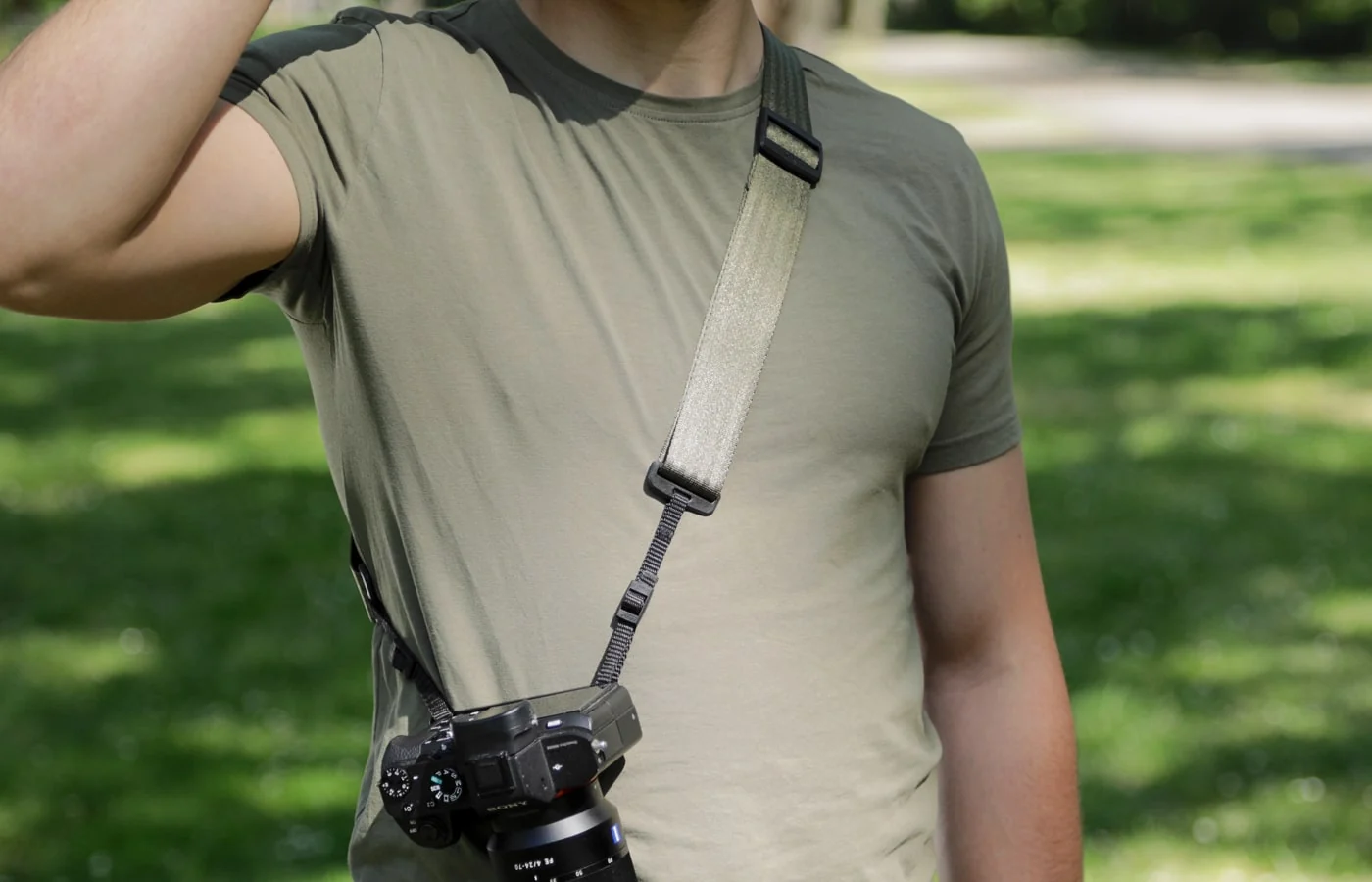
Neck straps keep the camera centered and are easy to understand, but they can swing while walking. Shoulder straps move the load to one side, while crossbody slings keep the camera at the hip and make it quicker to raise.
Peak Design Slide is the most flexible because it can serve all three positions. BLACKRAPID Sport X is more stable when used as its intended right-shoulder-to-right-hip sling, but less suitable for photographers who want to change sides or carry the camera centered.
Padding and width
Wide webbing spreads force over more of the shoulder. PGYTECH Wide Padded Strap measures 1.8 inches across and adds EPDM-lined padding, while neoprene models use softer material to reduce pressure around the neck and shoulders.
A narrow, lightweight strap is not automatically worse. K&F CONCEPT 100cm Strap weighs 60 grams and is easier to pack, but its lightweight design is better matched to a compact camera than to a heavy DSLR with a large lens.
Adjustment range
Adjustment determines whether the camera sits high and close, hangs at the hip, or works as a sling. Peak Design Slide offers a 39 to 57 inch range, while waka Rapid Strap adjusts from 20.8 to 31.5 inches. WANBY lists an adjustable 28 inch length, and K&F CONCEPT's lightweight model is 100cm.
A longer range is useful for changing clothing and carry position, but more webbing can create extra bulk. A short, close-fitting strap may feel more controlled, though it gives up the ability to carry the camera low across the body.
Quick release and tripod use
Quick-release hardware is valuable when a camera moves frequently between a strap and a hand. It is even more useful when the plate can remain installed while the camera goes onto a tripod, as with Altura Photo Sling Strap.
A quick-release buckle is not the same as a plate-based tripod system. Check whether the strap's connector matches the way your camera is normally mounted. Peak Design Cuff and Slide use Anchor Link connections, while several traditional neck straps attach directly to the camera's strap loops.

Frequently asked questions
Can a camera strap fit both DSLR and mirrorless cameras?
Several products here are designed for both types, including Peak Design Slide, Altura Photo Sling Strap, and BLACKRAPID Sport X. Traditional eyelet straps can also fit many bodies, but compatibility depends on the camera's attachment points. Check whether your camera uses strap eyelets or a tripod-screw connection before ordering.
Is a wrist strap safer than a neck strap?
A wrist strap can reduce the chance of dropping a camera while it is in your hand, but it does not let you carry the camera hands-free. Peak Design Cuff tightens around the wrist during an accidental drop. A neck or shoulder strap is more practical when you need both hands free.
Can I use a camera strap with a tripod?
Yes, but the experience depends on the attachment system. Altura Photo Sling Strap is designed so its plate can stay on the camera while switching to a tripod. A strap attached through camera eyelets may not interfere with a tripod, but it will not provide the same plate-based transition.
What strap is best for a heavy camera and lens?
Look for broad padding, strong connection hardware, and a secondary safety system. PGYTECH Wide Padded Strap has a 1.8 inch width and a stated load capacity of up to 90 kg. Altura Photo Sling Strap includes a metal plate and safety tether, while waka Rapid Strap adds a safety tether to its quick-release setup.
Are crossbody camera straps more comfortable?
They can be, especially when the camera sits at the hip instead of pulling directly at the neck. A padded shoulder section and an anti-slip or underarm stabilizer help keep the strap in place. Crossbody designs are directional, though, so check whether the arrangement suits your preferred shooting hand.
Do camera straps work with compact cameras?
Many do, but a full DSLR strap can be unnecessarily large for a compact body. Peak Design Cuff is designed for compact and point-and-shoot cameras, while K&F CONCEPT 100cm Strap is a lightweight option that rolls up for storage. Confirm that the camera has compatible strap loops or a suitable connection point.

The bottom line
The Best camera strap for most photographers is Peak Design Slide. Its 39 to 57 inch adjustment range, smooth and grippy sides, quick Anchor Link system, and three carrying modes make it the most adaptable pick in this group. PGYTECH Wide Padded Strap is the better choice for photographers who want broad support and an Arca-type QR plate.
Choose Altura Photo Sling Strap if you move between a shoulder carry and tripod work, or BLACKRAPID Sport X if you want a dedicated right-handed sling that stays stable while walking. For a smaller camera, Peak Design Cuff protects against drops without adding a full neck strap.
If you are undecided, choose Slide for flexibility, or choose Cuff if the camera will stay in your hand all day.
As an Amazon Associate we earn from qualifying purchases.