

A phone photo is easy to take and surprisingly hard to turn into a physical print without a desk, cables, and a full-size printer. The right compact model can turn a camera-roll image into a keepsake at a party, a sticker in a travel journal, or a proper 4x6 photo at home. The Best Portable Photo Printer depends first on the size and finish you actually want.
The Liene M100 is our top pick because it produces full-size 4x6 prints with dye-sublimation protection and supports up to five connected devices. The rest of the field ranges from tiny 2x3 sticker printers to the flexible Liene Amber M110, so this guide covers both everyday snapshots and more creative, pocket-sized printing.
Comparison table
| # | Product | Award | Print format | Printing method | Best for |
|---|---|---|---|---|---|
| 1 | Liene M100 | Best overall | 4x6 inches | Thermal dye sublimation | Full-size photo prints |
| 2 | Liene Amber M110 | Best dual-format | 4x6 and 3x3 inches | Thermal dye sublimation | Families and mixed projects |
| 3 | Nelko PP01 White | Best pocket inkjet | 2x3 inches | Inkjet | Stickers and scrapbooks |
| 4 | KODAK Mini 2 Retro | Best protected mini prints | 2x3 inches | 4PASS dye sublimation | Durable wallet-size photos |
| 5 | KODAK Step | Best zero-ink option | 2x3 inches | ZINK | Quick peel-and-stick prints |
| 6 | Liene Pearl N200 Pro | Best creative app | 2x3 inches | Thermal dye sublimation | AI edits and party printing |
| 7 | HP Sprocket 2nd Edition | Best social printing | 2x3 inches | ZINK | Shared print queues |
| 8 | Canon Ivy 2 | Best simple ZINK printer | 2x3 inches | ZINK | Straightforward phone printing |
| 9 | Nelko PP01 Pink | Best colorful pick | 2x3 inches | Inkjet | Journals and crafts |
1. Liene M100: Best Overall

Pros
- Prints proper 4x6-inch photos
- Thermal dye-sublimation output has a laminated surface
- Wi-Fi hotspot avoids reliance on an outside network
- Supports up to five simultaneous connections
- Includes 100 sheets and three color cartridges
Cons
- Larger than the 2x3-inch pocket printers
- Requires cartridges and dedicated photo paper
- The app is needed for editing features
Best for: anyone who wants phone printing that looks and feels like a conventional photo print.
The Liene M100 is the printer we'd choose when the photo itself matters more than carrying the smallest possible device. Its 4x6-inch format gives faces, landscapes, and group shots enough room to breathe. A 2x3 print is fun, but it is still a small keepsake. The M100 produces something that fits naturally in a frame, album, or envelope.
Its thermal dye-sublimation system prints the image in color layers and finishes it with a laminated surface. Liene says that surface resists water, scratches, fingerprints, and fading. That matters when prints are handled by children, passed around at a gathering, or tucked into a travel album rather than immediately put behind glass. The package includes 100 sheets and three color cartridges, split between the printer packaging and an additional box.
Connection is handled through the printer's built-in Wi-Fi hotspot. That is a useful distinction from Bluetooth-only models such as the KODAK Mini 2 Retro or Canon Ivy 2. The M100 does not need an outside wireless network, and it can accept connections from up to five devices at once. A family can send pictures from several phones without passing one handset around after every print.
The Liene app gives the M100 more to do than simply reproduce a camera-roll file. It can add square borders, apply filters, adjust contrast and brightness, show print status, and help prepare ID or visa photos. The weakness is physical portability. At roughly 9.84 inches wide and 7.48 inches in both height and length according to the listed dimensions, this is portable in the sense that it can move between rooms or travel in a bag, not pocket-sized like the HP Sprocket.
The M100 also asks you to keep the cartridge and paper system supplied, and Liene advises cleaning the print head if smudges appear. Those are reasonable trade-offs for larger, protected prints. Choose it over the Liene Amber M110 if 4x6 output is your main goal. Choose the M110 instead if switching between standard photos and small stickers matters more than the M100's focused format.
For people deciding between a pocket printer and something that can make a proper album print, the difference between tiny snapshots and full-size photo output is the important question. The Liene M100 is the answer when full-size memories come first.
2. Liene Amber M110: Best Dual-Format

Pros
- Handles both 4x6 and 3x3-inch paper
- Dual tray design simplifies switching formats
- Dye-sublimation prints have a protective laminated finish
- Bluetooth pairing is designed to take about 13 seconds
- Liene app supports borders, filters, and image adjustments
Cons
- Smaller 3x3 format is less useful for framed photos
- The printer is heavier than several mini models
- Requires separate paper and cartridge types for its formats
Best for: households that want standard prints and adhesive square photos from one printer.
The Liene Amber M110 solves the most annoying limitation of many portable photo printers: committing to one paper size. Its dual tray design accepts 4x6-inch photo paper and 3x3-inch square sticker paper. That makes it a better fit for a household where one person wants album photos and another wants small prints for a journal or craft project.
The larger format uses thermal dye sublimation, with the dyes penetrating the paper and a laminated surface intended to resist water, scratches, fingerprints, and fading. The 4x6 option gives it the same basic usefulness as the M100 for conventional photos. The 3x3 option changes the character of the printer, turning it into a source of small adhesive images for planners, cards, and scrapbook pages.
Bluetooth pairing is listed at about 13 seconds, and the printer supports multiple simultaneous connections. That is more convenient for a group than a one-phone-at-a-time workflow. The Liene app adds a Polaroid-style border, filters, contrast and brightness controls, and print-status information. It also supports ID and visa photo layouts for the 4x6 and 3x3 formats.
The M110 is not shaped like a true pocket printer. Its listed weight is 2.87 pounds, far above the Nelko PP01's listed 0.6 pounds and the KODAK Mini 2 Retro's roughly 0.56 pounds. The listed dimensions are also unusually compact on paper, so buyers should think of this as a small desktop unit with portable capability rather than something to carry in a jacket.
The main question is whether you will use both trays. If the answer is yes, the Amber M110 is more adaptable than the M100. If almost every print will be 4x6, the M100's simpler focus makes more sense. If almost every print will be a tiny sticker, the Liene Pearl N200 Pro offers more creative app features in a smaller format.
The M110 is the right pick for families, parties, and mixed craft projects where changing paper is part of the routine. It gives up pocketability, but it avoids buying separate printers for standard photos and square stickers.
3. Nelko PP01 White: Best Pocket Inkjet

Pros
- 2x3-inch prints have sticky backing
- Listed weight is 0.6 pounds
- Inkjet system claims 600 DPI output
- Cartridge is rated for up to 80 full-color photos
- App includes collages, filters, text, stickers, and AI editing
Cons
- Prints are much smaller than the Liene models
- An adapter is not included with the USB charging cable
- Ink cartridges need care if the printer sits unused
Best for: students, travelers, and crafters who want adhesive 2x3 prints with extensive phone editing.
The Nelko PP01 White is built around the appeal of a sticker printer that can disappear into a bag. Its 2x3-inch output is small, but that is exactly the point for planners, travel journals, labels, and scrapbook pages. The listed weight is 0.6 pounds, making it one of the easier models here to carry to school, a trip, or a family event.
Nelko uses an inkjet system rather than ZINK or dye sublimation. The product listing specifies 600 DPI and says the prints are vivid, smudge-proof, water-resistant, and tear-resistant. Each cartridge is rated for up to 80 full-color 2x3 photos. Those figures describe a printer aimed at detailed little images rather than the softer novelty prints some pocket models produce.
The prints use sticky-backed paper, so the output can go directly into a notebook or onto a project. Printing happens through the Nelko app over Bluetooth. The app includes frames, collages, filters, graffiti, borders, stickers, text, and AI image editing. Nelko says images can be edited in the app and printed in under 90 seconds, though the actual time will depend on the image and connection.
This model requires a little more care than a zero-ink printer. The instructions say to load the paper with the smooth side facing down, install the cartridge with the printer powered on, and clean the cartridge head vertically if the device has been idle for a long period. The included USB charging cable does not include an adapter, so the charging setup needs attention before taking it on the road.
The white and pink PP01 entries are the same printer family, with color as the distinguishing detail in this list. The white version is the quieter-looking choice for a desk or classroom, while its capabilities match the pink model. Compared with the KODAK Step, the PP01 offers a stated 600 DPI inkjet system and a more expansive editing toolkit. Compared with the Liene Pearl N200 Pro, it is lighter and more straightforward, but lacks that model's camera-style InstaPic mode.
The PP01 White is a strong fit for someone who thinks of a portable printer as a craft tool rather than a miniature photo lab. Skip it if you need 4x6 photos or do not want to manage cartridges. For stickers, labels, and customized journal pages, it makes more sense than its small output might suggest.
4. KODAK Mini 2 Retro: Best Protected Mini Prints

Pros
- 4PASS dye sublimation uses three color layers
- Clear lamination protects the finished image
- Prints are about credit-card size
- Bluetooth setup is simple
- Includes 38 sheets and four cartridges
Cons
- Limited to 2x3-inch prints
- The roughly 55-second print time is not instant in practice
- No larger print format for albums or frames
Best for: people who want small, durable prints with a more finished photo feel.
The KODAK Mini 2 Retro feels more like a tiny photo printer than a label maker. Its prints are about the size of a credit card, which makes them easy to slip into a wallet, planner, album, or small frame. The 2x3-inch format is still compact, but the finished surface gives the image a more traditional photo character than a plain sticker.
KODAK's 4PASS dye-sublimation process builds each image through three color layers and then adds a clear protective lamination layer. The listing says the result is resistant to fingerprints, water, and fading. That protective finish is the Mini 2 Retro's defining feature. It is a sensible choice for prints that will be handled often rather than immediately stuck to a page.
The workflow is uncomplicated. Power on the printer, connect over Bluetooth, open the KODAK Photo Printer app, and edit, crop, or customize the image before sending it to print. The included bundle has 38 sheets, four cartridges, a USB Type-C cable, and a user guide. KODAK lists an approximate print time of 55 seconds, so it is better described as quick than truly instantaneous.
It is also properly portable. The listed dimensions are about 5 inches wide, 3 inches long, and 1 inch high, with a listed weight of approximately 0.56 pounds. That is more travel-friendly than either Liene 4x6 printer, although the Nelko PP01 and KODAK Step are even more focused on pocket use.
The Mini 2 Retro sits between the inkjet PP01 and the ZINK models. It has a more layered, protected print process than the KODAK Step, while the PP01 offers more app-based craft tools and a stated 600 DPI specification. The Mini 2 Retro's weakness is its fixed format. There is no way to make a larger print for a conventional photo album page.
Pick it for parties, trips, and keepsakes where the small image needs to survive fingerprints and handling. It is a better match for a photo-first buyer than for someone who mainly wants decorative stickers.
5. KODAK Step: Best Zero-Ink Option

Pros
- ZINK paper has embedded dye crystals
- Prints are peel-and-stick
- Bluetooth and NFC connectivity are supported
- App includes collages, filters, borders, stickers, and text
- Built-in battery prints 25 photos on a full charge
Cons
- Output is limited to 2x3 inches
- Battery capacity is modest for a long event
- ZINK prints do not have the layered dye-sublimation process of the KODAK Mini 2 Retro
Best for: quick stickers and casual phone prints without separate ink cartridges.
The KODAK Step makes the least complicated argument in this roundup: load ZINK paper, connect a phone, and print. ZINK paper contains embedded dye crystals, so the printer does not use ink cartridges. That removes one piece of maintenance and makes the Step appealing for casual users who want a small print without thinking about color supplies.
Its 2x3-inch photos have peel-and-stick backing and are described as resistant to moisture, rips, tears, and smudges. The print size is ideal for lockers, journals, cards, and photo collages. It is not a substitute for the 4x6 output of the Liene M100, but it is more naturally suited to decorating a page than a full-size dye-sublimation printer.
The KODAK app handles the creative work. It can make collages and apply filters, borders, stickers, and text. The printer connects to iOS and Android devices through Bluetooth or NFC, giving compatible phones an extra connection option. The product listing also emphasizes a setup that is quick enough for informal use at gatherings.
A built-in lithium-ion battery supports 25 photos on a full charge. That is enough for a short outing or a few people sharing prints, but it is not a large reserve for an all-day event. The printer weighs less than a pound according to the listing, and its palm-sized design is easy to carry. The included package has the printer, a Micro USB charging cable, starter ZINK paper, a quick-start guide, and a limited warranty.
The Step is simpler than the Nelko PP01 because it avoids ink cartridges, but the PP01 offers a stated 600 DPI resolution and a cartridge rated for up to 80 photos. The KODAK Mini 2 Retro has a more elaborate 4PASS process and a laminated finish, so it is the better choice when surface protection and photo permanence matter more than cartridge-free operation.
Choose the Step if you want a friendly, low-maintenance sticker printer for occasional use. It is not the pick for large photos, fine archival work, or long print sessions away from a charger.
6. Liene Pearl N200 Pro: Best Creative App

Pros
- Dye-sublimation printing in a compact 2x3 format
- Includes 50 adhesive sheets and five cartridges
- App supports frames, watermarks, timestamps, and background removal
- InstaPic mode adds a shoot-and-print workflow
- Supports multi-device pairing
Cons
- Full charge is listed for up to 27 stickers
- 2x3 prints are too small for conventional photo display
- Creative features depend on the Liene app
Best for: parties and creative projects where app tools matter as much as the printed image.
The Liene Pearl N200 Pro is the most feature-heavy pocket printer in this group. It produces 2x3 adhesive photos through thermal dye sublimation, but its appeal is not limited to the print mechanism. Liene has built the experience around editing, quick sharing, and making the printer part of a party or creative activity.
Its Liene Photo App includes frames, official stickers, timestamps, watermarks, and AI-powered background removal. The listing also describes AI portrait styles that can change the background while keeping the subject unchanged. Those features will not replace a serious photo editor, but they give the N200 Pro a much broader creative range than a basic crop-and-print application.
The standout feature is InstaPic Print mode. It is designed as a shoot-and-print workflow with built-in CCD camera filters, so the user can take a picture and send it to the printer without first choosing an image from the phone's album. That is useful at parties or outdoors, where the novelty comes from producing a keepsake immediately rather than perfecting every edit.
Liene includes 50 sheets of 2x3 adhesive paper and five cartridges. The printer supports quick Bluetooth pairing and multi-device pairing, letting people share the printer rather than wait for a single phone. A full charge is listed for up to 27 stickers, which is enough for a small gathering but less than the cartridge capacity figures quoted for the Nelko PP01.
At about 5.69 inches long, 3.44 inches wide, and 1.16 inches high, with a listed weight of roughly 0.75 pounds, the N200 Pro is still easy to carry. It is slightly heavier than the KODAK Mini 2 Retro and much smaller than the Liene M100. Its weakness is that the feature set creates more app dependence. Someone who only wants to press print after selecting a phone photo may find the extra tools unnecessary.
The N200 Pro makes sense for people who want the printer to be part of the activity. The KODAK Step is easier for straightforward zero-ink printing, while the Nelko PP01 is lighter and more utilitarian. Choose the Liene when the editing experience, camera-style workflow, and group creativity are the reason you want a portable photo printer.
7. HP Sprocket 2nd Edition: Best Social Printing

Pros
- Pocket-friendly 2x3 peel-and-stick prints
- Bluetooth 5.0 stays connected in sleep mode
- Multiple devices can send photos
- LED indicates whose photo is printing
- App supports shared albums and augmented reality features
Cons
- Includes only a small starter load of paper
- Battery and paper capacity are limited for a large event
- Older model than several printers in this roundup
Best for: friends and families who want to share a printer at a gathering.
The HP Sprocket 2nd Edition is less about making a formal photo and more about keeping a group involved. Its 2x3-inch sticky-backed prints are designed for quick sharing, and multiple devices can connect so everyone can send images. An LED light identifies whose photo is being printed, a small detail that prevents confusion when several people are using the printer at once.
HP uses ZINK photo paper, so there is no ink cartridge to install. The included paper is smudge-proof and peel-and-stick, making the output a natural fit for notebooks, albums, and walls. The printer is sized for a pocket, purse, or backpack, with listed dimensions of about 4.63 inches wide, 3.15 inches long, and 0.98 inches high. Its listed weight is roughly 0.38 pounds.
Bluetooth 5.0 is the connection standard, and sleep mode is designed to keep the Sprocket ready without draining the battery as quickly. The app supports customized photo albums that can be shared with friends. It also has an augmented-reality feature that lets a user scan the Sprocket and view a virtual queue of print jobs, provided the phone meets the listed Android 5 or iOS 10 compatibility requirements.
The Sprocket's main limitation is its age and narrow print format. The KODAK Step offers a similar ZINK approach with Bluetooth and NFC, while the Canon Ivy 2 has Bluetooth 5.0 and updated claims around skin tones, contrast, and sharpness. The HP's advantage is the social workflow, not a larger print or a more sophisticated physical process.
The included package has 10 sheets of HP ZINK paper, so additional paper will be needed quickly if a group starts printing. HP includes a one-year limited hardware warranty, which adds some reassurance for a shared device. Still, the battery and paper capacity make it better for short bursts than for continuous event coverage.
Choose the HP Sprocket when several people will contribute photos and the social features sound useful. For someone who wants the simplest one-person print routine, the Canon Ivy 2 is less distracting. For a printer that feels more like a protected photo maker, the KODAK Mini 2 Retro is the stronger match.
8. Canon Ivy 2: Best Simple ZINK Printer

Pros
- ZINK technology requires no ink cartridges
- Peel-and-stick prints suit journals and displays
- Bluetooth 5.0 supports mobile printing
- Canon app provides photo customization
- Compact and light design
Cons
- Limited to 2x3-style sticky-back output
- No larger paper format
- The app and compatible phone are required for printing
Best for: users who want a compact Canon app and uncomplicated adhesive prints.
The Canon Ivy 2 is the quiet, straightforward option in this lineup. It takes a phone or tablet image, sends it through the Canon Mini Print app, and produces a peel-and-stick print without ink cartridges. There is no attempt to turn the printer into a camera, a shared party queue, or an AI editing station.
Canon uses ZINK technology, with color dye crystals embedded in the paper. That keeps the hardware compact and removes the need for a separate cartridge. The adhesive backing gives every print a second job as a sticker, whether it goes into a planner, onto a card, or on a suitable display surface.
The Ivy 2 connects over Bluetooth 5.0 to compatible iOS and Android devices. The Canon Mini Print app handles customization before printing. Canon also says the Ivy 2 improves skin-tone color, contrast, and photo sharpness compared with the earlier Ivy, though the listing does not provide a resolution figure or print-speed figure.
Its listed dimensions are about 4.70 inches long, 3.30 inches high, and 0.80 inches wide, with a listed weight of roughly 0.32 pounds. That makes it lighter than the Liene Pearl N200 Pro and close to the HP Sprocket in the category of easy-to-carry printers. It is not the smallest-looking model by every measurement, but it is thin and uncomplicated.
The Canon gives up features to the Liene Pearl N200 Pro, whose app includes AI background removal, watermarks, timestamps, and a shoot-and-print mode. The KODAK Step offers NFC as another connection option, while the HP Sprocket adds shared albums and an LED print indicator. The Ivy 2's strength is that none of those extras are necessary to understand the basic workflow.
This is the printer to choose when the buyer wants Canon's familiar mobile printing setup and a clean set of core features. Skip it if you want 4x6 photos, advanced group printing, or a more ambitious editing app. For ordinary 2x3 stickers from a phone, it keeps the process refreshingly direct.
9. Nelko PP01 Pink: Best Colorful Pick

Pros
- Compact 2x3 sticky-backed output
- Listed weight is 0.6 pounds
- 600 DPI inkjet specification
- App includes filters, frames, stickers, and text
- Cartridge is rated for up to 80 full-color photos
Cons
- Inkjet maintenance matters after long idle periods
- Charging adapter is not included
- Small prints cannot replace 4x6 photos
Best for: journalers and craft users who want the PP01 features in a pink finish.
The Nelko PP01 Pink is the colorful counterpart to the white PP01, and the color is the only meaningful distinction between these two entries. It has the same 2x3-inch format, adhesive paper, Bluetooth workflow, and pocket-oriented design. For a child, student, or crafter, the pink housing may be part of the appeal rather than a minor cosmetic detail.
The printer uses advanced inkjet technology and lists 600 DPI output. Nelko describes the prints as vivid, water-resistant, tear-resistant, and smudge-proof. The cartridge is rated for up to 80 full-color photos, which gives the PP01 a different supply routine from the cartridge-free KODAK Step and Canon Ivy 2.
The Nelko app is the real center of the experience. Users can create collages, apply filters, add graffiti, borders, stickers, and text, and use AI image editing. The app also supports frames for projects such as scrapbooking and journaling. The 2x3 adhesive format fits those uses naturally because the print can be placed directly into a page without glue.
The listed weight is 0.6 pounds, so the PP01 is portable enough for school, travel, and field trips. Charging uses the included USB cable, but an adapter is not included. Nelko also recommends loading the first sheet face down and securing the cartridge with the printer powered on. If the device sits unused, wiping the ink cartridge head vertically can help prevent clogging.
The pink PP01 has the same trade-off as the white version: it is more capable as a craft printer than as a conventional photo printer, but it asks for more maintenance than ZINK models. Compared with the HP Sprocket, it has a stronger stated resolution specification and richer editing tools. Compared with the Liene Pearl N200 Pro, it is less ambitious but lighter on features and easier to understand.
Choose this version if the color suits the owner or the gift matters. If the printer will live on a neutral desk, the Nelko PP01 White is the more understated version with the same core behavior. Neither should be chosen for 4x6 album photos, but both make practical little sticker printers for creative projects.

How to choose best portable photo printer
The right portable photo printer is defined by the physical print it makes, not just the size of the printer itself.
Print format
Start with the paper size. The Liene M100 and Liene Amber M110 can produce 4x6 photos, which are much better for albums, frames, and ordinary photo sharing. The other models here focus on 2x3 prints, with the Amber M110 also accepting 3x3 square sticker paper.
A small print is easier to carry and more naturally suited to a journal. A 4x6 print gives faces and scenery more room and looks less like a label. Do not buy a 2x3 printer expecting it to substitute for a full-size photo printer.
Printing method
ZINK printers such as the KODAK Step, HP Sprocket, and Canon Ivy 2 use paper with embedded dye crystals and do not need ink cartridges. That makes them simple to maintain. Inkjet models such as the Nelko PP01 can produce a stated 600 DPI output, but their cartridges and print heads need more attention.
Dye-sublimation printers such as the Liene models and KODAK Mini 2 Retro build the image in color layers and can add a protective finish. That process is a better fit for photo-like prints that will be handled often. The trade-off is a dedicated paper and cartridge system.
Buy the paper format you will use every week, not the printer that looks smallest in the product photo.
Phone connection
Bluetooth is the standard connection across the mini models. The Liene M100 uses its own Wi-Fi hotspot instead, which avoids outside network interference and supports up to five simultaneous connections. The Liene Amber M110 pairs over Bluetooth, and its listing gives a pairing time of about 13 seconds.
NFC on the KODAK Step adds another connection option for compatible devices. The HP Sprocket emphasizes Bluetooth 5.0, sleep mode, and multiple connected devices. For a group, simultaneous connections and a clear print queue matter more than the wireless label alone.
App features
Every printer needs a phone app, but the apps have different ambitions. The Canon Ivy 2 keeps customization simple. KODAK's apps handle crops, collages, filters, borders, stickers, and text. The Nelko app adds AI editing, while the Liene Pearl N200 Pro includes background removal, watermarks, timestamps, and an InstaPic shoot-and-print mode.
Think about the editing you will actually do. If you already edit photos elsewhere, a clean print command may be preferable. If the printer is for parties, scrapbooks, or children, frames, stickers, and shared workflows can make the device much more engaging.
Battery and portability
A pocket printer is only portable if it can be carried and used without becoming a burden. The KODAK Step lists up to 25 prints per full charge, while the Liene Pearl N200 Pro lists up to 27 stickers. The HP Sprocket has sleep mode to reduce battery drain, but its included paper load is small.
The Nelko PP01 weighs 0.6 pounds, the KODAK Mini 2 Retro is listed at roughly 0.56 pounds, and the Canon Ivy 2 is listed at roughly 0.32 pounds. The Liene M100 is a different class of product because its 4x6 output requires a larger body. If your printer will stay on a shelf, choose output quality first. If it will go in a day bag, weight and battery become central.
For a broader look at printers that travel beyond the photo category, the features that matter in a printer you carry are a useful comparison point. Shoppers who mainly print images should still prioritize paper format and surface finish.

Frequently asked questions
Are portable photo printers worth using for phone photos?
They are useful when the goal is a physical keepsake rather than a large archive print. Small models make stickers for journals, planners, albums, and cards, while the Liene M100 and Amber M110 produce 4x6 photos suitable for more conventional display.
Which portable photo printer makes 4x6 photos?
The Liene M100 prints 4x6 photos, and the Liene Amber M110 supports both 4x6 and 3x3 paper. The remaining products in this roundup are designed around smaller 2x3 output.
Is dye sublimation better than ZINK?
The two systems suit different priorities. Dye sublimation, used by the Liene models and KODAK Mini 2 Retro, builds color layers and can finish the print with a protective laminate. ZINK printers avoid ink cartridges and are often simpler for quick stickers.
Do these printers work with iPhone and Android phones?
The listings for all nine products describe compatibility with iOS and Android devices, though the exact app and connection method vary. The Liene M100 uses a built-in Wi-Fi hotspot, while most of the smaller models use Bluetooth. The KODAK Step also lists NFC support.
Can multiple people print to one portable photo printer?
Several models support group use. The Liene M100 supports up to five simultaneous connections, the Liene Amber M110 supports multiple simultaneous connections, and the Liene Pearl N200 Pro supports multi-device pairing. The HP Sprocket also allows multiple devices and uses an LED to identify the active print.
Do portable photo printers need ink?
Not all of them. The KODAK Step, HP Sprocket, and Canon Ivy 2 use ZINK paper with embedded dye crystals, so they do not need ink cartridges. The Liene, KODAK Mini 2 Retro, and Nelko models use cartridge-based printing systems.
Are the printed photos waterproof?
The product descriptions make different protection claims. The Liene models describe laminated surfaces that resist water, scratches, fingerprints, and fading, while KODAK Mini 2 Retro describes a clear protective lamination layer. The KODAK Step, HP Sprocket, and Nelko PP01 listings describe resistance to moisture or water, but buyers should still avoid treating small prints as fully waterproof photographs.
The bottom line
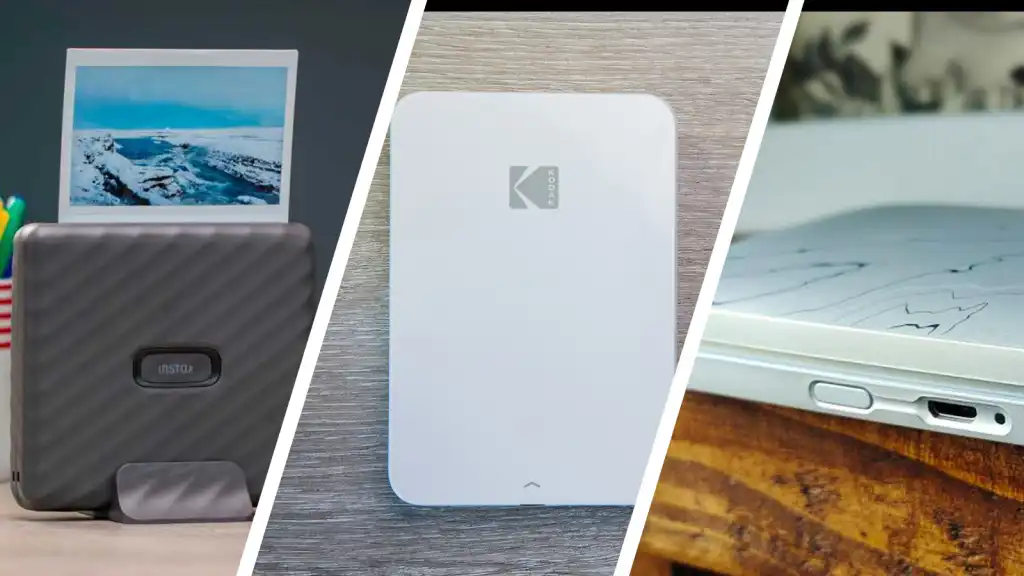
The Best Portable Photo Printer for most people is the Liene M100 because its 4x6 output is genuinely useful beyond a scrapbook, and its dye-sublimation process, laminated surface, app controls, and multi-device Wi-Fi support make it the most complete option here. It is larger than the pocket printers, but that is the cost of producing a proper photo.
The Liene Amber M110 is the better choice for households that need both 4x6 photos and 3x3 stickers. For a small adhesive print, the KODAK Mini 2 Retro offers a protected 4PASS finish, while the Nelko PP01 White is the more feature-rich craft option if a stated 600 DPI inkjet system and extensive app editing matter most.
If you are undecided, choose the Liene M100 for full-size prints, or choose the KODAK Mini 2 Retro if every print needs to fit in your pocket.
As an Amazon Associate we earn from qualifying purchases.