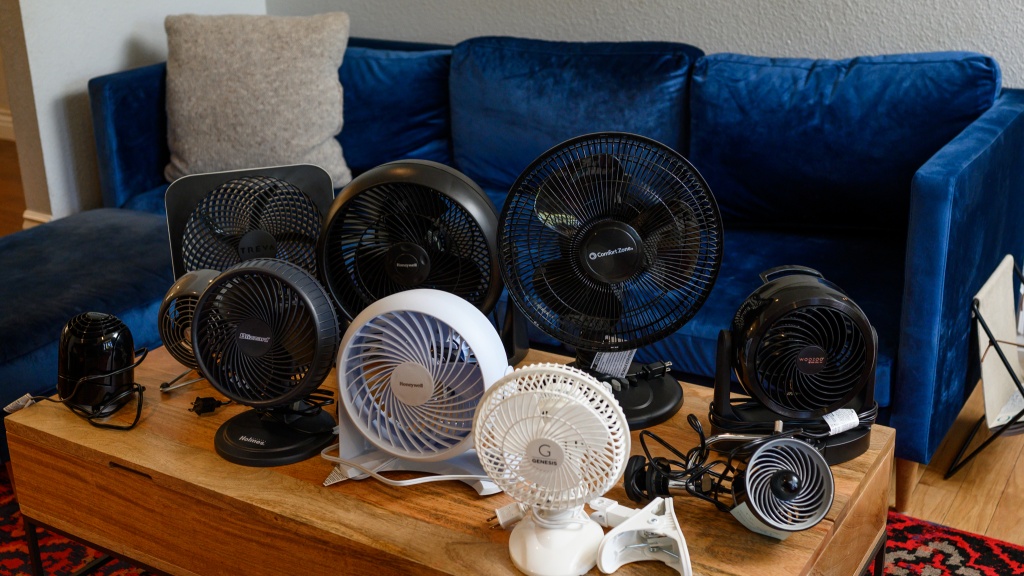

A desk fan has one job, but the wrong one can turn a quiet workspace into a rattling wind tunnel. The useful differences are easy to miss: some fans push air across a room, some only cool the person directly in front of them, and some trade a wall plug for a rechargeable battery.
We compared ten compact fans across those use cases. The Best desk fan for most people is the Honeywell HT900, while the list also includes quiet oscillating models, smart whole-room circulators, USB fans, and cordless options for travel.
Comparison table
| # | Product | Award | Airflow and control | Size or power | Best for |
|---|---|---|---|---|---|
| 1 | Honeywell HT900 | Best overall | 3 speeds, 90-degree pivot | 10.9 x 10.9 x 6.3 inches, 2.6 pounds | Direct cooling and air circulation |
| 2 | Honeywell QuietSet HTF210B | Best for bedrooms | 4 sound and power levels, oscillation | 13 x 10 x 10 inches, 2 pounds | Quiet personal cooling |
| 3 | KIMMOO Rechargeable 100-Speed | Best cordless control | 100 speeds, 90-degree rotation | 5.5 x 3.11 x 6.58 inches, 0.92 pounds | Travel and precise airflow |
| 4 | Honeywell HT-904 White | Best white circulator | 3 speeds, 90-degree pivot | 11.1 x 11.3 x 6.54 inches, 3.7 pounds | Simple room circulation |
| 5 | DREO 12-Inch Air Circulator | Best for whole-room airflow | 3 speeds, 120-degree tilt | 10.8 x 9.5 x 11.8 inches, 5.5 pounds | Bedrooms and larger rooms |
| 6 | Gaiatop 5-Inch Desk Fan | Best tiny AC fan | 3 speeds, 360-degree tilt | 5.59 x 5.65 x 4.33 inches, 0.62 pounds | Small desks and shelves |
| 7 | Gaiatop USB Desk Fan | Best USB personal fan | 3 speeds, 0 to 30-degree adjustment | 3 x 4.6 x 5.4 inches, 0.25 pounds | Laptops, cars, and travel |
| 8 | DREO Smart 565S | Best smart fan | 9 speeds, 3D oscillation, app and voice control | 9.45 x 9.45 x 12.2 inches, 3.97 pounds | Automated whole-room comfort |
| 9 | Levoit Mini Tower Fan | Best compact tower | 5 speeds plus Turbo, 30, 60, or 90-degree oscillation | 5 x 5 x 13 inches | Narrow desks and quiet rooms |
| 10 | FRONTSUN 100-Speed Fan | Best portable adjustment | 100 speeds, digital display, 360-degree tilt | 6 x 6.6 x 3.2 inches, 1 pound | Cordless personal cooling |
1. Honeywell HT900: Best Overall

Pros
- Strong focused airflow from a compact frame
- 90-degree pivot points air where it is needed
- Three straightforward speed settings
- Can sit on a desk or mount on a wall
Cons
- No oscillation
- AC powered rather than rechargeable
- Takes more desk depth than the smallest personal fans
Best for: someone who wants a compact fan with genuinely useful airflow and uncomplicated controls.
The Honeywell HT900 is the fan we would put on a desk first. It is not the smallest model here, and it does not have the long feature list of the DREO Smart 565S. Its appeal is more practical: the TurboForce design moves a noticeable column of air, the controls are easy to reach, and the head can be angled through 90 degrees instead of forcing you to reposition the whole fan.
Honeywell says the design can be felt from up to 25 feet away, which makes the HT900 more useful as an air circulator than a typical tiny personal fan. That does not mean it replaces a large room fan, but it gives the model enough reach for a desk, bedside table, or small office. The three speeds are less finely adjustable than the 100 settings on the KIMMOO Rechargeable 100-Speed, yet they are faster to understand when you need a little more air immediately.
The compact body measures 10.9 inches high and long and 6.3 inches wide, with a listed weight of 2.6 pounds. That footprint is reasonable beside a monitor, though the Gaiatop 5-Inch Desk Fan is far easier to squeeze onto a crowded shelf. The HT900 can also be wall-mounted, a useful option when desk space is scarce. Its listed high-efficiency classification and claim of being 25 percent quieter than comparable fans make it more office-friendly than its forceful airflow suggests.
The compromise is the lack of oscillation. Air stays pointed in one direction, so this is better for one person or for directing air toward a wall than for spreading a breeze across several seats. It also needs a power outlet. Choose the Honeywell HT900 when you want dependable direct airflow and simple operation, and skip it if cordless use or room-wide sweeping movement matters more.
For a computer workstation, fan placement matters almost as much as the fan itself. A desk that leaves room behind the monitor and keeps the airflow path clear makes this model more effective, especially if you are considering how much room a computer setup really needs.
2. Honeywell QuietSet HTF210B: Best for Bedrooms

Pros
- Four sound and power levels
- Oscillates for broader personal coverage
- Slim design suits nightstands
- Includes an auto shut-off timer
Cons
- Taller than a conventional circulator
- Less directable than a pivoting fan
- Designed for personal cooling rather than strong room circulation
Best for: sleepers and desk users who want adjustable cooling with less audible disruption.
The Honeywell QuietSet HTF210B takes a different approach from the HT900. It is a slim, 13-inch personal table fan with oscillation, so the breeze moves across a wider area instead of staying fixed on one person. That makes it a natural bedside choice, particularly for anyone who dislikes the concentrated blast from a circulator pointed straight at the face.
Its four sound and power levels are the important feature. The lower settings are intended for nighttime use, while the higher settings provide more cooling when you are awake or working. The controls let you choose the character of the fan as well as the airflow, which is more useful in a bedroom than simply having a powerful top speed. Honeywell also includes an auto shut-off timer, a small convenience that keeps the fan from running indefinitely after you fall asleep.
The fan measures 32.83 inches in the listed height field, while the product description identifies it as a 13-inch personal table fan. Because the data presents those measurements inconsistently, the safe takeaway is that this is a taller, slim tabletop design rather than a low horizontal circulator. Its 2-pound listed weight should make it manageable to move between a nightstand and a desk.
The HTF210B is quieter in spirit than the loudest direct-air models, but its airflow is not as room-filling as the DREO 12-Inch Air Circulator. The Levoit Mini Tower Fan offers a similarly narrow form with more speed options, while the Honeywell gives you a simpler interface and a more specifically bedroom-focused design. Pick the QuietSet when sleep comfort and oscillation outrank maximum reach.
3. KIMMOO Rechargeable 100-Speed: Best Cordless Control

Pros
- Rechargeable design works away from outlets
- 100 wind levels allow precise adjustment
- Digital display shows speed and battery status
- 8.5-hour stated runtime
- Compact and lightweight
Cons
- No oscillation
- Digital controls are more involved than a simple dial
- Maximum airflow is still from a small personal fan
Best for: anyone who wants cordless cooling with a precise, visible speed setting.
The KIMMOO Rechargeable 100-Speed is the most flexible small fan here when your preferred breeze falls between low and medium. Its 100 wind levels sound excessive until you use a personal fan close to your face or keyboard. Small changes can matter at that distance, and the digital display makes it possible to return to a familiar setting rather than guessing with a three-position switch.
KIMMOO lists a range of 2, 000 to 2, 900 RPM and says the lowest setting runs at 35dB. Those figures describe a fan built to cover both gentle bedside airflow and a stronger burst when a room feels stagnant. The 90-degree rotating adjustment helps aim that air, though it does not provide the side-to-side coverage of the Honeywell QuietSet HTF210B or the DREO Smart 565S.
Battery operation is the reason to choose this model. The stated continuous runtime is 8.5 hours, with a 2.5-hour recharge time using a 5V/2A adapter. Battery status appears on the LED screen, so there is less chance of discovering an empty battery when you need the fan. At 0.92 pounds and 5.5 by 3.11 by 6.58 inches, it is compact enough for a travel bag, dorm shelf, or temporary work spot.
The dual guard rail safety design is also aimed at homes with children or pets, although normal supervision around any spinning blade remains sensible. The weakness is that the 100-speed system adds complexity without solving the need for room circulation. The FRONTSUN 100-Speed Fan offers similar fine adjustment and a 360-degree tilt, but KIMMOO has a clearer stated runtime and a more compact listed footprint. Choose KIMMOO for portable, personalized airflow rather than broad cooling.
If your desk also houses a laptop, dock, or other warm electronics, it helps to separate personal comfort from device ventilation. Those looking at airflow around a computer can compare the airflow arrangements that suit a compact PC rather than expecting a desk fan to cool internal components.
4. Honeywell HT-904 White: Best White Circulator

Pros
- Focused TurboForce airflow
- Three easy speed settings
- 90-degree pivoting head
- Desk, floor, or wall placement
- White finish suits lighter rooms
Cons
- Heavier than the black HT900
- No oscillation
- No battery operation
Best for: a buyer who wants the HT900 style of airflow in a white housing.
The Honeywell HT-904 White is not a fundamentally different fan from the HT900. It is the white version of Honeywell's TurboForce tabletop circulator, with the same three-speed approach and 90-degree pivoting head. That makes it a sensible pick for a room where a white appliance blends better with the desk, wall, or surrounding furniture.
Its aerodynamic TurboForce design is intended to push air beyond the immediate personal zone. Honeywell states that airflow can be felt from up to 25 feet away and describes the fan as 25 percent quieter than comparable models. Those claims position it closer to a small air circulator than a USB breeze fan. It can help move air through a small or medium room, although its fixed direction still requires deliberate placement.
The listed dimensions are 11.1 inches long, 11.3 inches high, and 6.54 inches wide, with a weight of 3.7 pounds. That is a little larger and notably heavier than the HT900 in the supplied specifications. The extra heft can help it stay put, but it is less appealing if you regularly carry a fan from a desk to a bedside table.
The DREO 12-Inch Air Circulator moves toward whole-room coverage with a larger body and 70-foot stated reach, while the HT-904 remains easier to operate and more compact. Since the HT900 is the stronger all-around recommendation, the HT-904 makes sense mainly when the white finish or its particular placement suits your room. Skip it if you need oscillation, a timer, or cordless operation.
5. DREO 12-Inch Air Circulator: Best for Whole-Room Airflow

Pros
- Stated airflow reach of up to 70 feet
- 25dB quiet operation claim
- 120-degree adjustable tilt
- Removable parts simplify cleaning
- Can be placed on a floor or mounted on a wall
Cons
- Heavy at 5.5 pounds
- Only three speeds
- Larger than a typical personal desk fan
Best for: moving air through a bedroom, office, or other room rather than cooling one face at close range.
The DREO 12-Inch Air Circulator is the pick for readers who use a desk fan as a room tool. Its deep-pitched blades and WingBoost design are built to propel air farther than a small USB fan, and DREO gives the model a stated reach of up to 70 feet. The result should be more useful for mixing warm and cool pockets around a room than simply aiming a breeze at your hands.
The product uses a 7-inch blade inside a body measuring 10.8 inches deep, 9.5 inches wide, and 11.8 inches high. That is a substantial footprint beside a monitor, but still compact enough for a nightstand, dresser, or floor placement. A 120-degree adjustable tilt lets you send airflow upward or downward, which is useful when the goal is circulation rather than direct face-level cooling.
DREO claims noise as low as 25dB through its NACA and bionic design work. It has three built-in speeds controlled by a knob, so there is no app or display to distract from the basic task. Parts can be removed for cleaning, and the included base and handle support moving it between rooms. The fan can also be hung on a wall, an unusual flexibility in this group.
At 5.5 pounds, this is the heaviest model in the roundup. The DREO Smart 565S has more settings, two-axis oscillation, and app control, but the simpler DREO is easier to use and does not require a connected ecosystem. The Honeywell HT900 is a better fit for a single desk occupant, while this model makes more sense when air needs to travel. Choose it for whole-room circulation, and skip it if your desk has very little free space.
For rooms where a fan needs to support general comfort rather than only a workstation, ways to move cooling air through several parts of a home can help determine whether a circulator or a conventional oscillating fan fits better.
6. Gaiatop 5-Inch Desk Fan: Best Tiny AC Fan

Pros
- Very compact footprint
- 360-degree tilt
- Three manual speeds
- Detachable front cover for cleaning
- Rubber pads reduce slipping and vibration
Cons
- AC cable is permanently attached
- Limited reach compared with larger circulators
- Not cordless
Best for: a small desk, shelf, kitchen counter, or bedside table with an available outlet.
The Gaiatop 5-Inch Desk Fan is tiny enough to disappear into a crowded workstation, but it is not merely decorative. Its deep-pitched blades and aerodynamic design are intended to produce a focused stream of air, and the fan offers three manual speeds. For one person sitting close by, that is a more useful arrangement than a larger fan that takes up valuable desk depth.
Its body measures 5.59 by 5.65 by 4.33 inches, and the listed weight is about 0.62 pounds. Four rubber pads help prevent movement and reduce vibration on a hard surface. The 360-degree tilt is the standout adjustment, since you can aim airflow up toward a sleeping area, down toward your hands, or across a low shelf without turning the entire unit.
Gaiatop lists a 30dB noise level and a maximum wind speed of 6.2m/s. The fan is powered by a 120V AC connection and uses 6.8 watts, with a 4.92-foot cable that cannot be detached. That cable length is workable at a desk, but it limits where the fan can go more than the USB-powered Gaiatop USB Desk Fan, which can draw power from a laptop or compatible adapter.
There is no oscillation and no battery, so this is a close-range personal fan rather than a room circulator. The Honeywell HT900 is much better when air needs to cross a room, and the KIMMOO Rechargeable 100-Speed is the more practical travel companion. Choose the Gaiatop 5-Inch when physical size is the deciding factor and a nearby outlet is not a problem.
7. Gaiatop USB Desk Fan: Best USB Personal Fan
Pros
- Extremely light and compact
- USB power works with laptops and power banks
- Three speeds
- Vertical adjustment from 0 to 30 degrees
- Easy to carry
Cons
- Limited tilt range
- Needs a USB power source
- Third speed requires sufficient USB power
Best for: a laptop workstation, car, dorm room, or travel bag where minimal size matters.
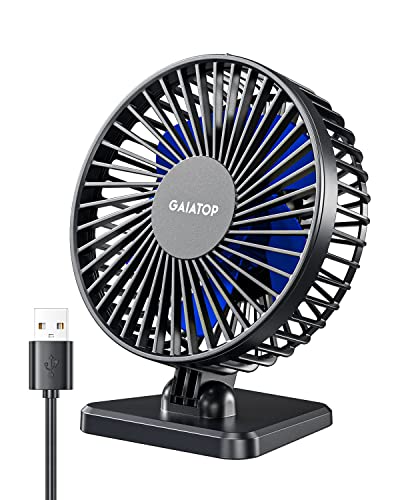
The Gaiatop USB Desk Fan is the simplest personal fan in this group. It weighs 0.25 pounds and measures 3 inches long, 4.6 inches wide, and 5.4 inches high, so it takes up almost no room beside a laptop. The fan is less about cooling a room and more about putting a small stream of air exactly where a seated person needs it.
There are three speed settings, selected by repeatedly pressing the power button. Gaiatop says the fan stays below 50dB even when producing strong airflow. That is not as quiet on paper as the 20dB claims from the Levoit Mini Tower Fan or DREO Smart 565S, but the tiny housing and short range make it a reasonable companion for work and rest.
The head rotates vertically from 0 to 30 degrees. That is enough to aim airflow across a keyboard or toward your face, though it does not match the 360-degree adjustment on the larger Gaiatop 5-Inch Desk Fan. USB compatibility is its real advantage: it can connect to a computer, laptop, mobile power bank, AC adapter, or car charger. The third speed requires USB 3.0 or current above 1A, so weak ports may not provide full performance.
The limited angle and modest reach rule it out for whole-room circulation. It is also not rechargeable on its own, which means the KIMMOO Rechargeable 100-Speed is a better choice when you want to leave an outlet behind. If you want a nearly weightless fan that plugs into the hardware already on your desk, the Gaiatop USB is the cleanest fit.
8. DREO Smart 565S: Best Smart Fan

Pros
- Stated airflow reach of up to 85 feet
- 20dB minimum noise claim
- Horizontal and vertical 90-degree oscillation
- App, Alexa, and Google Home control
- Nine speeds, six modes, and a 12-hour timer
Cons
- Smart features add setup and dependence on software
- Larger and heavier than personal fans
- Requires a power outlet
Best for: a connected home that needs quiet, automated room circulation.
The DREO Smart 565S is the most capable fan here, but its appeal depends on whether you actually want smart controls. It can be adjusted from the DREO app or through Alexa and Google Home, which makes it possible to change airflow without reaching across a desk or getting out of bed. That is useful when the fan is part of a bedroom routine, less useful if you prefer a physical knob.
DREO lists up to 950 CFM of airflow and a reach of 85 feet. Its 7-inch blade sits in a body that measures 9.45 inches square and 12.2 inches high. The combination is intended for whole-room circulation rather than a narrow personal breeze. Two-axis 90-degree oscillation moves air horizontally and vertically, helping reduce stagnant corners in a way the fixed Honeywell HT900 cannot.
Noise is listed as low as 20dB, and the brushless DC motor supports nine speed settings and six airflow modes. The fan includes an eight or 12-hour timer according to the product title, while the feature list specifically calls out a 12-hour timer, child lock, power-off memory, and a screen that turns off after 60 seconds. Those details make it better suited to overnight use than a basic three-speed circulator.
The drawback is complexity. App and voice control are convenient, but they introduce setup steps and create another layer between you and the breeze. At nearly 4 pounds, it is also not a portable personal fan. The simpler DREO 12-Inch Air Circulator is easier to operate, while the Levoit Mini Tower Fan offers quiet control without a connected ecosystem. Choose the Smart 565S if automation and broad airflow are central to your routine.
9. Levoit Mini Tower Fan: Best Compact Tower

Pros
- Slim 5 by 5 inch footprint
- Five speeds plus a Turbo setting
- Adjustable 30, 60, or 90-degree oscillation
- Listed noise range starts at 20dB
- Carrying handle and display-off option
Cons
- Must remain plugged in
- Tall shape is less stable to reposition than a low circulator
- No stated battery operation
Best for: narrow desks, bedside tables, and rooms where quiet oscillating airflow matters.
The Levoit Mini Tower Fan uses vertical space instead of desk depth. Its 5 by 5 inch footprint is among the easiest here to fit beside a monitor, lamp, or nightstand, while the 13-inch height gives it a broader vertical presence than a tiny personal fan. The carrying handle makes it easier to move between rooms without grabbing the grille.
It has five fan speeds plus a Turbo setting, so there is more control than on the Honeywell models. Its multi-angle oscillation can be set to 30, 60, or 90 degrees, letting you choose between a narrow sweep and wider room coverage. The airflow is described as strong and focused through VortexAir technology, with a maximum wind speed of 23 feet per second.
Levoit lists noise from 20 to 43dB across the speed range. Sound and display-off functions are useful beside a bed, especially when a bright indicator would be distracting. The fan uses a maximum of 7.5 watts, but it must stay plugged into a power outlet. It is not cordless, a point worth deciding before choosing it over the KIMMOO or FRONTSUN models.
The Levoit is a more space-efficient oscillating choice than the DREO 12-Inch Air Circulator, though the DREO has a more traditional circulator shape and stronger stated room reach. The Honeywell QuietSet HTF210B is the calmer, simpler bedroom alternative, while Levoit wins for a narrow footprint and more granular airflow. Choose it when a slim tower form solves a real space problem.
10. FRONTSUN 100-Speed Fan: Best Portable Adjustment

Pros
- 100-level stepless control
- Rechargeable battery operation
- Digital display shows speed and battery status
- 360-degree tilt
- Compact one-pound body
Cons
- No oscillation
- Less established control layout than the simplest fans
- Small body limits room circulation
Best for: portable personal cooling with a full range of angle and speed adjustment.
The FRONTSUN 100-Speed Fan is built around two adjustments: a stepless 1 to 100 speed range and a 360-degree tilt. That combination makes it easy to set a gentle breeze for reading, then aim stronger airflow upward or across a desk without moving the base. A digital display shows the selected speed and battery status, which is useful when the fan is running away from a wall outlet.
FRONTSUN describes its motor as near-whisper quiet, with noise as low as 30dB. Its dual-stage turbo design is intended to produce a stronger column of air than its small size suggests. The body measures 6 inches long, 6.6 inches wide, and 3.2 inches high, with a listed weight of 1 pound. It should fit on a shelf, nightstand, or travel surface without taking over the area.
The control approach is similar to the KIMMOO Rechargeable 100-Speed, but the physical design differs. KIMMOO is taller and narrower, lists an 8.5-hour runtime and a 2.5-hour recharge time, and offers a 90-degree rotation. FRONTSUN gives you a full 360-degree tilt, but the supplied information does not specify its battery runtime or recharge time. That missing information makes it harder to plan overnight or extended cordless use.
This is a personal fan, not a replacement for the DREO Smart 565S or DREO 12-Inch Air Circulator. It has no oscillation and cannot send air across a whole room. Choose FRONTSUN when portable positioning matters more than documented battery endurance, and choose KIMMOO when runtime information is a higher priority.

How to choose best desk fan
The right fan depends on the distance between you and the airflow, the amount of desk space available, and whether you need personal cooling or room circulation.
Airflow reach
A small personal fan only needs to push air a short distance to cool someone seated at a desk. The Gaiatop USB Desk Fan and Gaiatop 5-Inch Desk Fan suit that role, while the Honeywell HT900 and DREO models are designed to move air much farther.
Look for stated reach, blade design, and room-circulation features when the fan will sit across a bedroom or office. A high maximum speed is less meaningful if the fan cannot aim or circulate that airflow effectively.
For a whole room, prioritize reach and circulation. For one person, prioritize aim and low-speed control.
Speed control
Three speeds are quick to operate and work well for straightforward cooling. The KIMMOO Rechargeable 100-Speed and FRONTSUN 100-Speed Fan offer much finer adjustment, which is useful when low feels too weak but the next preset feels too strong.
More settings do not automatically mean more airflow. Judge them by how close the fan will be to your face, hands, or bed, and by whether the controls remain easy to use in a dark room.
Noise
Noise claims vary by model and speed, so a minimum decibel figure describes the quietest setting rather than every operating condition. The DREO Smart 565S and Levoit Mini Tower Fan list minimum levels of 20dB, while the DREO 12-Inch Air Circulator lists 25dB and the Gaiatop 5-Inch lists 30dB.
Bedroom buyers should also consider display lights, timers, and whether the fan offers a lower sound mode. If your computer is already loud, a fan with adjustable sound may be more useful than one with the highest airflow claim.
Tilt and oscillation
Tilt controls aim air vertically, while oscillation sweeps it across an area. The Honeywell HT900 pivots through 90 degrees, the Gaiatop 5-Inch offers 360-degree tilt, and the DREO Smart 565S combines 90-degree horizontal and vertical oscillation.
Choose a fixed or pivoting fan for one person. Choose oscillation when several people share the room or when you want air to mix rather than hit one spot continuously.
Power and portability
AC fans such as the Honeywell HT900 and Levoit Mini Tower Fan are ready to run near an outlet, but they cannot move freely around a room. USB models work well beside computers and power banks, while rechargeable models such as the KIMMOO and FRONTSUN can operate away from a cable.
Check the stated battery runtime when cordless use is important. A fan that fits in a bag is not automatically suitable for overnight use unless its battery information supports that routine.

Frequently asked questions
What is the best desk fan for an office?
The Honeywell HT900 is the strongest general office pick because its three speeds and 90-degree pivot are easy to use, while its TurboForce design is intended to move air beyond the immediate desktop. The Gaiatop USB Desk Fan is better when the workspace is extremely tight or when USB power is more convenient than an AC outlet.
Which desk fan is best for sleeping?
The Honeywell QuietSet HTF210B is designed for bedroom use, with four sound and power levels, oscillation, and an auto shut-off timer. The Levoit Mini Tower Fan and DREO Smart 565S also list low minimum noise levels, but their additional controls may be more than some sleepers need.
Are rechargeable desk fans useful?
Rechargeable fans are useful for travel, temporary workspaces, and bedside tables without a convenient outlet. The KIMMOO lists 8.5 hours of continuous cooling and a 2.5-hour recharge time, while the FRONTSUN offers a rechargeable design but does not provide runtime information in the supplied product details.
Is a desk fan enough to cool a whole room?
A desk fan does not lower room temperature in the same way an air conditioner does. Circulator models can move air across a room and help mix warm and cool areas, with the DREO 12-Inch Air Circulator and DREO Smart 565S offering the strongest stated reach in this group.
Should I choose a tower fan or a circulator?
Choose a tower fan when a narrow footprint and oscillating airflow matter. The Levoit Mini Tower Fan occupies a 5 by 5 inch footprint and offers 30, 60, or 90-degree oscillation, while a circulator such as the Honeywell HT900 is better at sending a focused stream of air in one selected direction.
Do more fan speeds make a fan quieter?
Not necessarily. More speed settings let you find a more suitable airflow level, but noise depends on the motor, blade design, and selected speed. The KIMMOO and FRONTSUN offer 100 levels, while the DREO Smart 565S lists nine speeds and the Honeywell models use simpler preset controls.
The bottom line
The Best desk fan for most workspaces is the Honeywell HT900. It combines focused airflow, a useful 90-degree pivot, three easy controls, and a design that can serve a desk, wall, or small room. The Honeywell QuietSet HTF210B is the better bedroom pick because it adds oscillation, four sound and power levels, and an auto shut-off timer.
For larger rooms, the DREO 12-Inch Air Circulator is the more convincing air-moving tool, while the DREO Smart 565S is the feature-rich choice for app, voice, and automated control. Travelers should look first at the KIMMOO Rechargeable 100-Speed or FRONTSUN 100-Speed Fan, and tiny workspaces are best served by one of the Gaiatop models.
If you are undecided, choose the Honeywell HT900 for direct cooling, the QuietSet for sleep, or the KIMMOO when cordless operation matters most.
As an Amazon Associate we earn from qualifying purchases.