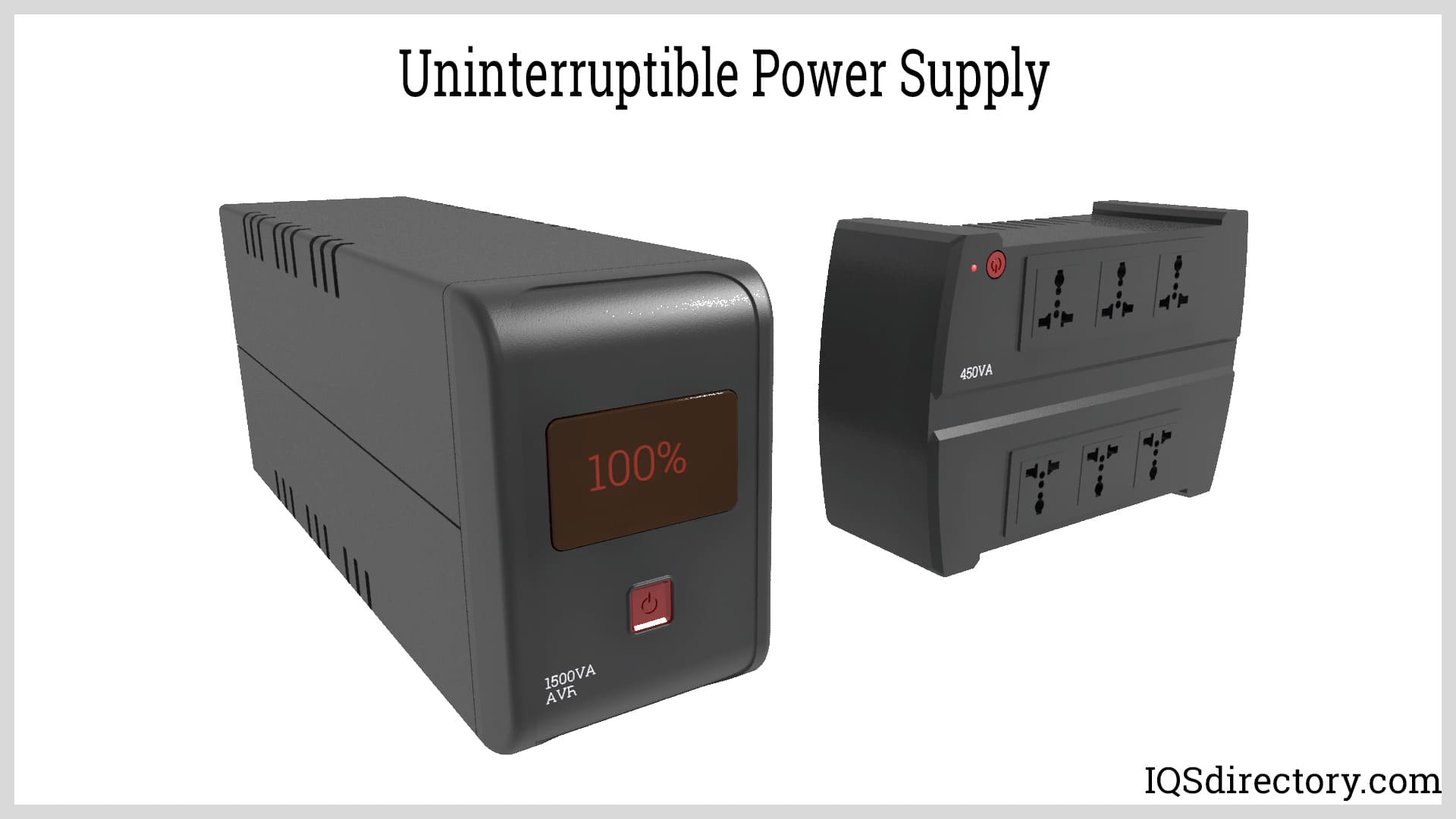

A power outage is inconvenient for a lamp, but it can corrupt a hard drive, drop a video call, or leave a router restarting just when you need it. The right Best uninterruptible power supply gives sensitive electronics time to ride through a short interruption or shut down cleanly.
The ten units here range from compact router backups to full-size systems for demanding desktops, NAS devices, and home offices. The CyberPower CP1500PFCLCD is our top pick because it combines pure sine wave output, 1, 000 watts of capacity, automatic voltage regulation, a useful display, and plenty of connections without giving up practical details such as replaceable protection features.
Comparison table
| # | Product | Award | Capacity | Battery-backed outlets | Best for |
|---|---|---|---|---|---|
| 1 | CyberPower CP1500PFCLCD | Best overall | 1500VA/1000W | 6 | Desktop PCs and mixed home-office setups |
| 2 | APC BE600M1 | Best compact computer backup | 600VA/330W | 5 | Computers, routers, and NAS devices |
| 3 | APC BX1500M | Best high-capacity standby model | 1500VA/900W | 5 | Large office and home setups |
| 4 | CyberPower CP1500AVRLCD3 | Best for USB charging | 1500VA/900W | 6 | Workstations with many peripherals |
| 5 | CyberPower ST425 | Best small standby UPS | 425VA/260W | 4 | Routers, consoles, and small electronics |
| 6 | CyberPower EC850LCD | Best for switched peripherals | 850VA/510W | 6 | Desks with peripherals to power down automatically |
| 7 | GOLDENMATE 1000VA Lithium | Best lithium battery design | 1000VA/800W | 8 | Long-term battery service |
| 8 | APC BE425M | Best wall-mountable router backup | 425VA/255W | 4 | Routers, modems, and VoIP phones |
| 9 | APC BR1500MS2 | Best pure sine wave APC model | 1500VA/900W | 6 | High-end PCs and NAS systems |
| 10 | CyberPower ST625U | Best standby model with USB | 625VA/360W | 4 | Small desks and mobile-device charging |
1. CyberPower CP1500PFCLCD: Best Overall

Pros
- Pure sine wave output supports active PFC power supplies
- 1000W capacity handles a demanding desktop setup
- Six battery-backed outlets plus six surge-only outlets
- Color LCD and automatic voltage regulation
- USB-A and USB-C charging ports
Cons
- Heavy at 24.9 pounds
- Wide footprint needs deliberate placement
- The display reports conditions rather than providing a network management interface
Best for: someone protecting a powerful desktop, workstation, or mixed home-office system.
The CyberPower CP1500PFCLCD is the unit we'd put behind a serious desktop first. It has enough capacity to support a workstation and its monitor without making the owner choose between the computer and the network gear. The pure sine wave output is the important distinction here. It is designed for active PFC and conventional power supplies, so modern PCs are less likely to object when the UPS switches to battery power.
Its 1500VA and 1000W rating give it more headroom than the 900W APC BX1500M, although that does not mean every setup will run for the same amount of time. The load still determines runtime. Six of its 12 NEMA 5-15R outlets provide battery backup and surge protection, while the other six provide surge protection only. That split makes it easy to reserve battery power for the computer, monitor, router, and storage while putting printers or speakers on the remaining outlets.
The color LCD is one of the better ownership details. It shows immediate information about battery and power conditions, and the panel tilts by up to 22 degrees so it can remain readable when the UPS is under a desk. Automatic voltage regulation corrects minor fluctuations without using the battery, which should reduce unnecessary battery cycling. Two USB charging ports, including one Type-C port and one Type-A port, keep small devices off the outlet block.
This is not a discreet little desktop accessory. At 14 inches long, 11 inches high, 3.9 inches wide, and 24.9 pounds, it needs a stable location with room around it. The high capacity also comes with a physical presence that makes it a poor fit for a router shelf. Buyers who only need to keep internet equipment alive should look to the APC BE425M or APC BE600M1 instead. For a computer owner who wants pure sine wave output, a clear status panel, and broad outlet coverage, this is the most complete choice in the group.
2. APC BE600M1: Best Compact Computer Backup
Pros
- Compact 600VA/330W capacity suits smaller systems
- Five battery-backed outlets and two surge-only outlets
- Up to 23 minutes at a 100W load
- USB charging works during an outage
- Replaceable internal battery
Cons
- Not intended for high-wattage desktops
- No LCD showing live runtime or load
- Fewer battery-backed outlets than the larger APC models
Best for: a home-office computer, router, NAS, or small electronics setup.
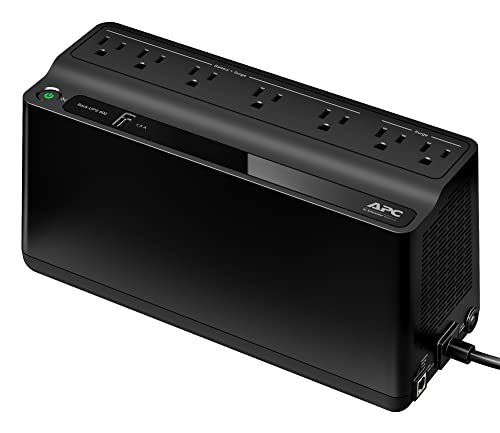
The APC BE600M1 gets the basic UPS job right without taking over the floor. Its 600VA and 330W capacity is aimed at smaller computer and network setups, not a high-powered workstation. That narrower role is useful because many people need a UPS for a computer, monitor, router, and external drive rather than for an entire room of equipment.
APC specifies up to 23 minutes of runtime at a 100W load. That figure is tied to a particular load, so it should not be read as a promise for a full desktop system. It does show what this unit is good at: maintaining a network connection, giving a small computer time to save work, or letting a NAS handle a short interruption. Five outlets have both battery backup and surge protection, and two more are surge-only for equipment that does not need to stay on.
The built-in 1.5A USB port continues working during an outage. That is a practical feature when the UPS is beside a desk, since a phone can remain connected without consuming one of the protected outlets. The internal battery can also be replaced in minutes using the APC replacement battery specified for the unit. That makes routine maintenance less disruptive than replacing the entire UPS.
Its 10.79 by 5.47 by 4.13-inch body and 7.5-pound weight make it far easier to place than the CyberPower CP1500PFCLCD. It does not have automatic voltage regulation or a detailed LCD, so it is less informative and less capable with unstable electrical service. The APC BE600M1 is the better fit for a modest setup that needs clear, straightforward backup, while owners of a powerful PC should step up to a pure sine wave model.
3. APC BX1500M: Best High-Capacity Standby Model

Pros
- 1500VA/900W capacity for large setups
- Up to 68 minutes at a 100W load
- Automatic voltage regulation
- Coaxial and Ethernet surge protection
- Replaceable battery
Cons
- Only five outlets provide battery backup
- Large and heavy at 24.25 pounds
- No LCD for live runtime information
Best for: a home office with several computers, displays, network devices, or storage units.
The APC BX1500M is built around capacity rather than convenience features. Its 1500VA and 900W rating gives a large setup enough room for a desktop, displays, router, and external storage, provided their combined draw stays within the limit. It is a sensible choice when a smaller 425VA or 600VA model would be pushed close to its ceiling.
The claimed runtime reaches up to 68 minutes at a 100W load. A demanding computer will reduce that figure substantially, but the low-load number is still useful for a router, NAS, or lightly loaded office setup. Five outlets have battery backup and surge protection, while five more are surge-only. Built-in coaxial and Ethernet surge protection adds another layer for connected equipment that has power and data cables entering the setup.
Automatic voltage regulation is a strong reason to choose this model over the smaller APC BE600M1. It corrects low voltage beginning at 88V and handles surges of plus or minus 13 percent without immediately draining the battery. APC also says it boosts or trims voltage to a stable 120V, which is helpful in places where brownouts are a recurring nuisance. The unit is compatible with active PFC supplies and is ENERGY STAR certified for more than 92 percent efficiency.
The trade-off is a conventional, information-light design. There is no LCD to show current load or remaining runtime, and the 15.04 by 9.84 by 3.94-inch chassis weighs 24.25 pounds. It is also less attractive for buyers who want pure sine wave output, where the CyberPower CP1500PFCLCD and APC BR1500MS2 are stronger choices. Choose the BX1500M when capacity, AVR, replaceable battery service, and wired-network protection matter more than a screen.
4. CyberPower CP1500AVRLCD3: Best for USB Charging
Pros
- 1500VA/900W capacity
- Six battery-backed outlets and six surge-only outlets
- USB-A and USB-C charging ports
- Color LCD with power-condition information
- Automatic voltage regulation
Cons
- Uses simulated sine wave output
- Heavy at 23.8 pounds
- No runtime figure supplied for a defined load
Best for: a large desk setup that needs many outlets and convenient device charging.
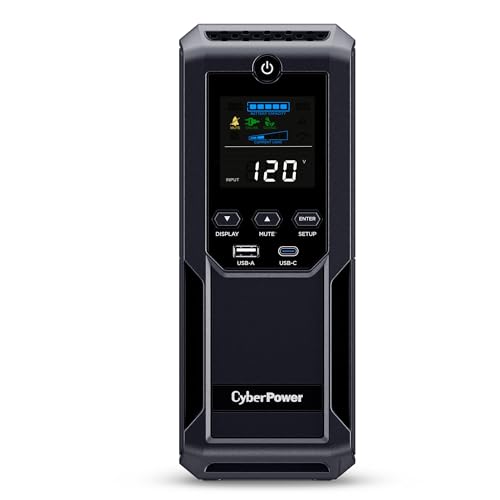
The CyberPower CP1500AVRLCD3 is a practical middle ground within CyberPower's larger lineup. It has the same 1500VA class as the CP1500PFCLCD, but its 900W rating and simulated sine wave output place it in a different role. It is suited to workstations, networking devices, and home entertainment gear that can operate properly with that output waveform.
Outlet access is excellent. Six of the 12 NEMA 5-15R outlets supply battery backup and surge protection, and six supply surge protection alone. That leaves enough protected connections for a computer, monitor, router, storage, and other essential equipment while keeping nonessential peripherals away from the battery load. USB-A and USB-C charging ports are positioned for phones and tablets, so those devices do not occupy a protected outlet.
The color LCD shows immediate information about battery and power conditions. It is more useful than a single status light when diagnosing a brownout or checking whether the UPS is carrying a load. AVR corrects minor power fluctuations without switching to battery power, helping preserve battery cycles. The included management software is another way to keep an eye on the system from a connected computer.
The central limitation is the simulated sine wave output. For a modern desktop with an active PFC power supply, the pure sine wave CyberPower CP1500PFCLCD is the safer match. The CP1500AVRLCD3 also measures 13.78 by 10.2 by 3.94 inches and weighs 23.8 pounds, so it is not a small peripheral. Pick it for its display, outlet layout, and USB charging, but skip it if your computer or other sensitive equipment specifically calls for pure sine wave power.
5. CyberPower ST425: Best Small Standby UPS

Pros
- Small 425VA/260W capacity for essential devices
- Eight outlets with four battery-backed connections
- Transformer-spaced outlets
- Simulated sine wave output
- LED power and wiring-fault indicators
Cons
- Limited capacity for desktop computers
- No USB charging
- No LCD or automatic voltage regulation
Best for: a router, game console, small computer, or a few low-power electronics.
The CyberPower ST425 is the kind of UPS that disappears beneath a desk until the power fails. Its 425VA and 260W capacity is enough for essential low-power electronics, but it is not designed to keep a demanding desktop running through a long outage. It makes sense for a broadband router, console, small office computer, or home entertainment component.
Four of its eight NEMA 5-15R outlets have battery backup and surge protection, while the other four are surge-only. Transformer-spaced outlets help bulky adapters avoid blocking neighboring sockets. The LED status light indicates power and wiring faults, which gives the owner a quick check without the complexity of a screen.
The standby design uses simulated sine wave output. That is a common approach in this class, but it makes the ST425 less suitable for a computer with a particularly sensitive power supply than the pure sine wave models higher in this list. CyberPower's GreenPower UPS design uses a compact charger and inverter to reduce power consumption, and the unit has a five-foot power cord with a right-angle, offset plug.
At 8.3 inches wide, 4.5 inches high, and 3.2 inches deep, it is notably compact, and its 3.8-pound weight makes placement easy. There is no USB port, AVR, LCD, or software, so buyers wanting detailed power information should choose the CyberPower EC850LCD or CP1500AVRLCD3. The ST425 is a clean fit when the goal is basic battery protection for a small load rather than full computer management.
6. CyberPower EC850LCD: Best for Switched Peripherals

Pros
- 850VA/510W capacity for home-office equipment
- Six battery-backed outlets and six surge-only outlets
- ECO outlets can shut down sleeping peripherals
- LCD provides power-condition information
- Three-year warranty including the battery
Cons
- Simulated sine wave output
- No USB charging ports
- ECO mode depends on the connected computer's state
Best for: a desk with peripherals that should power down when the main computer sleeps.
The CyberPower EC850LCD has a useful idea at its center: not every connected device needs to remain powered when the computer is asleep. Its ECO mode can automatically turn off peripherals connected to ECO-controlled outlets when the UPS detects that a computer is off or in sleep mode. That can reduce idle power use and keeps a desk from staying half awake all night.
The 850VA and 510W capacity sits between the compact APC models and the larger 1500VA units. Six of its 12 outlets provide battery backup and surge protection, and six are surge-only, with three of the latter designated for ECO control. That arrangement works well for a computer, monitor, router, speakers, and accessories that do not all need battery power.
An LCD panel shows immediate, detailed information about battery and power conditions. The display is a meaningful step up from the LEDs on the CyberPower ST425, especially for an owner who wants to know whether a UPS is overloaded. The five-foot cord has a right-angle, offset plug, and the unit includes PowerPanel Personal Edition software for management from a connected computer.
The EC850LCD uses simulated sine wave output rather than pure sine wave power. Owners of sensitive active PFC desktop supplies should consider the CyberPower CP1500PFCLCD or APC BR1500MS2 instead. Its 12.2 by 3.1 by 7-inch body and 7.7-pound weight are manageable, though its low profile still needs a suitable shelf or floor position. It is the right pick for organized desks where automatic peripheral shutdown is more useful than USB charging.
If the computer itself is the main concern, it helps to compare the protection needs of a desktop computer and its power supply before choosing a UPS. The battery backup protects against outages, but it does not replace a correctly sized internal power supply.
7. GOLDENMATE 1000VA Lithium: Best Lithium Battery Design

Pros
- 1000VA/800W pure sine wave output
- LiFePO4 battery rated for more than 10 years and 5000 charge cycles
- Eight battery-backed and surge-protected outlets
- LCD with battery and power information
- Buzzer mute function
Cons
- Cooling fan can activate during heavy battery use
- Safety instructions call for careful placement and compatible cabling
- Less established feature ecosystem than APC and CyberPower
Best for: someone who prioritizes a long-service lithium battery and pure sine wave output.
The GOLDENMATE 1000VA Lithium stands apart from the lead-acid models here by using a lithium iron phosphate battery pack. The manufacturer rates that battery for more than 10 years and over 5, 000 charge cycles. Those claims describe the battery's intended endurance, not a guaranteed service life in every environment, but they do make this UPS interesting for an installation where repeated maintenance is unwelcome.
Its 1000VA and 800W rating provides pure sine wave output for computers, workstations, network devices, and telecom equipment. Eight NEMA 5-15P outlets have both battery backup and surge protection, giving it a generous set of fully protected connections. The built-in battery management system monitors the pack, and the unit includes safeguards that stop charging or discharging if limits are exceeded.
The LCD reports battery and power conditions in real time. A buzzer sounds when the unit switches to battery mode, but the updated controls allow that alarm to be muted with a touch of the switch. A cooling fan rated below 50 dB may turn on when the battery management system detects heavy battery use. That is a detail to consider if the UPS will sit within arm's reach in a quiet room.
The manual's safety guidance deserves attention. This model supports 90 to 140V AC input for standard 110V household power, and the manufacturer says not to use it in high-temperature or enclosed environments. The 12.99 by 9.84 by 4.13-inch body weighs about 13 pounds, much less than the large lead-acid 1500VA models. Choose the GOLDENMATE for its battery architecture, pure sine wave output, and eight fully protected outlets, but buyers who want a familiar software and replacement-battery ecosystem may prefer APC or CyberPower.
8. APC BE425M: Best Wall-Mountable Router Backup

Pros
- Compact 425VA/255W capacity
- Up to 15 minutes at a 100W load
- Wall-mountable design
- Automatic voltage regulation
- Four battery-backed and two surge-only outlets
Cons
- Not designed for high-power computers
- No USB charging
- Six total outlets limit larger setups
Best for: a router, modem, VoIP phone, or small network device that needs a space-saving backup.
The APC BE425M is a focused network backup rather than a general-purpose desktop UPS. Its 425VA and 255W rating is well matched to a Wi-Fi router, modem, VoIP phone, or other small electronics. The compact design can sit under a desk or mount on a wall, which is especially helpful when the router is installed near a network connection rather than beside a workstation.
APC lists up to 15 minutes of runtime at a 100W load. A router and modem usually draw less than that, but actual runtime still depends on the connected equipment. Four of the six outlets provide battery backup and surge protection, and two provide surge protection only. The outlets are spaced to accommodate normal adapters without making the unit physically large.
Automatic voltage regulation corrects minor fluctuations without switching to the battery. That can preserve battery capacity for actual outages instead of using it every time household voltage moves slightly. Audible alarms and LED indicators communicate on-battery operation, low battery, and overload conditions, so the owner is not left guessing why a connected device has changed state.
The BE425M lacks the USB port found on the APC BE600M1 and the two USB ports on the CyberPower ST625U. Its 10 by 4.1 by 5.5-inch body and 5.72-pound weight are still easy to handle, but the six-outlet limit makes it less flexible for a full desk. Pick it when wall mounting and network continuity are the priority. For a computer plus router, the BE600M1 gives more battery-backed outlets and a higher capacity.
For a larger outage plan, the UPS only covers the electronics in one location. A separate guide to keeping essential household circuits running during a longer outage can help distinguish a desk-sized battery backup from a whole-home solution.
9. APC BR1500MS2: Best Pure Sine Wave APC Model

Pros
- Pure sine wave output for sensitive electronics
- 1500VA/900W capacity
- Up to 73 minutes at a 100W load
- LCD shows runtime and current watt draw
- USB-C and USB-A charging
- Coaxial and Ethernet surge protection
Cons
- Heaviest unit in this roundup at 27.55 pounds
- Only six battery-backed outlets
- Large chassis needs a sturdy location
Best for: a high-end computer, NAS, or home office that needs pure sine wave output and detailed monitoring.
The APC BR1500MS2 is the most information-rich APC in this group. Its pure sine wave output is designed for modern PCs, NAS drives, and other sensitive electronics, while its active PFC compatibility addresses a common concern with high-performance computer power supplies. It has the same 1500VA and 900W class as the APC BX1500M, but the output and monitoring features are more advanced.
The unit provides up to 73 minutes at a 100W load. That number is most relevant to lightly loaded network and storage equipment, but it illustrates the reserve available at modest draw. Six of its ten outlets provide battery backup and surge protection, and four are surge-only. Coaxial and Ethernet surge protection are built in, which matters when data lines enter the system from outside the room.
The angled LCD shows remaining runtime and current watt draw, not just a generic battery icon. That lets an owner see how much capacity a computer and monitor are using and decide what to disconnect during a longer outage. USB-C and USB-A ports charge devices without consuming one of the protected outlets, and the alarm can be silenced when a quiet work area matters.
This capability comes with substantial bulk. The BR1500MS2 measures 14.49 by 10.24 by 3.94 inches and weighs 27.55 pounds, making it the heaviest unit here. It also supplies fewer total outlets than the CyberPower CP1500PFCLCD. The CyberPower is the better fit when 12 outlets and a higher 1000W rating matter, while the APC wins for owners who want the live watt display, pure sine wave output, and data-line protection in an APC design.
10. CyberPower ST625U: Best Standby Model with USB

Pros
- 625VA/360W capacity for small home-office setups
- Four battery-backed and four surge-only outlets
- Two USB charging ports share 2.1 amps
- LED power and wiring-fault indicators
- Five-foot power cord
Cons
- Simulated sine wave output
- No LCD or automatic voltage regulation
- Limited battery-backed outlet count
Best for: a compact desk that needs basic computer protection and USB charging.
The CyberPower ST625U adds useful charging to a straightforward standby UPS. Its 625VA and 360W capacity gives small computers, routers, consoles, and home-office electronics more breathing room than the ST425, while keeping the same general approach of simple indicators and a compact case.
Four of the eight NEMA 5-15R outlets provide battery backup and surge protection, with four more offering surge protection only. Two USB ports share 2.1 amps for phones, tablets, and other mobile devices. That is convenient during an outage, though it is not the same as having USB-C fast charging or a live readout of remaining runtime.
The LED indicators show power-on and wiring-fault status. CyberPower's GreenPower design uses a compact charger and power inverter to reduce power consumption, and PowerPanel management software is available for download. The standby output is simulated sine wave, so this model is a better match for modest electronics than for a demanding active PFC desktop.
Its footprint is fairly easy to manage at 9.8 inches wide, 5.8 inches high, and 3.2 inches deep, with a five-pound weight. The CyberPower ST425 is smaller, but the ST625U's extra capacity and USB ports make it more useful for a desk. Step up to the CyberPower EC850LCD if you need an LCD and six battery-backed outlets, or to a pure sine wave model if the computer's power supply requires it.
How to choose best uninterruptible power supply
The right UPS is determined by the equipment's power draw, the type of output it needs, and how much information and control you want when the power fails.
Capacity and load headroom
VA and watts describe how much equipment a UPS can support. Watts are the more direct limit for a computer, monitor, router, and accessories, while VA describes the electrical capacity of the unit. Leave headroom rather than choosing a UPS that runs at its ceiling, since a near-limit load reduces runtime and leaves less room for another device.
The 425VA models are intended for routers and small electronics. A 600VA to 850VA unit suits a modest computer or mixed desk, while 1500VA models are more appropriate for a powerful desktop, several displays, storage, and network equipment. Add the rated draw of the devices you intend to connect before choosing.
Output waveform
Standby models such as the CyberPower ST425 and ST625U use simulated sine wave output. That is suitable for many low-power devices, but some computer power supplies can behave poorly when switching to that waveform.
Pure sine wave models, including the CyberPower CP1500PFCLCD, GOLDENMATE 1000VA Lithium, and APC BR1500MS2, are the safer choice for active PFC desktop power supplies, NAS equipment, and sensitive electronics. If the manufacturer of your computer or device specifies pure sine wave output, do not treat waveform as a minor detail.
Choose capacity from the equipment you will actually save, and choose waveform from the most sensitive power supply in that group.
Automatic voltage regulation
AVR corrects low or high voltage without immediately using the battery. That matters in homes with frequent brownouts or voltage fluctuations, because the battery remains available for a real outage instead of being consumed by every minor change.
The APC BE425M and BX1500M, along with the CyberPower CP1500PFCLCD, CP1500AVRLCD3, and GOLDENMATE model, include voltage regulation or voltage monitoring features. The simpler standby models do not offer the same correction. If unstable power is a regular problem, AVR is more useful than simply adding surge-only outlets.
Battery-backed outlets and runtime
A UPS may have many total outlets but fewer battery-backed outlets. Put the computer, monitor, router, modem, and storage on battery-backed connections. Printers, speakers, and other nonessential accessories can use surge-only outlets.
Runtime depends on the load. The APC BE600M1 lists 23 minutes at a 100W load, the APC BE425M lists 15 minutes at 100W, and the larger APC models list more than an hour at that same light load. A gaming desktop or workstation will draw far more than 100W, so use those figures for comparison rather than as a guarantee for your setup.
Size, controls, and maintenance
A large 1500VA UPS can weigh more than 20 pounds, while compact router models weigh around five pounds or less. Check the available floor or shelf space before choosing, and leave room for ventilation.
An LCD is helpful when you want to see load, battery state, or power conditions. USB charging adds convenience, and a replaceable battery extends the useful life of some lead-acid models. Lithium designs such as the GOLDENMATE 1000VA Lithium take a different approach, with a LiFePO4 pack and built-in battery management system.
Frequently asked questions
What size UPS do I need for a desktop computer?
Add the wattage of the desktop, monitor, router, and other equipment that must stay on during an outage. A 425VA model is generally for low-power equipment, while a 1500VA unit gives a larger desktop setup substantially more capacity and headroom.
Is pure sine wave output necessary for a PC?
It is the safer choice for a modern PC with an active PFC power supply. Simulated sine wave models can work with many computers, but pure sine wave output reduces compatibility concerns when the UPS switches to battery power.
Can a UPS keep my Wi-Fi working during an outage?
Yes, if the router and modem are connected to battery-backed outlets and the UPS has enough capacity. A compact model such as the APC BE425M or APC BE600M1 is designed for this type of equipment, though the internet connection itself may still fail if the provider's infrastructure loses power.
What is the difference between surge-only and battery-backed outlets?
Battery-backed outlets continue supplying power when the mains supply fails. Surge-only outlets protect against voltage spikes but turn off during an outage, so essential equipment should always use the battery-backed connections.
How long does a UPS battery last?
The answer depends on battery chemistry, temperature, use, and charging conditions. Several lead-acid models here include replaceable batteries, while the GOLDENMATE model uses a LiFePO4 battery rated by its manufacturer for more than 10 years and 5, 000 charge cycles.
Should a printer be connected to the battery backup?
Usually, a printer does not need battery power during an outage. Connect it to a surge-only outlet if protection is needed, and reserve the battery-backed outlets for the computer, display, router, modem, and storage devices.
The bottom line
The CyberPower CP1500PFCLCD is the Best uninterruptible power supply for most demanding home-office and desktop setups in this group. Its pure sine wave output, 1000W capacity, AVR, color LCD, USB charging, and 12 outlets make it more versatile than the smaller models, while the APC BR1500MS2 is the stronger alternative for buyers who want APC's detailed runtime display and pure sine wave protection.
For a router or modest computer, the APC BE600M1 is easier to place and has a useful 23-minute stated runtime at a 100W load. The APC BE425M is the more focused wall-mountable choice, and the GOLDENMATE 1000VA Lithium is the standout for buyers who specifically want a LiFePO4 battery and pure sine wave output.
If you are undecided, match the UPS to your equipment's wattage first, then choose pure sine wave output when your computer or storage device calls for it.
As an Amazon Associate we earn from qualifying purchases.