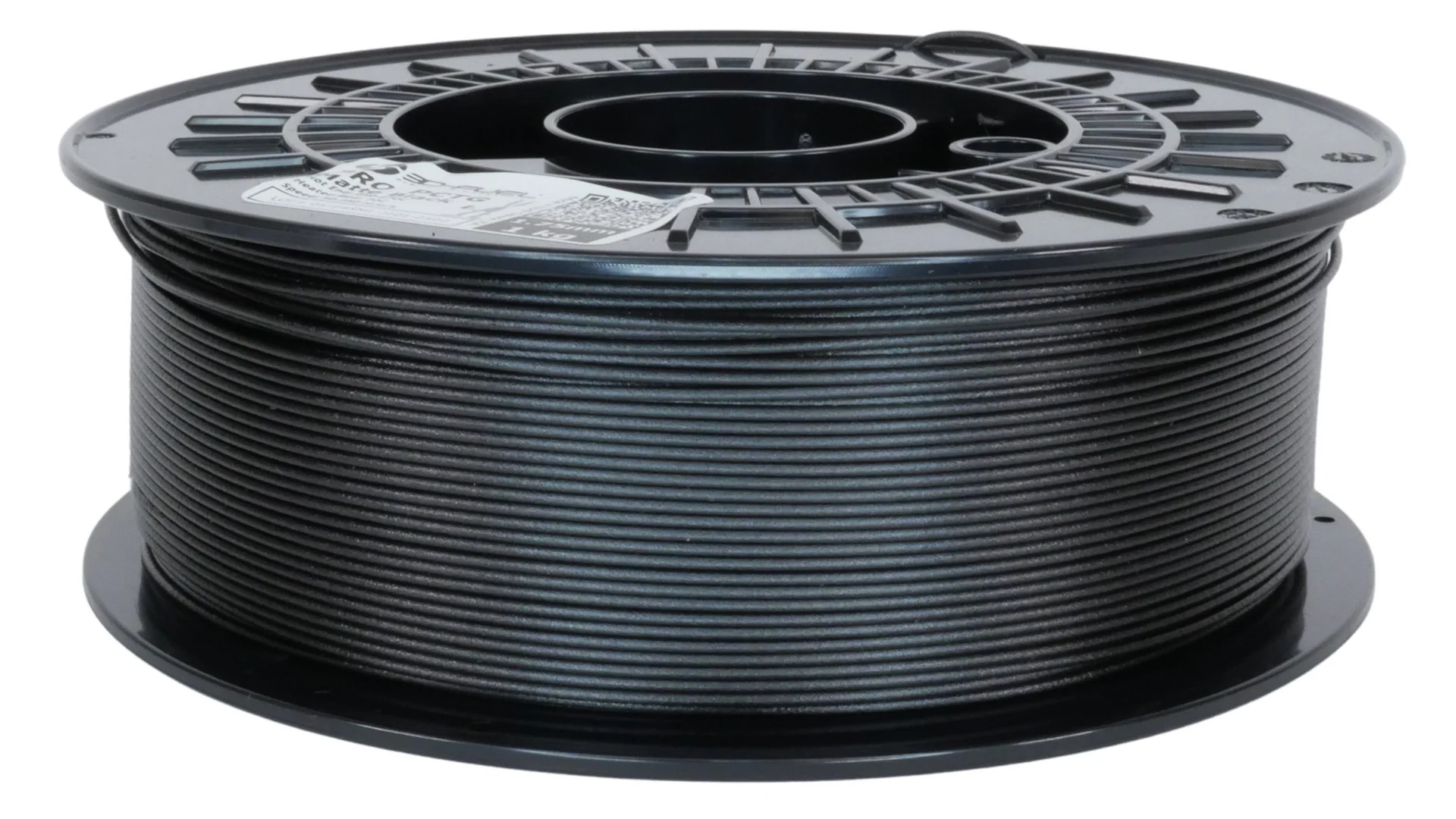

A filament spool can look like a simple purchase until a print starts under-extruding, tangling on the reel, or lifting at the corners. The right material affects far more than color. Diameter consistency, winding, moisture protection and the difference between standard PLA, PLA+, silk PLA and PETG all show up in the finished model.
Our Best 3D Filament picks cover dependable everyday PLA, tougher PLA+ options, small multicolor bundles and specialty finishes. SUNLU PLA+ 2.0 is the best all-around choice for most users, while the rest of the list spans colorful project filament, large two-spool bundles and PETG for tougher prints.
Comparison table
| # | Product | Award | Material | Diameter | Best for |
|---|---|---|---|---|---|
| 1 | SUNLU PLA+ 2.0 | Best overall | PLA+ | 1.75mm, ±0.02mm | Strong everyday prints |
| 2 | SUNLU Black PLA | Best standard PLA | PLA | 1.75mm, ±0.02mm | General-purpose printing |
| 3 | ELEGOO Black PLA | Best easy-print PLA | PLA | 1.75mm, ±0.02mm | Beginners and daily use |
| 4 | Creality Black and White PLA | Best two-color bundle | PLA | 1.75mm | Functional and model prints |
| 5 | Creality Rainbow PLA+ | Best rainbow PLA+ | PLA+ | 1.75mm, ±0.02mm | Color-shifting models |
| 6 | SUNLU Mini PLA Bundle | Best color variety | PLA | 1.75mm, ±0.02mm | Small multicolor prints |
| 7 | AMOLEN Silk PLA Bundle | Best dual-color finish | Silk PLA | 1.75mm, ±0.02mm | Decorative models |
| 8 | Stronghero3D Silk Rainbow | Best full-size silk spool | Silk PLA | 1.75mm, ±0.02mm claimed | Large display pieces |
| 9 | SUNLU 250g PLA Bundle | Best test-spool set | PLA | 1.75mm, ±0.02mm | Testing colors and profiles |
| 10 | Creality PETG | Best PETG option | PETG | 1.75mm, ±0.03mm | Tougher, glossy parts |
1. SUNLU PLA+ 2.0: Best Overall

Pros
- Designed for stronger, less brittle prints
- Supports a wide 100 to 300mm/s speed range
- Consistent 1.75mm diameter with ±0.02mm tolerance
- Reusable spool and vacuum packaging
Cons
- Black limits color flexibility
- Higher-speed printing still depends on the printer and profile
Best for: makers who want one spool for everyday models and more durable functional parts.
The first thing to know about SUNLU PLA+ 2.0 is that it is not merely a black version of ordinary PLA. Its purpose is to make prints less prone to brittleness and cracking, which matters for brackets, housings, clips and parts that will be handled repeatedly. It remains easier to work with than more demanding engineering materials, so it makes a sensible default spool for a mixed collection of projects.
Its dimensional tolerance is listed as ±0.02mm around the 1.75mm filament diameter. That consistency supports predictable extrusion and more even layers, especially when the printer is already calibrated. SUNLU recommends a nozzle range of 205 to 220°C and a bed range of 50 to 60°C. The advertised speed range reaches 300mm/s, but that is a ceiling rather than a promise that every printer will produce its best surface finish at that speed.
The neatly wound spool is another practical strength. Loose loops can turn a routine print into a feed problem, and the winding here is intended to reduce that risk. The 1kg spool measures 195mm across, 57mm wide and has a 63mm hub hole, so check that the holder has room before buying. Vacuum packaging helps protect the material before it is opened.
Compared with SUNLU Black PLA, this is the more useful choice when impact resistance matters. ELEGOO Black PLA is a straightforward alternative for easy decorative and general-purpose work, but this PLA+ formulation is the one we'd choose for parts that need to survive handling. Its weakness is that it is still a PLA-based material, not a replacement for every high-temperature or outdoor application. Choose it if you want a capable black everyday filament without moving into a more specialized material.
2. SUNLU Black PLA: Best Standard PLA

Pros
- Simple standard PLA profile
- ±0.02mm dimensional accuracy
- Neatly wound spool
- Broad 1.75mm FDM compatibility
Cons
- Not as toughness-focused as PLA+
- Recommended speed range stops at 100mm/s
Best for: routine models, prototypes, toys and household prints where standard PLA is the right material.
SUNLU Black PLA is the uncomplicated pick in this group. It uses the familiar PLA formula, avoids the extra tuning considerations of PETG, and is positioned for beginners as well as experienced users. For a printer that spends most of its time making models, organizers and decorative objects, that predictability is more important than a long list of special claims.
The filament is 1.75mm with a stated ±0.02mm tolerance. That is the kind of consistency that helps the extruder maintain a steady flow, which in turn supports clean walls and dependable first layers. SUNLU recommends a nozzle temperature from 200 to 230°C, a bed temperature from 50 to 65°C and a print speed from 50 to 100mm/s. Those settings give a new user a sensible starting point rather than forcing an unusually fast or narrow profile.
Spool dimensions are given as 8 inches in diameter, 2.5 inches wide and 2.2 inches for the hub hole. The reel is designed to fit many FDM printer holders, while the neatly wound filament reduces the chance of a knot interrupting a long print. SUNLU also describes the material as free of clogs, bubbles and tangles when used as intended, though storage after opening still matters for any filament.
It is a more conservative choice than SUNLU PLA+ 2.0, which is better suited to parts that need extra toughness. On the other hand, this standard PLA is an easier recommendation for ordinary objects because it does not ask the buyer to chase the benefits of a faster PLA+ profile. ELEGOO Black PLA is a close rival with the same stated ±0.02mm tolerance, but SUNLU offers a clearly specified standard PLA temperature and speed window. Skip this one only if you specifically need more flexibility, impact resistance or a specialty finish.
3. ELEGOO Black PLA: Best Easy-Print PLA

Pros
- Low-warping PLA formulation
- ±0.02mm dimensional accuracy
- Cardboard spool
- Vacuum sealed after drying
Cons
- Single black color
- No specific temperature range is provided
Best for: beginners and regular users who want a forgiving black PLA spool.
ELEGOO Black PLA keeps the focus on smooth extrusion and low-friction ownership. It is made from PLA, described as having low melting temperature, low warp and low shrinkage, and is intended to produce a glossy surface. That combination makes it a comfortable material for first projects, especially when the goal is to learn the printer rather than troubleshoot an unusual filament.
The 1.75mm diameter is specified at ±0.02mm accuracy. ELEGOO says the filament is mechanically wound and manually checked to limit tangles, snapping and line breaks. Its larger spool inner diameter is intended to make feeding easier, an unglamorous detail that can matter when a holder or guide is not perfectly aligned.
The filament is dried before packaging and vacuum sealed to limit moisture exposure. That is useful because wet PLA can produce inconsistent extrusion and visible surface problems. The 1kg spool weighs 2.2 pounds according to the product information, and its cardboard construction gives it a different feel from the reusable plastic reels used by some competing products.
Compared with SUNLU Black PLA, ELEGOO is just as easy to understand, but its product information puts more emphasis on drying, vacuum sealing and the cardboard spool. SUNLU PLA+ 2.0 is the stronger choice for parts that may be bent or knocked around, while ELEGOO is better for straightforward models and prototypes. The missing piece is a published nozzle and bed range, so users will need to start with their printer's ordinary PLA profile and adjust from there.
If you are still choosing the machine that will use this spool, the material is only half the decision. The printer's hot-end design, bed surface and automatic calibration can make more difference than small claims on a filament label, which is why the features that matter in a first 3D printer are worth settling before building a large material collection.
4. Creality Black and White PLA: Best Two-Color Bundle

Pros
- Includes separate black and white spools
- Two 1kg spools
- Designed for strong bonding and functional parts
- Compatible with most FDM and FFF printers
Cons
- Only two color choices
- Diameter tolerance is not specified in the listed features
Best for: households, classrooms and workshops that regularly use both black and white PLA.
Creality Black and White PLA solves a very specific storage problem. Instead of committing to one color, it supplies one black spool and one white spool, each described as 1kg. Those are the two colors many makers reach for first, whether they are printing labels, enclosures, prototypes or simple display models.
The material is standard PLA, with the manufacturer highlighting smooth printing, strong layer bonding and improved toughness. It is designed for functional parts as well as ordinary models, and the claimed compatibility covers 99% of FDM and FFF printers with heated beds. That broad language should still be read alongside your printer's own spool and temperature requirements.
The bundle's strongest practical advantage is continuity. A workshop can keep black on one printer and white on another, or switch colors without waiting for a small reel to run out. The product information lists dimensions of 8.26 inches by 8.26 inches by 5.51 inches and a total listed weight of about 5.51 pounds, so the two-spool package needs a stable storage spot.
SUNLU Black PLA offers more detailed diameter and temperature information, while Creality Black and White PLA gives you two full spools and a material description aimed at stronger parts. It is not the best fit for anyone who wants color variety or a tightly documented filament profile. For a classroom or maker space that consumes black and white material constantly, though, the format is unusually sensible.
5. Creality Rainbow PLA+: Best Rainbow PLA+

Pros
- Tougher PLA+ formulation
- Color-changing rainbow effect
- ±0.02mm tolerance
- Vacuum sealed with desiccant
Cons
- Color transitions are not fully predictable
- Single rainbow spool offers less control than separate colors
Best for: decorative models that need a more durable material than ordinary silk PLA.
Creality Rainbow PLA+ is the colorful option for users who still want the practical behavior of PLA+. The rainbow effect changes as the spool feeds, so the appeal is less about selecting an exact color for every layer and more about letting the material create a changing finish across a model.
Creality describes the filament as tougher than ordinary PLA, with less tendency to break when bent. It has a 1.75mm diameter and a stated minimum tolerance of ±0.02mm. The same consistency should help with smooth extrusion, while the product is positioned for models, educational toys, machine parts, home accessories and functional pieces.
Moisture protection is addressed with vacuum sealing and desiccant. The spool contains 1kg of filament, and the listed product dimensions are 8.26 inches long and wide by 2.79 inches high. The material is advertised as compatible with Creality's Ender and CR lines as well as most 1.75mm FDM printers.
Compared with Stronghero3D Silk Rainbow, Creality is the more practical pick when toughness matters more than shine. AMOLEN Silk PLA Bundle offers greater control through four separate small spools, but neither it nor the Stronghero3D spool has the same PLA+ positioning. The weakness of rainbow filament is control: the final color placement depends on the model and how much material it uses. Pick it for a lively finish and tougher handling, not for exact color matching.
6. SUNLU Mini PLA Bundle: Best Color Variety

Pros
- Eight distinct colors
- Eight 250g spools
- ±0.02mm tolerance
- Small reels suit accent parts and test prints
Cons
- Small spools run out sooner
- A 250g spool may need an adapter for some AMS setups
Best for: makers who need many colors without storing several full-size reels.
SUNLU Mini PLA Bundle is built around variety rather than uninterrupted production. The package contains eight 250g spools in black, white, gray, transparent, red, blue, orange and green. That makes it a useful palette for small models, lettering, accent pieces and test prints where a full-size spool would sit mostly unused.
The filament is standard PLA with a 1.75mm diameter and stated ±0.02mm tolerance. SUNLU recommends a nozzle temperature from 200 to 210°C, a bed temperature from 50 to 65°C and a print speed from 50 to 100mm/s. Those settings are conservative and familiar, which is exactly what most people want when switching among several colors.
Each reel measures 140mm in diameter, 36mm wide and has a 53mm hub hole. SUNLU says each 250g spool contains approximately 68 meters of filament and is mechanically wound to reduce kinks. The product is also described as compatible with 99% of FDM printers with heated beds and with 3D pens. For AMS users, the manufacturer recommends using a 250g spool adapter.
This bundle has more useful color coverage than AMOLEN Silk PLA Bundle, but AMOLEN's dual-color finish is much more distinctive. The full-size SUNLU Black PLA is the better choice for long single-color jobs, while this set is better for experimentation and small objects. Its real limitation is capacity. If a project needs a large uninterrupted run, the frequent spool changes will become part of the workflow.
For a broader look at material types and the trade-offs among everyday and specialty choices, how different filament materials behave during printing is a useful reference before you fill the shelf with small reels.
7. AMOLEN Silk PLA Bundle: Best Dual-Color Finish

Pros
- Four dual-color silk PLA spools
- Shiny finish for decorative models
- 200g per spool
- ±0.02mm diameter tolerance
Cons
- Less total material than a 1kg spool
- Silk finish is not the priority for functional parts
Best for: ornaments, display models, crafts and gifts that benefit from a reflective color shift.
AMOLEN Silk PLA Bundle is the most deliberately decorative set here. It includes four 200g spools, with dual-color combinations described as red and gold, red and green, red and blue, and blue and green. The effect is intended to move between hues across the printed surface, giving small objects more visual interest than a flat solid color.
The 1.75mm filament has a stated ±0.02mm tolerance. AMOLEN describes it as smooth feeding, bubble-free and resistant to jamming and warping, with good shaping and toughness for silk PLA. Those claims point toward a material that should be approachable for ordinary FDM users, though the glossy surface can make layer direction and lighting more noticeable.
The four-spool format is particularly well suited to small models. Each 200g reel lets you try a different color combination without dedicating a full 1kg spool to a finish you may use only occasionally. The total listed material is 800g, and the product is intended for most FDM printers using 1.75mm filament.
Compared with SUNLU Mini PLA Bundle, AMOLEN offers fewer individual color choices but a more dramatic finish. Stronghero3D Silk Rainbow gives you a full-size reel and a continuous gradient, while AMOLEN gives you four separate combinations and more control over which effect you load. The drawback is that silk PLA is not the sensible first choice for every bracket or mechanical part. Choose it when appearance is central to the project.
8. Stronghero3D Silk Rainbow: Best Full-Size Silk Spool

Pros
- Full 1kg rainbow silk spool
- Glossy gradient effect
- Vacuum sealed
- Designed for low warping and bed adhesion
Cons
- Color control is limited by the gradient
- First-layer settings may need adjustment
Best for: large decorative prints that need a continuous glossy color transition.
Stronghero3D Silk Rainbow takes the visual idea behind AMOLEN's bundle and puts it on a full-size spool. The candy-style rainbow effect shifts through colors such as orange, purple and pink as the material is used. That makes it especially attractive for vases, figures, ornaments and other objects where a changing surface is part of the design.
The product is a 1.75mm silk PLA spool with a listed net weight of 1kg and an advertised length of 330 meters. Its feature list states a ±0.02mm diameter tolerance and describes smooth feeding, low warping and good adhesion on glass, PEI and other build plates. The stated goal is a vivid, glossy surface that can make layer lines less visually prominent.
Stronghero3D recommends a bed temperature from 55 to 65°C, a first-layer speed of 25mm/s and a 0.6mm line width or 150% flow rate to reduce first-layer warping. Those recommendations are more interventionist than the everyday PLA profiles from SUNLU Black PLA and ELEGOO Black PLA. They are worth treating as tuning guidance rather than universal requirements.
This spool beats AMOLEN Silk PLA Bundle on uninterrupted capacity and suits larger pieces, while AMOLEN gives you four separate color combinations. Creality Rainbow PLA+ is the better match for parts that need extra toughness, because this is primarily a finish-oriented silk material. Choose Stronghero3D when you want one large spool to create a showpiece, and be prepared to slow the first layer while dialing in adhesion.
9. SUNLU 250g PLA Bundle: Best Test-Spool Set

Pros
- Eight compact 250g spools
- Eight colors for prototypes and accents
- ±0.02mm tolerance
- Small reel dimensions suit open spool holders
Cons
- Not ideal for long large prints
- AMS use may require a compatible adapter
Best for: new makers testing colors, small models and different print profiles.
SUNLU 250g PLA Bundle is nearly the same kind of product as the larger SUNLU mini-spool set, but it comes from a separate listing and is best understood as a compact color sampler. It includes eight 250g spools in white, red, orange, yellow, green, blue, cyan and purple. That spread is especially useful when a model needs several accent colors but not enough of any one shade to justify a large reel.
The filament is standard PLA designed for common PLA profiles. SUNLU lists a consistent 1.75mm diameter with ±0.02mm tolerance and describes low warping, dependable layer adhesion and smooth feeding. The material is aimed at models, toys, decor, prototypes and utility parts, so it is not restricted to novelty prints despite the small spool format.
Each spool measures 140mm in diameter and 36mm wide, with a 53mm center hole. SUNLU says the compact reels work with external, top-mounted and open holders. For Bambu Lab AMS or AMS lite systems, the listing recommends finding a compatible 250g spool adapter before use. That caveat matters because the reel size is the defining feature of this set.
Compared with SUNLU Mini PLA Bundle, the selection is more concentrated around bright colors and includes cyan and purple rather than transparent and gray. AMOLEN Silk PLA Bundle creates a more noticeable surface effect, but its palette is less suited to simple color matching. The weakness here is obvious: 250g disappears quickly on a large model. Pick this set when flexibility and low leftover waste matter more than uninterrupted printing.
10. Creality PETG: Best PETG Option

Pros
- Tougher PETG material
- Glossy finish and light transmission
- 1kg spool
- Vacuum sealed and neatly wound
Cons
- Requires hotter printing than PLA
- Looser stated tolerance of ±0.03mm
Best for: users who need stronger, tougher or more glossy parts than ordinary PLA provides.
Creality PETG is the outlier in this group, and that is exactly why it earns a place. PETG is generally chosen when standard PLA is not tough enough for the job. This black filament is described as combining toughness with good clarity, light transmission and a glossy finish, making it suitable for parts that need a more resilient material.
The recommended nozzle temperature is 220 to 250°C, while the base plate temperature is 70 to 80°C. Those temperatures are notably higher than the PLA settings used by SUNLU Black PLA and SUNLU PLA+ 2.0, so the printer needs to be ready for PETG. The filament diameter is 1.75mm with a stated ±0.03mm tolerance, slightly less tight on paper than the ±0.02mm claims common among the PLA options.
Creality says the spool is mechanically wound to limit tangles, snapping and line breaks. The material is dried and vacuum sealed to guard against moisture, and the product is described as compatible with most 1.75mm FDM printers, particularly Creality machines. The spool contains 1kg and the product information lists a weight of 2.56 pounds.
PETG is not automatically an upgrade for every print. It can require more careful temperature, cooling and adhesion tuning, and the higher heat range makes it less forgiving for a beginner's first spool. It is the right step beyond Creality Black and White PLA when toughness matters, but PLA+ remains simpler for many functional objects. Choose this one for durable, glossy black components and accept the extra setup.

How to choose best 3d filament
The right spool depends on the part's job, the printer's hot end and how much control you need over color and finish.
Material type
PLA is the easiest starting point for models, prototypes, toys and decorative objects. It generally prints at lower temperatures and tends to warp less than more demanding materials. PLA+ keeps much of that approachable behavior while emphasizing toughness, as seen in SUNLU PLA+ 2.0 and Creality Rainbow PLA+.
PETG is a better fit when the part needs more toughness or a glossy, slightly translucent appearance. It also asks for a hotter nozzle and bed, so confirm that the printer supports the recommended range before switching from PLA.
Pick standard PLA for predictable modeling, PLA+ for tougher handling, and PETG when the part's job matters more than easy setup.
Diameter consistency
Most products here use 1.75mm filament. The listed tolerance matters because uneven diameter changes the amount of plastic entering the nozzle, which can show up as thin walls, gaps or inconsistent top layers.
A stated ±0.02mm tolerance appears on both SUNLU and ELEGOO PLA products, AMOLEN's silk bundle and the Creality rainbow PLA+. Creality PETG lists ±0.03mm. Those figures are useful signals, but they do not replace a properly calibrated extruder and a clean nozzle.
Spool size and holder fit
A full 1kg spool is practical for long projects and repeated use, but it takes more storage space and gives you less color variety. The 250g SUNLU bundles are easier to use for accents and test prints, though their smaller reels may need an adapter in some automated material systems.
Check the spool diameter, width and hub hole against the printer's holder. A material can be perfectly compatible by diameter and still fail to fit the physical spool mount.
Winding and moisture protection
Neat winding helps the filament leave the reel without a loop catching underneath another loop. It is not a substitute for securing the loose end after printing, but it reduces one common source of interruptions.
Vacuum packaging, desiccant and pre-drying are also useful signs. Once opened, keep the filament sealed or dry when possible. PLA and PETG can both behave poorly after absorbing moisture, with PETG often demanding more attention.
Finish and color behavior
Solid black or white PLA is easier to plan around than rainbow or dual-color material. It gives you predictable color across the model and makes it easier to match replacement sections.
Silk PLA adds gloss but can make surface artifacts more visible under bright light. Rainbow filament creates an automatic gradient, but the exact transition depends on the model's size, orientation and material usage. Choose it for visual variety rather than exact color placement.
Frequently asked questions
Is PLA or PLA+ better for most 3D prints?
Standard PLA is usually the easier choice for models, prototypes and decorative objects. PLA+ is better when a part may be bent, dropped or handled frequently, because the products in this guide position it as less brittle and tougher than standard PLA.
Can these filaments work in any 3D printer?
The PLA products use the common 1.75mm format and are described as compatible with most FDM printers. Physical spool clearance, nozzle temperature capability and the printer's material profile still matter, so check those details before loading a new reel.
What does ±0.02mm tolerance mean?
It describes the claimed variation around the filament's stated diameter. A tighter and more consistent diameter can help the extruder maintain steady flow, though the printer still needs correct extrusion calibration and a clean nozzle.
Is PETG harder to print than PLA?
PETG generally needs more heat and a warmer build surface. The Creality PETG listing recommends a 220 to 250°C nozzle and a 70 to 80°C base plate, which is a more demanding setup than the PLA recommendations in this list.
Are small 250g spools useful?
Yes. Small spools are useful for testing a color, printing accents or making small models without storing several large reels. They are less convenient for large objects because the filament may run out before the print is complete.
Does silk PLA print differently from regular PLA?
Silk PLA is still intended for FDM printing, but its glossy finish and specialty color effects can make surface quality and lighting more noticeable. Slower first layers and careful adhesion may help, particularly with a large rainbow silk print.
The bottom line
The Best 3D Filament for most people is SUNLU PLA+ 2.0 because it combines familiar PLA handling with a tougher formulation, a stated ±0.02mm tolerance and a broad recommended speed range. For ordinary models and prototypes, SUNLU Black PLA and ELEGOO Black PLA are simpler standard PLA choices.
Choose AMOLEN Silk PLA Bundle or Stronghero3D Silk Rainbow when the finish is the point of the project. Choose Creality PETG when toughness and a glossy surface matter more than the easy setup of PLA.
If you are undecided, start with SUNLU PLA+ 2.0 for functional work or SUNLU Black PLA for straightforward everyday prints.
As an Amazon Associate we earn from qualifying purchases.