

A 43-inch television has to work harder than a huge living-room screen. It may sit in a bedroom, office, apartment, or small lounge, where limited viewing distance makes soft upscaling, harsh brightness, and sluggish menus especially obvious. The right model should make streaming simple without giving up useful picture controls or the connections needed for a console and soundbar.
Our Best 43 TV picks range from straightforward Fire TV sets to Mini LED and QLED models with stronger color, contrast, and motion features. The Hisense E6 Cinema is our top pick for the broadest mix of picture technology, streaming features, and gaming support, while the nine choices below cover different priorities.
Comparison table
| # | Product | Award | Picture | Smart platform | Motion and gaming | Best for |
|---|---|---|---|---|---|---|
| 1 | Hisense E6 Cinema | Best overall | Hi-QLED, Dolby Vision, HDR10+ Adaptive | Fire TV, Alexa | Motion Rate 120, Game Mode Plus | Buyers who want vivid movies and flexible HDR |
| 2 | Samsung M70H Mini LED | Best Mini LED picture | Mini LED HDR, one billion colors | Samsung TV Plus, Gaming Hub | DLG 120Hz | Sports and gaming |
| 3 | LG QNED73 | Best for webOS fans | Mini LED, QNED Color, HDR10 Pro | webOS, LG Channels | FreeSync Premium, ALLM | Streaming and console gaming |
| 4 | Toshiba C350 | Best Fire TV for movies | 4K, Dolby Vision | Fire TV, Alexa | VRR, ALLM, Sports Mode | Movie nights and mixed use |
| 5 | Samsung Q7F QLED | Best color-focused Samsung | QLED, Quantum HDR, HDR10+ | Samsung TV Plus, Gaming Hub | AI picture and sound optimization | Bright, colorful everyday viewing |
| 6 | Amazon Ember 4-Series | Best Fire TV interface | 4K, HDR10+ | Fire TV, Alexa+ | Amazon Luna and Xbox Game Pass support | Alexa-centered homes |
| 7 | Samsung U8000H | Best simple Samsung | Crystal UHD, Color Booster | Samsung TV Plus | Motion Xcelerator, up to 4K 60Hz | Straightforward streaming |
| 8 | Insignia F50 | Best connected Fire TV | 4K, HDR10 | Fire TV, Alexa | DTS Virtual:X | Bedrooms and smaller spaces |
| 9 | Samsung U8000F | Best slim design | Crystal UHD, 4K upscaling | Samsung TV Plus | Motion Xcelerator up to 60Hz | A neat, uncluttered setup |
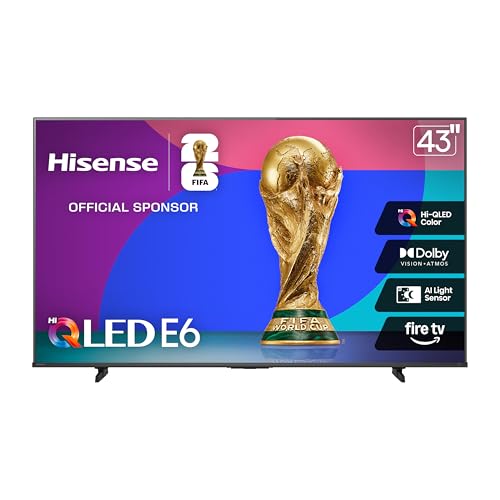
1. Hisense E6 Cinema: Best Overall
Pros
- Hi-QLED color is designed for vivid, lifelike images
- Supports Dolby Vision, HDR10+ Adaptive, HDR10, and HLG
- AI light sensor adjusts brightness to the room
- Fire TV and Alexa make streaming easy
- Wi-Fi 6 supports faster, more stable connections
Cons
- Fire TV interface is not as clean as webOS for every viewer
- The feature list is stronger than the available physical connection details
- Buyers wanting Mini LED backlighting should look elsewhere
Best for: someone who wants rich HDR support and a flexible smart TV in a compact size.
The Hisense E6 Cinema is the most complete television here because it avoids making you choose between color, HDR compatibility, smart features, and motion processing. Its Hi-QLED Color system is intended to produce richer shades than a basic LED set, which should be noticeable in animated films, sports uniforms, and brightly lit scenes. It also includes Filmmaker Mode, giving movie watchers a way to preserve the intended aspect ratio, frame rate, color, and audio settings.
The HDR support is unusually broad for a 43-inch model. Dolby Vision, HDR10+ Adaptive, HDR10, and HLG are all listed, so the set is equipped for a wide mix of streaming and broadcast content. Dolby Vision can be useful when compatible movies contain scene-by-scene brightness information, while HDR10+ Adaptive is designed to account for room lighting. The AI light sensor takes that idea further by adjusting screen brightness in response to ambient light, a useful feature for a television that may be watched from morning through late evening.
Motion features also give this Hisense a wider range than the basic Samsung models. Motion Rate 120, AI Smooth Motion, MEMC, and AI noise reduction are intended to reduce blur in fast scenes. Game Mode Plus adds gaming-focused support, though the listing does not provide a native panel refresh specification, so shoppers should not assume that every game will run at a true 120Hz. Wi-Fi 6 is a welcome addition for homes with many connected devices, and the Fire TV interface puts live channels and streaming apps on the same home screen.
Compared with the Toshiba C350, the Hisense has broader HDR support and room-aware brightness. The Samsung M70H Mini LED should have the stronger contrast potential because its backlight technology is more advanced, while the LG QNED73 is the better fit for someone committed to webOS and LG gaming tools. The Hisense's weakness is that its long feature list does not tell us everything about the physical inputs or stand arrangement. Skip it if you specifically want Mini LED dimming or a very precise connection plan. For mixed viewing, though, this is the one we'd choose.
2. Samsung M70H Mini LED: Best Mini LED Picture

Pros
- Mini LED backlighting targets brighter highlights and deeper blacks
- Supreme Mini LED Dimming improves contrast control
- DLG 120Hz is suited to fast games and sports
- Gaming Hub gathers console, cloud, and app-based games
- One billion colors support vivid everyday viewing
Cons
- Samsung interface may feel less direct than Fire TV for Alexa users
- The listing does not provide a detailed input count
- Soccer Mode is specialized rather than universally useful
Best for: sports fans and gamers who want advanced backlighting in a 43-inch screen.
The Samsung M70H Mini LED is the picture-first alternative to the Hisense. Its key advantage is the Mini LED backlight, paired with Supreme Mini LED Dimming. Smaller, more precisely controlled light sources can help a television show brighter highlights beside darker areas, and that is the kind of difference that matters in night scenes, stadium shots, and games with bright interface elements against a dark background.
Samsung also lists a Mini LED Processor 4K, Mini LED HDR, and Pure Color Spectrum technology with one billion colors. Those labels do not replace a proper hands-on measurement, but they describe a set built around brightness, color range, and contrast rather than merely basic 4K resolution. Color Booster is intended to make hues more intense, while the processor handles image enhancement for lower-quality material.
Motion is where the M70H separates itself from the Samsung U8000H and Samsung U8000F. Motion Xcelerator+ with DLG 120Hz is designed to keep rapid movement clearer, making it a more natural match for sports and responsive console play. Gaming Hub brings console, cloud service, and gaming app access into one place, so the television is not limited to acting as a display for an external console. The set also includes Soccer Mode with specialized motion and turf-color adjustments.
The M70H is not automatically the best fit for everyone. Its advanced picture hardware matters less if most viewing consists of casual daytime shows, and the listing does not spell out all of its connections. The LG QNED73 offers a more explicit gaming feature set with AMD FreeSync Premium and ALLM, while the Hisense E6 Cinema supports more named HDR formats. Choose the M70H when deeper contrast and fast motion are the priority, especially for a compact sports or gaming room.
3. LG QNED73: Best for webOS Fans

Pros
- Mini LED and Dynamic QNED Color target strong contrast and color volume
- HDR10 Pro adjusts brightness in bright and dark scenes
- webOS includes LG Channels and modern content tools
- FreeSync Premium and ALLM support console gaming
- AI Sound Pro and Wow Orchestra add audio flexibility
Cons
- It has fewer named HDR formats than the Hisense
- The Amazon exclusive model may not suit shoppers wanting Fire TV
- The listing does not identify a native refresh rate
Best for: viewers who prefer webOS and want a 43-inch set with serious gaming features.
The LG QNED73 takes a different route from the Fire TV models. It runs webOS, includes LG Channels, and adds Google Gemini and Microsoft Copilot access through the platform. That makes it a good match for a household already using LG's interface, particularly if you want streaming, free channels, and smart tools in one environment without switching to a separate streaming stick.
Its Mini LED backlight is the main picture attraction. Dynamic QNED Color is designed to improve color accuracy, and LG says the set has 100% Color Volume. HDR10 Pro dynamically adjusts brightness to preserve detail in both bright and dark scenes. Filmmaker Mode is also included, giving movie fans a picture mode that keeps the director's intended colors, settings, and frame rates rather than applying a more aggressive television look.
LG is unusually clear about its gaming features. AMD FreeSync Premium and ALLM are both listed, alongside a Game Dashboard and Game Optimizer. ALLM can let a compatible console trigger a lower-latency setting automatically, while FreeSync Premium is intended to reduce tearing with compatible hardware. The listing does not provide a native refresh rate, so this should not be treated as a direct 120Hz competitor to the Samsung M70H without further specification.
The LG's AI Sound Pro and Wow Orchestra features give it a more developed audio story than several entries here, although the listing does not provide speaker power or channel details. Its dimensions with the stand are 37.8 by 24.3 by 7.9 inches, and without the stand it is 37.8 by 22.2 by 2.8 inches, useful information for a narrow cabinet or wall-mount plan. Choose it over the Samsung Q7F QLED if gaming controls and webOS matter more than Samsung's Quantum Dot color system. Skip it if you want Alexa and Fire TV at the center of the experience.
4. Toshiba C350: Best Fire TV for Movies

Pros
- Dolby Vision and Dolby Atmos support movie playback
- AI 4K Upscaler improves lower-resolution content
- Game Mode includes ALLM, VRR, and eARC
- Sports Mode is designed for fast-moving action
- Fire TV keeps apps and live television together
Cons
- Basic LED hardware cannot match the Mini LED models
- The listing does not provide a native refresh rate
- Fire TV may show more content and recommendations than some viewers want
Best for: movie watchers who want Dolby formats and a familiar Fire TV interface.
The Toshiba C350 is the most cinema-minded of the straightforward LED televisions in this group. Its REGZA Engine ZR analyzes scenes to drive 4K picture processing, while the AI 4K Upscaler looks at neighboring pixel colors and texture rather than simply enlarging the source. That is helpful when a 43-inch screen is showing older broadcasts, DVDs, or compressed streams that can otherwise look rough at close range.
Dolby Vision and Dolby Atmos are the headline features. Dolby Vision can improve the way compatible HDR movies handle bright and dark areas, while Dolby Atmos support gives compatible audio equipment the information needed for a more immersive sound field. The television also includes Super Contrast Booster, which is intended to increase depth between darker and brighter parts of the image. These features make the C350 a more interesting movie option than the Insignia F50, even though both use an LED 4K approach.
Toshiba has not ignored games. Game Mode includes ALLM, VRR, and eARC, giving compatible consoles and sound systems useful ways to communicate with the television. VRR can help keep frame delivery smoother when game output varies, and ALLM can switch to a responsive mode automatically. Ultimate Motion and Sports Mode are intended to keep quick movement clearer, but the product information does not state a native refresh rate, so buyers should keep expectations grounded.
The C350's smart platform is simple to understand. Fire TV places apps, shows, and live television on a central screen, and Alexa voice control is built into the remote. The Hisense E6 Cinema has a stronger list of HDR formats and an AI light sensor, while the Amazon Ember 4-Series has newer Fire TV features and four HDMI inputs. Choose Toshiba for Dolby Vision, Dolby Atmos, and the combination of VRR and ALLM. It is less compelling for buyers who want the deepest contrast available from Mini LED hardware.
5. Samsung Q7F QLED: Best Color-Focused Samsung

Pros
- Quantum Dot color covers a broad range of shades
- Quantum HDR and HDR10+ enhance compatible content
- AI processing optimizes picture and audio by content type
- Gaming Hub brings games and cloud services together
- Knox Security protects connected TV data
Cons
- No native refresh rate is specified in the listing
- It lacks the M70H's named Mini LED backlight
- Buyers wanting Alexa and Fire TV should choose another platform
Best for: viewers who want Samsung's color-focused picture processing in a compact set.
The Samsung Q7F QLED is aimed at viewers who notice color first. Its Quantum Dots are designed to display billions of shades and keep them accurate even in bright scenes. That makes this set a logical step up from the Crystal UHD models for colorful animation, nature documentaries, sports graphics, and games with saturated worlds.
Quantum HDR and HDR10+ support are intended to bring out contrast and preserve detail in compatible content. Samsung's Q4 AI Gen1 Processor also works on 4K upscaling, which matters because not every source delivered to a 43-inch screen will be native 4K. The listing says the processor can optimize picture and audio according to the content type, though it does not provide technical measurements for brightness, contrast, or latency.
The Q7F includes Samsung's Gaming Hub, so it can act as a central place for console, cloud, and gaming app access. It is not as specifically equipped on paper as the LG QNED73, whose listing names FreeSync Premium and ALLM, and it does not have the M70H's Mini LED dimming system or DLG 120Hz feature. Still, the Q7F is a sensible everyday entertainment set when vivid color and Samsung's software ecosystem matter more than the most advanced motion hardware.
Knox Security is a useful supporting feature. Samsung says it protects against harmful apps and phishing sites, keeps sensitive data such as PINs and passwords secure, and safeguards connected IoT devices. Samsung TV Plus also provides a broad selection of free channels and content. The Q7F is not the pick for someone who wants Fire TV or Alexa voice control, but it is a strong fit for a Samsung-centered household that wants a more colorful picture than the U8000H or U8000F.
6. Amazon Ember 4-Series: Best Fire TV Interface

Pros
- New Fire TV interface organizes content and recommendations
- Alexa+ supports natural voice searches and smart-home control
- Wi-Fi 6 and a quad-core processor target quick navigation
- Four HDMI inputs simplify console and soundbar connections
- Ambient Experience and Omnisense add useful idle-screen behavior
Cons
- Picture hardware is less advanced than the Mini LED picks
- Amazon Luna and Xbox Game Pass features may require subscriptions
- Dolby Audio is listed, but not Dolby Vision or Dolby Atmos
Best for: households that want Alexa, Fire TV, and easy access to multiple devices.
The Amazon Ember 4-Series makes the strongest case for buying around the interface rather than the panel technology. Its newest Fire TV experience uses dedicated content categories, more app pinning, and recommendations from Alexa+. The goal is to cut down on menu wandering, which can matter more than a small picture improvement when the television is mainly used for casual streaming.
The screen supports 4K Ultra HD and HDR10+, with enhanced brightness and improved contrast in dark scenes. That gives it a more capable picture foundation than a basic Full HD set, but the listing does not identify QLED or Mini LED hardware. The Hisense E6 Cinema, Samsung M70H, and LG QNED73 therefore remain the more promising choices for color volume, dimming, and high-impact HDR.
Amazon adds a quad-core processor and Wi-Fi 6 support. Those are practical platform specifications: Wi-Fi 6 can help in a crowded network, while a newer processor should make app loading and navigation feel less hesitant. Four HDMI inputs are also explicitly listed, giving the Ember an advantage over models whose connection details are not fully provided. AirPlay support makes it easier to share compatible content from another device.
The television also includes Ambient Experience and Omnisense sensors that can wake the display when you enter, show artwork, or let you start watching quickly. Alexa Voice Remote Enhanced adds preset app buttons and voice control. Gaming features include Amazon Luna and Xbox Game Pass access without a console, but those services may involve separate subscriptions and the listing does not state a gaming refresh rate. Pick the Ember when the household already uses Alexa and values a quick, modern Fire TV experience. Choose Toshiba instead if movie formats such as Dolby Vision and Dolby Atmos are more important.
For a smaller room, it is also worth considering how much viewing distance affects a 43-inch screen before choosing a set. A television with a strong interface cannot compensate for a screen that is too large or too small for the seating position.
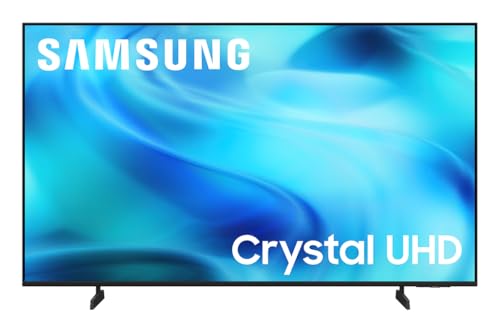
7. Samsung U8000H: Best Simple Samsung
Pros
- Crystal Processor 4K handles upscaling and detail enhancement
- Color Booster gives standard content more intensity
- Samsung TV Plus includes free channels and streaming options
- Motion Xcelerator supports smoother sports and game movement
- Compact 14.8-pound design is easier to position
Cons
- No QLED or Mini LED backlight is listed
- Motion performance is specified up to 4K 60Hz
- Samsung TV Plus may be more platform than some viewers need
Best for: viewers who want a current Samsung interface without advanced picture hardware.
The Samsung U8000H is the uncomplicated Samsung in this roundup. It uses a Crystal Processor to sharpen details, boost colors, and upscale lower-quality movies, shows, and games to a 4K presentation. That kind of processing is useful when the source varies from high-quality streaming to ordinary broadcast material, especially at the relatively close seating distances common with 43-inch sets.
Color Booster is designed to make reds, blues, and other shades look more intense. It is a software and processing advantage rather than the wider color approach associated with the Samsung Q7F QLED or the Mini LED hardware in the Samsung M70H. The U8000H should suit ordinary TV, news, and streaming well, but buyers looking for dramatic HDR contrast should move up the list.
Motion Xcelerator estimates frame transitions and adjusts movement in real time. Samsung specifies performance up to 4K 60Hz, which makes this a reasonable fit for everyday sports and standard console gaming. It is not the better choice for someone specifically seeking a 120Hz gaming experience, where the M70H has a clearer advantage through DLG 120Hz.
Samsung TV Plus adds more than 2, 700 free streaming options, including more than 750 subscription-free channels according to the listing. That gives the U8000H plenty to do immediately after setup, though the platform can feel busy if you already have a preferred streaming device. Its listed dimensions are 37.7 inches wide, 24 inches high, and 6.2 inches deep, with a listed weight of 14.8 pounds. Choose it for straightforward Samsung ownership and solid upscaling. Choose the Samsung U8000F if design and data security are more important, or the Toshiba C350 if movie HDR formats matter more.
8. Insignia F50: Best Connected Fire TV

Pros
- 4K Ultra HD and HDR10 support
- Fire TV includes free channels and major streaming apps
- Three HDMI ports plus eARC support
- Composite, optical, USB, headphone, coaxial, and Ethernet connections
- DTS Virtual:X adds a wider sound presentation
Cons
- Basic LED picture technology lacks QLED and Mini LED features
- HDR format support is narrower than the Hisense and Toshiba
- The listing does not provide a native refresh rate
Best for: bedrooms, guest rooms, and setups that need broad physical connectivity.
The Insignia F50 is the practical connectivity pick. It covers the essential 4K and HDR10 picture formats, then gives you a broad set of ways to connect older and newer equipment. That makes it particularly useful for a bedroom, guest room, or secondary entertainment area where a cable box, antenna, game console, headphones, and sound system may all need to share the television.
The three HDMI ports include eARC support, which can pass the original full-resolution audio signal to compatible equipment. There are also composite AV jacks, a digital optical output, a USB port, a headphone jack, a coaxial jack, and Ethernet. Those connections are unusually well documented in this group. The trade-off is picture ambition: unlike the Hisense E6 Cinema, Samsung M70H, and LG QNED73, the F50 is not presented as a QLED or Mini LED television.
Fire TV handles the software side, with apps such as Prime Video, Netflix, Disney+, Hulu, and HBO Max listed alongside free services including Fire TV Channels, Pluto TV, and Tubi. Alexa voice control is built into the remote, and parental controls can block content by rating or block entire channels behind a PIN. The set also works as a smart-home hub for compatible devices, including live camera feeds, lighting, and thermostat controls.
DTS Virtual:X is intended to create a more three-dimensional presentation from the television's speakers, though it is not a substitute for a properly positioned soundbar. The F50 is wall-mountable with a 200 by 300 VESA pattern, and its listed dimensions are 36.68 inches wide, 23.6 inches high, and 8.27 inches deep. Choose it over the Samsung U8000H when connections matter more than Samsung's processing. Skip it if your priority is deep HDR contrast or fast gaming motion.
9. Samsung U8000F: Best Slim Design

Pros
- Crystal UHD processing includes 4K upscaling
- MetalStream design uses a single metal sheet and slim bezel
- Knox Security protects personal data and connected devices
- Samsung TV Plus supplies free channels and content
- Motion Xcelerator supports movement up to 60Hz
Cons
- No QLED or Mini LED picture hardware is listed
- Motion features are less ambitious than the M70H
- Connection details are not fully specified
Best for: a neat Samsung setup where design and a slim bezel matter.
The Samsung U8000F is close to the U8000H in its intended role, but it puts more emphasis on the physical design. Samsung describes a single metal sheet, slim bezel, and aircraft-inspired styling. That makes it a sensible choice when the television will sit in a visible living space and you want the frame to recede rather than call attention to itself.
The Crystal UHD processor handles 3D color mapping and upscaling, with the aim of making lower-resolution sources look clearer in a 4K presentation. Motion Xcelerator estimates movement between frames and supports motion up to 60Hz. Those features are adequate for ordinary broadcasts, streaming shows, and casual games, but the Samsung M70H is the more appropriate choice for fast sports or games where a higher-speed presentation is central.
The software includes Samsung TV Plus, with more than 2, 700 free channels and more than 400 premium channels listed. Knox Security adds triple-layer protection against harmful apps and phishing sites, while also protecting PINs, passwords, and connected IoT devices. Alexa is built in, but this remains a Samsung smart TV rather than a Fire TV device, so it is a poor fit for someone who wants Amazon's interface and voice search at the center.
The U8000F measures 37.7 inches wide, 24 inches high, and 6.2 inches deep, with a listed weight of 14.6 pounds. Its physical design is the main reason to choose it over the Samsung U8000H, whose feature list is more focused on Color Booster and current model positioning. For a broader picture upgrade, the Samsung Q7F QLED is the stronger direction. Pick the U8000F when a clean Samsung design, free content, and dependable upscaling are enough.

How to choose best 43 tv
The right 43-inch television depends on the room, the content, and the devices you plan to connect. These are the specifications that matter most when comparing the Best 43 TV options.
Backlight and color technology
Basic LED sets such as the Insignia F50, Toshiba C350, and Samsung Crystal UHD models use conventional LED picture technology as described in their listings. QLED and QNED sets add color-focused layers or processing, while Mini LED models such as the Samsung M70H and LG QNED73 are designed for more precise backlight control.
Mini LED is the more meaningful upgrade for contrast because it is tied to dimming and highlight control. QLED and QNED can improve color volume, but they do not automatically guarantee deep blacks. For ordinary daytime viewing, a capable 4K LED set may be sufficient. For dark movies, HDR, and games, look for explicit dimming or Mini LED language.
HDR formats
HDR compatibility tells you which high-dynamic-range sources a television can handle. The Hisense E6 Cinema lists Dolby Vision, HDR10+ Adaptive, HDR10, and HLG, while the Toshiba C350 lists Dolby Vision and Dolby Atmos alongside its picture features. The Insignia lists HDR10, and the LG lists HDR10 Pro.
More formats provide flexibility, but format support alone does not determine picture quality. A television also needs enough contrast and brightness to make HDR visible. A set with Dolby Vision and stronger backlighting is generally a more useful movie television than one that simply lists many formats without comparable contrast hardware.
Motion and refresh features
Sports and games expose weak motion handling quickly. Motion Xcelerator on the Samsung U8000 models supports movement up to 60Hz, while the Samsung M70H lists DLG 120Hz. Toshiba includes Ultimate Motion, VRR, and ALLM, and LG lists AMD FreeSync Premium and ALLM.
Do not treat marketing names such as Motion Rate as a guaranteed native refresh rate. Look for a clearly stated refresh specification when fast gaming is important. VRR can smooth uneven game output, while ALLM can switch a compatible television into a responsive mode without manual adjustment.
For sports and gaming, a clear refresh specification matters more than a dramatic motion label.
Smart TV platform
Fire TV is the common thread among Insignia, Toshiba, Hisense, and Amazon Ember. It combines apps, live channels, Alexa search, and free ad-supported content. Amazon Ember adds Alexa+ recommendations, Wi-Fi 6, a quad-core processor, and a newer Fire TV layout.
Samsung's platform centers on Samsung TV Plus, free channels, Samsung's smart-home ecosystem, and features such as Gaming Hub. LG uses webOS, LG Channels, and additional smart tools. Pick the platform that matches the devices and voice assistant already used at home. Interface familiarity often affects daily satisfaction more than a minor difference in picture processing.
Connections and placement
Count the devices before buying. The Insignia lists three HDMI ports, eARC, composite AV, optical audio, USB, headphone, coaxial, and Ethernet. Amazon Ember lists four HDMI inputs and AirPlay support. Several other entries do not provide a complete connection list in the supplied information, so confirm the current listing if you need a specific port.
Placement matters just as much. The LG measures 37.8 inches wide, the Insignia 36.68 inches, and most of the Samsung models around 37.7 to 38.1 inches. For a different room layout, the screen sizes that suit tighter spaces can be useful to compare before committing to 43 inches.

Frequently asked questions
Is a 43-inch TV large enough for a living room?
A 43-inch screen can work well in a small living room, apartment, bedroom, office, or gaming space. The right choice depends on seating distance and how much of your view you want the screen to occupy. If the sofa is far away, a larger size may provide a more immersive picture.
Which 43-inch TV is best for movies?
The Hisense E6 Cinema is the strongest all-round movie pick because it lists Hi-QLED Color, Dolby Vision, HDR10+ Adaptive, Filmmaker Mode, and an AI light sensor. The Toshiba C350 is another good option because it combines Dolby Vision, Dolby Atmos, and AI 4K upscaling. The Samsung M70H is the better choice if contrast from Mini LED backlighting matters most.
Which model is best for gaming?
The Samsung M70H is the most motion-focused choice, with Motion Xcelerator+ and DLG 120Hz. The LG QNED73 is also compelling because it lists AMD FreeSync Premium, ALLM, Game Dashboard, and Game Optimizer. Toshiba's VRR and ALLM features make the C350 a useful alternative, but its native refresh rate is not provided.
Are all of these televisions 4K?
Yes. Every product in this roundup is described as a 4K television or 4K UHD television. That does not mean every source will be native 4K, which is why processing and upscaling features matter for broadcast television and older content.
Which 43-inch TV works best with Alexa?
The Insignia F50, Toshiba C350, Hisense E6 Cinema, and Amazon Ember use Fire TV with Alexa voice control. The Amazon Ember goes further with Alexa+ features and a newer Fire TV experience. Several Samsung models list Alexa built in, but they use Samsung's smart TV platform rather than Fire TV.
Do I need a soundbar with a 43-inch TV?
Not necessarily, but a soundbar can improve dialogue clarity, bass, and spaciousness. Toshiba lists Dolby Atmos, Insignia lists DTS Virtual:X and eARC, and LG lists AI Sound Pro and Wow Orchestra. Those features can help with compatible equipment, but none of the supplied listings gives enough speaker information to predict the exact built-in sound quality.

The bottom line
The Hisense E6 Cinema is our top Best 43 TV pick for most people because it combines Hi-QLED color, Dolby Vision, HDR10+ Adaptive, Filmmaker Mode, an AI light sensor, Fire TV, and gaming-oriented motion features. The Samsung M70H Mini LED is the better specialist choice for sports and gaming, where its Mini LED dimming and DLG 120Hz support are more important than broad HDR format coverage.
Choose the LG QNED73 if webOS, FreeSync Premium, and ALLM fit your setup. Choose the Toshiba C350 for a movie-friendly Fire TV with Dolby Vision and Dolby Atmos, or the Insignia F50 when connection flexibility matters most. For an undecided reader, start with the Hisense unless Mini LED gaming performance or webOS is your clear priority.
As an Amazon Associate we earn from qualifying purchases.