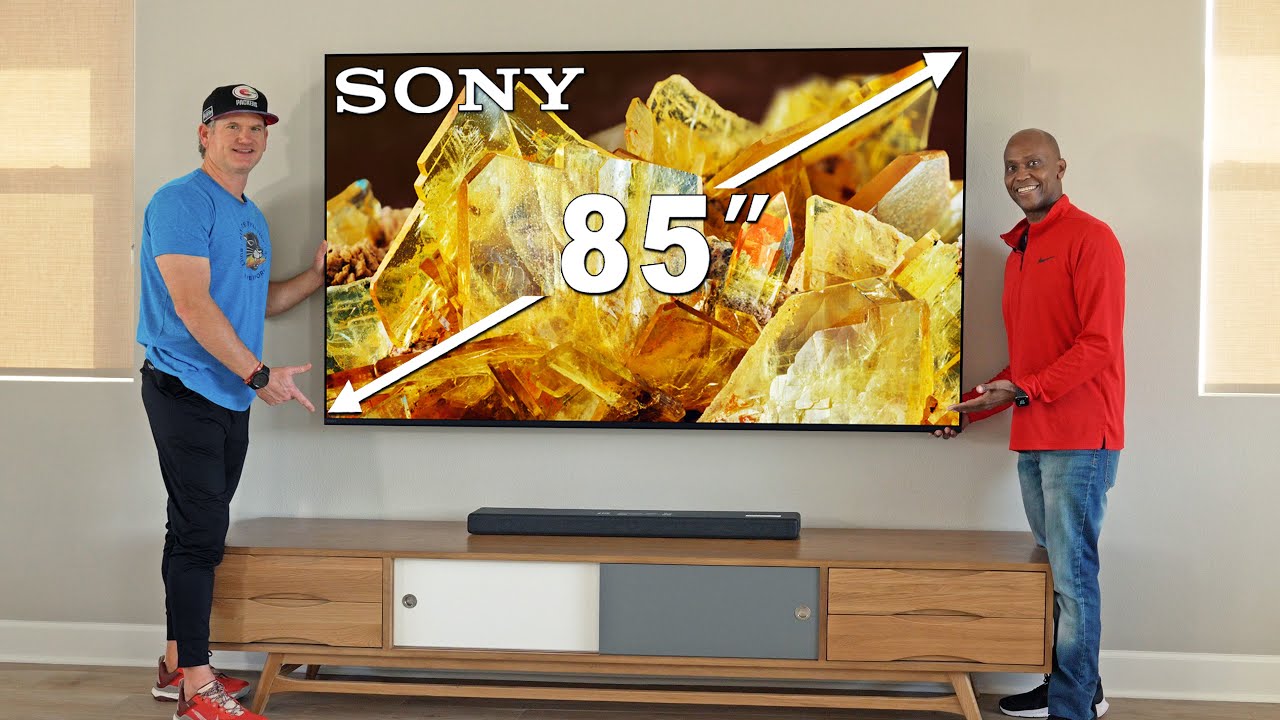

An 85-inch screen can make a living room feel like a private cinema, but it also exposes weak contrast, smeared sports action, and thin built-in sound more clearly than a smaller television. The right choice depends on more than resolution.
The Best 85 TV options here range from straightforward LED models with Fire TV to Mini-LED sets built for bright rooms and fast gaming. We have separated them by what they do best, while keeping the important weaknesses in view.
Our top pick is the Hisense U7, with the TCL QM6K, Hisense E7, and Samsung M80H covering the strongest alternatives for different rooms and priorities.
Comparison table
| # | Product | Award | Panel and lighting | Motion | HDR | Smart platform | Best for |
|---|---|---|---|---|---|---|---|
| 1 | Hisense U7 | Best overall | Hi-QLED Mini-LED | 165Hz, VRR up to 330Hz | HDR10+, Dolby Vision IQ | Google TV | Gaming and bright rooms |
| 2 | TCL QM6K | Best for contrast | QD Mini-LED QLED | 144Hz native | Dolby Vision, HDR10+, HDR10, HLG | Google TV | Movies, sports, and gaming |
| 3 | Hisense E7 | Best cinematic Hisense | Hi-QLED Mini-LED with FALD | 144Hz native | Dolby Vision IQ, HDR10+ Adaptive, HDR10, HLG | Fire TV | Film fans and sports |
| 4 | Samsung M80H | Best Samsung for gaming | Mini-LED | 144Hz, VRR | HDR-like remastering | Samsung smart TV | Samsung gaming setups |
| 5 | TCL T7 | Best 144Hz QLED | QLED | 144Hz | Dolby Vision, HDR10+, HDR10, HLG | Google TV | Console and PC gaming |
| 6 | Hisense E6 | Best Fire TV picture | Hi-QLED | Motion Rate 120 | Dolby Vision, HDR10+ Adaptive, HDR10, HLG | Fire TV | Streaming and mixed viewing |
| 7 | LG NU85 | Best for upscaling | Nano LCD | Not listed | HDR10 Pro | webOS | Broadcast TV and streaming |
| 8 | Samsung U8000H | Best simple Samsung | Crystal UHD LED | Up to 4K 60Hz | Not listed | Samsung smart TV | Everyday TV viewing |
| 9 | Insignia F50 | Best straightforward Fire TV | LED-backlit LCD | Not listed | HDR10 | Fire TV | Basic streaming setups |
1. Hisense U7: Best Overall
Pros
- Native 165Hz refresh rate
- VRR support up to 330Hz
- Anti-reflection treatment for bright rooms
- Dolby Vision IQ and Atmos
- Built-in 2.1.2-channel surround sound
Cons
- Heaviest television in this group
- Its most advanced gaming features need compatible hardware
- The feature set may be excessive for basic streaming
Best for: gamers and movie fans who want strong brightness, motion, and built-in audio in one large screen.
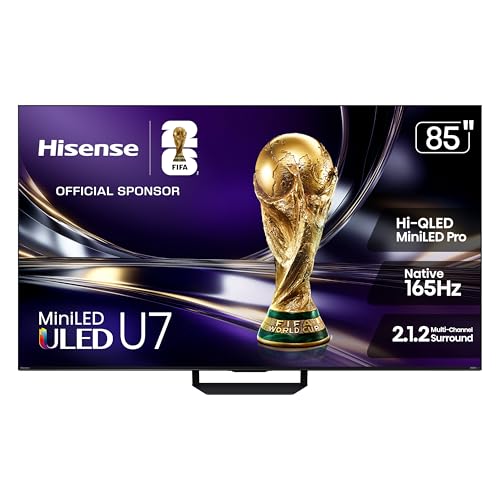
The Hisense U7 is the set that feels least compromised when the room, content, and source all change. Its Mini-LED backlight is paired with Hi-QLED color, and the television claims up to 3, 000 local dimming zones and up to 3, 000 nits of peak brightness. Those figures matter because precise zones can keep a bright highlight from washing out an adjacent dark area, while high brightness helps a large picture remain forceful in a sunlit room.
The screen is especially serious about motion. A native 165Hz refresh rate is useful for high-frame-rate gaming and can also make fast sports easier to follow. Game Booster 330 supports variable refresh rates up to 330Hz, giving compatible gaming hardware more room to reduce tearing and stutter. That is a more ambitious gaming specification than the TCL QM6K, TCL T7, and Samsung M80H, although the benefit depends on the games and connected devices you use.
Hisense also gives this model an anti-reflection and glare-free treatment, a detail that can matter more than another processing feature if the television faces windows or overhead lights. Dolby Vision IQ, HDR10+, and Dolby Atmos cover demanding movie formats, while the 2.1.2-channel multi-channel system tuned by Devialet gives the built-in audio more physical presence than the usual basic TV speakers. It is not a replacement for a carefully assembled surround system, but it makes the television easier to live with before adding one.
The weakness is practical rather than obvious on a feature sheet. At 89.2 pounds, it is the heaviest model here, so installation deserves planning and a suitably strong stand or wall mount. The screen is also a poor fit for someone who only watches occasional cable shows and does not need high refresh gaming, local dimming, or room-filling sound.
For anyone building a serious large-screen setup, the U7 is the most complete package. It is the Best 85 TV for a bright room that also doubles as a gaming and movie space.
2. TCL QM6K: Best for Contrast

Pros
- QD Mini-LED backlight
- Local dimming designed to reduce haloing
- Native 144Hz refresh rate
- Supports major HDR formats
- Dolby Atmos and Onkyo audio
Cons
- No listed built-in anti-reflection feature
- Google TV may feel busy to viewers who prefer a simple interface
- Large chassis still requires careful installation
Best for: viewers who want deep-looking contrast and smooth motion for movies, sports, and games.
The TCL QM6K is the most balanced alternative to the Hisense U7. Its QD Mini-LED system combines Mini-LED precision with quantum-dot color, so the picture is designed to be both bright and saturated rather than merely large. The more important feature is TCL’s Halo Control System, which uses advanced local dimming to target deeper blacks, preserve shadow detail, and limit halos around bright objects.
That contrast approach suits films especially well. Dark scenes have more room to show separation between a black coat, a dim room, and a night sky, while HDR highlights can remain pronounced. The QM6K supports Dolby Vision, HDR10+, HDR10, and HLG, giving it broad compatibility with current movie, streaming, and broadcast content. It is a more complete HDR specification than the Insignia F50 or Samsung U8000H provide.
Motion is another strong point. The native 144Hz refresh rate is suited to fast sports and gaming, while TCL also lists Motion Rate 480. The native figure is the one that matters most when comparing panels, and it places the QM6K alongside the TCL T7 and Hisense E7 rather than conventional 60Hz models. The television also includes Dolby Atmos and Onkyo audio, which should give dialogue and effects a fuller starting point than a very basic speaker system.
The QM6K gives up a few advantages to the U7. Hisense lists anti-reflection treatment and a much higher gaming VRR ceiling on the U7, while TCL does not list an equivalent glare-control feature here. The QM6K is therefore less obvious for a room with direct afternoon sun, though its high-brightness design still makes it a strong general-purpose option.
Choose the QM6K when movie contrast, HDR flexibility, and smooth sports matter more than the most extreme gaming numbers. It is also a sensible pick for a household that wants one screen to handle nearly everything without leaning too heavily toward a single use.
3. Hisense E7: Best Cinematic Hisense

Pros
- Mini-LED backlight with full array local dimming
- Native 144Hz refresh rate
- Dolby Vision IQ and Dolby Atmos
- AI picture and sports modes
- Fire TV voice control
Cons
- Fire TV interface is not for everyone
- No listed anti-reflection layer
- Built-in audio details are less extensive than the U7
Best for: movie and sports viewers who want Mini-LED contrast with a Fire TV interface.
The Hisense E7 takes the core idea of the E6 and makes it substantially more ambitious. Its Hi-QLED Mini-LED backlight uses thousands of small LEDs and full array local dimming to create stronger separation between highlights and shadows. That gives the E7 a clearer reason to exist than simply offering another 85-inch 4K screen.
Its native 144Hz panel is useful beyond gaming. Fast camera pans in sports and action films should look more controlled, and compatible games can take advantage of the faster refresh rate. AI Smooth Motion with MEMC adds another layer of motion processing, though viewers who prefer the original cinematic cadence may want to use Filmmaker Mode instead of leaving every enhancement active.
HDR support is broad. Dolby Vision IQ, HDR10+ Adaptive, HDR10, and HLG let the E7 respond to different sources, while Dolby Vision IQ can use scene and room information to adjust the presentation. The AI Light Sensor changes backlight behavior according to ambient light, which is convenient when the room shifts from bright daytime viewing to a darker evening session. Hisense also includes an AI Sports Mode that recognizes sports content and adjusts picture and sound for it.
Compared with the TCL QM6K, the E7 offers a similarly fast panel and a strong HDR feature set, but it uses Fire TV rather than Google TV. That makes it a better fit for households already comfortable with Alexa and the Fire TV layout. The Hisense U7 remains the stronger pick for extreme brightness, glare control, and advanced gaming, while the E7 is easier to justify for film and sports viewers who do not need the U7’s full gaming ceiling.
The drawback is that several of its automatic picture tools can make the image feel processed if used indiscriminately. Purists should expect to adjust modes rather than accept every AI setting at its default. The E7 is a compelling middle ground for a cinematic living room, especially when Fire TV is already part of the household.
4. Samsung M80H: Best Samsung for Gaming

Pros
- Mini-LED backlighting
- 144Hz motion performance
- Variable refresh rate support
- AI picture processing
- One billion color claim through Pure Color Spectrum
Cons
- HDR format support is not fully detailed
- No Dolby Vision feature is listed
- Samsung interface may require adjustment for non-Samsung users
Best for: Samsung fans who want Mini-LED lighting and fast gaming performance.
The Samsung M80H is the Samsung entry to take seriously if gaming and backlight control matter. Mini-LED technology gives it a more precise lighting foundation than the U8000H, and Samsung’s AI Mode is designed to analyze scenes and adjust clarity, color, and contrast. That combination should make the larger panel feel more dynamic than a basic LED set.
Motion Xcelerator 144Hz and variable refresh rate support put the M80H in the same broad gaming class as the TCL QM6K and TCL T7. The advantage is not just a smoother number on a specification sheet. Variable refresh rate can synchronize the display with changing game frame rates, which helps avoid visible tearing and uneven motion when a console or PC cannot hold one steady output.
Samsung’s Pure Color Spectrum claims one billion colors, while the NQ4 AI Gen2 processor handles real-time picture enhancement and upscaling. Auto HDR Remastering is aimed at standard dynamic range material, making it look closer to HDR through brighter highlights and more vivid color. That can be useful when a household watches a wide mix of older shows, broadcast content, and modern games rather than only carefully mastered 4K streams.
The important limitation is format clarity. The supplied information does not list Dolby Vision, HDR10+, or a full HDR compatibility set, so viewers who collect Dolby Vision films may prefer the TCL QM6K or Hisense E7. The M80H also does not offer the U7’s listed 165Hz native rate or its up-to-330Hz VRR gaming mode.
This is the Samsung to choose when brand consistency, Mini-LED, and 144Hz gaming are the priorities. It is less compelling for someone choosing purely by movie-format support, but it has a coherent feature set for a Samsung-centered entertainment room.
5. TCL T7: Best 144Hz QLED

Pros
- Native 144Hz panel
- QLED color technology
- Four HDMI inputs
- One HDMI input supports eARC
- Broad HDR format support
Cons
- Standard QLED backlight rather than Mini-LED
- Wi-Fi 5 rather than the newer Wi-Fi 6 listed on some rivals
- No listed local dimming system
Best for: gamers who want a fast QLED panel and flexible connections.
The TCL T7 is the straightforward performance pick in TCL’s lineup. It uses QLED technology to produce rich color across nearly the entire DCI-P3 color space, and the native 144Hz refresh rate makes its purpose clear. Fast games, live sports, and action-heavy films are the content this television is built to handle.
TCL’s AIPQ Pro processor works on color, contrast, and clarity for 4K HDR content. HDR Pro+ supports Dolby Vision, HDR10+, HDR10, and HLG, so the T7 is ready for a wide spread of streaming and disc formats. Dolby Atmos processing adds spatial effects to supported content, though shoppers who want the most substantial built-in audio should look at the Hisense U7’s listed 2.1.2-channel system or the QM6K’s Onkyo audio.
Connections are a real strength. Four HDMI inputs make it easier to keep multiple consoles, a receiver, and a streaming device connected, and one input includes eARC for sending higher-quality audio to a compatible soundbar or receiver. The width-adjustable feet are also useful for furniture with limited spacing or for positioning a soundbar beneath the display.
The trade-off against the TCL QM6K is the backlight. The T7 is QLED, while the QM6K adds Mini-LED and local dimming designed to improve black levels and reduce haloing. The T7 can still be the better match for someone who mainly wants a fast gaming panel and extra HDMI flexibility, but the QM6K is the more convincing movie screen.
Choose the T7 for a gaming-first setup that needs four HDMI inputs and broad HDR support. It avoids unnecessary complexity while still giving fast content the panel speed it needs.
6. Hisense E6: Best Fire TV Picture

Pros
- Hi-QLED color
- Dolby Vision and Dolby Atmos
- HDR10+ Adaptive support
- AI light sensor
- Wi-Fi 6 connectivity
Cons
- Not a Mini-LED model
- Motion specification is less advanced than the E7
- No local dimming feature is listed
Best for: Fire TV households that want broad HDR support and automatic picture adjustments.
The Hisense E6 is a practical step down from the E7, but it keeps several features that make it appealing for general streaming. Hi-QLED color is intended to add richer, more vivid tones, and the television supports Dolby Vision, HDR10+ Adaptive, HDR10, and HLG. That is a strong format list for a set without Mini-LED lighting.
Its AI Light Sensor is one of the more useful everyday features. It detects ambient light and adjusts brightness so the screen does not remain unnecessarily bright in a dark room or look flat during the day. AI 4K Upscaler also works on lower-resolution broadcasts, older films, and home videos, sharpening edges and textures toward a 4K presentation.
Motion Rate 120 and AI Smooth Motion with MEMC target sports and action scenes. That is enough to make fast content a focus, but it does not match the native 144Hz E7, 144Hz TCL models, or the 165Hz Hisense U7. The distinction matters most to gamers and sports obsessives. For ordinary shows and films, the E6’s broader HDR support and light-sensing behavior are more relevant.
Fire TV keeps live channels and apps together on the home screen, and Alexa voice control can search for content or handle compatible smart-home commands. Wi-Fi 6 is also listed, which can help a busy home with several connected devices. Still, there is no listed local dimming system, so the E6 cannot produce the same targeted dark-scene contrast as the E7 or Mini-LED alternatives.
Skip the E6 if your priority is high-refresh gaming or the strongest black-level control. It makes more sense for a Fire TV user who wants a large, colorful screen with convenient automatic adjustments and wide HDR compatibility.
7. LG NU85: Best for Upscaling

Pros
- Alpha 7 AI Processor 4K Gen9
- AI Super Upscaling
- Filmmaker Mode
- FreeSync Premium and ALLM
- webOS with LG Channels
Cons
- HDR support listed only as HDR10 Pro
- Refresh rate is not provided
- No Mini-LED backlight is listed
Best for: viewers who watch a mix of broadcast, streaming, and lower-resolution content.
The LG NU85 takes a different route from the Mini-LED models. Its appeal is processing, particularly for households that still watch cable channels, older movies, or varied streaming sources rather than a constant diet of high-quality 4K material. LG’s Alpha 7 AI Processor 4K Gen9 analyzes scenes, refines textures, sharpens edges, and adjusts contrast.
AI Super Upscaling is the feature to focus on. Upscaling cannot create original detail that was never captured, but good processing can make lower-resolution material look cleaner and less obviously soft on an 85-inch screen. That matters more at this size because flaws in a source become easier to see. The NU85 is a better fit for mixed content than a television chosen only for peak HDR brightness.
Filmmaker Mode preserves the source’s intended colors, settings, and frame rates, giving film fans a way to avoid excessive processing. HDR10 Pro adjusts brightness dynamically to reveal more detail across bright and dark scenes. The supplied specifications do not list Dolby Vision or HDR10+, so the Hisense E7, Hisense E6, or TCL QM6K are stronger choices for viewers with a broad HDR collection.
LG includes FreeSync Premium and ALLM for gaming, along with a Game Dashboard and Game Optimizer. Those features can make console or cloud gaming easier to manage, but the refresh rate is not listed, so this is not the set to buy on the assumption that it matches the 144Hz or 165Hz models. The webOS platform, LG Channels, and compatibility with Alexa round out a familiar smart TV experience.
The NU85 is not the most aggressive gaming or HDR choice here. Its strength is making a varied library easier to watch while keeping a filmmaker-friendly mode available. Choose it when the quality of your sources changes from one input to the next.
8. Samsung U8000H: Best Simple Samsung
Pros
- Crystal Processor for color and detail enhancement
- 4K upscaling
- Motion handling up to 4K 60Hz
- Samsung TV Plus access
- Straightforward Samsung smart TV platform
Cons
- No Mini-LED backlight
- No listed Dolby Vision or HDR10+ support
- Less suitable for high-refresh gaming
Best for: Samsung users who want a large everyday television without gaming-focused specifications.
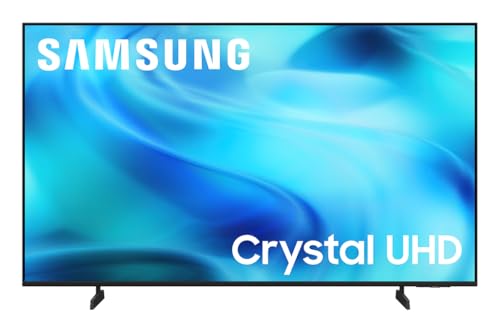
The Samsung U8000H is the least complicated Samsung option in this group. Its Crystal Processor is designed to enhance color, sharpen detail, and upscale lower-quality material to 4K. That makes it an approachable choice for broadcast TV, familiar streaming services, and general viewing rather than a screen built around enthusiast gaming.
Motion Xcelerator supports up to 4K 60Hz performance. Sports and ordinary shows should benefit from Samsung’s motion processing, but this is not a competitor to the 144Hz TCL T7 or the 165Hz Hisense U7. Gamers with current hardware should look higher in the list if refresh rate and variable refresh rate are central to the purchase.
Samsung TV Plus adds more than 2, 700 free streaming options, including over 750 subscription-free channels according to the supplied features. That gives the U8000H an easy source of live and on-demand material without relying entirely on paid services. Its 4K upscaling is also useful when much of the household’s viewing is not native 4K.
The limitation is the conventional LED platform. The U8000H does not list Mini-LED lighting, Dolby Vision, or HDR10+, so it will not deliver the same contrast control or format range as the Samsung M80H, TCL QM6K, or Hisense E7. Its 63.8-pound listed weight is relatively manageable for an 85-inch television, but installation still calls for two people and a suitable support surface.
Buy the U8000H when you want a large Samsung screen for ordinary TV use and do not need high-refresh gaming. It is a calm, familiar option, but the more advanced models here make a stronger case for movie enthusiasts.
9. Insignia F50: Best Straightforward Fire TV

Pros
- 4K Ultra HD resolution
- HDR10 support
- Fire TV apps and live content
- Three HDMI ports
- HDMI ARC and eARC support
Cons
- No QLED or Mini-LED backlight
- Motion rate is not listed
- Basic two-speaker audio design
Best for: viewers who want a large 4K Fire TV with useful home theater connections.
The Insignia F50 keeps the brief simple: a large LED-backlit LCD screen, 4K resolution, HDR10, and Fire TV built in. It is not trying to compete with the local dimming precision of the TCL QM6K or the gaming hardware support of the Hisense U7. Its appeal is that the core television experience is easy to understand and easy to connect.
Fire TV brings services such as Prime Video, Netflix, Disney+, Hulu, and HBO Max into one interface, while free ad-supported options include Fire TV Channels, Pluto TV, and Tubi. Amazon Alexa voice control is included through the remote, and the television can also act as a smart-home hub for compatible devices, including live camera feeds and lighting controls.
The connection selection is better than its uncomplicated picture system might suggest. There are three HDMI ports, composite AV inputs, digital optical output, USB, a headphone jack, coaxial, Ethernet, and Wi-Fi. HDMI ARC and eARC can send audio to a compatible soundbar or receiver, which is useful because the built-in DTS Studio Sound enhancement and two-speaker setup are unlikely to satisfy viewers seeking a cinema-like audio field.
The main weakness is the absence of more advanced panel features. The supplied information does not list a high refresh rate, local dimming, QLED color, or Mini-LED lighting. The result should suit casual streaming and ordinary TV, but fast gaming, HDR films, and dark-room viewing favor nearly every higher-ranked model here.
Choose the F50 when Fire TV access and broad physical connectivity matter more than peak picture refinement. It is the most straightforward route to an 85-inch smart screen, but not the one to pick for demanding movie or gaming performance.

How to choose best 85 tv
An 85-inch television magnifies both strengths and weaknesses, so start with the picture conditions and content you actually watch rather than the biggest feature number.
Backlight and contrast
Mini-LED and local dimming can control separate areas of the screen more precisely than a conventional LED-backlit LCD. That helps a bright subtitle, lamp, or star stand out against a dark scene without lifting the entire picture.
The Hisense U7, TCL QM6K, Hisense E7, and Samsung M80H use Mini-LED approaches. The Insignia F50 and Samsung U8000H use simpler LED or Crystal UHD designs. If films are a priority, local dimming is one of the most meaningful differences in this group.
On an 85-inch screen, better black-level control usually matters more than another layer of picture processing.
Brightness and room reflections
A bright room can flatten contrast and make dark scenes look gray. High peak brightness helps HDR highlights stay visible, while anti-reflection treatment can reduce distracting window and lamp reflections.
The Hisense U7 specifically lists anti-reflection and glare-free treatment, along with up to 3, 000 nits of peak brightness. That makes it the clearest fit for a room with difficult daylight. A television without listed glare control may still work well, but placement becomes more important.
If the screen will face a large window, how far back you should sit from a panel this size is only part of the setup question. The angle of the light and the position of the sofa can determine whether reflections remain visible during daytime viewing.
Refresh rate and variable refresh rate
A higher native refresh rate can make fast sports, camera pans, and games look smoother. The TCL QM6K, TCL T7, and Hisense E7 list native 144Hz panels, while the Samsung M80H lists 144Hz performance and VRR. The Hisense U7 goes further with a native 165Hz rate and Game Booster support up to 330Hz VRR.
Do not treat motion-branded numbers as equivalent to native refresh rate. The Insignia F50 does not list a refresh rate, the Samsung U8000H lists up to 4K 60Hz, and the LG NU85 does not provide a refresh figure in the supplied information. Those sets are less suitable for buyers who want high-frame-rate gaming.
HDR formats
HDR can add brighter highlights and richer shadow detail, but the television and source must support the same format. Dolby Vision, HDR10+, HDR10, and HLG appear in different combinations across this list.
The TCL QM6K and TCL T7 have broad format support. The Hisense E6 and E7 also cover several HDR standards, including Dolby Vision and HDR10+ variants. The Samsung U8000H and Insignia F50 have more limited HDR details listed, while the LG NU85 specifies HDR10 Pro.
Smart platform and connections
Fire TV, Google TV, webOS, and Samsung’s smart TV platform organize apps and live content differently. Choose the interface that matches your household’s preferred voice assistant, streaming habits, and existing devices.
Connections matter just as much when an 85-inch display becomes the center of a home theater. The TCL T7 lists four HDMI inputs and eARC. The Insignia F50 lists three HDMI ports, eARC, optical output, USB, Ethernet, and a headphone jack. Count your consoles, receiver, streaming boxes, and soundbar before choosing.
For smaller rooms or seating distances, the screen sizes that still work in tight spaces can provide a more comfortable viewing angle. An 85-inch model needs enough wall or furniture width and a clear path for installation.

Frequently asked questions
Is an 85-inch TV too large for a living room?
It depends on seating distance, room layout, and how much of your view the screen occupies. A large room with seating positioned too close can make lower-quality sources look rough, while a room with a long viewing distance may benefit from the extra scale.
Which of these TVs is best for gaming?
The Hisense U7 is the strongest gaming pick because it lists a native 165Hz refresh rate and VRR support up to 330Hz. The TCL QM6K, TCL T7, Hisense E7, and Samsung M80H are also aimed at fast gaming, with refresh rates of 144Hz listed for each model.
Which model is best for movies?
The TCL QM6K, Hisense E7, Hisense U7, and Samsung M80H are the strongest movie choices because they use Mini-LED backlighting. The QM6K has a particularly broad HDR format list and a local dimming system designed to improve dark-scene contrast.
Do all of these televisions support Dolby Vision?
No. Dolby Vision is listed for the Hisense E6, Hisense E7, TCL QM6K, and TCL T7. The supplied features for the Samsung U8000H, Samsung M80H, LG NU85, and Insignia F50 do not list Dolby Vision.
Is a soundbar necessary with an 85-inch TV?
It is not mandatory, but a soundbar can make dialogue, bass, and surround effects more convincing. The Hisense U7 lists a 2.1.2-channel system, and the TCL QM6K includes Onkyo audio, while the Insignia F50 uses a two-speaker system with DTS Studio Sound enhancement.
Which TV is easiest for streaming?
The answer depends on the interface you already use. The Insignia F50, Hisense E6, and Hisense E7 use Fire TV, the TCL models use Google TV, the LG NU85 uses webOS, and the Samsung models use Samsung’s smart TV platform.
Do I need an HDMI eARC port?
You need eARC when you want to send higher-quality audio formats from the television to a compatible soundbar or AV receiver through HDMI. The Insignia F50 lists HDMI ARC and eARC, and the TCL T7 lists four HDMI inputs with one supporting eARC.
The bottom line
The Best 85 TV for most demanding buyers is the Hisense U7. Its Mini-LED picture, anti-reflection treatment, native 165Hz panel, high VRR ceiling, Dolby Vision IQ, and built-in 2.1.2-channel audio give it the broadest set of serious capabilities.
The TCL QM6K is the better alternative for viewers who put movie contrast and broad HDR support ahead of the U7’s extreme gaming features. The Hisense E7 is another strong choice for Fire TV users who want Mini-LED, a native 144Hz panel, and a cinematic feature set without moving to the U7.
If you are undecided, choose the U7 for gaming or bright-room viewing, and choose the QM6K for a movie-first living room.
As an Amazon Associate we earn from qualifying purchases.