
The Radeon RX 9070 XT is a powerful GPU, but the card you choose can make a major difference to your build. Cooler design, physical size, display outputs, BIOS modes, and power requirements all matter once the specification sheet stops looking identical.
Our Best best 9070 xt card picks cover eight board designs from Gigabyte, ASRock, ASUS, Sapphire, and XFX. Some emphasize quieter operation, some prioritize a compact fit, and others bring stronger structural support or a higher factory boost clock.
For most builders, the Gigabyte Gaming OC is the best all-round pick, while the other seven cover smaller cases, white builds, extra display flexibility, and more specialized cooling designs.
Comparison table
| # | Product | Award | Memory | Cooling and design | Best for |
|---|---|---|---|---|---|
| 1 | Gigabyte Gaming OC | Best overall | 16GB GDDR6 | WINDFORCE, Hawk Fan, thermal gel | Most high-end gaming PCs |
| 2 | Gigabyte Gaming OC ICE | Best white build | 16GB GDDR6, 256-bit | WINDFORCE, alternate-spinning fans, dual BIOS | White or showcase builds |
| 3 | ASRock Challenger OC | Best compact design | 16GB GDDR6, 256-bit | Triple fan, 0dB silent cooling | Smaller gaming systems |
| 4 | ASUS Prime OC | Best 2.5-slot option | 16GB GDDR6 | Axial-tech fans, dual BIOS, 0dB mode | Builds with tighter expansion space |
| 5 | Sapphire Nitro+ | Best premium cooling | 16GB GDDR6, 256-bit | Nitro+ gaming design | Large, performance-focused cases |
| 6 | Sapphire Pulse | Best straightforward design | 16GB GDDR6, 256-bit | Pulse cooling design | Clean, uncomplicated builds |
| 7 | ASRock Steel Legend | Best reinforced build | 16GB GDDR6, 256-bit | Triple fan, reinforced metal frame | Long-term structural support |
| 8 | XFX Swift Triple Fan | Best triple-fan alternative | 16GB GDDR6 | SWFT triple-fan cooler | Straightforward high-airflow builds |
1. Gigabyte Gaming OC: Best Overall

Pros
- WINDFORCE cooling system with Hawk Fan
- Server-grade thermal conductive gel
- RGB lighting with customizable effects
- Familiar 16GB RX 9070 XT configuration
Cons
- Larger than the ASRock Challenger OC
- The listed dimensions may challenge compact cases
- No stated display output breakdown in the supplied listing
Best for: someone building a full-size gaming PC who wants a balanced RX 9070 XT design.
The Gigabyte Gaming OC is the card we'd start with when the case has room and there is no need to chase a specialist feature. Its appeal is not one dramatic trick. It is the combination of a recognizable RX 9070 XT platform, a substantial WINDFORCE cooling system, Hawk Fan technology, and server-grade thermal conductive gel. That gives it a sensible role as the default choice for a roomy gaming build.
The memory configuration is 16GB of GDDR6, which gives modern games room for detailed textures and leaves useful headroom for demanding resolutions. The card supports PCIe 5.0, so it fits naturally into a current-generation platform. That interface does not make an older motherboard unusable, but it does make the card a logical match for a new system designed around current expansion standards.
Physical planning matters here. The card is listed at 11.34 inches long, 5.2 inches wide, and 2.2 inches high, with a listed weight of about 3.92 pounds. Those measurements make it a serious piece of hardware rather than a casual drop-in upgrade. Check front radiator clearance, adjacent slot access, and support for the card before installation.
Gigabyte includes RGB lighting with 16.7 million customizable color options and multiple effects through Gigabyte Control Center. That is useful for a coordinated windowed case, though it will not matter to a closed system. The lack of a supplied output breakdown makes it less immediately informative for a multi-monitor buyer than the ASRock Challenger OC or Sapphire cards.
Compared with the Gaming OC ICE, this black model is the more visually neutral choice, while the ICE adds a white finish, a reinforced structure, and dual BIOS modes. The ASUS Prime OC is easier to place in a tighter expansion area, but its 12.3-inch length is greater. For a conventional mid-tower or full-tower system, the Gigabyte Gaming OC has the cleanest balance of cooling features, lighting, and familiar dimensions.
It should be skipped by anyone working with strict clearance limits or trying to minimize card weight. For everyone else, it is the safest starting point in this group. Readers comparing AMD options more broadly can also see how different graphics card designs affect a complete gaming build before choosing a board partner.
2. Gigabyte Gaming OC ICE: Best White Build

Pros
- White design for coordinated showcase systems
- Performance and Silent dual BIOS modes
- Reinforced metal backplate
- Alternate-spinning Hawk Fan cooling
- RGB lighting with extensive customization
Cons
- 2.7-slot design needs careful expansion-space planning
- Large footprint for compact cases
- White finish may not suit understated builds
Best for: someone creating a white PC who wants cooling controls and a reinforced card structure.
The Gigabyte Gaming OC ICE earns its place because it looks and behaves differently from the standard Gaming OC. The white finish is the obvious visual distinction, but the more useful upgrade for many builders is the dual BIOS arrangement. The default Performance mode favors the card's full operating profile, while Silent mode is intended for a quieter experience.
This model uses 16GB of GDDR6 memory on a 256-bit interface and supports PCIe 5.0. Those are the central traits to look for in an RX 9070 XT intended for high-resolution gaming. The supplied feature set also calls out HDMI and DisplayPort 2.1 support, giving it a modern connection set for current high-refresh displays.
Gigabyte's WINDFORCE system combines server-grade thermal conductive gel, alternate-spinning Hawk fans, composite copper heat pipes, a copper plate, 3D active fans, and screen cooling. Each part addresses a different part of the thermal problem. The fans move air, the heat pipes and copper plate spread heat, and the active airflow design helps keep more of the cooler involved under load.
The physical footprint is identical in length and width to the black Gigabyte card at 11.34 by 5.2 inches, while its listed height is 2.2 inches. The card is described as a 2.7-slot design, so the slot count deserves more attention than the height figure alone. Its listed weight is about 2.78 pounds, lighter than the standard Gaming OC in the supplied product information.
The reinforced metal backplate, bent edge, and connection to the I/O bracket give the board a sturdier presentation. RGB lighting can be set to one of 16.7 million colors and synchronized with other devices through Gigabyte Control Center. The downside is that the white finish becomes a poor match for a dark, non-windowed case, and the large cooler still needs room.
Compared with the standard Gigabyte Gaming OC, the ICE is the better choice when the case theme and BIOS flexibility matter. The ASUS Prime OC is narrower at 2.5 slots, while the ASRock Steel Legend offers its own reinforced metal frame. Choose the ICE when you want a visibly coordinated white build and do not want to give up a Silent BIOS mode.
3. ASRock Challenger OC: Best Compact Design

Pros
- 11.42-inch listed length
- Triple-fan cooling with 0dB silent mode
- 2970 MHz listed boost clock
- Three DisplayPort 2.1a outputs
- HDMI 2.1b connectivity
Cons
- The listing includes an unusual height measurement
- 800W power requirement is stated in the product title
- No lighting or dual BIOS feature is listed
Best for: someone who wants a shorter RX 9070 XT with modern display connectivity.
The ASRock Challenger OC is the most practical choice in this lineup for builders who are watching case length. Its listed length is 11.42 inches and its width is about 4.84 inches, making it shorter and narrower than several of the heavier designs here. That does not make it a small card in the general sense, but it gives compact and mid-size cases a better chance of accommodating it.
ASRock specifies a 2970 MHz boost clock, 16GB of GDDR6 memory on a 256-bit bus, and PCIe 5.0 support. The card also uses AMD's RDNA 4 architecture, with 64 compute units, third-generation ray tracing, and second-generation AI accelerators listed among its features. Those details matter most to buyers planning demanding games or workloads that use ray tracing and AI-assisted functions.
The triple-fan cooler uses Striped Axial Fan technology and a 0dB silent cooling mode. A zero-decibel mode is useful during light desktop work because the fans can remain inactive rather than constantly producing a low mechanical hum. Under sustained loads the fans will need to operate, so this is a noise feature for idle and light use, not a promise of silent high-end gaming.
Connectivity is a strong point. The Challenger has three DisplayPort 2.1a outputs and one HDMI 2.1b output, a particularly clear arrangement for a multi-display setup. It also gives a buyer more flexibility when mixing a high-refresh gaming display with secondary screens. That is more explicit than the supplied information for the standard Gigabyte Gaming OC.
The compromise is that the product title calls for an 800W power supply, so this is not a card to pair casually with an undersized system. The listed weight is about 2.29 pounds, lighter than the ASUS Prime OC and much lighter than some of the larger Sapphire entries. The supplied product information reports an unusual height figure, so rely on the case manufacturer's clearance guidance and verify the card's physical fit before ordering.
The Challenger OC is a better fit than the Gigabyte models when front-to-back room is the main concern. The ASUS Prime OC has a slimmer 2.5-slot design, but it is longer at 12.3 inches. Choose the Challenger when the three DisplayPort outputs and shorter listed length are more useful than RGB lighting or a second BIOS profile. For a wider look at Radeon-specific alternatives, the differences between Radeon board designs and cooler layouts are worth understanding before you commit.
4. ASUS Prime OC: Best 2.5-Slot Option

Pros
- 2.5-slot design for improved build compatibility
- Axial-tech fans with a barrier ring
- Dual-ball fan bearings
- 0dB mode for light gaming
- Dual BIOS support
Cons
- 12.3-inch listed length requires front clearance
- Heavier than the ASRock Challenger OC
- No detailed output count is supplied
Best for: someone balancing a substantial cooler with limited vertical expansion space.
The ASUS Prime OC makes a persuasive case for builders who care more about slot thickness than absolute card length. Its 2.5-slot design leaves more room around neighboring expansion cards than the 2.7-slot Gigabyte ICE or the 2.9-slot ASRock Steel Legend. That distinction is easy to overlook when shopping, but it can determine whether a second expansion card remains usable.
ASUS uses Axial-tech fans with a smaller hub, longer blades, and a barrier ring designed to increase downward air pressure. The card also uses a phase-change GPU thermal pad for heat transfer. These are meaningful cooler details because they focus on moving heat away from the GPU and pushing airflow through the heatsink rather than simply adding another fan.
The dual-ball fan bearings are specified to last up to twice as long as conventional sleeve-bearing designs. The card also includes 0dB technology, allowing light gaming to run in relative silence when the thermal load is low. Dual BIOS support adds another layer of control, although the supplied information does not spell out the behavior of each BIOS profile.
The key fit trade-off is obvious in the measurements. The card is listed at 12.3 inches long, 5.1 inches wide, and 2 inches high, with a weight of about 3.31 pounds. It is not short, but its 2.5-slot profile is friendlier to builds where the lower expansion slots are valuable. Measure the space in front of the motherboard, especially if the case has a front radiator or drive cage.
The ASUS is less visually expressive than the RGB-equipped Gigabyte models, and the supplied listing does not provide a detailed output count. It does, however, include HDMI and DisplayPort 2.1 support, making it a current display partner for high-resolution and high-refresh panels. Buyers who need three DisplayPort connections have a clearer match in the ASRock Challenger OC.
Compared with the Gigabyte Gaming OC, the ASUS Prime OC sacrifices some listed compactness in length to gain a slimmer slot design and a more explicit bearing and fan package. The ASRock Challenger OC is lighter and shorter, but the ASUS brings dual BIOS and a more detailed mechanical design. Skip it if your case is short front to back. Pick it when adjacent slot access matters most.
5. Sapphire Nitro+: Best Premium Cooling

Pros
- 16GB of GDDR6 memory
- 256-bit memory interface
- Two HDMI and two DisplayPort outputs
- Nitro+ gaming design
- Strong fit for large performance-focused systems
Cons
- Longest listed card in the roundup
- Heaviest listed card in the supplied data
- Few cooling details are provided in the listing
Best for: someone with a spacious case who wants a substantial Sapphire Nitro+ design.
The Sapphire Nitro+ is the card for buyers who have the case space and want a more imposing, premium-oriented board design. The Nitro+ name distinguishes it from Sapphire's Pulse model, and the supplied listing positions it as a gaming OC card built around AMD RDNA 4. The main appeal is the combination of a large physical design and a clear output arrangement.
Its 16GB of GDDR6 memory uses a 256-bit interface. That gives the card a wide memory path for handling high-resolution textures and demanding gaming workloads. Sapphire also lists two HDMI outputs and two DisplayPort outputs, a useful 2-and-2 split for buyers who use several screens or need flexibility between television and monitor connections.
The dimensions deserve serious attention. The supplied product information lists the card at 13.02 inches long and 5.06 inches wide, with a listed weight of about 5.73 pounds. That is the largest and heaviest entry in this group by the supplied measurements. A card of this size needs clearance in front of the motherboard and sensible support underneath or near the far end.
The weakness is not a missing core capability, but missing detail. The listing provides fewer cooler specifics than the Gigabyte, ASUS, and ASRock models. It does not state a slot count, fan arrangement, BIOS mode, or noise mode in the supplied features. That makes it harder to predict how the card will interact with a particular case, even though the Nitro+ branding clearly targets a serious gaming build.
The Sapphire Nitro+ is a different proposition from the Sapphire Pulse. The Pulse is shorter and lighter in the supplied information, while the Nitro+ is the larger, more premium-looking choice. The ASRock Steel Legend provides more explicit information about its 2.9-slot frame and power requirements, and the ASUS Prime OC is easier to place around other expansion cards.
Choose the Nitro+ only after measuring the case carefully. It is a poor match for compact systems, vertical mounting arrangements with limited clearance, or builds where card weight is a concern. For a roomy chassis with a multi-display setup, it offers a clear memory and output configuration that makes sense for an enthusiast system. Those weighing AMD against other GPU families can also compare how memory capacity and display connections shape a GPU choice before deciding.
6. Sapphire Pulse: Best Straightforward Design

Pros
- 16GB of GDDR6 memory
- 256-bit memory interface
- Two HDMI and two DisplayPort outputs
- Shorter and lighter than the Sapphire Nitro+
- Simple choice within Sapphire's lineup
Cons
- The listing gives limited cooling information
- No stated BIOS or noise mode
- Still needs substantial case clearance
Best for: someone who wants Sapphire's simpler Pulse design with a clear four-output layout.
The Sapphire Pulse is the uncomplicated option in Sapphire's RX 9070 XT range. It has the same fundamental 16GB GDDR6 memory capacity and 256-bit interface as the Nitro+, but the supplied dimensions make it a more manageable card. It is still a full-size high-performance GPU, yet it avoids some of the physical excess associated with its larger sibling.
Sapphire lists two HDMI outputs and two DisplayPort outputs. That balanced arrangement is easy to live with because it does not force a buyer toward one display connector type. It is especially handy for a desk with a pair of monitors, or for a PC that sometimes feeds a television while also driving a desktop display.
The card is listed at 12.6 inches long and 4.73 inches wide, with a weight of about 4 pounds. Those numbers are meaningfully less demanding than the Nitro+'s listed 13.02-inch length and approximately 5.73-pound weight. They do not remove the need to check clearance, but they make the Pulse a more realistic candidate for a wider range of standard cases.
The supplied feature list is sparse. It confirms the memory and output configuration, but does not specify a fan count, BIOS switch, 0dB mode, boost clock, or slot thickness. That lack of information is the Pulse's main weakness in a comparison where other cards explain their cooler hardware in detail. Buyers who want a clearly documented cooling system should look at the ASUS Prime OC, Gigabyte Gaming OC, or ASRock Challenger OC.
The Pulse is easier to separate from the Nitro+ by thinking about installation rather than raw identity. The Nitro+ is larger and heavier, with a stronger enthusiast presentation. The Pulse is the more sensible fit for a buyer who wants Sapphire's card family without immediately committing to the biggest chassis footprint. The XFX Swift Triple Fan is also a reasonable alternative, but its listed 12.99-inch length is greater.
Skip the Pulse if you want lighting, a stated dual BIOS, or detailed acoustic behavior. Choose it when two HDMI and two DisplayPort outputs matter and the case can accommodate a 12.6-inch card. It is a clean, no-nonsense pick for a gaming system whose owner would rather spend time checking fit than sorting through elaborate feature claims.
7. ASRock Steel Legend: Best Reinforced Build

Pros
- Reinforced metal frame
- 2970 MHz listed boost clock
- 16GB GDDR6 on a 256-bit bus
- Triple-fan cooling
- Polychrome SYNC lighting support
Cons
- 2.9-slot design takes considerable expansion space
- Requires two 8-pin PCIe power connectors
- Recommended 800W power supply
Best for: someone who wants a sturdy, feature-rich card for a spacious desktop chassis.
The ASRock Steel Legend is built around the idea that a large graphics card should be supported as well as cooled. Its reinforced metal frame is the defining feature, and the product information specifically calls out a 2.9-slot design. That makes it one of the least suitable cards here for a tight case, but it gives the card a substantial physical character for a full-size build.
ASRock lists a 2970 MHz boost clock, a 2400 MHz game clock, 16GB of GDDR6 memory, and a 256-bit memory bus running at 20 Gbps. The boost and game clock figures describe the card's factory operating targets, while the memory configuration gives it the bandwidth needed for detailed 4K textures and demanding workloads. It also uses PCIe 5.0 and AMD RDNA 4 architecture.
The triple-fan cooler is designed for sustained gaming loads, while the reinforced frame addresses the physical strain that can come with a long, heavy board. ASRock also includes Polychrome SYNC for lighting coordination. Those features make it more visually distinctive than the plainest models, although they are useful only if the system has a window or the builder cares about synchronized lighting.
Compatibility is the serious concern. The product information lists dimensions of 11.7 inches long and 5.2 inches wide, but the 2.9-slot design is the more important figure for neighboring expansion cards. It requires two 8-pin PCIe power connectors and comes with a recommended 800W power supply. Verify both the available slots and the power supply before installation.
The Steel Legend is more heavily built than the ASRock Challenger OC, despite the Challenger having a similar 2970 MHz listed boost clock. The Challenger is the easier choice for a smaller system and offers a more explicit 0dB mode. The ASUS Prime OC takes less vertical expansion room, while the Gigabyte Gaming OC offers a more balanced middle ground for a typical gaming PC.
This card is not for a compact build or a system with a borderline power supply. It is for the buyer who values the reinforced frame, the high listed clock targets, and the combination of triple-fan cooling with synchronized lighting. If the case has room and the power connections are already accounted for, the Steel Legend is one of the most complete enthusiast designs in the group.
8. XFX Swift Triple Fan: Best Triple-Fan Alternative
Pros
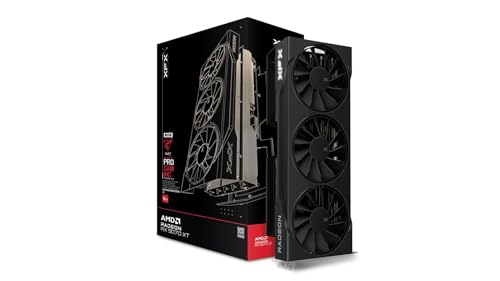
- SWFT triple-fan cooling solution
- 2970 MHz listed boost clock
- 16GB of GDDR6 memory
- HDMI and three DisplayPort outputs
- RDNA 4 RX 9070 XT chipset
Cons
- Nearly 13 inches long
- Listed width is 6.3 inches
- Limited information about BIOS and noise modes
Best for: someone who wants a triple-fan XFX card with three DisplayPort connections.
The XFX Swift Triple Fan keeps the proposition simple: an RX 9070 XT, 16GB of GDDR6 memory, a SWFT triple-fan cooler, and a high listed boost clock. It is a sensible alternative to the other triple-fan cards when XFX's design and display arrangement fit the system better.
The listed boost clock is up to 2970 MHz, matching the figures supplied for the ASRock Challenger OC and Steel Legend. That number is a factory target, not a guarantee that every game will run at that exact clock, but it tells you where XFX positions this board within the RX 9070 XT range. The RDNA 4 chipset and 16GB memory provide the central platform capabilities expected from this GPU class.
Display connectivity is one of the Swift's strongest practical details. The listing specifies one HDMI connection and three DisplayPort connections. That favors a desk with several DisplayPort monitors and makes the card more immediately useful for multi-display setups than a model with an even split between HDMI and DisplayPort.
The dimensions are less friendly to compact cases. The card is listed at 12.99 inches long and 6.3 inches wide, with a weight of about 3.31 pounds. The width figure deserves particular attention because it may affect side-panel clearance, cable routing, and access to adjacent expansion slots. Measure the case rather than assuming a standard mid-tower will accept it comfortably.
XFX does not provide the same level of detail about BIOS modes, fan bearings, or idle acoustics as ASUS or Gigabyte in the supplied features. That leaves the SWFT triple-fan solution as the main cooling information available. Buyers who want a clearly documented 0dB mode should consider the ASRock Challenger OC or ASUS Prime OC instead.
Compared with the Sapphire Pulse, the XFX has a similar long-card challenge but gives up one HDMI output in exchange for a third DisplayPort. Compared with the ASRock Challenger OC, it has the same listed boost target but is considerably wider on paper. Choose the Swift when three DisplayPort outputs matter and the case has generous side and front clearance.
How to choose best 9070 xt card
The right RX 9070 XT is less about the shared GPU name and more about how each board fits the rest of the PC.
Memory and display outputs
Every card here is listed with 16GB of GDDR6 memory, so the more useful distinction is the interface and output layout. A 256-bit memory interface appears on the Gigabyte Gaming OC ICE, ASRock Challenger OC, Sapphire Nitro+, Sapphire Pulse, and ASRock Steel Legend. The ASRock Challenger and Steel Legend list three DisplayPort outputs plus one HDMI, while both Sapphire cards list two HDMI and two DisplayPort outputs.
Choose the output arrangement around the screens you already own. A multi-monitor desk built around DisplayPort favors the ASRock or XFX layouts. A setup that alternates between monitors and a television may be easier with two HDMI ports.
Cooler and fan behavior
Triple-fan designs appear on the ASRock Challenger OC, ASRock Steel Legend, and XFX Swift, while Gigabyte and ASUS describe their own specialized fan systems. The Challenger and ASUS Prime explicitly include 0dB modes, which can reduce fan noise during light gaming or desktop work. Gigabyte's ICE model adds a Silent BIOS mode, giving it a separate way to prioritize acoustics.
A larger cooler can help manage heat, but it also consumes more case space. Do not judge cooling by fan count alone. Look at the slot thickness, length, width, and whether the manufacturer specifies features such as heat pipes, copper plates, thermal pads, or alternate-spinning fans.
A three-fan GPU is not compact by default. Measure the case before comparing cooler features.
Card dimensions and slot clearance
The cards range from the shorter listed ASRock Challenger OC at about 11.42 inches to the Sapphire Nitro+ at about 13.02 inches. Slot thickness varies too. ASUS lists a 2.5-slot design, Gigabyte ICE lists 2.7 slots, and ASRock Steel Legend lists 2.9 slots.
Length affects front clearance around radiators, drive cages, and intake fans. Width affects the side panel and power cable bend, while slot thickness determines whether neighboring expansion slots remain usable. A card that fits the motherboard can still fail the case check.
Power requirements
The ASRock Challenger OC title includes an 800W power requirement, and the ASRock Steel Legend lists a recommended 800W power supply plus two 8-pin PCIe connectors. The supplied information does not provide complete power guidance for every card, so do not assume all eight have identical requirements.
Check the card's connector needs, the power supply's available PCIe cables, and the clearance around those connectors. A clean installation depends on more than the PSU's wattage label. For a broader look at how graphics card power and case fit affect a system plan, compare those limits before selecting a board.
Build support and finish
Heavy cards benefit from sensible support, especially when they remain installed for years. The Gigabyte Gaming OC ICE has a reinforced metal backplate, while ASRock Steel Legend uses a reinforced metal frame. The ASUS Prime OC emphasizes a 2.5-slot format and GPU Guard, and several models add lighting or synchronization features.
Finish matters when the PC has a glass side panel. The ICE model is white, Steel Legend is listed in white and grey, and the Gigabyte Gaming OC includes RGB lighting. For a closed case, those details are less important than dimensions, power access, and the cooler's operating modes.

Frequently asked questions
Is 16GB of VRAM enough for an RX 9070 XT?
All eight cards in this roundup are listed with 16GB of GDDR6 memory. That gives them the same stated memory capacity for handling high-resolution textures and demanding games. Actual performance also depends on the game, settings, cooling, and the rest of the system.
Which RX 9070 XT has the most DisplayPort outputs?
The ASRock Challenger OC, ASRock Steel Legend, and XFX Swift Triple Fan each list three DisplayPort connections. The Sapphire Nitro+ and Sapphire Pulse list two DisplayPort and two HDMI outputs. Pick according to the connectors on your monitors rather than assuming one layout is universally better.
Do these cards need PCIe 5.0?
Each product title or feature set identifies PCIe 5.0 support for the relevant models in this roundup. A current PCIe 5.0 platform is a natural pairing, but the correct motherboard and power setup still matter more than the label alone. Check the motherboard slot and system compatibility before installation.
Which model is easiest to fit in a smaller case?
The ASRock Challenger OC has the shortest listed length among these cards at about 11.42 inches and is also relatively narrow in the supplied dimensions. The ASUS Prime OC uses a 2.5-slot design, which can help when adjacent expansion space is limited. Neither should be called small without checking the complete case clearance.
Which cards include a quiet or zero-decibel mode?
The Gigabyte Gaming OC ICE includes Performance and Silent BIOS modes. The ASRock Challenger OC and ASUS Prime OC list 0dB technologies for light use. These modes address idle or light loads, so they do not mean the fans will remain off during demanding gaming.
What power supply should I use?
The ASRock Challenger OC and Steel Legend listings reference an 800W power supply, with the Steel Legend also calling for two 8-pin PCIe connectors. The supplied information does not state a complete recommendation for every model. Check the exact card listing, PSU connectors, and available cable clearance before buying.
Is the Sapphire Nitro+ too large for a standard case?
The Nitro+ is listed at about 13.02 inches long, 5.06 inches wide, and 5.73 pounds. That makes it the most physically demanding card in this selection by the supplied measurements. Measure front clearance, side-panel space, and support requirements before choosing it.

The bottom line
The Gigabyte Gaming OC is the strongest all-purpose pick in the Best best 9070 xt card roundup because its WINDFORCE cooler, Hawk Fan, thermal gel, RGB lighting, and familiar 16GB configuration cover the needs of a typical full-size gaming PC. Choose the ASRock Challenger OC instead when the shorter listed length, 0dB cooling, and three DisplayPort outputs are more important.
The Gigabyte Gaming OC ICE is the better visual choice for a white system, while the ASUS Prime OC makes more sense when a 2.5-slot profile matters. Large cases can consider the Sapphire Nitro+ or ASRock Steel Legend, but both demand careful attention to clearance and support.
If you are undecided, measure your case and count your display connectors first, then choose the model that fits those two constraints without compromise.
As an Amazon Associate we earn from qualifying purchases.