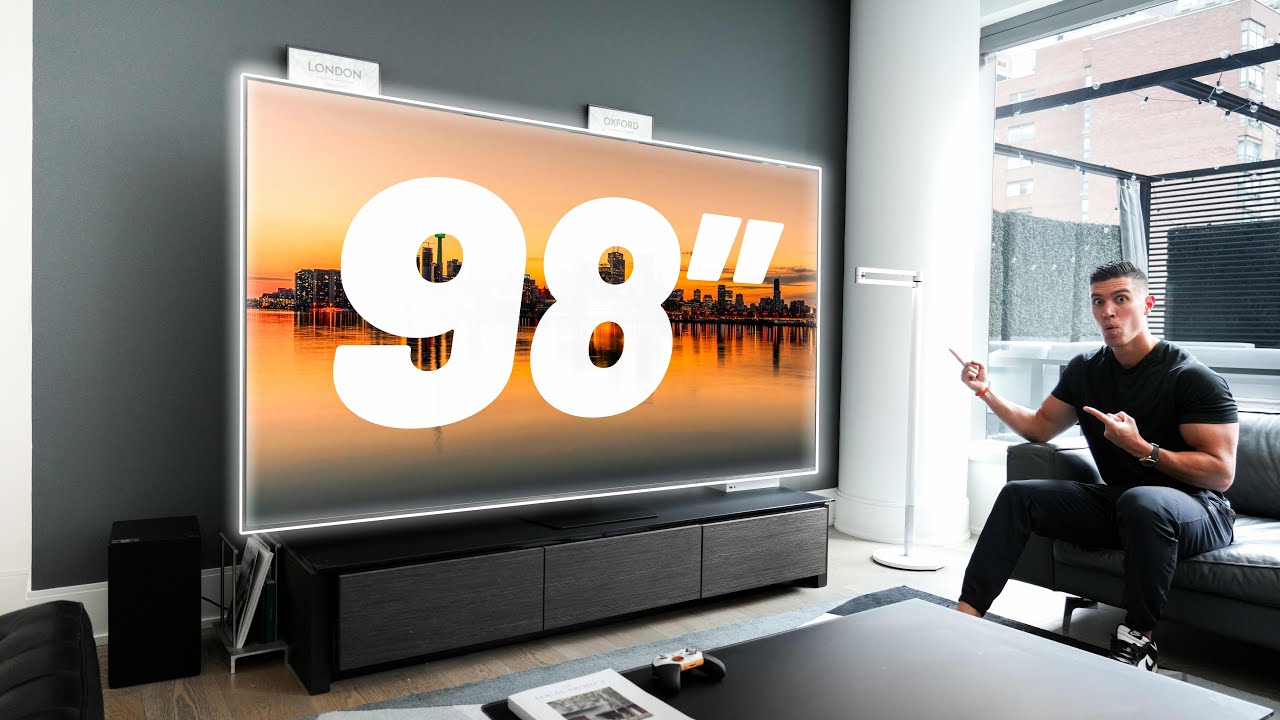

A 98-inch television can overwhelm a room before you even switch it on. The screen is about 86 inches wide on most models here, so wall space, viewing distance, glare, and the route into the room matter as much as picture quality. The Best 98 inch TV also needs enough processing power to make ordinary broadcast and streaming video look clean across such a large canvas.
The strongest choices split into two groups. Samsung and LG offer polished smart platforms with capable upscaling, while TCL supplies the widest range of Mini LED and QLED options, from the straightforward Q65 to the much more advanced QM8L. The TCL QM6K is our top pick, with the Samsung Q7F close behind for buyers who prefer Samsung's software and processing.
Comparison table
| # | Product | Award | Backlight or panel | Motion | Smart platform | Best for |
|---|---|---|---|---|---|---|
| 1 | TCL QM6K | Best overall | QD Mini LED, QLED | 144Hz native | Google TV | Sports, movies, and gaming |
| 2 | Samsung Q7F | Best Samsung QLED | QLED | Up to 120Hz | Tizen | Samsung households |
| 3 | TCL QM7K | Best glare control | QD Mini LED | 120Hz to 144Hz | Google TV | Bright rooms |
| 4 | Sony BRAVIA 5 | Best movie processing | Mini LED | 120Hz | Google TV | Film enthusiasts |
| 5 | TCL QM7L | Best gaming features | SQD Mini LED, QLED | 144Hz | Google TV | Console and PC gaming |
| 6 | TCL QM8L | Best brightness | SQD Mini LED, QLED | 144Hz | Google TV | Very bright rooms |
| 7 | Samsung U9000H | Best smooth Crystal UHD | Crystal UHD | 144Hz | Samsung smart TV | Sports and everyday viewing |
| 8 | LG NU85 | Best for LG users | Nano LED | 144Hz VRR | webOS | Upscaling and gaming |
| 9 | TCL Q65 | Best QLED simplicity | QLED | 120Hz, up to 144Hz VRR | Google TV | Streaming and casual gaming |
| 10 | Samsung DU9000 | Best Crystal UHD starter | Crystal UHD | 120Hz | Tizen | Large-screen streaming |
1. TCL QM6K: Best Overall

Pros
- QD Mini LED combines bright highlights with controlled blacks
- 144Hz native refresh rate suits sports and gaming
- Dolby Vision, HDR10+, HDR10, and HLG support
- Halo Control System targets blooming and haloing
- Motion Rate 480 is designed for fast action
Cons
- Google TV may feel busy for viewers who want a simple interface
- Mini LED processing cannot eliminate every backlight artifact
- Built-in television audio still has limits for a cinema setup
Best for: someone who wants a large screen that handles movies, sports, and games with equal confidence.
The TCL QM6K makes the most convincing case for buying a 98-inch screen instead of merely buying the largest panel available. Its QD Mini LED backlight and quantum-dot color system give bright sports broadcasts and animated films plenty of punch, while the Halo Control System is intended to keep bright objects from throwing obvious halos into dark scenes. That balance is more useful than a single headline brightness claim because a screen this large exposes weak contrast quickly.
Motion is another clear strength. The QM6K has a 144Hz native refresh rate and Motion Rate 480, so fast camera pans, racing games, and live sports have the hardware support needed for smooth movement. Its HDR compatibility covers Dolby Vision, HDR10+, HDR10, and HLG, giving streaming services and external players broad format support. The product information lists the set at 85.83 inches wide and 49.09 inches high, before accounting for its stand or the furniture beneath it. Measure that wall carefully.
Google TV brings the usual app hub and voice-oriented navigation, while the listed audio features include Dolby Atmos and Onkyo audio. Those features make the set easier to build into a living room system, although a separate soundbar or receiver remains the sensible route for a truly enveloping room. The screen's physical size is also a practical consideration. At 117.51 pounds, installation is a two-person job and wall hardware needs to be selected for the actual mounting surface.
Compared with the Samsung Q7F, the QM6K has the more advanced backlight architecture and a higher stated native refresh rate. The Q7F answers with Samsung's Tizen interface and its own AI picture and sound processing. The TCL QM7K goes further with its anti-reflective panel and precise dimming system, while the QM6K is the easier recommendation for most rooms because it preserves the key Mini LED benefits without turning the decision into a specialist exercise. This is the Best 98 inch TV for a mixed household that watches a little of everything.
2. Samsung Q7F: Best Samsung QLED

Pros
- QLED color is designed to retain vivid shades in bright scenes
- Up to 4K 120Hz supports smooth games and sports
- Q4 AI Gen1 Processor handles upscaling and picture enhancement
- Tizen offers Samsung's connected television experience
- Knox protection is included for personal data
Cons
- It lacks the Mini LED backlight used by several TCL rivals
- Object Tracking Sound Lite is not a substitute for dedicated audio
- Samsung's processing options can take time to tune
Best for: households already invested in Samsung devices and services.
The Samsung Q7F is the large Samsung screen to choose when the operating system matters as much as the panel. Tizen puts streaming apps, Samsung TV Plus channels, and the Gaming Hub in one familiar environment. That matters on a screen this big, where an awkward interface becomes part of every viewing session. Alexa is built in, and the set also includes Samsung's Object Tracking Sound Lite system for sound that follows movement on screen.
Its QLED panel is built around quantum-dot color, with Samsung saying the set can maintain more than a billion colors even in bright scenes. The Q4 AI Gen1 Processor handles 4K upscaling and picture enhancement, which is particularly important when an older HD program is spread across a 98-inch display. The set supports up to 4K 120Hz, so compatible games and fast sports can appear fluid rather than smeared. The listed width is 85.9 inches and the weight is 118.6 pounds.
Samsung's emphasis here is controlled enhancement rather than a long list of advanced backlight specifications. Quantum HDR, deep blacks, AI-enhanced color, and tear-free HDR gaming are all called out in the feature set. The result should appeal to viewers who want a bold, clean image without manually managing many picture modes. The trade-off is that this model does not have the QD Mini LED system found in the TCL QM6K, QM7K, QM7L, and QM8L.
That distinction makes the Q7F a more specialized pick than the TCL QM6K. The TCL has the stronger backlight design on paper, particularly for dark-room contrast, while the Samsung offers a smoother path for owners using other Samsung products. It also has a more polished choice of connected features than the simpler Samsung DU9000. Skip this model if deep local-dimming control is your priority. Choose the Q7F if you want a very large Samsung television with clear 4K processing and a dependable smart-TV environment.
3. TCL QM7K: Best Glare Control

Pros
- CrystGlow HVA panel is designed to block reflections
- Up to 2, 500 local dimming zones target strong contrast
- QD Mini LED produces high HDR brightness
- 120Hz to 144Hz motion range suits sports and gaming
- Halo Control System is designed to reduce blooming
Cons
- Its 121.9-pound body needs careful installation
- More advanced picture controls may overwhelm casual viewers
- Glare reduction does not make every viewing angle equally strong
Best for: a bright living room where windows and lamps regularly hit the screen.
The TCL QM7K solves a problem that many enormous televisions leave to the room: reflections. Its CrystGlow HVA panel is designed to block reflections while keeping image detail visible, which gives it a strong argument for open-plan spaces, sunlit rooms, and living rooms with lamps opposite the screen. A dark picture that disappears under a bright window is not useful, even if the panel has impressive contrast in a controlled room.
Behind that panel is a QD Mini LED system with up to 2, 500 precisely controlled local dimming zones. The purpose is straightforward. More controlled zones can let bright subtitles, headlights, or stadium lights stand apart from darker surroundings with less gray wash across the picture. TCL also lists a Halo Control System that works on blooming and shadow detail. These are design claims rather than a guarantee that every scene will be artifact-free, but they address the weaknesses that often show up on large LED screens.
The QM7K supports a 120Hz to 144Hz motion range and includes Dolby Atmos and Onkyo audio features. That combination suits sports watchers who want clean movement and viewers who plan to start with the television speakers before adding a sound system. The set is 85.8 inches wide, 50.6 inches high, and 121.9 pounds according to the product information. The width is similar to the other 98-inch TCL models, but the installation weight still deserves attention.
The QM6K is our easier all-purpose recommendation, since it already combines Mini LED contrast, broad HDR support, and a 144Hz native rate. The QM7K earns its place above that model for rooms where reflections are a constant nuisance. It is also a more compelling bright-room choice than the Samsung Q7F, whose QLED color is strong but whose listed features do not include an anti-reflective panel. If your seating area is dim, choose the QM6K. If daylight is unavoidable, the QM7K is the better fit.
4. Sony BRAVIA 5: Best Movie Processing

Pros
- Mini LED backlight uses XR Backlight Master Drive
- XR Processor with AI technology enhances picture detail
- Dolby Vision, Dolby Atmos, IMAX Enhanced, and DTS:X support
- Studio calibrated modes target creator intent
- PlayStation 5 features suit console owners
Cons
- It is the heaviest television in this roundup
- The 120Hz motion specification is lower than several TCL rivals
- Its 86.6-inch width and deep chassis require substantial planning
Best for: movie-focused rooms where accurate processing matters more than gaming speed.
The Sony BRAVIA 5 is aimed at viewers who care about the character of a film as much as its size. Sony's XR Processor with AI technology is used to enhance color, contrast, and clarity in real time, while XR Clear Image is intended to recover detail from HD and digital content. That is valuable on a 98-inch screen because poor source material has nowhere to hide. Sony also includes studio calibrated picture modes for Netflix, Prime Video, and Sony Pictures Core.
Its Mini LED system uses XR Backlight Master Drive to control thousands of Mini LEDs. The goal is brighter highlights and more convincing contrast without giving up the precision needed in dark scenes. XR Triluminos Pro handles a broad range of real-world colors, and the set supports Dolby Vision, Dolby Atmos, IMAX Enhanced, and DTS:X. The feature list also includes Google TV, Google Assistant, Apple AirPlay 2, and Google Cast, making the set flexible for households with different devices.
The 120Hz television specification is sufficient for smooth films, sports, and console play, but it does not match the 144Hz figures on the TCL QM6K, QM7K, QM7L, and QM8L. Sony counters with exclusive PlayStation 5 features and XR Motion Clarity for fast action. Its physical requirements are significant: the listed width is 86.6 inches, height is 52.2 inches, depth is 19.2 inches, and weight is 152.1 pounds. That is the heaviest option here, so do not treat delivery and mounting as an afterthought.
The BRAVIA 5 is a more film-oriented recommendation than the LG NU85, which puts more emphasis on AI upscaling, Filmmaker Mode, and high-refresh gaming. The TCL QM7L offers a stronger gaming specification and an anti-reflective panel, while Sony's appeal is the processing pipeline and cinematic format support. This is not the right pick for someone who wants the lightest installation or the highest refresh rate. It is the right Best 98 inch TV for a dedicated movie watcher who wants a carefully processed image.
5. TCL QM7L: Best Gaming Features

Pros
- 144Hz refresh rate supports responsive gaming
- Game Accelerator 288 VRR and FreeSync Premium Pro are included
- Anti-reflective HVA 2.0 Pro panel suits mixed lighting
- Up to 2, 100 local dimming zones target deep blacks
- Bang & Olufsen audio features expand the theater setup
Cons
- The feature set is more than casual players need
- Google TV and Gemini add complexity to the interface
- Precise dimming can still require picture-mode adjustment
Best for: gamers who want a huge display with an unusually complete gaming feature set.
The TCL QM7L is the 98-inch screen in this group that most clearly speaks to serious gaming. Its TCL Game Pack includes Game Accelerator 288 VRR, a Game Bar, and AMD FreeSync Premium Pro. The 144Hz refresh rate gives compatible hardware room to show fast movement smoothly, while variable refresh rate helps keep the image from breaking apart when frame delivery changes. Those features will matter most to PC and current-console owners with suitable sources.
Picture quality is built around SQD Mini LED, TCL's Ultra Color Filter, and the Halo Control System. TCL specifies up to 2, 100 precisely controlled dimming zones, giving the backlight a more granular way to separate dark backgrounds from bright effects. The HVA 2.0 Pro panel is described as high contrast and anti-reflective, a useful combination for a gaming room that is not fully dark. The Ultra Color Filter uses fine particles to target color accuracy, though the practical result will still depend on the source and selected picture mode.
The audio platform is unusually ambitious for a television. The QM7L lists Audio by Bang & Olufsen and support for an optional wireless subwoofer and satellite speakers. Google TV provides the streaming side, and Google Gemini Interactive AI adds conversational control. The television is listed at 85.8 inches wide and 73 pounds, though its other listed dimensions and installation requirements still call for careful handling. The unusually low listed weight should be checked against the mounting instructions before planning a one-person installation.
The LG NU85 also offers 144Hz VRR and AMD FreeSync Premium, so it remains a credible alternative for gamers who prefer webOS and LG's Game Optimizer. The QM7L pulls ahead with its stated dimming system and broader gaming bundle. The newer TCL QM8L promises even more brightness and dimming zones, but the QM7L is easier to justify when responsiveness and reflections matter more than chasing the largest specification. Choose it for a gaming room, not simply because it has a large screen.
6. TCL QM8L: Best Brightness

Pros
- Up to 6, 000 peak nits are specified for HDR highlights
- Up to 4, 000 discrete dimming zones target strong contrast
- 144Hz refresh rate and Game Accelerator 288 suit gaming
- Ultra Color Filter is designed for precise color
- Bang & Olufsen audio features support a larger system
Cons
- Its extensive processing can require careful calibration
- The chassis is deeper than several TCL alternatives
- Very bright picture modes may not suit a dark cinema room
Best for: a large, bright room where HDR impact and reflection control are priorities.
The TCL QM8L is the specification-heavy choice for a room that fights the television with daylight. TCL lists up to 6, 000 peak nits and up to 4, 000 discrete dimming zones, figures aimed at intense HDR highlights and tighter control over dark areas. That combination should help sunlight, explosions, stadium lights, and neon signs retain their impact without turning the entire screen gray. It is the most aggressive bright-room design in this roundup.
The SQD Mini LED system works with TCL's Ultra Color Filter and Enhanced Halo Control System. The filter is intended to improve color precision, while the backlight system manages the screen in many separate areas. A listed 7, 000:1 high static contrast ratio adds context to the design, though contrast performance will vary with content and viewing mode. Complete HDR support is included, and TCL also lists AI Color, AI Contrast, AI Clarity, AI Motion, AI upscaling, and AI Sound.
Gaming is not an afterthought. The set has a 144Hz refresh rate, Game Accelerator 288 VRR, Game Bar, and AMD FreeSync Premium Pro. Google TV and Gemini Interactive AI handle streaming and voice interaction. Audio by Bang & Olufsen is paired with support for an optional wireless subwoofer and satellite speakers. At 85.3 inches wide, the QM8L is slightly narrower than some of the other TCL models, but its 123.5-pound weight and 16.5-inch listed depth still make installation a serious project.
The QM7L is the more balanced gaming choice, and the QM7K is a better fit when you want strong Mini LED performance without the most extreme brightness claims. The QM8L earns its award in a specific setting: a broad, sunlit room where ordinary screens look washed out. If your room can be darkened and movie accuracy is the priority, the Sony BRAVIA 5 deserves a closer look. If glare and HDR impact dominate your decision, the QM8L is the Best 98 inch TV in this group.
7. Samsung U9000H: Best Smooth Crystal UHD

Pros
- 144Hz performance supports fast sports and games
- NQ4 AI Gen2 Processor handles upscaling and picture refinement
- AI color, contrast, depth, and sound controls are included
- Tizen includes a large selection of free streaming options
- Variable Refresh Rate targets stutter and tearing
Cons
- Crystal UHD lacks the Mini LED backlight of the leading TCL sets
- Samsung's enhancement features may not suit purist movie settings
- The tall, wide body needs a substantial stand or wall
Best for: viewers who want Samsung's connected experience with smoother motion than the older DU9000.
The Samsung U9000H is the most interesting Crystal UHD model here because it adds a 144Hz performance mode to a product family usually chosen for straightforward everyday viewing. Sports, action films, and compatible games can benefit from the smoother motion, while Variable Refresh Rate is intended to reduce stutter and tearing. Samsung also describes special large-screen enhancements that reduce noise and improve clarity, an important task when ordinary content is enlarged to this scale.
The NQ4 AI Gen2 Processor is the core of the picture system. It analyzes incoming content and upscales it toward 4K, while AI tools adjust color, contrast, depth, and sound. The television can also transform some non-HDR material toward an HDR-like presentation. These options are useful for older shows and mixed streaming libraries, although viewers who prefer the director's original image may want to disable some of the more assertive processing.
Tizen gives the U9000H a familiar Samsung platform, with thousands of free streaming options and Samsung TV Plus content listed among its features. Its AI Sound Controller can independently adjust voices, music, and sound effects, which may help households that struggle with dialogue clarity. The listed dimensions are 85.9 inches wide, 51.1 inches high, and 15.8 inches deep, with a weight of 117.8 pounds. That places it in the same installation class as the other large Samsung models.
The Samsung Q7F is the stronger Samsung pick for viewers who want QLED color and a more premium picture structure. The U9000H instead makes sense for people who value 144Hz motion, AI processing, and Tizen without moving to a QLED model. The TCL Q65 offers broad HDR format support and a 144Hz variable gaming mode, while the U9000H has a more unified Samsung experience. Choose this set for sports, television, and streaming rather than for the deepest possible local-dimming contrast.
8. LG NU85: Best for LG Users

Pros
- Alpha 8 processing targets detail, color, and texture
- AI Super Upscaling helps lower-resolution content
- 144Hz VRR and FreeSync Premium support gaming
- Filmmaker Mode preserves intended film settings
- webOS includes LG Channels and connected AI tools
Cons
- HDR10 Pro support is less broad than the TCL models' format lists
- Nano LED does not provide the local dimming detail of Mini LED
- The listed 17-inch depth may complicate a shallow cabinet
Best for: LG households that want familiar webOS, strong upscaling, and a high-refresh gaming mode.
The LG NU85 is a sensible choice for viewers already comfortable with LG's webOS interface. Its Alpha 8 processor analyzes picture data to refine textures, contours, and color, and AI Super Upscaling is designed to make HD and even SD content look closer to 4K. That matters more on a 98-inch television than it does on a smaller bedroom screen because compression, soft edges, and source noise become easier to see.
LG gives movie fans a useful shortcut with Filmmaker Mode. It is intended to preserve the original color, settings, and frame rates chosen for a film, rather than layering on aggressive motion enhancement. HDR10 Pro dynamically adjusts brightness to reveal detail in dark and bright scenes. The set also includes AI Sound Pro, Wow Orchestra compatibility, and Alexa support, although the feature data does not specify a built-in speaker configuration.
For gaming, the NU85 supports VRR at 144Hz, Motion Booster 288, AMD FreeSync Premium, and ALLM. The Game Dashboard and Game Optimizer put gaming controls within the television interface, so console and cloud players do not need to search through the full settings menu. The listed body is 86 inches wide, 52.9 inches high, and 17 inches deep. That depth is worth checking against the wall mount or cabinet plan before delivery.
The TCL QM7L is the more technically ambitious gaming display, with Mini LED, up to 2, 100 dimming zones, and a broader gaming suite. LG's advantage is the combination of webOS, Filmmaker Mode, AI upscaling, and an interface that will feel natural to existing LG owners. The Sony BRAVIA 5 is the stronger film-processing alternative, while the LG is more flexible for mixed streaming and gaming. Pick the NU85 if you want an LG-centered living room and do not need Mini LED contrast.
9. TCL Q65: Best QLED Simplicity

Pros
- QLED color covers nearly the entire DCI-P3 color space
- Dolby Vision, HDR10+, HDR10, and HLG are supported
- 120Hz panel with up to 144Hz VRR handles fast action
- Game Accelerator 240 targets responsive play
- Built-in subwoofer adds bass beyond basic television audio
Cons
- It lacks the Mini LED control of TCL's QM series
- The older 2024 model has less advanced processing than newer rivals
- Its 120.15-pound weight complicates installation
Best for: viewers who want broad HDR support, Google TV, and a simple QLED setup.
The TCL Q65 is the straightforward member of this lineup. It gives you a QLED panel, Google TV, and the major HDR formats without requiring a decision about several generations of Mini LED backlight technology. TCL says its quantum-dot system covers nearly the entire DCI-P3 color space, so colorful animation, sports graphics, and HDR streaming should have a lively presentation.
Its 120Hz panel supports up to 144Hz variable refresh rate, with Motion Rate 480 and MEMC frame insertion helping maintain clarity during fast movement. Game Accelerator 240 and Auto Game Mode are aimed at reducing delay and making game mode easier to activate. That is a useful feature set for a household that plays games occasionally, though the newer TCL QM7L offers a much more extensive gaming package for people who spend most of their time with a console or PC.
HDR Pro+ covers Dolby Vision, HDR10+, HDR10, and HLG, giving the Q65 broad compatibility with streaming services and external devices. The AIPQ Pro processor uses deep-learning AI to adjust color, contrast, and clarity, while the built-in subwoofer is intended to add deeper bass than standard television speakers. The product information lists the screen at 85.79 inches wide and 49.09 inches high, with a weight of 120.15 pounds.
The Q65 is not the right pick if your room needs the stronger blacks, tighter highlight control, and brightness of Mini LED. The QM6K is the clear step up in that respect, and the Samsung Q7F offers a more polished alternative for people committed to Tizen. The Q65 still has an appealingly uncomplicated role: it brings QLED color, broad HDR support, and Google TV to a huge screen without turning the buying decision into a technical comparison.
10. Samsung DU9000: Best Crystal UHD Starter

Pros
- Supersize Picture Enhancer targets noise and sharpness on large content
- Motion Xcelerator 120Hz supports smooth action
- Crystal Processor 4K upscales compatible content
- Tizen offers streaming apps and Samsung TV Plus
- Game Bar includes useful console and cloud features
Cons
- It has less advanced backlighting than the Mini LED models
- The 2024 model has fewer newer processing features than the U9000H
- Object Tracking Sound Lite remains limited without external audio
Best for: a Samsung buyer who wants a large, uncomplicated Crystal UHD television.
The Samsung DU9000 is the uncomplicated Samsung option in this group. Its Supersize Picture Enhancer is specifically intended to reduce noise and sharpen content on a very large screen, while the Crystal Processor 4K transforms compatible material toward 4K. That combination makes sense for viewers with a mixed library of streaming, cable, and older films rather than a room devoted solely to premium HDR movies.
Motion Xcelerator 120Hz gives the DU9000 enough refresh capability for sports and action, and the Game Bar adds options such as screen-ratio changes, AI Auto Game Mode, Mini Map Auto Detection, and Virtual Aim Point. Samsung's PurColor system is designed to show a wider spectrum than traditional RGB models, while Mega Contrast automatically adjusts brightness and contrast to separate objects from their surroundings.
Tizen handles apps, workouts, streaming, and Samsung TV Plus. Q-Symphony can pair the television with compatible Samsung soundbars so the television speakers and soundbar work together. The listed body measures 85.9 inches wide, 51.1 inches high, and 15.8 inches deep, with a weight of 117.7 pounds. Those figures are close to the newer U9000H, so both require a wide stand or a properly supported wall mount.
The newer Samsung U9000H is the better choice if 144Hz performance, newer AI processing, and more advanced sound controls matter to you. The TCL Q65 has broader HDR format support, while the DU9000 offers Samsung's familiar interface and game tools. The DU9000 belongs near the bottom of this list because its Crystal UHD backlight cannot compete with the Mini LED sets for difficult dark scenes. It remains a reasonable pick for a Samsung household that wants a simple, huge screen for everyday viewing.

How to choose the best 98 inch tv
A 98-inch television is too large to choose from a single specification. Start with the room, then match the panel, motion system, processing, and smart platform to what you actually watch.
Room size and viewing distance
Every model here is roughly 86 inches wide, so measure the wall, console, doorway, stairwell, and turning space before ordering. A screen this large can make a modest viewing distance feel intense, especially with bright HDR content. If you are unsure whether this size will dominate the room, compare the physical footprint with how a slightly smaller screen changes your seating plan.
The television's listed height and depth also matter. Several sets are close to 50 inches high, and weights range from 117.51 pounds to 152.1 pounds. Plan for two or more people and use a wall mount or stand rated for the actual television.
Backlight and contrast
Standard LED and Crystal UHD models, such as the Samsung DU9000 and U9000H, use picture processing and brightness adjustments to improve the image. QLED models such as the TCL Q65 and Samsung Q7F add quantum-dot color. Mini LED models such as the TCL QM6K, QM7K, QM7L, QM8L, and Sony BRAVIA 5 use more precise backlight control to separate bright and dark parts of a scene.
On a 98-inch screen, backlight control matters most when a bright object sits inside a dark scene.
Mini LED is not automatically perfect. Blooming, picture-mode behavior, and viewing conditions still affect the result. It is most useful for dark-room movies, high-contrast HDR, and rooms where you want bright highlights without lifting the entire image.
Brightness and glare
A bright room needs more than a vivid color mode. Look for a panel designed to manage reflections, such as the anti-reflective screens described for the TCL QM7K and QM7L. The TCL QM8L is the most brightness-focused option in the list, with a stated peak brightness of up to 6, 000 nits and up to 4, 000 dimming zones.
Do not confuse brightness with better picture quality in every room. In a dark cinema space, an aggressively bright setting can make films look harsh. If daylight is the problem, glare control and sensible placement can be more useful than the largest brightness claim.
Refresh rate and gaming features
A 120Hz panel is already well suited to sports, films, and console gaming. The TCL Q65 supports up to 144Hz VRR, while the TCL QM6K, QM7L, QM8L, Samsung U9000H, and LG NU85 list 144Hz capability. Variable refresh rate, Auto Low Latency Mode, AMD FreeSync, a game dashboard, and an on-screen game bar matter more than a refresh number alone.
The TCL QM7L is the most gaming-focused choice here because it combines 144Hz with Game Accelerator 288 VRR and FreeSync Premium Pro. The LG NU85 is a strong alternative for webOS users, while the Sony BRAVIA 5 adds features made specifically for PlayStation 5 consoles.
Upscaling and smart platform
Most television content is not native 4K, and softness is easier to notice when it fills a 98-inch panel. Samsung uses Crystal or NQ4 AI processing, LG uses Alpha 8 processing, Sony uses its XR Processor, and TCL uses AIPQ Pro or AI picture tools depending on the model. These systems are intended to improve lower-resolution content, but they cannot restore detail that was never captured.
Choose Google TV for a broad app hub and Google Assistant, Tizen for Samsung's connected ecosystem and Samsung TV Plus, or webOS for LG's interface, LG Channels, and gaming controls. The right platform is usually the one your household already understands.

Frequently asked questions
Is a 98-inch television too large for most rooms?
Not necessarily, but it needs a wall or stand about 86 inches wide and a sensible seating distance. The screen can dominate a small room, especially with bright HDR content. Measure the wall, furniture, and delivery route before choosing the size.
Do all of these televisions support 4K?
Yes. The listed products are 4K televisions or describe 4K processing and upscaling. Upscaling improves HD and lower-resolution material, but it does not turn the original source into native 4K.
Which 98-inch TV is best for sports?
The TCL QM6K is our leading mixed-use choice because it combines a 144Hz native refresh rate, Mini LED backlighting, and Motion Rate 480. The TCL QM7K is especially attractive in a bright room because its CrystGlow HVA panel is designed to reduce reflections. The Samsung U9000H is another capable option with 144Hz performance.
Which model is best for gaming?
The TCL QM7L has the most complete gaming feature set in this group, including 144Hz, Game Accelerator 288 VRR, a Game Bar, and AMD FreeSync Premium Pro. The LG NU85 also supports 144Hz VRR and FreeSync Premium, while the Sony BRAVIA 5 has dedicated features for PlayStation 5.
Do these televisions need a soundbar?
Not always, but a soundbar or separate audio system will create a wider, more cinematic soundstage. The TCL models list Dolby Atmos, and several include Onkyo or Bang & Olufsen audio features. Samsung's Q-Symphony can combine a compatible Samsung soundbar with the television speakers.
How much room is needed for installation?
Most models are about 86 inches wide, near 50 inches high, and weigh more than 117 pounds. The Sony BRAVIA 5 is listed at 152.1 pounds, making it the most demanding installation here. Use suitable wall hardware or a properly rated stand, and arrange help before the television arrives.
Is Mini LED better than QLED for a 98-inch TV?
They describe different parts of the picture system. QLED refers mainly to quantum-dot color, while Mini LED refers to more precise backlight control. A television can use both, as several TCL models do, and that combination can improve color, contrast, and HDR impact.
The bottom line
The Best 98 inch TV for most buyers is the TCL QM6K. Its QD Mini LED backlight, 144Hz native refresh rate, broad HDR format support, and Google TV platform make it the most balanced choice for sports, films, games, and everyday streaming. The TCL QM7K is the better alternative when reflections are a persistent problem, while the Samsung Q7F is the one to choose for a polished Samsung ecosystem.
Buy the Sony BRAVIA 5 for careful movie processing and the TCL QM7L for an especially capable gaming setup. If you are undecided, choose the TCL QM6K unless your room has severe glare or your household is committed to Samsung or LG software.
As an Amazon Associate we earn from qualifying purchases.