

A 98-inch television can turn an ordinary living room into a convincing home cinema, but its sheer size exposes weak processing, uneven brightness and motion blur that smaller screens can hide. The right model needs more than a large diagonal measurement. It needs strong upscaling, useful HDR control and a smart platform you will actually enjoy using.
Our Best 98 TV picks range from straightforward Crystal UHD models to Mini LED screens with thousands of precisely controlled lighting areas. Some make more sense for sports, some for console gaming, and others for film-focused viewing. The TCL QM7K is our top pick, with the TCL QM6K, Sony BRAVIA 5 and TCL F8D covering the strongest alternatives.
Comparison table
| # | Product | Award | Backlight or panel | Motion | Smart platform | Best for |
|---|---|---|---|---|---|---|
| 1 | TCL QM7K | Best overall | QD Mini LED, QLED | 120Hz to 144Hz | Google TV | Bright rooms and serious home cinema |
| 2 | TCL QM6K | Best for sports | QD Mini LED, QLED | Native 144Hz | Google TV | Fast sports and mixed viewing |
| 3 | Sony BRAVIA 5 | Best for movies | Mini LED | 120Hz | Google TV | Film-focused living rooms |
| 4 | TCL F8D | Best for gaming | QLED, direct LED | Native 144Hz | Fire TV | Console and PC gaming |
| 5 | Samsung Q7F | Best Samsung QLED | QLED | Up to 4K 120Hz | Tizen | Samsung device owners |
| 6 | TCL QM7L | Best premium TCL | SQD Mini LED, QLED | 144Hz | Google TV | High-end gaming and contrast |
| 7 | LG NU85 | Best for upscaling | Nano, LED | VRR 144Hz | webOS | Mixed-quality TV sources |
| 8 | Samsung U9000H | Best Samsung Crystal UHD | Crystal UHD | 144Hz | Tizen | Sports and everyday streaming |
| 9 | TCL Q65 | Best QLED starter | QLED | 120Hz, up to 144Hz VRR | Google TV | Bright, colorful streaming |
| 10 | Samsung DU9000 | Best Crystal UHD alternative | Crystal UHD | 120Hz | Tizen | Simple Samsung setups |
1. TCL QM7K: Best Overall

Pros
- Mini LED backlight with up to 2, 500 local dimming zones
- Anti-reflective CrystGlow HVA panel
- Strong HDR brightness and contrast
- QLED color with smooth 120Hz to 144Hz motion
- Google TV with Dolby Atmos support
Cons
- Large and heavy installation
- Picture system has a lot of processing controls
- Built-in audio may still invite a separate sound system
Best for: viewers who want the most balanced combination of contrast, brightness and motion.
The TCL QM7K is the 98-inch screen we would put in the center of a dedicated viewing room. It has the kind of backlight hardware that matters at this size, rather than relying on a basic LED array stretched across an enormous panel. TCL lists up to 2, 500 precisely controlled local dimming zones, and that gives the television a better chance of keeping bright highlights separated from dark backgrounds.
Its QD Mini LED system combines quantum-dot color with a more finely controlled backlight. The result should be especially useful for HDR films, sports and games, where a large screen can otherwise look washed out in a bright room. The CrystGlow HVA panel is designed to block reflections, while the high HDR brightness gives the picture more authority when daylight or lamps are present. That anti-reflective treatment is a practical advantage over many large-screen televisions that turn into mirrors during the afternoon.
Motion is another reason it leads this group. The panel supports 120Hz to 144Hz operation, and the TCL Game Pack adds Game Accelerator 288 VRR, a Game Bar and AMD FreeSync Premium Pro. Those features make it more versatile than the Samsung Q7F, which reaches up to 4K 120Hz, while the QM7K's local dimming hardware gives it a more convincing contrast foundation than the Q65. Google TV keeps the streaming side familiar, and the set supports complete HDR formats along with expandable Bang & Olufsen audio options.
The weakness is physical as much as technical. This is a very large television, and the listed weight is 121.9 pounds, so delivery, mounting and placement need real planning. Its feature set can also feel excessive if all you want is casual television. For a room with controlled lighting and a film-first priority, the Sony BRAVIA 5 has more creator-focused picture modes. For everyone else, the QM7K is the most complete all-rounder.
2. TCL QM6K: Best for Sports

Pros
- Native 144Hz refresh rate
- QD Mini LED contrast and color
- Dolby Vision, HDR10+, HDR10 and HLG support
- Halo Control System for darker scenes
- Google TV and Dolby Atmos support
Cons
- No anti-reflective panel claim like the QM7K
- Large installation footprint
- Many picture features are aimed at action rather than purist film viewing
Best for: households that watch live sports, action films and games on a huge screen.
The TCL QM6K is a particularly sensible match for sports. A 98-inch panel magnifies every camera pan and fast-moving player, so motion handling matters more than it does on a smaller television. Its native 144Hz refresh rate and Motion Rate 480 are built for that problem, keeping movement fluid while reducing the smeared look that can make a large sports broadcast tiring to watch.
TCL uses QD Mini LED backlighting with its Halo Control System. That combination gives the QM6K a stronger contrast base than a conventional direct-lit QLED, while quantum-dot color helps jerseys, field markings and broadcast graphics retain their intensity. The set supports Dolby Vision, HDR10+, HDR10 and HLG, so it is not tied to one HDR format when you switch between streaming services, live broadcasts and game consoles.
The picture processing is also aimed at varied sources. The product listing describes local dimming designed to reduce haloing and improve shadow detail, which is useful when a bright scoreboard sits against a dark arena. Google TV handles apps and voice control, while Dolby Atmos and Onkyo audio processing give the built-in sound a more expansive starting point than a thin television speaker system usually offers. It is more motion-focused than the Sony BRAVIA 5, and it is easier to recommend for broad household use than the more specialized Samsung Q7F.
The compromise is that TCL reserves its anti-reflective panel language for the QM7K in this group. If your room has a strong window directly opposite the screen, the top pick is the safer choice. The QM6K is also still a 98-inch installation, with a listed weight of 117.51 pounds. If your priority is live sports and you want fluid motion without stepping up to the more elaborate QM7K, this is the screen to choose.
3. Sony BRAVIA 5: Best for Movies

Pros
- Mini LED backlight with XR Backlight Master Drive
- XR Processor with AI scene enhancement
- Dolby Vision, Dolby Atmos, IMAX Enhanced and DTS:X
- Studio calibrated modes for several streaming services
- Strong PlayStation 5 feature set
Cons
- Heaviest television in this roundup
- 120Hz rather than 144Hz
- Deep chassis requires more wall or cabinet planning
Best for: movie fans who want careful processing and a cinema-oriented smart platform.
The Sony BRAVIA 5 takes a more deliberate approach than the feature-heavy TCL models. Its appeal is not just that it uses Mini LED, but that Sony pairs the backlight with XR Backlight Master Drive and an XR Processor with AI technology. Those systems are intended to improve brightness, contrast, color and clarity scene by scene, which is exactly the sort of processing a 98-inch screen needs when the source is not pristine.
Sony includes XR Triluminos Pro for color and XR Clear Image for upscaling HD and digital content. That matters in a real living room, where broadcast television and older films sit beside new 4K streams. Instead of treating all content as equally sharp, the set attempts to restore detail and reduce the roughness of lower-resolution sources. Its studio calibrated picture modes for Netflix, Prime Video and Sony Pictures Core also give film viewers a clearer route to a consistent presentation.
The 120Hz refresh rate is enough for sports, action films and console play, but it does not match the 144Hz options on the TCL F8D, QM6K or QM7K. Sony counters with XR Motion Clarity and PlayStation 5 features, including exclusive options intended for that console. Google TV, Google Assistant, Apple AirPlay 2 and Google Cast make it flexible for mixed households. Dolby Vision and Atmos, IMAX Enhanced and DTS:X round out a strong movie setup.
The physical design needs careful thought. The BRAVIA 5 weighs 152.1 pounds and measures 19.2 inches front to back according to the listed product dimensions, making it the least forgiving model to move or mount. It also gives up the higher refresh ceiling of the TCL F8D. For readers comparing screen sizes before making room, how much viewing distance a very large television needs is a useful question to settle first. Choose the Sony when creator-focused modes, upscaling and cinematic format support matter more than maximum gaming speed.
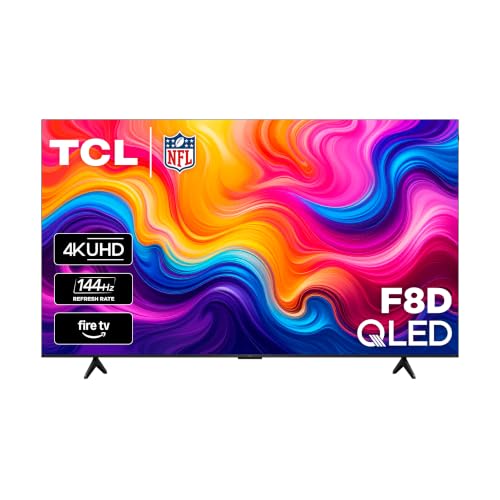
4. TCL F8D: Best for Gaming
Pros
- Native 144Hz refresh rate
- Four HDMI 2.1 inputs
- Two inputs support 4K at 144Hz
- VRR, ALLM and Game Accelerator 288
- Fire TV with Alexa+
Cons
- Direct LED backlight is less advanced than Mini LED
- Fire TV layout will not suit every household
- Large speaker system still cannot replace a full surround setup
Best for: players who want a 98-inch gaming display with broad connectivity.
The TCL F8D is the clearest gaming specialist here. Its native 144Hz panel is paired with VRR, ALLM and Game Accelerator 288, giving compatible games room to run smoothly while reducing tearing and responsiveness problems. On a screen this wide, those improvements are easy to appreciate because camera movement and fast traversal occupy so much of your field of view.
Connectivity is the standout practical feature. The F8D has four HDMI 2.1 inputs, with two supporting 4K at 144Hz and another providing eARC. That is a much easier arrangement for a household with multiple consoles, a gaming PC and a soundbar than a television that offers only one high-bandwidth connection. Wi-Fi, Bluetooth 5.4 and AirPlay 2 add flexibility for other devices.
The QLED panel uses quantum-dot color, and the direct LED backlight is described as high brightness. Dolby Vision, HDR10+, HDR10 and HLG cover the main HDR formats, while the ambient light sensor can adjust brightness for the room. Fire TV provides watchlists and recommendations, and Alexa+ can search for content or manage compatible smart-home devices. The built-in 2 by 15-watt plus 15-watt speaker system supports Dolby Atmos and DTS Virtual:X, which is more substantial than the basic audio on many very large sets.
The obvious limitation is its direct LED backlight. The Mini LED TCL QM7K and Sony BRAVIA 5 have more advanced systems for controlling bright objects against dark backgrounds, so film fans may see more reason to choose them. The F8D is also 104.28 pounds, which makes it a serious installation. If games, inputs and Fire TV matter most, it beats those more cinema-focused models on convenience.
5. Samsung Q7F: Best Samsung QLED

Pros
- QLED color with more than a billion color shades
- Up to 4K 120Hz motion
- AI-enhanced picture and audio processing
- Tizen with Gaming Hub and Samsung TV Plus
- Knox protection for personal data
Cons
- Not a Mini LED model
- Fewer explicit connectivity details than the TCL F8D
- Samsung ecosystem works best for existing users
Best for: Samsung households that want a large QLED with integrated gaming and streaming tools.
The Samsung Q7F is the Samsung model to choose when you want richer color and a more advanced picture system than a Crystal UHD set provides. Its QLED display is designed to keep colors true across bright scenes, and Samsung says it can show more than a billion color shades. On a 98-inch screen, that broad color range helps prevent large areas such as skies, grass and animated backgrounds from looking flat.
The Q4 AI Gen1 Processor handles 4K upscaling and AI-enhanced color and audio. That is useful when the television is fed a mix of streaming quality, broadcast content and console output. The set also emphasizes deep blacks, bold contrast and motion-based sound through Object Tracking Sound Lite. It will not provide the local dimming control of the TCL QM7K or Sony BRAVIA 5, but its processing gives everyday content a polished presentation.
Gaming support reaches up to 4K 120Hz, with tear-free and stutter-free HDR gaming features. Samsung's Gaming Hub puts supported game services in the smart interface, and Alexa is built in. Tizen also brings Samsung TV Plus with free channels, while Knox provides a layer of protection for apps, websites, passwords and connected IoT devices. It is a more unified experience than the Google TV models if the rest of your home already uses Samsung devices.
The Q7F's main weakness is the gap between QLED color and Mini LED contrast. The TCL QM6K offers a 144Hz native refresh rate and Mini LED control, while the Q7F stays at up to 4K 120Hz. It is also listed at 118.6 pounds and 52.1 inches high, so this is not a casual move. Pick it for Samsung's interface, processing and ecosystem, not for the most sophisticated backlight in the group.
6. TCL QM7L: Best Premium TCL

Pros
- SQD Mini LED with up to 2, 100 dimming zones
- Ultra Color Filter for precise color
- Anti-reflective HVA 2.0 Pro panel
- 144Hz refresh rate and Game Accelerator 288
- Bang & Olufsen audio system
Cons
- Very feature-dense setup
- Listed depth is 16.5 inches
- Its premium audio features may be unnecessary with a soundbar
Best for: buyers who want TCL's broadest combination of picture, gaming and audio features.
The TCL QM7L is the most ambitious television in TCL's 98-inch range here. Its SQD Mini LED system combines the Deep Color System with the Halo Control System, and the product information lists up to 2, 100 precisely controlled local dimming zones. That gives it the hardware needed for strong separation between a bright subject and a dark background, while the Ultra Color Filter uses five-nanometer particles to target color accuracy.
The HVA 2.0 Pro panel is anti-reflective, which gives it a useful advantage in rooms with lamps or windows. Its AIPQ Pro Processor adjusts picture clarity, contrast, color, motion, upscaling and backlighting based on the incoming signal. That broad processing remit makes sense on a screen that may show everything from older television episodes to new HDR films. Complete HDR format support adds flexibility for streaming services and physical media players.
Gaming is well covered. The 144Hz panel works with Game Accelerator 288 VRR, AMD FreeSync Premium Pro and the TCL Game Bar. Google Gemini Interactive AI gives the smart system conversational control, and Google TV handles ordinary streaming. Audio by Bang & Olufsen is the unusual extra, with an optional wireless subwoofer and satellite speakers for a more expandable setup than the built-in sound on the Q7F or DU9000.
The QM7L is not the easy choice for a small room. It is listed at 73 pounds, which is lighter than several other entries, but its listed depth is 16.5 inches and its feature set demands time during setup. The QM7K has a higher stated dimming-zone count and a simpler case for bright-room viewing, while the Sony BRAVIA 5 is more film-calibrated. Choose the QM7L if you want premium TCL processing, gaming and an upgradeable audio path in one system.
7. LG NU85: Best for Upscaling

Pros
- Alpha 8 processing for detail and upscaling
- AI 4K Super Upscaling for HD and SD sources
- Filmmaker Mode with Ambient Light Technology
- VRR 144Hz and AMD FreeSync Premium
- webOS with LG Channels
Cons
- HDR support listed as HDR10 Pro
- No Mini LED backlight
- Listed depth is 17 inches
Best for: viewers with a mixed library of streaming, broadcast and older content.
The LG NU85 makes its strongest case with processing rather than backlight complexity. Its Alpha 8 system analyzes textures, contours and colors, while AI 4K Super Upscaling is designed to improve HD and even SD material. That is a meaningful strength for a family television, because not every source watched on a 98-inch display will be native 4K.
LG also includes Filmmaker Mode with Ambient Light Technology. This mode aims to preserve the director's original colors, settings and frame rates, while the ambient-light element helps the presentation adapt to the room. HDR10 Pro dynamically adjusts brightness to reveal detail in bright and dark scenes. The feature set is less expansive than the HDR format coverage on the TCL Q65 or Sony BRAVIA 5, but the processing focus is clear.
Gamers get VRR at 144Hz, Motion Booster 288, AMD FreeSync Premium and ALLM. The Game Dashboard and Game Optimizer put game controls in one place, and webOS 2026 adds Google Gemini and Microsoft Copilot integration according to the listing. LG Channels provides more than 400 free channels and on-demand movies and shows, making the interface useful even without opening a separate app.
The NU85 does not have the Mini LED contrast hardware found in the QM7K, QM6K, QM7L or BRAVIA 5. Its listed dimensions also extend 17 inches front to back, so wall mounting and cabinet depth deserve attention. Readers deciding if a smaller screen would be more practical can compare the room-planning questions that come with a 75-inch display. Choose the LG when imperfect source quality and a clean upscaling system matter more than deep local-dimming control.
8. Samsung U9000H: Best Samsung Crystal UHD

Pros
- AI-enhanced color and 4K upscaling
- 144Hz performance with VRR
- NQ4 AI Gen2 Processor
- AI Sound Controller for dialogue and effects
- Tizen with free Samsung TV Plus channels
Cons
- Crystal UHD rather than QLED or Mini LED
- No detailed HDMI specification in the listing
- Very large footprint
Best for: Samsung users who want smooth sports and a straightforward smart interface.
The Samsung U9000H is the more capable of Samsung's Crystal UHD entries in this roundup. Its NQ4 AI Gen2 Processor analyzes incoming content and enhances sharpness, motion, color and sound in real time. Samsung also describes AI processing that transforms non-HDR content into an HDR-like presentation, which can make older shows and general television feel more lively on a huge panel.
Motion is a clear improvement over the DU9000. The U9000H supports 144Hz performance with Variable Refresh Rate, so sports and compatible games can look fluid while reducing stutter and tearing. Its depth and color processing are intended to make a large screen look cleaner, addressing the problem of oversized pixels that can become obvious when the source is weak.
The television also adds useful sound controls. AI Sound Controller lets the viewer adjust voices, music and sound effects independently, a practical feature when dialogue disappears into a busy soundtrack. Tizen supplies streaming apps and Samsung TV Plus, with thousands of free options listed in the product details. That keeps the everyday experience simple and familiar for Samsung households.
The U9000H remains a Crystal UHD model, so it does not have the QLED color layer of the Q7F or the Mini LED backlight of the TCL QM6K. Its listed weight is 117.8 pounds, and its width is 85.9 inches, which confirms that careful delivery planning is essential. It is the Samsung choice for smooth motion and useful AI processing, but movie enthusiasts seeking stronger HDR contrast should move up to a Mini LED alternative.
9. TCL Q65: Best QLED Starter

Pros
- QLED color covering nearly the entire DCI-P3 space
- 120Hz panel with 144Hz variable refresh rate
- Dolby Vision, HDR10+, HDR10 and HLG
- Game Accelerator 240 and Auto Game Mode
- Built-in subwoofer
Cons
- Conventional LED backlight
- Less precise dark-scene control than Mini LED models
- Listed weight is 120.15 pounds
Best for: streaming households that want vivid QLED color and strong motion support.
The TCL Q65 is the most straightforward way into this list's QLED side. Its quantum-dot system is designed to cover nearly the entire DCI-P3 color space, so the 98-inch picture should look lively with films, sports and animated content. The High Brightness+ LED backlight helps the image hold up in brighter rooms, though it does not offer the localized control of TCL's Mini LED models.
Motion support is unusually strong for a conventional LED television. The Q65 has a 120Hz panel with 144Hz Variable Refresh Rate, Motion Rate 480 and MEMC frame insertion. Game Accelerator 240 and Auto Game Mode target responsive play, while the higher refresh ceiling helps fast games and sports avoid the sluggish look that can become distracting on a screen this large.
HDR Pro+ supports Dolby Vision, HDR10+, HDR10 and HLG. The AIPQ Pro Processor uses deep-learning AI to optimize color, contrast and clarity, which should help the set handle varied streaming sources. Google TV and a voice remote keep the smart experience accessible, and the built-in subwoofer gives the television more low-end presence than the Samsung DU9000.
The trade-off is picture control in dark scenes. The QM6K and QM7K use QD Mini LED systems with local dimming, while the Q65 uses a high-brightness LED backlight. That does not make the Q65 a poor fit, but it makes it less compelling for a dark-room movie setup. If you want colorful streaming, broad HDR support and strong gaming motion without stepping into TCL's more complex Mini LED range, it remains a sensible pick.
10. Samsung DU9000: Best Crystal UHD Alternative

Pros
- Supersize Picture Enhancer for large-screen clarity
- 4K upscaling through the Crystal Processor
- Motion Xcelerator 120Hz
- PurColor and Mega Contrast processing
- Tizen, Game Bar and Q-Symphony
Cons
- Not a QLED or Mini LED display
- 120Hz rather than 144Hz
- Listed weight is 117.7 pounds
Best for: Samsung fans who want a simple large-screen television with familiar features.
The Samsung DU9000 is designed around an important problem: a 98-inch television can make soft content look rough. Its Supersize Picture Enhancer reduces noise and increases sharpness for a very large display, while the Crystal Processor 4K transforms compatible content and adds 3D color mapping. Those tools make it a more considered choice than a basic large LED set.
PurColor expands the visible color range beyond traditional RGB, and Mega Contrast automatically adjusts brightness and contrast so objects stand out. Samsung also describes HDR processing that adjusts brightness and contrast frame by frame. These are useful everyday features for television, sports and streaming, though the DU9000 cannot produce the same dark-scene control as the TCL QM7K or Sony BRAVIA 5.
Motion Xcelerator reaches 120Hz, which is enough for smooth sports and console play. The Tizen platform supplies apps and streaming services, while the Game Bar adds tools such as AI Auto Game Mode, Mini Map Auto Detection and Virtual Aim Point. Q-Symphony can combine the television speakers with a compatible Samsung soundbar, giving existing Samsung owners a straightforward audio upgrade path.
The DU9000's weakness is its position among newer alternatives. The Samsung U9000H offers 144Hz performance and a newer NQ4 AI Gen2 Processor, while the Q65 adds QLED color and broad HDR format support. The DU9000 makes sense for someone committed to Samsung's interface who values large-screen upscaling and uncomplicated setup more than the latest backlight technology.
How to choose best 98 tv
At this size, the right television depends on the room, the sources you watch and whether games or films dominate your time.
Backlight and contrast
Mini LED uses many small light sources and local dimming to control bright and dark parts of the image more precisely. That gives the TCL QM7K, QM6K, QM7L and Sony BRAVIA 5 a stronger foundation for night scenes than the Crystal UHD Samsung models or the direct-lit TCL F8D. QLED improves color, but QLED alone does not tell you how precisely the backlight handles black levels.
Refresh rate and gaming features
A 120Hz panel is useful for sports, action films and compatible consoles. The 144Hz models add extra headroom for gaming PCs and supported sources, while VRR matches the screen's refresh behavior to game output to reduce tearing. Look for ALLM, a dedicated game menu and the right HDMI support, especially if several consoles or a PC will share the television.
HDR format support
HDR can improve highlight detail, shadow depth and color, but format support varies. The TCL Q65, QM6K and F8D list Dolby Vision, HDR10+, HDR10 and HLG, while the Sony BRAVIA 5 adds Dolby Vision and IMAX Enhanced. Samsung and LG use their own HDR processing approaches in the products covered here, so buyers who switch between many streaming services should check format compatibility before choosing.
On a 98-inch screen, weak upscaling and room reflections are not minor flaws. They become part of the picture.
Upscaling and source quality
Many broadcasts, older shows and lower-quality streams are not native 4K. Samsung's Supersize Picture Enhancer and Crystal Processor, Sony's XR Clear Image, LG's Alpha 8 system and TCL's AIPQ processors all target this issue. If your viewing is mostly older content, processing can matter more than a headline refresh-rate figure.
Room brightness and reflections
A bright room favors high HDR brightness and an anti-reflective panel. The TCL QM7K has a CrystGlow HVA panel, while the QM7L uses an anti-reflective HVA 2.0 Pro panel. A large television also needs distance from seating and enough wall or cabinet width. If you are weighing a smaller alternative, the practical viewing-distance trade-offs for a large living room can help before you commit to a 98-inch installation.
Frequently asked questions
Is a 98-inch TV too large for most rooms?
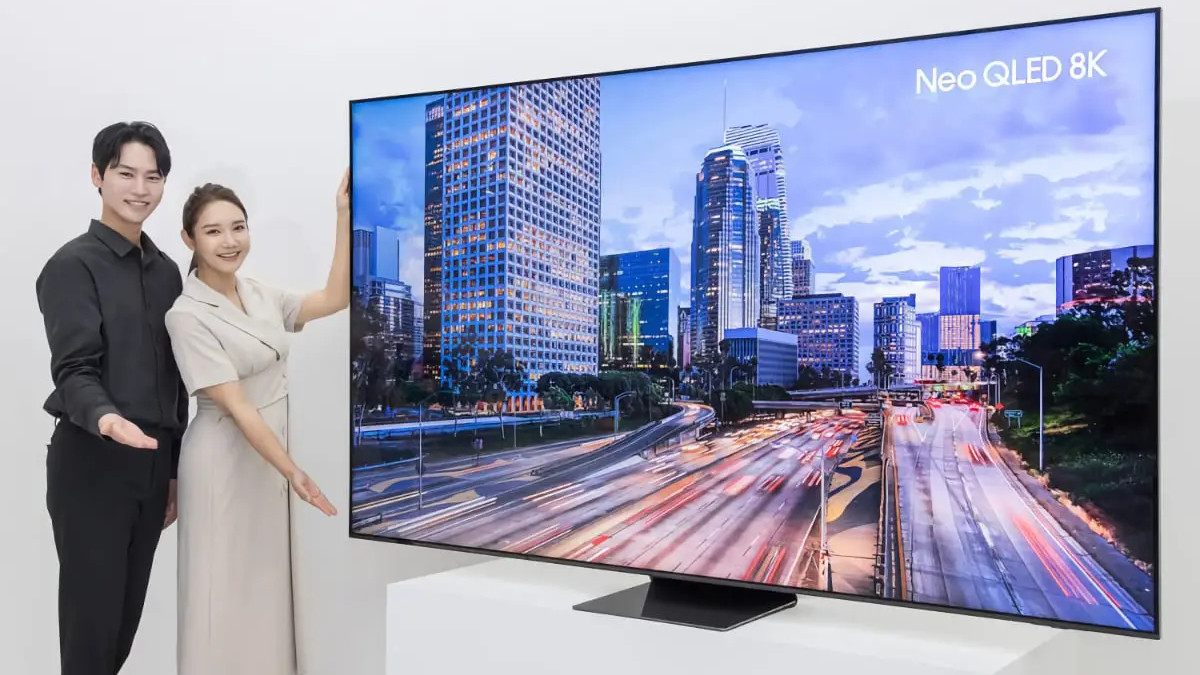
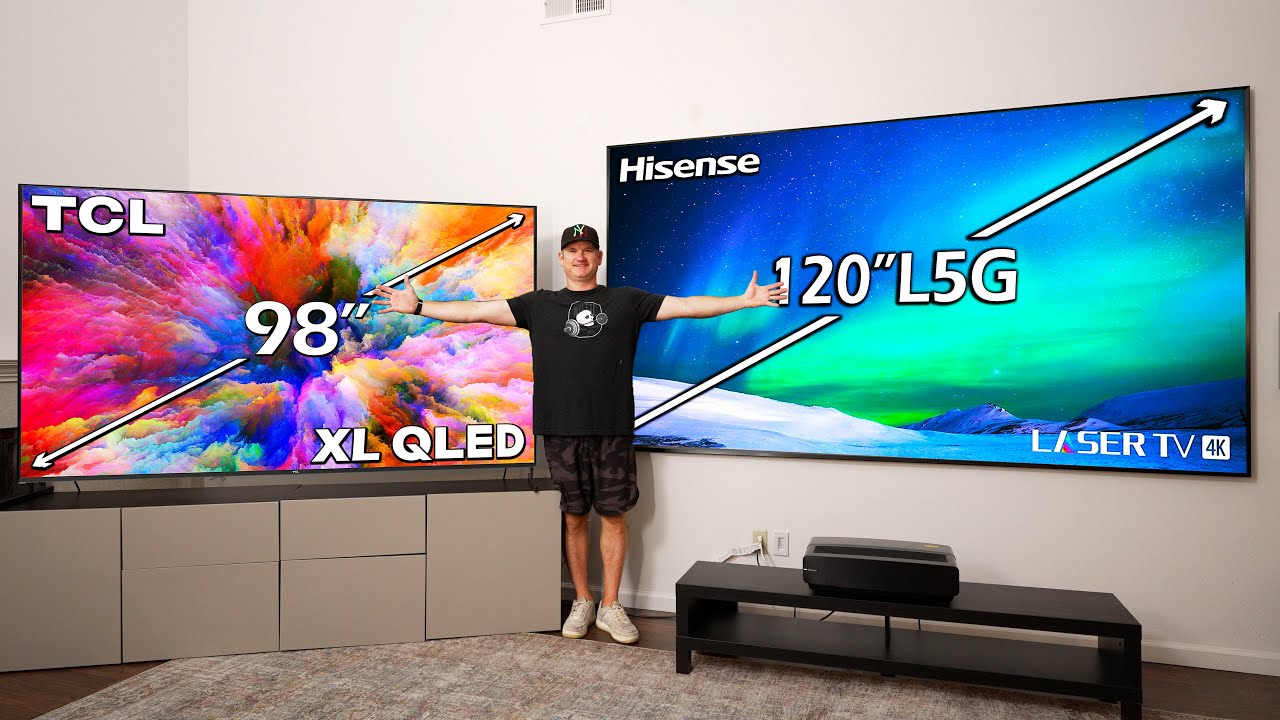
It can be if the seating is close or the wall cannot safely support the installation. The listed widths in this roundup are generally around 86 inches, so measure the wall, cabinet and delivery route before ordering. Viewing distance also affects whether the screen feels immersive or overwhelming.
Are Mini LED TVs better than QLED TVs?
Mini LED and QLED describe different parts of the picture system. Mini LED refers to the backlight and local dimming, while QLED refers to quantum-dot color. A television can use both, as the TCL QM7K and QM6K do, giving it both strong color and more precise contrast control.
Is 120Hz enough for gaming on a 98-inch TV?
Yes, 120Hz is enough for many console games and provides smooth motion for sports and action. A 144Hz model such as the TCL F8D, QM6K or QM7K can be more useful with a compatible gaming PC. VRR, ALLM and suitable HDMI inputs matter just as much as the refresh-rate ceiling.
Which model is strongest for movies?
The Sony BRAVIA 5 is the most film-focused option because it combines Mini LED, XR processing, Dolby Vision, studio calibrated modes and IMAX Enhanced support. The TCL QM7K is a stronger all-round choice for a brighter room or mixed gaming household. Both are more cinema-oriented than the Crystal UHD models.
Do these televisions need a soundbar?
Not necessarily, but a soundbar or receiver can add clearer dialogue, stronger bass and wider surround effects. The TCL F8D has Dolby Atmos, DTS Virtual:X and a 2 by 15-watt plus 15-watt speaker system, while the TCL models include Atmos-oriented audio features. Samsung's Q-Symphony can be useful if you already have a compatible Samsung soundbar.
Can a 98-inch TV be wall mounted?
The size and listed weights make professional installation a sensible consideration. Several models weigh more than 117 pounds, and the Sony BRAVIA 5 is listed at 152.1 pounds. Check the mount requirements for the specific television, the wall structure and the clearance needed for cables and ventilation.
The bottom line
The TCL QM7K is our Best 98 TV pick because its QD Mini LED backlight, up to 2, 500 dimming zones, anti-reflective panel and 144Hz gaming support cover the widest range of rooms and uses. The TCL QM6K is the better fit for sports-first households, while the Sony BRAVIA 5 earns its place when accurate film presentation and careful upscaling matter most.
For gaming, choose the TCL F8D for its four HDMI 2.1 inputs and native 144Hz panel. Samsung owners may prefer the Samsung Q7F or Samsung U9000H for Tizen and ecosystem features, while the LG NU85 is the strongest alternative for mixed-quality sources.
If you are undecided, choose the TCL QM7K unless your room, console setup or film preferences point clearly to another model.
As an Amazon Associate we earn from qualifying purchases.