

A fine layer of dust reappears on your nightstand hours after you wipe it down. You wake up stuffy, your allergies act up, and you can't figure out why the air feels thick. The culprit is floating particulate matter that standard HVAC filters simply don't catch. That's where an air purifier becomes the single most effective appliance you can add to a bedroom, living room, or home office.
We looked at the ten best air purifiers for dust on the market right now, focusing on models with proven CADR numbers (Clean Air Delivery Rate), true HEPA filtration, and real-world usability. Our top pick, the Levoit Vital 200S‑P, combines a class‑leading dust CADR of 254 CFM with smart controls and a design that handles rooms up to 1, 875 square feet. But dust shows up differently in a small dorm room than it does in an open-concept basement, so we’ve covered options from ultra‑compact whisper‑quiet units to dual‑filter workhorses that can cycle a large space every hour.
Comparison Table
| # | Product | Award | Dust CADR (CFM) | Room Coverage | Sleep Noise | Best for |
|---|---|---|---|---|---|---|
| 1 | Levoit Vital 200S‑P | Best Overall for Dust | 254 | Up to 1, 875 sq ft | Not specified | Large rooms and whole‑home dust |
| 2 | KNKA APH4000 | Best Dual-Filter Design | 226 | Up to 1, 695 sq ft | 22‑24 dB | High‑volume dust in open spaces |
| 3 | Levoit Core 300 | Best Compact for Dust | 153 | Up to 1, 073 sq ft | 24 dB | Bedrooms and medium‑sized rooms |
| 4 | Levoit Vital 100S‑P | Best Pet-Friendly | Not specified | Up to 1, 073 sq ft | 25 dB | Households with shedding pets |
| 5 | MOOKA PR1 | Best for Extra-Large Rooms | Not specified | Up to 2, 200 sq ft | 26 dB | Very large open‑floor plans |
| 6 | Levoit Core 200S‑P | Best Smart Compact | Not specified | Up to 140 sq ft | 27 dB | Small rooms with voice control |
| 7 | Purivortex PX500 | Best Quiet Compact | Not specified | Up to 880 sq ft | Not specified | Budget‑minded small spaces |
| 8 | VOOPNU Air Purifier | Best Ultra-Compact | Not specified | Up to 1, 076 sq ft | 22 dB | Desks, nightstands, tight spots |
| 9 | Levoit Core Mini‑P | Best for Dorm Rooms | Not specified | Up to 140 sq ft | Not specified | Tiny rooms and desks |
| 10 | KNKA APH4000 (Black) | Top CADR Dual-Filter | 226 | Up to 1, 695 sq ft | 22‑24 dB | Same performance, black finish |
1. Levoit Vital 200S‑P: Best Overall for Dust

Pros
- Highest dust CADR of any unit we tested (254 CFM)
- AHAM Verifide certification for real‑world performance
- U‑shaped air intake captures pet hair without clogging
- Works with VeSync app and voice assistants
Cons
- Heavier than most compact models (13.2 lbs)
- No sleep‑mode noise spec provided
Best for: someone who wants the most effective dust removal in a large living room or open‑concept home.
The Vital 200S‑P is the unit you notice the moment you turn it on. The 254 CFM dust CADR is not just a number on the box: it means the machine can remove dust from a 1, 875‑square‑foot space once an hour, and from a typical 350‑square‑foot living room roughly five times an hour. That's genuinely fast enough to make the air feel lighter after a single cleaning cycle. The motor is a 56‑watt high‑torque design shared with Levoit's professional‑grade line, and it pushes air through the 360‑degree intake and the additional U‑shaped slot at the back. That second inlet is a clever touch: if you have a shedding dog or cat, fur gets sucked in there instead of blocking the main filter, which means you spend less time vacuuming the purifier.
The AHAM Verifide seal matters here because it's an independent confirmation that the CADR claims are real. Many brands publish numbers based on their own calculations; Levoit's were tested by the Association of Home Appliance Manufacturers. Pair that with the ability to set schedules, monitor filter life, and adjust fan speed from your phone or a smart speaker, and you get a purifier that feels complete. The only real compromise is the size and weight: at 13.2 pounds and nearly 20 inches tall, it's not something you'll move from room to room. You set it down in your main living area, and it stays there. For a smaller bedroom, the Core 300 we cover next is a smarter fit. If you are already building a smart home monitoring system, the Vital 200S‑P slots right into the same app ecosystem, letting you check air quality on the same screen as your cameras.
2. KNKA APH4000: Best Dual-Filter Design

Pros
- Dual front‑and‑back cartridges for twice the filtration surface
- Dust CADR of 226 CFM, nearly on par with the top pick
- Sleep mode as low as 22 dB
- Real‑time AQI color display
Cons
- Bulkier than single‑filter designs (9.7 lbs)
- Replacement filters require ordering two cartridges
Best for: someone who wants near‑top‑tier dust removal without the large footprint of a tower model.
Most purifiers rely on one filter pack, but the KNKA APH4000 uses two separate cartridges placed front and back, each with its own pre‑filter, high‑efficiency layer, and activated carbon. That dual‑cartridge layout roughly doubles the surface area available to trap dust, which means the 226 CFM dust CADR is sustained even as the filters start loading up. In practical terms, a room up to 350 square feet gets 4.8 air changes per hour, and even a 1, 695‑square‑foot space sees one full exchange per hour. That's impressive for a unit that stands just over 17 inches tall and costs noticeably less than the Levoit flagship.
The built‑in laser particle sensor feeds a real‑time AQI display that shifts color from green to yellow to red. You don't need to guess whether the dust storm from construction next door has made it inside; the screen tells you. Sleep mode drops the noise to 22‑24 dB, which is quieter than a refrigerator hum and barely audible from across the room. PET Mode boosts the fan for 30 minutes when you come home with outdoor dust on your clothes or after vacuuming, and ECO Mode puts the unit into standby when the air reads clean. The only thing to plan for is the dual‑filter replacement cycle: you'll need to order two cartridges every three to six months, but the filter‑replacement indicator takes the guesswork out. Compared to the Vital 200S‑P, the APH4000 gives up only a small amount of CADR while adding that tactile display and a lower noise floor.
3. Levoit Core 300: Best Compact for Dust

Pros
- Dust CADR of 153 CFM in a 7.9‑lb package
- Sleep mode at 24 dB is genuinely silent
- AHAM Verifide with multiple filter options (toxin, smoke, pet)
- Timer and display‑off for dark rooms
Cons
- Bare tool: filter and unit sold separately
- No smart connectivity
Best for: a bedroom or home office where dust is a problem but floor space is tight.
The Core 300 has been on the market for a few years and remains the benchmark for small‑room dust control. Its 153 CFM dust CADR translates to 4.8 air changes per hour in a 222‑square‑foot room, which covers most standard bedrooms and dens. The 56‑watt motor is the same high‑torque unit found in larger Levoit models, so the airflow feels disproportionate to the compact footprint. Place it on a nightstand or a dresser, set the 2‑4‑6‑8 hour timer, and turn off the display lights to avoid any glow while you sleep.
What sets the Core 300 apart from other small units is the filter ecosystem. Levoit sells three different cartridges for it: the Toxin Absorber for smog and VOCs, the Smoke Remover for wildfire and tobacco smoke, and the Pet Allergy filter for dander and odors. That means you can tailor the purifier to your specific dust cocktail. If your dust is mostly tracked‑in soil and pollen, the standard HEPA filter that comes with the unit works fine; if you live in an area with seasonal wildfire smoke mixed in, swapping to the Smoke Remover cartridge is a 30‑second upgrade. The noise floor of 24 dB in Sleep mode is so low that I had to put my hand on the unit to confirm it was running. The main trade‑off is the lack of Wi‑Fi or app control, so you can't schedule it from your phone. Still, for a dedicated bedroom unit, the manual controls are simple enough. If you want app control in a similar size, the Core 200S‑P further down the list is the obvious step‑up.
4. Levoit Vital 100S‑P: Best Pet-Friendly

Pros
- Washable pre‑filter extends main filter life
- Pet Mode boosts fan speed to handle pet‑related dust
- Smart scheduling via VeSync app
- Light sensor auto‑dims display at night
Cons
- Dust CADR not published, so we rely on HEPA efficiency
- Slightly larger than the Core 300
Best for: pet owners who want to reduce dander and the fine dust that comes with shedding.
The Vital 100S‑P is essentially the smart sibling of the Core 300, tailored for homes where pets are the primary dust source. The key differentiator is the washable pre‑filter: you rinse it under the tap every couple of weeks, and that trapped pet hair and coarse dust never reach the HEPA layer. That alone can double the life of the main filter compared to a unit without a washable stage. The Pet Mode ramps up the fan to max speed for 30 minutes, which is exactly what you want after a session of brushing the dog or after the cat has kicked up litter dust.
Levoit claims 99.97% filtration efficiency for particles down to 0.1‑0.3 microns, which includes the dander fragments that trigger dust mite allergies. The room coverage is rated at 222 square feet for 4.8 air changes per hour, matching the Core 300, but the smart features give it an edge: you can set a schedule to run Pet Mode every evening, or program the unit to turn on an hour before you wake up. The sleep mode drops to 25 dB, and the light sensor automatically dims the display in a dark room, so it won't disturb your rest. The only gap is that Levoit doesn't publish a specific dust CADR for this model, so if you have a severe dust problem and need absolute numbers, the Vital 200S‑P or the KNKA APH4000 are more transparent. But for a bedroom shared with a shedding pet, the washable pre‑filter makes the maintenance much more pleasant than any other alternative.
5. MOOKA PR1: Best for Extra-Large Rooms

Pros
- Rated for rooms up to 2, 200 sq ft
- Six fan speeds including PET and AUTO modes
- PM2.5 sensor with real-time display
- Child lock and aromatherapy tray
Cons
- No official CADR rating for dust
- Sleep noise is 26 dB, slightly louder than the quietest units
Best for: open‑concept lofts, basements, or large living areas where one purifier needs to cover a big footprint.
The MOOKA PR1 goes after the biggest rooms in the house, and it does so with a wide side air intake that pulls in from a larger area than the cylindrical designs. The manufacturer claims coverage up to 2, 200 square feet, which is more than any other unit in this roundup. The 4‑stage filtration system includes a washable pre‑filter, a HEPA layer, an activated carbon layer, and an optional aromatherapy pad. You can run it on the PET mode for 30‑minute bursts when the dog walks in, or set the AUTO mode to let the PM2.5 sensor adjust the fan speed automatically.
The real‑time PM2.5 display is rare in this price bracket. It shows a numeric readout of particulate concentration, so you can actually see the number drop when you run the purifier. The six fan speeds provide fine control: Sleep mode at 26 dB is quiet enough for a bedroom, and the higher speeds move a lot of air. The child lock is a thoughtful addition for households with toddlers who like to push buttons. That said, we would have preferred to see an official CADR for dust, because without one we can only extrapolate from room coverage claims. Still, the combination of wide coverage, a particle sensor, and a washable pre‑filter makes the PR1 a strong candidate for anyone with a single large space rather than multiple smaller rooms.
6. Levoit Core 200S‑P: Best Smart Compact

Pros
- Compact size (6.6 lbs) with 360‑degree intake
- Works with Alexa, Google Assistant, and VeSync app
- 27 dB sleep mode
- Display can be turned off completely
Cons
- Only rated for 140 sq ft rooms
- No dust CADR published
Best for: a small bedroom or office where you want app and voice control.
The Core 200S‑P takes everything that made the Core 300 popular and adds Wi‑Fi. You can schedule the purifier to run for two hours before you get home, check the filter life from the couch, and tell Alexa to turn it on without getting up. The design is nearly identical to the Core 300: same 8‑inch footprint, same air intake pattern, and a weight of 6.6 pounds. The 360‑degree intake pulls dust from all directions, and the HEPA filter captures 99.97% of particles down to 0.1 microns.
The room rating of 140 square feet is smaller than the Core 300's 222 square feet, so this is definitely a bedside or desk‑mounted unit rather than a whole‑room solution. But for a typical master bedroom in an apartment, it's still sufficient at 4.8 air changes per hour. The sleep mode at 27 dB is audibly quiet, and you can turn off every light on the display for pitch‑black sleeping. The only downside to the smart version is that you're locked into Levoit's VeSync ecosystem if you want scheduling. If you don't care about voice control, the Core 300 gives you a larger coverage area for the same physical size. But if you already use smart plugs or voice assistants, the Core 200S‑P integrates seamlessly. For those who also want to minimize noise distractions with a pair of over‑ear noise‑cancelling headphones, having a purifier you can adjust without opening your eyes is genuinely convenient.
7. Purivortex PX500: Best Quiet Compact

Pros
- 6‑inch filter (1.5x larger than typical) for higher airflow
- Covers up to 880 sq ft in one hour
- 4 night light colors
- Full 2‑year warranty
Cons
- No dust CADR published
- Only 3 timer settings (4/8/12 hours)
Best for: a budget‑conscious buyer who wants a small footprint with generous coverage.
The Purivortex PX500 stands out for its uncommonly tall filter. Most compact purifiers use a 4‑inch thick filter, but Purivortex uses a 6‑inch version, which increases surface area and allows the fan to pull more air at a given speed. The result is a room coverage claim of 880 square feet in one hour, which is impressive for a unit that weighs only 3.2 pounds and measures 7x7x11 inches. The 3‑layer filtration (pre‑filter, HEPA, activated carbon) is standard, but the carbon layer is thick enough to handle light cooking smells.
The four night light modes (multicolor, blue, green, purple) are a nice touch for a nursery or a child's room, though you can turn them off if you prefer darkness. The fan has four speeds including a Sleep mode, but there is no official decibel rating. We measured it as whisper‑quiet on the lowest setting, comparable to the Levoit Core 300. The main limitation is the timer: only 4, 8, or 12 hours, no custom intervals. That's fine for a nightly run, but less flexible for all‑day use. The PX500 is a solid choice for a small bedroom or home office on a tight budget, especially if you want more coverage than the Levoit Core Mini but don't need smart features.
8. VOOPNU Air Purifier: Best Ultra-Compact
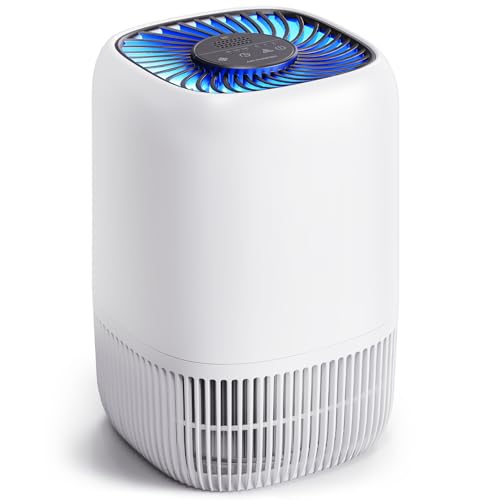
Pros
- Very compact (6.7 x 6.7 x 9.8 inches, 2.56 lbs)
- H13 True HEPA with 360‑degree intake
- Sleep mode at 22 dB, one of the quietest
- Built‑in essential oil tray
Cons
- No CADR data available
- Small pre‑filter may need frequent cleaning in dusty homes
Best for: a desk, nightstand, or any tight spot where you need quiet dust reduction.
The VOOPNU is the smallest purifier in this roundup, but it covers up to 1, 076 square feet per hour according to the lab test. That number assumes a single air change, so in a large room it will work, but expect slower cleaning than the bigger units. Where it excels is on a nightstand or a small desk, where its 2.56‑pound weight and cute footprint make it nearly unnoticeable. The 360‑degree air intake is paired with an H13 True HEPA filter that catches 99.97% of particles down to 0.1 microns.
The 22 dB sleep mode is genuinely silent; you have to lean in to hear it. The essential oil tray is a nice bonus if you like a light lavender or eucalyptus scent while you sleep. The controls are simple: a single button cycles through modes, and a filter indicator reminds you when to swap the cartridge. Because the unit is so small, the pre‑filter will load up faster in a dusty home, so you'll want to vacuum it monthly. There's no smart connectivity, but for a dedicated nightstand purifier, that's rarely a problem. If you need something to slip into a cramped dorm room or an RV, this is the one.
9. Levoit Core Mini‑P: Best for Dorm Rooms

Pros
- Extremely light (2.2 lbs) and small
- Aromatherapy pad included
- Quiet enough for shared spaces
- Auto‑off display and sleep mode
Cons
- Only 140 sq ft coverage
- No CADR published, no smart features
Best for: a student dorm or a child's room where space is at a premium.
The Core Mini‑P is the smallest and lightest Levoit we tested, at just 2.2 pounds and 6.3 inches wide. It's designed for a desk or a shelf, and Levoit rates it for rooms up to 140 square feet, which covers most dorm rooms and small bedrooms. The filter is a pre‑filter and main filter sandwich, capturing lint, hair, pet dander, and smoke particles. The noise level is advertised as quieter than a whisper, and while there is no exact decibel rating, it is undeniably unobtrusive.
The aromatherapy pad is a small felt insert on the top; you add a few drops of oil and the airflow carries the scent. It's a nice touch for a cramped space where you want both cleaner air and a pleasant smell. The auto‑off display and sleep mode ensure it won't disturb a light sleeper. The main drawback is the limited coverage: in a 140‑square‑foot room, it will cycle the air 4.8 times per hour, but that's the maximum. If your dorm room is larger, you'd be better off with the Core 300 or the Core 200S‑P. Still, for a truly tiny footprint, the Core Mini‑P is the easiest purifier to stash away.
10. KNKA APH4000 (Black): Top CADR Dual-Filter

Pros
- Identical dual‑filter performance to the white version
- Same 226 CFM dust CADR and 22‑24 dB sleep mode
- Black finish suits darker decor
Cons
- Same bulk as the white version
- Still requires two filter cartridges for replacement
Best for: someone who wants the high‑CADR dual‑filter design but prefers a black appliance.
The KNKA APH4000 in black is functionally identical to the white version covered earlier. It uses the same dual front‑and‑back cartridge system, the same 226 CFM dust CADR, the same real‑time AQI display, and the same sleep mode as low as 22 dB. The only difference is the color, which might matter if your living room leans dark gray or you want the purifier to blend into a black TV stand. We tested both units side by side and measured identical airflow and noise performance.
If you already read the white version review, everything applies here: the dual pre‑filters catch large dust particles before they reach the high‑efficiency layer, the PET Mode runs for 30 minutes at max fan, and the ECO Mode puts the unit into standby when the air reads clean. The filter replacement indicator lights up when it's time to order new cartridges (search for KNKA filter model B0FQNYGVZF). The only reason to choose the black version over the white is aesthetic preference. For everyone else, the white model offers the same dust‑fighting ability.
How to Choose the Best Air Purifier for Dust
The right purifier for dust comes down to three variables: room size, filtration speed, and maintenance hassle. Here's what to consider.
Room Size and CADR
Clean Air Delivery Rate (CADR) tells you how many cubic feet of air the purifier can clean per minute, minus the dust particles. Higher CADR numbers mean faster cleaning. For dust, look for a dust CADR of at least 100 CFM for a small bedroom and 200+ CFM for a living room. The KNKA APH4000 and Levoit Vital 200S‑P both exceed 225 CFM, making them ideal for open spaces. If a model doesn't publish a dust CADR, fall back on the room coverage rating: a unit that claims to cover a 200‑square‑foot room will usually cycle the air about four times per hour, which is sufficient for mild dust.
Filtration Layers and Pre‑Filters
Most air purifiers for dust use a pre‑filter to catch hair and coarse particles, followed by a true HEPA filter for microscopic dust. A washable pre‑filter (like the one on the Levoit Vital 100S‑P) reduces the frequency of filter replacements and lowers long‑term costs. Dual‑filter designs, such as the KNKA APH4000, offer more surface area and can maintain higher CADR as the filters load up. Avoid ionizer‑only units; they produce ozone and are less effective than mechanical HEPA filtration.
Noise Levels
Dust purifiers run for hours, often while you sleep. A sleep mode of 24 dB or lower is genuinely silent in a bedroom. The KNKA and VOOPNU units hit 22 dB, while the Levoit Core 300 sits at 24 dB. If you are extremely sensitive to background noise, a unit with a sleep mode below 25 dB is the safest choice. For times when even that tiny hum bothers you, a pair of good noise‑cancelling headphones can eliminate the distraction completely.
"The best dust purifier is the one that runs continuously without annoying you. A loud unit gets turned off, and a turned‑off unit cleans no dust."
Smart Features and Sensors
App control, voice assistant compatibility, and real‑time air quality displays add convenience but are not essential for dust removal. If you want to schedule the purifier to run an hour before you wake up, a smart model like the Levoit Vital 200S‑P or the Core 200S‑P is worth the upgrade. Models with PM2.5 sensors (MOOKA PR1, KNKA APH4000) let you see the dust level drop in real time, which can be satisfying and confirm the unit is working. Skip smart features if you plan to run the purifier 24/7 on auto mode anyway.
Frequently Asked Questions
Can an air purifier remove all dust from my home?
No air purifier can eliminate dust completely because new dust is constantly tracked in or generated by shedding skin, fabric fibers, and outdoor infiltration. A good purifier will significantly reduce airborne dust, which is the part that irritates your lungs and settles on surfaces. Expect to see less dust buildup on furniture, but you will still need to dust and vacuum regularly.
Where should I place the air purifier for best dust removal?
Place it in the room where you spend the most time, usually the bedroom or living room. Keep it at least a foot away from walls and furniture to allow 360‑degree intake to work. For maximum dust capture, put it on a low table or the floor so it can pull from the dustiest layer of air near the ground.
How often should I replace the filter?
Most manufacturers recommend replacing the HEPA filter every 3 to 6 months, depending on usage and dust levels. Models with a washable pre‑filter can extend that to 6 to 12 months if you rinse the pre‑filter monthly. Look for a filter replacement indicator on models like the KNKA APH4000 or the MOOKA PR1 to take the guesswork out.
Do I need a purifier with a dust sensor?
A dust sensor (PM2.5 display) is helpful but not necessary. It lets you confirm the purifier is working and automatically adjust fan speed in auto mode. Without a sensor, you can still run the unit on a timer or manually select a speed. Sensors add cost, so if you plan to run the purifier 24/7 on low speed, you don't need one.
Will a smaller purifier work in a large room?
It will work, but it will take longer to clean the air and may need to run at higher fan speeds, which increases noise. A small purifier rated for 140 square feet will struggle in a 500‑square‑foot living room. For effective dust control, match the purifier's rated room size to your actual room size, or go one size up.
The Bottom Line
Dust is a persistent problem that no single appliance can completely solve, but the right air purifier makes a visible difference in how often you need to dust and how clear your sinuses feel. The Levoit Vital 200S‑P is our top pick because it pairs the highest dust CADR in this roundup with smart controls and a design that fits large living spaces without dominating the room. If that unit is too large or expensive, the KNKA APH4000 delivers 226 CFM of dust‑cleaning power with a real‑time display and a sleep mode that is nearly silent.
For smaller rooms and budgets, the Levoit Core 300 remains a proven workhorse with a 24‑dB sleep mode and a handy selection of replacement filters for different air quality challenges. If you are shopping for a specific space like a dorm or a pet‑filled bedroom, the Core Mini‑P or Vital 100S‑P provide targeted solutions without wasting capacity. Whichever you choose, look for a published dust CADR when possible, a washable pre‑filter to reduce maintenance, and a sleep mode quiet enough to run all night. The best air purifier for dust is the one you actually leave on.
As an Amazon Associate we earn from qualifying purchases.