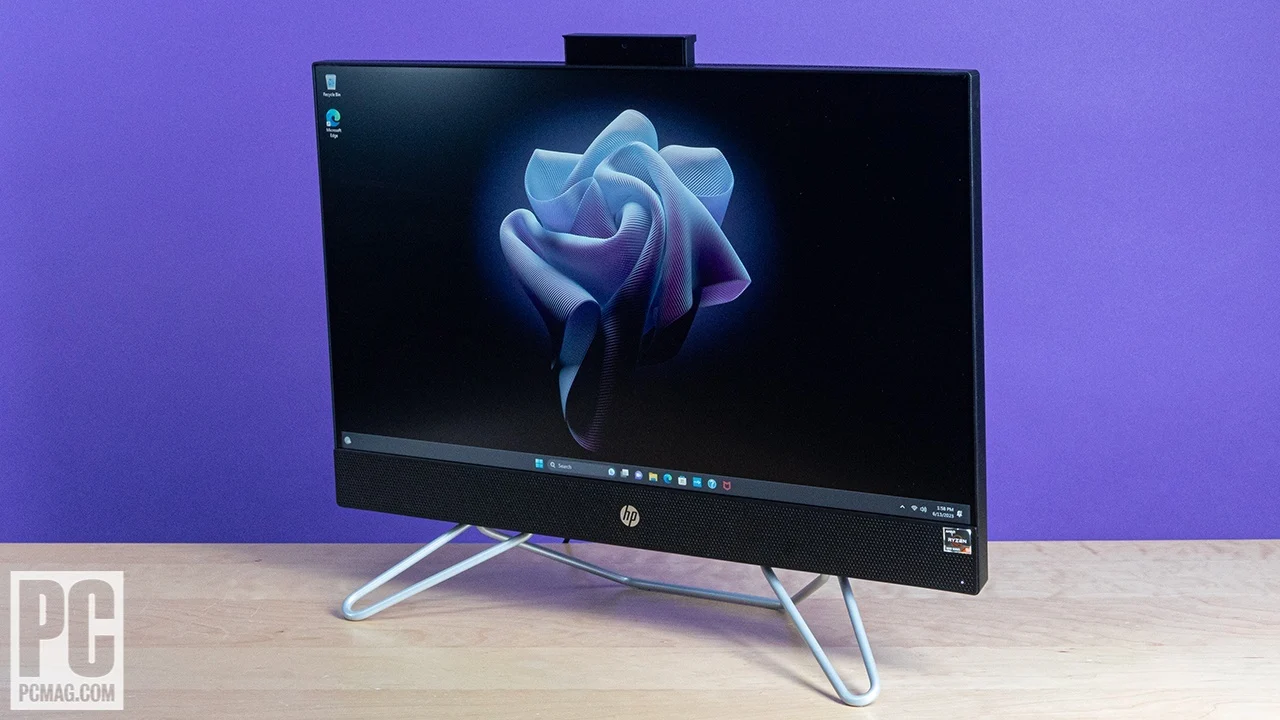

An all-in-one PC should simplify the desk without turning ordinary work into a waiting game. The wrong model can leave you choosing between a cramped screen, limited storage, and sluggish multitasking, while the right one combines a capable computer, display, webcam, and speakers in a single clean setup.
Our Best best all in one pc picks range from compact everyday machines to large touchscreen desktops with fast solid-state storage and stronger processors. HP 27-inch Ryzen 7 AIO is the one we'd choose first, while the other eight make sense for smaller desks, lighter workloads, flexible connectivity, or more demanding home-office use.
| # | Product | Award | Screen | Processor | Memory and storage | Best for |
|---|---|---|---|---|---|---|
| 1 | HP 27-inch Ryzen 7 AIO | Best overall | 27-inch FHD | AMD Ryzen 7 7730U | 32GB, 1TB SSD | Multitasking and home offices |
| 2 | HP 27-inch Ryzen 5 Touch | Best touchscreen | 27-inch FHD IPS touch | AMD Ryzen 5 7520U | 16GB, 1TB SSD | Touch-friendly productivity |
| 3 | Dell 23.8-inch Ultra 7 AIO | Best for AI features | 23.8-inch FHD touch | Intel Core Ultra 7 | 16GB, 1TB SSD | Modern business workflows |
| 4 | Lenovo 24-inch N100 AIO | Best business setup | 23.8-inch FHD IPS | Intel N100 | 16GB, 256GB SSD | School and office work |
| 5 | Cybrimax 24-inch i5 AIO | Best for wireless connectivity | 24-inch HD | Intel i5 | 16GB, 256GB SSD | Video calls and peripherals |
| 6 | Lenovo IdeaCentre V100 | Best expandable option | 23.8-inch FHD IPS | Intel N100 | 8GB, 512GB SSD | Everyday home computing |
| 7 | MECHAZER 23.8-inch Curved AIO | Best curved display | 23.8-inch curved | Intel Core i7-7700HQ | 16GB, 512GB SSD | Compact desk entertainment |
| 8 | HP 22-inch N100 AIO | Best compact HP | 21.5-inch FHD | Intel N100 | 8GB, 128GB SSD | Small desks and basics |
| 9 | Core Innovations 24-inch AIO | Best for light tasks | 24-inch FHD IPS | Intel Celeron N5095 | 4GB, 128GB storage | Basic browsing and documents |
1. HP 27-inch Ryzen 7 AIO: Best Overall

Pros
- 32GB of memory suits heavy multitasking
- 1TB solid-state storage leaves room for large file libraries
- Slim three-sided micro-edge display
- Pop-up privacy camera and noise-reduction microphones
Cons
- Display resolution is limited to Full HD
- No touchscreen listed
- Windows 11 Home is less business-focused than Windows 11 Pro
Best for: home-office users who want a large screen and enough memory for demanding daily multitasking.
The HP 27-inch Ryzen 7 AIO is the easiest model here to recommend to someone who wants one desktop for work, video calls, browsing, and a large collection of documents or photos. Its 27-inch screen gives spreadsheets and side-by-side windows more breathing room than the 23.8-inch models, while the slim three-sided micro-edge design keeps the front from feeling bulky.
The important advantage is the combination of an AMD Ryzen 7 7730U processor, 32GB of memory, and a 1TB solid-state drive. The generous memory is the part that changes daily use most. It gives a busy browser, office software, communication apps, and background utilities more room to run together without forcing the system to constantly shuffle tasks. The 1TB SSD also means there is room for a substantial document, media, and application library before storage management becomes a routine chore.
HP has paid attention to calls as well. The pop-up privacy camera can be hidden when it is not needed, and the system includes dual-array microphones with noise-reduction technology. The display has a high screen-to-body ratio, so the computer feels more like a broad workspace than a monitor with a thick frame attached. The specification confirms Full HD resolution, but it does not identify the panel as touch-enabled, so this is a conventional display rather than a hands-on interface.
Compared with the HP 27-inch Ryzen 5 Touch, this model has twice the memory but gives up the touchscreen. Compared with the Dell 23.8-inch Ultra 7 AIO, it has a larger display and more memory than the listed Dell configuration, but the Dell brings newer connectivity and a more advanced camera design. That makes the HP the stronger general-purpose workstation, while the Dell is more interesting for buyers focused on newer AI-oriented features.
The weakness is straightforward: Full HD spread across 27 inches is practical, but not especially dense for fine text or detailed creative work. It also runs Windows 11 Home, not Pro. Choose it for spacious everyday productivity, multitasking, and calls. Skip it if touch input, business-specific Windows features, or a sharper high-resolution panel matters more than screen size.
2. HP 27-inch Ryzen 5 Touch: Best Touchscreen

Pros
- Large 27-inch IPS touchscreen
- 16GB memory and 1TB PCIe NVMe SSD
- 99% sRGB coverage
- 1080p IR privacy camera
- Wireless keyboard and mouse included
Cons
- AMD Ryzen 5 processor is behind the Ryzen 7 HP
- 250-nit brightness is modest
- Memory is onboard
Best for: users who want touch controls, a broad display, and Windows 11 Pro in a tidy desktop package.
The HP 27-inch Ryzen 5 Touch is the more inviting desktop when you regularly reach toward the screen. Its 27-inch FHD IPS panel supports touch, has an anti-glare coating, and covers 99% of the sRGB color space. That combination suits recipe viewing, large menus, casual photo organization, and office work where tapping a control is more natural than reaching for a mouse.
The screen's 1, 920 by 1, 080 resolution is standard Full HD, and the 250-nit brightness rating tells you where it belongs. It should be most comfortable in a controlled indoor room rather than beside a bright window or under strong overhead lighting. The IPS panel and wide viewing design matter when more than one person is looking at the screen, while the anti-glare surface helps keep reflections from taking over.
Inside, AMD's Ryzen 5 7520U works with 16GB of onboard LPDDR5-5500 memory and a 1TB PCIe NVMe M.2 SSD. That is a sensible pairing for office software, web work, video calls, and keeping a large set of files close at hand. The memory is onboard, so this is not the model to select if you expect to upgrade the RAM later. HP includes a white wireless keyboard and mouse, which keeps the area beneath the screen cleaner than a wired setup.
The built-in camera is unusually well specified for this group. It is a 1080p FHD IR tilt privacy camera with temporal noise reduction and dual-array digital microphones. Windows 11 Pro adds business-oriented features that the HP 27-inch Ryzen 7 AIO does not list, though the Ryzen 7 model counters with 32GB of memory. For a different kind of screen, the MECHAZER 23.8-inch Curved AIO offers a curved panel, but not the HP's touchscreen or IPS specification.
The main limitation is processing headroom. The Ryzen 5 chip is appropriate for normal desktop work, but the Ryzen 7 HP is the safer pick for large multitasking sessions. Bright-room use is another concern because 250 nits is not a high brightness figure. Pick this HP when touch input and a large, color-conscious IPS panel matter most, and pass on it if you need upgradeable memory or sustained heavy workloads.
3. Dell 23.8-inch Ultra 7 AIO: Best for AI Features

Pros
- Intel Core Ultra 7 processor with a dedicated 48 TOPS NPU
- FHD InfinityEdge touchscreen
- Retractable 5MP privacy camera
- Wi-Fi 6E and Bluetooth 5.3
- Wireless keyboard and mouse included
Cons
- Smaller screen than the 27-inch HP models
- Listed configuration has 16GB memory
- AI features may matter less for basic desktop work
Best for: professionals who want a current business-oriented desktop with touch, newer wireless standards, and dedicated AI acceleration.
The Dell 23.8-inch Ultra 7 AIO is the most technically ambitious computer in this group. It combines a 23.8-inch FHD InfinityEdge touchscreen with an Intel Core Ultra 7 Series 3 processor and a dedicated 48 TOPS neural processing unit. That NPU is designed for AI acceleration, so this is the desktop to consider if local AI-assisted productivity and newer Copilot+ PC features are part of the plan.
Dell's screen is smaller than either 27-inch HP, but the InfinityEdge design minimizes the visual bulk around it. Full HD resolution keeps the interface familiar and readable, while touch input gives the machine a tablet-like option for quick interaction. The 16GB of listed DDR5 memory and 1TB PCIe SSD form a strong everyday foundation for office applications, document work, video calls, and storing substantial projects.
The camera is a standout feature. Dell lists a retractable 5MP privacy camera that hides when not in use, along with dual-array microphones and stereo speakers. That is a more complete conferencing setup than the basic HD camera on the Lenovo IdeaCentre V100, and it avoids the awkwardness of placing a separate webcam on top of the screen. Wi-Fi 6E and Bluetooth 5.3 also give it a newer wireless platform than the Wi-Fi 6 and Bluetooth 5.2 combinations used by the Lenovo models.
This is a very different proposition from the HP 27-inch Ryzen 7 AIO. The HP offers a larger workspace and 32GB of memory, while the Dell brings a newer processor platform, a touchscreen, a retractable 5MP camera, and a dedicated NPU. The HP 27-inch Ryzen 5 Touch also has a touchscreen, but the Dell is the more forward-looking option for users who specifically care about AI-capable hardware and modern wireless connectivity.
The catch is that many ordinary users will not see a dramatic benefit from the NPU in simple browsing and document editing. The 23.8-inch screen is also less spacious for wide spreadsheets than the HP's 27-inch panels. Choose the Dell for a business setup built around new AI features, privacy, and wireless accessories. Skip it if your priority is maximum screen area or if your work does not use AI acceleration.
4. Lenovo 24-inch N100 AIO: Best Business Setup

Pros
- 16GB memory with a PCIe SSD
- Wi-Fi 6 and Bluetooth 5.2
- Anti-glare IPS panel with 99% sRGB coverage
- Useful selection of USB and HDMI ports
- Wireless keyboard and mouse included
Cons
- Intel N100 is aimed at everyday workloads
- 256GB SSD is less spacious than the HP and Dell drives
- Display is not touch-enabled
Best for: offices, study areas, and home users who need a balanced screen, wireless setup, and practical ports.
The Lenovo 24-inch N100 AIO gets the basics right without making the desk feel like a workstation. Its 23.8-inch FHD IPS anti-glare display is a comfortable middle size for a study area or office, and the 250-nit brightness with 99% sRGB coverage gives the panel a clear, restrained specification for documents, browser work, and general media.
The Intel N100 processor has four cores, four threads, a 6MB cache, and a maximum turbo frequency of 3.40GHz. Those figures point to a computer designed for everyday applications rather than complex rendering or demanding creative workloads. The stronger feature is the 16GB of DDR4 memory, which gives browser tabs, office applications, and communication software more room than the 8GB configurations lower down this list.
Storage is a 256GB PCIe SSD. It should make startup and application launches feel responsive, but it is not a large archive. Users who keep most files in cloud storage will find the capacity easier to live with than someone who stores a large media library locally. Connectivity is well covered with Wi-Fi 6, Bluetooth 5.2, two USB-A ports rated for 10Gbps, two USB-A 2.0 ports, HDMI-out, Ethernet, and a headset combination jack.
The included wireless keyboard and mouse reinforce its office role. Windows 11 Pro also fits a business environment better than the Home editions on the Lenovo IdeaCentre V100 and HP 27-inch Ryzen 7 AIO. The Cybrimax 24-inch i5 AIO offers the same memory and SSD capacity with Wi-Fi 6 and Bluetooth 5.3, but Lenovo gives more explicit detail about its IPS panel, anti-glare coating, and port layout.
The limitation is the processor. Four N100 cores are fine for common work, yet this is not a sensible choice for heavy editing or demanding software. The storage can also fill quickly if the computer becomes a central media hub. Choose the Lenovo for a clean, business-ready desk with good connectivity and sensible multitasking capacity.
5. Cybrimax 24-inch i5 AIO: Best for Wireless Connectivity

Pros
- 16GB dual-channel memory
- Wi-Fi 6 and Bluetooth 5.3
- Privacy protection webcam
- 256GB SSD
- Compact integrated design
Cons
- Processor model is not identified beyond the i5 label
- Display is described as HD without a detailed panel specification
- Windows 11 Home is less suited to managed business environments
Best for: people who want a ready-to-use desktop with wireless peripherals, video calling, and a compact black design.
The Cybrimax 24-inch i5 AIO is built around a familiar home-office formula: a 24-inch screen, a claimed i5 processor, 16GB of dual-channel memory, and an SSD. Its black integrated chassis should fit naturally into a study, small office, or shared work area, and the system is presented as ready to use with Windows 11 and its drivers already installed.
Cybrimax says the i5 processor can reach 3.3GHz, but it does not identify the exact generation or model. That missing detail matters because i5 branding covers a wide range of performance levels. The 16GB dual-channel RAM is clearer and more useful as a buying signal. It should make the desktop comfortable with multiple browser windows, document work, video meetings, and ordinary productivity software.
The 256GB SSD gives the system quick storage for applications and active files. It is enough for a focused work machine, though people with large photo or video libraries will need another storage plan. Wireless connectivity is one of the stronger points: Wi-Fi 6 handles current network traffic, while Bluetooth 5.3 is useful for wireless keyboards, mice, headsets, printers, and other accessories.
The built-in privacy webcam suits remote work, and the product description positions the 24-inch display for long work sessions, data analysis, and video calls. The Lenovo 24-inch N100 AIO provides more precise display information, including IPS, anti-glare treatment, 250 nits, and 99% sRGB coverage. On the other hand, the Cybrimax has the more attractive processor label and newer Bluetooth version, even though its exact CPU is less transparent.
That uncertainty is the real weakness. A buyer who needs predictable processor performance should choose a model with a fully named chip, such as the Dell 23.8-inch Ultra 7 AIO or Lenovo N100 machines. The display description is also less complete than Lenovo's. Pick the Cybrimax for a compact wireless workstation and privacy webcam, not for specialized software or demanding performance where the unidentified i5 becomes a concern.
6. Lenovo IdeaCentre V100: Best Expandable Option

Pros
- 512GB PCIe SSD
- Memory supports expansion up to 32GB
- 23.8-inch IPS anti-glare display
- Wi-Fi 6 and Bluetooth 5.2
- HDMI-out supports a second display
Cons
- Ships with 8GB DDR4 memory
- Intel N100 is intended for everyday computing
- Windows 11 Home
Best for: home users and students who want useful storage now with a clearer memory upgrade path later.
The Lenovo IdeaCentre V100 is the practical pick for someone who wants a conventional 23.8-inch desktop with more local storage than many entry-level configurations. Its 23.8-inch FHD IPS anti-glare screen has 250 nits of brightness and 99% sRGB coverage, making it a credible workspace for documents, browsing, and general media rather than merely a screen attached to a small computer.
The Intel N100 processor has four cores, four threads, a maximum turbo speed of 3.4GHz, and a 6MB cache. That puts it in the same everyday category as the Lenovo 24-inch N100 AIO, so both are aimed at schoolwork, office tasks, web browsing, and routine business software. The V100 starts with 8GB of DDR4-3200 memory, but Lenovo says the system can support up to 32GB total. That upgrade path is the reason to choose it over a machine with a fixed memory configuration.
Storage is a 512GB PCIe SSD, giving it more room for applications, documents, and media without immediately depending on external drives. The computer also has an HDMI-out port that can support two displays total, including the built-in panel. That is a valuable detail for anyone who needs a second screen for reference material, communication, or a larger spreadsheet.
Its port selection is generous for this size of desktop. There is one USB-C port rated at 10Gbps, two USB-A 2.0 ports, two USB-A ports rated at 10Gbps, HDMI-out, Ethernet, and a 3.5mm headset jack. Wi-Fi 6 and Bluetooth 5.2 cover wireless networking and accessories, while an HD camera, dual 2W speakers, and a mono microphone handle basic calls. A USB Calliope keyboard is included.
The trade-off is the initial 8GB memory, which can feel restrictive once many browser tabs and applications are open. The Lenovo 24-inch N100 AIO avoids that issue with 16GB from the start, though it offers only 256GB of SSD storage in the listed configuration. Choose the V100 if storage and future memory expansion matter more than immediate multitasking headroom. Skip it if you want maximum responsiveness without opening the upgrade question.
7. MECHAZER 23.8-inch Curved AIO: Best Curved Display
Pros
- Curved 23.8-inch display
- 16GB memory and 512GB SSD
- Windows 11 Pro
- Four USB 3.0 ports listed
- Wired keyboard and mouse included
Cons
- Older Core i7-7700HQ platform
- Display resolution and brightness are not specified
- Wired accessories add desk cables
Best for: users who prefer a curved screen and need a compact desktop for routine work and entertainment.
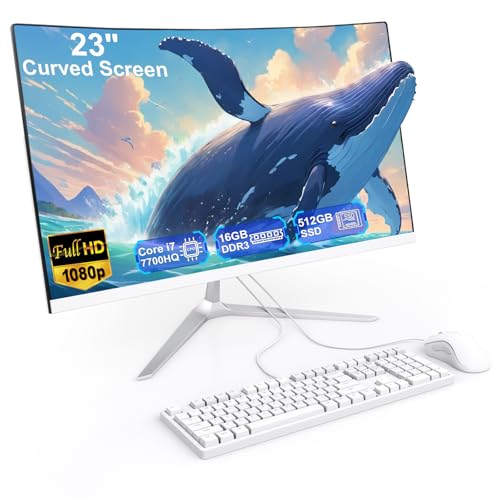
The MECHAZER 23.8-inch Curved AIO takes a different path from the flat-screen office machines here. Its curved display is the central attraction, giving the compact desktop a more distinctive feel for entertainment, browsing, and general work. A curve is most noticeable when you sit centered and fairly close to the screen, so it makes the most sense for a dedicated personal desk rather than a machine viewed from across a room.
The computer uses a Core i7-7700HQ processor with four cores, eight threads, a 2.8GHz main frequency, a turbo frequency up to 3.8GHz, and a 6MB cache. The chip is from an older mobile platform, so the i7 name should not be treated as a direct indication that it will outrun newer N100 or Ryzen processors in every task. It is still a clearly specified four-core processor for everyday work, but the age of the platform is a reason to keep expectations sensible.
The listed 16GB of memory and 512GB SSD are helpful pairings. There is enough memory for ordinary multitasking, and the storage gives more breathing room than the 128GB drives in the two smallest systems. MECHAZER also lists dual-band Wi-Fi, Bluetooth, two USB 2.0 ports, four USB 3.0 ports, a LAN port, HDMI, two audio jacks, and VGA. That range is useful if you have older accessories or need several wired connections at once.
A wired keyboard and mouse come in the box, which is simple but not especially tidy on a streamlined all-in-one desk. The product description says Windows 11 Pro is preinstalled, a useful distinction from the Home editions on the Lenovo IdeaCentre V100 and Cybrimax 24-inch i5 AIO. For a more modern platform, the HP 27-inch Ryzen 5 Touch offers a specified IPS panel, touch input, and a much newer memory standard, but it does not offer this model's curved screen.
The missing display details are the biggest concern. The listing identifies the size and curved form but does not provide the resolution, brightness, or panel type. That makes it harder to judge text sharpness and room-light performance before buying. Choose the MECHAZER because the curved design and broad connectivity suit your desk, and avoid it if panel quality, processor age, or wireless accessories are more important.
8. HP 22-inch N100 AIO: Best Compact HP

Pros
- Compact 21.5-inch Full HD screen
- Windows 11 Pro
- Wi-Fi 6 and Bluetooth 5.3
- USB-C and HDMI-out
- Webcam privacy shutter
Cons
- 8GB memory limits heavier multitasking
- 128GB SSD is small
- Smaller screen than the other HP models
Best for: small desks, front counters, and straightforward documents, browsing, and video calls.
The HP 22-inch N100 AIO is the space-conscious choice in this group. Its 21.5-inch Full HD display takes up less visual and physical room than the 23.8-inch and 27-inch options, making it a natural fit for a narrow desk, reception area, or study corner. The anti-glare coating should help in normal indoor lighting, and the 1, 920 by 1, 080 resolution keeps text and interfaces familiar.
The Intel N100 has four cores, four threads, a maximum speed of 3.4GHz, and integrated Intel UHD Graphics. That is enough for browsing, documents, online meetings, and everyday Windows use. The 8GB of DDR5 memory is adequate for lighter sessions, but it gives less room for a large collection of browser tabs than the 16GB Lenovo and Cybrimax configurations.
Storage is the clear compromise. The 128GB SSD should provide quick startup and application launches, but it leaves limited space for large photo libraries, downloaded media, or numerous applications. This is a machine that works best when files are kept organized, stored externally, or accessed through online services. If you need more local capacity, the Lenovo IdeaCentre V100 provides a 512GB SSD and a memory configuration that can be expanded up to 32GB.
HP does give this compact model useful connections. It has USB-C for data transfer, USB-A ports, a headphone and microphone combination jack, Ethernet, HDMI-out, Wi-Fi 6, and Bluetooth 5.3. The built-in HD webcam includes a privacy shutter, and dual stereo speakers handle basic calls and media. Windows 11 Pro adds business-oriented features, which separates it from several similarly sized home systems.
The small footprint comes with a smaller working area and less multitasking headroom. The Core Innovations 24-inch AIO has a larger display but only 4GB of memory, so this HP remains the more sensible compact office machine. Choose the HP when desk space and Windows 11 Pro matter most. Skip it if you store many files locally or keep several demanding applications open together.
9. Core Innovations 24-inch AIO: Best for Light Tasks

Pros
- 24-inch FHD IPS display
- Dual-band compatible Wi-Fi
- Simple integrated desktop design
- Windows 11 included
- Suitable for basic browsing and documents
Cons
- Only 4GB of memory
- 128GB of storage
- Intel Celeron N5095 is aimed at light workloads
Best for: basic web browsing, email, documents, and a simple shared computer.
The Core Innovations 24-inch AIO is a straightforward desktop for the narrowest set of tasks in this roundup. Its 24-inch 1, 920 by 1, 080 IPS screen is comfortably sized for web pages and documents, while the integrated form keeps the desk uncluttered. It is the kind of computer that makes sense when the main requirements are a screen, Windows, web access, and a place to write or read.
The Intel Celeron N5095 runs at 2.9GHz and is intended for light everyday computing. Core Innovations lists 4GB of RAM and 128GB of storage, which are both restrictive compared with every stronger recommendation above it. A few browser tabs and basic documents should be manageable, but this is not the system for heavy multitasking, complex creative software, or a large local file collection.
Wireless networking supports both 2.4GHz and 5GHz bands through 802.11b/g/n/ac. That covers ordinary home and office internet access, although it does not offer the newer Wi-Fi 6 standard found in the Lenovo IdeaCentre V100, Lenovo 24-inch model, or Cybrimax. The available details do not identify a webcam, Bluetooth version, port selection, or bundled input devices, so buyers should not assume features that are not listed.
The display is the most appealing part of the specification. An IPS panel at Full HD resolution should provide a more useful workspace than the smaller HP, and the 24-inch size is easier to place than a 27-inch machine. But the HP 22-inch N100 AIO is the safer choice for compact use because it lists a newer N100 processor, DDR5 memory, Windows 11 Pro, HDMI, USB-C, Wi-Fi 6, and a privacy shutter.
The Core Innovations model's limitations are not hidden: 4GB of RAM and 128GB of storage define its role. Choose it for light browsing, email, and documents where the larger screen matters more than multitasking. Skip it if the computer will serve as a primary work machine or needs to remain comfortable with many applications open.
How to choose best all in one pc
The right all-in-one depends on more than screen size. Match the processor and memory to the work you actually do, then check the display, storage, camera privacy, and ports before choosing a model.
Processor class
The processor sets the ceiling for multitasking, application responsiveness, and demanding workloads. Intel N100 systems such as the Lenovo models and HP 22-inch model are designed for everyday work, while the Ryzen 7 HP gives you more headroom through its stronger processor and 32GB of memory.
Be careful with vague labels. The Cybrimax lists an i5 processor reaching 3.3GHz but does not identify the generation or model, while the MECHAZER names the Core i7-7700HQ but uses an older platform. A fully identified newer processor is easier to judge than a familiar badge without generation details.
Memory capacity
Memory affects how comfortably an all-in-one handles browser tabs, office software, calls, and background utilities at once. 16GB is a sensible target for a primary work computer, and 32GB gives the HP Ryzen 7 model extra room for heavier multitasking.
Systems with 8GB can still handle ordinary tasks, but the difference becomes clear when several applications stay open. The Lenovo IdeaCentre V100 is more interesting than a fixed 8GB machine because its memory can support up to 32GB total. The Core Innovations model's 4GB is best reserved for light use.
For a desktop that stays on the same desk for years, memory headroom matters more than a flashy processor label.
Display size and panel
A 23.8-inch or 24-inch screen is the practical middle ground for most desks. It gives enough room for documents without the footprint of a 27-inch panel. A 27-inch display is better for large spreadsheets and side-by-side windows, but Full HD resolution appears less dense as the screen grows.
Panel details matter. IPS and anti-glare specifications, such as those listed for the HP Ryzen 5, Lenovo IdeaCentre V100, and Lenovo 24-inch AIO, give you more confidence about viewing angles and reflections. Touch is useful for direct interaction, while the MECHAZER's curve is primarily a shape preference. If you are unsure about placement, how much desk space a desktop screen really needs can help you settle the size before buying.
Storage type and capacity
An SSD makes startup and application launches feel quicker than a traditional hard drive. Capacity determines how often you need to move files elsewhere. The 1TB drives in the HP and Dell models suit large local libraries, while the 512GB drives in the MECHAZER and Lenovo IdeaCentre offer a useful middle ground.
The 256GB systems work well for focused office setups, especially when files live in cloud storage. A 128GB drive, found in the smaller HP and Core Innovations model, requires more discipline. It can work for documents and basic applications, but it leaves little room for accumulated media.
Camera, privacy, and connectivity
A retractable or shuttered camera is preferable when the computer sits in a shared room. The Dell has a retractable 5MP camera, while the HP models with listed camera details add privacy features of their own. The Core Innovations listing does not provide enough camera information to assume similar protection.
Check the ports as carefully as the wireless standards. USB-C, HDMI-out, Ethernet, and multiple USB-A ports determine whether the computer can handle your existing accessories and a second display. For a desk built around several peripherals, the practical difference between wired and wireless desktop accessories is useful context, even if your final setup is a computer rather than a printer.
Frequently asked questions
Are all-in-one PCs good for home office work?
Yes, provided the processor and memory match the workload. The Lenovo 24-inch N100 AIO, HP 27-inch Ryzen 7 AIO, and Dell 23.8-inch Ultra 7 AIO are especially well suited to documents, calls, browser work, and general office software.
Is 16GB of memory enough for an all-in-one PC?
16GB is a strong fit for ordinary multitasking, including office applications, browser tabs, and video calls. Choose 32GB, as found in the HP 27-inch Ryzen 7 AIO, if you regularly keep many demanding applications open or want more headroom.
Should I choose a 27-inch or 24-inch all-in-one?
A 27-inch screen gives you more room for large spreadsheets and side-by-side windows. A 24-inch model is easier to place on a smaller desk and still provides a comfortable Full HD workspace for most home and office tasks.
Do all-in-one PCs have touchscreens?
No. Touchscreen support is specifically listed for the HP 27-inch Ryzen 5 Touch and Dell 23.8-inch Ultra 7 AIO. The other products in this roundup are described as conventional displays or do not list touch support.
Can an all-in-one PC use a second monitor?
Some can. The Lenovo IdeaCentre V100 explicitly supports up to two displays total, including its built-in screen, through HDMI-out. Other models list HDMI-out, but the product information does not always state the supported display arrangement.
Is 128GB of storage enough for an all-in-one PC?
It can be enough for Windows, basic applications, and documents if larger files are stored elsewhere. It becomes restrictive for photos, videos, games, and large application collections, so a 256GB, 512GB, or 1TB SSD is more comfortable for a primary computer.
Do all-in-one PCs include a keyboard and mouse?
Several do, but the connection type varies. The HP 27-inch Ryzen 5 Touch, Dell 23.8-inch Ultra 7 AIO, and Lenovo 24-inch N100 AIO list wireless keyboard and mouse bundles, while the MECHAZER lists wired accessories.
The bottom line
The HP 27-inch Ryzen 7 AIO is our top recommendation for the Best best all in one pc roundup because it combines the largest screen size here with 32GB of memory, a 1TB SSD, and useful privacy-focused conferencing features. It is the strongest fit for a busy home office, though its Full HD display and Windows 11 Home limit it for buyers who want sharper visuals or Pro-specific features.
The HP 27-inch Ryzen 5 Touch is the better alternative when touch input, an IPS panel, and Windows 11 Pro matter more than maximum processor headroom. For a newer business platform with AI acceleration and a retractable camera, choose the Dell 23.8-inch Ultra 7 AIO instead.
If you are undecided, choose the largest memory and storage combination that matches your work, then decide whether touch input or a smaller footprint matters more.
As an Amazon Associate we earn from qualifying purchases.