

A first 3D printer can either turn a sketch into a satisfying little object or leave a beginner staring at a tangled mess of filament. The difference usually comes down to setup, first-layer reliability, software, and how much of the machine a new user is expected to understand.
The Best begineer 3d printer picks below range from compact enclosed machines built around kids and guided apps to much faster CoreXY printers that give adults room to grow. We also included a four-color model and two Magic Jimmy versions that share the same capabilities but have different finishes.
FLASHFORGE Adventurer 5M Pro is the single best pick, with the Adventurer 5M close behind and several enclosed choices for younger makers.
Comparison table
| # | Product | Award | Build volume | Speed or creative feature | Best for |
|---|---|---|---|---|---|
| 1 | FLASHFORGE Adventurer 5M Pro | Best overall | 220 x 220 x 220mm | Up to 600mm/s | Adults and older beginners |
| 2 | FLASHFORGE Adventurer 5M | Best fast starter | 220 x 220 x 220mm | Up to 600mm/s | Makers who want a simpler setup |
| 3 | Entina Tina2C | Best compact beginner printer | 3.9 x 3.9 x 3.9in | WiFi and TF card | Small projects and classrooms |
| 4 | ANYCUBIC Kobra X | Best for four-color printing | 260 x 260 x 260mm | Native four-color printing | Colorful family projects |
| 5 | AOSEED AI Printer | Best enclosed creative printer | Not stated | 8, 000 plus models and AI tools | Kids who want guided creativity |
| 6 | Magic Jimmy Purple | Best kid-focused design tools | Not stated | Up to 400mm/s | AI-assisted toy design |
| 7 | Magic Jimmy Yellow | Best alternative finish | Not stated | Up to 400mm/s | Kids who want the yellow version |
1. FLASHFORGE Adventurer 5M Pro: Best Overall
Pros
- Setup is designed to take about 10 minutes
- Automatic leveling removes a major beginner hurdle
- CoreXY frame supports high-speed printing
- Wide material support and interchangeable nozzle sizes
- Remote control and live video monitoring
Cons
- Heavier and larger than the compact enclosed models
- Its feature set may be more than a young child needs
- Regular nozzle and platform cleaning is still required
Best for: an adult or older beginner who wants an easy start without quickly outgrowing the printer.
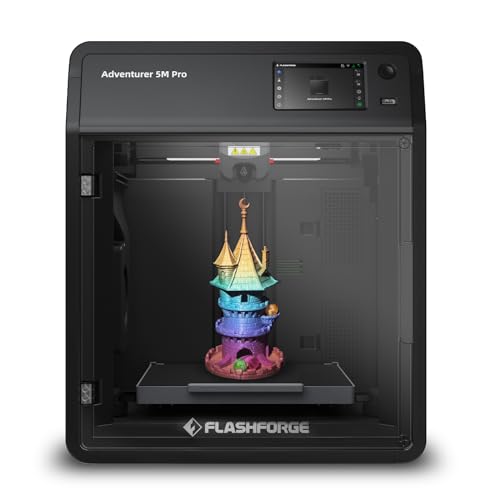
The FLASHFORGE Adventurer 5M Pro is the printer we would give to someone who wants to learn 3D printing properly without beginning with a pile of manual adjustments. Its appeal is not just the headline speed. The machine combines a CoreXY structure, a full-metal frame, automatic leveling, a flexible dual-sided PEI platform, and remote controls into a package that feels ready for serious projects from the first session.
Setup takes about 10 minutes according to the product information, and the pressure-based automatic leveling handles platform-height detection without manual Z-axis calibration. That matters because first-layer problems are among the fastest ways to make a beginner think the whole hobby is broken. The dual-sided PEI platform also makes finished models easier to remove, while the printer heats its nozzle to 200°C in 35 seconds. Those details make the first session less about troubleshooting and more about seeing a shape appear.
The Pro can reach 600mm/s travel speed with 20, 000mm²/s acceleration, although a new user should think of those figures as headroom rather than a requirement for every model. The 280°C all-metal direct extruder supports PLA, ABS, PETG, ASA, TPU, PC, PLA-CF, and PETG-CF, giving the machine a long runway as the owner learns what different materials can do. Four nozzle sizes, from 0.25mm to 0.8mm, let the user choose fine detail or quicker, broader layers. The Flash Maker app adds remote control, live video monitoring, and real-time adjustments.
Compared with the Adventurer 5M, the Pro is the better long-term teaching tool because it supports a broader range of materials and puts more control in the user's hands. The regular 5M remains a sensible alternative for someone who wants the same 220 x 220 x 220mm build volume and fast CoreXY approach with fewer advanced considerations. The Pro is also more substantial physically, weighing about 32.19 pounds and measuring roughly 15.75 by 14.96 by 17.83 inches, so it needs a stable, dedicated spot.
Its weakness is that it is not the most child-oriented machine here. It is not an enclosed toy printer, and its flexibility means the owner still has to learn material choices and basic maintenance. Cleaning the nozzle and platform remains part of ownership. If the intended user is a young child who mainly wants to select a model and press print, the AOSEED AI Printer or Magic Jimmy Purple is a gentler fit. For everyone else, the Pro offers the clearest blend of easy calibration, speed, expandability, and useful supervision tools.
2. FLASHFORGE Adventurer 5M: Best Fast Starter

Pros
- Automatic bed leveling simplifies the first print
- CoreXY structure supports fast movement
- 35-second warm-up to 200°C
- Quick three-second nozzle changes
- Remote monitoring through the Flash Maker app
Cons
- The regular model has fewer advanced features than the Pro
- A 220 x 220 x 220mm workspace is not intended for oversized parts
- It still needs nozzle and platform cleaning
Best for: a first-time maker who wants fast, automated printing and a straightforward path into larger projects.
The FLASHFORGE Adventurer 5M is the uncomplicated sibling in this group. It has the same basic reason to buy the Pro, namely a fast CoreXY design with automatic leveling, but it presents the idea with less emphasis on advanced materials and supervision. That makes it attractive to a beginner who wants a capable desktop printer rather than a small enclosed educational appliance.
Its build area is 220 x 220 x 220mm, enough for a wide range of household models, desk accessories, toys, and learning projects. The product information lists travel speeds up to 600mm/s and acceleration up to 20, 000mm²/s. Those numbers are useful because they give the printer room to shorten routine jobs, but print quality still depends on the model, material, and chosen settings. The 32mm³/s high-flow nozzle is designed to keep material moving during quicker jobs.
The automatic bed-leveling system is the feature beginners will notice first. It removes the need for manual adjustments before every project and helps establish a consistent first layer. The printer reaches 200°C in 35 seconds, and its 280°C direct extruder gives it useful flexibility with standard filament types. The quick three-second nozzle change is another practical touch. It makes switching nozzle sizes less intimidating and gives an experienced user a way to trade fine detail for faster output. The dual-sided PEI platform helps with model removal after printing.
The Flash Maker mobile app supports real-time monitoring and intelligent operation, so the printer does not have to be placed directly beside the user. Vibration compensation and dual-fan nozzle cooling are intended to help maintain quality at higher movement speeds. The available nozzle options range from 0.25mm to 0.8mm, although beginners will likely spend most of their time with the standard choice before exploring that range.
The Adventurer 5M Pro beats it for material breadth and remote oversight, while the Adventurer 5M is easier to justify when those extras are not central to the plan. Its physical footprint is about 15.83 by 14.29 by 17.64 inches, and it weighs 23.8 pounds, so it is easier to place than the Pro but still needs a sturdy surface. The limitation is the fixed-size workspace. Someone who already knows they want large cosplay parts or oversized prototypes should look elsewhere.
This is the right pick for the beginner who wants a serious machine with an approachable starting point. It is less kid-centered than the Entina or AOSEED models, but it offers more room to learn traditional slicing and filament choices. If automatic leveling, high-speed movement, and a familiar open desktop format are the priority, this is the most direct route into the hobby.
3. Entina Tina2C: Best Compact Beginner Printer

Pros
- Fully assembled and designed to start in about eight minutes
- Compact footprint suits desks and classrooms
- App, WiFi, and TF card printing options
- Auto leveling and power-loss recovery
- Flexible magnetic plate and quick-swap printhead
Cons
- The 3.9-inch cube build volume limits project size
- It is aimed at small models rather than ambitious fabrication
- The app-centered experience may feel restrictive to advanced users
Best for: a child, student, or first-time maker working on small projects in a limited space.
The Entina Tina2C understands that a beginner often needs the least intimidating machine, not the fastest one. It arrives fully assembled, uses a compact body with rounded edges, and is designed to begin a first print in as little as eight minutes. That combination makes it particularly well suited to a classroom, family desk, or child who is likely to lose interest during a long mechanical setup.
The build volume is 3.9 by 3.9 by 3.9 inches, which sharply defines what this printer is for. Small figures, simple STEM projects, desk ornaments, and individual toy parts make sense. Large functional components do not. The limited workspace is also the reason the Tina2C can fit into places where the Flashforge and Anycubic models would dominate the desk. Its listed dimensions are about 8 inches long, 6.5 inches wide, and 10 inches high, with a weight of about 5.29 pounds.
Automatic leveling handles one of the most common sources of failed first prints. Power-loss recovery can continue a job after an interruption, which is useful in a shared home or classroom. The flexible magnetic build plate bends to help release a model, and the self-cleaning nozzle and quick-swap printhead are intended to reduce the maintenance burden. These are small details, but they make a difference when the owner has not yet learned how to diagnose every failed layer.
Control is flexible for a mini printer. The Poloprint Cloud app provides AI-powered search, photo-to-print tools, more than 20 creative modules, and access to more than 3, 000 models. The Tina2C supports 2.4G WiFi printing as well as offline printing through a TF card. It works with Windows, macOS, Linux, and Chromebook systems, and the product information lists compatibility with Cura and Simplify3D. That gives a beginner a guided path while leaving room to learn standard slicing software later.
Compared with the Magic Jimmy Purple, the Tina2C feels more like a small traditional 3D printer, while Magic Jimmy puts more emphasis on enclosed kid-safe design and AI toy creation. The AOSEED AI Printer offers a much larger creative library and an enclosed format, but the Tina2C takes up less space and has a simpler physical presence. Its real weakness is capacity. A user who starts with small models and soon wants larger objects will outgrow it quickly.
Choose the Tina2C when the goal is to make learning approachable and keep the printer easy to place. It is also a strong match for parents who want app guidance without giving up offline printing. For a broader look at how a first printer fits into a home workspace, consider the room, supervision, and project size before choosing a compact model.
4. ANYCUBIC Kobra X: Best for Four-Color Printing

Pros
- Native four-color printing
- Larger 260 x 260 x 260mm build volume
- Automatic 49-point leveling
- Built-in camera with error and spaghetti detection
- Quiet 45dB operation
Cons
- Its color system adds complexity beyond a basic single-color printer
- The larger chassis needs substantial desk space
- The product information does not specify a maximum nozzle temperature
Best for: families who want colorful prints, monitoring features, and more room for larger models.
The ANYCUBIC Kobra X is the most interesting choice for beginners who care about what comes out of the printer as much as how easy it is to start. Native four-color printing lets users create colorful toys and decorations without treating every color change as a separate manual project. It arrives pre-assembled and is designed to go from unboxing to the first print in about 15 minutes, which gives it a more approachable entry than its feature list might suggest.
Its 260 x 260 x 260mm print size is larger than the 220mm cube offered by both Flashforge models. That extra space matters for broad bases, larger toys, and parts that would otherwise need to be split and assembled. It also means the machine itself is not small. The listed dimensions are roughly 17.93 inches long, 17.53 inches wide, and 18.16 inches high. At about 20.94 pounds, it is lighter than the Adventurer 5M Pro but still belongs on a dedicated, stable surface.
Leveling is unusually specific here. Anycubic's LeviQ 3.0 system uses 49-point leveling with stated 0.02mm accuracy, while the XYZ gantry is intended to provide a stable structure. For a beginner, the practical point is that the printer measures the bed across multiple points instead of asking the user to make repeated manual corrections. It operates at a stated 45dB, a useful trait when the printer shares a living room, study, or bedroom-adjacent space.
The Kobra X also adds a 720P camera and AI monitoring. It can detect foreign objects, identify printing errors such as spaghetti, pause automatically, and send a phone notification. Filament and power recovery provide another layer of protection against interrupted jobs. ACE GEN 2 technology is described as reducing filament waste and speeding up color printing. Those systems are especially useful for family projects, where nobody may be watching every minute of a multicolored model.
The trade-off is that four-color printing is not the simplest possible introduction. There is more to understand than with a single-color enclosed machine, and the product information does not provide a maximum nozzle temperature or a broad material list. The FLASHFORGE Adventurer 5M Pro is the stronger choice for someone who wants to explore materials and learn a more conventional high-speed workflow. The Kobra X wins when color, monitoring, and workspace are more important than a minimalist learning curve.
It is also a good choice for households where quiet operation and phone alerts matter. A child can focus on choosing a colorful object while an adult retains visibility into the print. Readers comparing machines for younger users may also want to think about which safety features matter around children before deciding between an open-frame printer and a more protected design.
5. AOSEED AI Printer: Best Enclosed Creative Printer

Pros
- Enclosed, pinch-resistant design for home use
- Access to more than 8, 000 models
- AI tools support voice, text, image, and photo-based creation
- Built-in camera supports monitoring and time-lapse videos
- Includes eight rolls of PLA filament
Cons
- Single-color printing only
- App-led creativity may not suit users who want a traditional workflow
- The product information does not state the build volume
Best for: families who want a safe, guided creative experience with a large model library.
The AOSEED AI Printer is built around the idea that a young beginner should start with an idea, not a slicer tutorial. Its enclosed, pinch-resistant body keeps hot components and moving parts away from children, while the one-tap app workflow reduces the number of decisions between choosing a design and starting a print. The platform is described as leveling-free, and the printer supports iOS, Android, and Windows along with WiFi and voice control.
The creative library is the headline feature. It includes more than 8, 000 human-reviewed and print-tested models across 17 themed modules, covering characters, accessories, decorations, and DIY projects. AI Doodle can turn voice, text, or image prompts into printable models. AI MiniMe creates cartoon-style figures from photos, and MINIMAKIE supports personalized avatars and toys. These tools give a child meaningful creative choices even before they know how to model an object from scratch.
The printer is also designed for quick results. The product information describes regular print speeds of 220 to 250mm/s, peaks up to 400mm/s, and precision up to 0.05mm. Small toy projects can take as little as 20 minutes, although the final time will depend on the model and settings. A quick-release nozzle simplifies filament changes, and filament runout detection pauses the job when the supply is depleted. The built-in camera lets parents check progress from a phone and automatically create time-lapse videos.
The package includes eight rolls of PLA filament, a magnetic build plate, essential tools, and DIY stickers. The supplied material is described as TÜV Rheinland ISO 16000-tested PLA. This is a practical advantage for a family starting from nothing because the first session can be focused on learning the creative system rather than figuring out which consumables are needed.
There is one important limitation: the printer supports single-color printing only. Multicolor designs need to be printed as separate parts and assembled, so the ANYCUBIC Kobra X is the better fit for users who want color changes handled by the printer. The AOSEED also does not state its build volume in the supplied information, which makes it harder to assess for large projects. It is best viewed as a guided creative appliance, not as the most open-ended machine for learning every part of 3D printing.
For children and families, that focus is a strength rather than a flaw. The Magic Jimmy Purple offers a similar AI-centered approach and also has an enclosed design, but AOSEED provides the larger stated model library and includes eight PLA rolls. Choose it when safety, guided creation, and quick access to kid-friendly designs matter more than traditional printer control.
6. Magic Jimmy Purple: Best Kid-Focused Design Tools

Pros
- Fully assembled and ready to connect to WiFi
- Enclosed child-focused design
- AI Craft, AI Doodle, AI MiniMe, and MiniMakie tools
- More than 8, 000 toy and STEM models
- Built-in camera creates print time-lapse videos
Cons
- The product information does not specify the build volume
- It is limited to the supplied non-toxic PLA workflow
- AI and library features depend on the guided software experience
Best for: a child who wants to turn drawings, words, or photos into printable toys.
The Magic Jimmy Purple is less interested in teaching a new user what every printer setting does and more interested in making the first creative success happen quickly. It arrives fully assembled, requires no tools for assembly, and is designed around connecting to WiFi, loading the included white PLA filament, and choosing a project. For a child, that removes much of the machinery that can make a first printer feel like an appliance repair job.
Its AI tools are unusually central to the experience. AI Craft can turn sketches or text into printable 3D models, AI Doodle supports drawing-based creation, and AI MiniMe turns a photo into a cartoon figurine. MiniMakie adds another route for creating avatars and personalized toys. Those features are useful for children who have plenty of ideas but no experience with CAD software. They also turn a tablet or phone from a passive entertainment screen into a design tool.
Magic Jimmy provides access to more than 8, 000 models across toys, animals, vehicles, and STEM projects. The product information says new models are added regularly and that users can also import STL files from Thingiverse, Printables, and other sources. That combination gives a child an easy starting library while leaving a route toward more independent projects. Small models can finish in as little as 20 minutes, and most library models are described as taking one to three hours.
The enclosed chamber keeps hot components and moving parts away from children. The cool-touch exterior, non-toxic PLA-only workflow, and magnetic build plate are all intended to make the machine easier to supervise at home. A built-in camera records a time-lapse of each print, which adds a fun record of the process and lets children watch the object take shape rather than only seeing the final result.
The limits are important. The data supplied for this model does not state a build volume, maximum nozzle temperature, leveling system, or material range beyond non-toxic PLA. That makes it a poor choice for an adult who wants to experiment with different filaments or compare detailed mechanical settings. The AOSEED AI Printer has a similar kid-first direction but states more detail about its detection, app compatibility, and starter materials. The Entina Tina2C is better for a compact traditional learning path.
Magic Jimmy Purple is the right choice when the child cares about making a character, avatar, or toy more than understanding the mechanics of extrusion. It is also a good fit for a family that wants an enclosed machine with a strong design library and minimal assembly. For a broader comparison of the features that make a printer approachable for new users, pay particular attention to how much of the design process the software handles.
7. Magic Jimmy Yellow: Best Alternative Finish

Pros
- Fully assembled for a simple first setup
- Enclosed design keeps moving and hot parts away
- AI tools turn prompts and photos into model ideas
- More than 8, 000 models across toy and STEM categories
- Camera records time-lapse footage
Cons
- The supplied product information does not state build volume
- PLA-only operation limits material experimentation
- It has the same guided-software dependency as the Purple version
Best for: families choosing the Magic Jimmy platform who prefer the yellow finish.
The Magic Jimmy Yellow is the same kid-focused printer platform as the Purple version, with the yellow finish distinguishing this listing. That means the buying decision is not about a different print engine or a different set of software tools. It is about choosing the version that fits the intended room or the child's preference while keeping the same simple, enclosed creative workflow.
The printer comes fully assembled and is designed to be connected to WiFi before loading the included white PLA filament. A child can browse the library, create an idea, and start a print without manually assembling a frame. AI Craft can turn text or sketches into 3D models, while AI Doodle, AI MiniMe, and MiniMakie give children several ways to move from an idea or photo to a personalized object.
The model library contains more than 8, 000 toy, animal, vehicle, and STEM designs, with new models added regularly according to the product information. Users can also import STL files from external model libraries, so the machine is not locked entirely to its built-in catalog. Small models can take as little as 20 minutes, and the stated upper printing speed is up to 400mm/s. The built-in camera records time-lapse videos, which is a nice way for a child to see the stages of a print.
Safety and simplicity define the hardware. The enclosed chamber keeps the hot components and moving parts away from children, the exterior is described as cool touch, and the magnetic build plate helps with model removal. The printer is intended to use non-toxic PLA filament only. That is a focused home setup, but it is not the right platform for someone who wants to explore ABS, PETG, TPU, or other materials.
The Magic Jimmy Purple offers the same capabilities, so there is no functional reason to choose Yellow over Purple in this dataset. The AOSEED AI Printer is the more informative alternative for families who want a stated precision figure, runout detection, eight included PLA rolls, and a more detailed app compatibility list. The Entina Tina2C takes a more compact and conventional approach, with a stated 3.9-inch cube print volume and TF card support.
Choose Magic Jimmy Yellow when the child is the primary user and AI-assisted toy design is the point. Skip it if the buyer wants a printer that can grow into material experimentation or if a clearly stated build volume is essential. As a kid-friendly creative station, though, it has a clear purpose and a straightforward first-use story.
How to choose best begineer 3d printer
The right first printer is the one that matches the user's age, project size, and tolerance for learning machine settings. These are the capabilities that matter most.
Setup and automatic leveling
A beginner should not have to start by assembling a complicated frame or manually adjusting the print bed at several points. Fully assembled machines such as the Entina Tina2C, AOSEED AI Printer, and Magic Jimmy models reduce that barrier, while the Flashforge printers use automatic leveling to simplify calibration.
Automatic leveling does not eliminate every possible failed print, but it reduces one of the most frustrating early tasks. Look for a guided startup process, a platform that releases models cleanly, and recovery features that can help after a power interruption.
Build volume
Build volume determines the size of the object that can be printed in one piece. The Tina2C's 3.9 by 3.9 by 3.9-inch space suits small models and classroom projects, while the Flashforge machines provide a 220 x 220 x 220mm cube. The Kobra X expands that to 260 x 260 x 260mm.
A larger workspace gives a beginner more room to grow, but it also usually means a larger printer and a more permanent home on the desk. The AOSEED and Magic Jimmy product information does not state build volume, so buyers considering larger projects should confirm that detail before ordering.
The easiest printer to learn is not always the smallest one. It is the one whose build space matches the objects you actually want to make.
Enclosure and child safety
An enclosed design is useful when children will be near the printer. The AOSEED and Magic Jimmy models use enclosed chambers, cool-touch or pinch-resistant design details, and kid-focused software. The Tina2C has a compact rounded body and low-noise operation, but it is a different style of machine from the fully enclosed kid-focused models.
Adults and older students may prefer the more open access of the Flashforge or Anycubic printers. That format makes maintenance and observation easier, but it requires more attention around hot and moving parts. Consider the user's age, the location of the printer, and how closely an adult will supervise each job.
Speed and frame stability
Fast movement can shorten routine prints, but speed only helps when the printer can keep the motion stable. The Adventurer 5M and 5M Pro use CoreXY structures, with stated travel speeds up to 600mm/s and acceleration up to 20, 000mm²/s. The AOSEED and Magic Jimmy machines state peaks up to 400mm/s, while the Kobra X focuses on color printing and a stable XYZ gantry.
A beginner should not choose by the largest speed figure alone. A rigid frame, automatic leveling, vibration control, and suitable material settings matter just as much. The Flashforge Pro adds a full-metal frame and vibration compensation, which makes it the strongest option here for someone who expects to move beyond simple PLA projects.
Software and model libraries
Guided software can make 3D printing feel creative immediately. AOSEED and Magic Jimmy provide large model libraries and AI tools for turning prompts, drawings, and photos into designs. Entina offers the Poloprint Cloud app, more than 3, 000 models, AI search, photo-to-print tools, and more than 20 creative modules.
Traditional printers still have an advantage for learning how the hobby works. The Tina2C supports Cura and Simplify3D, and the Flashforge models support remote control through the Flash Maker app while offering multiple nozzle sizes and broader materials. Think about whether the buyer wants a ready-made creative library, a conventional slicing workflow, or a mixture of both.

Frequently asked questions
What should a beginner look for in a 3D printer?
Automatic leveling, a dependable build plate, clear software, and a manageable setup are the most useful starting features. Enclosure and guided model libraries matter more when a child will use the machine. Adults who expect to learn advanced materials should also consider nozzle temperature and filament compatibility.
Is the FLASHFORGE Adventurer 5M Pro suitable for a first-time user?
Yes. Its automatic leveling and quick setup remove several common first-printer obstacles, while the CoreXY frame, 280°C direct extruder, and material support leave room to develop. It is better suited to adults or older beginners than to very young children because it is a more open, advanced-style printer.
Which model is best for small spaces?
The Entina Tina2C is the most compact option in this group. Its listed dimensions are about 8 inches long, 6.5 inches wide, and 10 inches high, and its small print volume matches small desk projects. The larger Flashforge and Anycubic models need substantially more surface area.
Which printer can print in multiple colors?
The ANYCUBIC Kobra X is the only model here specifically described as offering native four-color printing. The AOSEED AI Printer supports single-color printing, so multicolor designs must be made as separate parts and assembled. The other listed models do not provide a native four-color feature in the supplied information.
Are enclosed 3D printers better for children?
An enclosure can keep hot components and moving parts away from children, which is a useful safety feature in a family space. The AOSEED and Magic Jimmy models are specifically described with enclosed, kid-focused designs. Adult supervision and the manufacturer's operating guidance still matter with any printer.
Can these printers use materials other than PLA?
The Flashforge Adventurer 5M Pro is explicitly described as supporting PLA, ABS, PETG, ASA, TPU, PC, PLA-CF, and PETG-CF through its 280°C all-metal direct extruder. AOSEED and Magic Jimmy are described around PLA, with Magic Jimmy limited to non-toxic PLA in the supplied information. Material support for the Entina and Anycubic models is not fully stated in the supplied product details.
Which printer has the easiest creative software?
The AOSEED AI Printer and Magic Jimmy models put the strongest emphasis on guided AI creation, with tools for text, sketches, voice, images, and photos. The Entina Tina2C also offers app-based guidance, AI search, photo-to-print features, and a large model library. The Flashforge models are better for users who want to learn a more traditional printer workflow.

The bottom line
The FLASHFORGE Adventurer 5M Pro is the Best begineer 3d printer for adults and older beginners who want reliable automatic leveling today and broader material support tomorrow. Its fast CoreXY structure, 280°C direct extruder, multiple nozzle sizes, and remote monitoring make it the most complete machine in this group. The regular FLASHFORGE Adventurer 5M is the better fit for someone who wants a slightly simpler fast starter with the same 220 x 220 x 220mm class of workspace.
For children, the AOSEED AI Printer is the strongest enclosed creative option, while the Entina Tina2C makes more sense when desk space and small projects matter most. The ANYCUBIC Kobra X earns its place for native four-color printing and a larger build area. Magic Jimmy Purple and Magic Jimmy Yellow are functionally the same choice, separated here by their finishes and suited to children who want AI-assisted toy design.
If you are undecided, choose the Adventurer 5M Pro for growth, the AOSEED AI Printer for guided child-friendly creativity, or the Tina2C when the printer must fit into a very small space.
As an Amazon Associate we earn from qualifying purchases.