

A failed first layer can turn an exciting 3D printing project into a lesson in bed leveling, nozzle height, and patience. The right starter machine removes much of that setup friction, while still leaving room to learn how filament, slicing, and model design work together.
Our Best best beginner 3d printer picks range from compact machines for children and small projects to fast CoreXY models and enclosed printers that can grow with a new maker. Automatic calibration, easy nozzle changes, useful software, and a sensible build area matter more than headline speed alone.
The Bambu Lab P1S Combo is the best pick for most beginners, while the other eight cover quieter operation, compact spaces, multi-color printing, and lower-complexity introductions to the hobby.
Comparison table
| # | Product | Award | Build volume | Speed | Best for |
|---|---|---|---|---|---|
| 1 | Flashforge Adventurer 5M | Best overall | 220 x 220 x 220mm | Up to 600mm/s | Fast, straightforward printing |
| 2 | Bambu Lab P1S Combo | Best multi-color system | Not stated | Up to 500mm/s | Color and material flexibility |
| 3 | Bambu Lab A1 mini LED Kit | Best compact beginner pick | Compact format | High-speed printing | Small workspaces and crafts |
| 4 | Flashforge AD5X | Best multi-color Flashforge | 220 x 220 x 220mm | Up to 600mm/s | Four-color creative projects |
| 5 | Bambu Lab P1S | Best enclosed solo printer | Not stated | Up to 500mm/s | Beginners who want an enclosure |
| 6 | Flashforge Adventurer 5M Pro | Best advanced materials pick | 220 x 220 x 220mm | Up to 600mm/s | Wider filament compatibility |
| 7 | Flashforge AD5M | Best easy-maintenance printer | 220 x 220 x 220mm | Up to 600mm/s | Fast nozzle changes |
| 8 | Entina Tina2C | Best for kids | 3.9 x 3.9 x 3.9 inches | Not stated | STEM learning and small models |
| 9 | Bambu Lab A1 | Best quiet full-size option | Not stated | 10, 000mm/s² acceleration | Quiet home printing |
1. Flashforge Adventurer 5M: Best Overall

Pros
- Automatic bed leveling simplifies the first print
- 220 x 220 x 220mm build volume suits everyday projects
- Quick-swap nozzle system is easy to maintain
- CoreXY frame supports fast movement
- Remote monitoring works through the Flash Maker app
Cons
- The open design offers less environmental control than the P1S models
- The standard extruder reaches 280°C, limiting some material choices
- High-speed printing still requires sensible slicer settings
Best for: beginners who want a capable, fast printer without jumping straight to a more complex enclosed system.
The Flashforge Adventurer 5M gets the important beginner experience right. It is not built around a long sequence of manual adjustments. Automatic bed leveling handles one of the most common causes of poor first layers, and the one-click printing approach makes it easier to move from an idea to a physical object without first becoming a printer technician.
Its 220 x 220 x 220mm print area is large enough for useful household parts, toys, desk organizers, and many decorative models. That is a more flexible working space than the compact Entina Tina2C, while remaining familiar territory for someone learning how to orient models on a build plate. The CoreXY structure is designed for movement up to 600mm/s, with acceleration listed at 20, 000mm/s². Those figures describe the machine's capability rather than a speed every beginner should use, but they give the 5M room to shorten routine print jobs as confidence grows.
The 280°C direct extruder supports common materials such as PLA and PETG, and the quick 3-second nozzle change is a practical advantage. The included nozzle options range from 0.25mm to 0.8mm. A smaller nozzle can help with fine detail, while a wider nozzle can make sturdy larger parts more quickly. The dual-sided PEI platform should also make model removal less fussy, and the printer's stated 35-second warm-up to 200°C keeps the waiting period short.
The weakness is the open format. The Bambu Lab P1S and Bambu Lab P1S Combo provide an enclosed body, which is a better fit for users who expect to explore the printer's broader material support. The 5M is also not a multi-color machine by itself, so the Flashforge AD5X is more appealing for color-focused projects. For a first printer, though, the Adventurer 5M has the strongest balance of size, calibration, maintenance, and speed.
This is the machine we would recommend to a beginner who wants to learn by making things rather than by constantly tuning hardware. It is especially well suited to someone who wants a full-size work area and remote monitoring without starting with the most elaborate feature set.
2. Bambu Lab P1S Combo: Best Multi-Color System

Pros
- AMS system supports multi-color and multi-material printing
- Enclosed body helps with advanced filament use
- Automatic bed leveling reduces setup work
- 500mm/s top speed and 20, 000mm/s² acceleration
- Setup is listed at about 15 minutes
Cons
- The complete system is heavy at 47.52 pounds
- The AMS adds complexity compared with a single-spool printer
- Carbon and glass fiber reinforced polymers are not recommended
Best for: beginners who already know they want color changes, multi-material projects, or a printer they can keep using for years.
The P1S Combo is the most ambitious beginner choice here, and the reason is the included AMS. Instead of treating multi-color printing as a future upgrade, this package makes it part of the initial experience. The system can handle up to 16 colors when the required equipment is connected, giving a new maker a straightforward path from single-color calibration models to signs, figurines, and functional parts with multiple filament colors.
The enclosed body is just as important. It creates a more controlled printing environment and makes the P1S a better candidate for materials beyond basic PLA. The listed ideal materials include PLA, PETG, TPU, PVA, PET, ABS, and ASA, while PA and PC are listed as capable. Carbon and glass fiber reinforced polymers are not recommended, so this is broad compatibility rather than unlimited compatibility. A beginner should still start with a forgiving filament and learn the basics before experimenting.
Bambu Lab lists speeds up to 500mm/s and acceleration of 20, 000mm/s². That combination is useful when the printer is producing many parts, although the fastest setting is not automatically the cleanest setting for every model. Automatic bed leveling removes a tedious adjustment step, and the stated 15-minute setup gives this machine a more welcoming first impression than a kit that requires extensive assembly.
The catch is physical and procedural. At 47.52 pounds, the Combo is much heavier than the Bambu Lab A1 mini LED Kit, and the AMS introduces another system to load, configure, and keep tidy. The Flashforge AD5X also offers multi-color printing with a smaller, lighter body, but the P1S Combo has the advantage of an enclosure and the broader Bambu Lab ecosystem. The single-printer Bambu Lab P1S is the cleaner choice if color is not central to your plans.
For someone searching for the Best best beginner 3d printer with room to grow, this is the pick when multi-color work matters. It is not the simplest machine on the list, but it is the most complete creative platform and the one least likely to feel limiting after the first few months.
3. Bambu Lab A1 mini LED Kit: Best Compact Beginner Pick

Pros
- Automatic calibration keeps the starting process simple
- Compact design fits smaller workspaces
- Quiet operation suits home use
- Bambu Handy app and MakerWorld support
- Included LED Lamp Kit adds a practical project path
Cons
- The compact format is less suitable for large models
- The lamp kit is specialized rather than universally useful
- No enclosed body is listed
Best for: first-time makers who have limited desk space and prefer small creative projects.
The A1 mini is a friendly way into 3D printing because it makes the machine feel less intimidating. Its compact footprint and stated weight of 12.125 pounds make it easier to place, move, and store than the substantial P1S models. That matters for a beginner who may be setting up on a bedroom desk, craft table, or shared workspace rather than dedicating a permanent bench to the hobby.
Bambu Lab emphasizes automatic calibration and simple setup, with the printer designed to handle the early mechanical chores for the user. The company also describes it as fast and quiet, which is a useful combination for home printing. Quiet operation will not make every print silent, but it makes the A1 mini more comfortable around study areas and living spaces than a machine that constantly draws attention to itself.
The strongest reason to choose this particular package is the included LED Lamp Kit. Compatible lamp models turn a basic printer into a project with an immediate purpose, and the result can be used as room décor or a personalized gift. The printer also works with the Bambu Lab ecosystem, including the MakerWorld model library and Bambu Handy app. That combination helps a beginner find models, start jobs, and manage the printer without building a workflow from scratch.
The limitations are tied to its size and scope. The dataset does not state a numerical build volume, but the machine is explicitly positioned as compact, so it should not be the first choice for large functional parts. The Bambu Lab A1 offers a fuller-size alternative with the same emphasis on automatic calibration and quiet printing. The Entina Tina2C is smaller still and more directly aimed at children, but the A1 mini feels like the more capable long-term creative tool.
The A1 mini is a good match for someone who wants a calm introduction, a guided software ecosystem, and projects that fit a smaller workspace. It is the Best best beginner 3d printer for a maker who values accessibility and compactness more than maximum build size.
4. Flashforge AD5X: Best Multi-Color Flashforge

Pros
- Supports up to four colors simultaneously
- 300°C direct-drive extruder
- 220 x 220 x 220mm build volume
- Automatic leveling and filament handling
- Nozzle options from 0.25mm to 0.8mm
Cons
- Multi-color printing adds operational complexity
- The open design is less controlled than an enclosed printer
- The 600mm/s headline speed is not ideal for every model
Best for: beginners who want multi-color printing with a full-size build area and a Flashforge workflow.
The AD5X takes the approachable design of the Adventurer line and adds the feature that changes how people use a printer: multi-color output. It supports up to four colors simultaneously, so it can produce more expressive models without requiring the user to paint every detail afterward. Automatic filament feeding and retraction also reduce the number of routine steps involved in changing between materials.
The build volume is 220 x 220 x 220mm, matching the useful working space of the Adventurer 5M and AD5M. Its CoreXY structure is rated for up to 600mm/s and 20, 000mm/s² acceleration. Those specifications make the AD5X a strong candidate for repeated prototypes or batches of small objects. Beginners should treat them as a performance ceiling, then choose slower profiles when surface finish and intricate detail matter more than turnaround time.
The 300°C direct-drive extruder gives the AD5X a wider temperature range than the 280°C extruders in the Adventurer 5M, Adventurer 5M Pro, and AD5M. The supplied 0.4mm nozzle is a sensible everyday starting point. Optional 0.25mm, 0.6mm, and 0.8mm choices let the user move toward fine miniature detail or faster, stronger large parts. Dual-channel cooling and vibration compensation are intended to help maintain quality when movement speeds rise.
The main compromise is that multi-color printing is never as simple as loading one spool and pressing start. Color changes can add management overhead and may require more attention to filament routing. The Bambu Lab P1S Combo is the stronger choice for users who want an enclosed multi-color system, while the AD5X is more attractive to someone who prefers the Flashforge interface and a lighter machine. Its open structure also makes it less suitable for users who expect to focus on enclosure-dependent materials.
Choose the AD5X if color is part of the reason you want a printer in the first place. It offers a generous build space, broad nozzle flexibility, and a beginner-friendly calibration routine without making multi-color printing an afterthought.
5. Bambu Lab P1S: Best Enclosed Solo Printer

Pros
- Enclosed design supports a broader material range
- Automatic bed leveling reduces manual setup
- Up to 500mm/s printing speed
- Supports PLA, PETG, TPU, PVA, PET, ABS, and ASA
- Setup is listed at about 15 minutes
Cons
- Multi-color printing requires additional AMS equipment
- Weighs 39.02 pounds
- Not recommended for carbon or glass fiber reinforced polymers
Best for: beginners who want an enclosed printer and do not need multi-color hardware immediately.
The P1S is the more focused version of the P1S Combo. It keeps the enclosed body, automatic bed leveling, and fast CoreXY platform, but removes the included AMS from the starting setup. That makes the machine easier to understand as a single-spool printer and leaves multi-color printing as a later expansion rather than a requirement on day one.
Bambu Lab lists a top speed of 500mm/s and acceleration of 20, 000mm/s². For a new user, the real benefit is not simply finishing a model quickly. A fast motion system means the printer can handle routine parts efficiently, and the user can choose profiles that favor quieter operation, surface quality, or reliability. The automatic leveling system is more important during the first week, when manual bed adjustment can otherwise become the dominant part of the experience.
The enclosure broadens the practical material choices. PLA, PETG, TPU, PVA, PET, ABS, and ASA are listed as ideal materials, with PA and PC listed as capable. Those options give a beginner a useful progression from easy everyday filament to projects that need more heat resistance or flexibility. Carbon and glass fiber reinforced polymers are not recommended, so the P1S should not be treated as a specialist composite-material machine.
At 39.02 pounds, the P1S is not a printer to move around casually. The enclosure also takes up more visual and physical space than the open Bambu Lab A1, and beginners interested in color should step up to the Bambu Lab P1S Combo instead. On the other hand, the P1S is less complicated than that Combo and more controlled than the open Flashforge models.
The P1S is the right middle ground for a beginner who wants a sturdy, enclosed base and expects to explore more than basic PLA. It is a sensible long-term machine for home workshops, especially when color printing is optional rather than central.
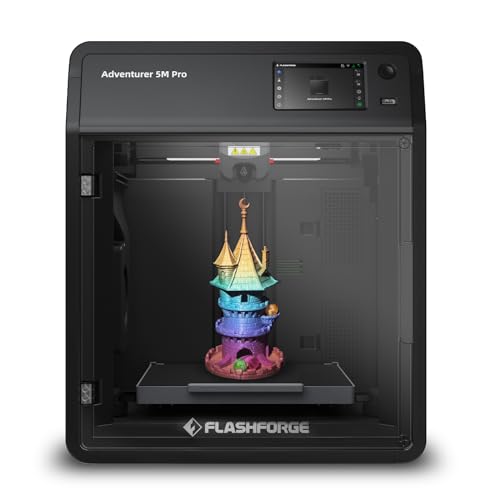
6. Flashforge Adventurer 5M Pro: Best Advanced Materials Pick
Pros
- 220 x 220 x 220mm build volume
- Enclosed design supports more demanding materials
- 280°C all-metal direct extruder
- Automatic pressure-based leveling
- Remote control and live video monitoring
Cons
- Heavier and more involved than the standard Adventurer 5M
- No multi-color system is listed
- Open-frame printers can be easier to inspect while learning
Best for: beginners who want an enclosed Flashforge machine for a wider range of filament experiments.
The Adventurer 5M Pro is the choice for a beginner who already knows that material flexibility matters. Its enclosed structure gives it a more controlled workspace than the standard Adventurer 5M, while the CoreXY all-metal frame is built for the same kind of high-speed movement. Flashforge says it can reach 600mm/s with 20, 000mm/s² acceleration, but the enclosure and material support are the more meaningful reasons to choose the Pro.
The 220 x 220 x 220mm build volume is large enough for most first projects and does not force the user into miniature models. A 280°C all-metal direct extruder supports PLA, ABS, PETG, ASA, TPU, PC, PLA-CF, and PETG-CF according to the listing. That is a substantial range for a starter machine, though the presence of support does not mean every material will be equally easy. New users should begin with PLA, then move outward as they understand cooling, adhesion, and enclosure behavior.
Setup is listed at 10 minutes from unboxing to the first print. Pressure-based automatic leveling removes manual Z-axis calibration, and the dual-sided PEI platform should make finished models easier to release. Nozzle choices from 0.25mm to 0.8mm provide a useful way to balance detail against throughput. The 35-second heat-up to 200°C is another small but welcome convenience when the printer is used for several short projects.
The Pro is not the obvious choice for everyone. The Flashforge Adventurer 5M is simpler and lighter, and the Bambu Lab P1S provides a similarly enclosed approach with a different software ecosystem. The Pro also does not list multi-color printing, so the AD5X or P1S Combo is the better direction for colorful models. Its wider filament support can be wasted if the buyer only plans to print simple PLA toys.
For a beginner with plans beyond basic models, the Adventurer 5M Pro is a strong foundation. It gives the user an enclosed, remotely monitored machine without requiring the initial leap to a more elaborate color system.
7. Flashforge AD5M: Best Easy-Maintenance Printer

Pros
- One-click automatic calibration
- Quick-release nozzle changes in about 3 seconds
- 220 x 220 x 220mm build volume
- Double-sided PEI plate
- Power-loss recovery and remote monitoring
Cons
- Open design provides less control for advanced materials
- No multi-color hardware is listed
- App and slicer features may take time to learn
Best for: beginners who want a fast full-size printer with unusually simple nozzle maintenance.
The AD5M's defining feature is the quick-release nozzle. Flashforge says the nozzle can be changed in as little as 3 seconds, without tools. That is more than a novelty for a new owner. Nozzles are wear items, and an easy swap makes it less intimidating to move between a standard 0.4mm nozzle, a fine 0.25mm option, and wider 0.6mm or 0.8mm choices.
The printer uses an all-metal CoreXY motion structure with automatic one-click calibration. Its 220 x 220 x 220mm build volume is the same practical size found on several other Flashforge picks, so the AD5M can handle ordinary household parts and creative models rather than being restricted to tiny objects. The listing states a maximum speed of 600mm/s, but beginners will get more useful results by treating speed as adjustable rather than fixed.
The double-sided PEI steel plate is another thoughtful detail. One side is specifically intended for PETG, and bending the flexible plate can help release a finished model. Power-loss recovery saves the ongoing layer and resumes after electricity returns, which is useful for longer jobs. Orca-Flashforge supports one-click batch file transmission and multi-printer monitoring, while the Flash Maker app allows remote status checks and adjustments.
The AD5M gives up the enclosure and higher-temperature extruder found on the Flashforge Adventurer 5M Pro. It also lacks the multi-color hardware of the Flashforge AD5X. The advantage is a more direct, maintainable machine that does not ask the buyer to manage an extra color system. The software features may feel like a lot at first, particularly for a child or a user who wants the simplest possible interface.
This is a good Best best beginner 3d printer candidate for a hands-on learner. Pick it if easy maintenance and a full-size build area matter more than enclosure control or multi-color output.
8. Entina Tina2C: Best for Kids

Pros
- Fully assembled starter design
- Stated setup time of as little as 8 minutes
- Auto leveling and power-loss recovery
- Wi-Fi and TF card printing
- Quiet compact body with integrated LED lighting
Cons
- 3.9 x 3.9 x 3.9-inch print volume is small
- Less suitable for large functional parts
- App-centered workflow may not suit every adult maker
Best for: children, classroom activities, and families starting with small STEM projects.
The Tina2C is designed to remove the intimidating parts of a first printer. It arrives fully assembled, and the listing says a first print can begin in as little as 8 minutes. Automatic leveling helps with the first layer, while the Poloprint Cloud app provides guided setup and access to models and creative modules. That combination makes the Tina2C more approachable for a child with adult supervision than a larger machine that assumes the user already understands slicing.
Its compact 3.9 x 3.9 x 3.9-inch print volume clearly defines the kind of work it is meant to do. Small toys, classroom demonstrations, ornaments, and short STEM projects fit the brief. Large organizers, substantial replacement parts, and bigger decorative models do not. The 10-inch-high body and 5.29-pound weight also make it much easier to place on a shelf or carry between a classroom and storage area.
Wi-Fi printing and TF card offline mode give families two ways to work. The app includes AI-powered search, photo-to-print features, and more than 20 creative modules according to the listing. Compatibility with Windows, macOS, Linux, and Chromebook, plus support for Cura and Simplify3D, means the printer can become a more traditional learning tool later. A flexible magnetic build plate, self-cleaning nozzle, quick-swap printhead, and power-loss recovery reduce some of the routine frustrations that can end a child's interest quickly.
The small build area is the decisive weakness. The Bambu Lab A1 mini LED Kit is a better fit for an adult who wants a compact printer with a broader creative ecosystem, while the full-size Bambu Lab A1 makes more sense for a family that expects projects to grow. The Tina2C's rounded body, low-noise operation, and integrated LED lighting are more valuable when safety, visibility, and simplicity take priority.
Families looking for hands-on projects that make sense for younger makers should put the Tina2C near the top of their list. It is a focused educational machine, not a full workshop printer, and that focus is exactly what makes it appealing.
9. Bambu Lab A1: Best Quiet Full-Size Option

Pros
- Full automatic calibration
- Active flow rate compensation
- Quiet motor noise canceling
- Quick-swap nozzle design
- Touchscreen interface for straightforward control
Cons
- Open design offers less material control than the P1S
- Multi-color printing requires AMS lite equipment
- The large footprint needs dedicated desk space
Best for: beginners who want a quiet, approachable printer for regular home use.
The A1 is the full-size alternative to the A1 mini. It keeps the beginner-friendly emphasis on automatic calibration, but gives the buyer a larger machine for projects that would outgrow a compact starter printer. The listing does not provide a numerical build volume, so it is better to think of the A1 as the broader-format member of this family rather than assign it an unverified measurement.
Bambu Lab lists 10, 000mm/s² acceleration and describes the printer as a high-speed precision machine. Active flow rate compensation adjusts extrusion according to readings, which is intended to keep lines consistent as the printer works. For a beginner, that feature matters because uneven extrusion can otherwise be mistaken for a problem with the model or slicer. Full automatic calibration also handles Z-offset and bed leveling without asking the user to reach for adjustment tools.
Noise control is the A1's strongest everyday advantage. Active motor noise canceling and a simplified touchscreen interface make it easier to live with in a home office, craft room, or family space. The one-clip quick-swap nozzle design keeps maintenance approachable. The printer can also use multi-color printing with AMS lite, but the required hardware is not included in this listing, so color should be treated as an expansion path.
The open design is the trade-off. The Bambu Lab P1S is better suited to users who want an enclosure and a wider range of material experiments, while the Bambu Lab A1 mini LED Kit occupies less space. The A1 also has a broad footprint, measuring 21.76 inches long and 20.83 inches wide, so its quiet operation does not eliminate the need for a proper work surface.
The A1 is a strong choice for a family or adult beginner who expects to print regularly and wants a calmer machine than many fast printers. It belongs on a shortlist of the Best best beginner 3d printer options when quiet operation and automatic calibration matter more than enclosure support.

How to choose best beginner 3d printer
The right first printer should reduce avoidable setup work without boxing you into tiny projects or a narrow set of materials.
Automatic calibration
Automatic bed leveling measures the relationship between the nozzle and build plate so the first layer starts at the right height. That first layer determines whether a print adheres properly, so automatic calibration is one of the most useful beginner features in this category.
One-click or full-auto systems are preferable for a newcomer. A printer that requires repeated manual leveling may still produce excellent work, but it turns every setup problem into a mechanical lesson before the creative part begins.
Build volume
Build volume determines the largest object the printer can create in one piece. The 220 x 220 x 220mm space on the Flashforge Adventurer 5M, AD5X, Adventurer 5M Pro, and AD5M is a practical full-size target for household models and functional parts. The Tina2C's 3.9 x 3.9 x 3.9-inch volume is much better suited to small projects.
Do not choose a compact printer solely because it occupies less space. Think about the objects you expect to make, then compare that need with the room available on the desk.
A beginner printer should make the first layer boring, not the whole hobby.
Extruder temperature
The extruder temperature affects which filaments the printer can process reliably. The 280°C direct extruders on several Flashforge models handle common materials and some more demanding options, while the AD5X reaches 300°C. The P1S models list support for materials including PLA, PETG, TPU, PVA, ABS, ASA, PA, and PC, with specific limitations.
PLA is the natural starting point for most new users. Broader support becomes useful once the owner understands cooling, adhesion, enclosure behavior, and slicer settings. A higher temperature figure alone does not guarantee easy results with every filament.
Enclosure and frame
An enclosure helps create a more controlled environment and is particularly useful when printing materials that are more sensitive to temperature changes. The Bambu Lab P1S and P1S Combo are enclosed, as is the Adventurer 5M Pro. The open Flashforge Adventurer 5M, AD5X, and AD5M are easier to inspect and access.
CoreXY frames support fast movement by keeping the moving mass arranged differently from many basic printer designs. The listed 500mm/s and 600mm/s maximums are impressive, but a stable frame and sensible print profiles matter more than chasing the highest number.
Software and maintenance
A beginner-friendly printer should offer an uncomplicated route from model library to finished object. Bambu Lab's MakerWorld and Bambu Handy ecosystem, Flashforge's Flash Maker app, and Entina's Poloprint Cloud app each take different approaches to finding models and monitoring prints.
Maintenance also matters. Quick-swap or quick-release nozzles, flexible PEI plates, automatic filament handling, and power-loss recovery reduce the consequences of routine problems. The AD5M stands out for its stated 3-second nozzle changes, while the Tina2C emphasizes a self-cleaning nozzle and simple printhead replacement.
For a broader look at how setup, calibration, and model access affect a first purchase, the practical differences between starter printer designs are worth considering before choosing a machine.

Frequently asked questions
What is the easiest 3D printer for a complete beginner?
The Flashforge Adventurer 5M is the easiest general-purpose choice in this group because it combines automatic leveling, a full 220 x 220 x 220mm build volume, and quick nozzle changes. The Bambu Lab A1 mini is also very approachable for smaller projects and quieter spaces.
Should a beginner buy an enclosed 3D printer?
An enclosed printer is useful if you expect to explore materials such as ABS or ASA, or if you prefer a more controlled printing environment. The Bambu Lab P1S, P1S Combo, and Flashforge Adventurer 5M Pro are the enclosed options in this selection.
Is multi-color printing useful for a first printer?
Multi-color printing is useful for signs, figures, decorations, and models where color is part of the design. It also adds filament management and can make the workflow more involved, so a single-spool printer may be a better first step for someone focused on learning the basics.
Is a 220 x 220 x 220mm build volume enough?
For most beginner projects, that build volume is a strong middle ground. It accommodates many toys, organizers, replacement parts, and decorative models without requiring an unusually large machine. The smaller Tina2C is better only when compact projects are the main goal.
What filament should a beginner start with?
PLA is the most sensible starting point among the materials listed for these printers. It lets a new user learn model orientation, bed adhesion, supports, and slicer settings before moving to materials that require more careful temperature or enclosure management.
Are very high print speeds important?
High speed can reduce the time needed for routine models, but it does not replace a stable frame, good calibration, or appropriate slicer settings. The Flashforge models list speeds up to 600mm/s and the Bambu Lab P1S models list up to 500mm/s, yet beginners should choose profiles based on print quality and reliability.
Which printer is best for a child?
The Entina Tina2C is the most directly child-focused model here. Its fully assembled design, compact build volume, guided app, quiet operation, LED lighting, and STEM-oriented creative modules make it easier to use with adult supervision.
The bottom line
The Bambu Lab P1S Combo is the strongest pick for the Best best beginner 3d printer search when multi-color capability, enclosure support, and long-term flexibility all matter. Its AMS system adds complexity, but it also gives a beginner an unusually broad creative path from the first model onward.
For a simpler single-spool experience, the Flashforge Adventurer 5M is the one we would keep. It has a useful 220 x 220 x 220mm build area, automatic leveling, quick nozzle changes, and a fast CoreXY platform without the extra equipment of a color system. Families should choose the Entina Tina2C, while small-space users should look closely at the Bambu Lab A1 mini LED Kit.
If you are undecided, choose the Adventurer 5M for straightforward full-size printing, or the P1S Combo if multi-color projects are already part of the plan.
As an Amazon Associate we earn from qualifying purchases.