

A phone can handle a family snapshot, but it cannot make a distant bird fill the frame without turning feathers into digital mush. A bridge camera solves that problem with a fixed superzoom lens, a built-in grip, and controls that are easier to manage than a camera system with interchangeable lenses.
The Best bridge camera for most people is the KODAK PIXPRO AZ528, thanks to its 52x optical zoom, optical stabilization, burst shooting, Wi-Fi, and useful 24mm wide-angle view. The other nine picks cover longer wildlife reach, 4K video, RAW capture, AA battery convenience, and simpler travel shooting.
Comparison table
| # | Product | Award | Optical zoom | Photo and video | Stabilization or standout feature | Best for |
|---|---|---|---|---|---|---|
| 1 | KODAK AZ528 | Best overall | 52x, 24mm wide angle | 16MP, 1080p | Optical image stabilization, Wi-Fi, 6 fps burst | Wildlife, sports, and travel |
| 2 | Nikon P950 | Best for extreme reach | 83x, 2000mm maximum focal length | 16MP, 4K UHD | Image stabilization, RAW, rotating LCD | Birds, moon, and distant subjects |
| 3 | KODAK AZ528 Astro | Best bundle | 52x, 24 to 1248mm | 16MP, 1080p | Optical image stabilization, Wi-Fi, 6 fps burst | New photographers and vloggers |
| 4 | Canon SX70 HS | Best Canon option | Not specified | 20.3MP | CMOS sensor | Canon users seeking a bridge design |
| 5 | Panasonic FZ80D | Best for 4K shooting | 60x, 20 to 1200mm | 4K photo and video | POWER O.I.S., electronic viewfinder | Action, video, and bright outdoor scenes |
| 6 | Minolta MN40Z | Best AA-powered bundle | 40x, 24 to 960mm | 20MP, 1080p at 30 fps | Optical image stabilization, Wi-Fi | Travel with replaceable batteries |
| 7 | KODAK AZ653 | Best RAW-capable Kodak | 65x, 24mm wide angle | 20MP, 1080p at 30 fps | Optical stabilization, electronic viewfinder | Wildlife photographers who edit |
| 8 | KODAK AZ405 | Best simple long zoom | 40x, 24mm wide angle | 20MP, 1080p | Optical image stabilization, AA batteries | Straightforward family and travel photos |
| 9 | Minolta MN67Z | Best for flexible framing | 67x | 20MP, 1080p | Optical stabilization, articulating LCD, Wi-Fi | Vlogging and distant subjects |
| 10 | KODAK AZ255 | Best compact AA option | 25x, 24mm wide angle | 16MP, 1080p | Optical image stabilization | Casual travel and family use |
1. KODAK AZ528: Best Overall

Pros
- 52x optical zoom reaches distant subjects
- Optical stabilization works across the zoom range
- Wi-Fi enables transfers and remote control
- 6 fps burst mode helps with moving subjects
Cons
- Video is limited to 1080p
- Uses a smaller 16MP sensor
- No RAW support is listed
Best for: travelers and wildlife photographers who want one approachable camera with serious reach.
The KODAK AZ528 gets the balance right. Its 52x optical zoom is long enough for wildlife, sports, and stage performances, while the 24mm wide-angle end still works for landscapes and group shots. It feels like a camera built around the practical question most bridge-camera buyers ask: how much reach can I carry without changing lenses?
The 16MP BSI CMOS sensor is paired with optical image stabilization, which matters most at the long end of the lens. Stabilization cannot freeze a moving bird, but it can reduce the blur caused by your hands while you frame a stationary animal or distant detail. The 6 fps burst mode gives you a better chance of catching a useful frame when a subject moves unpredictably.
This is also one of the easier picks to share from the field. Built-in Wi-Fi can transfer photos to a phone and lets the phone act as a remote viewfinder. Full HD 1080p video is suitable for travel clips and family events, though the Nikon P950 and Panasonic FZ80D are stronger choices if 4K matters. For broader camera advice, the practical differences between long zoom cameras are useful to understand before choosing a focal range.
The main compromise is the lack of RAW support in the listed specifications. Photographers who want maximum control during editing should look at the KODAK AZ653 or Nikon P950 instead. For everyone else, the AZ528 is the pick we would hand to a traveler who wants reach, stabilization, burst shooting, and wireless sharing without a complicated setup.
2. Nikon P950: Best for Extreme Reach

Pros
- 83x optical zoom is the longest reach here
- Captures 4K UHD video
- RAW format supports more serious editing
- Bird and Moon modes simplify specialized subjects
Cons
- Large body is less convenient for casual carrying
- The 16MP resolution matches the smaller-sensor picks
- Extreme telephoto shooting demands careful technique
Best for: birdwatchers, moon photographers, and anyone who regularly shoots subjects far beyond normal zoom range.
The Nikon P950 is the specialist of this group. Its 83x optical zoom reaches a stated maximum focal length of 2000mm, a substantial step beyond the 52x KODAK AZ528 and 60x Panasonic FZ80D. That reach changes what is possible from a fixed-lens camera, especially when you cannot move closer to a bird, moon, or distant subject.
Nikon includes image stabilization, which is essential at this focal length. Even tiny hand movements become obvious when the subject is magnified so heavily, so stabilization helps you compose and hold a shot. The camera also includes dedicated Bird and Moon modes, plus other scene modes, making it less intimidating for people who want specialized results without manually adjusting every setting.
The P950 records 4K UHD video and supports RAW format. Those two features separate it from much of this list. 4K gives video more detail than the 1080p-only models, while RAW gives an editor more latitude to adjust exposure and color. The rotating LCD screen is useful when composing from less conventional angles, although the camera's listed dimensions show that this is not a pocketable companion.
Its weakness is size and specialization. The KODAK AZ528 is easier to recommend for general travel, and the Panasonic FZ80D is a more balanced choice for 4K and everyday shooting. Choose the P950 when extreme reach is the reason you are buying a bridge camera, not as an all-purpose lightweight camera.
3. KODAK AZ528 Astro: Best Bundle

Pros
- Same useful 52x optical range as the AZ528
- Includes optical stabilization and Wi-Fi
- 6 fps burst mode suits moving subjects
- Bundle includes a tripod, bag, card, and cleaning kit
Cons
- Full HD rather than 4K video
- 16MP still resolution
- Bundle body dimensions are listed unusually large
Best for: first-time camera owners who want basic accessories ready for travel and vlogging.
The KODAK AZ528 Astro is essentially the accessory-focused version of the AZ528 in this lineup. The camera itself has a 52x optical zoom covering 24 to 1248mm, so it can move from a wide landscape to a distant subject without changing lenses. That range is broad enough for travel, family events, and casual wildlife photography.
Its 16MP BSI CMOS sensor, optical image stabilization, and 6 fps burst mode give it a sensible feature mix. The back-illuminated sensor is intended to reduce noise, while stabilization helps steady the view at long zoom settings. The 3-inch LCD is the main framing display, and built-in Wi-Fi supports transfers and remote control from a smartphone.
The bundle adds a 32GB memory card, flexible vlogging tripod, camera bag, cleaning kit, hand strap, card wallet, and USB card reader. Those extras make the package easier to start with than a camera body that requires a separate search for basic carrying and storage gear. Still, accessories do not change the camera's 1080p video limit or its lack of listed RAW support.
Compared with the standard KODAK AZ528, this version makes more sense when you genuinely need the included kit. The Panasonic FZ80D offers 4K and a viewfinder, while the KODAK AZ653 offers RAW, so both are stronger for advanced shooting. The Astro bundle is aimed at a beginner who wants a complete setup for trips, simple vlogs, and distant subjects.
4. Canon SX70 HS: Best Canon Option

Pros
- 20.3MP CMOS sensor
- Familiar Canon PowerShot design
- Bridge-camera form factor with integrated lens
- More compact than some bundled alternatives
Cons
- The listed data does not specify optical zoom
- The listed data does not specify video resolution
- Feature details are sparse
Best for: Canon users who specifically want a PowerShot bridge camera.
The Canon SX70 HS is the hardest camera here to judge from the listed specifications because its product information is unusually limited. What is clear is that it uses a 20.3MP CMOS sensor and a bridge-camera body. Its dimensions are about 4.61 by 5.00 by 3.58 inches, and its listed weight is about 1.34 pounds, placing it in a familiar full-size superzoom shape rather than a tiny travel camera.
That 20.3MP resolution gives the Canon a little more room for cropping than the 16MP KODAK models, at least in bright enough conditions. The sensor type is identified as CMOS, but the supplied data does not specify the optical zoom range, stabilization system, video modes, screen design, or wireless features. Those omissions matter because reach and handling are the central reasons to choose a bridge camera.
The comparison is therefore straightforward. The KODAK AZ528 spells out its 52x optical zoom, Wi-Fi, 6 fps burst mode, and 1080p video. The Nikon P950 and Panasonic FZ80D provide clearly stated 4K options. The Canon may appeal to someone already comfortable with the PowerShot line, but the other products make it easier to match specifications to a particular use.
Skip this listing if you need a clearly documented zoom range or video format before buying. It remains a plausible choice for a Canon loyalist who values the brand and 20.3MP CMOS sensor, but it is not the most transparent recommendation in this roundup.
5. Panasonic FZ80D: Best for 4K Shooting

Pros
- 60x optical zoom from 20 to 1200mm
- 4K video and 4K Photo modes
- POWER O.I.S. helps at the telephoto end
- Electronic viewfinder is rated at 2, 360K dots
Cons
- Heavier than the compact KODAK AZ255
- No RAW support is listed
- Post Focus is more specialized than essential
Best for: outdoor photographers who want 4K recording and a clear viewfinder in bright light.
The Panasonic FZ80D is the most convincing middle ground for photographers who want more than basic Full HD without moving to the Nikon P950's extreme size and reach. Its 60x optical zoom covers 20 to 1200mm, beginning wider than the Nikon's stated 2000mm maximum and ending well beyond ordinary compact-camera territory.
POWER O.I.S. is particularly important at the telephoto end. It suppresses hand-shake vibration while you frame distant subjects, which makes the long lens more usable from a standing position. The 2, 360K-dot electronic viewfinder with a 0.74x equivalent view is another practical advantage in direct sunlight, where a rear screen can be difficult to judge.
Panasonic's 4K Video mode records at up to four times the resolution of Full HD, and 4K Photo lets you extract an 8MP still from video. That is useful for fast action when a conventional single frame is easy to miss. Post Focus also lets you select the focus area after the shot, though it is a feature for deliberate experimentation rather than a replacement for good composition.
The FZ80D beats the KODAK AZ528 when 4K and an electronic viewfinder matter, but the Nikon P950 wins for sheer reach and RAW support. The Panasonic's listed weight of about 1.41 pounds is reasonable for its capabilities, though the KODAK AZ255 is easier to carry. For travel planning, the camera features that matter most on a long trip are a useful checklist. Pick the FZ80D for outdoor action, bright-sun viewing, and flexible 4K capture.
6. Minolta MN40Z: Best AA-Powered Bundle

Pros
- 40x optical zoom covers 24 to 960mm
- Uses four AA batteries with charger included
- 20MP photos and 1080p video at 30 fps
- Wi-Fi and 3-inch LCD
Cons
- Much heavier in the listed specifications
- No 4K video is listed
- Bundle is bulky for lightweight travel
Best for: travelers who prefer replaceable batteries and want a ready-to-use accessory kit.
The Minolta MN40Z takes a practical approach to power. It uses four AA batteries, and its bundle includes a charger, so it suits travelers who do not want to depend on a proprietary battery format. That can be convenient on long trips, although four cells add to the camera's listed weight of 4.06 pounds, considerably more than several competing models.
Its 40x optical zoom covers 24 to 960mm. That is less reach than the KODAK AZ528, Panasonic FZ80D, or Minolta MN67Z, but the 24mm wide end remains useful for landscapes and groups. Optical image stabilization helps reduce hand movement at longer focal lengths, while the 20MP sensor provides more stated still resolution than the 16MP AZ528.
The MN40Z records 1080p Full HD video at 30 frames per second and has a 3-inch LCD for composition. Wi-Fi and app integration allow wireless transfers and device control. The bundle includes a 64GB memory card, travel bag, cleaning kit, hand strap, flexible tripod, card wallet, and USB card reader, making it a complete starter package.
The main concern is portability. The KODAK AZ405 offers 40x reach in a much lighter listed body, and the Panasonic FZ80D is the better choice for 4K. Choose the MN40Z when AA power, included charging gear, and the broad accessory bundle matter more than carrying weight.
7. KODAK AZ653: Best RAW-Capable Kodak

Pros
- 65x optical zoom with a 24mm wide-angle end
- 20MP BSI CMOS sensor
- RAW support and 5 fps burst shooting
- Electronic viewfinder and 3-inch LCD
- Wi-Fi remote control and transfers
Cons
- Video is limited to 1080p at 30 fps
- Less reach than the Nikon P950
- Newer model with a relatively sparse feature description
Best for: photographers who want long Kodak zoom reach with RAW files for editing.
The KODAK AZ653 is the more ambitious Kodak in this group. Its 65x optical zoom starts at a 24mm wide-angle view, giving it more reach than the AZ528 while retaining the ability to photograph landscapes and groups. That makes it a natural fit for wildlife and outdoor subjects that are too far away for a conventional compact camera.
The 20MP BSI CMOS sensor is paired with optical image stabilization and a 5 fps burst mode. Stabilization helps with camera shake, while burst shooting gives moving subjects several frames instead of forcing you to rely on one decisive press. The electronic viewfinder adds a second way to compose, which is helpful when the rear 3-inch LCD is hard to see in bright conditions.
RAW support is the key reason to choose it over the AZ528 Astro. RAW files preserve more editing flexibility than finished JPEGs, so photographers can make more deliberate adjustments after a difficult exposure. Built-in Wi-Fi supports transfers and remote control through the PIXPRO Remote Viewer app, keeping the camera practical for sharing as well as editing.
The AZ653 records 1080p video at 30 fps, so the Panasonic FZ80D and Nikon P950 are better for 4K work. The Nikon also reaches farther at 83x, but the AZ653 is a more manageable choice for someone who wants RAW without making extreme telephoto the entire point of the camera. It is the Kodak to choose when post-processing matters.
8. KODAK AZ405: Best Simple Long Zoom
Pros
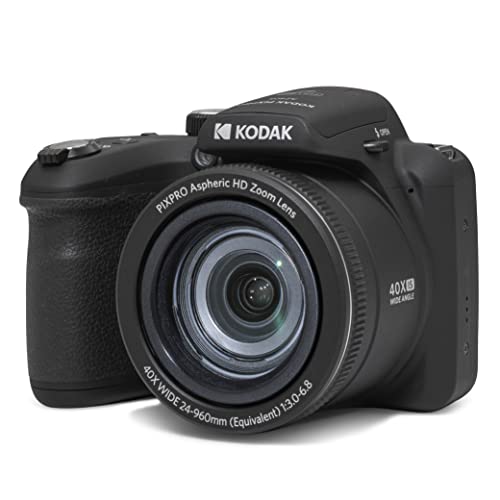
- 40x optical zoom and 24mm wide-angle lens
- 20MP sensor
- Optical image stabilization
- AA battery operation
- Automatic scene detection
Cons
- 1080p is the highest listed video format
- No Wi-Fi is listed
- Shorter reach than the other long-zoom picks
Best for: families and travelers who want straightforward controls, optical stabilization, and replaceable batteries.
The KODAK AZ405 is deliberately uncomplicated. It provides a 40x optical zoom with a 24mm wide-angle end, so it can cover a family group, a landscape, or a distant performer without requiring lens changes. Its 20MP CMOS sensor is a little more generous on paper than the 16MP sensors in the AZ528 and AZ255.
Optical image stabilization is the feature that matters most when the lens is extended. It reduces the effect of hand movement at the long end, making the camera easier to use at a concert, sports field, or outdoor event. Automatic shooting modes and scene detection keep the camera approachable for users who would rather concentrate on framing than exposure settings.
The AZ405 records 1080p HD video and accepts SD, SDHC, and SDXC cards up to 512GB. It runs on standard AA batteries, which is useful when a charger is inconvenient or replacement cells are easier to find. The listed body weight is about 0.96 pounds, making it one of the more manageable options here.
The trade-off is missing connectivity. The KODAK AZ528 adds Wi-Fi and a faster 6 fps burst mode, while the Panasonic FZ80D adds 4K and an electronic viewfinder. The AZ405 is the better fit for someone who wants a simple camera with long reach and AA convenience, not a connected or advanced video platform.
9. Minolta MN67Z: Best for Flexible Framing

Pros
- 67x optical zoom
- 20MP photos and 1080p video
- Optical image stabilization
- Fully articulating 3-inch LCD
- Wi-Fi and 27 shooting modes
Cons
- Listed weight is more than four pounds
- No 4K or RAW support is listed
- Bundle adds carrying bulk
Best for: vloggers and photographers who need a movable screen with substantial zoom reach.
The Minolta MN67Z stands out for its fully articulating 3-inch LCD. A screen that moves makes low-angle framing, self-recording, and vlogging easier than a fixed display. That feature gives it a distinct purpose even though the rest of its specification sits close to the other Full HD superzoom cameras.
Its 67x optical zoom is longer than the KODAK AZ528 and Panasonic FZ80D, though shorter than the Nikon P950. Optical image stabilization helps counter camera shake, and the 20MP sensor gives it the same stated still resolution as the AZ405 and AZ653. The camera also offers 27 intelligent shooting modes, which can help beginners approach different scenes without adjusting every control manually.
Wi-Fi enables wireless sharing, and the camera records 1080p Full HD video. The bundle includes a 32GB SDHC card, camera bag, cleaning kit, HDMI cable, hand strap, flexible tripod, card wallet, and USB card reader. Those extras suit a creator who wants to start shooting immediately, but the listed body weight of 4.19 pounds makes the package a poor match for minimalist travel.
The MN67Z is more flexible than the Minolta MN40Z for framing and more far-reaching than the KODAK AZ405. It loses to the Panasonic FZ80D for 4K and to the Nikon P950 for extreme telephoto work. Choose it for the articulating screen and Wi-Fi, especially if vlogging is part of the plan.
10. KODAK AZ255: Best Compact AA Option

Pros
- Lightest listed body in the roundup
- 25x optical zoom with a 24mm wide angle
- Optical image stabilization
- Standard AA battery support
- 1080p video
Cons
- Shortest optical zoom in this group
- 16MP sensor
- No Wi-Fi is listed
Best for: casual travel, family events, and buyers who prioritize a lighter camera.
The KODAK AZ255 is the least intimidating camera here. Its 25x optical zoom is still a meaningful step beyond a standard phone camera, and its 24mm wide-angle view works for landscapes and groups. It is not designed to compete with the Nikon P950's distant-subject reach, but it is easier to justify when a camera will spend most of its time in a day bag.
Optical image stabilization helps keep handheld shots sharp throughout the zoom range. The 16MP CMOS sensor records detailed stills, and the camera records 1080p Full HD video for travel memories and family events. It also accepts SD, SDHC, and SDXC cards up to 512GB, so storage will not be a limiting factor for a normal day of shooting.
AA battery support is a practical advantage. The camera ships with four starter AA alkaline batteries and can use lithium AAs or rechargeable NiMH cells. The listed body weight is about 0.78 pounds, the lightest in this group, which makes it noticeably easier to carry than the Minolta bundles and the larger superzooms.
The limitation is reach and connectivity. The AZ405 offers 40x zoom and a 20MP sensor, while the AZ528 adds Wi-Fi and a faster burst mode. For casual travel, the features that help a camera stay easy to carry matter more than maximum magnification, and that is where the AZ255 makes sense.

How to choose best bridge camera
A bridge camera is defined by the relationship between its lens reach, stabilization, sensor, viewfinder, and physical size. These are the factors that separate a genuinely useful superzoom from a camera that sounds impressive on a specification sheet.
Optical zoom and focal range
Optical zoom is the most important reason to buy a bridge camera. The KODAK AZ255's 25x range is suitable for family events and travel, while the KODAK AZ528, Panasonic FZ80D, and Nikon P950 reach much farther for wildlife and distant sports.
Look at the wide-angle starting point as well as the maximum reach. A 24mm equivalent view, available on several KODAK models and the Minolta MN40Z, is useful for landscapes and groups. Long telephoto reach is only helpful if the camera can still frame the subject steadily.
Image stabilization
At long focal lengths, small hand movements become large movements in the frame. Optical image stabilization helps counter that shake, but it cannot freeze a bird or athlete that is moving quickly.
For handheld wildlife work, look for both stabilization and a burst mode. The AZ528 combines optical stabilization with 6 fps shooting, while the AZ653 uses stabilization with a 5 fps burst. A tripod still helps when the subject is distant and stationary.
A longer zoom is useful only when you can hold the subject inside the frame.
Sensor and file format
The listed cameras use small sensors, but their resolutions range from 16MP to 20.3MP. More pixels can allow more cropping in good light, but sensor resolution alone does not guarantee cleaner images in dim conditions.
RAW support is important if you edit seriously. The Nikon P950 and KODAK AZ653 list RAW capture, while the other models here do not. If you mostly share finished images directly, a straightforward JPEG-focused camera may be easier to live with.
Video features
The Nikon P950 and Panasonic FZ80D list 4K video, making them the strongest options for detailed motion footage. The other specified models record 1080p, which remains suitable for family clips, travel memories, and simple vlogs.
Consider how you frame video too. The Minolta MN67Z has a fully articulating LCD, while the Panasonic FZ80D offers 4K Photo and Post Focus features. A movable screen may matter more to a self-shooter than a higher resolution mode used only occasionally.
Power and handling
Rechargeable battery systems are convenient when you can charge regularly. AA-powered models such as the KODAK AZ255, KODAK AZ405, and Minolta MN40Z are easier to keep running in places where replacement batteries are widely available.
Weight also changes how likely you are to carry the camera. The AZ255's listed body weight is about 0.78 pounds, while the Minolta MN40Z and MN67Z listings are above four pounds. A camera that stays at home cannot make use of its zoom range.

Frequently asked questions
What is a bridge camera?
A bridge camera sits between a simple compact camera and an interchangeable-lens camera. It normally has a fixed lens with a broad zoom range, a shaped grip, and more controls than a basic point-and-shoot model. The lens cannot be removed, but the design avoids carrying multiple lenses.
Which camera has the longest zoom?
The Nikon P950 has the longest listed optical zoom at 83x, with a stated maximum focal length of 2000mm. The Minolta MN67Z follows at 67x, while the KODAK AZ653 provides 65x optical zoom.
Which bridge camera is best for wildlife?
The Nikon P950 is the strongest specialist option because of its 83x optical zoom, image stabilization, Bird and Moon modes, and RAW support. The KODAK AZ528 is a more general-purpose alternative with 52x zoom, 6 fps burst shooting, and Wi-Fi.
Do all of these cameras record 4K video?
No. The Nikon P950 and Panasonic FZ80D list 4K video recording. The KODAK AZ528, KODAK AZ528 Astro, KODAK AZ653, KODAK AZ405, KODAK AZ255, Minolta MN40Z, and Minolta MN67Z list 1080p video.
Is optical image stabilization important on a bridge camera?
Yes. Long zoom lenses magnify hand movement as well as the subject, so stabilization helps produce a steadier view and sharper handheld images. It is especially useful at the telephoto end, although it cannot stop a moving subject from blurring.
Which model supports RAW photos?
The Nikon P950 and KODAK AZ653 list RAW format support. RAW files are useful when you plan to adjust exposure, color, and detail carefully in editing software.
Are AA batteries useful for travel photography?
AA batteries can be useful when access to charging is limited because replacement cells are widely available. The KODAK AZ255 and AZ405 use AA batteries, while the Minolta MN40Z bundle includes four AA batteries and a charger.
The bottom line
The KODAK AZ528 is the Best bridge camera for most people who want a practical mix of reach, stabilization, burst shooting, Wi-Fi, and a 24mm wide-angle view. The Panasonic FZ80D is the better choice for 4K video and viewfinder use, while the Nikon P950 is the clear specialist for extreme wildlife and moon photography.
If you are undecided, choose the AZ528 for general shooting, the P950 for maximum reach, or the FZ80D when 4K matters more than having the longest lens.
As an Amazon Associate we earn from qualifying purchases.