

A first layer that peels up, a nozzle that clogs halfway through a long print, or a bed that needs constant adjustment can turn a promising 3D printer into a frustrating project. The right machine should make the first successful print feel routine, not like a repair job.
Our Best best budget 3d printer picks cover compact beginner machines, fast CoreXY printers, enclosed models, and multicolor systems. The FLASHFORGE Adventurer 5M is the best all-around choice, while the other eight make stronger cases for specific users and workloads.
Comparison table
| # | Product | Award | Build volume | Maximum speed | Best for |
|---|---|---|---|---|---|
| 1 | FLASHFORGE Adventurer 5M | Best overall | 220 x 220 x 220mm | 600mm/s | Fast everyday printing |
| 2 | Bambu Lab A1 mini | Best for beginners | Compact format | Not specified | First-time users and small projects |
| 3 | FLASHFORGE Adventurer 5M Pro | Best enclosed Flashforge | 220 x 220 x 220mm | 600mm/s | Advanced filament and quieter rooms |
| 4 | Bambu Lab P1S | Best enclosed ecosystem | Not specified | 500mm/s | Reliable connected printing |
| 5 | FLASHFORGE AD5M | Best easy-maintenance pick | 220 x 220 x 220mm | 600mm/s | Tinkerers who want quick servicing |
| 6 | Creality Ender 3 V3 SE | Best traditional design | 8.66 x 8.66 x 9.84 inches | 250mm/s | Simple PLA, TPU, and PETG projects |
| 7 | FLASHFORGE AD5X | Best multicolor Flashforge | Not specified | 600mm/s | Four-color creations |
| 8 | AOSEED AI 3D Printer | Best for kids | Enclosed compact format | Up to 400mm/s | Supervised family projects |
| 9 | Creality K2 Combo | Best larger multicolor printer | 260 x 260 x 260mm | 600mm/s | Bigger prints and expanded color |
1. FLASHFORGE Adventurer 5M: Best Overall

Pros
- Automatic leveling removes a common setup chore
- CoreXY frame supports fast movement
- Quick nozzle changes and flexible nozzle sizes
- Dual-sided PEI platform makes removal easier
Cons
- Open design offers less protection for advanced materials
- The advertised top speed is not the right setting for every model
- Remote monitoring depends on the Flash Maker app
Best for: people who want a quick, capable printer for everyday parts and models.
The FLASHFORGE Adventurer 5M is the one that makes the most sense for a wide range of home users. It removes much of the ritual that can make a first printer intimidating. Automatic bed leveling handles the nozzle-to-bed adjustment, and the dual-sided PEI platform gives you a practical surface for printing and a simpler way to release finished models.
Its CoreXY all-metal structure is the important hardware detail behind the speed claim. The printer is rated for travel speeds up to 600mm/s and acceleration up to 20, 000mm/s², though those figures are best understood as headroom rather than a promise that every object should be printed at maximum speed. For large simple parts, faster movement can shorten the wait. For detailed models, sensible settings matter more than chasing the top number.
The direct extruder reaches 280°C, which gives the machine useful flexibility across common materials. The supplied feature set names PLA, PETG, and TPU compatibility, while the 32mm³/s high-flow nozzle supports the printer's fast-printing design. Nozzle changes take about three seconds, and available diameters from 0.25mm to 0.8mm let you choose fine detail or quicker, broader layers. A 35-second warm-up to 200°C is another small convenience that makes short jobs less tedious.
Compared with the FLASHFORGE AD5M, this model offers a similar fast CoreXY concept with a clearer all-purpose position. The Adventurer 5M Pro adds an enclosed design and broader material guidance, while the Bambu Lab A1 mini is easier to place but gives up build room. The weakness here is the open frame. It is less reassuring around children and less naturally suited to temperature-sensitive enclosed-material work. Choose the Adventurer 5M if you want speed, automatic setup, and a standard-size build area without committing to a more specialized machine.
2. Bambu Lab A1 mini: Best for Beginners

Pros
- Automatic calibration and simple setup
- Quiet operation suits bedrooms and workspaces
- Bambu Handy app and MakerWorld access
- Includes an LED lamp kit for creative projects
Cons
- Smaller format limits the size of finished models
- Single-printer package is aimed at compact work
- The lamp kit is a niche bonus for some buyers
Best for: a new maker who wants guided printing and small creative projects.
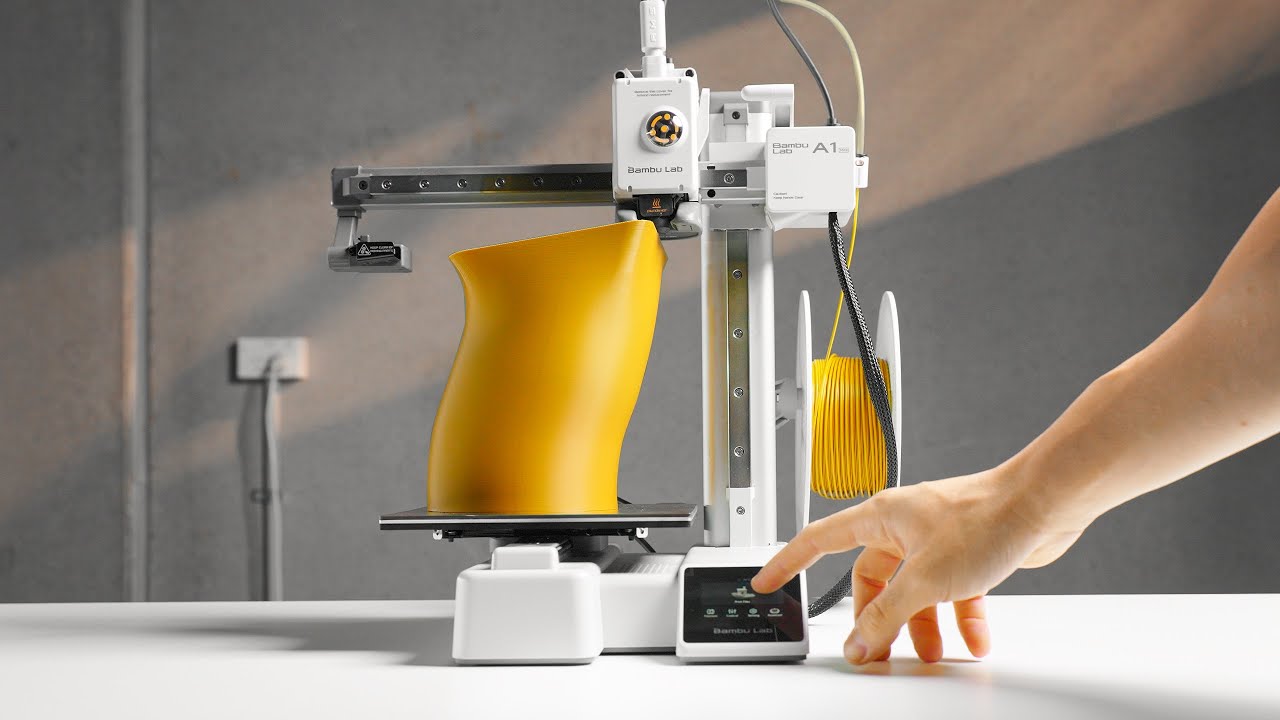
The Bambu Lab A1 mini is the least intimidating printer here. It is designed around the moment when a newcomer wants to go from opening the box to making something useful, rather than learning bed adjustment and machine tuning first. Automatic calibration and a ready-to-use setup make it a particularly appealing starting point for toys, decorations, gifts, and small household pieces.
The compact footprint is both its charm and its limitation. Its listed dimensions are about 15.21 inches long, 16.77 inches wide, and 17.94 inches high, with a weight of about 12.1 pounds. That makes it easier to move between a desk and a shelf than the heavier Bambu Lab P1S or FLASHFORGE Adventurer 5M Pro, but you need to accept that larger models may need to be split into multiple parts.
Bambu's ecosystem does a lot of the teaching. MakerWorld provides ready-to-print models, and the Bambu Handy app is intended to manage projects without forcing a new user to master a complicated workflow immediately. The included LED Lamp Kit gives the printer a more tangible creative path: print compatible lamp designs, assemble the project, and get a functional result instead of a collection of test shapes.
Quiet operation is a welcome trait in a home office or shared room. The machine is not the choice for someone who needs a larger build area or wants to experiment immediately with demanding materials. The FLASHFORGE Adventurer 5M is faster on paper and gives you a standard 220 x 220 x 220mm build volume, but the A1 mini is friendlier at the starting line. Readers comparing several beginner workflows may also want to consider the setup features that matter most for a first printer. Pick the A1 mini when ease, compactness, and a gentle learning curve matter more than print size.
3. FLASHFORGE Adventurer 5M Pro: Best Enclosed Flashforge
Pros
- Enclosed body suits a broader materials list
- Automatic pressure-based leveling
- 280°C direct extruder
- Remote control and live video monitoring
- Quick setup and dual-sided PEI platform
Cons
- Heavier than the open Adventurer 5M
- Build volume is not larger than the standard model
- Advanced material support still requires careful settings
Best for: makers who want fast printing with an enclosed structure and wider filament options.
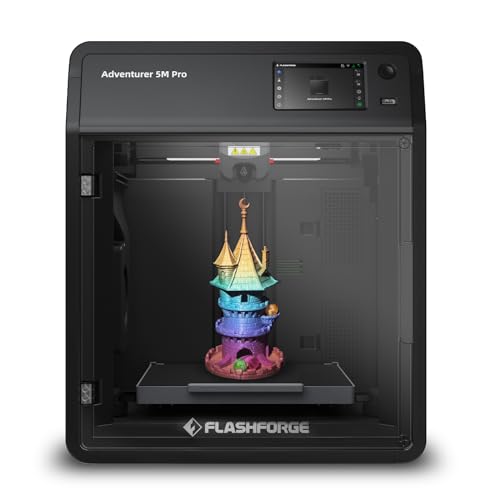
The FLASHFORGE Adventurer 5M Pro takes the straightforward 5M formula and gives it a more controlled environment. The enclosed body is the reason to choose it. It helps the printer suit materials such as ABS and ASA more naturally than an open-frame machine, and it is a more comfortable fit for a shared room where exposed moving parts are undesirable.
Under the enclosure is a CoreXY all-metal structure rated for 600mm/s travel speed and 20, 000mm/s² acceleration. The 220 x 220 x 220mm build volume is familiar from the regular Adventurer 5M, so the Pro is not a larger-object machine. Its advantage is the combination of speed, enclosure, and material flexibility. The 280°C all-metal direct extruder is listed for PLA, ABS, PETG, ASA, TPU, PC, PLA-CF, and PETG-CF.
Automatic pressure-based leveling removes manual Z-axis calibration. The dual-sided PEI platform helps with adhesion and model removal, while nozzle choices from 0.25mm to 0.8mm allow a more deliberate balance between detail and throughput. Flash Maker app integration adds remote control, live video monitoring, and real-time adjustments, useful when a longer print is running away from the desk.
The tradeoff is physical heft. At about 32.2 pounds, it is much less casual to relocate than the A1 mini or Creality Ender 3 V3 SE. The Bambu Lab P1S is the more compelling alternative for people already invested in Bambu's connected ecosystem, while the Adventurer 5M is the simpler pick for mostly PLA and PETG work. Choose the Pro when the enclosure and expanded material support are worth prioritizing, and skip it if you only need small, open-frame PLA projects.
4. Bambu Lab P1S: Best Enclosed Ecosystem

Pros
- Enclosed body supports more demanding filament choices
- Automatic bed leveling
- Fast 500mm/s printing and 20, 000mm/s² acceleration
- Ready-to-use setup in about 15 minutes
- Optional path to multicolor printing
Cons
- The listed package does not include AMS
- Carbon and glass fiber reinforced polymers are not recommended
- Large, heavy body needs a permanent workspace
Best for: users who want an enclosed printer that can grow into a connected multicolor setup.
The Bambu Lab P1S is a strong choice for someone who wants a printer to feel like an appliance rather than a weekend assembly project. It is ready to use in about 15 minutes, and automatic bed leveling removes one of the most common causes of poor first layers. The enclosed body also gives the machine a more versatile role than a basic open-frame printer.
Its rated speed reaches 500mm/s with 20, 000mm/s² acceleration. That is slightly below the 600mm/s claims of several Flashforge models, but the P1S is still designed for fast work. The more meaningful distinction is its balance between quick movement, enclosure, and a mature connected workflow. It supports PLA, PETG, TPU, PVA, PET, ABS, and ASA, with PA and PC listed as capable materials. Carbon and glass fiber reinforced polymers are not recommended.
The P1S can support up to 16 colors when connected to Bambu's AMS system, but the package represented here is the printer without AMS. That distinction matters. The machine gives you an upgrade path rather than immediate multicolor printing. For a broader look at enclosed machines and material handling, the practical differences between home printer designs are useful to settle before choosing a permanent workspace.
The body measures roughly 15.31 inches high and long, 18.03 inches wide, and weighs about 39 pounds. It is the heaviest model in this group with a listed weight, so it belongs on a stable surface that you do not plan to move often. The Adventurer 5M Pro offers a similar enclosed idea with a 280°C direct extruder and a 220mm cubed build area, while the P1S makes the stronger case for an integrated software and upgrade ecosystem. Choose the P1S if that connected path matters more than having multicolor hardware immediately included.
5. FLASHFORGE AD5M: Best Easy-Maintenance Pick

Pros
- One-click automatic calibration
- Tool-free nozzle changes in about three seconds
- Double-sided PEI steel plate
- Print-resume function after an outage
- Remote monitoring through Flash Maker
Cons
- Open-frame design is less controlled for advanced materials
- No multicolor system included
- CoreXY speed can require careful slicer settings
Best for: hands-on users who want fast printing and simple access for routine maintenance.
The FLASHFORGE AD5M is aimed at the person who does not mind learning a little about the machine but does not want maintenance to become a project. Its one-click automatic leveling measures the nozzle-to-build-plate distance and sets the offset for you. That makes first-layer preparation far less fiddly than on older entry-level designs.
This is another all-metal CoreXY printer with a 220 x 220 x 220mm build area and a maximum speed of 600mm/s. The speed is useful for repeated prototypes and simple functional parts, but the real ownership benefit is the quick-release nozzle. The available 0.25mm, 0.4mm, 0.6mm, and 0.8mm diameters let you change the character of a print, and the tool-free swap can take about three seconds.
The double-sided PEI steel plate is flexible enough to help release finished models by bending it. The reverse side is specifically intended for PETG, which gives the surface a more defined role than a generic flat platform. A print-resume function also saves the current layer after an electricity interruption and continues when power returns. Those details do not make failed prints impossible, but they reduce the annoyance of routine interruptions.
The AD5M is physically lighter than the Pro at about 22 pounds and has a similar footprint to the Adventurer 5M. Its open design remains the main limitation. The Creality Ender 3 V3 SE is a more traditional alternative with a lower stated top speed, while the Adventurer 5M is the better fit for someone who wants a more polished general-purpose package. Choose the AD5M if nozzle access, platform flexibility, and outage recovery are high on your list.
6. Creality Ender 3 V3 SE: Best Traditional Design

Pros
- CR Touch auto leveling and strain-sensor Z offset
- Sprite direct extruder handles PLA, TPU, and PETG
- Dual Z-axis design helps reduce wobble
- Automatic filament loading and unloading
- Three-step assembly
Cons
- Slower than the CoreXY printers in this group
- Open frame provides less environmental control
- Setup still involves more assembly than the most ready-to-use picks
Best for: newcomers who prefer a familiar open-frame printer with accessible controls and materials.
The Creality Ender 3 V3 SE is the conventional choice in a field dominated by faster CoreXY machines. It keeps the familiar open-frame layout and focuses on the features that prevent the most common beginner mistakes. CR Touch handles automatic leveling, while a strain sensor sets the Z offset without requiring the user to perform that adjustment manually.
Its build volume is listed as 8.66 x 8.66 x 9.84 inches, a little taller than it is wide. The maximum print speed is 250mm/s with 2, 500mm/s² acceleration, so it will not keep pace with the Flashforge Adventurer models on a long production run. For ordinary PLA parts, TPU accessories, and PETG projects, that speed is still meaningful. It simply leaves more reason to plan around print time.
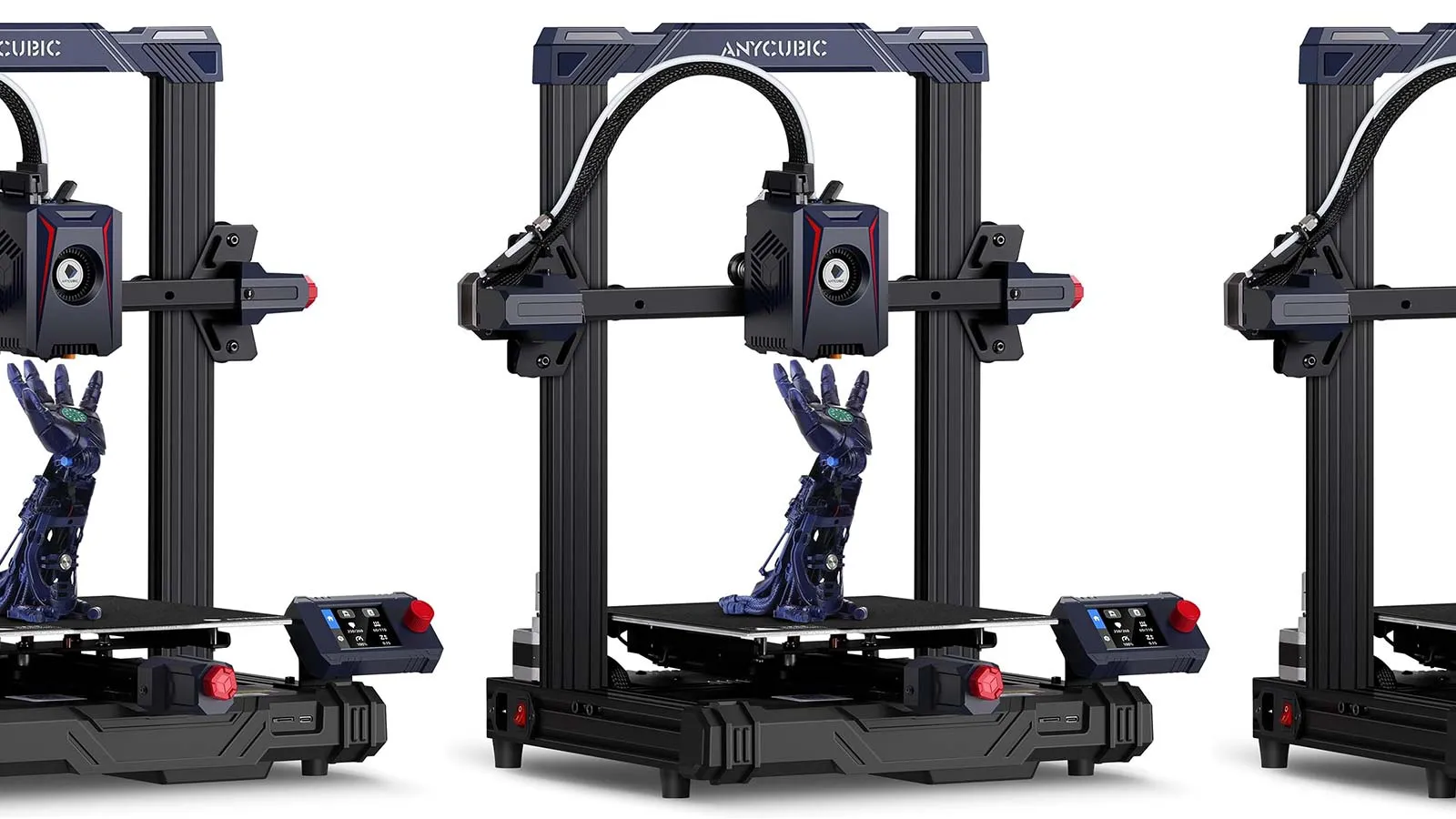
The Sprite full-metal dual-gear direct extruder is designed to feed filament smoothly and supports PLA, TPU, and PETG. Automatic loading and unloading make material changes easier: the printer can extrude when loading and retract when unloading. Dual Z-axis lead screws and steel Y-axis linear shafts are intended to reduce wobble and keep the motion system stable over time.
Assembly takes three steps and the listing estimates about 20 minutes from unpacking to the first print. That is more involvement than the A1 mini, but it can also make the printer easier to understand and service. Users looking for the features that make a first printer less frustrating should compare that hands-on approach with a more automated model. The AD5M is faster and has quicker nozzle servicing, but the Ender 3 V3 SE remains a sensible pick for straightforward materials and an accessible mechanical design.
7. FLASHFORGE AD5X: Best Multicolor Flashforge

Pros
- Four-color printing through the Intelligent Filament System
- Automatic leveling
- 600mm/s speed and 20, 000mm/s² acceleration
- Filament backup feature
- CoreXY structure with vibration compensation
Cons
- Multicolor printing adds workflow complexity
- Build volume is not specified in the supplied data
- More specialized than a single-color printer
Best for: makers who want multicolor and multimaterial projects without moving to a larger machine.
The FLASHFORGE AD5X earns its place by making color the central reason to buy. Its Intelligent Filament System supports four-color printing and can work with PLA, TPU, PETG, SILK, PLA-CF, and PETG-CF. That opens up projects that would otherwise require painting or assembling separate colored parts.
It retains the fast CoreXY approach found in the other Flashforge models. The claimed maximum is 600mm/s with acceleration up to 20, 000mm/s². Automatic bed leveling checks multiple points so the first layer starts at a consistent nozzle distance. Vibration compensation is also built into the design, helping reduce alignment shifts when the motion system changes direction quickly.
The filament system is arranged with four spools side by side, and the listing describes the printer as compact and modular. A filament backup feature can help a long project continue when one spool runs out, though a multicolor workflow inevitably involves more filament changes and more opportunities for waste than a single-color print. That is a capability tradeoff, not a reason to treat the AD5X like a basic printer.
The Creality K2 Combo goes further for users who need a 260 x 260 x 260mm build volume and a possible 16-color setup, but it is physically larger and more ambitious. The AD5X is the more focused choice for four-color designs and a compact workspace. Skip it if you mainly print single-color brackets or utility parts. Choose it when color separation and multimaterial experiments are central to the hobby.
8. AOSEED AI 3D Printer: Best for Kids

Pros
- Enclosed, pinch-resistant design
- One-tap printing and AI-assisted creation tools
- Built-in camera and time-lapse support
- Includes eight rolls of PLA filament
- Access to more than 8, 000 models
Cons
- Single-color printing only
- The kid-focused ecosystem may feel limiting to experienced makers
- The supplied data does not specify a build volume
Best for: families seeking a guided and supervised introduction to 3D printing.
The AOSEED AI 3D Printer is not trying to be a general workshop machine. It is a family creativity device built around one-tap projects, an enclosed body, and a large catalog of models. The app provides access to more than 8, 000 human-reviewed and print-tested designs across 17 themed modules, giving children somewhere to start without needing CAD skills.
AI Doodle can create models from voice, text, or image prompts, while AI MiniMe turns photos into cartoon-style figures. Those tools are more relevant to a child who wants to make something personal than a raw speed specification. The printer also supports iOS, Android, and Windows, with Wi-Fi, voice control, and a built-in assistant intended to guide the process.
The printer supports single-color printing only. Multicolor designs must be printed as separate parts and assembled, so it should not be confused with the AD5X or K2 Combo. The machine is listed with precision up to 0.05mm, normal speeds of 220 to 250mm/s, and peaks up to 400mm/s. Small toy projects can take as little as 20 minutes, while filament runout detection pauses the job if the material ends.
The enclosed, pinch-resistant design and quiet operation make it more suitable for a family room than an exposed machine. A built-in camera enables real-time monitoring and time-lapse videos, and the package includes eight rolls of PLA, tools, a magnetic build plate, and stickers. Families wanting a deeper comparison can look at the safety and supervision questions parents should settle first. Choose AOSEED for guided creativity, not for large engineering parts or unrestricted material experimentation.
9. Creality K2 Combo: Best Larger Multicolor Printer

Pros
- 260 x 260 x 260mm build volume
- Four CFS units can support up to 16 colors
- 600mm/s printing speed
- 95 percent preassembled design
- AI camera and targeted automatic leveling
Cons
- Largest physical footprint in this group
- Multicolor equipment creates a more involved setup
- The expanded system is unnecessary for simple single-color prints
Best for: makers who need more build room and a route to complex multicolor models.
The Creality K2 Combo is the ambitious pick. Its 260 x 260 x 260mm build volume is larger in every direction than the 220mm cubed Flashforge models, giving you more freedom with helmets, larger props, and multi-part designs. The included CFS unit handles multicolor printing, and the system can reach up to 16 colors when four CFS units are connected.
The printer is rated for 600mm/s printing and uses three step-servo motors in the extruder and X and Y axes. Creality says those motors can adjust torque dynamically in less than a millisecond, with the goal of improving extrusion consistency, accuracy, speed, and noise control. Silent Mode uses step-servo motors and dynamically balanced fans, with operation described as no louder than someone typing on a laptop computer.
Setup is intended to be approachable because the printer is 95 percent preassembled. Smart automatic leveling probes only the area needed for the target print, rather than treating the entire bed as a single calibration job. The AI camera watches for spaghetti failures and idle states in real time, which can be useful when a large print runs for hours.
The drawback is scale. The K2 measures about 21.06 inches high, 16.93 inches long, and 16.54 inches wide, so it needs more deliberate placement than the compact AOSEED or A1 mini. The FLASHFORGE AD5X is a more focused four-color option, while the K2 is the better choice when larger models and future color expansion matter. Choose it for capacity and capability, not if your projects are mostly small single-color toys.
How to choose best budget 3d printer
The right printer depends less on a headline speed than on the kind of objects you plan to make, the materials you will use, and how much maintenance you are willing to handle.
Build volume
Build volume determines the largest object you can print in one piece. A 220 x 220 x 220mm printer handles common household parts, toys, brackets, and many display models. The Creality K2 Combo's 260mm cubed volume gives more room for large parts, while the A1 mini is better suited to compact creations.
Automatic leveling
Automatic leveling measures the relationship between the nozzle and build plate before printing. It helps produce a more consistent first layer, which is critical because a poor first layer can ruin an otherwise good model. Every pick here offers some form of automated leveling or a leveling-free workflow, but the sensors and processes differ.
A fast printer with a poor first layer is still a slow way to make anything.
Motion system and speed
CoreXY designs such as the Flashforge models and Bambu Lab P1S move quickly while keeping the heavier hardware more controlled. Maximum speed figures are useful for comparing potential, but detailed models often need slower settings to preserve surface quality. The Ender 3 V3 SE is slower on paper, yet its 250mm/s ceiling remains ample for many ordinary projects.
Extruder and materials
A direct extruder feeds filament close to the nozzle and is useful for flexible TPU. Nozzle temperature and material guidance matter when moving beyond PLA. The 280°C extruders in the Flashforge models support a broader stated material range, while the enclosed P1S and Pro are better aligned with ABS and ASA than open machines.
Enclosure and safety
An enclosure helps contain moving parts and creates a more controlled printing environment. It is particularly useful for advanced materials and shared living spaces. The AOSEED uses an enclosed, pinch-resistant design for family use, while open printers such as the Adventurer 5M and Ender 3 V3 SE are easier to access but need more careful placement.
Color and filament handling
Single-color printing is simpler and generally creates a more direct workflow. Systems such as the AD5X and K2 Combo can switch between colors or materials, but they add hardware and planning. Remember that the Bambu Lab P1S listing here does not include AMS, so its multicolor capability requires a separate connection.
Frequently asked questions
What should a beginner look for in a 3D printer?
Automatic leveling, a direct extruder, simple setup, and a usable model library are the most helpful starting points. The Bambu Lab A1 mini is especially approachable, while the AOSEED adds a kid-focused app and enclosed design.
Is a 600mm/s printer always faster in practice?
No. The top speed is a maximum capability, not a universal setting for every model. Shape complexity, layer height, acceleration, material, and the slicer profile all affect how quickly a print completes.
Which printer is best for multicolor printing?
The FLASHFORGE AD5X supports four-color printing through its Intelligent Filament System. The Creality K2 Combo is the stronger choice for larger objects and can reach up to 16 colors with four CFS units connected.
Do I need an enclosed 3D printer?
Not for ordinary PLA projects. An enclosure becomes more useful for ABS and ASA, for temperature control, and for keeping exposed moving parts away from children. The Adventurer 5M Pro and Bambu Lab P1S are the strongest enclosed options in this group.
Which printer is easiest to maintain?
The FLASHFORGE AD5M is built around quick maintenance, particularly its tool-free nozzle replacement in about three seconds. Its double-sided PEI steel plate and automatic calibration also reduce several routine chores.
Is the Creality Ender 3 V3 SE suitable for flexible filament?
Its Sprite direct extruder is listed as compatible with TPU, as well as PLA and PETG. Flexible filament can still require careful settings and a suitable profile, so automatic loading does not remove every adjustment.
Can children use a 3D printer safely?
Children should use a printer with adult supervision, especially around hot components and moving parts. The AOSEED is the most family-oriented option here because it has an enclosed, pinch-resistant design, quiet operation, one-tap printing, and a kid-focused content library.
The bottom line
The FLASHFORGE Adventurer 5M is our top recommendation for the Best best budget 3d printer because it combines automatic leveling, a 220 x 220 x 220mm build area, a 280°C direct extruder, quick nozzle changes, and fast CoreXY movement. The Bambu Lab A1 mini is the easier first step for compact projects, while the FLASHFORGE Adventurer 5M Pro is the better fit for enclosed printing and a broader material list.
Choose the FLASHFORGE AD5X or Creality K2 Combo if color is central to your projects. Families should start with the AOSEED AI 3D Printer, and hands-on users who prefer a more traditional machine can choose the Creality Ender 3 V3 SE.
If you are undecided, choose the Adventurer 5M for general printing, or the A1 mini when simplicity matters most.
As an Amazon Associate we earn from qualifying purchases.