

A thin TV speaker or laptop speaker can make voices hard to follow and music feel flat. The fix is not always a large stereo system. A well-chosen pair of bookshelf speakers can add real separation, useful bass, and much better control without taking over the room.
The Best budget bookshelf speakers range from simple wired desktop models to powered systems with Bluetooth, optical, HDMI ARC, and subwoofer outputs. We ranked these 10 picks by their capabilities, connection options, driver design, and suitability for different listening setups.
Edifier R1280T is the best all-around pick here, while the lineup also includes a capable HDMI ARC system, compact computer speakers, passive home theater models, and several Bluetooth options.
Comparison table
| # | Product | Award | Driver setup | Inputs | Best for |
|---|---|---|---|---|---|
| 1 | Edifier R1280T | Best overall | 4-inch full-range unit, 13mm silk dome tweeter | Dual AUX, RCA | Music and desktop listening |
| 2 | Saiyin 3.5-inch Bluetooth Speakers | Best connected compact system | 3.75-inch woofer, 0.5-inch horn tweeter | Bluetooth 5.3, optical, coaxial, AUX, RCA | Flexible TV and music setups |
| 3 | Polk Audio T15 | Best passive home theater pick | 5.25-inch driver, 0.75-inch tweeter | Speaker wire | Receiver-based surround systems |
| 4 | ULTIMEA BS-3 | Best TV upgrade | 5.25-inch woofer, dedicated midrange, tweeter | HDMI ARC, RCA, optical, USB, Bluetooth 6.0 | TV, vinyl, and room-filling sound |
| 5 | Saiyin 4-inch Bluetooth Speakers | Best for adding a subwoofer | 4-inch woofer, 0.5-inch silk dome tweeter | Bluetooth 5.3, optical, coaxial, RCA | Expandable stereo systems |
| 6 | Edifier R980T | Best simple desktop pair | 4-inch active speaker design | Dual AUX, RCA | Computers and small desks |
| 7 | Klipsch R-51M | Best passive detail | Dual 5.25-inch woofers, 1-inch tweeters | Speaker wire | Detailed receiver-based music |
| 8 | Electrohome Huntley | Best compact Bluetooth pair | 3-inch drivers | Bluetooth 5, RCA, AUX | Small rooms and mixed sources |
| 9 | Edifier R1280DB | Best wireless Edifier | 4-inch bass driver, 13mm silk dome tweeter | Bluetooth, optical, coaxial | TVs and wireless music |
| 10 | Sanyun SW208 | Best USB desktop speakers | 3-inch carbon fiber units | USB, Bluetooth 5.0 | Near-field computer listening |
1. Edifier R1280T: Best Overall

Pros
- Two AUX inputs allow simultaneous wired connections
- 4-inch driver and silk dome tweeter give a balanced stereo presentation
- Side controls adjust bass and treble
- Remote control makes everyday volume changes easy
- Wood-effect MDF enclosure suits a living room or desk
Cons
- No Bluetooth or optical input
- The active speaker needs to be placed near a power outlet
- Not designed as a receiver-free home theater hub
Best for: someone who wants dependable stereo sound for a desk, shelf, or small living room.
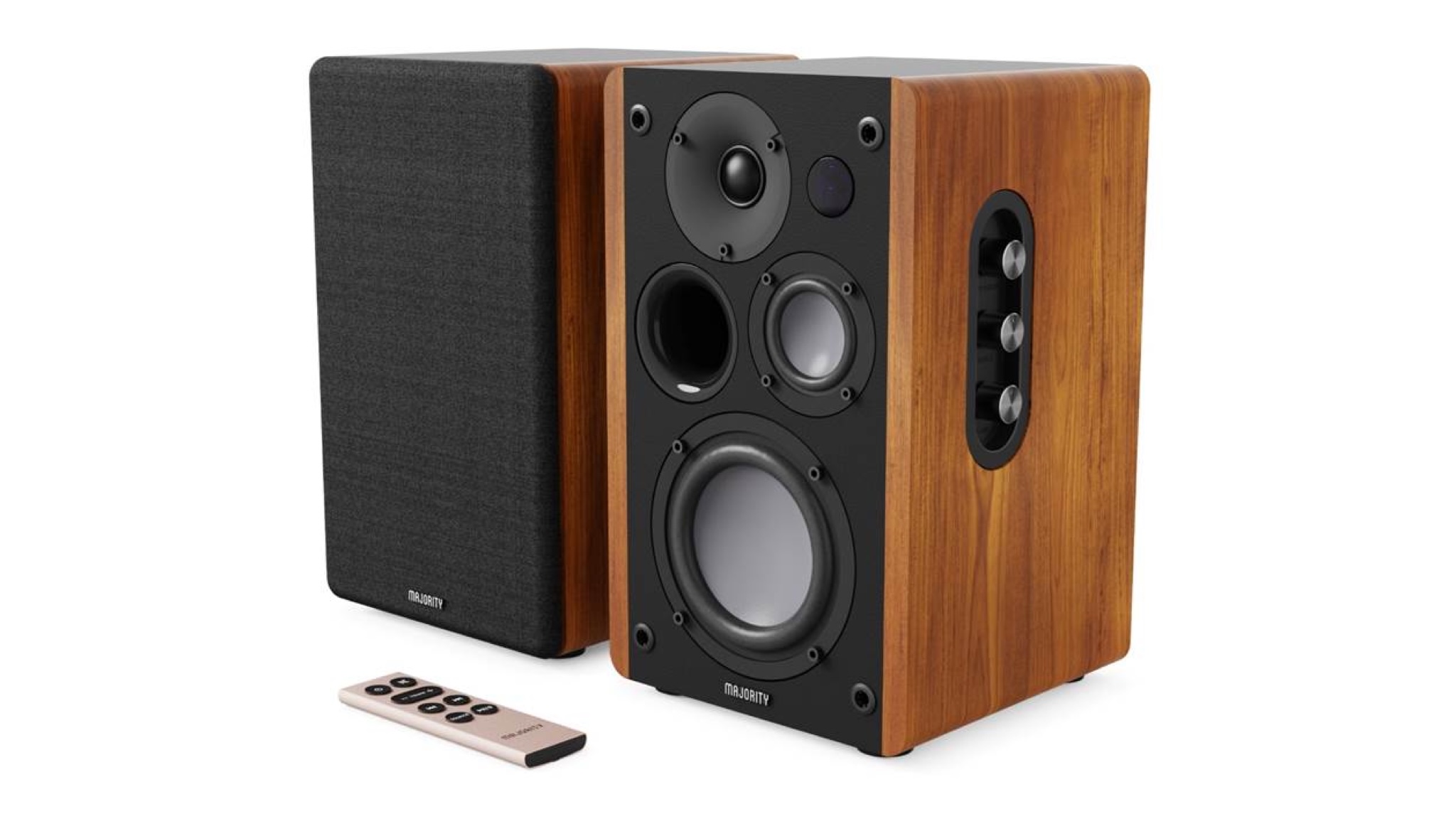
The Edifier R1280T is the pair we would start with when someone asks for the Best budget bookshelf speakers without a complicated shopping brief. It is a straightforward powered system with a pleasing sense of scale, practical controls, and enough connection flexibility for a computer, phone adapter, turntable with the right output, or another analog source. The wood-effect cabinet also looks more at home beside a television or record player than a typical plastic desktop speaker.
Its driver arrangement is sensible for close and moderate-distance listening. A 4-inch full-range unit handles the bulk of the music, while the 13mm silk dome tweeter adds high-frequency detail without turning the presentation into an aggressive listening experience. The system is rated at 42 watts RMS, which gives it more headroom than the smaller Edifier R980T. That extra room matters when you move from quiet desk listening to filling a bedroom or office.
Connection choices are intentionally old-school. Two AUX inputs let you keep two analog sources connected at once, so a computer and another device can share the speakers without cable swapping. Bass and treble controls sit on the side of the powered speaker, and the included remote handles volume from across the room. Those details make the R1280T easier to live with than a speaker that sounds similar but requires reaching behind the cabinet for every adjustment.
The main limitation is the lack of Bluetooth and digital inputs. The Edifier R1280DB is the better match for a TV with optical output or anyone who streams from a phone regularly, while the Saiyin 3.5-inch Bluetooth Speakers offer more input types in a similarly compact category. The R1280T remains the cleaner choice for a listener who mostly uses analog connections and wants a proven two-speaker layout rather than a feature-heavy control system.
If you need wireless playback, this is not the right pick. If you want natural near-field sound, useful tone controls, and a pair that can move between a computer and a living room, the R1280T is the most complete starting point in this group.
2. Saiyin 3.5-inch Bluetooth Speakers: Best Connected Compact System

Pros
- Bluetooth 5.3 supports wireless playback from phones and computers
- Optical and coaxial inputs suit modern TVs and digital sources
- Remote control switches inputs and adjusts volume
- Horn tweeter and 3.75-inch woofer provide a two-way design
- Built-in amplification avoids a separate receiver
Cons
- Turntable use requires the correct output or a preamplifier
- PCM, stereo, or non-surround output is required for compatible sources
- The smaller woofer has less low-end reach than larger systems
Best for: a listener who needs Bluetooth and several wired inputs in one compact powered pair.
The Saiyin 3.5-inch Bluetooth Speakers are built around connection flexibility. They are a good fit for the person whose desk also serves as a TV station, music setup, and occasional record-player listening area. Bluetooth 5.3 covers phones, tablets, Macs, and PCs, while optical and coaxial inputs make the pair much more useful with a television than a basic analog-only speaker.
The internal layout uses a 3.75-inch woofer with a 0.5-inch silk dome horn tweeter. That is a more deliberate two-way arrangement than the single full-range approach used by some small desktop speakers. The result should make vocals and high-frequency effects easier to separate, while the woofer gives music and TV sound more body than a tiny computer speaker. Its active and passive speaker design also means no amplifier or receiver is required.
The remote is a strong part of the package. It can change inputs, mute the system, and move between optical, coaxial, line-in, and Bluetooth modes. Buttons on top of the main speaker provide a backup, and the active cabinet measures 5.3 inches wide, 6.3 inches deep, and 8.6 inches high according to the feature information. That footprint is manageable, though the pair is taller than the Edifier R980T and Sanyun SW208.
There are setup conditions to understand before buying. A turntable needs a line-level output or an external phono preamp, and digital sources should be set to PCM, stereo, or another supported non-surround signal. That is not unusual for powered stereo speakers, but it can cause confusion when a TV is set to an incompatible surround output. The R1280T is simpler for an all-analog setup, while the Saiyin 4-inch Bluetooth Speakers add a subwoofer output and a larger woofer.
Choose these when the input panel matters as much as the sound. They are especially suitable for a small TV or mixed-use desk where Bluetooth, optical, and analog sources need to coexist without a receiver.
3. Polk Audio T15: Best Passive Home Theater Pick

Pros
- 5.25-inch Dynamic Balance driver supports fuller low frequencies
- 0.75-inch tweeter is aimed at clear high-frequency detail
- Wall-mountable design works for front, left, right, or rear positions
- Easy connection to an AV receiver
- Can form part of an expandable surround system
Cons
- Requires an AV receiver or amplifier
- No Bluetooth or built-in amplification
- Larger cabinet needs more shelf or wall space
Best for: someone starting a receiver-based stereo or surround system.
The Polk Audio T15 is the first major split in this roundup because it is passive. There is no power cord for the speaker pair and no Bluetooth pairing process. You connect speaker wire to an AV receiver or amplifier, then let that separate component handle power and source selection. For a home theater system that may eventually add a center channel, towers, or a subwoofer, that architecture makes more sense than a powered desktop pair.
A 5.25-inch Dynamic Balance driver gives the T15 a larger acoustic foundation than the Edifier R1280T's 4-inch unit. Its 0.75-inch tweeter handles the upper range, and Polk positions the speakers for front, left-right, or rear surround use. That makes them adaptable as a system changes. Their 10.7-inch height and 7.3-inch length also give them a more substantial presence than compact computer speakers, so placement deserves some planning.
The T15's biggest strength is integration. Polk specifically describes it as a starting point for a broader surround setup, with matching center and tower options in the same family. Readers comparing bookshelf speakers with a longer-term theater plan should also consider how separate speakers fit into a larger surround setup, especially if the receiver and speaker positions are not decided yet.
The trade-off is convenience. The Saiyin 3.5-inch Bluetooth Speakers and ULTIMEA BS-3 work directly with sources, but the T15 needs an amplifier in the chain. It also lacks the input switching, remote volume, and wireless streaming that make the powered models easy for casual listening. That is not a flaw in a passive design, but it is the wrong match for someone who wants a speaker pair to work straight from a TV or phone.
Buy the T15 when the receiver is already part of the room, or when you want to build around one. Skip it if you are replacing a soundbar or computer speaker and do not want another component between the source and the speakers.
4. ULTIMEA BS-3: Best TV Upgrade

Pros
- Three-way design includes a 5.25-inch woofer, midrange, and tweeter
- HDMI ARC supports TV audio and convenient control
- 70 watts RMS provides substantial output headroom
- Subwoofer output allows a future 2.1 setup
- App EQ includes dialogue, bass, and high-frequency adjustments
Cons
- Large and heavy compared with most pairs here
- Turntable without a built-in preamp needs an external phono preamp
- More features mean more setup decisions
Best for: a TV owner who wants powered stereo sound with room to expand.
The ULTIMEA BS-3 is the most ambitious powered system in this group. It is aimed squarely at a TV and living-room setup, not just a computer desk. HDMI ARC is the headline feature because it allows the speakers to receive TV audio through a single connection and supports easier control from the television environment. That makes it a more natural soundbar alternative than the analog-only Edifier R980T.
The three-way layout is also unusual in this field. A 5.25-inch woofer handles low frequencies, a dedicated midrange driver works on the vocal region, and a tweeter covers the highs. In practice, that division gives the system a better chance of keeping dialogue distinct while also producing fuller music and movie effects. The listed 70 watts RMS should provide more headroom than the 42-watt Edifier systems, although room placement and source material still matter.
The BS-3 has an unusually broad input panel: HDMI ARC, RCA, optical, USB, Bluetooth 6.0, and a subwoofer output. An external powered subwoofer can be added later, which is a meaningful advantage over speakers that lock you into their original bass response. The ULTIMEA app adds EQ modes for music, movies, games, dialogue, deeper bass, and clearer highs. Those controls are useful, but they also mean owners may spend more time tuning than they would with the simpler R1280T.
Physical size is the cost of that capability. The system measures 9.17 inches high, 7.4 inches deep, and 13.15 inches wide in the supplied product information, and its listed weight is 18.96 pounds. That is a serious pair of cabinets for a narrow shelf. The Polk Audio T15 is also a better fit if you already own a receiver and want passive speakers, while the ULTIMEA is the simpler route for direct TV connection.
Turntable buyers should check the output carefully. RCA works when the turntable has a built-in preamp or line output, while a phono-only deck needs an external preamp. The BS-3 is the right choice for someone who wants TV-friendly control, a broad input selection, and a system that can grow into a 2.1 arrangement.
5. Saiyin 4-inch Bluetooth Speakers: Best for Adding a Subwoofer

Pros
- 4-inch woofer gives more low-end support than the smaller Saiyin model
- Subwoofer output allows a powered bass upgrade
- Optical and coaxial inputs support digital TV connections
- Bluetooth 5.3 handles wireless playback
- Remote and top-panel controls simplify source changes
Cons
- Requires a powered subwoofer for the subwoofer output
- Turntables with only phono output need a preamplifier
- Large listed dimensions may not suit a shallow desk
Best for: someone who wants powered speakers now and a straightforward path to more bass later.
The Saiyin 4-inch Bluetooth Speakers are the more expandable of the two Saiyin entries. They keep the same general idea of a powered stereo pair with wireless and digital inputs, but move to a 4-inch woofer and add a dedicated SUB OUT jack. That makes them a better fit for music, games, or TV viewing when you want the option of adding a powered subwoofer rather than replacing the whole speaker system.
The driver arrangement uses a 4-inch woofer and a 0.5-inch silk dome tweeter. The larger woofer should give the pair a fuller foundation than the 3.75-inch woofer in the other Saiyin model, while the tweeter keeps the design focused on separated high-frequency detail. These are active speakers, so no amplifier or receiver is required. The subwoofer output is for an external powered subwoofer, not a passive bass enclosure.
Optical and coaxial inputs support up to 24-bit, 192k digital audio according to the supplied features, while RCA handles compatible analog sources. Bluetooth 5.3 covers a phone, tablet, Mac, or PC. The remote can switch inputs and adjust volume, and physical controls remain available on the main cabinet. For a TV and turntable combination, this is more adaptable than the R1280T, though it has more source-compatibility details to keep straight.
The dimensions listed for the active speaker are 6.7 inches high, 11.8 inches long, and 9 inches wide. Those measurements suggest a cabinet that needs a proper shelf rather than a cramped monitor stand. The ULTIMEA BS-3 is larger still but adds HDMI ARC and a three-way design, while the Saiyin model is less specialized and gives you a simpler route to a subwoofer.
The main weakness is that the system does not replace a full receiver-based theater setup. Its digital input also expects a standard PCM, stereo, or non-surround signal. Pick it for a flexible stereo arrangement with future bass expansion, and choose the smaller Saiyin if cabinet size matters more than the 4-inch woofer and SUB OUT connection.
6. Edifier R980T: Best Simple Desktop Pair

Pros
- 24 watts RMS suits near-field computer listening
- Front-facing bass reflex port helps with flexible placement
- Two AUX inputs allow two analog sources
- Wooden enclosures are designed to minimize resonance
- RCA, 3.5mm cables, and speaker wire are included
Cons
- No Bluetooth, optical, or coaxial input
- Less output headroom than the Edifier R1280T
- No remote control or subwoofer output
Best for: a computer user who wants a small wired stereo upgrade.
The Edifier R980T is the least fussy speaker pair here. It is designed around a computer or close listening position, where a compact cabinet and simple analog connection matter more than Bluetooth or television control. Put the powered speaker beside the monitor, connect the included cable, and you have a conventional stereo setup without a receiver or app.
Its 24 watts RMS is enough for a desk, office, or small room at moderate listening levels. The front-facing flared bass reflex port is a practical choice because it reduces the need to leave a large gap behind the cabinet. Each enclosure uses a wooden construction intended to minimize acoustic resonance, and the pair includes RCA and 3.5mm cables along with speaker wire. Those included connections make it easy to move between a computer, headphone output, or analog source.
Two AUX inputs are the key convenience feature. You can keep two analog devices connected at the same time rather than unplugging a computer whenever another source is needed. That is useful on a desk, though the lack of a remote means volume adjustments happen at the source or on the speaker. The Sanyun SW208 is a stronger desktop alternative when USB audio and Bluetooth matter, while the R1280T offers more power and a tweeter-based design.
The R980T has a narrow use case, and that is also its weakness. There is no optical input for a TV, no wireless streaming, and no SUB OUT for a powered subwoofer. The system is not a sensible choice for a living-room hub or a growing home theater. Readers comparing computer setups can also look at the connection choices that make desktop audio less cluttered, especially when a monitor, laptop, and game console share one desk.
Choose the R980T when the speakers will stay near a computer and you prefer a direct wired connection. Skip it if you expect to stream from a phone or connect a television digitally.
7. Klipsch R-51M: Best Passive Detail

Pros
- 1-inch aluminum LTS tweeters offer a distinct high-frequency design
- 90 by 90 square Tractrix horns focus the tweeter output
- Dual 5.25-inch spun-copper IMG woofers add scale
- Rear-firing bass reflex port supports low-frequency extension
- Passive design works with a quality amplifier or receiver
Cons
- Requires separate amplification
- Rear port needs breathing room behind the cabinets
- Larger than compact desktop speakers
Best for: a listener who already has amplification and wants a more serious passive stereo pair.
The Klipsch R-51M is a conventional passive speaker with a more distinctive driver arrangement than the Polk Audio T15. It needs an amplifier or AV receiver, but in return it is built for a system where speaker placement, source quality, and amplification can be chosen separately. This is the pick for a listener who wants to shape a stereo setup rather than use a self-contained powered pair.
Klipsch uses a 1-inch aluminum LTS tweeter mounted in a 90 by 90 square Tractrix horn. That horn is the defining feature, directing high-frequency energy into the room instead of relying on a small exposed tweeter alone. Two 5.25-inch spun-copper IMG woofers give the R-51M more driver area than the Edifier models and match the larger scale expected from a receiver-based speaker.
The rear-firing bass reflex port helps the low end, but it also makes placement more important. These should not be pushed hard against a wall or packed into a narrow cubby. The supplied dimensions are 13.3 by 7 by 8.5 inches in the feature list, while the product information gives a height of about 15.3 inches, so shoppers should measure their shelf carefully and confirm the intended orientation before installing them.
Compared with the Polk T15, the Klipsch has a more elaborate horn-loaded tweeter and dual woofer setup, while Polk is the more straightforward choice for a basic surround system. Compared with the powered Edifier R1280T, the R-51M can become part of a more customizable system but adds an amplifier to the chain. Its presentation may also be more forward than someone seeking the softer, close-range character of a desktop pair.
This is not the speaker to buy for a laptop, a bare TV, or a room without amplification. It is a better match for a receiver owner who wants more scale and a recognizable horn design, especially for two-channel music or front-channel theater duty.
8. Electrohome Huntley: Best Compact Bluetooth Pair

Pros
- Bluetooth 5 supports wireless music streaming
- RCA and AUX cover common wired sources
- 3-inch drivers suit compact rooms and desks
- Rear-ported wood cabinets support bass response
- Built-in amplifier works with a TV, computer, or turntable
Cons
- Smaller drivers have less scale than the 4-inch and 5.25-inch models
- No optical, HDMI ARC, or subwoofer output
- Turntable connection depends on the turntable's output type
Best for: a small room or desk that needs Bluetooth and basic wired inputs.
The Electrohome Huntley is the smallest-looking solution in this roundup, and its appeal is easy to understand. It is a powered stereo pair with Bluetooth 5, RCA, and AUX, so it can handle a phone, computer, TV analog output, or compatible turntable without an external amplifier. The retro wood cabinet design gives it more character than a plain plastic computer speaker.
Its 3-inch drivers are intended to create a warm, balanced sound in a compact enclosure. Electrohome also uses a rear-ported cabinet to support bass response, but the smaller drivers cannot move as much air as the 4-inch Edifier and Saiyin models or the 5.25-inch Polk and Klipsch units. That makes the Huntley more appropriate for close listening and modest rooms than for a large open living area.
The physical footprint is unusually small in the supplied product information: 5.9 inches high, 4.8 inches long, and 4.5 inches wide, with a listed weight of 4.08 pounds. Such dimensions are useful when a desk or shelf is already crowded. The trade-off is a shorter path to room-filling sound. The Sanyun SW208 is similarly compact but adds USB audio and a built-in 24-bit DAC, while the Edifier R980T offers more conventional computer-oriented inputs and a larger 4-inch design.
Connection simplicity is the Huntley's strongest practical feature. Bluetooth handles wireless music, RCA suits a line-level source, and AUX works with common analog outputs. A turntable with only a phono output still needs the correct preamp arrangement, and the speakers do not offer optical, HDMI ARC, or a subwoofer output. The ULTIMEA BS-3 is a much better TV hub when digital control and expansion are important.
Choose the Huntley for a bedroom, office, dorm room, or small listening corner. It is not the right choice for deep bass, large-room playback, or a system that needs to grow beyond its original pair.
9. Edifier R1280DB: Best Wireless Edifier

Pros
- Bluetooth adds convenient wireless playback
- Optical and coaxial inputs support TVs and computers
- 4-inch bass driver and 13mm silk dome tweeter
- Remote control switches inputs and adjusts volume
- Side controls provide bass and treble adjustment
Cons
- No HDMI ARC
- No subwoofer output
- Larger cabinet needs a dedicated shelf or stand
Best for: someone who likes the R1280T design but needs wireless and digital inputs.
The Edifier R1280DB takes the familiar R1280T formula and adds the connections that modern living rooms tend to need. It keeps a powered two-speaker layout, a 4-inch bass driver, a 13mm silk dome tweeter, side-panel tone controls, and a remote. Bluetooth, optical, and coaxial inputs make it a much easier companion for a TV, computer, or phone.
Optical is the most useful upgrade for a television because it avoids the analog output limitations found on some sets. Coaxial provides another digital route, while Bluetooth handles casual listening from a mobile device. The remote can toggle inputs and adjust volume, so the system does not need to be placed within arm's reach. For a broader look at the trade-off between wired inputs and wireless playback, it helps to decide which sources you use every week before choosing a speaker pair.
The 4-inch driver gives the R1280DB enough body for music and general TV listening, and the silk dome tweeter is intended for natural high-frequency reproduction. Bass and treble controls let you compensate for a bright room, a soft-sounding source, or a speaker position that is less than ideal. The cabinets are substantial, measuring roughly 7.9 inches high, 11.8 inches long, and 9.4 inches wide in the supplied information.
The missing HDMI ARC connection is the most important drawback. The ULTIMEA BS-3 is better for television control, dialogue modes, and future subwoofer expansion, while the R1280DB is simpler and more compact in concept. The R1280T remains the better choice when Bluetooth and digital inputs are unnecessary, since its dual AUX layout is enough for a basic analog desk or stereo setup.
Pick the R1280DB when you want Edifier's familiar active speaker format with Bluetooth and optical input. Skip it if you want one-cable HDMI TV integration or plan to add a powered subwoofer later.
10. Sanyun SW208: Best USB Desktop Speakers

Pros
- USB connection uses a built-in 24-bit DAC
- Bluetooth 5.0 supports wireless playback
- Carbon fiber 3-inch units target clear near-field sound
- Side controls adjust volume, treble, and bass
- Noise elimination system keeps standby operation quiet
Cons
- 3-inch drivers are not suited to large rooms
- No optical, RCA, HDMI ARC, or subwoofer output
- USB connection is most useful at a computer desk
Best for: a computer user who wants direct USB audio in a compact stereo pair.
The Sanyun SW208 is the most computer-focused speaker here after the Edifier R980T, but it takes a different approach. Its built-in 24-bit DAC lets a computer send digital audio directly over USB, bypassing the computer's analog output stage. Bluetooth 5.0 is available when a cable-free connection is more convenient, so the pair can serve both a desktop and a nearby mobile device.
Each speaker uses a 3-inch carbon fiber unit with a multi-layer voice coil design. Sanyun describes the intended sound as warm through the midrange, strong in the low frequencies, and clear in the highs. The compact driver size makes these near-field speakers, meaning they are best placed on either side of a monitor and listened to from the desk rather than used to fill a wide living room.
The side of the main speaker carries volume, treble, and bass controls. That is helpful on a desk where placement and listening distance can change from one setup to another. Sanyun also includes a noise elimination system intended to filter unwanted noise during standby, and the speakers are designed for quiet, energy-conscious operation. The pair measures 5.35 inches high, 7.48 inches long, and 4.68 inches wide in the product information.
The SW208's narrow input selection is the catch. USB and Bluetooth are convenient, but there is no optical connection for a TV, no RCA input for a traditional analog source, and no subwoofer output. The Edifier R980T is more flexible for two wired analog devices, while the Electrohome Huntley is a better compact choice for RCA and AUX sources. The SW208 is the stronger pick when USB audio is the deciding feature.
Use these as close-range computer speakers, particularly if you want to avoid a noisy or weak headphone output from a laptop or desktop. Skip them for a living-room TV, vinyl system, or any setup that needs several physical inputs.
How to choose best budget bookshelf speakers
The right pair depends less on cabinet appearance than on how your sources connect, how far away you sit, and whether the system must grow later.
Powered or passive design
Powered speakers contain their own amplifier, so they can connect directly to a computer, television, phone, or turntable with the appropriate output. Edifier, Saiyin, ULTIMEA, Electrohome, and Sanyun use this approach. It is usually the easiest route for a first stereo setup.
Passive speakers such as the Polk Audio T15 and Klipsch R-51M need an AV receiver or amplifier. That adds equipment, but it also makes the speakers easier to integrate into a larger stereo or surround system. Do not choose a passive pair if you expect a simple cable from a TV to be the entire setup.
Driver size and layout
A larger woofer generally has an easier time producing fuller bass at ordinary listening levels, though cabinet design and tuning matter too. The 3-inch Huntley and SW208 are most comfortable near a desk, while 4-inch models such as the Edifier R1280T and R1280DB suit desktops and smaller living spaces.
Three-way designs such as the ULTIMEA BS-3 add a dedicated midrange driver between the woofer and tweeter. That can help with vocals and dialogue. A two-way speaker can still sound balanced, and the Klipsch uses a horn-loaded tweeter to give its passive design a distinct presentation.
Inputs and source compatibility
Check every source before choosing. Optical is useful for many TVs, Bluetooth is convenient for phones, USB can improve a computer setup, and RCA or AUX works with standard analog outputs. HDMI ARC is the most TV-friendly connection in this roundup because it supports audio through the television and can simplify control.
Turntables need special attention. A deck with a built-in preamp or line output can connect to the appropriate powered speaker input. A turntable with phono output alone needs an external phono preamp. Bluetooth only works with a turntable that can transmit Bluetooth audio, not one that merely receives music from a phone.
Placement and room size
Bookshelf speakers need separation between the left and right cabinets to create a convincing stereo image. Small models can sit beside a monitor, but larger pairs need a stable shelf with enough depth and clearance. Rear-ported speakers should not be pushed tightly against a wall.
A compact 3-inch system can sound satisfying at a desk yet lose authority across a large room. For a living room, the 4-inch and 5.25-inch models give you more physical scale, while the ULTIMEA BS-3 is designed for a stronger TV-focused presentation.
Choose the connections you will use every week first, then choose the driver size your room can actually support.
Expansion options
A subwoofer output is useful if you want stronger low bass without replacing the speakers. The Saiyin 4-inch model and ULTIMEA BS-3 provide that route, while the passive Polk and Klipsch can be expanded through the receiver that powers them. The R1280T, R1280DB, R980T, Huntley, and SW208 are more self-contained.
A receiver-based system offers the broadest home theater path, but it also requires more planning. A powered pair is better when the goal is a compact system that works immediately with a small number of sources.
Frequently asked questions
Do powered bookshelf speakers need a receiver?
No. Powered speakers have built-in amplification and connect directly to compatible sources. The Edifier, Saiyin, ULTIMEA, Electrohome, and Sanyun models in this roundup are powered. The Polk Audio T15 and Klipsch R-51M are passive and do require an amplifier or AV receiver.
Can these speakers connect to a turntable?
Some can, provided the turntable has a line-level output or a built-in phono preamp. A turntable with only a PHONO output needs an external phono preamp before connecting to most powered speakers. Bluetooth connection also requires a turntable that can transmit Bluetooth audio.
Are bookshelf speakers suitable for a TV?
Yes, but the input type matters. Optical works with many TVs, while HDMI ARC on the ULTIMEA BS-3 offers the most direct TV-focused setup in this group. Analog RCA or AUX can work too, but you may need to manage volume with the speaker remote or the television's output controls.
Which speakers are best for a computer desk?
The Edifier R980T and Sanyun SW208 are the most desk-focused choices. The R980T offers dual analog AUX inputs, while the SW208 adds USB audio through a built-in 24-bit DAC and Bluetooth. The Edifier R1280T is better if the desk opens into a larger room and you want more output headroom.
Can a powered speaker pair use a subwoofer?
Only when the powered speakers include a suitable subwoofer output. The Saiyin 4-inch Bluetooth Speakers and ULTIMEA BS-3 have SUB OUT connections for powered subwoofers. A passive pair can also work with a subwoofer through a compatible receiver, depending on the receiver's outputs and bass-management features.
Do bookshelf speakers need to be placed on a bookshelf?
No. They can sit on a desk, media console, speaker stands, or wall mounts when the design supports mounting. Keep the left and right speakers separated, place the tweeters near ear level when possible, and leave sensible clearance around rear ports.
What does a horn tweeter change?
A horn helps direct the tweeter's output into the listening area. The Saiyin 3.5-inch model uses a horn tweeter, and the Klipsch R-51M uses a larger Tractrix horn with its 1-inch tweeter. Horn designs can create a more direct, energetic presentation, though the final result still depends on placement and room acoustics.

The bottom line
The Edifier R1280T is the safest recommendation for most people shopping for the Best budget bookshelf speakers. Its 4-inch driver, 13mm silk dome tweeter, dual AUX inputs, remote, and tone controls cover everyday music and desktop listening without making the setup complicated.
Choose the ULTIMEA BS-3 for a TV-centered room where HDMI ARC, a three-way driver layout, app EQ, and subwoofer expansion matter more than compact size. For a receiver-based system, the Polk Audio T15 is the more approachable home theater choice, while the Klipsch R-51M suits listeners who want a more distinctive passive design and already have amplification.
If you are undecided, choose the Edifier R1280T for analog simplicity, or the Edifier R1280DB when Bluetooth and optical input are essential.
As an Amazon Associate we earn from qualifying purchases.