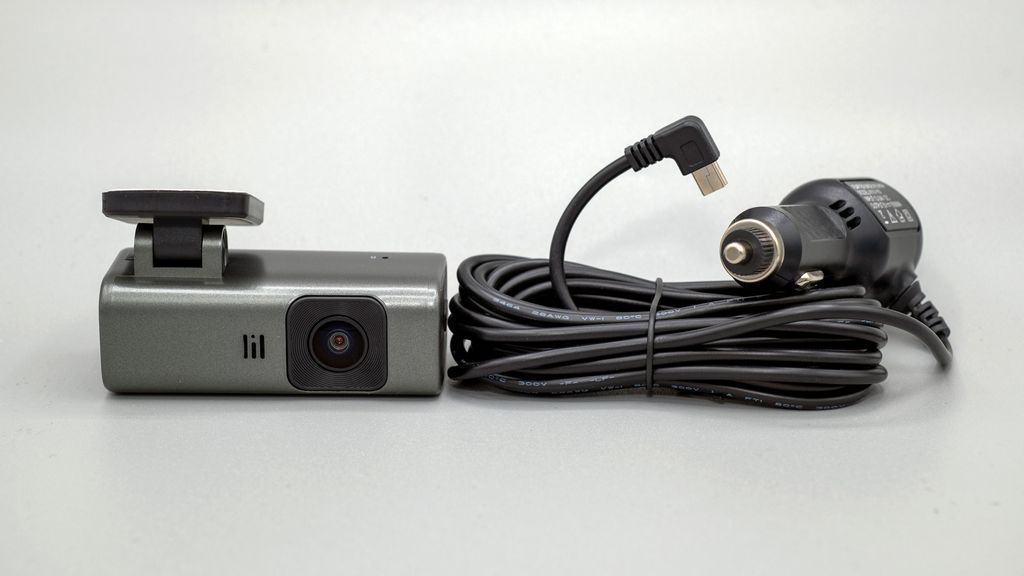

A dash cam earns its place when something happens quickly: a sudden stop, a parking lot scrape, or a disagreement about which lane a car occupied. The hard part is finding one that records useful detail without turning installation and video retrieval into a daily chore. The Best budget dash cam options now range from compact front-only models to four-camera systems with GPS and phone apps.
We focused on the features that matter after the camera is mounted. Resolution helps, but lens coverage, low-light handling, storage, emergency file protection, and the practical demands of parking mode matter just as much. The top picks cover different drivers, from commuters who want a discreet camera to rideshare drivers who need an interior view.
The single best pick is the REDTIGER F7NP, with the ROVE R2-4K close behind and several more specialized choices covering cabin, side, and remote monitoring needs.
Comparison table
| # | Product | Award | Front and rear video | Channels | Best for |
|---|---|---|---|---|---|
| 1 | REDTIGER F7NP | Best overall | 4K + 1080P | 2 | Most drivers |
| 2 | ROVE R2-4K | Best for GPS features | 4K + 1080P | 2 | Route and speed records |
| 3 | galphi Mini 4K | Best screen-free design | 4K front | 1 | Discreet installation |
| 4 | E-YEEGER S50 | Best simple dual camera | 2.5K + 1080P | 2 | Straightforward operation |
| 5 | REDTIGER F7N Touch | Best for touch controls | 4K + 1080P | 2 | Hands-free controls |
| 6 | XYGCACO D65 | Best 360-degree coverage | 4K + 1080P x3 | 4 | Side coverage |
| 7 | 70mai A810 Lite | Best remote access | 4K + 1080P | 2 | Connected parking monitoring |
| 8 | FAIMEE F6 | Best rear resolution | 4K + 2K | 2 | Rear-facing detail |
| 9 | SUVCON 3-Channel | Best cabin coverage | 1296P front and rear | 3 | Rideshare and family use |
| 10 | TERUNSOUl 3-Channel | Best three-view detail | 4K + 1080P x2 | 3 | Front, rear, and cabin recording |
1. REDTIGER F7NP: Best Overall

Pros
- 4K front and 1080P rear recording
- STARVIS 2 sensor with WDR and HDR
- Fast 5.8GHz WiFi transfers
- Supercapacitor design for heat resistance
Cons
- Parking monitoring needs a separate hardwire kit
- No touch control or voice control listed
Best for: drivers who want sharp dual-camera coverage without a complicated setup.
The F7NP is the camera we would put in most cars first. It covers the two views that matter for ordinary driving, keeps the main unit compact, and avoids making the driver interact with a large screen. The 4K front recording is the headline feature, but the 1080P rear camera is what makes this more useful than a front-only unit when a collision or disputed maneuver happens behind you.
The front camera combines a STARVIS 2 sensor, an F1.5 aperture, and a six-layer optical lens. Those details matter most when the scene is difficult: a dark road with bright headlights, a gray afternoon, or a tunnel exit where exposure changes rapidly. WDR and HDR are intended to keep bright and dark areas from collapsing into one unreadable image. The 170-degree front view and 140-degree rear view also give the footage useful context around the lanes, not just a narrow view directly ahead.
Its built-in 5.8GHz WiFi is one of the F7NP's strongest ownership features. The REDTIGER Cam app can preview, download, and replay footage, while the stated transfer speed reaches up to 20MB/s. GPS data records route, speed, and location, which can make a clip more informative when viewed later. Loop recording automatically replaces older unlocked files, and the G-sensor locks clips after a detected impact.
The weakness is the control experience. This model does not list a touchscreen or voice control, so the phone app handles much of the convenient file management. Its parking modes include time-lapse and G-sensor recording, but continuous parked protection requires a separate hardwire kit. That is common in this group, though it is important for anyone expecting the camera to monitor a car overnight straight from the box.
The F7NP beats the E-YEEGER S50 on front resolution and low-light hardware, while the ROVE R2-4K offers a larger 3-inch display and more extensive parking options. For a driver who wants a balanced front and rear camera with fast wireless transfers, this is the Best budget dash cam in the lineup.
2. ROVE R2-4K: Best for GPS Features
Pros
- 4K front and 1080P rear video
- Built-in GPS with speed and compass display
- 5GHz and 2.4GHz WiFi
- Three parking mode options
- 3-inch IPS screen
Cons
- Parking modes need a hardwire kit
- Larger display is less discreet than a screen-free design
Best for: drivers who want GPS information and controls directly on the camera.
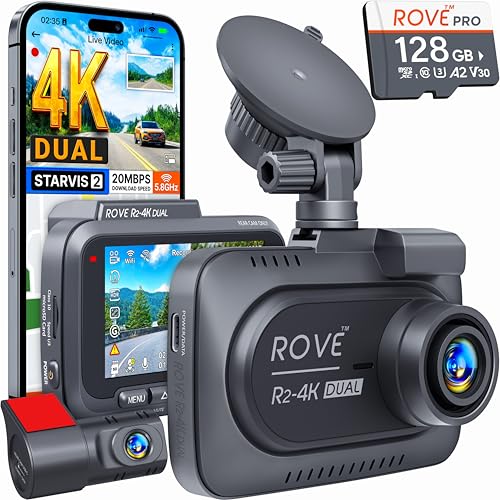
The R2-4K feels like a complete dual-camera system rather than a basic recorder with a second lens attached. Its 3-inch IPS screen gives you a practical way to confirm that both cameras are working, check settings, and review clips without reaching for a phone. That convenience comes at the expense of a little discretion, since a larger screen is harder to hide behind a rearview mirror.
The front camera records at 3840 by 2160 and the rear at 1920 by 1080, both at 30 frames per second. A 150-degree front view and 140-degree rear view balance broad coverage with a useful perspective on vehicles and road signs. The Sony IMX675 STARVIS 2 sensor, F1.5 front aperture, and F1.8 rear aperture give the front camera a strong foundation for low-light recording. The rear camera has less light-gathering ability, but its 1080P resolution remains appropriate for identifying what is happening behind the car.
ROVE makes video handling particularly clear. Its app works over 5GHz or 2.4GHz WiFi and supports downloads up to 20MB/s, plus settings and firmware updates. GPS is built in, and the screen can show live speed and compass information. Location, route, and speed stamps are embedded in recordings, with a GPS Player for viewing the data on a computer.
The parking system is more flexible than most here. It offers 1fps time-lapse, motion detection, and collision detection. When a parked event occurs, the camera records a full one-minute clip, locks it, and can provide a voice alert when the car starts again. The catch is the same practical one found on the REDTIGER F7NP: a hardwire kit is required, and it is not included.
For drivers who care more about a clear operating interface, the R2-4K is the stronger choice than the screen-free galphi Mini 4K. The REDTIGER F7N Touch has touch and voice controls, but the ROVE provides the more explicit GPS presentation. It is the Best budget dash cam for someone who wants route evidence and a camera that explains what it is doing.
3. galphi Mini 4K: Best Screen-Free Design

Pros
- 4K front recording
- Compact screen-free body
- 5GHz WiFi with app control
- 160-degree viewing angle
- 32GB card included
Cons
- No rear camera
- App transfer speed is lower than the leading dual-camera models
- Parking mode needs a Type C hardwire kit
Best for: drivers who want a small front camera with minimal visual distraction.
The galphi Mini 4K takes a clear position: record the road ahead, keep the camera small, and leave the screen out of the cabin. That is a sensible design for drivers who do not want a glowing display competing with the windshield view. Its body measures about 3.07 inches wide by 1.77 inches high, and the screen-free layout should make it easier to place discreetly.
This is a front-only camera, so it cannot match the incident context of the REDTIGER F7NP or ROVE R2-4K. Its 4K 2160P recording and 160-degree lens do provide a detailed, broad view ahead. The F1.6 aperture and WDR are designed to preserve detail in low light and balance scenes with headlights, rain, snow, or deep shadows.
The included 32GB card lets the camera operate out of the box. Loop recording overwrites the oldest unlocked clips when storage fills, while the G-sensor locks footage after a collision or sudden movement. The camera supports cards up to 256GB, though the included capacity is more limited than the larger cards bundled with several dual-camera models.
The 5GHz WiFi connection works with a companion app for previewing and downloading video, with transfers listed up to 8MB/s. That is enough for occasional clips, though it will feel slower than the 20MB/s claims attached to the ROVE R2-4K and REDTIGER models. The 24-hour parking mode uses time-lapse recording and requires a Type C hardwire kit that is not included.
The lack of a rear camera is the decisive limitation. Someone who regularly drives in dense traffic or wants evidence of a rear impact should choose the FAIMEE F6 or another dual-camera option instead. If the priority is a small, quiet installation and strong front detail, the galphi Mini 4K is a clean answer and a particularly approachable Best budget dash cam for a second car.
4. E-YEEGER S50: Best Simple Dual Camera

Pros
- 2.5K front and 1080P rear recording
- 2-inch IPS display
- 170-degree front and 160-degree rear views
- Physical controls and screen saver
- Supports cards up to 256GB
Cons
- Memory card is not included
- Parking mode requires a separate hardwire kit
- No WiFi or GPS listed
Best for: first-time buyers who want direct controls and dual-camera coverage.
The S50 is refreshingly uncomplicated. It has a front camera, a wired rear camera, a small screen, and physical buttons. There is no app setup, wireless transfer, or GPS layer to learn. For a second vehicle, a family car, or anyone who wants to press a button and see whether recording is active, that simplicity has real appeal.
Its 2560 by 1440 front video sits below the 4K models in this guide, while the rear records at 1080P. The 170-degree front and 160-degree rear lenses are wider than those on the ROVE R2-4K, which helps include nearby lanes and the area around a rear-end incident. The wider angle does not automatically mean more detail, but it can provide better context when positioning matters.
Low-light performance gets help from an F1.6 aperture, a six-layer glass lens, and a starlight sensor. WDR is designed to balance bright headlights against darker road areas. Those features give the S50 a more credible night setup than its modest front resolution might suggest, though the available data does not promise the same sensor architecture as the STARVIS 2 models.
Loop recording offers one, three, or five-minute clips. A G-sensor can lock a clip after a collision or sudden braking, and the 2-inch IPS screen lets you review footage, format the card, and change settings locally. The screen saver turns the display off without stopping recording. A microSD card is required but not included, and 24-hour parking protection needs the V5F three-core hardwire kit.
This is not the right pick for someone who expects to send clips to a phone or verify a route with GPS. The galphi Mini 4K is more discreet, but it loses the rear view. The S50 wins for buyers who prefer a straightforward dual camera and do not want an app involved.
5. REDTIGER F7N Touch: Best for Touch Controls

Pros
- 4K front and 1080P rear recording
- Touchscreen and voice control
- Built-in GPS
- 5.8GHz WiFi with 20MB/s downloads
- 128GB card included
Cons
- Parking monitoring needs a separate hardwire kit
- More controls and features can add setup time
Best for: drivers who want to manage the camera without reaching for a phone.
The F7N Touch is the feature-rich sibling to the F7NP. Its main advantage is not sharper footage, since both record 4K front and 1080P rear video. It is the interaction model: a touchscreen, physical buttons, and voice commands give you several ways to lock an event, turn on WiFi, or capture a scene.
The front camera uses a STARVIS 2 sensor with a 170-degree view, while the rear camera records 1080P through a 140-degree view. WDR and HDR support night recording and difficult contrast. The 4K front image is the better source for road signs and distant detail, while the rear camera gives the system meaningful coverage of following traffic.
Built-in GPS records location, speed, and route information in the footage. The REDTIGER Cam app connects through 5.8GHz WiFi and supports downloads up to 20MB/s, so a driver can move a relevant clip to a phone without removing the memory card. Loop recording handles ordinary storage, while the G-sensor protects clips associated with sudden movement or impact.
The F7N Touch includes a 128GB card, which gives more room for two-channel recording than the 32GB card bundled with the galphi Mini 4K. Its parking system includes G-sensor and time-lapse modes, but a separate hardwire kit is still required. Voice control is useful for hands-free actions, though anyone who wants the least distracting installation may prefer a camera with no visible screen.
Compared with the ROVE R2-4K, this REDTIGER offers more direct control and a touchscreen, while the ROVE has a larger 3-inch display and three stated parking options. Compared with the F7NP, the F7N Touch is the better choice when phone-free operation matters. It is a strong Best budget dash cam for drivers who want a long feature list without moving to a specialized four-channel system.
6. XYGCACO D65: Best 360-Degree Coverage

Pros
- Four-channel recording
- 4K front plus three 1080P views
- Adjustable front, rear, left, and right lenses
- 3-inch IPS screen
- GPS and 5GHz WiFi
Cons
- Four cameras create a more involved installation
- Parking mode needs a hardwire kit
- Side coverage may be more useful to some vehicles than others
Best for: drivers who want side coverage as well as front and rear views.
The D65 solves a problem the other dual-channel cameras do not: what happens beside the car. Its four lenses record the front, rear, left, and right sides at the same time. That makes it the most comprehensive camera here for lane changes, close side impacts, and incidents that happen outside the usual forward and rear viewing angles.
The front camera records in 4K, while the three additional lenses record in 1080P. A 3-inch IPS screen shows the four feeds, and the lenses are adjustable so the installation can be tailored to the car. The extra views require more careful positioning and cable routing than a simple front and rear kit. It is not the discreet choice, but it is the one to consider when blind spots are the main concern.
The camera includes a 64GB card and uses loop recording to maintain continuous coverage. Its G-sensor locks footage after sudden movement or a collision. GPS and dual-band 5GHz WiFi connect the camera to the Viidure app, where recordings can be viewed, managed, and downloaded. GPS can trace the vehicle's path and document the location of an event.
The D65 also includes a 24-hour parking mode. Its front sensor monitors objects within a stated range of 3 to 4 meters, and the camera can start quickly and record a one-minute clip when an event is detected. A separate hardwire kit is required for parked monitoring. Eight infrared LED lights, WDR, and an F1.6 aperture are intended to keep footage balanced when headlights or low light make exposure difficult.
A four-channel camera is excessive for drivers who only need evidence of a front or rear collision. The SUVCON 3-Channel adds a cabin view with less installation complexity, while the D65 is the stronger choice for side coverage. Drivers weighing these layouts may find that how many camera views a car really needs depends more on parking conditions and passengers than on resolution alone.
7. 70mai A810 Lite: Best Remote Access

Pros
- 4K front and 1080P rear recording
- WiFi 6 transfers up to 25MB/s
- GPS with three positioning systems
- 4G LTE remote access support
- Voice control and supercapacitor
Cons
- Remote access requires a UP05 4G hardwire kit
- Parking modes also require a hardwire kit
- Some connected features need extra setup
Best for: owners who want to check on a parked vehicle from a distance.
The A810 Lite stands apart because it treats a dash cam as a connected vehicle monitor. Its front and rear cameras cover normal driving, but the headline feature is optional 4G LTE access. With the required UP05 4G hardwire kit, the app can provide live view, vehicle location, and alerts while the car is parked away from home.
The front records 3840 by 2160 and the rear records 1080P. An F1.55 aperture and HDR are designed for low-light scenes, tunnels, rain, and glare from headlights. That combination should help the camera retain useful contrast, though the rear camera remains the less detailed view. The compact, credit card-sized design is intended to sit behind the rearview mirror without blocking the driver's view.
WiFi 6 on the 5GHz band is listed at up to 25MB/s, the fastest stated transfer speed in this group. The app supports preview, playback, downloads, settings, GPS data, and firmware updates. GPS uses GPS, GLONASS, and BDS, giving the recorded route and speed data more positioning sources than a basic GPS-only description.
Parking protection includes G-sensor detection, time-lapse recording, and low-voltage protection intended to help prevent battery drain. The camera uses a supercapacitor instead of a battery, which is better suited to heat and long periods in a parked car. Voice control adds hands-free operation for supported actions.
The limitation is that its most unusual feature is not self-contained. Remote access needs the UP05 4G hardwire kit, and the parking modes need one of the listed hardwire kits. For a driver who only wants ordinary front and rear recording, the REDTIGER F7NP is simpler. For someone who leaves a car at an airport, workplace, or street parking area and wants remote visibility, the A810 Lite is the clear specialist.
8. FAIMEE F6: Best Rear Resolution

Pros
- 4K front and 2K rear recording
- 170-degree lenses on both cameras
- GPS and dual-band WiFi
- 3-inch IPS screen
- 64GB card included
Cons
- Parking monitoring needs hardwiring
- Rear recording is not 4K
- Larger screen is less discreet than a screen-free camera
Best for: drivers who want more rear detail than standard 1080P systems provide.
The F6 makes a useful compromise for drivers who spend as much time watching what is behind them as what is ahead. Its rear camera records at 2K, above the 1080P rear resolution used by most dual-camera picks here. That does not make the rear view equal to the 4K front image, but it gives the system more detail to work with when following traffic or capturing a rear incident.
Both cameras use 170-degree wide-angle lenses, and the front records in 3840 by 2160 while the rear reaches 2304 by 1296. The F1.8 aperture and WDR support difficult lighting, including strong highlights and darker areas. Night vision is part of the design rather than an afterthought, though actual clarity will still depend on windshield cleanliness, headlights, and road lighting.
A 3-inch IPS screen makes setup and local review easier. The camera includes a 64GB high-endurance card and supports expansion up to 256GB. Loop recording overwrites older footage, while the G-sensor locks clips when it detects a sudden collision. That gives the F6 a practical operating rhythm: record continuously, protect events, and let the camera manage ordinary storage.
The F6 also has built-in GPS and dual-band WiFi. GPS records speed, route, and location coordinates, while the FAIMEE app supports live view and downloads over 5.8GHz or 2.4GHz WiFi. Its time-lapse parking mode uses low frame rates and low power, but parked monitoring requires a hardwiring kit.
The ROVE R2-4K has more detailed GPS presentation and broader parking mode choices, while the F6 counters with a sharper rear camera. The 70mai A810 Lite is more compelling for remote access, but only after adding its connected accessories. For drivers who want front and rear detail without moving to four channels, the F6 is a sensible fit.
9. SUVCON 3-Channel: Best Cabin Coverage

Pros
- Front, rear, and cabin cameras
- Infrared lights for interior recording
- HDR night vision
- 32GB card included
- Simple plug-and-play setup
Cons
- Front recording is 1296P rather than 4K
- No WiFi or GPS listed
- Parking mode details are less extensive than some competitors
Best for: rideshare drivers and families who need an interior view.
The SUVCON is built around the cabin. It records the road ahead, the road behind, and the space inside the vehicle, making it a better fit for rideshare work, family trips, or anyone who wants an account of what happened inside the car as well as outside it. The cabin camera has four infrared LED lights, a practical feature when the interior is dark but the driver still needs usable footage.
Its three channels use a 170-degree front view, a 150-degree cabin view, and a 150-degree waterproof rear view. The front resolution is 1296P, so this is not the pick for maximum road-sign or license-plate detail at distance. The benefit is coverage: three perspectives can explain an event that a sharper front-only camera might leave ambiguous.
HDR adjusts exposure across changing light, and the cabin camera's infrared illumination is intended to keep interior footage clear in low light. The IPS screen provides a view of the feeds and keeps the controls local. The camera records in one or three-minute clips, and loop recording replaces older files when the 32GB card is full.
A G-sensor locks footage after sudden impacts or vibrations, including events detected while parked. The product information describes parking monitoring but does not specify a hardwire requirement in the same detail as several other models, so buyers should confirm the installation requirements before relying on it for continuous parked coverage. There is no listed WiFi or GPS, which means clips are managed through the camera rather than a phone app or route player.
The TERUNSOUl 3-Channel records 4K at the front and adds WiFi and GPS, so it is the stronger choice for detail and connected file management. The SUVCON is easier to justify when the interior view is the priority and the installation needs to stay simple. It is a practical cabin-focused option rather than a resolution-focused one.
10. TERUNSOUl 3-Channel: Best Three-View Detail

Pros
- 4K front plus 1080P rear and cabin cameras
- 170-degree front and 165-degree rear and cabin views
- GPS and 5.8GHz WiFi
- 3.16-inch IPS display
- 128GB card included
Cons
- Parking mode needs a separate hardwire kit
- Three-camera installation takes more work
- No stated interior infrared lighting
Best for: drivers who want cabin recording without giving up 4K front detail.
The TERUNSOUl combines the broad purpose of the SUVCON with the front detail of the leading dual cameras. It records the road ahead in 4K, the rear in 1080P, and the cabin in 1080P. That arrangement suits rideshare drivers and family vehicles that need a record of passenger activity, but it also keeps the front view strong enough for road signs and traffic details.
The front lens covers 170 degrees, while the rear and cabin lenses each cover 165 degrees. Those wide views reduce the chance that a relevant event falls just outside the frame. A 3.16-inch IPS screen helps with setup and review, although the larger body and extra camera cable make this less discreet than the galphi Mini 4K.
The included 128GB card supports simultaneous three-channel recording, while loop recording overwrites older files as storage fills. A collision sensor automatically locks severe-impact footage. GPS records route, speed, location, compass, and timestamp information, and the free GPS player can be used on Windows or Mac. The combination gives this camera more useful evidence than a cabin camera that only stores local clips.
Dual-band 5.8GHz and 2.4GHz WiFi connect to the TERUNSOUl app for previews, downloads, and firmware updates. Downloads are listed at up to 20MB/s. A starlight-grade five-layer lens, F1.6 aperture, and HDR are intended to preserve detail in low light. The interior camera does not list infrared lighting, so the SUVCON may be better suited to a completely dark cabin.
The three-channel setup has a clear trade-off: more coverage means more cables, more camera positions, and more footage to manage. Parking mode requires a separate hardwire kit. If the cabin is not important, the FAIMEE F6 gives a sharper rear view. If the cabin is central to the purchase, the TERUNSOUl is the more detailed alternative to the SUVCON.
How to choose best budget dash cam
The right dash cam is the one whose coverage and controls match the incidents you actually need to document, not simply the one with the largest resolution number.
Front and rear coverage
A front camera records the most obvious evidence, but a rear camera can clarify a tailgating incident, rear-end collision, or lane change. Dual-channel systems such as the REDTIGER F7NP and ROVE R2-4K are the sensible baseline for most cars. Check both resolutions rather than reading only the front-camera headline, since many systems pair 4K front video with 1080P rear video.
Channel count
Three channels add a cabin view, while four channels add left and right views. A cabin camera makes sense for rideshare drivers, parents, and anyone who wants interior context. Side cameras are more useful for drivers concerned about blind-spot incidents, but they require more installation work. A higher channel count also creates more simultaneous footage to store and review.
Choose the camera views that explain your likely disputes, then choose resolution within that layout.
Low-light recording
Night footage depends on more than a 4K label. Look for a large aperture, WDR or HDR, and a sensor designed for low light. STARVIS 2 appears in the REDTIGER F7NP, REDTIGER F7N Touch, and ROVE R2-4K, while other models use starlight sensors, large apertures, or infrared cabin lighting. Headlight glare and dark road edges are the difficult parts, so balanced exposure matters more than a bright-looking marketing image.
Storage and event protection
Loop recording allows the camera to keep recording by replacing older unlocked clips. A G-sensor should lock footage after an impact or sudden movement so it is not overwritten. Included cards vary widely in capacity, and a three or four-channel camera uses storage faster than a front-only model. The ROVE R2-4K and TERUNSOUl 3-Channel include 128GB cards, while the galphi Mini 4K includes 32GB.
WiFi, GPS, and controls
WiFi is useful for moving a clip to a phone without removing the memory card. GPS adds speed, route, and location information, which can help establish where an event occurred. A screen provides local control, while a screen-free camera is less distracting and easier to hide. Drivers who want remote viewing should look closely at the accessory requirements for 4G LTE, not just the camera's app description.
Parking mode and power
Parking mode is not usually a cable-free feature. Time-lapse recording, motion detection, and impact detection need the camera to receive power after the car is switched off, commonly through a hardwire kit. Check whether the kit is included, whether low-voltage protection is specified, and whether the camera uses a supercapacitor. The REDTIGER and 70mai models specifically describe supercapacitor designs.
Frequently asked questions
Is a front and rear dash cam better than a front-only model?
For most drivers, yes. A rear camera provides useful evidence when another vehicle hits you from behind or when the important action occurs outside the front view. A front-only model can still make sense when a discreet installation matters more than coverage, as with the galphi Mini 4K.
Does 4K make a dash cam better at night?
Not by itself. 4K can preserve more detail in good conditions, but low-light performance also depends on the sensor, aperture, HDR or WDR processing, lens, and glare control. The REDTIGER F7NP and ROVE R2-4K pair 4K recording with STARVIS 2 sensors and large apertures.
Do dash cams record when the car is parked?
They can, but parking recording usually needs a hardwire kit that supplies power after the ignition is off. Some models offer time-lapse, motion, or impact-triggered recording. Check the specific camera's power requirements before assuming parked monitoring will work from the standard car charger.
Is GPS important on a dash cam?
GPS is useful when you want speed, route, or location data embedded in the recording. It is not required for the camera to record video, and drivers who only want footage may prefer a simpler model without GPS. The ROVE R2-4K, REDTIGER F7NP, FAIMEE F6, and TERUNSOUl 3-Channel include GPS features.
How many camera channels should a rideshare driver use?
Three channels are usually the most practical layout because they cover the road ahead, the road behind, and the cabin. The SUVCON adds infrared lights for interior recording, while the TERUNSOUl adds 4K front footage and connected GPS and WiFi features. Four channels are more useful when side coverage is a priority.
Can I transfer dash cam videos to my phone?
Models with WiFi can transfer clips through a companion app. The ROVE R2-4K, REDTIGER F7NP, and TERUNSOUl 3-Channel list transfer speeds up to 20MB/s, while the 70mai A810 Lite lists up to 25MB/s through WiFi 6. Cameras without listed WiFi generally require local playback or removing the memory card.
What happens when the memory card is full?
Loop recording normally overwrites the oldest files that have not been locked. Impact detection and manual emergency locks protect important clips from being replaced. Use a compatible card and format it according to the camera's instructions, especially when recording multiple channels.
The bottom line
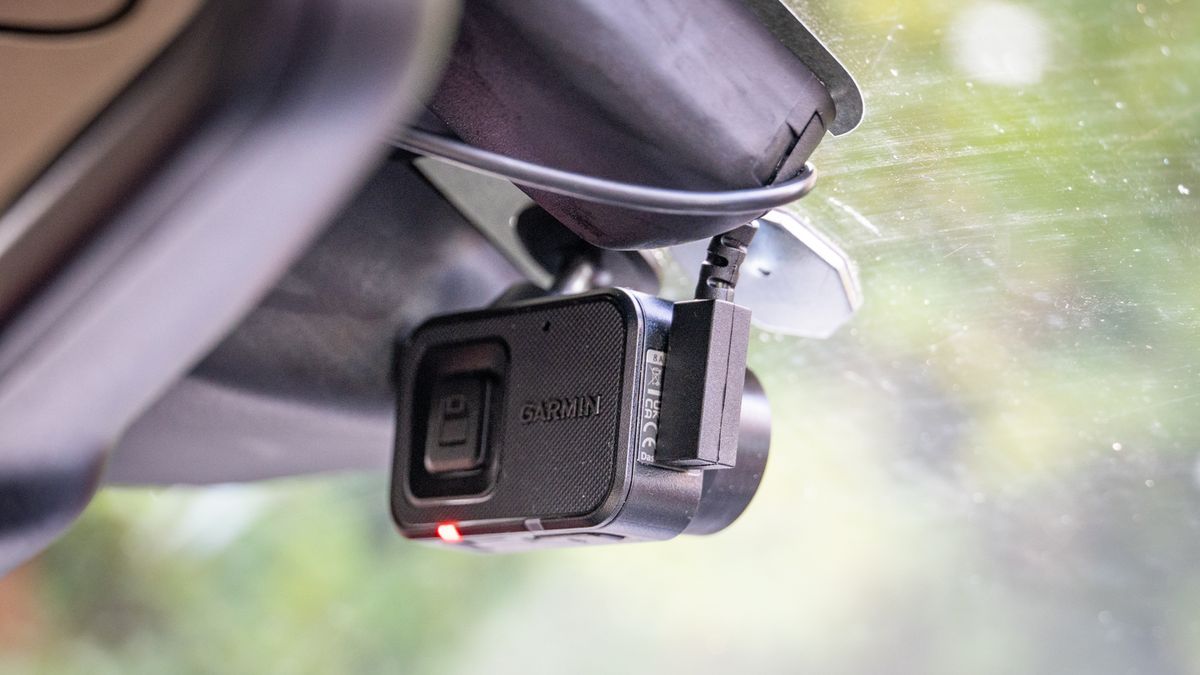
The Best budget dash cam for most drivers is the REDTIGER F7NP. It combines 4K front recording, a 1080P rear camera, STARVIS 2 low-light hardware, GPS, fast WiFi, and a supercapacitor without forcing a complicated control scheme. The ROVE R2-4K is the better alternative when a larger screen, detailed GPS presentation, and three parking modes matter more.
Specialized needs point elsewhere. Choose the galphi Mini 4K for a small front-only installation, the XYGCACO D65 for side coverage, the 70mai A810 Lite for connected remote monitoring, or the SUVCON 3-Channel for a cabin view. If you are still undecided, choose the number of camera views first, then pick the highest-quality night and rear recording that fits that layout.
As an Amazon Associate we earn from qualifying purchases.