

A delay pedal can be the difference between a dry guitar part and one that fills the room. The trouble is that “delay” covers everything from a tiny analog slapback box to a multi-mode workstation with looping, tap tempo, and reverb.
We compared 10 pedals that suit different playing styles, from compact analog-voiced models to advanced digital units. The Best delay pedal for most players is the BOSS DD-8, while the Donner Yellow Fall, JHS 3 Series Delay, and MXR Carbon Copy make stronger choices for specific kinds of echo.
Comparison table
| # | Product | Award | Delay range | Modes or controls | Best for |
|---|---|---|---|---|---|
| 1 | BOSS DD-8 | Best overall | Up to 10 seconds | 11 modes, looper, tap tempo | Players who want maximum flexibility |
| 2 | JHS 3 Series Delay | Best simple premium delay | 80 to 800ms | Digital and analog-voiced modes | Players who want easy tone shaping |
| 3 | MXR Carbon Copy | Best analog character | Up to 600ms | Analog delay with modulation | Warm, atmospheric repeats |
| 4 | BOSS DD-3T | Best straightforward digital delay | 12.5 to 800ms | Three ranges, tap tempo, short loop | Reliable live performance |
| 5 | SONICAKE Levitate | Best delay and reverb combo | Up to 2000ms | Digital delay and plate reverb | Compact ambient setups |
| 6 | Donner Echo Square | Best multi-mode mini pedal | 20 to 838ms | Seven delay modes | Experimenting with different textures |
| 7 | JOYO JF-08 | Best analog-voiced control | 25 to 600ms | Time, Repeat, Level | Slapback and mellow repeats |
| 8 | Donner Yellow Fall | Best compact analog delay | 20 to 620ms | Delay level and feedback | Small pedalboards |
| 9 | SONICAKE Sonic Ambience | Best tap-tempo ambience | Up to 2000ms | Four delay and four reverb modes | Guitar and bass ambience |
| 10 | POGOLAB Analog Delay | Best compact basic delay | Not specified | Time and mix controls | Simple pedalboard builds |
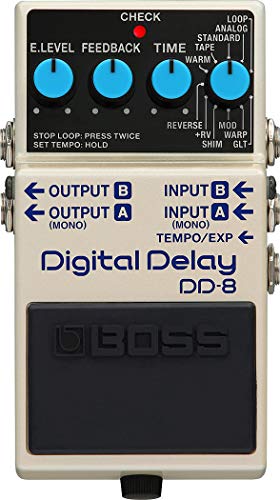
1. BOSS DD-8: Best Overall
Pros
- 11 delay modes cover conventional and unusual sounds
- Tap tempo supports delays up to 10 seconds
- Looper records up to 40 seconds with overdubbing
- Delay and reverb are available in one mode
Cons
- More complicated than a basic three-knob delay
- External footswitches are needed for expanded looper control
Best for: guitarists who want one delay pedal that can cover standard, ambient, rhythmic, and looping duties.
The BOSS DD-8 is the pedal to choose when you do not want to guess which delay style you will need later. It has 11 modes, including basic digital delay, vintage echo, shimmer, modulation, looper, and the newer Warm, +RV, and GLT types. That gives it a much broader range than the Donner Yellow Fall or MXR Carbon Copy, both of which are intentionally focused on a particular flavor of repeat.
Its headline feature is the combination of long delay time and live control. The DD-8 reaches up to 10 seconds and accepts tap tempo, so a guitarist can set a rhythm by foot instead of turning a knob between songs. The GLT mode is aimed at rhythmic delay, while the +RV mode combines delay and reverb. Those options make the pedal useful for spacious parts as well as conventional rock and pop echoes.
The built-in looper is a meaningful extra rather than a token feature. It offers up to 40 seconds of recording time, overdubbing, and three-pedal operation when paired with external footswitches. That makes it more capable than the short loop function on the BOSS DD-3T. Players who already use a dedicated looper may not need this feature, but solo performers can build a compact rig around it.
The weakness is the learning curve. A simple delay such as the JHS 3 Series Delay gets you to a usable sound quickly, while the DD-8 asks you to understand its modes and foot controls. Its 5.95 by 3.8-inch footprint is also larger than the mini Donner pedals. Still, for a player who wants the widest set of tones and practical live functions, this is the one we'd keep.
2. JHS 3 Series Delay: Best Simple Premium Delay

Pros
- Clear digital and darker analog-voiced options
- 80 to 800ms range handles slapback through ambient washes
- Straightforward control layout
- Analog mode can create runaway repeats
Cons
- No tap tempo
- Fewer modes than the BOSS DD-8
- Requires a 9V center-negative supply
Best for: players who want two useful delay characters without a crowded control scheme.
The JHS 3 Series Delay has a strong sense of restraint. It does not try to be a looper, reverb, shimmer unit, and rhythmic delay at once. Instead, it gives you a practical delay range and a Type toggle that switches between a clearer digital voice and a darker analog-voiced sound. That focus makes it especially easy to place in a pedalboard when you already know the kind of repeats you use.
Its 80 to 800ms range is broad enough for the essential jobs. Short settings produce a tight slapback effect, while the longer end moves toward spacious, pad-like echo. The analog-voiced setting is the more characterful of the two, particularly when the Repeats control is pushed high. JHS specifically describes classic bucket-brigade runaway behavior in that mode, which gives players a way to move from normal repeats into controlled feedback.
The pedal is also a sensible middle ground between the JOYO JF-08 and the BOSS DD-3T. The JOYO offers a similar analog-minded approach with a 25 to 600ms range, but the JHS gives you a distinct digital setting and reaches farther for long ambient sounds. The BOSS has tap tempo and a short loop function, so it is the better live utility pedal. The JHS is easier to understand at a glance.
There is no tap tempo, and that omission matters for players who sync delay to a drummer or backing track. It also needs a 9V DC negative-center power supply and consumes 71mA. The 4 by 3-inch enclosure is not a mini pedal, but it remains manageable on most boards. Choose it if direct controls and a convincing analog-style mode matter more than a long feature list.
3. MXR Carbon Copy: Best Analog Character

Pros
- All-analog bucket-brigade delay
- Modulation controls add tape-like movement
- Up to 600ms of delay time
- Purpose-built for rich, warm repeats
Cons
- Less versatile than digital multi-mode pedals
- No tap tempo listed
- Larger and heavier than mini delay pedals
Best for: guitarists who want warm analog repeats with adjustable modulation.
The MXR Carbon Copy is the most committed analog pedal in this group. Its all-analog design and bucket-brigade technology give it a clear identity, rather than trying to reproduce several unrelated delay types. The repeats are intended to sit behind the dry guitar part, which is exactly what many players want for lead lines, blues phrasing, and atmospheric rhythm work.
The delay time reaches 600ms. That is enough for slapback, rhythmic echo, and spacious trails, though it does not compete with the 2000ms ceiling offered by the SONICAKE models or the 10 seconds available from the BOSS DD-8. Its modulation controls emulate tape echo tones, adding movement to the repeats instead of leaving them perfectly static. Used subtly, that can make a sustained chord feel less clinical. Turned up, it becomes a noticeable effect in its own right.
This is the more focused alternative to the JHS 3 Series Delay. The JHS lets you switch between digital and analog-voiced operation, while the Carbon Copy stays with analog character and gives its modulation section more importance. The Donner Yellow Fall is smaller and also promises a vintage analog sound, but the MXR has a more distinctive control concept for players who want to shape the movement of the repeats.
Its limitation is flexibility. There are no listed digital modes, tap tempo functions, or looper features, so it is not the right choice for a player who needs precise rhythmic changes on stage. At 5.5 by 4.5 inches and 1 pound, it also occupies more board space than the Donner and POGOLAB mini pedals. Pick the Carbon Copy when the sound of the repeats matters more than having every possible delay format.
4. BOSS DD-3T: Best Straightforward Digital Delay

Pros
- Easy operation for fast sound creation
- 12.5 to 800ms range
- Tap tempo through the onboard switch
- Short Loop setting adds basic looping
- Direct output supports separate dry and wet amps
Cons
- Fewer modes than the DD-8
- The listed dimensions appear unusually large for a compact pedal
Best for: players who want dependable digital delay with useful live features and minimal menu diving.
The BOSS DD-3T is the practical digital delay in this lineup. Its controls are designed for quick setup, and the three delay ranges cover everything from a short 12.5ms effect to an 800ms repeat. That makes it a better fit than the Carbon Copy for players who need a clean, repeatable digital sound rather than a deliberately dark analog response.
Tap tempo is available through the onboard pedal switch or an external footswitch. That is a major advantage over the Donner Yellow Fall, JOYO JF-08, and JHS 3 Series Delay when a song requires repeats to follow a set tempo. The Short Loop setting also revives the original DD-3's Hold-style function, giving you a compact phrase-looping tool without turning the pedal into a full looper workstation.
The DD-3T sits below the DD-8 in complexity. The DD-8 adds 11 modes, up to 10 seconds of delay, a more substantial looper, and delay plus reverb options. The DD-3T answers with quicker operation and fewer distractions. Its Direct Output is useful for rigs that send dry and wet sounds to separate amplifiers, a routing feature not specified for most of the other pedals here.
It is not the most adventurous choice. Players seeking reverse, shimmer, modulation, or tape-style sounds should look toward the BOSS DD-8 or Donner Echo Square. The product information also lists 7.874-inch dimensions for height, length, and width, which is unusual for a compact pedal and worth checking before planning a tight board. For straightforward digital delay and live tempo control, though, the DD-3T remains a clear fit.
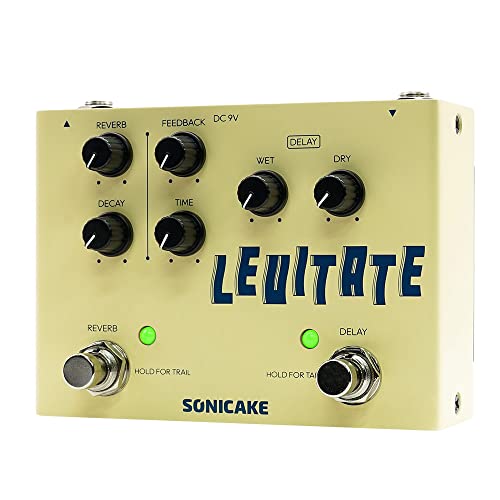
5. SONICAKE Levitate: Best Delay and Reverb Combo
Pros
- Combines digital delay and plate reverb
- Delay reaches 2000ms
- Trail and tap tempo functions
- Buffer bypass circuit is designed to keep the signal pristine
Cons
- Combines two effects rather than offering many delay voices
- Power supply is not included
- Heavier than the mini Donner pedals
Best for: guitarists who want long delay trails and reverb in one pedal.
The SONICAKE Levitate makes sense when a delay pedal needs to do more than repeat notes. It combines digital delay with plate reverb, so one enclosure can provide the echo and the sense of space around it. That is particularly useful for a compact ambient board, where adding separate pedals would take more room and require more cable routing.
A maximum delay time of 2000ms gives it considerably more reach than the 600ms Carbon Copy or the 800ms JHS 3 Series Delay. Long settings can create extended trails behind chords, while shorter settings remain useful for rhythmic parts. The reverb has a large adjustable Decay parameter, so the ambient character can be kept controlled or allowed to spread out.
Tap tempo and trails make this a more stage-aware design than the Donner Yellow Fall. Tap tempo lets you set the delay rate in real time, while trails help the effect continue naturally when bypassed. The special buffer bypass circuit is intended to keep the guitar signal pristine. That differs from the true-bypass designs listed for several of the smaller analog-style pedals, so players should decide whether a buffered signal path suits the rest of their rig.
The compromise is focus. The JHS 3 Series Delay gives more direct control over two delay voices, and the BOSS DD-8 offers far more modes and looping options. The Levitate is for someone who specifically wants delay and plate reverb together, not for a player chasing a deep menu of echo textures. Its 4.88 by 3.54-inch body and roughly 0.97-pound weight are still manageable, but it is not a tiny pedal.
6. Donner Echo Square: Best Multi-Mode Mini Pedal

Pros
- Seven delay modes in a compact enclosure
- Includes digital, analog, tape, mod, sweep, lofi, and reverse
- 20 to 838ms range
- True bypass and aluminum-alloy construction
Cons
- No tap tempo listed
- Requires a 9V adapter
- Three-knob layout offers less direct control than larger pedals
Best for: players who want several delay textures without giving up much pedalboard space.
The Donner Echo Square is the fun option. Its small enclosure hides seven distinct delay modes: digital, analog, tape, modulation, sweep, lo-fi, and reverse. That is an unusually broad palette for a mini pedal, and it makes the Echo Square more interesting than a conventional three-knob analog delay when you want to explore sounds outside standard repeats.
The controls stay simple. Mix adjusts the dry and effected signal ratio, Time covers 20 to 838ms, and Feedback controls the number of repeats. The range is long enough for most standard guitar work and extends beyond the JHS 3 Series Delay's 800ms maximum by a small margin. The reverse and lo-fi modes are the real separators, since neither the Donner Yellow Fall nor the JOYO JF-08 lists those kinds of textures.
The Echo Square also compares well with the BOSS DD-8 in one narrow area: quick access to unusual sounds. The BOSS is substantially more capable overall, with 11 modes, tap tempo, and a looper, but the Donner offers a compact three-knob interface that is less intimidating. Its 3.7 by 1.7-inch footprint and roughly 0.55-pound weight suit a crowded board.
There is no listed tap tempo, so it is less suitable for players who need tempo-synced repeats in a live set. It also requires a 9V adapter, which is not included. If your ideal delay is a familiar warm echo that you rarely adjust, the Donner Yellow Fall or MXR Carbon Copy is more focused. Choose this one when reverse, lo-fi, and sweep sounds are part of the appeal.
7. JOYO JF-08: Best Analog-Voiced Control

Pros
- Filter circuit gives digital delay an analog-voiced character
- 25 to 600ms range
- Simple Time, Repeat, and Level controls
- True bypass and aluminum-alloy housing
- Suitable for electric guitar and bass
Cons
- No tap tempo
- Only one listed delay character
- Power adapter is not included
Best for: players who want mellow, easy-to-control repeats for guitar or bass.
The JOYO JF-08 takes a digital circuit and deliberately softens its behavior. Its special filter circuit is designed to produce a warm, mellow, analog-voiced decay, so the repeats can fade into the background instead of staying bright and prominent. That makes it a natural fit for slapback, restrained ambience, and lead sounds that need space without a sharp digital edge.
Its control layout is exactly what many players want from a basic delay. Time runs from 25 to 600ms, Repeat controls how long the effect continues, and Level sets the balance of effected signal. The shorter setting reaches tight slapback territory, while the longer end is enough for wider echoes. Keeping the controls to three knobs also makes it easier to adjust while standing at a pedalboard.
Compared with the Donner Echo Square, the JOYO gives up modes but offers a more focused voice. The Echo Square includes reverse, lo-fi, sweep, and modulation settings, while the JF-08 stays with its filtered analog character. The JHS 3 Series Delay is more flexible because its Type switch offers both digital and analog-voiced operation, but the JOYO is smaller and lighter at about 390 grams.
The lack of tap tempo is the obvious limitation. This is a pedal for setting a sound by ear, not for changing delay timing to match every song. It uses a 9V adapter and has true bypass, with an aluminum-alloy housing intended for pedalboard use. Players who want one warm delay tone and direct controls should consider it, while those who need multiple effects should move up to the Donner Echo Square or BOSS DD-8.
8. Donner Yellow Fall: Best Compact Analog Delay

Pros
- Warm, natural analog delay character
- 20 to 620ms delay range
- Mini 3.7 by 1.7-inch enclosure
- True bypass
- Aluminum-alloy construction
Cons
- No tap tempo or alternate modes
- Power supply is not included
- Delay level and feedback are the main adjustment options
Best for: players who need a small, uncomplicated analog-style delay.
The Donner Yellow Fall is refreshingly narrow in purpose. It aims to reproduce a warm, natural classic analog delay sound, and its small enclosure leaves room for other effects on the board. If you mostly use delay for slapback, lead support, or a modest echo behind rhythm parts, that limited scope can feel like a benefit rather than a missing feature.
Delay time runs from 20 to 620ms. The low end covers very short repeats, while the upper end gives enough room for more spacious phrases. Delay level and feedback provide the essential controls, and the true-bypass design is intended to keep the guitar signal transparent when the effect is off. That is a simple setup compared with the BOSS DD-8, but it is also much faster to dial in.
The Yellow Fall is smaller than nearly every pedal here, measuring 3.7 by 1.7 inches and weighing about 0.55 pounds. It has the same compact footprint class as the Donner Echo Square, but the two serve different players. The Echo Square is the better choice for reverse, lo-fi, and modulation sounds. The Yellow Fall is the cleaner pick for someone who wants one analog-flavored sound and does not need to browse modes.
It cannot compete with the BOSS DD-3T or SONICAKE Levitate for tempo control, and it does not offer the Carbon Copy's modulation controls. Its 9V DC power supply is not included, so that needs to be accounted for when assembling a board. For a small setup centered on classic analog-style echo, however, this is one of the easiest pedals here to understand.
9. SONICAKE Sonic Ambience: Best Tap-Tempo Ambience

Pros
- Four delay modes and four reverb modes
- Delay reaches 2000ms
- Tap tempo controls delay rate in real time
- Designed for guitar and bass
- Buffer bypass circuit preserves the signal path
Cons
- Larger than mini single-effect pedals
- Less delay-focused than a dedicated unit
- Power supply is not included
Best for: musicians who want tap-tempo delay and several reverb textures in one enclosure.
The SONICAKE Sonic Ambience is built around the same practical idea as the Levitate, but it gives the player more selectable textures. Four delay modes and four reverb modes create a broader ambient toolkit, while the pedal remains a single unit for guitar or bass. It is a sensible choice for a player who wants to reduce the number of boxes without giving up tap tempo.
The maximum delay time is 2000ms, matching the Levitate and exceeding the JHS 3 Series Delay, JOYO JF-08, and MXR Carbon Copy. Tap tempo provides real-time rate control, which is useful when delay has to follow a song rather than sit at one manually chosen setting. The four reverb modes add another layer of space, though the supplied details do not identify the individual mode names.
This pedal is more expansive than the Donner Yellow Fall but less specialized than the MXR Carbon Copy. The MXR is the stronger choice for all-analog repeats and modulation, while the Sonic Ambience is better for a guitarist or bassist who wants to move between different delay and reverb flavors. Its buffer bypass circuit is intended to keep the signal pristine, a design choice that may suit a board with long cable runs.
The trade-off is a larger enclosure. At roughly 4.13 inches wide and 2.56 inches long, it takes more room than a mini delay, although its listed weight is about 0.46 pounds. Players who only need a short analog echo will find it unnecessarily broad. For ambient players who want tap tempo, long trails, and reverb without adding another pedal, it earns its place.
10. POGOLAB Analog Delay: Best Compact Basic Delay

Pros
- Simple analog delay design
- Mix control balances dry and effected signals
- Compact aluminum-alloy enclosure
- True bypass
- Easy side-mounted input and output layout
Cons
- Delay range is not specified
- No tap tempo or alternate modes listed
- 9V adapter and cable are not included
Best for: guitarists who want a small, direct analog delay with basic controls.
The POGOLAB Analog Delay keeps the assignment simple. It is an analog delay with a Time control for adjusting the repetition interval and a Mix control for balancing wet and dry signals. That is enough for the common delay jobs, from a modest echo behind a rhythm part to a more noticeable trail on a lead line.
Unlike the Donner Yellow Fall and JOYO JF-08, the supplied product details do not state a delay-time range. That makes it harder to predict how far it can move from slapback into longer ambient repeats. The product does confirm an aluminum-alloy enclosure, an indicator light, and true bypass, so the basic pedalboard construction is clear even though the timing specification is not.
Its 3.62 by 1.93-inch footprint and roughly 0.4-pound weight make it one of the smaller options here. The Donner Yellow Fall is slightly longer but similarly compact and provides a stated 20 to 620ms range. The JOYO JF-08 is also more explicit about its controls and reaches 600ms. Those pedals are easier recommendations when you need to plan exact sounds before buying.
The POGOLAB is best treated as a straightforward entry point rather than a feature-rich delay. It has no listed tap tempo, reverb, looper, or alternate modes, and the 9V center-negative adapter is not included. Choose it when a small enclosure and basic analog delay controls are all you need. Skip it if the delay range or live tempo control is central to your setup.
How to choose best delay pedal
The right delay pedal depends on how much control you need after the first sound is dialed in. Start with delay time and repeat behavior, then consider tone, tempo control, extra effects, and pedalboard space.
Delay time
Delay time determines the distance between the original note and its repeat. Short settings around 20 to 80ms create slapback and thickening, while settings around 600 to 800ms support broader echoes and ambient parts. The SONICAKE pedals reach 2000ms, and the BOSS DD-8 reaches up to 10 seconds, so they suit players who want extended trails or rhythmic experimentation.
A pedal with a shorter maximum is not automatically weak. The MXR Carbon Copy's 600ms range is well matched to its analog character, while the Donner Yellow Fall's 20 to 620ms range covers the everyday delay sounds most guitarists use.
Analog and digital character
Analog delay typically emphasizes warmth and a darker repeat, while digital delay can preserve a clearer, more precise copy of the original note. The MXR Carbon Copy uses an all-analog bucket-brigade design. The JHS 3 Series Delay lets you switch between digital and analog-voiced operation, and the JOYO JF-08 uses a filter circuit to give its digital design a mellow character.
Choose the delay character by the way you want repeats to leave the mix, not by the label on the enclosure.
Modes and sound shaping
Multiple modes matter when you want reverse, modulation, lo-fi, sweep, tape, shimmer, or rhythmic effects. The Donner Echo Square includes seven delay modes, while the BOSS DD-8 offers 11 modes and adds delay plus reverb. A focused pedal such as the Donner Yellow Fall or POGOLAB is easier to operate, but it cannot cover those special effects.
Look at the controls as well as the mode count. A Mix or Level control sets the dry and wet balance, Time controls the interval, and Feedback or Repeat determines how long the echoes continue. Those three controls are enough for many conventional sounds.
Tap tempo and looping
Tap tempo lets you set delay time by pressing a footswitch in rhythm. It is useful when the effect needs to follow a song's tempo, especially during live performances. The BOSS DD-3T, BOSS DD-8, and both SONICAKE models list tap-tempo functions.
Looping is a separate consideration. The DD-8 offers up to 40 seconds of recording, overdubbing, and expanded control with external footswitches. The DD-3T has a Short Loop setting, but it is not designed as a full looping workstation.
Pedalboard size and power
Mini pedals such as the Donner Yellow Fall, Donner Echo Square, and POGOLAB leave more room for other effects. Larger models can provide more switches and controls, but they need more board space. The BOSS DD-8 measures 5.95 by 3.8 inches, while the Yellow Fall measures 3.7 by 1.7 inches.
Most pedals in this roundup require an external 9V supply, and several explicitly say the adapter is not included. Check that the pedal's power requirement matches the rest of your board before installation. Players assembling a wider signal chain may also want to compare how different effects fit together in a complete guitar rig.
Frequently asked questions
What does a delay pedal do?
A delay pedal records the guitar signal and plays it back after a set interval. The controls usually adjust the delay time, the level of the repeat, and how many repeats occur. Short delays can thicken a part, while longer delays create obvious echoes and ambient trails.
Is analog or digital delay better?
Neither design is universally better. Analog pedals such as the MXR Carbon Copy emphasize warm, darker repeats, while digital pedals can offer clearer echoes, longer timing, and more modes. The JHS 3 Series Delay and JOYO JF-08 provide analog-voiced options without using the same all-analog approach as the MXR.
Do I need tap tempo?
Tap tempo is useful if the delay needs to match a song's rhythm or change during a performance. It is less important if you use one fixed slapback or ambient setting. The BOSS DD-3T, BOSS DD-8, SONICAKE Levitate, and SONICAKE Sonic Ambience include tap-tempo functions.
Can a delay pedal also replace reverb?
Some can, especially when the delay is set short with a restrained mix. A dedicated delay and reverb pedal such as the SONICAKE Levitate or Sonic Ambience gives you both effects in one enclosure. A dedicated reverb pedal will usually provide a broader range of room and space sounds, so players focused on reverb should compare the controls that shape guitar reverb trails.
Where should a delay pedal go in the signal chain?
Delay is commonly placed after drive and distortion so the repeats remain clear, though placing it before gain can create a different, more blended sound. The best position depends on the tone you want and how your amplifier handles effects. Start after distortion, then move it if the repeats need to react more strongly to the gain effect.
Can I use these pedals with bass?
The JOYO JF-08 is listed for electric guitar and bass, and the SONICAKE Sonic Ambience is also identified for guitar and bass. The other products are described primarily as guitar effects. Bass players should check the intended frequency response and whether the pedal preserves enough dry signal for their rig.
The bottom line
The Best delay pedal for the widest range of players is the BOSS DD-8. Its 11 modes, tap tempo, 10-second delay time, delay plus reverb setting, and 40-second looper make it the most capable pedal here, although it takes longer to learn than a simple three-knob unit.
For a more focused sound, the JHS 3 Series Delay is the easier recommendation, while the MXR Carbon Copy is the specialist pick for rich analog repeats and modulation. The Donner Yellow Fall and JOYO JF-08 make sense when a compact analog-voiced pedal is the priority.
If you are undecided, choose the BOSS DD-8 for flexibility, or the MXR Carbon Copy if you already know you want analog character.
As an Amazon Associate we earn from qualifying purchases.