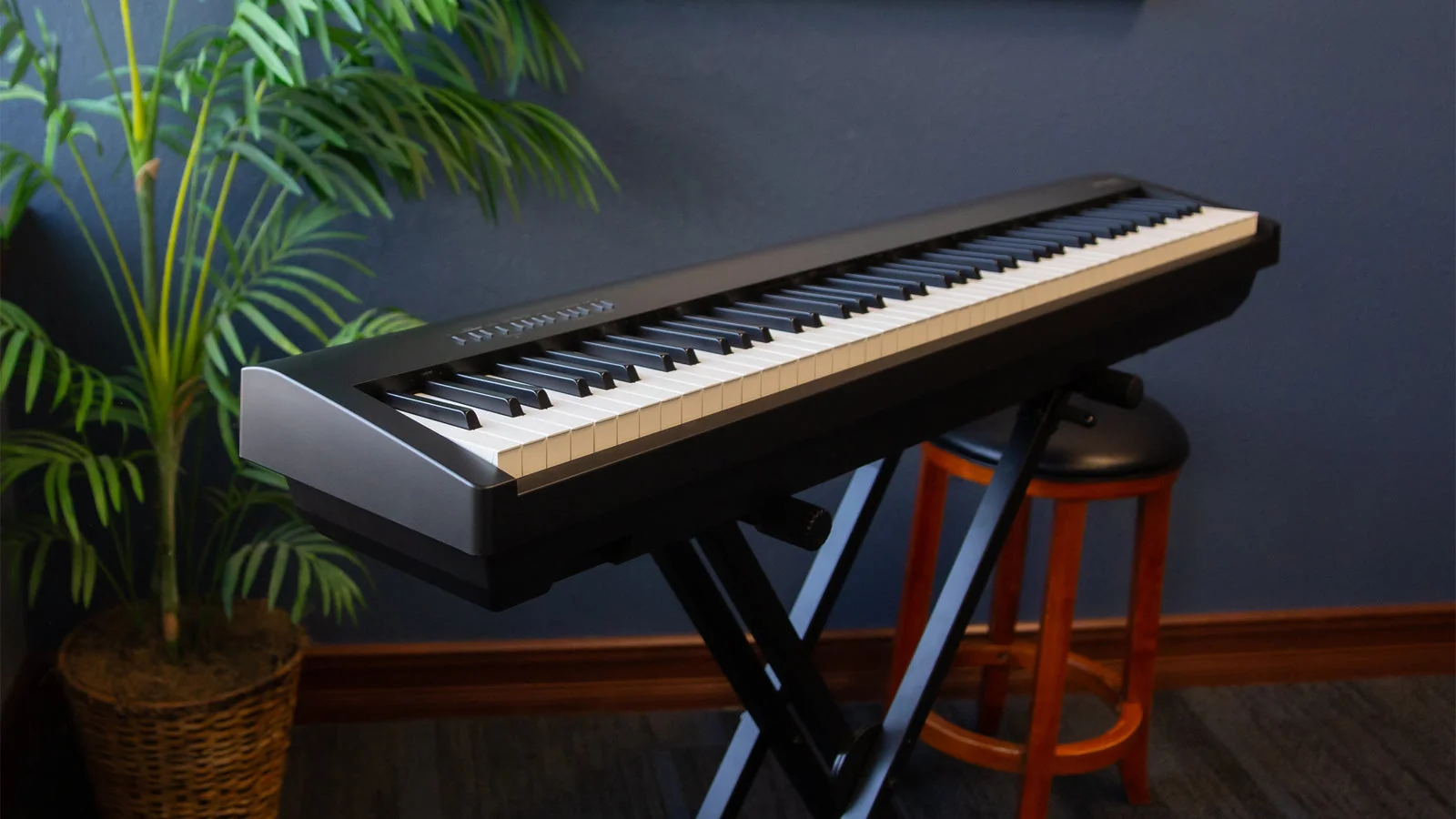

Learning piano becomes frustrating when the keyboard feels like a toy, the stand wobbles, or the controls get in the way of practicing. A proper 88-key instrument should make quiet practice, expressive playing, and steady progress feel natural from the first session.
The Best digital piano choices here range from portable Yamaha instruments to full furniture-style setups, with several useful alternatives for beginners who want lessons, recording features, or a large sound library. We compared the action, sound controls, connectivity, included accessories, and physical design.
Our top pick is the Yamaha P145BT, while the Yamaha P71 remains the simplest choice for focused piano practice. The rest of the list covers full-size weighted models, beginner bundles, portable keyboards, and home instruments with three-pedal systems.
Comparison table
| # | Product | Award | Key action | Useful features | Best for |
|---|---|---|---|---|---|
| 1 | Yamaha P145BT | Best overall | 88 weighted, touch-sensitive keys | Bluetooth audio, app support | Home practice and travel |
| 2 | Yamaha P71 | Best for simplicity | 88 weighted, touch-sensitive keys | 10 voices, Dual Mode | Focused piano practice |
| 3 | Roland FP-30X | Best sound and expression | PHA-4 Standard keyboard | Bluetooth audio and MIDI, 22-watt stereo system | More expressive playing |
| 4 | Donner DEP-20 Stand Bundle | Best full home setup | 88 full-weighted hammer-action keys | 238 tones, 128-note polyphony, three pedals | A furnished practice station |
| 5 | Yamaha P-143 Bundle | Best complete Yamaha setup | 88 weighted keys | Stand, bench, music rest, sustain foot switch | A ready-to-use home piano |
| 6 | Alesis Recital Play | Best for beginner features | 88 full-size touch-sensitive keys | 480 sounds, 160 rhythms, lesson and record modes | Exploring many styles |
| 7 | Donner DEP-20 Keyboard | Best portable weighted option | 88 full-weighted hammer-action keys | 238 tones, 128-note polyphony | Keyboard-only setups |
| 8 | UISCOM Home Piano | Best three-pedal alternative | 88 weighted keys | Triple pedals, USB playback, MIDI | Traditional home-style playing |
| 9 | Ngdgtt 88-Key Keyboard | Best beginner bundle | 88 semi-weighted keys | Bluetooth, 128 voices, 80 demo songs | First lessons and casual playing |
1. Yamaha P145BT: Best Overall

Pros
- Natural-feeling Graded Hammer Compact action
- Bluetooth audio for playing along with music
- Slim, relatively light design
- Compatible with Smart Pianist and Rec’n’Share apps
Cons
- Comes with a sustain foot switch rather than a full pedal unit
- More focused on piano playing than deep sound experimentation
- Music rest and adapter are useful, but a furniture stand is not included
Best for: players who want a compact Yamaha piano with weighted keys and modern practice features.
The Yamaha P145BT gets the important things right without making the instrument feel complicated. It is slim enough for a room where a full cabinet piano would be awkward, yet its 88 weighted, touch-sensitive keys give beginners the full keyboard range and a more convincing response than an unweighted arranger keyboard. The design is also light enough to make moving it between rooms or taking it along for travel more realistic.
Its Graded Hammer Compact action is the detail that matters most under the fingers. The keys are weighted to create a more acoustic-piano-like response, with the lower and higher registers intended to feel different as you move across the keyboard. That makes soft playing, louder accents, and finger-strength practice more meaningful than on the semi-weighted Ngdgtt 88-Key Keyboard. It is a piano built around learning proper control rather than simply triggering notes.
The P145BT also fits modern practice better than the simpler Yamaha P71. Bluetooth audio lets you stream music and play along, while Smart Pianist and Rec’n’Share expand the ways you can practice and share performances. Yamaha includes a music rest, sustain foot switch, and AC adapter, so the basic setup is straightforward. The built-in speakers keep the instrument self-contained for everyday playing.
The weakness is its narrow focus. Yamaha lists Bluetooth audio and app support, but this model is not presented as a large sound workstation with hundreds of tones and rhythms. The included sustain switch is useful, though players who want sostenuto and soft pedals will need a different setup. It also needs a suitable stand or table, unlike the furniture-style Donner DEP-20 Stand Bundle and Yamaha P-143 Bundle.
The P145BT is the one we'd keep for a student, returning player, or apartment musician who wants dependable weighted action in a compact body. It is the strongest balance here between expressive piano playing, simple controls, portability, and useful wireless practice.
2. Yamaha P71: Best for Simplicity

Pros
- Full 88-key weighted action
- Simple one-button operation
- 10 built-in voices
- Dual Mode can layer two voices
- Sustain pedal included
Cons
- No Bluetooth feature listed
- Smaller voice selection than the Donner and Alesis models
- Basic, keyboard-only presentation
Best for: beginners and experienced players who want a straightforward weighted piano without a busy control panel.
The Yamaha P71 is refreshingly direct. Turn it on, choose a sound, and play. That simplicity is not a minor convenience for a first piano. A new player can spend more time learning hand position and rhythm instead of navigating a screen, arranging patterns, or sorting through a large library of novelty sounds.
The 88 keys use a weighted, touch-sensitive action intended to replicate the feel of an acoustic piano. Yamaha does not give this model the more recent P145BT name or its Bluetooth practice features, but the P71 remains easy to understand. The full range is suitable for lessons and repertoire that uses both extremes of the keyboard, and touch sensitivity lets the player shape notes through how firmly the keys are pressed.
There are 10 voices, including a Yamaha grand piano sound, along with a Dual Mode that blends two voices such as piano and strings. That is enough variety for basic experimentation and accompaniment without turning the instrument into an arranger keyboard. The included sustain pedal adds an important expressive control from the beginning, particularly for players learning to connect chords and let notes ring naturally.
Compared with the Yamaha P145BT, the P71 gives up Bluetooth audio and the newer app-oriented practice approach. The P145BT is also the more convincing choice if the piano must move often or sit in a compact room. The P71 counters with a very clean operating experience, and its 25-pound listed weight keeps it manageable despite the weighted action. Its 52.25-inch length still calls for a proper surface or stand.
This model is not the right pick for someone who wants hundreds of instrumental voices, recording tools, or wireless playback. It is the right pick for someone who has one central goal: sit down and practice piano. If that sounds like your routine, the P71 avoids distractions better than almost anything else here.
3. Roland FP-30X: Best Sound and Expression

Pros
- PHA-4 Standard keyboard with acoustic-style touch
- SuperNATURAL Piano sound engine
- 22-watt stereo speaker system
- Bluetooth audio and MIDI support
- Broad selection of onboard sounds
Cons
- Heavier than the Yamaha P145BT and P71
- Bluetooth headphones are not supported
- More controls and features than a minimalist learner may need
Best for: players who care about expressive piano tone, strong built-in sound, and wireless connections to mobile devices.
The Roland FP-30X feels aimed at the player who has already decided that keyboard response and tone matter. Its PHA-4 Standard keyboard is designed to provide an acoustic-style piano touch, and the SuperNATURAL Piano sound engine is built to respond across a wide range from soft playing to forceful accents. It has more musical character than a basic starter keyboard, especially for someone who plans to spend years practicing rather than treating the instrument as a temporary introduction.
The speaker system is a major practical advantage. Roland specifies a 22-watt stereo setup, and the FP-30X also has a dedicated setting for optimizing sound when the piano is placed on a desktop. That makes it more flexible in a real room than a model that assumes a particular stand or cabinet. The P145BT is slimmer and lighter at 24.471 pounds, while the FP-30X is listed at 32.7 pounds, but the Roland's extra heft comes with a more substantial playing and listening experience.
Bluetooth audio and MIDI are useful for lessons, backing tracks, and mobile music applications. Roland's Piano Partner 2 app can handle sound selection and metronome controls from a phone or tablet, so the physical panel does not have to carry every function. The FP-30X also includes onboard sounds across electric pianos, organs, strings, and synthesizers. For a player who wants to move beyond solo piano, it is much more versatile than the Yamaha P71.
There is one connectivity detail to understand before buying. Roland specifically says Bluetooth headphones are not supported, so wireless audio should not be assumed simply because Bluetooth audio and MIDI are present. The FP-30X is also less portable than the lightweight Yamaha models, and it lacks the included stand-and-bench presentation of the Yamaha P-143 Bundle.
The Roland is the best fit for a serious home player who wants a rich piano voice, an expressive keybed, and speakers that can fill a room. It is more instrument than beginner appliance. Skip it if your priority is the simplest possible control scheme or a keyboard that will be carried frequently.
4. Donner DEP-20 Stand Bundle: Best Full Home Setup

Pros
- 88 full-weighted hammer-action keys
- Adjustable touch response
- Furniture stand and three-pedal unit included
- 238 tones and 128-note polyphony
- Backlit LCD and two 25-watt amplifiers
Cons
- Much less convenient to move than a keyboard-only model
- Broad feature set can feel busy for a first-time player
- The included furniture setup takes more room
Best for: a home player who wants a permanent piano station with three pedals and plenty of built-in sounds.
The Donner DEP-20 Stand Bundle changes the shape of the purchase. Instead of starting with a bare keyboard and improvising a place to put it, this package is built around a furniture stand and a three-pedal unit. That makes it feel more like a dedicated home piano than the portable Yamaha P71 or P145BT. For a family room, bedroom, or teaching space, the stable presentation can make regular practice easier to maintain.
Under the hands, the DEP-20 uses 88 full-weighted hammer-action keys with adjustable touch response. That gives a beginner the complete range and lets the player choose a response that suits their playing style. The three-pedal unit adds sustain, sostenuto, and soft-pedal control, although the product description refers to the pedal arrangement as a sustain pedal and triangle pedal in one feature. The bundle is still clearly aimed at players who want more foot control than a single switch provides.
Donner loads this version with 238 tones and 128-note polyphony. The large tone count includes instruments such as ukulele, drum, and bass, while the polyphony figure means the piano can retain many notes when chords, layered sounds, and effects overlap. A dual-tone mode can combine voices, and the backlit LCD helps with choosing sounds and adjusting settings. Two 25-watt amplifiers are specified, which gives the built-in system more presence than the compact portable options.
The DEP-20 Stand Bundle is more feature-heavy than the Yamaha P71 and more home-bound than the keyboard-only Donner DEP-20. It also gives up the Yamaha P145BT's Bluetooth audio and app-centered approach. A player who wants to practice with phone audio may prefer the Yamaha, while someone who wants tones, recording mode, MP3 playback, and audio inputs and outputs may find the Donner more engaging.
The main weakness is the size of the commitment. A furniture stand is useful once assembled, but it is not the choice for frequent moves or limited floor space. Choose this Donner when a dedicated station and three pedals matter more than portability.
5. Yamaha P-143 Bundle: Best Complete Yamaha Setup

Pros
- 88 weighted keys
- Stand, bench, music rest, and sustain foot switch included
- Slim design with Yamaha piano sound
- One-button controls
- Ready-to-use home presentation
Cons
- Larger footprint than a keyboard-only P145BT
- The included foot switch is not a full three-pedal unit
- Limited feature detail compared with arranger-style keyboards
Best for: households that want a Yamaha piano with its stand and seating sorted from the start.
The Yamaha P-143 Bundle is the most complete way to turn a portable-style piano into a home setup. It includes the 88-key weighted keyboard, stand, bench, music rest, sustain foot switch, and AC adapter. That matters because a good keyboard can still feel unfinished when it is placed on an unsuitable table or used without a comfortable playing position. This package removes much of that friction.
Yamaha describes the action as providing acoustic piano expression, and the keyboard is built around the same basic priorities as the P145BT: weighted keys, a slim design, and a piano-first interface. The included bench makes the bundle more inviting for lessons and scheduled practice. The stand and bench also give it a more settled presence than the Yamaha P71, which is essentially a keyboard and pedal that need furniture supplied separately.
Controls are deliberately uncomplicated. Yamaha lists one-button control and accompanying apps, along with a music rest and sustain foot switch. This is not the model to choose for a large rhythm library or a huge collection of alternate voices. It is designed to make the act of sitting down, powering up, and practicing feel familiar. The keyboard remains described as lightweight and easy to take along, though the complete bundle is naturally less portable once the stand and bench are part of the setup.
The P145BT is the better fit for someone who regularly moves the keyboard or wants Bluetooth audio for playing along with songs. The P-143 Bundle is more appealing for a fixed room because the stand and bench are already part of the package. Compared with the Donner DEP-20 Stand Bundle, Yamaha offers a simpler control experience, while Donner offers far more tones, polyphony, and multimedia functions.
The compromise is pedal depth. A single sustain foot switch works for ordinary piano practice, but it does not give the three-pedal control available from the Donner bundle or UISCOM Home Piano. Pick the P-143 Bundle if you want a tidy, recognizable home setup and prefer Yamaha's restrained approach over a feature-packed keyboard.
6. Alesis Recital Play: Best for Beginner Features

Pros
- 88 full-size touch-sensitive keys
- 480 sounds, 160 rhythms, and 140 demo songs
- Lesson, split, record, and transpose modes
- USB-MIDI for computer software
- Stand, headphones, case, pedal, and sheet music stand included
- Can run on six AA batteries
Cons
- Touch-sensitive keys are not described as weighted
- Large feature set may distract from piano fundamentals
- Batteries are not included
Best for: a beginner who wants lessons, recording, many sounds, and a portable all-in-one bundle.
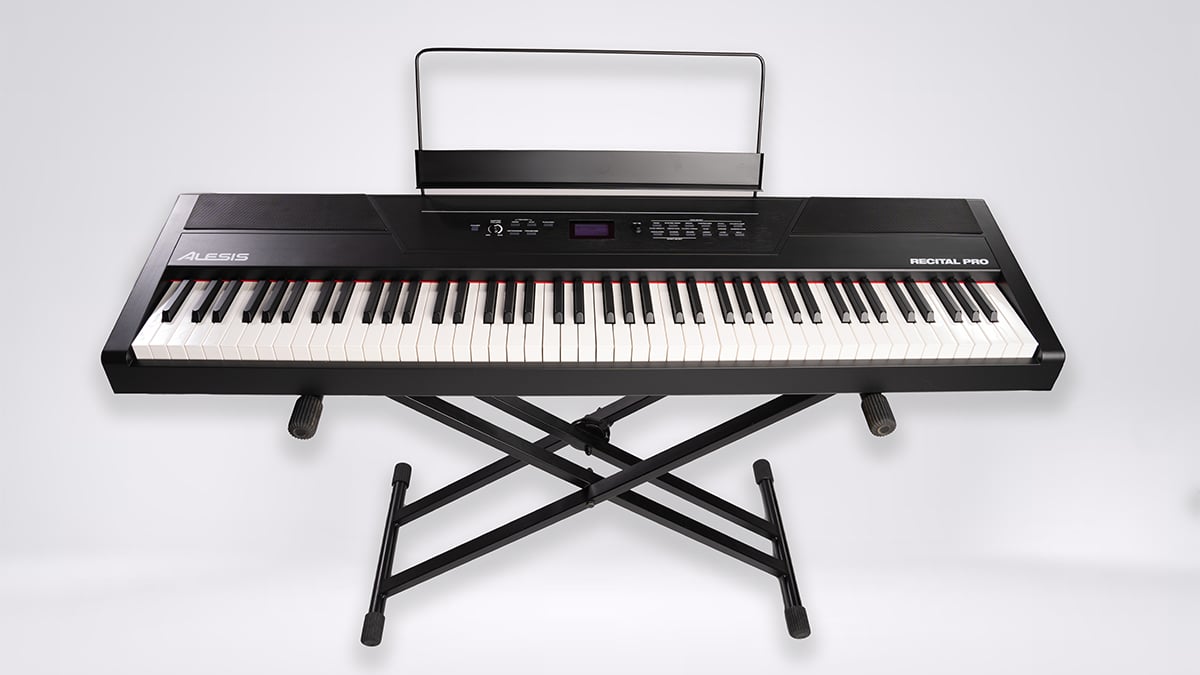
The Alesis Recital Play is less of a traditional digital piano and more of a complete learning keyboard. It has 88 full-size, touch-sensitive, piano-style keys, but the supplied information does not describe them as weighted. That distinction matters. The keys can respond to playing force and help build finger control, yet a student specifically preparing for an acoustic piano may prefer the weighted actions in the Yamaha P145BT, Yamaha P71, or Roland FP-30X.
Where the Alesis stands apart is its enormous collection of built-in material. There are 480 sounds, 160 rhythms, and 140 demo songs, with reverb effects and a one-touch song mode. Split, Lesson, and Record modes give the instrument a clear educational purpose. A teacher and student can use the keyboard together in Lesson Mode, and the built-in metronome and transpose function are useful when working through unfamiliar pieces or matching another instrument.
Connectivity is unusually practical for a beginner bundle. USB-MIDI lets the Recital Play work with a Mac or PC and compatible music or educational software. The package also includes premium lessons from Skoove and Melodics, according to the product information. A 1/4-inch sustain pedal input, 1/8-inch auxiliary input, and 1/8-inch headphone output cover the basics for pedal use, backing audio, and private practice.
The complete bundle includes an adjustable keyboard stand, sheet music or tablet stand, sustain pedal, headphones, carrying case, and power supply. It can also run from six AA batteries, though those batteries are not included. At a listed weight of 12.12542441 pounds, it is far easier to move than the 32.7-pound Roland FP-30X or the furniture-style models. That portability makes it appealing for lessons, practice in different rooms, and occasional travel.
The weakness is the key action's place in the category. If your priority is authentic weighted piano resistance, the Alesis is behind the Yamaha and Roland choices. If your priority is exploration and structured learning, it does much more than a stripped-down piano. It is the keyboard we'd recommend to a young beginner or curious family that wants lessons and creative features in one box.
7. Donner DEP-20 Keyboard: Best Portable Weighted Option

Pros
- 88 full-weighted hammer-action keys
- Adjustable touch response
- 238 tones and 128-note polyphony
- Dual-tone mode and recording mode
- Two 25-watt amplifiers
- Audio inputs and outputs
Cons
- Keyboard-only package does not include the furniture stand
- No Bluetooth feature listed
- More than 52 inches long, so transport still requires planning
Best for: players who want weighted keys and broad sound controls without committing to a furniture-style bundle.
The keyboard-only Donner DEP-20 is the more flexible version of the DEP-20 idea. It keeps the weighted action and musical functions but leaves the stand arrangement up to the owner. That makes sense for a player who already has a suitable keyboard stand, needs to store the instrument after practice, or wants to avoid a permanent furniture setup.
The 88 full-weighted hammer-action keys have adjustable touch response. That is a meaningful advantage over the semi-weighted Ngdgtt model and the touch-sensitive but non-weighted Alesis description. A beginner can practice the full piano range, while a more experienced player can adjust the response to make the keyboard feel more comfortable. The product is listed at about 25.57 pounds, which is manageable for occasional movement even though its length is just over 52 inches.
The feature set is unusually broad for a portable piano. Donner provides 238 tones and 128-note polyphony, with options ranging from piano and organ-style sounds to drums, bass, and ukulele. Dual Keyboard mode can split or combine playing roles, and the control panel includes a backlit LCD. Recording mode, an MP3 player, and audio inputs and outputs make the DEP-20 useful for practice and simple arranging rather than only silent repetition of piano pieces.
Compared with the Donner DEP-20 Stand Bundle, this version gives up the furniture stand and three-pedal unit. The bundle is more natural for a dedicated room, while this keyboard is easier to place on existing furniture or move away after use. The Yamaha P145BT is slimmer and offers Bluetooth audio and app connections, but Donner gives you far more tones, a larger multimedia feature set, and a more explicitly adjustable action.
The omission of Bluetooth is the most noticeable modern limitation. Someone who wants to stream songs directly from a phone will find the Yamaha approach cleaner. Choose the keyboard-only Donner when weighted action, built-in variety, and flexible placement matter more than wireless playback.
8. UISCOM Home Piano: Best Three-Pedal Alternative

Pros
- 88 weighted keys
- Wooden desk design
- Sustain, sostenuto, and soft pedals
- MIDI and USB playback
- Two headphone jacks
- Reverb, chorus, recording, and playback controls
Cons
- Only eight tones are listed
- No Bluetooth feature listed
- Product information provides limited physical specifications
Best for: home players who want a desk-style instrument with traditional three-pedal control and simple recording features.
The UISCOM Home Piano is built around the furniture side of digital piano ownership. Its wooden desk design and triple-pedal arrangement make it look and function more like a home instrument than a portable keyboard. That will appeal to a player who wants the piano to stay in one place and who expects soft and sostenuto pedals alongside sustain.
The 88 keys are weighted, though the product information does not specify the action mechanism or an adjustable touch curve. UISCOM pairs the keyboard with the French Dream5704 sound chip and lists eight distinct tones. That is a small library compared with the 238 tones in either Donner DEP-20 or the 480 sounds in the Alesis Recital Play, but a focused piano player may not need a long menu of alternate instruments.
The control set is more useful than the tone count suggests. There is dual-tone mode, recording and playback, adjustable reverb, chorus, and tempo, plus MIDI functionality for controlling external MIDI equipment or working with a computer. A built-in USB MP3 player can play music from a USB device, and the two headphone jacks are helpful for a parent and student practicing together. The triple pedals provide sustain, sostenuto, and soft functions for more nuanced classical and contemporary playing.
The Yamaha P-143 Bundle has a cleaner brand ecosystem and includes a bench and stand, but its listed accessory set centers on a sustain foot switch. The UISCOM gives more pedal control in the instrument itself. The Donner DEP-20 Stand Bundle is more ambitious for sounds and polyphony, while the UISCOM is more restrained and home-oriented.
The lack of Bluetooth limits easy phone streaming, and there are not many physical dimensions in the supplied information to help plan a room. That makes measuring the intended space especially important. Choose the UISCOM when three pedals and a traditional desk-style presentation are central, not when portability or a broad sound library comes first.
9. Ngdgtt 88-Key Keyboard: Best Beginner Bundle

Pros
- Full 88-key layout
- Semi-weighted, touch-sensitive keyboard
- Bluetooth and MIDI connectivity
- 128 instrument voices and rhythms
- 80 demo songs
- Stand, carrying case, headphones, pedal, and power supply included
Cons
- Semi-weighted action is less piano-like than the weighted Yamaha and Roland models
- Brand and model information are less specific than the established piano lines here
- The feature listing does not provide physical dimensions
Best for: a first-time learner who wants a complete accessory bundle and a wide range of sounds.
The Ngdgtt 88-Key Keyboard is built to make a first purchase feel complete. The package includes a stand, carrying case, headphones, sustain pedal, and power supply, so a beginner does not have to assemble a practice setup one accessory at a time. The full 88-key layout also avoids the cramped range found on small starter keyboards.
Its keys are semi-weighted and touch-sensitive. That should feel more substantial than an unweighted keyboard, but it is not the same proposition as the full-weighted actions in the Yamaha P71 or Roland FP-30X. A student who is specifically preparing for an acoustic piano should treat the action difference seriously. For casual practice, basic lessons, and learning note positions, the layout and touch response still provide a useful starting point.
The sound section is generous. Ngdgtt lists 128 instrument voices and rhythms along with 80 demo songs. Bluetooth allows connections to other devices, and MIDI expands its usefulness with compatible equipment or software. These features give a beginner room to experiment with accompaniment and different styles, while the stand and headphones make private practice easier.
The Yamaha P71 is a better fit for someone who wants a straightforward piano feel and a smaller, more established voice selection. The Alesis Recital Play goes further for lesson modes, recording, USB-MIDI, and built-in creative features. The Ngdgtt sits between those ideas: more bundled and exploratory than the P71, but less educationally developed than the Alesis.
The semi-weighted action is the reason to skip it if classical technique is the main goal. Choose it for a first instrument, a casual home keyboard, or a player who wants Bluetooth and a complete starter bundle without needing a large set of piano-specific controls.
How to choose best digital piano
The right keyboard depends less on the number of sounds than on how closely its action, pedals, speakers, and layout match the way you plan to play.
Key action
Weighted keys use resistance to create a response closer to an acoustic piano. Full-weighted or hammer-action designs, such as those in the Yamaha P145BT, Yamaha P71, Roland FP-30X, and Donner DEP-20 models, are the strongest fit for students developing finger control and dynamic playing.
Semi-weighted and touch-sensitive keys can still work well for casual playing, especially when portability and a large sound library matter. The Ngdgtt keyboard and Alesis Recital Play are more flexible starter keyboards, but neither is described as having the same weighted action as the piano-focused models.
If proper piano technique is the goal, prioritize the feel of the keys before counting the built-in voices.
Pedal system
A sustain pedal is the starting point for connected chords and expressive phrasing. The Yamaha P71, P145BT, and P-143 Bundle include a sustain pedal or foot switch, which is enough for much of a beginner's repertoire.
A three-pedal system adds soft and sostenuto control. The Donner DEP-20 Stand Bundle and UISCOM Home Piano are better suited to players who expect those functions. Check the difference between a single included switch and a fixed triple-pedal unit before planning a classical practice setup.
Sound engine and speakers
A digital piano's main voice should remain clear at quiet and loud playing levels. The Yamaha models emphasize grand piano-style sound, while Roland uses its SuperNATURAL Piano sound engine. The Donner models emphasize variety, with 238 tones and 128-note polyphony, and the Alesis offers 480 sounds, 160 rhythms, and 140 demo songs.
Speaker output matters when you play without headphones. Roland specifies a 22-watt stereo speaker system, and the Donner DEP-20 models list two 25-watt amplifiers. Smaller portable keyboards can still be useful, but a player who wants room-filling sound should examine the speaker system rather than assuming every 88-key model is equally strong.
Connectivity
Bluetooth audio is useful when you want to play along with songs from a phone or tablet. Bluetooth MIDI can also connect a compatible instrument to software, but the two functions are not interchangeable. Roland supports Bluetooth audio and MIDI, while the Yamaha P145BT emphasizes Bluetooth audio and app connections.
USB-MIDI, traditional MIDI, auxiliary inputs, and headphone outputs each solve different problems. If recording or educational software matters, the Alesis Recital Play's USB-MIDI connection is especially useful. For a broader guide to connecting keyboards and controlling music software, choosing controls that fit your music software can clarify which connections you actually need.
Size and setup
An 88-key instrument is long even when it is portable. The Yamaha P71 is listed at 52.25 inches long and 25 pounds, while the Roland FP-30X is 51.2 inches long and 32.7 pounds. The Alesis Recital Play is much lighter at 12.12542441 pounds, but its key action is not described as weighted.
A stand, bench, and pedal unit can make a home piano more comfortable, but they also take up permanent floor space. The Donner DEP-20 Stand Bundle and Yamaha P-143 Bundle suit dedicated rooms. The Yamaha P145BT, P71, and keyboard-only Donner DEP-20 make more sense when the instrument needs to move or be stored.
Practice tools
Beginners may benefit from lesson modes, demo songs, recording, metronomes, transpose controls, and app support. A large sound library is useful for exploration, but it should not hide a weak playing experience. The Alesis Recital Play has the strongest lesson-oriented feature set in this group, while Yamaha and Roland offer a simpler piano-first route with app connections.
If you also use written music or digital study materials, a portable way to organize music and notes can keep practice materials separate from the piano's own controls.
Frequently asked questions
Do all of these digital pianos have weighted keys?
No. The Yamaha P145BT, Yamaha P71, Roland FP-30X, both Donner DEP-20 versions, and UISCOM Home Piano are described with weighted or full-weighted actions. The Ngdgtt keyboard is semi-weighted, and the Alesis Recital Play is described as having touch-sensitive piano-style keys rather than weighted keys.
Is an 88-key digital piano better for a beginner?
An 88-key layout gives a beginner the full range used by acoustic piano repertoire and avoids needing to upgrade quickly because the keyboard is too short. It also takes more space than a compact keyboard. For serious lessons, the full range and a weighted action are usually the more useful combination.
Which models include a stand?
The Donner DEP-20 Stand Bundle includes a furniture stand and three-pedal unit. The Yamaha P-143 Bundle includes a stand and bench, while the Alesis Recital Play bundle includes an adjustable keyboard stand. The Ngdgtt package also lists a stand, while the Yamaha P71, Yamaha P145BT, Roland FP-30X, keyboard-only Donner DEP-20, and UISCOM model do not list the same stand arrangement in the supplied features.
Can these pianos connect to a phone?
The Yamaha P145BT supports Bluetooth audio and app connections, Roland FP-30X supports Bluetooth audio and MIDI, and the Ngdgtt keyboard lists Bluetooth. Other models offer different wired or USB-based options. Bluetooth headphones should not be assumed to work with the Roland FP-30X because its product information specifically says they are not supported.
Do any of them include three pedals?
The Donner DEP-20 Stand Bundle includes a three-pedal unit, and the UISCOM Home Piano lists sustain, sostenuto, and soft pedals. The other Yamaha, Roland, Alesis, Ngdgtt, and keyboard-only Donner packages list a sustain pedal or foot switch rather than the same full three-pedal arrangement.
Which model is easiest to move?
The Alesis Recital Play is listed at 12.12542441 pounds and can run from six AA batteries, though the batteries are not included. The Yamaha P145BT is listed at 24.471 pounds, and the Yamaha P71 at 25 pounds. Furniture bundles are less convenient to move once their stands and benches are assembled.
The bottom line
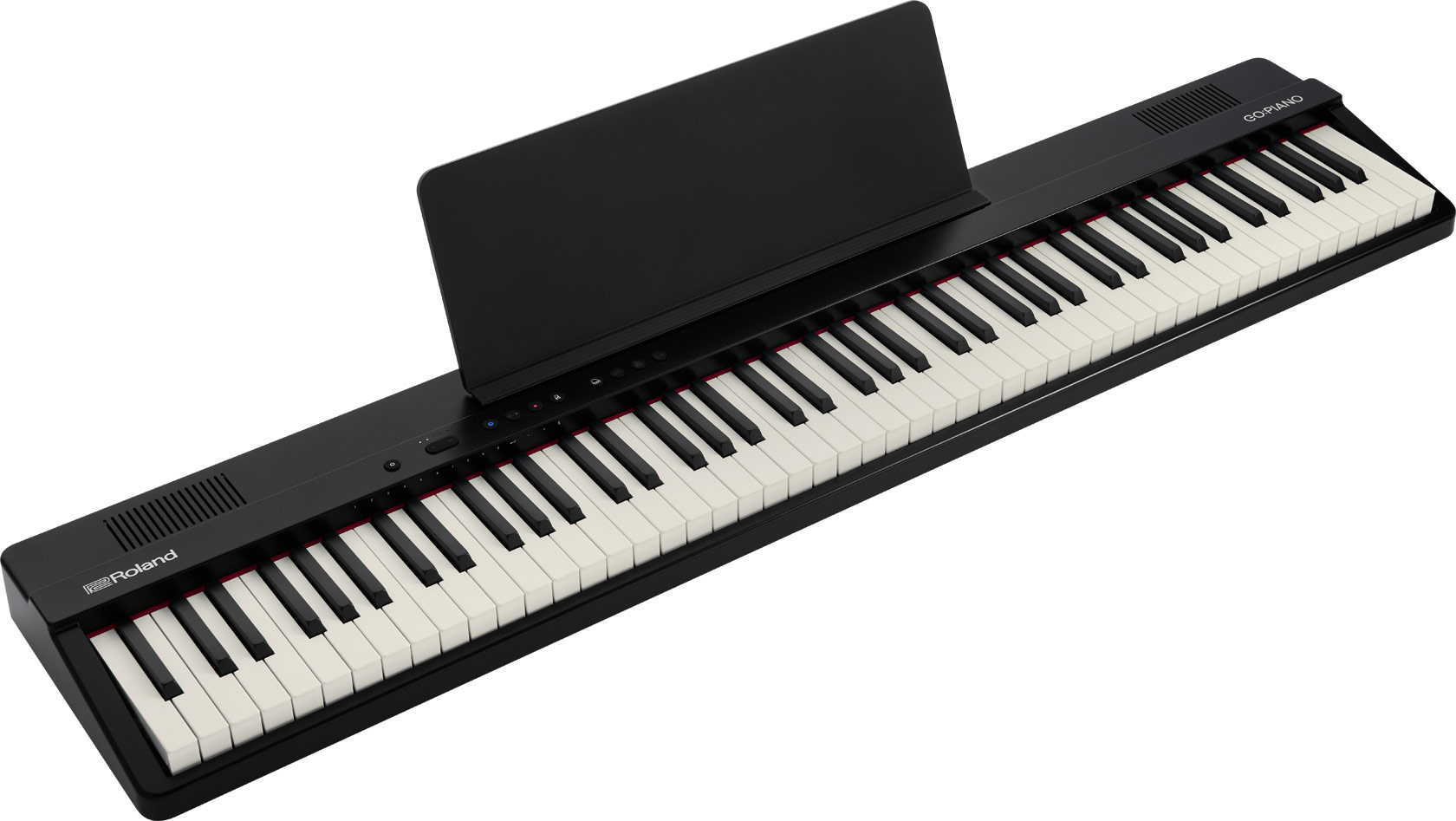
The Best digital piano for most home players is the Yamaha P145BT. Its weighted, touch-sensitive keys, compact design, Bluetooth audio, and app support create a balanced instrument for lessons, daily practice, and playing along with music. The Yamaha P71 is the better choice for someone who wants fewer distractions and a simple piano-first control scheme.
Choose the Roland FP-30X if expressive action, strong onboard speakers, and richer sound control matter more than low weight. For a furnished home station, the Donner DEP-20 Stand Bundle or Yamaha P-143 Bundle makes setup easier, while the Alesis Recital Play is the most useful route for lessons, recording, rhythms, and experimentation.
If you are undecided, choose the Yamaha P145BT for portable piano practice, or choose the Yamaha P-143 Bundle when you want the stand and bench included.
As an Amazon Associate we earn from qualifying purchases.