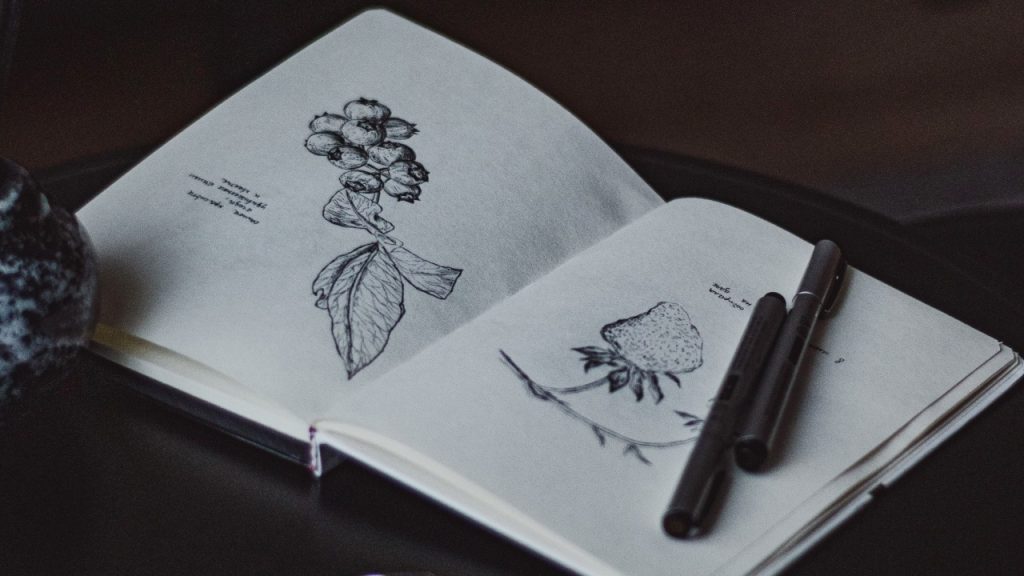

A beginner usually discovers the hard part of drawing pens after the first page: one nib is too broad for detail, another skips on textured paper, and a brush tip can feel impossible to control. The right set should make those choices easier, not turn every sketch into an exercise in guesswork.
We compared ten black fineliner and calligraphy sets, plus one colored collection, looking at tip variety, ink behavior, and how approachable each set is for someone still learning line weight. The Best drawing pens for beginners are the PANDAFLY Calligraphy Pens, but the other picks make strong cases for technical drawing, brush lettering, mixed media, or adding color.
Comparison table
| # | Product | Award | Tips | Ink | Best for |
|---|---|---|---|---|---|
| 1 | PANDAFLY Calligraphy Pens | Best overall | 10 sizes, including brush | Waterproof, fadeproof pigment | First drawing and lettering set |
| 2 | Muchcute Micro Fineliner Pens | Best tip range | 0.2 mm to 3.0 mm, plus brush | Waterproof archival pigment | Fine detail and varied line work |
| 3 | Craft 'n' Beyond Brush Pens | Best starter trio | Small, medium, and large brush tips | Fadeproof, water-based | Learning pressure control |
| 4 | GETHPEN Brush Pen Set | Best for lettering variety | 10 sizes, including angled and flat | Waterproof, fadeproof archival ink | Bold lettering and signatures |
| 5 | Brusarth 10 Size Pens | Best smooth-flow set | Extra-fine through soft brush | Waterproof, fadeproof pigment | General sketching and journaling |
| 6 | KERIFI 16-Piece Fineliners | Best for mixed media | 0.20 mm to 3.0 mm, plus two brush tips | Waterproof archival pigment | Watercolor and technical work |
| 7 | Ohuhu 8-Size Fineliners | Best organized set | 0.2 mm to 1 mm, plus brush | Waterproof pigment | Clean, controlled line art |
| 8 | MARTCOLOR 10 Size Pens | Best calligraphy range | 0.5 mm to 3 mm, extra-fine, brush | Waterproof, fadeproof pigment | Hand lettering practice |
| 9 | Brusarth Precision Fineliners | Best compact fineliners | 0.2 mm to 0.6 mm, plus brush | Waterproof archival pigment | Stippling and technical detail |
| 10 | Ohuhu Colored Fineliners | Best for adding color | 7 black tips plus 11 colors | Waterproof, alcohol-resistant pigment | Colorful sketchbooks and journals |
1. PANDAFLY Calligraphy Pens: Best Overall

Pros
- Ten distinct nib styles cover fine lines, lettering, and broad strokes
- Waterproof and fadeproof pigmented black ink
- Includes both hard tips and a flexible brush tip
- Straightforward starting point for drawing and calligraphy
Cons
- The set does not provide colored ink
- A broad selection can feel like a lot to learn at once
- The listing does not specify individual barrel dimensions
Best for: someone who wants one approachable black-ink set for drawing, lettering, and early experimentation.
The PANDAFLY set is the one we would put in front of a beginner who has not yet decided what kind of drawing they enjoy. It avoids forcing a choice between micro-detail pens and brush markers by including both. The result is a useful learning curve: start with the extra-small or 0.5 mm pen for outlines, move to the 0.8 mm or 1 mm options for stronger contours, then try the soft brush when you want expressive marks.
Its ten-piece lineup includes 0.5 mm, 0.8 mm, 1 mm, 2 mm, and 3 mm tips, along with extra-small, small, medium, large, and a soft brush tip. Those labels are more useful than a single all-purpose marker because they let a new artist see how line weight changes a drawing. Fine tips help with facial features, hatching, and small objects. The larger tips make filling lettering and sketch accents faster, while the brush responds to pressure for lines that taper and swell.
The water-based pigmented black ink is described as waterproof, fadeproof, and non-bleeding. That combination is especially useful for beginners who like to add a wash or other layers after inking, although paper still matters and the ink should have time to dry. The pens are also positioned for signatures, greeting cards, illustration, and journaling, so the set is not limited to one style of drawing.
Compared with the three-pen Craft 'n' Beyond set, PANDAFLY offers far more ways to practice controlled line changes. Compared with Muchcute, it has fewer fine increments, but its selection is easier to understand and puts more emphasis on calligraphy-style brush work. The real weakness is that ten nib types can encourage random switching instead of deliberate practice. A beginner who wants only precise technical outlines should choose Ohuhu 8-Size Fineliners instead.
For most new artists, that breadth is a strength. PANDAFLY makes it possible to discover whether you prefer delicate outlines, bold graphic marks, or pressure-sensitive lettering without replacing the set immediately. It is the most balanced starting point here and the safest recommendation for someone still finding a visual style.
2. Muchcute Micro Fineliner Pens: Best Tip Range
Pros
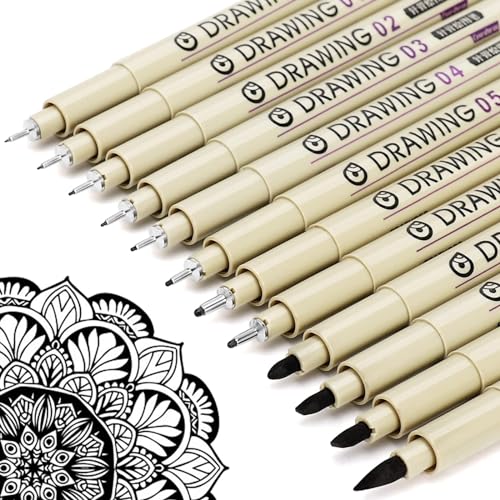
- Twelve tips span 0.2 mm to 3.0 mm
- Includes a brush tip for expressive marks
- Waterproof, quick-drying, fade-resistant archival ink
- Coded sizes make the collection easier to navigate
Cons
- Extra-fine points need a light touch
- More overlap between sizes than a focused beginner may need
- The ink must dry fully before water resistance is reliable
Best for: a beginner who wants to explore tiny details, bold outlines, and brush marks in one collection.
Muchcute is the most ambitious black-ink set in this group. Its appeal is not simply that it has twelve pens, but that the tips create a gradual path from delicate technical marks to broad drawing strokes. That makes it a good fit for someone who is already sketching and wants more control over line hierarchy.
The range begins at 0.2 mm and moves through 0.25 mm, 0.3 mm, 0.35 mm, 0.4 mm, 0.45 mm, and 0.5 mm before reaching 1 mm, 2 mm, and 3 mm tips. A brush tip rounds out the set. The closely spaced smaller sizes are useful for crosshatching and architectural details, where a small change in line width can separate foreground objects from background texture. The 2 mm and 3 mm tips give a drawing a much stronger edge without asking the brush tip to do every job.
The nylon nibs are designed for smooth, skip-free writing, and the set is described for use with journals, watercolor, tracing paper, vellum, and other surfaces. Its archival pigment ink is listed as waterproof, smear-resistant, fade-resistant, quick drying, acid free, and non-toxic. The important beginner lesson is to wait a few seconds for the ink to dry before applying water. That small pause can prevent a carefully inked contour from turning gray and fuzzy.
The Muchcute pens are a stronger choice than PANDAFLY when the drawing involves many fine line decisions. PANDAFLY is friendlier for broad calligraphy exploration, while Muchcute gives the detail artist more intermediate steps. Its weakness is the same feature that makes it attractive: twelve options can slow down a beginner who has not learned which widths they actually use. The extra-fine tips also deserve a light hand, since pressing hard can damage a narrow point.
The plastic packaging doubles as a storage case, which is useful when the set travels between a desk, classroom, or sketchbook bag. Choose Muchcute if precision and range matter more than simplicity. It is particularly well suited to manga-style outlines, zentangle patterns, drafting, and illustrations that depend on several carefully separated line weights.
3. Craft 'n' Beyond Brush Pens: Best Starter Trio

Pros
- Only three pens to learn, with clear size differences
- Pressure-sensitive tips teach basic brush control
- Quick-drying, fadeproof black ink
- Designed specifically for lettering, sketching, and journaling
Cons
- The water-based ink is not waterproof
- No fine technical nib or angled brush is included
- Minimal tip range compared with the other sets
Best for: a first-time user who wants to learn pressure and stroke control without sorting through a large assortment.
Craft 'n' Beyond takes the opposite approach to Muchcute. Instead of presenting a dozen widths, it gives the beginner three pressure-sensitive brush pens in small, medium, and large sizes. That focus is valuable when the immediate goal is learning how a pen responds to a light upstroke, a heavier downstroke, and a change in direction.
The size progression is easy to understand. The small pen can handle tighter lettering and modest outlines, the medium is a useful everyday brush, and the large marker creates broad strokes for headers or filled accents. Because all three are brush-style tools, they teach a different skill from the rigid fineliners in the Ohuhu and Brusarth Precision sets. The tips reward relaxed movement rather than a tight grip.
The ink is water-based, quick drying, fadeproof, and intended to resist bleed-through, though the product information specifically says it is not waterproof. That distinction matters if you plan to paint over the drawing or use a wet brush for shading. On ordinary writing and journaling pages, fade resistance and minimal bleed are more relevant than water resistance, but mixed-media artists should look at PANDAFLY or KERIFI instead.
Craft 'n' Beyond also makes clear that this set does not include a chisel or angled brush. That is not a flaw for someone learning rounded brush lettering, but it narrows the kind of calligraphy the pens can produce. The set is less useful for micro-detail drawing than PANDAFLY, and it cannot match GETHPEN's range of tip shapes. Its advantage is that it removes distractions.
For a young artist, a lettering student, or anyone who finds a ten-pen case intimidating, this trio has a sensible teaching role. It gives you three tools with obvious jobs and enough pressure sensitivity to build confidence. Skip it if your main interest is tiny line art, watercolor overlays, or a single collection that covers every possible nib width.
4. GETHPEN Brush Pen Set: Best for Lettering Variety
Pros
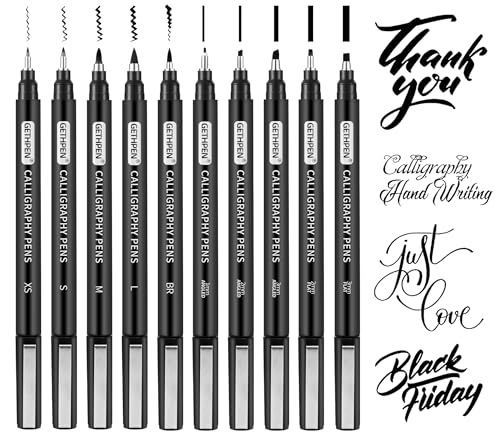
- Ten sizes include angled, flat, hard, and soft brush options
- Waterproof and fadeproof archival black ink
- Flexible tips support thick and thin strokes
- Works across paper, canvas, leather, wood, and journals
Cons
- The broad selection is more lettering-focused than technical-drawing-focused
- Surface claims are broad, so testing on a project surface is sensible
- The listing does not identify every individual nib width
Best for: beginners who want to practice decorative lettering alongside illustration and signatures.
GETHPEN stands out because it treats tip shape as seriously as tip width. The set includes 1 mm angled and 2 mm flat tips, along with brush tips and other sizes. For a beginner working on greeting cards, headers, or signatures, that variety can produce more noticeable changes than a group of closely spaced fineliners.
A flat tip helps establish consistent broad strokes and sharp edges, while an angled tip can make letter construction feel more deliberate. The brush tips then add pressure-driven transitions, allowing a single pen to move from a narrow hairline to a heavier stroke. Those are useful skills for hand lettering, and they also transfer to stylized drawing where line weight is part of the composition.
The black ink is described as waterproof, fadeproof, and archival. GETHPEN also positions the markers for paper, canvas, leather, wood, and scrapbooking journals. That range sounds attractive for a hobbyist who moves between craft projects, but different surfaces absorb ink differently. Beginners should still test a small mark before committing to a finished card or object.
GETHPEN is more expressive than the Brusarth Precision Fineliners and more shape-oriented than Ohuhu 8-Size Fineliners. PANDAFLY remains the easier all-purpose recommendation because its size labeling is more explicit, while GETHPEN makes more sense for someone who wants calligraphy to lead the experience. The main limitation is that its product information does not spell out every nib size, so it is harder to plan a precise technical drawing workflow.
The set comes in a case and is aimed at students, artists, and hobbyists. Pick it when broad lettering, signatures, and decorative marks are central to the project. If your pages are mostly tiny diagrams, stippling, or controlled architectural lines, choose a dedicated fineliner set instead.
5. Brusarth 10 Size Pens: Best Smooth-Flow Set

Pros
- Extra-fine through soft brush tips in one set
- Water-resistant, fadeproof, fast-drying ink
- Non-toxic, odorless, and acid-free formulation
- Useful for drawing, outlining, journaling, and cards
Cons
- The product information lists the pack as eight pens despite the title saying ten size
- No color options are included
- Tip dimensions are not fully specified
Best for: a beginner who wants a general-purpose black set with an emphasis on smooth everyday writing and drawing.
Brusarth's 10 Size Pens are aimed at the person who wants drawing markers that can also handle notes, cards, signatures, and journal layouts. The appeal is a smooth, uncomplicated ink flow rather than a highly specialized technical system. That makes the set easy to fold into an existing creative routine.
The nib selection runs from extra-fine tips through fine and medium options to soft brush tips. The listing does not provide the individual millimeter widths, so this set cannot offer the same precision when planning line weights as Muchcute or Brusarth Precision Fineliners. Still, the broad progression should cover the basic moves most beginners make: outlining, adding interior details, emphasizing a contour, and creating a thicker decorative stroke.
Brusarth describes the ink as water-based, odorless, acid-free, non-toxic, fast drying, waterproof, fadeproof, and non-bleeding. Those properties make it a sensible choice for notebooks and general drawing paper. The exact result will vary with the page, especially on absorbent paper, but the combination of quick drying and water resistance is useful when a beginner wants clean marks without waiting through a long drying period.
There is an important catalog inconsistency here. The title says ten size, while the product information identifies a set of eight. We would not treat that as a reason to assume missing pens or invent a specific lineup. It simply means shoppers who need an exact number of nibs should inspect the current package carefully. PANDAFLY and MARTCOLOR provide clearer ten-pen descriptions.
That uncertainty keeps Brusarth behind the more clearly documented picks, but the intended use is broad and beginner-friendly. It is a good fit for someone who values smooth writing across drawing, lettering, and journaling more than a detailed technical specification sheet. Choose another set if exact nib widths or watercolor layering are central to the project.
6. KERIFI 16-Piece Fineliners: Best for Mixed Media

Pros
- Sixteen assorted tips from 0.20 mm to 3.0 mm
- Includes two brush tips
- Waterproof archival pigment ink
- Specifically described for watercolor and mixed-media work
Cons
- The largest set may be excessive for a first pen collection
- Brush tips should not be covered with wet watercolor
- Heavier than several smaller sets
Best for: beginners who want to combine fine ink drawing with watercolor, markers, pencils, or mixed-media backgrounds.
KERIFI is the set to consider when drawing is only one layer of the finished piece. It is built around black line work, but the product information spends unusual attention on watercolor, highlighters, alcohol markers, pencils, vellum, and mixed-media paper. That makes it more purposeful than a generic large pack.
The sixteen tips span 0.20 mm to 3.0 mm and include two brush tips. That spread gives a beginner enough room to experiment with hairline details, medium outlines, bold accents, and pressure-based marks. The narrowest points are useful for mandala patterns, stippling, technical details, and small comic features. The wider tips can reinforce an outer contour or fill a handwritten heading without relying on a separate marker.
KERIFI's waterproof, quick-drying archival pigment ink is designed to resist smudging and bleeding on most paper types. The instructions make a useful distinction for watercolor users: the fine liners can be used before watercolor or over a dried watercolor base, but the brush tips are recommended only over dry watercolor. That is practical guidance rather than a vague promise of universal compatibility. Drying time and paper texture still matter, so a test mark remains wise.
The main question is whether a beginner needs sixteen choices. PANDAFLY is easier to approach, and Ohuhu 8-Size Fineliners offer a cleaner, more compact progression. KERIFI wins when the project needs more intermediate widths and multiple brush options. Its listed weight is about 0.33 pounds, so the set is also somewhat less light than the smaller collections for carrying around.
Artists who sketch in ink first and add color later will appreciate the flexibility. Beginners working only in a plain notebook may find the range unnecessarily elaborate. If you want room to grow into technical drawing, watercolor line work, and detailed pattern making, KERIFI is one of the most capable sets here.
7. Ohuhu 8-Size Fineliners: Best Organized Set

Pros
- Eight clearly defined tip sizes
- Coded caps and barrels make nib selection quick
- Waterproof, fade-resistant pigment ink
- Rounded barrels and caps help with handling and storage
Cons
- Fewer sizes than Muchcute or KERIFI
- Only one brush tip is included
- Best results are expected on smooth, non-porous paper
Best for: beginners who want a compact black fineliner set with easy-to-read size coding.
Ohuhu's 8-Size Fineliners are refreshingly disciplined. There are enough nibs to cover the major drawing tasks, but not so many that the case becomes a catalog of tiny distinctions. For a new artist learning when to switch from a light detail line to a stronger contour, that restraint is helpful.
The lineup includes 0.2 mm, 0.25 mm, 0.3 mm, 0.35 mm, 0.45 mm, 0.5 mm, 1 mm, and a brush tip. It is a useful progression for sketching and illustration. The 0.2 mm and 0.25 mm points handle delicate marks, while the 0.3 mm through 0.5 mm group covers most everyday outlining. The 1 mm and brush options provide a clear jump for emphasis and expressive strokes.
The coded caps and barrels are one of the best small usability details in the roundup. A beginner should not have to draw a test line with every pen to find the right one. The round barrel is intended to provide a comfortable grip, and the caps prevent the pens from rolling away. These are modest design choices, but they make practice less interrupted.
The ink is described as waterproof, fade-resistant, acid-free, quick drying, and bleed-proof. It works with alcohol markers, water-based markers, pencils, and other markers, with one important caution: alcohol markers can smear fineliner ink if applied before the ink is fully dry. The product points users toward smooth, non-porous drawing paper, which is a sensible match for fine points.
Ohuhu is less versatile than KERIFI and less broad than PANDAFLY, but it is easier to organize than both. The weakness is the limited number of broader choices, especially if you want several brush widths. For clean line art, bullet journaling, and controlled beginner exercises, this is one of the most approachable sets in the group.
If you are building your first drawing setup around a tablet rather than paper, how pressure-sensitive tools change the way beginners draw is a useful comparison before choosing between physical pens and a digital workflow. Ohuhu remains the better fit for anyone who wants the direct feel of ink and an uncomplicated set of sizes.
8. MARTCOLOR 10 Size Pens: Best Calligraphy Range

Pros
- Ten sizes cover fine, medium, broad, and brush work
- Includes both brush and soft brush tips
- Waterproof, fadeproof, non-bleeding pigment ink
- Designed for an easy transition from practice to finished lettering
Cons
- More focused on calligraphy than micro-detail drawing
- No colored or gray ink options
- The finest listed size is not specified numerically
Best for: beginners whose drawing practice includes hand lettering, cards, headers, and expressive line work.
MARTCOLOR is a close relative in spirit to PANDAFLY, but its strongest identity is calligraphy. The set combines rigid sizes with brush behavior, giving a beginner a way to compare consistent lines with pressure-sensitive strokes. It is especially appealing for someone who wants every practice session to produce usable lettering rather than only technical exercises.
The ten options include 0.5 mm, 0.8 mm, 1 mm, 2 mm, and 3 mm sizes, plus extra-fine, fine, medium, brush, and soft brush tips. That makes the progression easy to understand. The smaller pens can form letter details and narrow outlines, while the 2 mm and 3 mm pens establish bold forms. The brush and soft brush tips are where the set becomes more expressive, allowing stroke width to change with pressure.
MARTCOLOR describes its ink as water-based, pigmented, waterproof, fadeproof, and non-bleeding. The pens are aimed at greeting cards, signatures, illustrations, hand lettering, and practice. That broad use makes them suitable for a beginner's desk, although someone working on highly detailed line art will get more precise width information from Ohuhu or Muchcute.
The set also emphasizes ease of use compared with a dip pen. That matters to beginners because the ink is contained, the workflow is cleaner, and there is no need to manage a nib, reservoir, or separate bottle. The trade-off is that the brush tips may take a few practice pages before their pressure response feels predictable.
PANDAFLY is the stronger all-around pick because its feature list and ten-tip arrangement are similarly broad while leaning slightly more toward drawing. MARTCOLOR makes more sense when hand lettering is the main reason for buying. It is not the set to choose for colored sketching, and it does not offer the fine size granularity of the Muchcute collection.
For a new calligrapher, that division of labor is clear. Use the hard tips to learn spacing and structure, then move to the brush tips when you are ready to vary stroke weight. MARTCOLOR is a solid choice for cards, journal headers, signatures, and decorative black-and-white illustrations.
9. Brusarth Precision Fineliners: Best Compact Fineliners

Pros
- Nine tips cover 0.2 mm to 0.6 mm plus a brush
- Coded caps and pocket clips improve portability
- Waterproof, fadeproof archival pigment ink
- Strong fit for stippling and detailed outlines
Cons
- Less suitable for broad calligraphy than the ten-size brush sets
- The brush tip spans 1 mm to 2 mm rather than offering several broad options
- The product information does not list a case or storage system
Best for: beginners who want fine black lines for stippling, note-taking, drafting, and technical sketches.
The Brusarth Precision Fineliners are more focused than the other Brusarth set. Their center of gravity is narrow line work, not brush lettering. That makes them a sensible first step for a beginner who already knows they want to draw small patterns, diagrams, architectural forms, or detailed illustrations.
The set has nine distinct nibs: 0.2 mm, 0.25 mm, 0.3 mm, 0.35 mm, 0.4 mm, 0.45 mm, and 0.5 mm, plus a 0.6 mm tip and a soft brush tip rated from 1 mm to 2 mm. The closely spaced fine sizes are useful when a drawing needs subtle hierarchy. A 0.2 mm line can sit inside a 0.5 mm contour without making the interior look heavy, and the brush adds a separate option for softer accents.
The pens use water-based pigmented black ink described as waterproof, fadeproof, and non-bleeding. The set is also presented as non-toxic, and each pen has a coded cap and pocket clip. Those details suit a portable sketching routine. The clips make it easier to attach a pen to a notebook, while the codes reduce the time spent searching for a particular line width.
Compared with Ohuhu, Brusarth offers one more narrow-size step and a 0.6 mm option, but Ohuhu has a more explicit 1 mm tip and a storage-friendly barrel design. Muchcute covers a wider span up to 3 mm and adds more room for bold strokes. Brusarth Precision is the better choice only when fine control matters more than broad versatility.
The absence of several broad tips is the real limitation. A beginner hoping to move between tiny outlines and large calligraphy strokes may outgrow this set quickly. For stippling, mandala work, technical drawing, and compact journal pages, though, its focused range is easier to use than a larger collection.
10. Ohuhu Colored Fineliners: Best for Adding Color

Pros
- Eighteen pens include seven black fineliners and eleven colors
- Black set covers 0.2 mm to 0.5 mm plus a brush
- Waterproof and alcohol-resistant pigment ink
- Works with pencils, watercolors, and marker-based workflows
Cons
- Colored pens use a single medium 0.45 mm nib
- The set has fewer black width choices than Muchcute or KERIFI
- Color is less useful for artists who want only monochrome line control
Best for: beginners who want to add color to journals, illustrations, cards, and sketchbook studies.
Ohuhu's colored collection changes the question from “Which black line should I use?” to “How should color support the line?” That makes it a different kind of beginner set from the other nine. It is a good pick for sketchbooks, cards, lettering accents, and illustrations where a small controlled color mark can do more than a heavy fill.
The set contains seven black pens with 0.2 mm, 0.25 mm, 0.3 mm, 0.35 mm, 0.45 mm, and 0.5 mm tips, plus a brush tip. The product information describes the colored pens as medium 0.45 mm nibs. That split is practical: the black pens handle structure and detail, while the eleven colors add accents in yellow, orange, red, pink, purplish red, purple, blue, sky blue, green, grass green, and brown.
The ink is described as waterproof and alcohol-resistant pigment ink. Ohuhu also says the pens work with water-based pens, alcohol-based markers, colored pencils, and watercolors. The multiple-surface claim is broad, so paper choice remains important, but the ink profile gives a beginner room to explore mixed techniques. Color can mark shadows, separate objects, or create a focal point without changing the basic drawing method.
This set is less flexible for black-only line art than PANDAFLY, and its seven black fineliners do not offer the sixteen-tip spread of KERIFI. It also does not provide several colored widths, so the colored pens are not a replacement for a full set of technical nibs. The trade-off is a much more immediate sense of play and a wider palette for finished pages.
If you are drawn to colorful journals, illustrated notes, or small studies, Ohuhu makes the first step feel creative rather than technical. If you are still learning line weight, begin with the black pens, then introduce one color at a time. It is the most distinctive pick here, even if it is not the most complete monochrome drawing set.
How to choose best drawing pens for beginners
The right set depends on whether you need rigid fineliners, pressure-sensitive brush tips, or both. Pay attention to the ink and paper combination as closely as the number of pens.
Tip width and shape
Tip width determines how much visual weight a line carries. Ultra-fine tips from 0.2 mm to 0.3 mm are useful for hatching, tiny details, and intricate patterns. Medium tips around 0.4 mm to 0.5 mm are easier for everyday outlines, while 1 mm and wider tips create stronger contours and lettering.
Shape matters too. A rigid fineliner gives a consistent line, a flat or angled nib creates more structured lettering, and a brush tip changes width with pressure. Beginners who are unsure what they enjoy should choose a mixed set such as PANDAFLY. Someone focused on technical line work may prefer the narrower progression of Brusarth Precision Fineliners.
Ink behavior
Waterproof pigment ink is useful when you plan to add watercolor or another wet layer after the drawing dries. Fadeproof and archival descriptions suggest a focus on long-lasting marks, while quick-drying ink can reduce accidental smears during ordinary sketching.
Not every waterproof claim means the ink is immediately water-safe. Ohuhu and Muchcute both emphasize allowing the ink to dry fully, and Craft 'n' Beyond specifically uses water-based ink that is not waterproof. If wet media is part of your routine, test the pen on the exact paper you plan to use.
A beginner-friendly pen is not the one with the most nibs. It is the one whose next line you can predict.
Paper compatibility
Fine points behave best on smooth paper because rough fibers can catch the nib, interrupt ink flow, and make a narrow line look uneven. Ohuhu recommends smooth, non-porous drawing paper, while KERIFI describes compatibility with sketchbooks, watercolor backgrounds, vellum, and mixed-media paper.
Absorbent pages can make ink feather or appear wider than expected. Thin pages can also show marks through to the reverse side, even when a product is designed to resist bleed-through. Keep a scrap sheet underneath while practicing and choose a smoother page for finished line art.
Brush control
Brush tips are useful for calligraphy, expressive outlines, and marks that need to taper. They can also be the least predictable nib for a new artist because small pressure changes affect line width. Craft 'n' Beyond simplifies this lesson with only small, medium, and large brush pens, while GETHPEN and PANDAFLY combine brush tips with harder drawing nibs.
If brush lettering is your main goal, look for both soft and firm brush options or a set with different brush shapes. If it is only an occasional technique, one brush tip alongside several fineliners is enough.
Color and mixed media
Black ink is the most flexible place to learn structure, but color can make practice more engaging. Ohuhu's colored set includes eleven colored pens alongside seven black fineliners, with the colored pens using 0.45 mm tips. That is useful for accents, journal layouts, and simple illustrations rather than detailed multicolor rendering.
Mixed-media users should check whether the ink is described as compatible with watercolor, alcohol markers, pencils, or highlighters. KERIFI is especially explicit about working over dry watercolor, while Ohuhu warns that alcohol markers can smear fineliner ink if the ink is still wet.

Frequently asked questions
Are drawing pens suitable for complete beginners?
Yes. Fineliners and brush pens are easier to start with than dip pens because the ink is contained and the stroke is ready immediately. A mixed set with several widths can teach line weight without requiring advanced technique.
Which tip size should a beginner use first?
A medium fine tip around 0.4 mm to 0.5 mm is a comfortable starting point for general outlines. Move to 0.2 mm or 0.3 mm for small details, and use a 1 mm or brush tip when you want a stronger contour.
Are these pens safe to use with watercolor?
Several sets describe their ink as waterproof and suitable for watercolor, including PANDAFLY, KERIFI, and Ohuhu. Let the ink dry completely first, and remember that KERIFI recommends using its brush tips only over dried watercolor rather than placing wet watercolor over those marks.
What is the difference between a fineliner and a brush pen?
A fineliner usually produces a consistent line based on its fixed nib width. A brush pen responds to pressure, so a light touch makes a narrow line and heavier pressure makes a broader one. Fineliners are easier for controlled detail, while brush pens are useful for lettering and expressive strokes.
Do waterproof pens bleed through paper?
Waterproof describes how the dry ink reacts to water, not how every paper handles the mark. Thin or absorbent paper can still show ink on the reverse or allow some spread. Smooth drawing paper usually gives fine tips cleaner results.
Can beginners use these pens for technical drawing?
Yes, especially the sets with narrow sizes from 0.2 mm to 0.5 mm. Muchcute, Ohuhu 8-Size Fineliners, and Brusarth Precision Fineliners offer the clearest fine-line choices for diagrams, drafting, stippling, and detailed outlines.
Should I choose black pens or colored fineliners?
Choose black pens if you are learning structure, shading, and line weight. Choose the Ohuhu Colored Fineliners if colored accents, journals, cards, and illustrated notes are a central part of what you want to make.

The bottom line
The Best drawing pens for beginners are the PANDAFLY Calligraphy Pens because they combine ten useful nib styles with waterproof, fadeproof black pigment ink and a manageable path from fine outlines to brush lettering. They are broad enough for experimentation without being locked into a single drawing style.
Muchcute is the better choice for a beginner who wants the widest range of fine-to-broad line weights, while Craft 'n' Beyond is the clearest teaching set for pressure-sensitive brush lettering. KERIFI deserves attention from anyone combining ink with watercolor or other mixed media, and Ohuhu Colored Fineliners are the most engaging option for colorful sketchbooks.
If you are undecided, choose PANDAFLY for the most adaptable first set, or Ohuhu 8-Size Fineliners if precise, organized black line work matters more than brush lettering.
As an Amazon Associate we earn from qualifying purchases.