

A headset can make a competitive game feel unfair in the right way, but a poor one turns every match into a negotiation with muffled dialogue, a weak microphone, or a cable caught on the desk. The Best gaming headset for you depends on where you play, how much wireless flexibility you need, and whether positional audio matters more than music quality.
We found a wide spread here. The Logitech G Astro A50 is the most complete wireless pick for households with several gaming systems, while the HyperX Cloud Alpha and Razer BlackShark V2 X keep things simple with wired connections. SteelSeries, Turtle Beach, Acer, and Razer also offer compelling alternatives for battery life, simultaneous audio, noise rejection, and cross-platform play.
The Logitech G Astro A50 is our top pick, with the Logitech G522, HyperX Cloud Alpha, and the rest covering everything from lightweight wired play to high-end multi-source audio.
Comparison table
| # | Product | Award | Connection | Battery | Drivers | Best for |
|---|---|---|---|---|---|---|
| 1 | Logitech G Astro A50 | Best overall | LIGHTSPEED, Bluetooth, USB C | Up to 24 hours | 40mm PRO-G Graphene | Multi-system gaming |
| 2 | Logitech G522 | Best long-battery wireless | LIGHTSPEED, Bluetooth, USB | Up to 60 hours | PRO-G | PC and mobile gaming |
| 3 | HyperX Cloud Alpha | Best wired comfort | 3.5mm | Wired | Dual chamber | Simple cross-platform setups |
| 4 | Razer BlackShark V2 X | Best lightweight wired | 3.5mm | Wired | 50mm TriForce Titanium | PC and console basics |
| 5 | SteelSeries Arctis Nova Elite | Best high-end audio control | 2.4GHz, Bluetooth, line-in | Up to 30 hours per battery | Carbon fiber | Multi-source enthusiasts |
| 6 | Turtle Beach Stealth 600 | Best battery life | 2.4GHz, Bluetooth 5.4 | Up to 80 hours | 50mm Nanoclear | Long wireless sessions |
| 7 | Razer BlackShark V3 | Best competitive wireless | 2.4GHz, Bluetooth 5.3, USB | Up to 70 hours | 50mm TriForce Titanium Gen 2 | PC and PlayStation FPS |
| 8 | Acer Gaming Headset | Best tri-mode simplicity | 2.4GHz, Bluetooth 5.3, 3.5mm | Up to 40 hours | 50mm | Flexible everyday use |
| 9 | SteelSeries Arctis Nova 7P Gen 2 | Best app-assisted wireless | 2.4GHz, Bluetooth | Over 50 hours | Neodymium magnetic | PS5 and mixed-device play |
| 10 | Turtle Beach Stealth 700 | Best immersive Turtle Beach model | 2.4GHz, Bluetooth 5.2 | Up to 80 hours | 60mm Eclipse dual | Xbox and multi-platform play |
1. Logitech G Astro A50: Best Overall

Pros
- Plays audio across three connected systems
- Strong 48 kHz microphone
- Magnetic charging base keeps it ready
- Bluetooth audio can mix with game sound
- Detailed 40mm PRO-G Graphene drivers
Cons
- Battery life is shorter than several alternatives
- More setup and software control than a wired headset
- Its full feature set matters most to multi-system players
Best for: players who move between PC, PlayStation, Xbox, and Switch.
The Logitech G Astro A50 is the headset we would keep when several consoles and a computer share one room. Its defining feature is not simply wireless freedom. The PLAYSYNC system lets it connect to three platforms at once through USB C, with on-ear controls for switching between Xbox, PS5, PC or Mac, and Nintendo Switch or Switch 2. That removes the irritating routine of moving a dongle whenever the gaming device changes.
The 40mm PRO-G Graphene drivers are tuned for separation, timing, and location rather than just oversized bass. That matters when a game places footsteps, reloads, and environmental noise close together in the mix. The headset also supports 24-bit LIGHTSPEED wireless audio, while the 48 kHz full-bandwidth boom microphone gives team chat more articulation than the average gaming mic. Bluetooth dual-device mixing is useful for bringing a phone, Discord conversation, or music into the same listening session.
Battery life reaches 24 hours at 78 dB, and the included magnetic base station makes charging a habit rather than a chore. The base is also central to the headset's multi-system design. Logitech's G HUB and G mobile app provide a 10-band parametric EQ, microphone settings, noise gate, stream output mixing, and saved audio processing through the headset's 7-core DSP. That is a lot of control, but it is practical control for someone who wants a different setup on each system.
The Logitech G522 lasts much longer away from a charger and weighs 280 g, so it is the calmer choice for a PC-first user. The A50 wins on system switching, dock convenience, and more elaborate audio routing. Its weakness is that the shorter battery run and more involved setup are unnecessary if you use one platform. Readers focused on a simple wired connection should look at the HyperX Cloud Alpha or Razer BlackShark V2 X instead.
For a living-room setup with multiple systems, the Logitech G Astro A50 is the Best gaming headset in this group. It is for the player who will actually use its switching and mixing features, not someone looking for the fewest controls possible.
2. Logitech G522: Best Long-Battery Wireless

Pros
- Up to 60 hours with lighting off
- 280 g lightweight construction
- 48 kHz/16-bit microphone
- Supports LIGHTSPEED, Bluetooth, and wired USB
- Washable suspension band
Cons
- RGB lighting reduces its stated battery endurance
- PC-focused feature set is less comprehensive than the A50
- No multi-system switching feature like PLAYSYNC
Best for: PC players who want a light wireless headset with long endurance.
The Logitech G522 is the most straightforward wireless alternative to the A50. It has the comfortable, uncomplicated feel many PC players want, but it does not give up useful device flexibility. LIGHTSPEED handles low-latency PC gaming, Bluetooth covers mobile devices, and a USB A to USB C wired connection provides a fallback for uninterrupted play.
Its 280 g build is notably light among the wireless models here. The rounded ear cushions and washable suspension band are the details that matter during a long session, since the headset spreads contact over the head instead of relying on a narrow hard band. Side-facing LIGHTSYNC RGB lighting can use up to 16.8 million colors, but switching the lighting off is what enables the stated battery life of up to 60 hours.
The PRO-G drivers support synchronized 48 kHz/24-bit audio, with low distortion and a fuller bass response. The microphone supports 48 kHz/16-bit capture, and Blue VO!CE processing through G HUB or the G mobile app gives you a way to shape voice output. Those controls make the G522 more useful for regular voice chat and streaming than a basic headset with one fixed mic profile.
Compared with the A50, the G522 trades the charging base, three-system switching, and more advanced routing for a lighter design and considerably longer use between charges. The Razer BlackShark V3 has a competitive 70-hour claim and more aggressive spatial features, but it is much heavier according to its listed specifications and does not work with Xbox consoles. The G522 is the easier recommendation for a PC and phone combination.
The main catch is that the RGB feature is at odds with the longest battery figure. Keep the lighting on and you should not expect the same endurance. For PC users who want a comfortable wireless headset with useful software and minimal charging, the Logitech G522 is a strong second pick.
3. HyperX Cloud Alpha: Best Wired Comfort

Pros
- Dual chamber drivers separate frequencies
- Durable aluminum frame
- Detachable braided cable
- Detachable noise-cancellation microphone
- Works with a broad range of devices
Cons
- No wireless connection
- 3.5mm devices determine the available controls
- Older design lacks app-based sound shaping
Best for: players who want comfortable plug-and-play audio across many platforms.
The HyperX Cloud Alpha remains a persuasive wired headset because it gets the basics right without surrounding them with software. Plug the detachable braided cable into a compatible 3.5mm device and you can use it with PC, PlayStation 4 and 5, Xbox consoles, Mac, mobile devices, Nintendo Switch, and VR hardware. That broad compatibility makes it a sensible shared headset for a family with several kinds of gaming hardware.
Its dual chamber driver design separates bass from the mids and highs, which helps reduce the congested sound that can make dialogue and positional cues compete with explosions. The listed frequency response runs from 15 Hz to 25, 000 Hz, though the more useful part of the design is the tuning separation rather than the endpoints. The aluminum frame and expanded headband give it a sturdy structure without making it feel like a rigid studio headset.
Comfort is the Cloud Alpha's strongest reason to buy. The over-ear fit, familiar HyperX padding, and 0.657-pound listed weight make it easier to wear through a long session than many bulky wireless models. The detachable microphone has noise cancellation, and the cable includes convenient in-line audio control. If the cable is damaged, it is also easier to replace than a built-in wireless assembly.
The Razer BlackShark V2 X is lighter at 240 g and uses 50mm drivers, so it has the edge for players who want the least weight. The Cloud Alpha feels more substantial and offers a more reassuring frame. It also avoids battery management entirely. That makes it a good choice for anyone still deciding what you give up moving from wired to wireless, especially if the headset will be used on several consoles.
The weakness is obvious: there is no wireless mode, no Bluetooth, and no app for saving EQ profiles. A wireless player should skip it. For everyone else, the Cloud Alpha is a comfortable, durable wired headset with an unusually flexible device list.
4. Razer BlackShark V2 X: Best Lightweight Wired

Pros
- Lightweight 240 g design
- 50mm TriForce Titanium drivers
- Memory foam cushions help isolate outside sound
- 7.1 surround support on Windows
- Clear HyperClear cardioid microphone
Cons
- Wired 3.5mm connection only
- Surround feature is limited to Windows 10 64-bit
- Xbox One stereo adapter may be required
Best for: PC and console players who want a light wired headset with positional audio options.
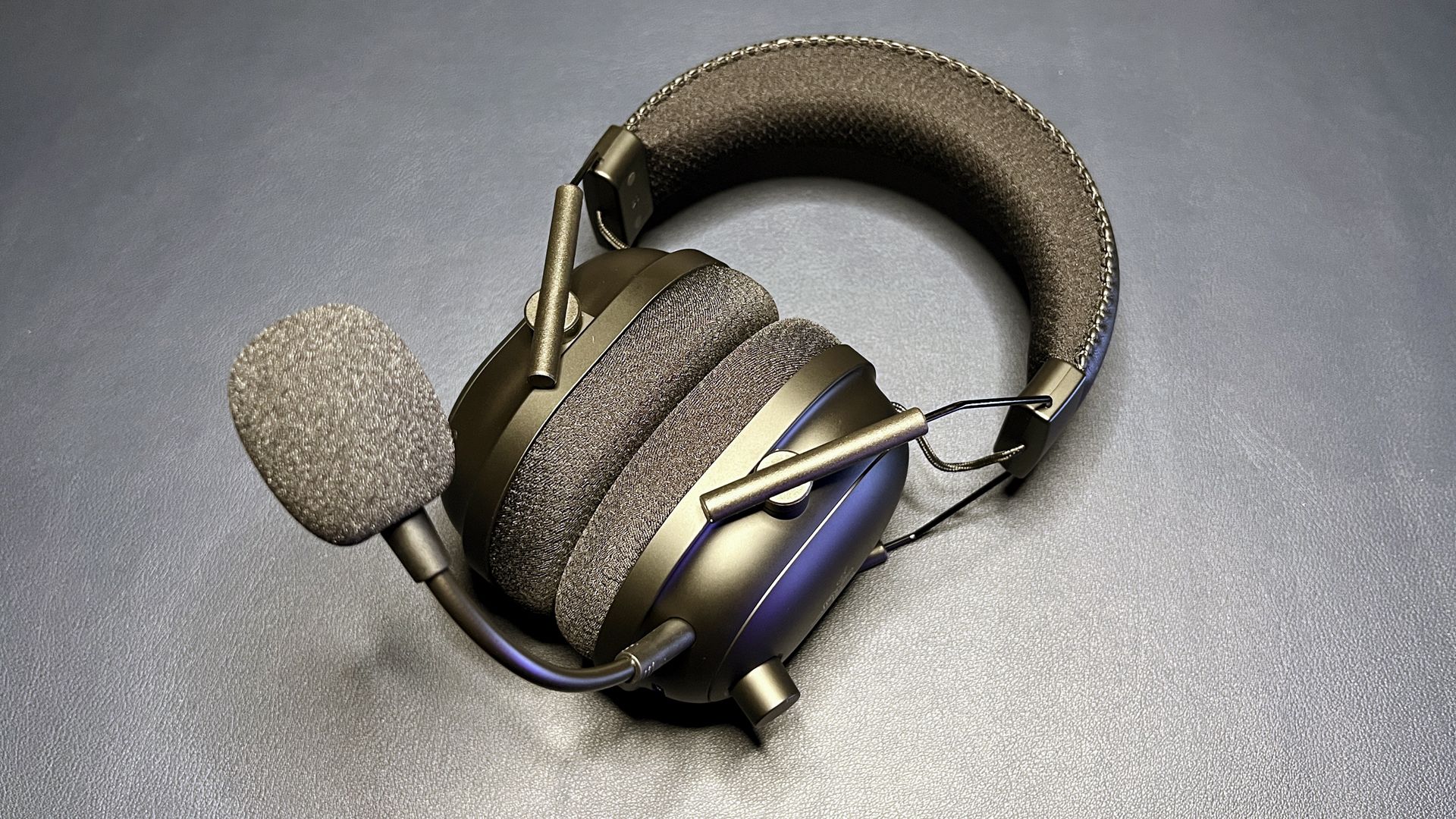
The Razer BlackShark V2 X is the headset to choose when weight is the first concern. At 240 g, it is the lightest model in this roundup with a listed weight, and its breathable foam ear cushions keep the closed earcups from feeling as bulky as some wireless designs. The passive seal also helps keep external distractions from competing with game audio.
Razer uses 50mm TriForce Titanium drivers with separate tuning for highs, mids, and lows. That arrangement aims to keep dialogue and small positional details clear while still giving explosions and music some impact. On Windows 10 64-bit, software-enabled 7.1 surround sound adds a wider positional presentation. It is a platform-specific feature, so console users should treat the headset as a stereo 3.5mm model.
The HyperClear cardioid microphone is shaped to prioritize the speaker's voice and taper off sound arriving from the back and sides. That is useful near a keyboard or a fan, although it does not provide the same kind of software depth as the Logitech and SteelSeries models. The headset works through its 3.5mm jack with PC, Mac, PlayStation, Xbox One, and Nintendo Switch. Razer notes that an Xbox One stereo adapter may be needed.
The Cloud Alpha has a more robust aluminum frame and dual chamber drivers, while the BlackShark V2 X wins for low weight and a more immediate competitive focus. Neither gives you wireless freedom. If your PC is the main platform and you care about positional audio without wearing a heavy headset, the Razer is the cleaner fit.
Do not choose it for mobile convenience or couch gaming away from a cable. Its best features also depend on Windows software, and the 3.5mm connection can be limiting on newer devices. For a lightweight wired setup, though, the Razer BlackShark V2 X is exceptionally easy to recommend.
5. SteelSeries Arctis Nova Elite: Best High-End Audio Control

Pros
- 96 kHz/24-bit wireless audio support
- Mixes up to four audio sources
- Swappable battery system
- Active noise cancellation
- AI noise rejection for the microphone
Cons
- Its extensive controls require time to learn
- Each battery is rated for up to 30 hours
- The feature set is excessive for single-platform players
Best for: enthusiasts who want deep control across PC, console, Bluetooth, and line-in sources.
The SteelSeries Arctis Nova Elite is built around the idea that a gaming headset can be the central audio hub for a desk or entertainment room. Its GameHub connects PC, PS5, Xbox, Switch, and other sources, while OmniPlay can mix up to four inputs: PC, console, Bluetooth, and line-in. That is a much broader arrangement than the usual wireless dongle and Bluetooth pairing.
The carbon fiber drivers are designed to stay rigid and respond quickly, with a two-piece construction and brass surround intended to support accurate movement. The headset supports 96 kHz/24-bit audio over 2.4GHz or Bluetooth through the LC3+ codec. Those numbers will matter most to listeners who already care about high-resolution sources and precise control. For ordinary console chat, the benefit is more about clean separation and flexibility than a dramatic change in every game.
Active noise cancellation reduces surrounding sound, and the onboard AI noise rejection is designed to reduce background noise for the microphone. SteelSeries lists up to 97% background-noise reduction for that system and up to 42% more ambient-noise reduction from ANC against key competitors in its stated testing. Those are manufacturer-provided claims, so the practical result will depend on the room, but the features are unusually comprehensive for gaming.
The most distinctive hardware decision is the two-battery setup. One battery powers the headset while the other charges in the GameHub, with up to 30 hours per battery. A 15-minute fast charge is listed as providing four hours. That avoids the dead-headset problem better than the A50's dock alone, although it adds another component to keep track of.
The Arctis Nova Elite is too elaborate for a player who uses one console and never mixes audio. The Arctis Nova 7P Gen 2 offers similar simultaneous 2.4GHz and Bluetooth behavior in a simpler package, while the Elite wins on source count, ANC, and battery swapping. If your setup involves several systems, calls, music, and serious audio adjustment, this is the pick. For a simpler guide to separating game sound from voice chat, the right microphone setup for team communication is worth considering alongside it.
6. Turtle Beach Stealth 600: Best Battery Life

Pros
- Up to 80 hours of battery life
- 2.4GHz wireless and Bluetooth 5.4
- Glasses-friendly memory foam cushions
- Flip-to-mute microphone with AI noise reduction
- Swarm II app with 10-band EQ
Cons
- Features are spread across headset controls and an app
- No active noise cancellation listed
- It is less focused on high-resolution audio than the SteelSeries Elite
Best for: wireless players who want to charge as infrequently as possible.
The Turtle Beach Stealth 600 is a practical wireless workhorse. Its headline feature is up to 80 hours of battery life, but the more useful story is that it combines that endurance with low-latency 2.4GHz wireless and Bluetooth 5.4. You can use the dedicated wireless link for gaming, then move to a mobile device without abandoning the headset.
Its 50mm Nanoclear drivers are intended to produce vibrant spatial audio. Built-in EQ modes and Superhuman Hearing provide quick ways to emphasize certain game sounds, while the Swarm II desktop and mobile app adds an advanced 10-band EQ for people who want finer control. A mappable wheel and mode button reduce the need to open the app during a match.
The memory foam cushions use Turtle Beach's glasses-friendly design, and the earcups can lie flat for storage. The flip-to-mute mic is easy to understand at a glance, with AI-based noise reduction aimed at keeping voice chat clear. The headset's adjustable construction should suit a range of head sizes, although the listed weight of about 0.705 pounds means it is not an ultra-light model.
The Turtle Beach Stealth 700 also reaches up to 80 hours and uses simultaneous 2.4GHz wireless plus Bluetooth, but it steps up to 60mm Eclipse dual drivers and a steel-reinforced design. The Stealth 600 is the more restrained option. It is also easier to justify for a player who wants strong battery life without needing the Stealth 700's larger driver platform.
There is no active noise cancellation listed, and the headset's many functions may take a little time to organize. It is a particularly good fit for Xbox players and anyone who dislikes frequent charging. If battery life is the deciding factor, the Turtle Beach Stealth 600 deserves serious attention.
7. Razer BlackShark V3: Best Competitive Wireless

Pros
- Up to 70 hours of battery life
- Wireless latency as low as 10 ms
- 50mm Gen 2 TriForce Titanium drivers
- Detachable 9.9mm wideband microphone
- PC, PlayStation, Switch, mobile, and USB support
Cons
- Not compatible with Xbox consoles
- Listed weight is higher than the other Razer model
- Competitive EQ profiles need some setup
Best for: PC and PlayStation players who prioritize fast wireless response.
The Razer BlackShark V3 is aimed squarely at players who care about timing. Its HyperSpeed Wireless Gen 2 connection is rated for latency as low as 10 ms, which keeps the wireless link from becoming a noticeable part of the gaming experience. It also supports Bluetooth 5.3 and USB, so it can serve a PC, console, or mobile device instead of being locked to one connection method.
Razer uses 50mm Gen 2 TriForce Titanium drivers tuned for clarity and positional performance. THX Spatial Audio adds a 7.1.4 surround mode with overhead sound, while game-specific FPS profiles and customizable EQ let players alter the balance for particular titles. The headset can save custom EQ settings, which is useful if you move between competitive games and more cinematic single-player audio.
The detachable HyperClear Super Wideband microphone is 9.9mm and designed to capture more voice detail. That gives it a stronger specification than the fixed or simpler microphones on the wired BlackShark V2 X and HyperX Cloud Alpha. Simultaneous 2.4GHz and Bluetooth mixing is also supported, so a mobile call or chat can sit beside game audio.
The battery reaches up to 70 hours, which is strong but behind the 80-hour Turtle Beach models and the 60-hour Logitech G522 only when the latter's lighting is off. The bigger issue is compatibility. Razer explicitly says this model does not work with Xbox Series X, Series S, or Xbox One consoles. The listed weight is also about 1.7 pounds, considerably more than the 240 g BlackShark V2 X.
That makes the BlackShark V3 a specialist recommendation, not a universal one. PC and PlayStation players who want fast wireless response, detailed positional cues, and a detachable high-bandwidth mic should shortlist it. Xbox owners should skip it and choose the A50, Turtle Beach Stealth 600, or Turtle Beach Stealth 700 instead.
8. Acer Gaming Headset: Best Tri-Mode Simplicity

Pros
- 2.4GHz, Bluetooth 5.3, and 3.5mm modes
- Up to 40 hours of battery life
- 50mm drivers
- Stated wireless latency of 20 ms or less
- Detachable noise-reduction microphone
Cons
- App and EQ depth are not specified
- Shorter battery life than the leading wireless picks
- Compatibility details focus on PS5, PS4, PC, and Switch
Best for: players who want one headset for wireless, Bluetooth, and wired use.
The Acer Gaming Headset makes its case with three connection options rather than one standout audio technology. It supports 2.4GHz wireless, Bluetooth 5.3, and a 3.5mm wired connection, giving it a useful fallback when a device does not cooperate with a wireless dongle. The listed compatibility includes PS5, PS4, PC, Switch, and other devices.
Its 50mm drivers are designed for stereo sound with a stated wireless latency of 20 ms or less. That should be responsive enough for ordinary gaming, and the larger driver size gives game audio room for both directional cues and low-frequency effects. The detachable omnidirectional microphone uses noise reduction and can be adjusted to the preferred angle.
Comfort comes from memory foam ear cushions and an adjustable headband, while the aluminum frame is intended to provide a more durable structure. Battery life reaches up to 40 hours, and a full charge is listed as taking three hours. That is enough for several long sessions, although the Logitech G522, Turtle Beach Stealth 600, and Razer BlackShark V3 all go substantially longer between charges.
The Acer is less ambitious than the SteelSeries Arctis Nova 7P Gen 2, which adds simultaneous game and mobile audio, a 50-hour-plus battery, game-specific presets, and a more developed noise-rejection system. The Acer's advantage is simplicity: three clear connection modes and no need to commit to a single platform ecosystem.
The main limitation is missing detail about software controls and EQ adjustment. Buyers who want extensive audio customization should move up to Logitech, Razer, or SteelSeries. For a flexible headset that can shift from console wireless to phone Bluetooth to a cable, Acer has the right basic layout.
9. SteelSeries Arctis Nova 7P Gen 2: Best App-Assisted Wireless

Pros
- More than 50 hours of battery life
- Simultaneous 2.4GHz and Bluetooth audio
- More than 200 game-specific audio presets
- ClearCast Gen 2 microphone
- Steel frame and elastic headband
Cons
- App control is central to its feature set
- The product data does not specify a precise weight
- Its strongest features require time spent tuning profiles
Best for: PlayStation and PC players who want live app control and mixed audio.
The SteelSeries Arctis Nova 7P Gen 2 is a strong middle ground between a basic wireless headset and the elaborate Arctis Nova Elite. Its main trick is simultaneous 2.4GHz and Bluetooth, allowing game audio and mobile audio to play together. That is handy for calls, music, or a second chat channel without repeatedly pairing and unpairing devices.
The headset uses custom neodymium magnetic drivers and supports 360-degree spatial audio. SteelSeries also highlights more than 200 game-specific audio presets, which can make the headset feel very different from one title to another. The real-time app control is the point here. Players who enjoy adjusting sound for footsteps, dialogue, or a particular game genre will get more from it than those who prefer one fixed sound.
Battery life is listed at more than 50 hours, with USB C fast charging. The rugged steel frame, elastic headband, and memory foam cushions balance durability with a familiar suspension fit. The ClearCast Gen 2 microphone reduces background noise by up to 25 dB, and Sonar AI can enhance that processing on PC.
The Nova Elite beats it on high-resolution audio, ANC, four-source mixing, and swappable batteries. The Logitech G522 is simpler and lighter at 280 g, while the Nova 7P Gen 2 offers the stronger platform mix for PS5, PS4, PC, Switch, Switch 2, and mobile. It is also a more natural fit for someone who wants audio presets to stay central to the experience.
The weakness is that the headset's most appealing features are not entirely plug and play. If you never adjust EQ or use Bluetooth at the same time as game audio, the simpler Turtle Beach Stealth 600 may be easier to live with. If you enjoy tailoring sound and need PS5 plus mobile flexibility, this SteelSeries is a thoughtful choice.
10. Turtle Beach Stealth 700: Best Immersive Turtle Beach Model

Pros
- Up to 80 hours of battery life
- 60mm Eclipse dual drivers
- Simultaneous 2.4GHz and Bluetooth 5.2
- Steel-reinforced lay-flat design
- Glasses-friendly memory foam cushions
Cons
- Heavier than the Stealth 600
- More features than some players need
- Platform setup requires attention to the dual-transmitter system
Best for: Xbox and multi-platform players who want large drivers and long battery life.
The Turtle Beach Stealth 700 is the more substantial counterpart to the Stealth 600. It keeps the same up to 80-hour battery claim and simultaneous low-latency 2.4GHz wireless plus Bluetooth, but adds 60mm Eclipse dual drivers for a bigger, more immersive presentation. That difference should appeal to players who want campaign soundtracks and large game effects to have more physical scale.
The CrossPlay dual transmitter system is designed for multi-platform wireless audio. A mappable wheel and mode button put common adjustments on the headset, while the Swarm II desktop and mobile app provides a 10-band EQ and other tuning options. Superhuman Hearing and built-in EQ modes offer quicker sound changes when you do not want to work through detailed settings.
The flip-to-mute microphone uses AI-based noise reduction, and the memory foam cushions include a glasses-friendly design. The steel-reinforced frame folds flat for storage. At 0.9 pounds, the Stealth 700 is heavier than the Stealth 600, so the larger drivers and reinforced construction come with a more noticeable presence on the head.
The Stealth 600 is the better pick if you want the same headline battery endurance in a lighter, less elaborate design. The Arctis Nova 7P Gen 2 has a more refined app and preset approach, while the Stealth 700 is more immediately focused on large-scale audio, Xbox use, and physical controls. Readers comparing broader listening options may also want to consider how gaming audio changes outside the headset, particularly for single-player games.
The Stealth 700 is not the right choice for someone who dislikes a heavier headset or never uses EQ controls. It makes sense for Xbox players and multi-platform households that want long endurance, simultaneous audio, and a sturdier frame.

How to choose the best gaming headset
The best gaming headset is the one whose connection, microphone, fit, and audio controls match the systems and games you actually use.
Connection types
Wired 3.5mm headsets such as the HyperX Cloud Alpha and Razer BlackShark V2 X are simple and do not need charging. Wireless models generally use 2.4GHz for low-latency game audio, while Bluetooth is better for phones and secondary devices. Headsets that mix both connections, including the Arctis Nova 7P Gen 2 and Turtle Beach models, are more useful when you need game audio and a call at the same time.
Check the console compatibility carefully. The Razer BlackShark V3 is designed for PC, PlayStation, Switch, mobile, and USB use, but it does not work with Xbox consoles. A headset with broad claims is not automatically universal if its wireless transmitter or console support is limited.
Battery life
Battery capacity matters most when the headset is your daily audio device. The listed figures range from 24 hours for the Astro A50 to up to 80 hours for the Turtle Beach Stealth 600 and Stealth 700. A charging dock makes shorter endurance easier to manage, while swappable batteries, as used by the Arctis Nova Elite, can avoid downtime altogether.
Remember that special features can change the result. The Logitech G522's up to 60-hour figure is specified with lighting off. A headset that lasts longer on paper may still need frequent charging if you keep high-power lighting or other wireless functions active.
Drivers and positional audio
Driver size alone does not determine sound quality. The Cloud Alpha uses dual chamber drivers to separate frequency ranges, the Razer models use TriForce Titanium designs, and SteelSeries uses neodymium magnetic or carbon fiber drivers depending on the model. The construction and tuning matter more than the diameter printed on the box.
Positional audio is useful only when the headset keeps footsteps, voices, and effects separate enough to interpret quickly.
Virtual surround and spatial audio can help with direction, but availability may depend on the platform or software. The BlackShark V2 X's 7.1 mode is limited to Windows 10 64-bit, while other headsets offer spatial processing through their apps or console connections.
Microphone quality
A detachable or flip-to-mute microphone is convenient, but the pickup pattern and processing determine how clearly teammates hear you. The Astro A50 and Logitech G522 list 48 kHz microphone capture, the Razer BlackShark V3 uses a detachable 9.9mm wideband mic, and the SteelSeries models add background-noise rejection.
For a quiet room, nearly any decent boom mic can work. In a room with a fan, keyboard, or another person talking, look for a cardioid design or stated noise-rejection processing. App controls are useful when you want to adjust voice tone, noise gates, or chat balance rather than accept one preset.
Comfort and construction
Headset weight, cushion material, clamping force, and headband design matter more after the first hour than they do in a product photograph. The Razer BlackShark V2 X lists a 240 g weight, the Logitech G522 lists 280 g, and several wireless options are heavier. A suspension or elastic band can distribute weight, while memory foam cushions can improve the seal and accommodate glasses.
Durable construction is helpful, but a steel or aluminum frame may add weight. The Cloud Alpha uses an aluminum frame, the Arctis Nova 7P Gen 2 uses a steel frame with an elastic headband, and the Stealth 700 adds steel reinforcement for a lay-flat design. Choose the balance that matches your wearing habits.
Frequently asked questions
Do wireless gaming headsets have noticeable delay?
A 2.4GHz wireless connection is designed for low-latency gaming and should be much more responsive than ordinary Bluetooth audio. The Razer BlackShark V3 lists latency as low as 10 ms, while the Acer headset lists 20 ms or less. Bluetooth is more useful for mobile audio and calls unless a device supports a suitable low-latency mode.
Can one gaming headset work with several consoles?
Some can, but the connection method matters. The Logitech G Astro A50 supports three connected platforms through USB C, and the Turtle Beach Stealth 700 uses a dual-transmitter system for multi-platform wireless audio. Wired 3.5mm models such as the HyperX Cloud Alpha can work across many devices when those devices provide a compatible jack.
Is a wired headset better for competitive gaming?
A wired headset avoids battery management and can provide a consistent connection. The Razer BlackShark V2 X also weighs 240 g and supports Windows spatial audio, which may appeal to competitive PC players. Wireless models are now practical for competition when they use a dedicated 2.4GHz link, so the decision often comes down to comfort and setup rather than a simple wired advantage.
Which headset is best for Xbox?
The Logitech G Astro A50, Turtle Beach Stealth 600, and Turtle Beach Stealth 700 are strong fits for Xbox use. The Razer BlackShark V3 should be excluded because its listed compatibility does not include Xbox consoles. Check the exact transmitter and platform support before choosing a wireless model.
Can gaming headsets mix game audio with phone calls?
Yes, several models support simultaneous wireless and Bluetooth audio. The Astro A50, Arctis Nova Elite, Arctis Nova 7P Gen 2, Stealth 600, Stealth 700, and BlackShark V3 all list some form of mixed or simultaneous device audio. The specific controls differ, so consider whether you want quick on-ear adjustment or deeper app control.
How important is active noise cancellation for gaming?
ANC can reduce steady outside sounds, but it is not essential for every gaming room. The SteelSeries Arctis Nova Elite is the only model here that lists active noise cancellation. Closed earcups with memory foam, such as those on the Razer BlackShark V2 X and Turtle Beach headsets, provide passive isolation without adding an ANC system.

The bottom line
The Best gaming headset in this roundup is the Logitech G Astro A50 for players who switch among several systems and want a dock, mixed Bluetooth audio, detailed controls, and a strong microphone. Its 24-hour battery life is not the longest here, but the PLAYSYNC switching and charging base make it the most complete multi-platform package.
Choose the Logitech G522 for a lighter PC-first wireless headset with up to 60 hours of battery life, or the HyperX Cloud Alpha if you want dependable wired comfort without charging or software. Competitive PC and PlayStation players should consider the Razer BlackShark V3, while Xbox users have better options in the Turtle Beach Stealth 600 and Stealth 700.
If you are undecided, choose wired simplicity with the HyperX Cloud Alpha, or choose the Astro A50 when several devices need to share one headset.
As an Amazon Associate we earn from qualifying purchases.