

A poor gaming mouse makes every small mistake feel bigger. A shape that does not fit your hand creates tension, extra weight slows quick turns, and a cluttered button layout can send the wrong command at the worst moment. The right model should disappear beneath your hand and respond exactly when you need it.
Our picks for the Best gaming mouse range from simple wired designs to ultralight wireless models and feature-heavy mice with 11 programmable controls. We ranked them by the capabilities that matter during real play, including sensor performance, connection type, shape, button layout, and battery design.
The Logitech G305 Lightspeed Wireless is our top pick, with the Razer Viper V3 Pro, Logitech G502 Hero, and Razer Basilisk V3 covering different kinds of players.
Best gaming mouse comparison
| # | Product | Award | Connection | Weight | Key controls | Best for |
|---|---|---|---|---|---|---|
| 1 | Logitech G305 Lightspeed Black | Best overall | Wireless | 3.4 oz | 6 buttons, 12, 000 DPI | Most PC gamers |
| 2 | Razer Viper V3 Pro | Best for esports | Wireless | 54 g | Optical switches, 35, 000 DPI | Competitive FPS players |
| 3 | Logitech G502 Hero | Best wired all-rounder | Wired | 0.27 lb | 11 buttons, 25, 600 DPI | Macro-heavy games |
| 4 | Razer Basilisk V3 | Best ergonomic design | Wired | 0.2225 lb | 11 buttons, 26, 000 DPI | Palm grip players |
| 5 | Logitech Pro X2 Superstrike | Best advanced wireless | Wireless | 0.134 lb | 8 kHz polling, 44, 000 DPI | Enthusiast competitors |
| 6 | Logitech G502 X Plus | Best feature-rich wireless | Wireless | 0.23 lb | 11 buttons, 25, 000 DPI | Custom control setups |
| 7 | Logitech G502 Lightspeed | Best classic wireless | Wireless | 0.81 lb | 11 buttons, 25, 600 DPI | G502 fans |
| 8 | Razer Viper V3 HyperSpeed | Best long-battery wireless | Wireless | 82 g | 5 DPI stages, 30, 000 DPI | Players who dislike charging |
| 9 | Logitech G305 Lightspeed White | Best compact white mouse | Wireless | 0.21 lb | 12, 000 DPI | Compact wireless setups |
| 10 | Logitech G305 Lightspeed Blue | Best colorful wireless | Wireless | 0.3 lb | 6 buttons, 12, 000 DPI | Simple portable setups |
1. Logitech G305 Lightspeed Black: Best Overall
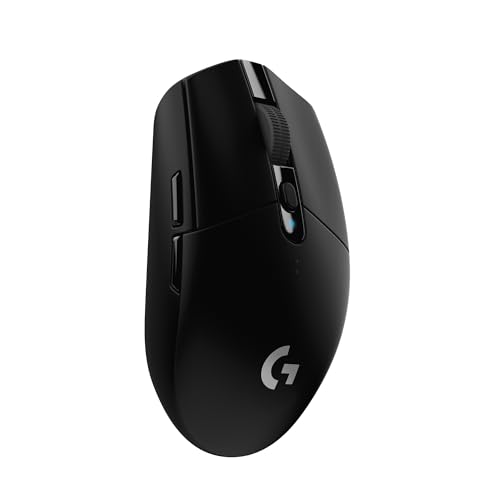
Pros
- Responsive 1 ms LIGHTSPEED wireless connection
- 12, 000 DPI HERO sensor with 400 IPS precision
- Up to 250 hours from one AA battery
- Compact body with receiver storage
Cons
- Uses a replaceable AA battery
- Fewer programmable controls than the G502 models
- Shape may feel narrow for large hands
Best for: most players who want a light, dependable wireless mouse without unnecessary complexity.
The Logitech G305 Lightspeed Black gets the fundamentals right so cleanly that it is easy to forget how little it asks from the user. It has a familiar compact shape, a low-friction wireless setup, and enough precision for fast shooters, strategy games, and general desktop use. There is no cable dragging across the desk, but the mouse still feels direct when you make a quick correction.
Its HERO optical sensor reaches 12, 000 DPI and tracks at up to 400 IPS. Most players will use a much smaller sensitivity setting, but the important point is consistency at those lower settings. LIGHTSPEED wireless uses a 1 ms report rate, which keeps cursor movement and clicks feeling immediate. The mouse weighs 3.4 ounces, a useful middle ground that makes it easy to move without feeling insubstantial.
Battery life is the practical advantage. Logitech rates it for up to 250 hours of continuous play from one AA battery, and G HUB can switch it to Endurance mode for up to nine months of battery life. That makes the G305 easier to live with than rechargeable mice that need a cable at an inconvenient time. The receiver also stores inside the compact body, which helps if you move between a desktop and gaming laptop.
The limitation is the control layout. Six buttons are enough for most games, but the G502 Hero and Basilisk V3 are much better when you need a thumb button for every ability or command. The G305 also uses a replaceable battery rather than an internal rechargeable cell. For a broad mix of games and everyday work, though, it is the one we'd keep. Readers pairing it with a full setup can also consider how a mouse and keyboard should work together on a gaming desk.
2. Razer Viper V3 Pro: Best for Esports

Pros
- Very light 54 g construction
- Focus Pro 35K sensor with one-DPI adjustment
- Up to 8, 000 Hz polling
- Optical switches rated for 90 million clicks
- Up to 95 hours of battery life
Cons
- Sparse control layout
- No wired connection listed in the supplied details
- Esports-focused shape is less versatile for some grips
Best for: competitive FPS players who value low weight and rapid, controlled movement above extra buttons.
The Razer Viper V3 Pro is built around one clear idea: remove anything that gets between your hand and a fast flick. At 54 g, it is dramatically lighter than the G502 models and noticeably easier to redirect during low-sensitivity aiming. The centered mass and simple wireless body make broad swipes feel predictable rather than top-heavy.
Razer's Focus Pro 35K optical sensor offers one-DPI step adjustments and tracking on a wider variety of surfaces, including glass. The headline sensitivity is not the reason to buy it. Fine adjustment is more useful, especially for players who spend time matching sensitivity across games. HyperSpeed wireless supports polling rates up to 8, 000 Hz, though the benefit depends on the rest of the computer and display chain.
The Gen 3 optical switches are rated for a 0.2 ms actuation time and a 90-million-click lifecycle. That combination favors players who want crisp, repeatable button presses and do not want to worry about traditional switch wear. Battery life is rated at up to 95 hours, giving it a much longer stretch between charges than many high-performance wireless designs.
The Viper V3 Pro beats the G305 Lightspeed Black for speed-focused movement, but the Logitech is more approachable for mixed gaming and daily use. The Viper has fewer obvious reasons to choose it if your games depend on macros or many side controls. It is also a specialized shape rather than an ergonomic, thumb-rest design. For competitive shooters, however, its low weight and precise tracking make it the strongest choice here.
3. Logitech G502 Hero: Best Wired All-Rounder
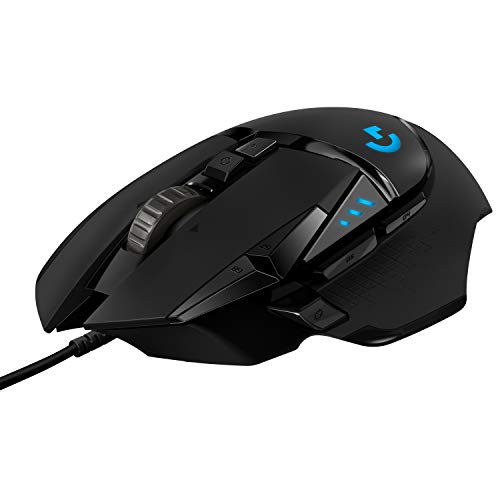
Pros
- 11 programmable buttons
- HERO sensor reaches 25, 600 DPI
- Adjustable balance with five 3.6 g weights
- Dual-mode hyper-fast scroll wheel
- Metal-tensioned primary buttons
Cons
- Cable restricts desk movement
- Heavier feel than lightweight wireless models
- Shape and controls can be excessive for simple games
Best for: players who want extensive controls, adjustable weight, and a direct wired connection.
The Logitech G502 Hero remains the obvious choice for someone who looks at a lightweight mouse and thinks it has removed too much. It has a substantial hand-filling shell, a thumb rest, and a button arrangement that makes complex games easier to manage. The cable is the main thing separating it from the G502 Lightspeed, but on a stable desk it remains straightforward to use.
The HERO sensor tracks at up to 25, 600 DPI with no smoothing, filtering, or acceleration. That gives the mouse plenty of range, although consistency at a comfortable sensitivity matters more than the maximum figure. The 11 programmable buttons are more meaningful than the sensor number for players who switch between abilities, items, push-to-talk, and shortcuts.
The scroll wheel can move between a tactile mode and hyper-fast free spinning. That is useful in menus and long documents, while the five removable 3.6 g weights let you tune the balance and mass. Logitech also uses a metal spring tensioning system and metal pivot hinges in the left and right buttons, giving the clicks a crisp, deliberate feel.
The Razer Basilisk V3 offers a similarly feature-rich ergonomic approach, while the G305 is far easier to move quickly. The G502 Hero is the better pick when control density matters more than low weight. It is not the right mouse for someone who makes wide, rapid FPS swipes or dislikes a cable. For a wired setup with many commands, it remains a remarkably complete tool. If your desk also needs a non-gaming pointing device, the features that matter in an everyday computer mouse are different from the ones that define this pick.
4. Razer Basilisk V3: Best Ergonomic Design

Pros
- Hand-supporting ergonomic shape with thumb rest
- 11 programmable buttons
- 11-zone Chroma RGB lighting
- Free-spinning or tactile tilt scroll wheel
- 26, 000 DPI Focus Plus sensor
Cons
- Wired-only design
- Larger shape is not ideal for every grip
- Requires Razer software for deeper customization
Best for: palm-grip players who want accessible controls and a supported hand position.
The Razer Basilisk V3 is the most comfortable fit for players who want their hand supported rather than perched over a small shell. Its thumb rest gives the left side a defined landing zone, and the buttons sit where a relaxed palm grip can reach them. That makes it a better match for long sessions than the Viper V3 Pro if comfort and control access come first.
Its Focus Plus optical sensor reaches 26, 000 DPI and is designed to track without smoothing. Again, that upper limit is far beyond what most people need, but the sensor's consistent low-sensitivity movement is valuable. The optical switches use 0.2 ms actuation and are rated for up to 70 million clicks, with the design intended to reduce unintended misclicks.
The scroll wheel is one of the Basilisk's strongest details. It can free-spin for quickly moving through long pages or switch to a tactile mode for controlled weapon and ability selection. Tilt inputs add two more customizable controls, while 11 Chroma RGB zones provide extensive lighting adjustment. Razer says the lighting can react to more than 150 integrated games, though the software setup is part of the experience.
Compared with the G502 Hero, the Basilisk V3 has a similarly generous button count but a different click and lighting ecosystem. It is also slightly less useful for people who want adjustable physical weights. Skip it if you prefer a small, symmetrical-feeling mouse or if a cable will constantly catch on your desk. Palm-grip players who want a thumb rest and a flexible wheel should choose it over the lighter options.
5. Logitech Pro X2 Superstrike: Best Advanced Wireless

Pros
- Customizable actuation with 10 levels
- Five rapid-trigger reset levels
- Haptic feedback through the HITS system
- HERO 2 sensor reaches 44, 000 DPI
- Up to 8 kHz wireless polling
Cons
- Advanced controls require Logitech G HUB
- POWERPLAY support requires a separate accessory
- Battery life varies from 60 to 90 hours
Best for: competitive players who want to tune click behavior as carefully as sensor sensitivity.
The Logitech Pro X2 Superstrike is the most technically unusual mouse in this group. Its defining feature is not the shape or lighting. The Haptic Inductive Trigger System gives the clicks haptic feedback, while the actuation point and rapid-trigger reset can be adjusted to suit the game and the player's preference. That is a level of control the G305 and Viper V3 HyperSpeed simply do not attempt.
The HERO 2 sensor is rated for more than 888 IPS, 88 g-force, and up to 44, 000 DPI. Those figures speak to a high-performance tracking system, but the practical attraction is stable response during fast movement. Wireless performance supports up to 8 kHz polling, which can provide more frequent position updates on a suitably capable setup.
At roughly 0.134 lb, it is also light without taking the extreme approach of the 54 g Viper V3 Pro. Logitech lists battery life between 60 and 90 hours, and the mouse can work with a POWERPLAY 2 charging system for continuous wireless use. The case uses a 0.7 mm thin-wall construction and extra-large UHMWPE feet, details intended to keep movement smooth while limiting unnecessary mass.
This is a more specialized purchase than the G305 Lightspeed Black or Viper V3 Pro. The Superstrike is for someone who will actually tune its click behavior, not a player who wants to plug in a receiver and forget about settings. Logitech G HUB is required for advanced features, and POWERPLAY is a separate ecosystem. Choose it when click customization and haptic feedback matter more than simplicity.
6. Logitech G502 X Plus: Best Feature-Rich Wireless

Pros
- 11 programmable controls
- LIGHTFORCE hybrid optical-mechanical switches
- Dual-mode tilt scroll wheel
- Customizable eight-LED RGB lighting
- Removable and reversible DPI-shift button
Cons
- Bulkier than lightweight FPS mice
- POWERPLAY charging system is separate
- RGB lighting can affect battery use
Best for: wireless players who want the G502 control layout with updated switches and lighting.
The Logitech G502 X Plus takes the familiar G502 formula and cuts away some of its older assumptions. It is still a large, right-handed mouse with a thumb rest and a broad collection of controls, but the LIGHTFORCE hybrid switches give the primary buttons a quicker, more modern response. It feels designed for players who want one mouse to handle shooters, role-playing games, and productivity shortcuts.
The HERO 25K sensor tracks with no smoothing, filtering, or acceleration. More important for daily use is the redesigned DPI-shift button, which can be removed or reversed to suit your grip. That small bit of physical customization helps prevent the button from sitting under an awkward part of the thumb.
The scroll wheel switches between precise ratcheting and free spinning, and it tilts left and right for two extra commands. Eight LED zones handle RGB lighting, with effects that can adapt during play and power-management options intended to preserve battery life. LIGHTSPEED wireless uses an updated protocol that Logitech describes as 68 percent faster in response rate than its previous generation.
The G502 Lightspeed has the same broad control philosophy, but the X Plus is the newer design with LIGHTFORCE switches and a more adjustable DPI button. The Viper V3 Pro is much easier to fling across a large pad, while the X Plus wins for commands and ergonomics. Avoid it if your hand prefers a small, low-profile shell. For wireless macro-heavy play, it is the more complete G502.
7. Logitech G502 Lightspeed: Best Classic Wireless

Pros
- Wireless version of the familiar G502 design
- 11 customizable buttons
- HERO sensor with up to 25, 600 DPI
- Hyper-fast scroll wheel
- POWERPLAY compatible
Cons
- Heavy compared with the G305 and Viper models
- POWERPLAY charging system is separate
- Older design than the G502 X Plus
Best for: G502 fans who want to remove the cable without changing the basic control layout.
The Logitech G502 Lightspeed is the straightforward wireless answer for people who already know they like the G502 shape. It keeps the thumb rest, generous button cluster, and large scroll wheel, but replaces the cable with Logitech's LIGHTSPEED wireless connection. That makes it a natural upgrade from the wired G502 Hero rather than a radically different mouse.
Its HERO 25K sensor supports 1:1 tracking, more than 400 IPS, and sensitivity from 100 to 25, 600 DPI. The sensor has no smoothing, filtering, or acceleration, so it behaves predictably across low and high sensitivity settings. Eleven customizable buttons let you assign macros and shortcuts through G HUB, which is the main reason to choose this shape over the simpler G305.
The scroll wheel can move quickly through menus and long documents, and the mouse is compatible with the POWERPLAY wireless charging system. That system is sold separately, but the compatibility gives owners a way to avoid regular charging interruptions. The supplied details identify the wireless receiver as included with or inside the mouse, so setup remains conventional.
The G502 X Plus is the better pick if you want the newer switch system and redesigned controls. The G502 Hero is the better pick if a wired connection suits your desk. The G502 Lightspeed sits between them as the classic wireless option, though its 0.81 lb listed weight makes it a poor choice for players chasing an ultralight feel. Choose it for the shape, not for speed of movement.
8. Razer Viper V3 HyperSpeed: Best Long-Battery Wireless

Pros
- Up to 280 hours from one AA battery
- Focus Pro 30K sensor
- Centralized 82 g design
- On-mouse DPI button with five stages
- HyperSpeed wireless supports multiple devices
Cons
- Heavier than the Viper V3 Pro
- Uses a replaceable AA battery
- Mechanical switches are less advanced than the Pro's optical switches
Best for: wireless players who want long stretches between battery changes and a clean FPS layout.
The Razer Viper V3 HyperSpeed takes the Viper name in a more practical direction. At 82 g, it is not an ultralight mouse, but its centralized mass is intended to keep swipes consistent rather than making the battery side feel unbalanced. The shape leaves more room for a relaxed grip than the G305, while retaining the uncomplicated layout that suits shooters.
The Focus Pro 30K optical sensor supports accurate tracking on surfaces including glass and uses a forward sensor placement. The mouse has a top-mounted DPI button that can cycle through five stages or be remapped to another command. That is useful when you need to move between sensitivities without reaching for software.
Battery life is the headline feature. Razer rates it for up to 280 hours of gaming from one AA battery, which is far longer than the Viper V3 Pro's listed 95 hours. HyperSpeed wireless is designed for a low-latency, stable connection and supports multiple devices, making it more flexible for a shared gaming and work setup.
The Viper V3 Pro is lighter, has optical switches, and supports much higher polling, so it is the more serious competitive tool. The G305 is smaller and simpler, while the Viper V3 HyperSpeed offers a roomier shape and substantially longer battery life. Pick the HyperSpeed when charging is the thing you most want to avoid.
9. Logitech G305 Lightspeed White: Best Compact White Mouse
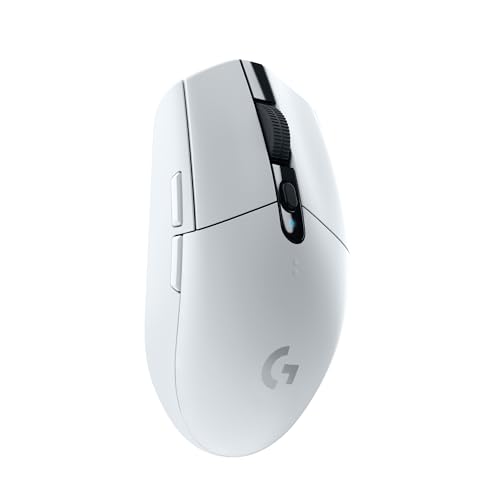
Pros
- 1 ms LIGHTSPEED wireless response
- 12, 000 DPI HERO sensor
- Up to 250 hours from one AA battery
- Compact design with receiver storage
- Light mechanical construction
Cons
- Replaceable battery instead of internal charging
- Limited button count
- Compact shape may not suit large hands
Best for: players building a compact white setup around a simple wireless mouse.
The Logitech G305 Lightspeed White has the same useful foundation as the black G305, with a compact shape that travels easily between a desktop and laptop. Its light mechanical design keeps movements nimble without requiring a cable, and the receiver stores inside the mouse when it is packed away.
The HERO optical sensor reaches 12, 000 DPI, while LIGHTSPEED wireless provides a 1 ms response time. Those specifications place it comfortably in the same practical performance class as the black version. The mouse does not need a complicated setup to feel responsive, which is one reason the G305 family works well for players who move between different genres.
Logitech rates the white model for up to 250 hours of continuous gaming on one AA battery. The supplied details list a 4.6-inch height, 2.4-inch length, and 1.5-inch width, giving a useful sense of its compact footprint. That shape is easy to carry, but it can feel cramped if your hand is large or you prefer a full palm rest.
There is no performance reason to choose this over the G305 Lightspeed Black. The choice is primarily about the finish and the surrounding setup. The Razer Viper V3 HyperSpeed offers a larger body and a longer battery stretch, while the G305 remains easier to carry. Choose the white model when its smaller shape and color fit your desk better.
10. Logitech G305 Lightspeed Blue: Best Colorful Wireless

Pros
- 12, 000 DPI HERO optical sensor
- 1 ms LIGHTSPEED wireless response
- Up to 250 hours of battery life
- Built-in receiver storage
- Compact, portable design
Cons
- Uses one AA battery
- Fewer controls than feature-rich mice
- Listed dimensions and weight differ slightly from the other G305 entries
Best for: players who want the G305 platform in a distinct blue finish.
The Logitech G305 Lightspeed Blue is the same kind of uncomplicated wireless mouse as the black and white G305 entries, but its blue finish gives a setup a little more personality. The compact body is easy to move and easy to pack, and the built-in receiver storage helps keep the small wireless accessory from being lost.
Its HERO sensor reaches 12, 000 DPI and offers 400 IPS precision, while LIGHTSPEED wireless uses a 1 ms report rate. That is enough responsiveness for fast games without forcing the player into a high-maintenance configuration. The classic shape is also suitable for ordinary desktop use, where a predictable sensor matters more than a large collection of macro buttons.
Battery life is rated at up to 250 hours from one AA battery, and Logitech says Endurance mode can extend operation to up to nine months. The supplied product information lists a 4.6-inch by 2.4-inch by 1.5-inch size, while the listed weight is 0.3 lb. It is still a compact mouse, but the data does not match the black and white entries exactly, so buyers should not assume every listing detail is identical.
The G305 Lightspeed Black is the safer default for a neutral setup, and the white version is the cleaner alternative. The blue model earns its place for the same dependable sensor and wireless connection, with the finish as the deciding detail. Skip it if you need 11 buttons or a supported palm shape. Choose it if a small, portable mouse is enough and the blue exterior suits your desk.

How to choose the best gaming mouse
The right mouse depends less on a maximum DPI number than on how its shape, controls, connection, and weight match the games you play.
Shape and grip
Shape determines whether the mouse feels controlled after a long session. Palm-grip players often prefer an ergonomic body with a thumb rest, as found on the Razer Basilisk V3 and G502 family. Fingertip and claw-grip players may prefer the smaller G305 or the streamlined Viper models.
A good fit leaves your fingers resting naturally on the primary buttons without forcing the wrist outward. Large, heavy designs can feel secure, but they require more effort for broad movements. Compact shapes are easier to reposition, though they can crowd larger hands.
Weight and movement
Weight affects how quickly the mouse starts and stops. The 54 g Razer Viper V3 Pro is built for fast flicks, while the 82 g Viper V3 HyperSpeed takes a more balanced approach. The G502 models are much heavier, which can be an advantage when you prefer deliberate movements and a substantial hand feel.
Low weight helps aim only when the shape remains stable in your hand.
Do not choose the lightest model automatically. A mouse that slips, cramps your fingers, or makes the buttons hard to reach will be less controllable than a heavier model with a better fit.
Sensor performance
A sensor should track consistently without unwanted smoothing, acceleration, or filtering. The models here list sensors ranging from the G305's 12, 000 DPI HERO sensor to the Pro X2 Superstrike's 44, 000 DPI HERO 2 sensor. The number is not a direct measure of quality, since most players use a much lower sensitivity.
Look for accurate low-sensitivity movement, reliable tracking during fast swipes, and software that lets you set sensitivity precisely. The Razer Viper V3 Pro supports one-DPI step adjustments, which is useful for players who carefully match settings between games.
Wired and wireless connections
A wired mouse avoids battery management and is simple to keep connected. The G502 Hero and Basilisk V3 are good fits for a fixed desk where the cable can be routed cleanly. Wireless models remove cable drag and are easier to move between systems.
Modern wireless options in this list use dedicated low-latency systems such as LIGHTSPEED or HyperSpeed. Battery design still matters. The G305 and Viper V3 HyperSpeed use one AA battery, while the Pro X2 Superstrike is rechargeable and supports optional POWERPLAY charging.
Buttons and scroll wheel
Six buttons are enough for many shooters, but games with abilities, macros, or inventory commands benefit from more. The G502 Hero, Basilisk V3, G502 X Plus, and G502 Lightspeed each offer 11 programmable buttons.
A scroll wheel can also change how a mouse feels outside games. The G502 and Basilisk models support fast free spinning as well as tactile scrolling. Tilt controls add extra inputs, while the Viper V3 HyperSpeed keeps the layout simpler with an on-mouse DPI button.
Switches and software
Switch design affects click feel, actuation, and long-term durability. Optical switches appear in the Razer Basilisk V3, Viper V3 Pro, and G502 X Plus, while the G502 Hero uses a mechanical tensioning system. The Pro X2 Superstrike adds adjustable actuation and rapid-trigger reset through its haptic system.
Software is part of the buying decision. Logitech G HUB and Razer Synapse handle button mapping, sensitivity, lighting, and advanced features. If you do not want to install software, prioritize a mouse whose default controls already match your games.

Frequently asked questions
Is a wired or wireless gaming mouse better?
Neither connection type is automatically better for every player. Wired models avoid charging and battery replacement, while wireless models eliminate cable drag and make a cleaner desk. The G305, Viper V3 Pro, and G502 X Plus are wireless options with gaming-focused connections.
What DPI should a gaming mouse have?
DPI describes sensitivity, not accuracy by itself. A sensor with a wide range gives you flexibility, but most players use a setting well below the maximum listed by these products. Consistent tracking and a comfortable sensitivity matter more than choosing the largest DPI number.
Is the Logitech G305 good for FPS games?
Yes. The G305 has a 12, 000 DPI HERO sensor, a 1 ms LIGHTSPEED connection, and a 3.4 oz listed weight. Its compact shape and six-button layout are less specialized than the Razer Viper V3 Pro, but they work well for players who want one mouse for shooters and other game types.
Which mouse is best for games with many abilities?
The Logitech G502 Hero, Logitech G502 X Plus, Logitech G502 Lightspeed, and Razer Basilisk V3 each offer 11 programmable buttons. Their larger ergonomic bodies also provide more places to rest the hand. The G502 Hero and Basilisk V3 are wired, while the two G502 wireless models remove the cable.
Does a heavier gaming mouse improve aim?
A heavier mouse can feel more planted and deliberate, but it also takes more effort to move quickly. The G502 models suit players who prefer a substantial hand feel, while the Viper V3 Pro favors fast, broad flicks. Grip, sensitivity, and control matter more than weight alone.
How long does a wireless gaming mouse battery last?
Battery life varies by model and operating mode. The G305 models list up to 250 hours from one AA battery, the Viper V3 HyperSpeed lists up to 280 hours, and the Viper V3 Pro lists up to 95 hours. The Pro X2 Superstrike lists 60 to 90 hours and uses a rechargeable design.
Do RGB lights affect gaming performance?
RGB lighting does not improve sensor accuracy or click response. It can make a setup more personal, but lighting features may affect battery management on wireless mice. The Basilisk V3, G502 X Plus, and G502 Hero offer customizable lighting, while the simpler G305 models focus on core controls.

The bottom line
The Best gaming mouse for most people is the Logitech G305 Lightspeed Black. Its 1 ms wireless connection, 12, 000 DPI HERO sensor, compact 3.4 oz design, and 250-hour AA battery life cover the needs of a wide range of players without making the mouse complicated. The Razer Viper V3 Pro is the better specialist choice for competitive FPS players who want a 54 g body, 8, 000 Hz polling, and optical switches.
Choose the Logitech G502 Hero if you want 11 programmable buttons, adjustable weights, and a wired connection. Choose the Razer Basilisk V3 for a palm-friendly thumb-rest design, or the Razer Viper V3 HyperSpeed when long battery life matters more than the lightest possible body.
If you are undecided, start with the G305 for a balanced wireless design, then move to the Viper V3 Pro or G502 Hero only if your grip and game library point clearly in that direction.
As an Amazon Associate we earn from qualifying purchases.