

A guitar pedal can solve one very specific problem or replace an entire effects board. The hard part is knowing which kind of flexibility you actually need. A single distortion box, a tuner, and a compact multi-effects unit serve completely different players, even when they all sit on the same pedalboard.
Our guide to the Best guitar pedals includes dedicated effects, loopers, tuners, and multi-effects processors. The MOOER GE100 is our top pick for the widest mix of tones, practice tools, and straightforward control, while the rest of the list covers players who want a focused distortion sound, a durable tuner, a reverb specialist, or deeper modeling.
Comparison table
| # | Product | Award | Effects or key feature | Best for |
|---|---|---|---|---|
| 1 | MOOER GE100 | Best overall | 66 effects, 180-second looper | Home practice and broad tone exploration |
| 2 | Zoom G1X Four | Best for practice | 71 effects, 30-second looper, expression pedal | Players who want rhythm backing |
| 3 | BOSS DS-1 | Best classic distortion | Wide tone control, hard-edged attack | Rock and hard-rock rhythm |
| 4 | BOSS DS-1 Bundle | Best ready-to-play package | DS-1 with power supply and cables | New pedalboard owners |
| 5 | BOSS TU-3 | Best tuner | 21-segment meter, tuning mute | Live guitar and bass rigs |
| 6 | BOSS RC-1 | Best simple looper | 12 minutes of recording, stereo operation | Practice and solo performance |
| 7 | Donner Verb Square | Best compact reverb | Seven reverb modes, true bypass | Adding ambience in tight spaces |
| 8 | MOOER GE150 Pro | Best for deep modeling | 170 effects, 55 amp models, USB OTG | Recording and complex live setups |
| 9 | Flatsons KMF-1 | Best for hands-on editing | 77 effects, 18 amp models, 30-second looper | Experimenting with modeled sounds |
1. MOOER GE100: Best Overall

Pros
- 66 effect types across eight modules
- 180-second looper and built-in drum machine
- 80 preset patches plus 80 user patches
- Assignable expression pedal controls
Cons
- Smaller feature set than the GE150 Pro
- Interface takes time to learn
- Not a dedicated single-effect pedal
Best for: guitarists who want one pedal for practice, sound creation, and basic performance work.
The MOOER GE100 is the pedal we would hand to a guitarist who has not yet settled on one sound. It gives you a broad playground without forcing you to assemble a chain of separate boxes. The controls are approachable enough for casual practice, but the 80 user patches mean you can keep experimenting instead of overwriting the factory sounds you want to revisit.
Its 66 effect types are arranged across eight effect modules, so the GE100 can cover the usual combinations of drive, modulation, delay, and reverb. That number matters less than the way the modules are organized. You can build a complete signal path, save it, and call it back later with a press of the Save button. The six assignable expression pedal parameters also make the pedal more interactive than a row of fixed knobs.
The practice features are a major reason it takes the top position. The built-in looper records for 180 seconds, and the drum machine supplies rhythm patterns for playing against a steady pulse. A scale and chord learning function adds something the Zoom G1X Four does not emphasize in the same way. The GE100 can also run in line out mode, which helps when you are playing without a traditional amplifier.
The compromise is that it is less deep than the MOOER GE150 Pro, which offers 200 presets, 55 amp models, cabinet simulations, and USB OTG recording. The GE100 is also not as immediate as the BOSS DS-1 if all you want is one familiar distortion sound. Its display and menu structure reward patience, and players who dislike editing patches may prefer a dedicated stompbox. For a first multi-effects unit or a compact practice center, though, this is the most balanced choice.
2. Zoom G1X Four: Best for Practice

Pros
- 71 built-in effects and 13 amp models
- 68 rhythm patterns
- 30-second looper
- Expression pedal included
- Headphone and auxiliary connections
Cons
- Looper is much shorter than the GE100's
- Less extensive modeling than the GE150 Pro
- More oriented toward presets than a single analog effect
Best for: players who want a practice pedal with rhythms, looping, and silent monitoring.
The Zoom G1X Four feels designed around the moment when you pick up a guitar and want something to play along with immediately. Its 68 rhythm patterns turn an isolated practice session into a more musical one, and the 30-second looper is enough for short chord progressions, repeated riffs, and simple improvisation. The included expression pedal gives it a physical control that many small multi-effects units leave out.
There are 71 effects and 13 amp models to explore, covering clean, distorted, ambient, and heavily processed sounds. The G1X Four is not trying to compete with the GE150 Pro's 55 amp models or its cabinet and impulse response options. Instead, it keeps the focus on accessible combinations that work through an amplifier, headphones, or a recording setup.
The auxiliary input is useful when you want to play along with music from another device, while the headphone connection supports quiet practice. Zoom's Guitar Lab software for Mac and Windows lets you edit patches, build tones, and expand the way you organize your sounds. That gives the pedal a useful path from casual practice to more deliberate tone building.
The shorter looper is the most obvious limitation beside the MOOER GE100, and the 13 amp models are not the right fit for someone planning a detailed modeled rig. The BOSS RC-1 is the more focused choice for straightforward looping, while the G1X Four wins when rhythms and an expression pedal matter just as much as the loop. Choose it if practice is the center of your setup, not if you want one signature distortion box.
For players comparing different ways to build a flexible effects setup, the G1X Four is a useful middle ground. It offers plenty to investigate without turning every session into a programming project.
3. BOSS DS-1: Best Classic Distortion

Pros
- Hard-edged attack stays clear at high distortion
- Smooth sustain for leads
- Wide-ranging tone control
- Works as a booster at lower distortion
- Five-year BOSS warranty
Cons
- Covers distortion rather than multiple effect types
- Takes up a dedicated pedal position
- Less useful for players seeking ambient or modulation sounds
Best for: guitarists who want a recognizable distortion voice with simple footswitch control.
The BOSS DS-1 is the simplest recommendation here because it knows exactly what it is. It is a compact distortion pedal with a direct control layout and a sound that has been part of guitar rigs since 1978. Turn it on and you get a firm, bright attack with sustain that works particularly well for rock rhythms and cutting leads.
The tone control is more useful than its basic appearance suggests. It can move the sound toward sharper, tighter highs or warmer lows, while the distortion control takes the pedal from restrained edge to a much more aggressive voice. The DS-1 also preserves the character of different guitars and pickups rather than flattening every instrument into the same texture.
At lower distortion settings, it can act as a booster, giving a clean or already driven amplifier more push. Rolling back the guitar's volume also cleans up the sound without the muddy transition that can make some distortion pedals difficult to control from the instrument. That responsiveness is a strong reason to choose it over a multi-effects preset when your hands and guitar controls are part of your sound.
The limitation is obvious: the DS-1 does distortion, and it does not replace the range of the MOOER GE100 or the practice tools in the Zoom G1X Four. It is also less immediately useful than the bundled version if you need cables and a power supply for a new setup. Players who want a dependable, focused rock sound should choose this one. Players who are still searching for their effects vocabulary should start with a multi-effects unit instead.
A broader look at how dedicated effects change a guitar signal can help if you are deciding between a single stompbox and a more configurable processor.
4. BOSS DS-1 Bundle: Best Ready-to-Play Package
Pros
- Familiar DS-1 distortion circuit
- Power supply included
- Instrument and patch cables included
- Rugged all-metal pedal chassis
- Battery operation remains available
Cons
- Same core distortion limits as the standard DS-1
- Included accessories are basic
- Bundle is less useful if you already own cables
Best for: a new player who wants to connect a classic distortion pedal without assembling accessories separately.
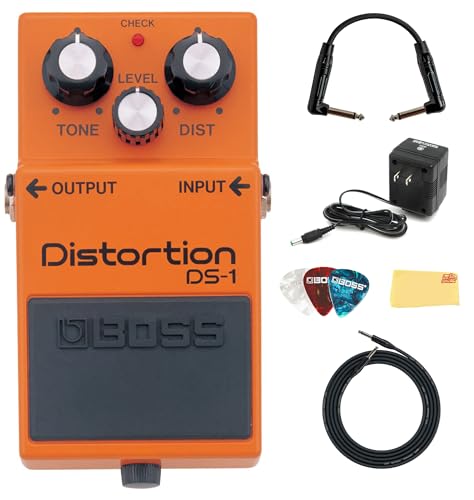
The BOSS DS-1 Bundle is the same basic distortion idea as the standard DS-1, but it removes a practical obstacle for someone starting a pedalboard. The package includes a power supply, an instrument cable, a patch cable, picks, and a polishing cloth. That makes it easier to get from opening the box to placing the pedal between a guitar and amplifier.
The pedal itself retains the DS-1's bright, cutting distortion, tight low end, and smooth sustain. Its tone control lets you move between a sharper rhythm sound and a fuller lead setting, while the compact all-metal chassis is built for regular foot use. It can run from a 9V alkaline battery or an external supply, though the included adapter makes powered operation the natural starting point.
This version makes more sense than the standalone BOSS DS-1 when the rest of the rig is still taking shape. It does not sound different, and it does not provide more effects. The advantage is simply that the essential connection pieces arrive together. The MOOER GE100 remains a better single-box option for someone who wants reverb, delay, looping, and rhythm patterns in one unit.
The weakness is that accessories lose their usefulness once you have a stocked pedalboard. The included cables and picks are functional additions, not a reason for an experienced player to replace an existing setup. Choose the bundle for a first distortion pedal or a straightforward gift. Choose the standard DS-1 if you already have reliable power and cables.
5. BOSS TU-3: Best Tuner

Pros
- 21-segment LED meter
- Accurate to plus or minus one cent
- Automatic signal muting
- Supports guitar and bass modes
- Can supply power to up to seven BOSS pedals
Cons
- Provides tuning rather than sound effects
- Larger than some mini tuners
- More functionality than a casual player may need
Best for: guitarists and bassists who need clear, quiet tuning on stage.
The BOSS TU-3 is the practical anchor of a pedalboard. It does not add distortion or atmosphere, but it solves the problem that can undermine every other pedal: an instrument that is not in tune. Pressing the tuner mutes the signal automatically, so tuning on stage does not send a burst of noise through the amplifier.
Its 21-segment LED meter is easy to read, and the high-brightness mode is designed for situations where glare can wash out a small display. The tuner is accurate to plus or minus one cent, and the Accu-Pitch Sign function gives a visual confirmation when the string reaches pitch. Those details make the difference when a player needs to make a quick adjustment without second-guessing the display.
The TU-3 supports chromatic operation as well as guitar and bass modes. It can handle seven-string guitars and six-string basses, and Guitar Flat mode supports drop tunings up to six semitones below standard pitch. It can also supply power for up to seven BOSS compact effects, which gives it a useful role in a larger board rather than leaving it as a tuner that occupies one isolated spot.
The trade-off is that this is a dedicated utility pedal. The BOSS RC-1 adds creative control, while the Donner Verb Square changes the feel of a sound. The TU-3 does neither, and its sturdy enclosure takes more room than a tiny tuner. If reliable muting, clear visibility, and flexible tuning modes matter, it is the right specialist choice. If you only need a tuner for home practice, its stage-focused features may be more than necessary.
Before choosing a tuner, consider what makes a tuner easy to read during a performance, especially if your board will be used under bright lights.
6. BOSS RC-1: Best Simple Looper

Pros
- Record, play back, and overdub loops
- Undo and redo functions
- 12 minutes of recording time
- Stereo looping
- Clear 24-segment LED indicator
Cons
- Focused on looping rather than full effects
- One main footswitch requires careful timing
- Rhythm patterns are not included
Best for: guitarists who want to build layered parts without learning a complicated looper.
The BOSS RC-1 is a good example of a pedal that benefits from refusing to do too much. Its purpose is clear: record a phrase, play it back, add an overdub, and undo or redo when the layer is not right. The stompbox operation keeps the process familiar, which matters when your attention is on a performance rather than a screen.
It provides 12 minutes of recording time, far beyond what is needed for most practice loops. The 24-segment LED indicator shows where you are in the loop, helping with timing and making the pedal easier to follow than a box with only a small status light. Stereo looping also allows it to fit into a more involved signal path.
Compared with the MOOER GE100, the RC-1 gives up drum patterns, multiple effects, and an expression pedal. In exchange, it makes looping the center of the experience. The G1X Four includes a shorter 30-second looper and 68 rhythm patterns, so it is the better choice if you want your backing material and effects in one unit.
The RC-1's weakness is the same as its strength. There are no modeled amps, reverb modes, or rhythm patterns to distract from the timing of your loop. A player seeking a complete practice station should choose the GE100 or Zoom instead. A guitarist who wants to layer chords, practice solos, or build a simple live arrangement will find the RC-1 easier to understand and easier to trust.
7. Donner Verb Square: Best Compact Reverb

Pros
- Seven reverb modes
- True bypass design
- Aluminum alloy enclosure
- Mini pedal format
- LED status indicator
Cons
- Power supply is not included
- Reverb only, with no looping or other effects
- Small enclosure can be cramped to adjust
Best for: players who want several ambience styles from a pedalboard-friendly reverb.
The Donner Verb Square is for the guitarist who knows the board needs more space around the notes. It provides seven reverb modes, including Room, Hall, Church, Spring, Plate, Studio, and Mod. That range covers short ambience, larger spaces, spring-like character, and more animated textures without requiring a multi-effects processor.
Its digital circuit uses true bypass, so the pedal is designed to keep the dry signal transparent when switched off. The enclosure is made from aluminum alloy, and the mini format makes it easy to fit beside larger pedals such as the BOSS DS-1. A small LED shows when it is active, which is useful when the pedal is placed among several footswitches.
The Verb Square is much narrower than the GE100 or GE150 Pro, but that is exactly why it can make sense. You are not browsing dozens of amp models or building a complete patch. You are choosing an atmosphere and shaping the guitar's sense of space. It also gives a dedicated reverb a place on a board that already has a tuner, distortion, and looper.
The main omission is the power supply, which is not included, and the pedal runs on DC 9V. The mini enclosure may also feel tight for players who want very fine control over multiple parameters. Skip it if you need an all-in-one processor. Pick it if the rest of your rig already works and you want seven distinct reverb directions in a small footprint.
8. MOOER GE150 Pro: Best for Deep Modeling
Pros
- 200 factory preset tones
- 55 amp models and 26 cabinet simulations
- 20 amp and 20 cabinet sample slots
- Four multi-purpose footswitches
- USB OTG recording and stereo outputs
Cons
- Larger and heavier than the GE100
- Deep feature set takes time to configure
- More capability than a simple stompbox user needs
Best for: guitarists who need modeled rigs, recording connections, and more live control.
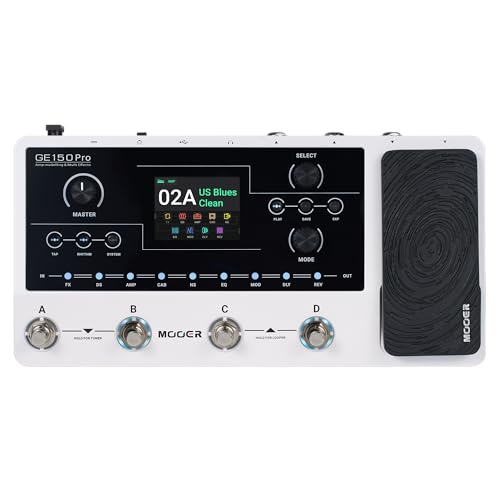
The MOOER GE150 Pro is the serious multi-effects workstation in this group. It is built for players who want to construct complete signal chains rather than add one effect at a time. The 200 factory presets give you a starting library, while the four footswitches make it possible to browse patches and trigger functions without stopping to reach for the controls.
The modeling depth is the headline. There are 55 amp preamps, 26 cabinet simulations, and 20 slots for amp samples plus 20 cabinet slots. MNRS support gives the processor a way to work with MOOER's sample files, while the amp and cab modules can be shaped as part of a larger modeled rig. That makes it far more suitable for direct recording or amplifier-free setups than the DS-1 or Donner pedal.
It also has the connections and practice features to support that ambition. The USB-C interface handles computer editing, data management, and firmware updates, while OTG connectivity supports recording and playback with a phone. Stereo quarter-inch outputs, an auxiliary input, and a headphone output cover the main routing needs. An 80-second stereo looper, 40 drum rhythms, and 10 metronome modes add useful practice tools.
The GE150 Pro is not the obvious choice for someone who wants to step on a pedal and hear one effect. It is larger than the GE100 and weighs about 2.4 pounds, so it asks for more board space and more setup attention. The Flatsons KMF-1 offers a similar modeling concept with 77 effects, but the GE150 Pro goes further with its amp count, cabinet options, footswitch control, and recording connections. Choose this one when your rig is moving toward direct recording, complex patches, or live preset changes.
9. Flatsons KMF-1: Best for Hands-On Editing

Pros
- 77 effects across eight modules
- 18 amp models and 18 cabinet simulators
- 50 preset patches
- 30-second looper and 42 drum rhythms
- Expression pedal with six assignable effects
Cons
- Short battery runtime of up to 2.5 hours
- Heavier than a compact single-effect pedal
- Less established ecosystem than BOSS or Zoom
Best for: players who want modeled sounds, editing modes, and practice tools in one pedal.
The Flatsons KMF-1 takes a hands-on approach to multi-effects. Its Stomp Mode uses five independent effect blocks that can be enabled and sequenced, so it behaves more like a row of individual pedals than a fixed preset machine. Edit Mode then lets you adjust the parameters inside those effects, which is useful for players who want to understand how a sound is assembled.
There are 77 effects across amplifier, cabinet, drive, modulation, delay, dynamics, reverb, and filter modules. The KMF-1 also includes 18 amp models and 18 cabinet simulators, giving it a meaningful direct-playing and headphone-practice role. Its 128 by 32 LCD displays real-time feedback, while the controls and customizable expression pedal make parameter changes less abstract than they can be on a basic multi-effects unit.
The practice features are well chosen. There are 50 preset patches, a 30-second looper, 42 drum rhythms, a built-in tuner, and an auxiliary input for playing along with a phone. The expression pedal supports six assignable effects. For an outdoor session, the battery compartment accepts six AA batteries and provides up to 2.5 hours of use, though that runtime is a clear reason to plan around external power for longer sessions.
The KMF-1 is not as deep as the MOOER GE150 Pro, and the Zoom G1X Four has a more established practice-oriented layout with 68 rhythm patterns. It is also heavier at about 2.56 pounds. When using headphones, studio monitors, or powered speakers without a real cabinet, the cab module should be enabled. With a real cabinet or amplifier, it should be disabled to avoid double cabinet simulation. Choose this pedal if editing and experimentation matter more than a minimal interface.

How to choose best guitar pedals
The right pedal depends on whether you want one distinctive effect, a complete modeled rig, or a tool that makes practice more musical.
Effect type
Start by deciding what problem the pedal must solve. A distortion pedal changes the character and gain of the guitar signal, a reverb pedal adds a sense of space, a tuner keeps the instrument in tune, and a looper records phrases for repetition. A multi-effects pedal combines several of these jobs but usually asks you to spend more time navigating presets and modules.
Dedicated pedals are easier to understand at a glance. Multi-effects units make more sense when you want to explore several sounds or avoid filling a board with separate boxes.
Modeling and cabinet simulation
Amp models and cabinet simulations matter most when the pedal will feed headphones, powered speakers, an audio interface, or a recording device directly. The GE150 Pro has 55 amp models, 26 cabinet simulations, and dedicated sample slots, while the KMF-1 has 18 amp models and 18 cabinet simulators. Those capabilities are less important when you always run into a traditional guitar amplifier.
Do not enable cabinet simulation automatically. It belongs in a direct setup, but using it alongside a real cabinet or amplifier can create an unnatural layered sound.
A multi-effects pedal is only useful if you can reach the sound you need before the song moves on.
Looping and rhythm tools
Looper length affects how much musical structure you can build. The GE100 records for 180 seconds, the GE150 Pro offers an 80-second stereo looper, and both the Zoom G1X Four and Flatsons KMF-1 provide 30 seconds. The BOSS RC-1 has 12 minutes of recording time and is the specialist choice for extended phrases.
Rhythm patterns matter just as much for practice. The Zoom includes 68 patterns, the GE150 Pro has 40 drum rhythms and 10 metronome modes, and the KMF-1 has 42 drum rhythms. If you prefer playing against a pulse rather than repeating a chord manually, these features should guide your choice.
Controls and footswitches
A pedal with direct knobs is quick to adjust, while a processor with menus and assignable controls can create more complex sounds. Expression pedals allow volume or effect changes with your foot. The GE100 has six assignable expression parameters, the GE150 Pro supports parameter and volume control, and the KMF-1 also offers six assignable effects.
Four footswitches on the GE150 Pro provide more control during patch changes and looping. A single-switch pedal such as the RC-1 keeps the action simple but requires accurate timing.
Power and connections
Check the power arrangement before building a board. The Donner Verb Square requires DC 9V power and does not include a supply. The BOSS DS-1 can use a 9V alkaline battery or external power, while its bundle includes an adapter. The Flatsons KMF-1 accepts six AA batteries and offers up to 2.5 hours of use.
Headphone, auxiliary, USB, and stereo connections become important when practicing silently or recording. The Zoom has headphone and auxiliary connections, while the GE150 Pro adds USB-C, OTG recording, stereo outputs, auxiliary input, and headphone output.
Frequently asked questions
Should a beginner choose a multi-effects pedal or a single effect?
A multi-effects pedal is useful when you are still learning which sounds you enjoy because it exposes you to several effect types. The MOOER GE100 and Zoom G1X Four are easier starting points for exploring distortion, delay, modulation, reverb, and practice tools. A single pedal such as the BOSS DS-1 is better when you already know you want one focused distortion sound.
Is the BOSS DS-1 good for heavy rock?
The DS-1 has a hard-edged attack, smooth sustain, and a tone control with a broad range. It can produce cutting rhythm sounds and expressive lead tones, and it works as a booster at lower distortion settings. Players wanting several amp and cabinet styles should look at the GE150 Pro instead.
Which pedal is best for silent guitar practice?
The Zoom G1X Four supports headphone monitoring and an auxiliary input, so you can play along with external audio without relying on an amplifier. Its 68 rhythm patterns and 30-second looper also make practice more active. The GE100 and GE150 Pro offer similar practice-oriented features, with different levels of modeling depth.
Do I need a separate tuner if I have a multi-effects pedal?
Not necessarily. The GE150 Pro, Flatsons KMF-1, and other multi-effects units in this list include tuning functions. A dedicated BOSS TU-3 is still useful if you want a highly visible 21-segment meter, automatic signal muting, guitar and bass modes, and a tuner that can help power other BOSS compact pedals.
What is the difference between a looper and a multi-effects pedal?
A looper records and repeats your playing so you can layer parts. A multi-effects pedal combines several processing types and may include a shorter looper as one feature. The BOSS RC-1 is the focused looping choice, while the MOOER GE100 and Zoom G1X Four combine looping with tones and practice functions.
Does reverb belong before or after distortion?
The position changes the result. Reverb after distortion usually keeps the distorted note more defined while placing the ambience around it, whereas reverb before distortion can make the entire texture more heavily processed. The Donner Verb Square is useful when you want to experiment with Room, Hall, Church, Spring, Plate, Studio, and Mod settings.

The bottom line
The MOOER GE100 is our leading recommendation among the Best guitar pedals because it combines 66 effects, 80 user patches, a 180-second looper, drum patterns, and an expression pedal without becoming a specialist-only device. The Zoom G1X Four is the better practice companion if rhythm patterns, headphones, and an included expression pedal are the features you will use most.
For a focused rig, choose the BOSS DS-1 for classic distortion, the BOSS TU-3 for dependable stage tuning, the BOSS RC-1 for uncomplicated looping, or the Donner Verb Square for compact reverb. The MOOER GE150 Pro belongs with players who want deeper amp modeling and recording connections, while the Flatsons KMF-1 favors hands-on editing.
If you are undecided, choose the GE100 for breadth, or choose the DS-1 if one strong distortion sound is all you need.
As an Amazon Associate we earn from qualifying purchases.