

A pick that flexes too much can make precise playing feel vague, while one that is too stiff can make strumming tiring. The shape, material, surface and gauge all change the way a guitar responds under your hand.
Our Best guitar picks range from thin celluloid options for light rhythm to thick nylon designs for controlled lead work. We included variety packs for finding your preferred thickness, along with dependable single-gauge packs for players who already know what they like.
The Dunlop Tortex Standard .73mm is the single best pick here for most players, while the Fender Premium Picks Sampler is the better starting point if you are still figuring out your preferred gauge.
Comparison table
| # | Product | Award | Gauge or range | Material | Best for |
|---|---|---|---|---|---|
| 1 | Fender Premium Picks Sampler | Best overall variety pack | .46mm.71mm.97mm | Celluloid | Trying thin, medium and heavy picks |
| 2 | Dunlop Tortex Variety Mix | Best gauge range | .50mm to 1.14mm | Tortex | Comparing six thicknesses |
| 3 | Fender Pearl Celluloid Red Moto | Best classic medium pick | .71mm | Pearl celluloid | Familiar all-purpose playing |
| 4 | Fender Premium 24 Pack Sampler | Best large sampler | .46mm.71mm.97mm | Celluloid | Keeping multiple gauges on hand |
| 5 | Fender Pearl Celluloid Ocean Turquoise | Best medium pick with warranty | .71mm | Celluloid | Acoustic, electric and bass |
| 6 | Tortex Standard Variety Pack | Best grippy sampler | Variety pack | Tortex | Bright attack and secure handling |
| 7 | ROTOPATA Variety Pack | Best organized assortment | .5mm.75mm, 1.0mm | Celluloid | Beginners and pick storage |
| 8 | Dunlop Max-Grip Nylon .60mm | Best non-slip nylon pick | .60mm | Nylon | Players who lose picks in hand |
| 9 | Dan's Precision Pick | Best precision shape | 1.5mm body | Nylon | Technical playing and firm control |
| 10 | Dunlop Tortex Standard .73mm | Best single-gauge pick | .73mm | Tortex | Riffs, chords and everyday playing |
1. Fender Premium Picks Sampler: Best Overall Variety Pack

Pros
- Covers thin, medium and heavy gauges
- Familiar 351 shape suits many playing styles
- Celluloid gives a warm, rounded character
- Includes options for rhythm, lead and bass work
Cons
- Only 12 picks total
- Players who already know their preferred gauge may not need the assortment
- The smooth celluloid surface is less specialized than textured designs
Best for: guitarists who want to compare three useful gauges before settling on one.
The appeal of the Fender Premium Picks Sampler is simple: it removes the guesswork from thickness. The pack includes four thin .46mm picks, four medium .71mm picks and four heavy .97mm picks, giving a new player a practical way to feel how flexibility changes the attack. It is also useful for an experienced guitarist moving between acoustic strumming, electric rhythm and lead playing.
All three gauges use Fender's 351 shape, with a wider body and rounded tip. That shape gives you more material to hold than a small jazz-style pick, while the rounded tip stays comfortable during longer chord sessions. The thin option is aimed at light strumming and acoustic rhythm. The medium gauge sits in the middle for general use, and the heavy option gives lead lines and bass notes a firmer response.
The celluloid construction is the other reason this sampler works so well as a starting point. Fender describes it as offering warm, round tone, smooth string release and reduced pick noise. Compared with the brighter, snappier sound associated with the Tortex packs below, these picks are the calmer choice when you want a traditional feel and less edge in the attack.
The weakness is that none of the surfaces is designed around maximum grip. Players who routinely rotate picks or drop them during energetic playing should look at the Dunlop Max-Grip Nylon .60mm or the Tortex Standard Variety Pack instead. The sampler is also less useful once you have settled on a thickness, but for the player still learning what feels natural, it is the most useful first purchase in this group.
2. Dunlop Tortex Variety Mix: Best Gauge Range

Pros
- Six distinct gauges from .50mm to 1.14mm
- Two picks of each gauge
- Matte Tortex surface helps with grip
- Good introduction to a widely used pick shape
Cons
- Does not provide a large supply of any one gauge
- Tortex attack is brighter than celluloid
- Standard shape may feel large to jazz-pick users
Best for: players who want the widest useful gauge comparison in one 12-pick pack.
The Dunlop Tortex Variety Mix takes a more methodical approach to finding a pick. Instead of three broad choices, it supplies two each of .50mm.60mm.73mm.88mm, 1.00mm and 1.14mm. Those closer steps make it easier to tell whether your ideal feel is just above or below a familiar medium gauge.
That range matters because a small change in thickness can alter both resistance and control. The .50mm and .60mm options suit lighter rhythm work, while the .73mm and .88mm choices move toward a more balanced mix of flexibility and firmness. The 1.00mm and 1.14mm picks are better suited to players who prefer a rigid pick for articulate single-note work. The pack is designed for experimentation and practice, so it makes sense for a beginner who wants to compare rather than guess.
Tortex has a matte, grip-enhancing surface and a bright, snappy attack. That makes it a clear contrast to the Fender sampler's warm celluloid character. The standard shape uses a narrow yet rounded tip, which aims to balance fullness with articulation. Dunlop also emphasizes durability, so these are a better fit for players who are hard on picks than a very thin, soft option.
The trade-off is commitment to the Tortex sound and surface. If you prefer the smoother release and rounder character of celluloid, Fender's options will be more natural. If you want to understand how pick thickness affects your playing while keeping the same basic material and shape, this is the more informative sampler.
3. Fender Pearl Celluloid Red Moto: Best Classic Medium Pick

Pros
- Versatile .71mm medium gauge
- Traditional 351 shape
- Warm, round celluloid tone
- Works with acoustic, electric and bass guitar
- Twelve-pick pack
Cons
- No gauge options in the pack
- Smooth surface may not suit players needing extra grip
- Celluloid feels less bright than Tortex
Best for: players who already know they prefer a traditional medium 351 pick.
The Fender Pearl Celluloid Red Moto is the straightforward choice for a guitarist who wants the familiar Fender 351 experience without a sampler. Its .71mm medium gauge sits in the useful middle ground: flexible enough for strumming, but substantial enough for individual notes and basic lead work.
The 351 shape is wider than a compact precision pick and has a rounded tip. That gives it an easy, conventional hand position, particularly for players who learned on standard guitar picks. Fender positions it for acoustic, electric and bass guitar, so the design is not tied to one instrument or one playing technique.
The pearl celluloid material brings a smooth striking surface and the warm, round tone associated with traditional celluloid. That can make chord work feel less sharp at the initial contact than the Tortex Standard .73mm. The difference is not simply a matter of thickness. The materials and surface treatments produce a different interaction with the strings, and some players will prefer the quieter, smoother release of this Fender.
The limitation is fixed by the product itself: every pick is medium gauge. Players who are still comparing thin and heavy picks should choose the Fender Premium Picks Sampler instead. Players who want a more secure hold should consider the Max-Grip Nylon. For everyone else, this is an uncomplicated pack of familiar, versatile picks, with the distinctive Red Moto finish making them easier to spot in a case.
4. Fender Premium 24 Pack Sampler: Best Large Sampler

Pros
- Includes thin, medium and heavy gauges
- Twenty-four picks for practice and backup use
- Consistent 351 shape across the assortment
- Warm celluloid sound
Cons
- Larger pack is unnecessary for players seeking one gauge
- Smooth material offers no dedicated grip texture
- Gauge distribution is not specified in the listing
Best for: households, teachers or players who want a substantial supply of three Fender gauges.
The Fender Premium 24 Pack Sampler has the same core idea as the 12-pack sampler, but it makes more sense when several players need picks or when you want extras in multiple cases. It includes thin .46mm, medium .71mm and heavy .97mm gauges, all in Fender's familiar 351 shape.
The three thicknesses cover distinct jobs. Fender describes the thin picks for light strumming and acoustic rhythm, the medium picks for versatile playing, and the heavy picks for precise lead work, articulate picking and firm bass response. Keeping the same shape across those gauges makes the comparison more useful because you are changing flexibility without also changing the basic grip area and tip profile.
The celluloid construction gives the whole assortment a consistent material character. Its warm, rounded response and smooth string release differ from the snappy Tortex sound, while the wide 351 body remains comfortable for players who do not want a small precision pick. If you are working out what suits an acoustic guitar, the lighter picks are an easy place to start, while electric players may gravitate toward the medium or heavy choices.
The main drawback is that the listing does not specify how the 24 picks are divided among the three gauges. That makes the smaller Fender sampler easier to assess if you want a clearly defined trial set. The 24-pack is the better fit for keeping spares around, but the Dunlop Tortex Variety Mix offers more distinct thickness steps for a more controlled comparison.
5. Fender Pearl Celluloid Ocean Turquoise: Best Medium Pick With Warranty

Pros
- Medium .71mm gauge for broad use
- Traditional 351 shape
- Smooth, warm celluloid response
- Suitable for acoustic, electric and bass guitar
- One-year limited warranty
Cons
- Only one gauge is included
- Smooth surface may not provide enough grip for some players
- Medium thickness may not suit heavy lead or very light strumming
Best for: players who want a dependable medium Fender pick with a one-year limited warranty.
The Fender Pearl Celluloid Ocean Turquoise is functionally very close to the Red Moto pack, and that is a strength rather than a flaw. It gives you twelve medium .71mm picks in Fender's standard 351 profile, so the experience is familiar, predictable and easy to use across acoustic and electric guitar.
Medium gauge is a sensible default because it avoids the extremes. It has more resistance than a thin pick when you attack single notes, but it still flexes enough for chord strumming. Fender describes this gauge as combining some of the warmth of a heavy pick with some of the flexibility of a thin pick, which captures its role in the range.
The celluloid material produces a smooth striking surface and warm, round musical tone. That makes this a natural alternative to the Jim Dunlop Max-Grip Nylon .60mm, which prioritizes a molded non-slip surface, and to the Tortex .73mm, which has a brighter attack. The Ocean Turquoise finish is also a practical detail for anyone who tends to misplace picks among darker gear.
A one-year limited warranty is listed for this Fender accessory, though it does not change the fundamental limitation: this is a fixed medium-gauge pack. Beginners should use a sampler if they do not know what thickness they prefer. Experienced players who want a classic 351 medium pick, consistent celluloid feel and a little extra product support will find this the more appealing of Fender's two single-gauge packs.
6. Tortex Standard Variety Pack: Best Grippy Sampler

Pros
- Grip-enhancing matte surface
- Bright, snappy attack
- Durable Tortex construction
- Standard shape balances fullness and articulation
- Useful for comparing Tortex picks
Cons
- The exact gauge mix is not specified in the listing
- Brighter attack is not ideal for every player
- Standard shape is not as compact as a precision pick
Best for: players who want Tortex grip and attack while exploring the available variety pack.
The Tortex Standard Variety Pack is the pick to consider when the surface matters as much as the gauge. Its matte finish is designed to improve grip, and the material has a distinctive bright, snappy attack. That combination gives it a more purposeful feel than a smooth celluloid pick, especially for players who play quickly or hold the pick lightly.
Dunlop describes the standard shape as having a narrow yet rounded tip. The result is intended to balance fullness and articulation, so the pick can handle riffs and chords without feeling as blunt as a wide rounded profile. Tortex is also described as durable under heavy playing conditions, which makes this assortment a sensible way to try the material before committing to one thickness.
The listing calls this a 12-pack variety set, but it does not spell out the gauge breakdown. That is the key difference from the Dunlop Tortex Variety Mix, which clearly identifies two picks each in six gauges from .50mm to 1.14mm. Choose this set when the Tortex material, matte surface and established shape are your priorities. Choose the mix pack when precise thickness comparison matters more.
Tortex has been made in the United States since 1981, according to the product information, and the construction is positioned as a long-running standard rather than a novelty. It will not suit someone who wants a warm, soft celluloid response, and players who prefer a very small pick should look toward the Dan's Precision Pick. For a secure standard-shaped pick with a crisp attack, this is the Tortex sampler to keep in mind.
If pick texture is only one part of a larger setup, the right choice also depends on the strings and electronics you use. Players exploring a fuller electric rig may want to consider how different effects shape your guitar's response after settling on a pick.
7. ROTOPATA Variety Pack: Best Organized Assortment

Pros
- Fifteen assorted picks
- Three thicknesses from .5mm to 1.0mm
- Celluloid construction
- Works with guitar, bass and ukulele
- Includes a clear organizer box
Cons
- Exact distribution by thickness is not specified
- Designs and colors vary
- Less established pick profile than Fender or Dunlop
Best for: beginners who want several thicknesses and a simple way to keep them together.
The ROTOPATA Variety Pack is built around convenience. It includes fifteen assorted celluloid picks in three thicknesses, plus a clear plastic organizer box. That box is a small but useful addition because guitar picks tend to disappear into gig bags, sofa cushions and the bottom of cases.
The thicknesses are clearly separated into thin .5mm, medium .75mm and heavy 1.0mm options. Those steps are broad enough for a beginner to feel the basic difference between flexible rhythm picks and firmer lead-oriented picks. ROTOPATA also lists the picks for acoustic guitar, electric guitar, bass and ukulele, so the assortment is not limited to one playing context.
Celluloid keeps the feel in the same broad family as Fender's Pearl Celluloid picks. It is described as lightweight and durable, with different thicknesses intended to produce different tone colors. The assorted colors and designs can make it easier to identify which pick you are holding, although the changing appearance will appeal more to casual players than to someone seeking a uniform set.
The weakness is consistency of information. The listing gives the three thicknesses and total count, but not the number of picks in each gauge. Players who want a carefully defined trial will get clearer guidance from the Dunlop Tortex Mix or Fender's 12-pack sampler. For a first box of picks that can stay organized and cover the basic thickness range, ROTOPATA is a practical choice.
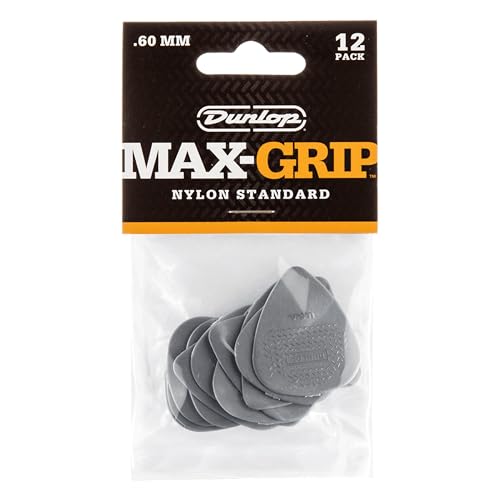
8. Dunlop Max-Grip Nylon .60mm: Best Non-Slip Nylon Pick
Pros
- Molded Max-Grip texture across the gripping surface
- Durable nylon material
- Light but usable .60mm gauge
- Twelve-pick pack
- Available in several other gauges within the line
Cons
- This pack includes only .60mm picks
- Nylon feel differs from celluloid and Tortex
- Light gauge may flex too much for some lead players
Best for: players who need a textured surface to keep a light pick from slipping.
The Dunlop Max-Grip Nylon .60mm solves a specific problem: keeping the pick in position. Its Max-Grip technology is molded into the entire gripping surface rather than added as a small printed mark, giving the player a more deliberate contact point than the smooth Fender designs.
At .60mm, this is a relatively light pick. That makes it a natural fit for strumming and players who like some flex under the fingers. It will feel less rigid than the .73mm Tortex Standard and substantially more forgiving than the 1.5mm Dan's Precision Pick. The nylon material is durable, and Dunlop lists the Max-Grip range in .60mm.73mm.88mm, 1.0mm, 1.14mm and 1.5mm gauges, although this particular pack is the .60mm model.
The texture changes the character of the pick in your hand. A secure hold can help when a smooth pick becomes difficult to control, but the surface may feel more noticeable than the quiet release of celluloid. The light gauge also means that players who rely on firm, sharply defined lead picking may prefer a heavier Max-Grip option or the Precision Pick.
This is not the universal pick in the roundup, but it is the most direct answer to slipping. It is a better choice than the Fender Pearl Celluloid packs for sweaty hands or forceful strumming, while the Tortex varieties remain more attractive if you want a bright attack and a less pronounced grip texture. Pickers who already favor .60mm and want a reliable hold should start here.
9. Dan's Precision Pick: Best Precision Shape

Pros
- Thick 1.5mm nylon body
- Double-beveled edges
- Dagger tip for precise strikes
- Fingerprint-sensitive abrasive grip pattern
- High-visibility color
Cons
- Specialized shape takes adjustment
- Too thick for players who prefer flexible strumming picks
- Medium-small size offers less body than a standard 351
Best for: technical players who want a thick, highly grippy pick with a sharp point.
The Dan's Precision Pick is the most specialized design here. Rather than copying the broad, rounded 351 profile, it uses a medium-small body, a 1.5mm nylon construction and a dagger tip. The result is aimed at players who care about exact contact with the string more than broad strumming comfort.
The double-beveled edge is designed to sharpen the angle of attack and help the pick glide. A defined tip can make individual notes feel more deliberate, while the thick body resists the flex found in the .60mm Dunlop or .71mm Fender options. Dan's also says the added strength and mass can produce more sound with less effort, though the most important practical difference is the firm, controlled hand position.
Grip is a major part of the design. The fingerprint-sensitive abrasive pattern is intended to keep the pick in place, and the high-visibility color should make it easier to find than a dark pick on a floor or in a case. Those details make it more purpose-built than the already grippy Max-Grip Nylon, but they also make the Precision Pick less neutral in the hand.
Players who mostly strum open chords should skip it. The 1.5mm body and pointed profile are more likely to appeal to technical electric players, fast alternate pickers and anyone who finds standard shapes too vague. If that sounds like your style, it offers more targeted control than the broad Tortex and Fender options. If you are still learning basic rhythm technique, the Fender Premium Picks Sampler is a friendlier place to start.
10. Dunlop Tortex Standard .73mm: Best Single-Gauge Pick

Pros
- Balanced .73mm gauge
- Matte grip-enhancing surface
- Bright, snappy attack
- Durable Tortex material
- Standard shape suits riffs and chords
Cons
- Fixed .73mm gauge
- Brighter tone is not for every guitar or player
- Standard shape may feel large beside precision picks
Best for: everyday players who want one dependable medium-weight Tortex pick.
The Dunlop Tortex Standard .73mm is the most convincing everyday pick in this group. Its thickness is close to Fender's .71mm medium gauge, but the Tortex material and matte surface give it a different personality. It feels more controlled and produces the bright, snappy attack Dunlop is known for.
The .73mm gauge is a useful middle point for players who alternate between chords and individual notes. It has enough body for a defined attack without moving into the rigid feel of the Precision Pick. The standard shape has a narrow yet rounded tip, which gives riffs a degree of articulation while retaining enough fullness for chord work.
The matte surface is a practical advantage. It is not as aggressively textured as the Max-Grip Nylon, but it is more secure than a smooth celluloid pick and supports faster or harder playing. Dunlop also describes Tortex as durable under heavy conditions, and the picks have been made in the United States since 1981. The yellow color makes this .73mm version easy to recognize in a mixed pick collection.
Its weakness is the same one shared by any single-gauge pack: you need to already like this thickness. A beginner who wants to compare flexibility should choose the Fender Premium Picks Sampler or the Dunlop Tortex Variety Mix. Players who prefer a rounder, warmer response should choose the Fender Pearl Celluloid Red Moto. But for the guitarist who wants a crisp, secure, versatile pick and does not need a gauge experiment, this is the one we would keep nearby.
A pick is only part of the feel at the instrument. If you are still assembling a setup, the right tuner features for quick, reliable tuning can make practice less frustrating, especially when you are comparing small changes in attack and intonation.

How to choose best guitar picks
Start with the way you play, then narrow the choice by gauge, material, shape and grip. The Best guitar picks are not identical for every player, but the right specifications make the choice much less mysterious.
Gauge
Gauge controls how much the pick flexes. Thin picks such as the .46mm Fender option and the .50mm ROTOPATA option bend more readily and suit light rhythm work. Medium gauges around .60mm to .75mm are more versatile, while 1.0mm and above provide a firmer response for precise single notes.
A variety pack is useful when you cannot predict your preference from a number alone. Compare picks while playing the same passage, because changing your technique at the same time makes the result harder to judge.
Choose the lightest gauge that still gives your picking hand the control you want.
Material
Celluloid, Tortex and nylon do not feel interchangeable. Fender's celluloid picks are described as warm, round and smooth, while Tortex emphasizes a bright, snappy attack and matte surface. Nylon appears in both the textured Max-Grip design and the thicker Precision Pick, where it supports a more controlled, rigid shape.
Material affects release, attack and hand feel. If you like a traditional pick that glides easily, celluloid is a sensible starting point. If you want a brighter response and more surface friction, Tortex is the stronger direction. Nylon makes sense when grip or durability is the main concern.
Shape and tip
The Fender 351 shape has a wider body and rounded tip. It is familiar and forgiving for general strumming, chord work and mixed playing. Dunlop's standard Tortex shape is narrower at the tip while retaining a rounded profile, which aims for a balance between fullness and articulation.
A pointed or dagger-style tip, such as the one on Dan's Precision Pick, provides a more exact contact point. That can help technical playing, but it is less natural for broad strumming. Small precision shapes also give you less body to hold, so do not choose one only because the tip looks sharp.
Grip surface
A smooth celluloid pick may be comfortable, but it can move more easily during hard playing. Tortex uses a matte grip-enhancing surface, while the Max-Grip Nylon has a molded non-slip texture across the gripping area. Dan's Precision Pick uses an abrasive pattern intended to respond to the fingers.
Grip is particularly important if you play forcefully, sweat during performances or hold the pick with a light touch. A highly textured pick can feel less fluid than celluloid, so the strongest grip is not automatically the best choice for every technique.
Sound and playing context
Thin picks are commonly associated with light acoustic rhythm, while medium and heavy picks offer more resistance for lead work and firm bass response. The Fender sampler makes these differences easy to compare in one shape. The Tortex options lean brighter and more articulate, while Fender's celluloid options lean warmer and rounder.
Also consider the instrument. A pick that feels right on an acoustic guitar may not give the same attack on an electric guitar or bass. If you are choosing accessories for a broader instrument setup, the pickup characteristics that change a bass guitar's response are worth considering alongside your pick material and gauge.

Frequently asked questions
What guitar pick gauge should a beginner use?
A medium gauge around .60mm to .75mm is a sensible starting point because it can handle both strumming and individual notes. The Fender Premium Picks Sampler and Dunlop Tortex Variety Mix make it easier to compare nearby and more distant gauges rather than committing immediately.
Are thin or thick guitar picks better for strumming?
Thin picks flex more easily and are often comfortable for light strumming. Thick picks provide more resistance and a firmer attack, which some players prefer for precise rhythm or lead work. Neither is universally better, so the right choice depends on the amount of flexibility you want.
What is the difference between celluloid and Tortex picks?
The Fender celluloid picks in this roundup are described as warm, round and smooth, with a traditional release. Tortex picks are described as brighter and snappier, with a matte surface intended to improve grip. The difference is noticeable in both hand feel and attack.
Do guitar picks wear out?
They can, particularly during heavy playing. Tortex is described as durable under demanding conditions, and the Fender celluloid picks are designed for dependable use. Replace a pick when the tip becomes uneven or the edge affects your attack.
What pick shape is easiest to hold?
The wider Fender 351 shape gives many players a familiar grip area. Players who need more control may prefer the smaller, thicker Dan's Precision Pick, while players who mainly need security should look at textured surfaces such as the Max-Grip Nylon.
Are guitar picks interchangeable between acoustic and electric guitar?
Many standard picks work on both. The Fender 351 picks in this roundup are listed for acoustic and electric guitar, and the Ocean Turquoise pack is also listed for bass. Gauge and material change the response, so a pick that feels comfortable on one instrument may still sound or feel different on another.
Why do some guitar picks have textured surfaces?
Textures help reduce movement between the fingers and pick. Tortex uses a matte surface, while Dunlop's Max-Grip design uses molded non-slip texture across the gripping area. Textured picks can improve control, though some players prefer the smoother release of celluloid.

The bottom line
The Dunlop Tortex Standard .73mm is the strongest all-purpose recommendation because its medium gauge, matte surface, durable material and bright attack cover a wide range of playing. The Fender Premium Picks Sampler is the smarter first step for anyone who has not yet decided between thin, medium and heavy picks.
For maximum grip, choose the Dunlop Max-Grip Nylon .60mm. For a compact, highly controlled precision design, choose the Dan's Precision Pick. The Best guitar picks are the ones that match your attack, so an undecided player should start with a variety pack and compare gauges using the same song.
As an Amazon Associate we earn from qualifying purchases.