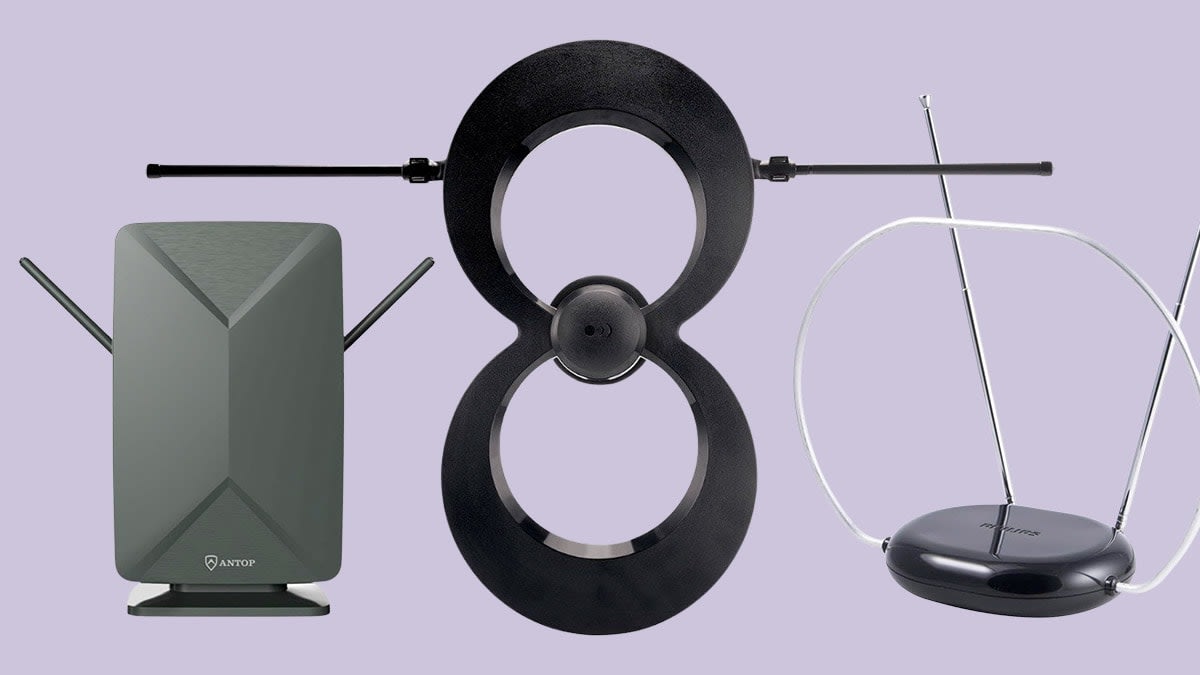

A weak indoor antenna can turn a local news broadcast into a freeze-frame of blocky pixels, especially when it is hidden behind a television or placed against an interior wall. The right setup matters as much as the antenna itself, which is why the Best HD TV Antennas Indoors need to be judged by cable length, placement options, amplification, and compatibility rather than bold range claims alone.
The nine models here cover compact magnetic designs, long-cable antennas, detachable boosters, and two hover-style units that sit directly on top of a TV. HIDB Indoor Antenna is our top pick for its compact construction, magnetic base, and flexible positioning. The rest range from the long-cable Fabriyut to the simple UltraPro and the full-size Philips hover design.
Comparison table
| # | Product | Award | Range or reception | Cable or placement | Best for |
|---|---|---|---|---|---|
| 1 | HIDB Indoor Antenna | Best overall | Omnidirectional | Magnetic base, compact body | Most indoor TV setups |
| 2 | Fabriyut 33.8-Foot Antenna | Best for distant placement | Claimed 5000+ miles | 33.8-foot coaxial cable, amplifier | TVs far from windows |
| 3 | Intelbras Smart IC Antenna | Best for signal filtering | Long-range reception | Window or wall placement | Homes near interference |
| 4 | DAANT Long Range Antenna | Best cable construction | Long-range reception | 16-foot coaxial cable | Smart and digital TVs |
| 5 | JM NEXLOV Amplified Antenna | Best for flexible installation | Long-range amplified reception | 18-foot coaxial cable | Indoor or outdoor setups |
| 6 | Vansky Detachable Amplifier | Best adjustable amplifier | VHF and UHF, up to 4K | 16.5-foot cable, detachable booster | Troubleshooting weak signals |
| 7 | Philips Hover Amplified Antenna | Best top-mounted design | Up to 50 miles | Top-of-TV bracket, wall or flat surface | Clean entertainment centers |
| 8 | UltraPro Hover Antenna | Best compact hover antenna | Up to 40 miles | Top mount, tape, or flat surface | Small TVs and tight spaces |
| 9 | BEIMQN 360 Antenna | Best for old TVs | Claimed 2500+ miles | 16.5-foot cable, 360-degree reception | Smart and older TV models |
1. HIDB Indoor Antenna: Best Overall

Pros
- Compact body is easy to hide
- Magnetic base supports flexible placement
- Omnidirectional reception does not require precise aiming
- Flame-retardant, moisture-resistant dual-PC material
Cons
- No cable length is specified
- Reception still depends heavily on placement
- Not the right pick for a confirmed outdoor installation
Best for: someone who wants a small indoor antenna that can be moved easily while searching for a stronger signal.
The first thing to like about the HIDB Indoor Antenna is that it does not demand much space. Its body measures about 5 inches high and roughly 2.44 inches across in the listed dimensions, so it can sit on a TV stand without becoming part of the room's decor. The magnetic base gives it more placement flexibility than a flat adhesive panel, and moving an antenna a few inches can matter when a wall or cabinet is blocking a broadcast signal.
HIDB describes the reception pattern as omnidirectional, which is useful when you do not know the exact direction of local broadcast towers or when the TV cannot face the best window. That does not mean the antenna can ignore the room. The included guidance recommends trying both vertical and horizontal placement, raising the antenna, and positioning it near a window facing the towers. After every move, the TV should be rescanned.
The material choice is more substantial than the usual vague plastic description. HIDB specifies a flame-retardant dual-PC soft material with moisture resistance and lightning protection for indoor use. Those details speak to the housing and indoor durability, not a license to install it outside. For a simple living-room setup, the compact construction is more useful than a huge advertised range number.
Compared with the UltraPro Hover Antenna, HIDB is less tied to the TV itself and easier to shift around a room. The Vansky Detachable Amplifier is a better troubleshooting tool when a booster is needed, but its larger 13-inch dimensions take more visual space. HIDB's weakness is the lack of a stated cable length and the absence of a supplied amplifier in the listed features. Skip it if the antenna must reach a distant window or if you already know your home needs active signal assistance. It is the right first try for a tidy indoor installation where placement flexibility matters most.
2. Fabriyut 33.8-Foot Antenna: Best for Distant Placement

Pros
- 33.8-foot coaxial cable allows unusual placement freedom
- Built-in amplifier is included
- Listed for indoor or outdoor use
- Waterproof, windproof, and anti-thunder design
Cons
- The 5000+ mile range claim is not a realistic way to predict reception
- Requires USB power for the amplifier
- Larger placement scope can make setup less tidy
Best for: someone whose strongest signal is across the room or near a window far from the television.
The Fabriyut 33.8-Foot Antenna solves a common indoor antenna problem: the TV is in the convenient spot, but the signal is not. Its supplied 33.8-foot coaxial cable gives you room to move the antenna toward a window, higher wall position, or another part of the room without relocating the television. That is a more useful feature than the product's “5000+ miles” language, which should not be treated as a literal prediction of reception.
A built-in amplifier is part of the setup, and the instructions call for USB power. An amplifier can help preserve a weak signal after a long cable run, though it cannot create channels that do not reach the house. It can also make a poor signal noisier in some situations, so the antenna's position should be settled before assuming the booster is the answer.
Fabriyut lists support for 8K, 4K, and 1080p formats. Those labels describe the display formats the antenna can feed, not the resolution of broadcast signals in your area. The more meaningful compatibility detail is that the antenna is intended for both smart TVs and older TVs with an HDTV tuner. It is also described as waterproof, windproof, and anti-thunder for indoor or outdoor use, giving it a wider installation brief than HIDB.
The trade-off is cable management. A 33.8-foot lead is excellent when the best signal spot is far away, but it can become a loose coil behind furniture in a conventional setup. The JM NEXLOV Amplified Antenna offers an 18-foot cable and is easier to keep neat, while the DAANT Long Range Antenna has a shorter 16-foot lead and no listed amplifier. Choose Fabriyut when placement distance is the central problem. Skip it when the TV already sits beside a usable window and you want the least complicated installation.
3. Intelbras Smart IC Antenna: Best for Signal Filtering

Pros
- Smart IC chip is designed to filter cellular and FM signals
- Includes a long-range regulator
- Supports 4K, UHD, and 1080 HDTV broadcasts
- Interchangeable blue and orange accessories
Cons
- The cable length is not specified
- Regulator settings add one more setup variable
- The long-range wording is not a measured distance
Best for: households that need interference filtering and are willing to adjust the regulator and placement.
The Intelbras Smart IC Antenna takes a more adjustable approach than the simplest passive indoor models. Its listed smart IC chip is designed to filter cellular and FM signals, while a signal regulator is intended to help manage reception. That combination gives you something to adjust when nearby electronics or a crowded indoor environment seem to be affecting the picture.
Intelbras says the antenna receives 4K, UHD, and 1080 HDTV broadcasts and can reach long ranges. The useful part of that claim is its broad digital-broadcast compatibility, not the vague distance language. As with every antenna here, building materials, terrain, tower direction, and local broadcast availability will determine the result.
Setup is conventional but rewards patience. The coaxial connection goes to the TV's antenna input, then the antenna should be placed near a window or on a wall before a channel scan. Intelbras specifically says to switch the regulator to short range when the home is within 35 miles of a broadcast tower. That instruction is important because maximum amplification is not automatically the cleanest setting.
The blue version includes interchangeable orange and blue accessories, a small cosmetic distinction that may help it blend with a room. The downside is that the listing does not state the cable length, so it is harder to plan a distant window placement than with the Fabriyut or JM NEXLOV. The HIDB Indoor Antenna is smaller and simpler, while Intelbras is the more interesting choice when filtering and regulator control matter. Choose it for a signal environment that needs tuning, not for a plug-in-and-forget installation.
4. DAANT Long Range Antenna: Best Cable Construction

Pros
- 16-foot coaxial cable supports window placement
- Three aluminum shielding layers are specified
- Smart IC chip supports 4K, UHD, and 1080 broadcasts
- Works with smart and digital TVs
Cons
- Not suitable for older analog televisions
- No amplifier is listed
- Large size is less discreet than the compact picks
Best for: someone who wants a straightforward digital antenna with a specifically described shielded cable.
The DAANT Long Range Antenna is a practical pick for anyone more concerned with a usable cable than with elaborate electronics. The included 16-foot coaxial cable gives enough reach for many living rooms, and the antenna can be placed near a window or in another elevated position rather than being forced to sit beside the TV.
DAANT describes the cable in unusually concrete terms. It has a solid center conductor, dielectric insulation, three aluminum shielding layers, and a durable outer layer. Those construction details are relevant because a long indoor cable can pick up interference or become vulnerable to bends and damage. They do not guarantee reception, but they make the connection easier to trust than a cable with no description at all.
The antenna uses an upgraded Smart IC chip and is listed for 4K, UHD, and 1080 HDTV broadcasts. It supports smart TVs and digital TVs, but the listing explicitly says it is not suitable for older analog televisions. That limitation separates it from the BEIMQN 360 Antenna, which is marketed for both smart and older TV models.
The DAANT package does not list an amplifier, so this is not the model to choose simply because a distant tower produces a weak signal. Its larger listed size and 0.63-pound weight also make it less invisible than HIDB or UltraPro. The benefit is a simple setup with a well-described cable and no booster behavior to troubleshoot. Choose DAANT when your TV has a digital tuner, the window is within cable reach, and you prefer a clear, conventional installation.
5. JM NEXLOV Amplified Antenna: Best for Flexible Installation

Pros
- 18-foot coaxial cable gives useful placement range
- Built-in amplifier is designed for weak signals
- Listed for indoor and outdoor installation
- Supports VHF, UHF, and several HD formats
Cons
- The amplifier needs careful placement and rescanning
- No specific reception distance is provided
- Outdoor use requires more installation planning than indoor use
Best for: someone who may need to place the antenna away from the TV or use it in more than one kind of installation.
The JM NEXLOV Amplified Antenna sits between a basic indoor antenna and a more ambitious long-cable model. Its 18-foot coaxial cable is long enough to make window placement realistic in many rooms, while the high-gain amplifier is intended to strengthen weak broadcast signals and reduce cellular and RF interference.
The listed format support includes 720p, 1080i, 1080p, 2K, and 4K HDR. That is a broad compatibility statement, though it should not be read as a guarantee that local channels broadcast in every format. The antenna is also described as suitable for all smart TVs and for indoor or outdoor installation, giving it more flexibility than DAANT, which is explicitly limited to digital and smart TVs.
The installation instructions are refreshingly direct: connect the antenna, place it in a promising spot, and rescan after moving it. That last step matters more than the “2026 upgraded smart IC chip” language in the listing. A boosted signal can be useful, but an amplifier cannot compensate for a wall, a metal cabinet, or a broadcast tower blocked by terrain.
Fabriyut is the better choice when you need 33.8 feet of cable, and HIDB is the cleaner answer for a compact tabletop setup. JM NEXLOV makes more sense when 18 feet is enough and you want the option of indoor or outdoor placement. Its weakness is that the listing does not give a precise reception distance, so shoppers who need a clearly defined indoor range may prefer Philips or UltraPro. Pick it when installation flexibility matters more than a small footprint.
6. Vansky Detachable Amplifier: Best Adjustable Amplifier

Pros
- Detachable amplifier can be tested on or off
- 16.5-foot coaxial cable supports flexible placement
- Supports VHF, UHF, and ATSC formats
- Flame-retardant indoor construction
Cons
- Broad 250-mile size label is not a reliable indoor forecast
- Larger 13-inch body is harder to hide
- Requires trial and error to find the right amplifier setting
Best for: someone who wants a booster but also wants the option to remove it when amplification makes reception worse.
The Vansky Detachable Amplifier has one feature that makes it more useful than many amplified antennas: the booster can be removed. In a strong-signal area, amplification may be unnecessary or even counterproductive. Vansky's own guidance says to disconnect the external booster and rescan if a stable signal cannot be locked with it attached. That is exactly the kind of adjustment an indoor antenna setup sometimes needs.
The 16.5-foot coaxial cable is long enough to place the antenna near a window or on a wall rather than directly beside the television. The antenna supports VHF, UHF, and ATSC formats, with listed compatibility covering 720p, 1080i, 1080p, and 4K. Again, those formats describe the signal and display standards it is designed to handle, not a promise of 4K channels in every location.
Vansky's physical design is less discreet than HIDB. The listed dimensions are 13 inches by 13 inches and 0.8 inches high, so this is a broad panel rather than a tiny magnetic unit. That extra surface area may be easy to accommodate on a wall or window, but it is not the right shape for a crowded TV stand.
The Intelbras Smart IC Antenna also offers a way to tune reception, but Vansky's detachable booster is easier to understand: try it, then remove it if needed. Philips is more polished as a top-mounted product, while Vansky gives you more direct control over the signal path. Skip it if you want an antenna that disappears behind a screen. Choose it if reception is uncertain and you value the ability to compare amplified and unamplified operation.
7. Philips Hover Amplified Antenna: Best Top-Mounted Design

Pros
- Designed to sit securely on top of a flat-screen TV
- Built-in amplifier includes a 4G and 5G LTE filter
- Supports VHF, UHF, 4K, and 8K-ready setups
- Compatible with ATSC 3.0 broadcasts where available
Cons
- Top-of-TV placement may not be the strongest signal position
- 17-inch height is substantial for a compact antenna
- Shorter effective placement flexibility than long-cable models
Best for: someone who wants a recognizable, tidy antenna that mounts directly to the television.
The Philips Hover Amplified Antenna is built around a very specific idea: keep the antenna on top of the TV instead of letting a cable lead it across the room. Its mounting bracket is designed for a flat-screen television, and the bracket can be removed for wall or flat-surface placement. That makes the installation cleaner than a loose panel on a shelf.
Philips lists a built-in amplifier with TruAmp technology and a 4G/5G LTE filter. Filtering nearby cellular interference is a sensible feature in a modern living room, where the antenna may sit close to wireless devices. The antenna is also rated for VHF and UHF broadcasts, with reception up to 50 miles and support for 4K and 8K Ultra HD formats.
The antenna is compatible with ATSC 3.0 broadcasts where available, which gives it a more forward-looking specification than several of the basic models here. It also comes with a mounting bracket and a stated limited lifetime replacement pledge, plus U.S.-based technical support. Those support details will matter to shoppers who would rather have a clear manufacturer contact than a generic setup card.
The compromise is placement. A top-mounted antenna may look excellent while receiving less effectively than an antenna positioned near a window. The UltraPro Hover Antenna is smaller and swivels horizontally, making it less imposing, while Fabriyut and JM NEXLOV are better when the strongest location is far from the TV. Choose Philips when a clean top-mounted installation and LTE filtering matter more than maximum placement freedom.
8. UltraPro Hover Antenna: Best Compact Hover Antenna

Pros
- Compact hover design attaches directly to the TV
- Swivels horizontally for positioning adjustments
- Supports VHF and UHF signals up to 40 miles
- Includes top, wall, and flat-surface placement options
Cons
- Top-of-TV placement can limit signal strength
- No amplifier is listed
- Mounting tape may not suit every wall surface
Best for: someone with a small entertainment center who wants the least visible antenna installation.
The UltraPro Hover Antenna is the compact alternative to Philips's larger hover design. It attaches to the top of a TV, can sit on a flat surface, or can be mounted to a wall with the included tape. The low-profile shape is easy to blend into a home theater setup, and the push-on coax connector keeps the initial connection simple.
UltraPro lists reception up to 40 miles across VHF and UHF signals. It is designed for 1080p HD viewing and works with 4K and 8K TVs, while its ATSC 3.0 compatibility supports newer broadcasts where those signals are available. These capabilities make it a good match for modern televisions, though they do not remove the need to scan for channels after installation.
The antenna can swivel horizontally to help optimize its position. That is useful, but it is still less flexible than a 16-foot or 33.8-foot cable that lets the antenna move independently of the TV. If the screen sits against an exterior wall facing the broadcast towers, the hover design may work neatly. If the room has thick walls or a poor signal direction, a separate window position is likely to be more effective.
Compared with Philips, UltraPro takes up less visual space and has a shorter listed range, while Philips adds an amplifier and LTE filtering. Compared with HIDB, UltraPro is easier to attach directly to the TV but harder to relocate around the room. Skip it if the TV is in a difficult signal spot. For a bedroom, office, or secondary TV where appearance and compactness lead the decision, it is the most discreet option here.
9. BEIMQN 360 Antenna: Best for Old TVs

Pros
- Designed for smart and older TV models
- Supports VHF and UHF frequencies
- 16.5-foot shielded coaxial cable
- 360-degree reception and included signal amplifier
Cons
- The 2500+ mile range claim should not guide placement expectations
- Amplifier performance depends on local signal conditions
- Older televisions may still need a digital tuner or converter
Best for: someone who needs one antenna for a modern TV and a compatible older set.
The BEIMQN 360 Antenna is the broad-compatibility pick in this group. It is marketed for smart and older TVs, supports both VHF and UHF, and includes a signal amplifier. That makes it a sensible candidate for a household with more than one type of television, though an older analog-only set may still require a separate digital converter or tuner.
The included 16.5-foot shielded coaxial cable gives you enough room to move the antenna toward a window or higher position. BEIMQN also describes the reception as 360-degree and says a smart chip filters interference from nearby electronics. Omnidirectional coverage can reduce the need to aim the antenna precisely, but it does not make every spot in a room equally good. Walls, metal, distance, and terrain remain decisive.
The product listing uses a “2500+ miles” range claim and describes support for 4K and 1080p. The practical takeaway is compatibility with common digital broadcast formats, not literal reception across that distance. Channel availability should be checked for the home, then the antenna should be positioned and rescanned until the most stable result is found.
DAANT is a better match for a digital TV owner who values its explicitly described cable construction, while BEIMQN is more attractive for mixed-age televisions. Fabriyut provides much more cable for a distant window, but BEIMQN is easier to manage in a typical room. Choose it when compatibility is the priority and you want a 360-degree design with an amplifier. Skip it if you have a strong local signal and want a completely passive, minimalist antenna.
How to choose best hd tv antennas indoors
The Best HD TV Antennas Indoors are separated less by the resolution printed on the box than by how well their design matches the room, the TV tuner, and the local broadcast environment.
Signal placement
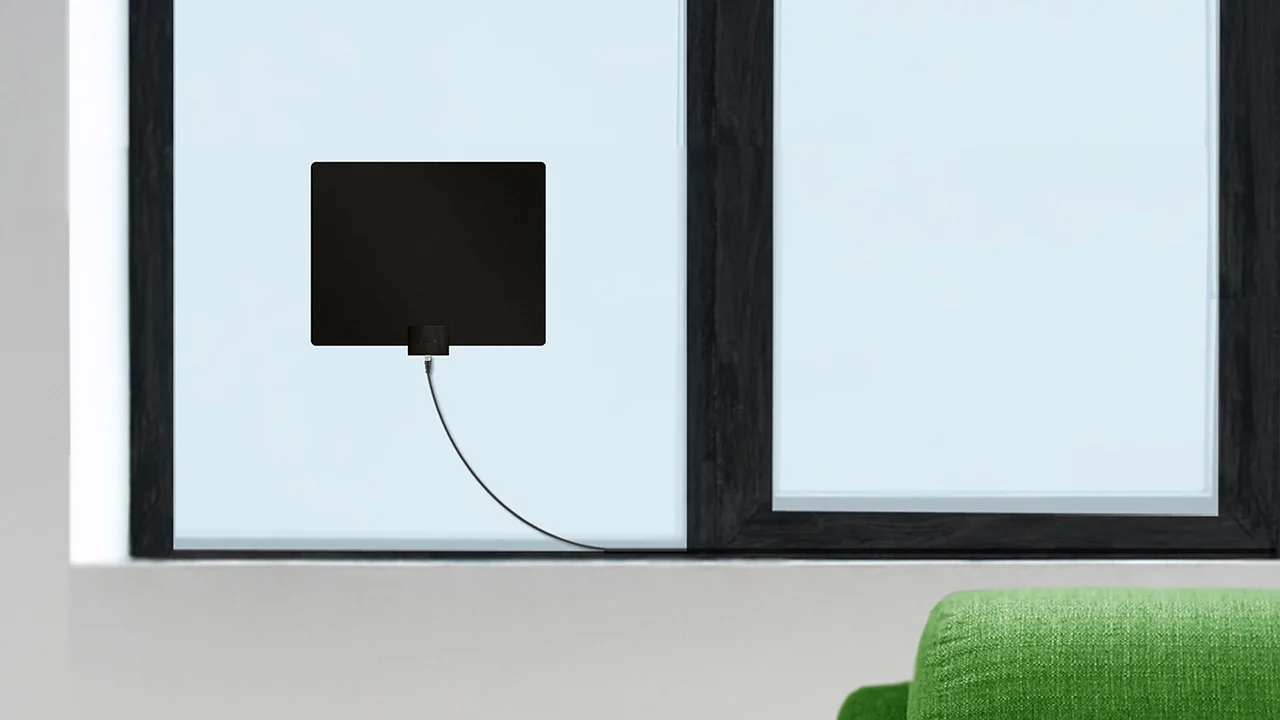
An indoor antenna works best when it has a clear path toward local broadcast towers. A window or exterior-facing wall is usually a better starting point than a cabinet, basement shelf, or spot behind the TV. Models with long cables, such as Fabriyut, JM NEXLOV, DAANT, Vansky, and BEIMQN, give you more freedom to find that position.
A longer cable often improves reception more reliably than a bigger range claim, because it lets the antenna reach the signal.
Amplification and filtering
An amplifier can help when a weak signal needs a boost before reaching the TV, but it is not a substitute for good placement. Vansky is unusually useful because its amplifier is detachable, while Philips includes a 4G/5G LTE filter and Intelbras offers a regulator with a short-range setting. A passive antenna such as HIDB may be preferable in an area with strong signals or when you want fewer powered components.
For a closer look at how active components affect reception, the difference a signal booster makes in a difficult room is a useful place to start.
Cable length and shielding
Cable length determines whether the antenna can sit in the strongest location rather than the most convenient one. Fabriyut's 33.8-foot cable offers the most freedom, followed by JM NEXLOV's 18 feet and the 16 to 16.5-foot cables on DAANT, Vansky, and BEIMQN. DAANT is the only model here with a detailed description of three aluminum shielding layers, which may help reduce interference during a longer run.
TV compatibility
A modern smart TV usually has an HDTV tuner and can connect directly to an antenna through its antenna input. DAANT is explicitly not suitable for older analog televisions, while Fabriyut, BEIMQN, and several other models are marketed for older sets. Check the television's tuner before buying. A TV without a digital tuner may need a separate converter even when the antenna itself supports current broadcasts.
Mounting and form factor
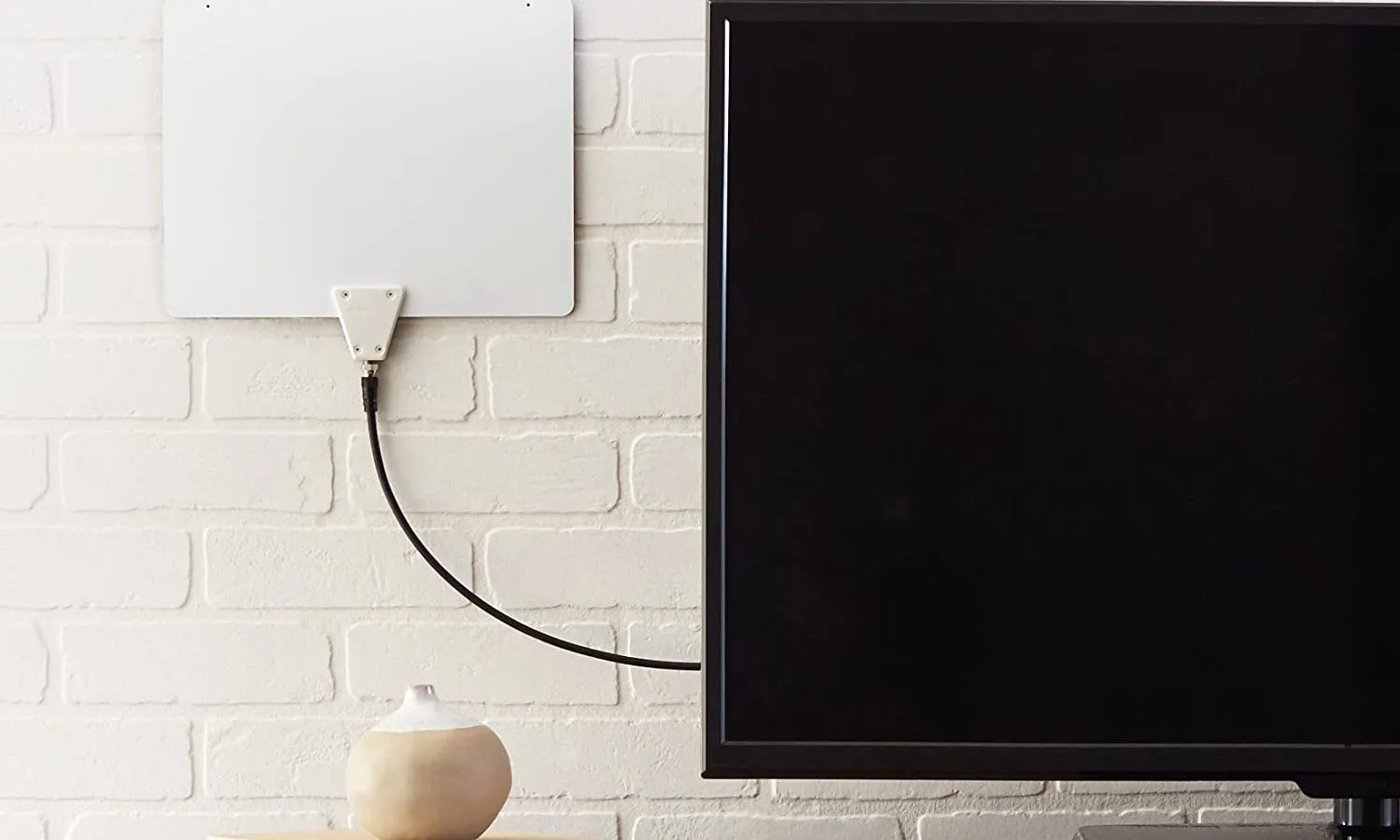
A top-mounted hover antenna keeps the cable and antenna close to the screen. Philips offers a bracket that can also be removed for wall or flat-surface placement, while UltraPro adds horizontal swiveling and mounting tape. HIDB is smaller and easier to move around a room. Broad panels such as Vansky can give you more surface area but require more wall or shelf space.
For homes where indoor placement cannot produce a stable picture, how an exterior installation changes the reception equation explains when moving the antenna outside is the more sensible solution.
Frequently asked questions
Do indoor antennas work with smart TVs?
Yes, an indoor antenna connects to a smart TV through its antenna or RF input, provided the television has an HDTV tuner. The antenna receives over-the-air broadcasts, while the smart features remain available for streaming and other apps. You still need to run a channel scan after connecting it.
Does an indoor antenna receive 4K channels?
An antenna can carry a broadcast that uses a 4K format, but the antenna does not create 4K resolution. The listings for several models mention 4K, 8K, or 1080p support as compatibility claims. Actual channel format depends on the local broadcaster, the TV tuner, and the signal quality at your location.
Is an amplifier always better?
No. An amplifier can help a weak signal, especially after a long cable run, but it can also add noise or overload a strong signal. Vansky lets you detach its amplifier, while Fabriyut, JM NEXLOV, Philips, and BEIMQN include amplified designs. Try placement first, then compare reception with the amplifier enabled when the design allows it.
Where should an indoor antenna be placed?
Start near a window or on an exterior-facing wall, preferably higher than the television and away from large metal objects. Test vertical and horizontal orientations, then rescan channels after each major move. A cable long enough to separate the antenna from the TV can make a significant difference.
Can an indoor antenna work with an old television?
It depends on the television's tuner. Models such as BEIMQN and Fabriyut are marketed for older TVs, but an analog-only television may still require a digital converter box. Check the TV's inputs and tuner type before connecting an antenna.
Do omnidirectional antennas need to face the towers?
They generally need less precise aiming than directional designs, but placement still matters. HIDB and BEIMQN use omnidirectional or 360-degree reception language, yet walls, terrain, and electronic interference can still affect the result. Rescanning after moving the antenna is essential.
The bottom line
The Best HD TV Antennas Indoors for most people is HIDB Indoor Antenna because its compact 5-inch body, magnetic base, and omnidirectional reception make it easy to position without dominating the room. Choose Fabriyut 33.8-Foot Antenna instead when the strongest signal is far from the television and its 33.8-foot cable is the feature that will determine success.
For a polished TV-mounted installation, Philips Hover Amplified Antenna is the stronger specialist pick, while UltraPro Hover Antenna is better when compactness matters most. Vansky Detachable Amplifier is the most flexible choice for experimenting with amplification, and BEIMQN 360 Antenna makes the most sense for mixed smart and older TV households.
If you are undecided, choose the antenna that can reach your best window position, not the one with the biggest printed range claim.
As an Amazon Associate we earn from qualifying purchases.