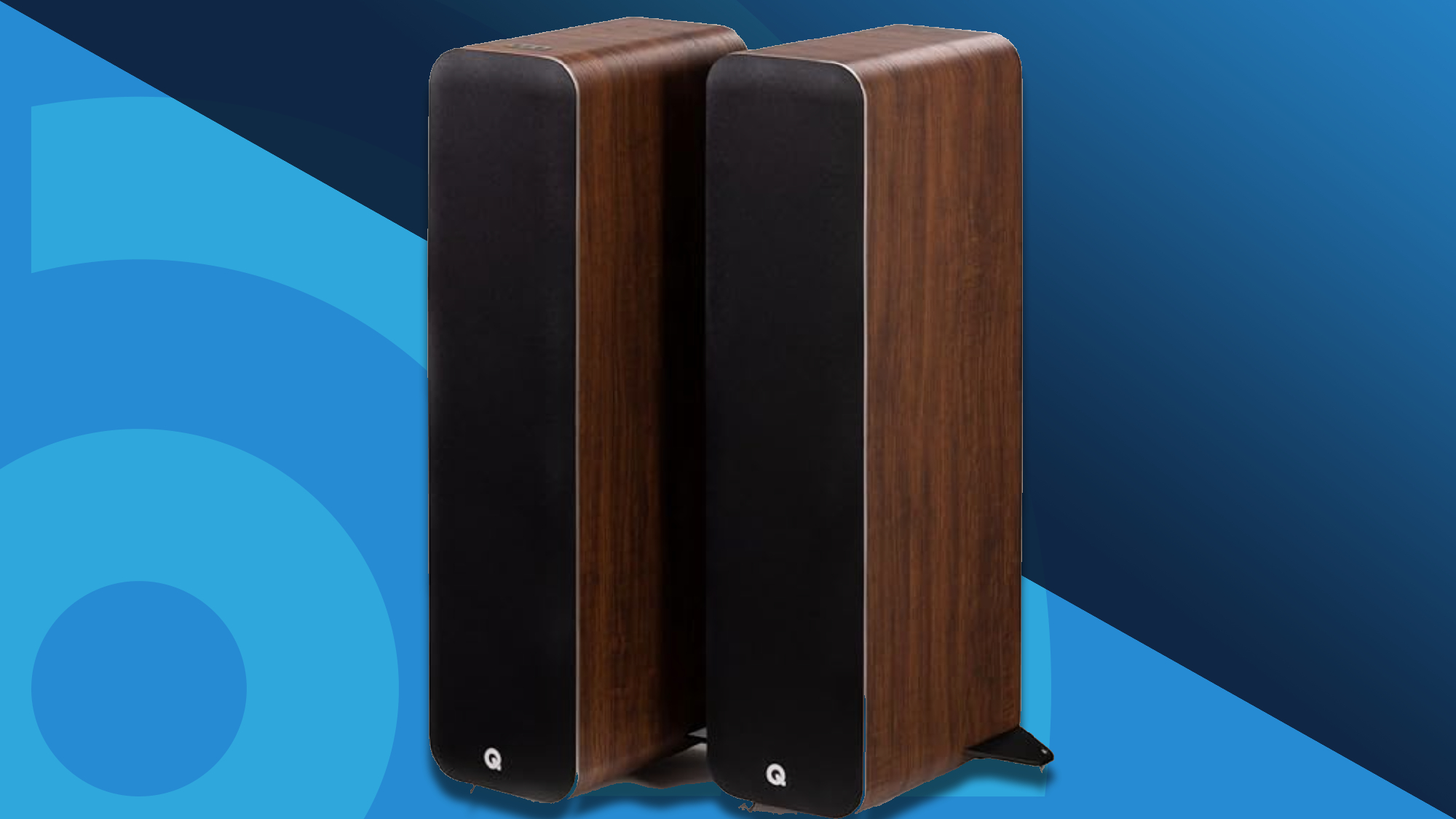

A television can have a sharp picture and still sound flat, thin, or hard to understand. The right setup depends on a room's size, whether you already own an amplifier, and how much of the installation you want to handle yourself. The Best home audio speakers are not all the same kind of product, which is why this list includes passive bookshelf speakers, floorstanding towers, complete surround systems, soundbars, and the wire needed to connect them.
Our top pick is the Polk Audio T15, a straightforward passive pair that is easy to place and easy to build around. The rest of the lineup covers bigger Polk towers, immersive ULTIMEA systems, a convenient LG package, a compact Saiyin kit, and three speaker-wire options for custom installations.
Comparison table
| # | Product | Award | Setup | Key detail | Best for |
|---|---|---|---|---|---|
| 1 | Polk Audio T15 | Best overall | Passive bookshelf pair | 0.75-inch tweeter, 5.25-inch driver | First home theater system |
| 2 | Polk Audio Monitor XT60 | Best mid-size tower | Passive single tower | 1-inch tweeter, 6.5-inch woofer | Room-filling stereo |
| 3 | ULTIMEA Aura A60 Pro | Best surround package | 7.1-channel system | Four surround speakers, Dolby Atmos | Immersive TV sound |
| 4 | LG S40TR | Best easy setup | 4.1-channel soundbar system | Wireless subwoofer and rear speakers | Simple living-room upgrades |
| 5 | Install Link 16 AWG Wire | Best long-run wire | Passive speaker cable | 100 feet, CCA conductors | Multi-speaker installations |
| 6 | ULTIMEA 5.1.2 Soundbar | Best Atmos layout | 5.1.2-channel system | Up-firing drivers, HDMI eARC | Height-effect movie sound |
| 7 | Saiyin 5.0 System | Best compact passive kit | Five-speaker passive system | Four 3-inch speakers and center | Small-room surround |
| 8 | GEARit 14 AWG Wire | Best heavy-gauge wire | Passive speaker cable | 14 gauge, 100 feet | Longer or demanding runs |
| 9 | Polk Audio Monitor XT70 | Best large tower | Passive single tower | Two 6.5-inch woofers, two 8-inch radiators | Large listening rooms |
| 10 | Audio Express 16 AWG Wire | Best short-run wire | Passive speaker cable | 40 feet, 74-strand CCA | Small stereo connections |
1. Polk Audio T15: Best Overall

Pros
- Pair of passive speakers is easy to position
- Clear, balanced sound at low volumes
- Wall-mountable for front or surround duty
- Simple connection to an AV receiver
Cons
- Requires an AV receiver or amplifier
- Does not include a subwoofer
- Smaller scale than the Polk tower speakers
Best for: someone starting a flexible home theater system with a receiver already in place.
The Polk Audio T15 is the speaker set we would recommend first to someone who wants proper left and right channels without turning the room into a construction project. These are passive bookshelf speakers, so they need an AV receiver or amplifier, but that also makes them more adaptable than an all-in-one soundbar. Put them on shelves, use them at the front of a system, or mount them as rear channels.
Each speaker pairs a 0.75-inch tweeter with a 5.25-inch Dynamic Balance driver. That combination gives voices and instruments a clear place in the mix while keeping the cabinet compact. Polk lists deep bass performance even at low volume, but the sensible way to read that claim is that the T15 should sound composed during ordinary TV watching and music listening, not that it replaces a dedicated subwoofer. Its 10.7-inch height, 7.3-inch length, and 6.5-inch width make placement easier than with either Monitor tower.
The T15 is also the most useful starting point for expansion. Polk specifically positions it as part of a larger system that can add T50 towers, a T30 center speaker, and a subwoofer later. That upgrade path matters more than a dramatic feature list. The right way to balance speakers in a growing theater is to keep matching channels in mind, and the T15 gives a new receiver owner a sensible place to begin.
The limitation is clear: there is no built-in amplification, wireless connection, or bass module. A buyer who wants one cable to the TV should choose the LG S40TR or one of the ULTIMEA systems instead. The T15 wins here because it is compact, versatile, and useful in more than one position. Choose it for a modest living room, a first receiver-based setup, or a system you expect to improve over time.
2. Polk Audio Monitor XT60: Best Mid-Size Tower

Pros
- Floorstanding design creates a larger presentation
- 6.5-inch woofer and dual passive radiators
- Dolby Atmos, Auro 3D, and DTS:X compatible
- Rubber feet suit carpet and hardwood
Cons
- Sold as a single speaker
- Requires amplification and speaker wire
- Takes substantially more floor space than the T15
Best for: listeners who want a full-range front speaker and plan to build a matching Polk system.
The Polk Audio Monitor XT60 changes the character of a system simply by standing on the floor. It has more physical scale than the T15, and that makes movie effects, vocals, and music feel less confined to a small bookshelf cabinet. This listing is for one tower, so a stereo pair requires two units. That detail is easy to miss and should shape the buying decision from the start.
Its driver arrangement includes a 1-inch tweeter, a 6.5-inch dynamically balanced woofer, and two 6.5-inch passive radiators. The radiators help the cabinet produce more low-end presence without requiring a separate powered bass unit for every listening session. The result should suit a medium-sized room better than the T15, particularly when the speakers are being asked to carry more of the soundtrack.
At 36 inches tall, 7 inches long, and 10 inches wide, the XT60 is still relatively easy to place for a tower. Rubber feet are included for carpet and hardwood, and Polk says the model is compatible with Hi-Res Audio, Dolby Atmos, Auro 3D, and DTS:X sources. Compatibility does not create height effects by itself, but it makes the XT60 a sound front channel in a receiver-based theater. It is also timbre matched with other Monitor XT speakers, including the MXT20, MXT30, MXT90, and MXT12 families named in the product details.
The XT70 below is the stronger choice for a large room because it uses larger bass hardware, while the T15 is easier to fit and less imposing. The XT60 sits between them, offering a more convincing front stage without the XT70's 40-inch height and 35-pound weight. Skip it if you do not have an amplifier or if the room has no clear floor positions beside the TV. For a growing Polk theater, though, the XT60 is the balanced tower to build around.
3. ULTIMEA Aura A60 Pro: Best Surround Package

Pros
- 7.1-channel layout with four surround speakers
- Dolby Atmos support
- Wireless connection for the rear right surround speaker
- App offers 121 EQ presets and 10-band control
- Includes a wired 5.25-inch subwoofer
Cons
- Recommended room size is 108 to 270 square feet
- Several speakers still use wired connections
- App control may be more adjustment than some users want
Best for: movie watchers who want a broad surround field without adding a separate AV receiver.
The ULTIMEA Aura A60 Pro is the most ambitious complete surround package in this group. Instead of asking the buyer to choose an amplifier, speakers, subwoofer, and cables separately, it puts the main soundbar, four surround speakers, and a subwoofer into one system. That is the appeal for anyone who wants a cinematic layout but does not want to learn the entire passive-speaker ecosystem first.
The 7.1-channel design uses three main channels and four surround speakers. Two front surround speakers and two rear surround speakers are wired into the system, while the rear right surround speaker pairs wirelessly with the soundbar. That is not a cable-free room, but it can reduce the most awkward run across the back of the seating area. The 5.25-inch wired subwoofer adds the low-frequency impact that a slim bar alone cannot provide.
Dolby Atmos is the headline feature, and the Aura A60 Pro is recommended for rooms from 108 to 270 square feet. The included Ultimea app is unusually central to the design. It offers 121 professionally tuned EQ presets, a 10-band control, and six modes covering Movie, Music, Voice, Sport, Game, and Night listening. That gives the system a useful way to adapt dialogue, bass, or late-night playback rather than locking the listener into one factory balance.
The LG S40TR is simpler and likely easier for a household already using an LG television, while the ULTIMEA 5.1.2 Soundbar offers a more specific height-channel layout. The Aura A60 Pro makes the stronger case when rear speaker coverage matters more than a short setup. Its weakness is the physical complexity of four surround speakers and mixed wired and wireless connections. Choose it for a dedicated movie room or a living room within its recommended size, not for someone who wants a discreet bar and nothing else.
4. LG S40TR: Best Easy Setup
Pros
- 4.1-channel layout with wireless subwoofer
- Wireless rear surround speakers
- Dolby Audio and DTS Digital compatibility
- Clear Voice Plus helps dialogue stand out
- WOW Interface works with an LG TV remote
Cons
- Fewer channels than the ULTIMEA Aura A60 Pro
- Height effects are not listed
- Requires room for rear speakers and a subwoofer
Best for: LG TV owners who want a tidy surround upgrade with minimal receiver setup.
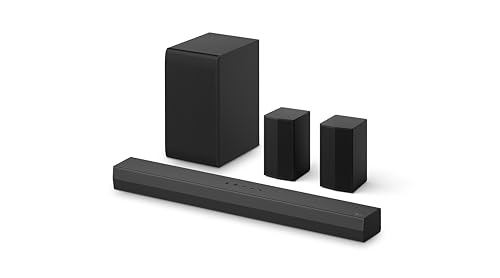
The LG S40TR is the most approachable package here for a household that wants better TV sound without assembling a traditional theater. It uses a 4.1-channel soundbar arrangement, a wireless subwoofer, and wireless rear speakers. There is still some placement work, but the system avoids the separate receiver and speaker-wire runs demanded by the Polk and Saiyin options.
LG gives the S40TR several features aimed at everyday television rather than just action movies. Clear Voice Plus analyzes the output to improve conversation clarity, and Smart Up-Mixer uses all the speakers to turn two-channel material into a wider multichannel presentation. Dolby Audio and DTS Digital compatibility cover common movie and TV formats. The supplied wireless rear speakers help put effects behind the seating position without requiring a special receiver.
The strongest reason to choose this model is its relationship with an LG television. WOW Interface lets the TV remote adjust sound modes, volume, and connection status, while WOW Orchestra can combine the TV and soundbar audio on compatible LG TV setups. The LG Soundbar app adds a 3-band equalizer for bass, treble, and mid-range adjustments. Its 28.4-inch width and 2.5-inch height should fit comfortably below many televisions, though the listed dimensions are not a substitute for checking the space under your screen.
The ULTIMEA systems offer more elaborate channel layouts and deeper app controls, while the LG is better at making the controls disappear into normal TV use. The S40TR is not the pick for someone chasing Dolby Atmos height effects or the widest possible surround field. It is the one to choose when clear dialogue, wireless rear speakers, and TV-remote convenience matter more than maximum channel count.
5. Install Link 16 AWG Wire: Best Long-Run Wire

Pros
- 100-foot length supports multi-speaker layouts
- Double-conductor construction
- Red and black jacket makes polarity easy to follow
- SoftFlex jacket is flexible during installation
- Suitable for home theater and car audio
Cons
- CCA is not pure copper
- Wire alone needs a receiver or amplifier and speakers
- 16 gauge is not the heaviest option here
Best for: a receiver-based theater that needs one long roll for several speaker connections.
Install Link 16 AWG Wire is not a speaker, but it solves the practical problem that appears as soon as passive speakers enter the room. The 100-foot roll gives an installer enough reach for several channels, and the red and black frosted jacket makes it easier to keep positive and negative connections consistent. That matters when a receiver is feeding front, center, and rear speakers across different parts of a room.
The cable uses stranded copper-clad aluminum conductors. CCA keeps the wire flexible and lighter than a comparable pure-copper cable, but it should be understood on its own terms. This is a sensible connection cable for ordinary home theater and car-audio installations, not a reason to make claims about improved sound. The 16 gauge size is a practical middle ground for many short and medium speaker runs.
The SoftFlex jacket is one of the more useful details. Flexible cable is easier to route around furniture, behind a cabinet, or along a baseboard, and it can be stripped without turning a simple installation into a fight. Install Link also says the wire is designed for easy polarity identification and connection to an AV receiver or amplifier.
GEARit's 14 AWG cable is the better choice when a run is longer or the system calls for thicker conductors. Audio Express is more convenient for a compact stereo connection because it comes in a 40-foot coil. Choose Install Link when the job involves several passive speakers and you want one 100-foot roll with clear conductor identification. Skip it if you need a powered soundbar system, since neither the cable nor a passive speaker can replace that electronics package.
6. ULTIMEA 5.1.2 Soundbar: Best Atmos Layout

Pros
- 5.1.2-channel design includes up-firing drivers
- HDMI eARC supports lossless Atmos transmission
- Two rear surround speakers
- App has 10-band EQ and 121 presets
- OTA updates can add features
Cons
- Not compatible with DTS
- Best results depend on HDMI eARC
- More involved than a basic soundbar
Best for: viewers who want Atmos height effects and have a TV with HDMI eARC.
The ULTIMEA 5.1.2 Soundbar is the more focused choice for listeners who specifically want sound to appear above the screen. Its layout combines a soundbar, two rear surround speakers, and up-firing Atmos channels. That makes the system more directional and more demanding about placement than the LG S40TR, but it also gives movie sound a clearer path to a three-dimensional presentation.
The up-firing drivers use neodymium internal magnets and 18-core voice coils, according to the product information. The important part for the buyer is not the internal construction by itself. The drivers are intended to throw high-frequency sound upward so the ceiling can contribute to the perceived height effect. Results will depend on the room and ceiling, so this is not a substitute for installing speakers overhead.
HDMI eARC is the other major differentiator. The system supports bandwidth up to 37 Mbps for lossless 5.1.2-channel audio, with CEC allowing the TV and soundbar to coordinate power, volume, and input switching. A TV with only regular ARC may not expose the full capability. The system also uses Ultimea's SurroundX processing, but it is not compatible with DTS, a meaningful limitation for libraries or devices that rely on that format.
The Aura A60 Pro offers more surround speakers and a 7.1-channel layout, while this system is the better fit for an Atmos-first room. Its 31.5-inch length and 3.54-inch height keep the main bar relatively easy to place, but the rear speakers still need thoughtful positioning and power. Pick it for a compatible television, Atmos-heavy movie use, and a listener willing to adjust the system through its app. If you want broad format support, the Polk passive systems or LG package are safer choices.
7. Saiyin 5.0 System: Best Compact Passive Kit

Pros
- Five-speaker passive layout
- Dedicated center channel for dialogue
- Four identical 3-inch bookshelf speakers
- Flexible shelf, stand, or wall placement
- Wood enclosures reduce resonance
Cons
- Receiver or amplifier is required
- Speaker wire is not included
- No subwoofer is included
- Small drivers have limited low-end scale
Best for: a compact room where a receiver-based five-speaker layout matters more than deep bass.
The Saiyin 5.0 System is a complete speaker set in the traditional sense, but it is not a complete powered theater. It includes four bookshelf speakers and a center speaker, all of which are passive. That distinction makes it a natural match for an AV receiver and a poor fit for someone expecting to connect it directly to a television.
The four bookshelf speakers use 3-inch drivers, and the center speaker is designed to improve dialogue clarity. A dedicated center channel is useful for movies and shows because voices have a defined speaker rather than sharing the entire front soundstage. Saiyin says the four bookshelf speakers are identical, which should help keep effects consistent as sounds move around the room.
Placement is flexible. The speakers can sit on shelves or stands, or be mounted on walls, and the system can be arranged around the room's size and layout. The enclosures use a classic wood finish and are described as handcrafted with unique wood textures and colors. Saiyin also says the enclosure design is intended to reduce sound resonance, though the real advantage for most buyers will be the compact form and the ability to position five channels independently.
There is no subwoofer, so the Saiyin cannot match the low-end authority of the ULTIMEA packages or the Polk Monitor towers without adding one. The included speakers also need wire and amplification, neither of which comes in the package. The speaker placement decisions that make dialogue easier to hear are especially important with a small passive system. Choose Saiyin for a modest room, a receiver already on hand, and a preference for separate left, center, right, and surround channels.
8. GEARit 14 AWG Wire: Best Heavy-Gauge Wire

Pros
- 14 gauge conductors suit longer runs
- 100-foot length
- Sequential foot markers simplify cutting
- Clear polarity markings
- Flexible PVC jacket
- Fits banana plugs, spade tips, and standard terminals
Cons
- CCA construction is not pure copper
- Thicker cable can be less convenient in tight spaces
- Requires separate passive speakers and amplification
Best for: larger passive systems with longer cable runs and frequent measured cuts.
GEARit 14 AWG Wire is the installation pick when the cable run matters more than keeping the cable as small as possible. It comes as a 100-foot roll and uses 14 gauge CCA conductors. A thicker gauge gives an installer more headroom for longer runs than the 16 gauge options here, though it also takes a little more room when routed behind furniture or through a tight channel.
The useful design touch is the sequential foot marking printed on the jacket. It allows the installer to measure a cut without stretching out a tape measure for every connection. Clear polarity markings help prevent reversed terminals, and that becomes increasingly helpful as a system grows from two channels to five or more.
The soft PVC jacket is intended to bend around furniture and through tight car interiors without kinking. GEARit says the wire can be used with banana plugs, spade tips, and standard speaker terminals, giving it a broad range of practical connections. Those details make it a better fit for a deliberate installation than for someone who only needs a short replacement lead.
Install Link 16 AWG Wire is easier to handle and still provides 100 feet, while Audio Express is the better choice when 40 feet is enough. GEARit is the one to use for a longer home theater layout, especially with multiple passive speakers such as the Saiyin 5.0 System. Do not choose it for a powered soundbar, and do not mistake the 14 gauge label for a promise of audible improvement over every shorter cable.
9. Polk Audio Monitor XT70: Best Large Tower

Pros
- Two 6.5-inch dynamically balanced woofers
- Two 8-inch passive radiators
- 1-inch tweeter
- 4-ohm and 8-ohm amplifier compatibility
- Rubber feet for carpet and hardwood
- Timbre matched with other Monitor XT speakers
Cons
- Sold as a single tower
- Requires capable amplification and speaker wire
- 40-inch height and 35-pound weight demand careful placement
Best for: a larger room where a substantial front-stage speaker can stand clear of the furniture.
The Polk Audio Monitor XT70 is the biggest conventional speaker in this roundup, and it is meant to be treated that way. This is a single floorstanding tower, not a stereo pair, with enough cabinet and driver hardware to anchor the front of a serious home theater. It is overkill for a cramped apartment, but the extra scale makes sense when the listening room needs sound to travel without relying on a subwoofer for every lower note.
Polk equips the XT70 with a 1-inch tweeter, two 6.5-inch dynamically balanced woofers, and two 8-inch passive radiators. The woofers handle the main low and midrange work, while the passive radiators help extend the cabinet's bass response. That arrangement is substantially more imposing than the XT60's single woofer and smaller radiators, and it gives the XT70 the stronger case for large-room music and film playback.
The tower measures 40 inches high, 9 inches long, and 10 inches wide, and weighs 35 pounds. Rubber feet are supplied for both carpet and hardwood. Polk lists compatibility with Dolby Atmos and DTS:X sources and says the speaker works with 4-ohm and 8-ohm amplifiers. Those amplifier details matter: a receiver should be comfortable driving the chosen load before this speaker is installed as part of a theater.
The XT60 is easier to accommodate and more restrained, while the XT70 is the pick when the room can benefit from greater physical scale. Like the XT60, it is timbre matched with other Monitor XT models, including matching center, bookshelf, height, and subwoofer options. Skip it if you need a compact speaker, a powered solution, or a pair in one box. Choose it when a large room, a robust receiver, and a full Polk front stage are the priorities.
10. Audio Express 16 AWG Wire: Best Short-Run Wire

Pros
- 40-foot length suits compact installations
- 74-strand CCA construction
- Soft, flexible PVC jacket
- Red polarity stripe
- Supplied as a compact coil
Cons
- Shorter than the two 100-foot options
- CCA is not pure copper
- Wire alone needs an amplifier and passive speakers
Best for: connecting a small stereo or short surround run without managing a large roll of cable.
Audio Express 16 AWG Wire is the most sensible cable here when the installation is small and a full 100-foot roll would simply get in the way. The coil contains 40 feet, or 12.19 meters, of two-conductor cable. That is enough for many compact stereo arrangements and some short surround connections, but it is not the cable to choose for a large room with distant rear channels.
The wire uses 74-strand, 0.15 OD CCA construction and a clear PVC jacket. The red polarity stripe gives the installer a quick visual reference when connecting a receiver or amplifier to a speaker. That small detail prevents the avoidable mistake of reversing one channel, especially when both conductors otherwise look similar.
Audio Express describes the jacket as soft and flexible, which should make it easier to route around furniture. The coil format is also convenient for a short job. It connects a power amplifier or receiver to passive speakers, so it belongs with products such as the Polk Audio T15 or Saiyin 5.0 System, not with the wireless LG S40TR or the powered ULTIMEA packages.
Install Link offers the same 16 gauge approach with 100 feet, and GEARit steps up to 14 gauge for longer runs. Audio Express wins on compactness and a clearly defined 40-foot length. Choose it when you have measured the route and know that short cable is enough. If there is any uncertainty, a longer roll avoids having to redo the installation.
How to choose best home audio speakers
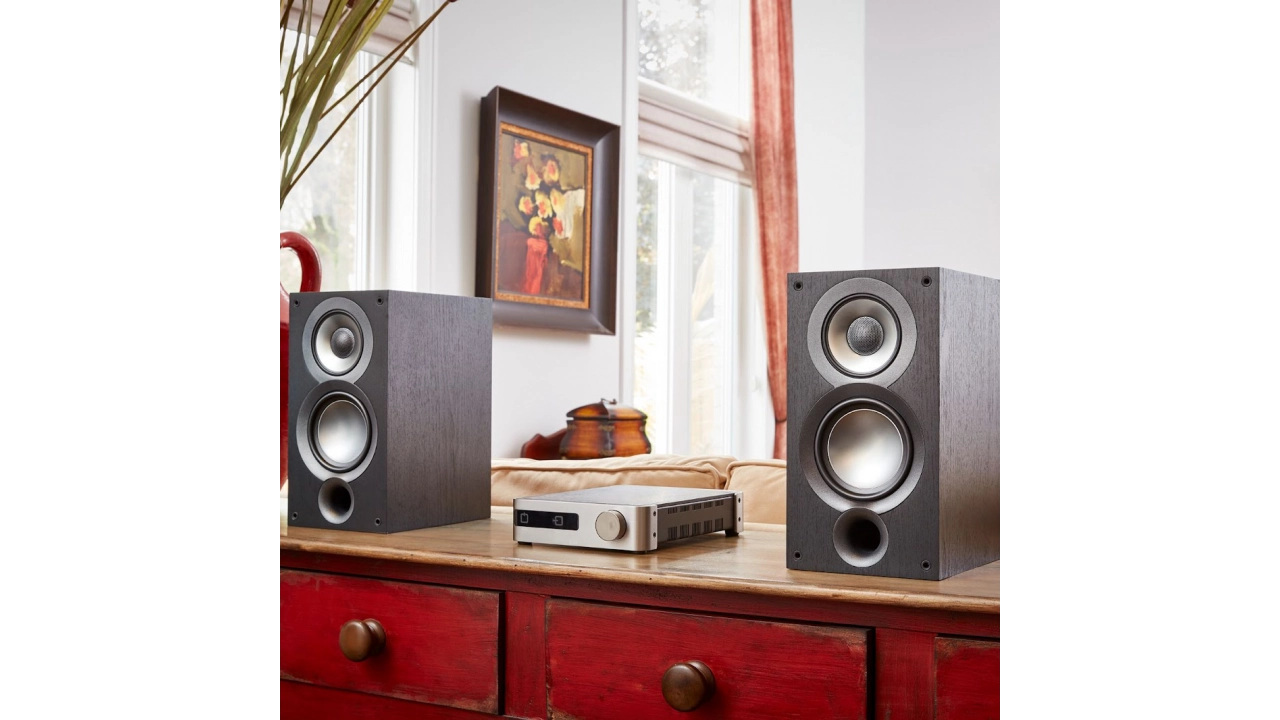
Start with the room, the equipment already in place, and the kind of sound you want to control. A passive speaker system and a powered soundbar solve different problems, even when both are described as home theater audio.
Passive or powered design
Passive speakers such as the Polk Audio T15, Monitor XT60, Monitor XT70, and Saiyin 5.0 System need an AV receiver or amplifier. They offer more freedom to replace individual components and arrange channels, but they also require speaker wire and more setup.
Powered systems such as the LG S40TR and both ULTIMEA models include the amplification inside the package. They are easier to connect to a TV, though their upgrade paths and input compatibility are more limited. Decide this before comparing driver sizes or surround formats.
Channel layout
A 2.0 bookshelf pair gives you left and right separation. A 5.0 package adds a center speaker and rear channels, while 5.1 and 7.1 systems add bass and more surround positions. The ULTIMEA 5.1.2 Soundbar adds two height channels through up-firing drivers, while the Aura A60 Pro emphasizes four surround speakers.
Channel numbers only tell part of the story. A system with many channels still needs room for those speakers and a sensible seating position. A well-placed 4.1 system can be more enjoyable than a crowded 7.1 arrangement.
Driver size and bass
Larger woofers and passive radiators generally give a speaker more ability to move air, but cabinet placement and amplification still matter. The T15's 5.25-inch driver suits a bookshelf, the XT60 uses a 6.5-inch woofer, and the XT70 adds two 6.5-inch woofers with two 8-inch passive radiators.
Soundbars take a different route by pairing small main enclosures with a separate subwoofer. The LG includes a wireless subwoofer, while both ULTIMEA systems use a subwoofer in their packages. A passive set without a subwoofer, such as the Saiyin system, leaves room for a later addition.
Room size and placement
Measure the space around the TV and the distance to the seating position. The T15 is 10.7 inches tall, while the XT60 and XT70 are 36 and 40 inches tall respectively. Towers need stable floor positions, and rear surround speakers need enough room behind or beside the seats.
The Aura A60 Pro is recommended for rooms from 108 to 270 square feet. The ULTIMEA 5.1.2 system depends on up-firing drivers, so its height effect also depends on the ceiling and the soundbar's position. Do not buy a large multi-speaker system without deciding where every component will go.
Connections and cable gauge
Passive systems need two-conductor speaker cable. Install Link and Audio Express use 16 gauge CCA wire, while GEARit uses 14 gauge CCA wire. The 100-foot rolls suit longer or multi-channel runs, and the 40-foot Audio Express coil is better for a measured short connection.
Look for polarity markings, flexible jackets, and enough length to route the cable without tension. CCA is copper-clad aluminum, not solid copper, so choose it with realistic expectations about installation convenience and the run length.
Buy the speaker layout your room can place correctly, not the channel count you cannot physically use.
Frequently asked questions
Do passive home speakers need a receiver?
Yes. The Polk and Saiyin speakers in this roundup are passive and require an AV receiver or amplifier. They cannot connect directly to a television without suitable amplification.
Are soundbars better than bookshelf speakers for TV?
A soundbar is usually easier to install because it combines amplification and several channels in one package. Bookshelf speakers can create more flexible left and right placement, but they require a receiver, speaker wire, and more setup.
Is a subwoofer necessary for home audio speakers?
It is not mandatory, but it adds low-frequency impact and lets smaller main speakers focus on midrange and treble. The Polk T15 and Saiyin 5.0 System can work without one, while the LG and ULTIMEA systems include a subwoofer.
What does 5.1.2 mean?
The first number represents the main channels, the second represents the subwoofer channel, and the final number represents two height channels. In the ULTIMEA 5.1.2 system, the height effect comes from up-firing drivers.
Can 16 gauge speaker wire work with a home theater?
Yes, 16 gauge wire is suitable for many ordinary home theater connections, particularly short and medium runs. Measure carefully, keep polarity consistent, and choose a longer roll when rear speakers are far from the receiver.
Is CCA speaker wire pure copper?
No. CCA means copper-clad aluminum, with an aluminum core covered by copper. The Install Link, GEARit, and Audio Express cables in this roundup all specify CCA construction.
Can I use one Polk tower as a stereo speaker?
A single tower can serve as one channel, but stereo listening needs a left and right speaker. The Monitor XT60 and Monitor XT70 listings are for one tower each, so plan accordingly when building a stereo pair.
The bottom line
The Best home audio speakers for most people here are the Polk Audio T15 because they are compact, versatile, and easy to expand around a receiver. Choose the ULTIMEA Aura A60 Pro instead when a complete surround package and four surround speakers matter more than the simplicity of a passive pair.
For a larger traditional theater, the Polk Audio Monitor XT60 is the more manageable tower, while the Polk Audio Monitor XT70 suits a room that can accommodate its larger cabinet and stronger bass hardware. The LG S40TR is the easiest everyday TV upgrade, and the ULTIMEA 5.1.2 Soundbar is the specialist pick for Atmos height effects.
If you are undecided, choose the T15 for a receiver-based system and the LG S40TR for the fewest setup decisions.
As an Amazon Associate we earn from qualifying purchases.