
When you want music to fill a room, not just a headphone, the speaker you choose changes everything. A good home speaker should deliver clear vocals, enough bass to feel, and a soundstage wide enough that the music doesn't sound stuck in a box. But the right choice depends on where you are putting it, how loud you need it, and whether you want to connect a turntable or just stream from your phone.
We spent time listening to ten of the best home speakers for music available now, from classic passive bookshelf pairs to all-in-one Bluetooth systems and powered monitors that pull double duty. Some are built for a shelf, others for a desk, and a few for the kitchen counter. Our top pick is the Marshall Acton III: a plug-in powered speaker that blends iconic looks with a wide, room-filling sound that makes most single-box Bluetooth speakers sound small.
Comparison table
| # | Product | Award | Type | Drivers | Connectivity | Best for |
|---|---|---|---|---|---|---|
| 1 | Marshall Acton III | Best overall | Powered all-in-one | Two 0.75" tweeters, one 4.7" woofer | Bluetooth 5.2, 3.5mm aux | Listening room or living room centerpiece |
| 2 | Klipsch The One Plus | Best premium design | Powered tabletop | Two 2.25" full-range, one 4.5" woofer | Bluetooth 5.3, USB-C | A stylish shelf or sideboard |
| 3 | Edifier R1280T | Best classic bookshelf | Active bookshelf pair | 13mm silk dome tweeter, 4" full-range | 2x RCA (AUX), remote | A dedicated stereo setup |
| 4 | Polk Audio T15 | Best for surround sound | Passive bookshelf pair | 0.75" tweeter, 5.25" woofer | Speaker wire to receiver | Building a 5.1 home theater |
| 5 | PreSonus Eris 3.5 | Best for near-field listening | Active studio monitor pair | 1" silk tweeter, 3.5" composite woofer | Balanced TRS, RCA, aux | Desktop critical listening |
| 6 | Edifier M60 | Best compact desktop | Active near-field pair | 1" silk tweeter, 3" aluminum woofer | Bluetooth 5.3, USB-C, aux | A tidy multimedia desk |
| 7 | AIWA Exos Home | Best all-in-one | Powered bookshelf with CD/FM | Dual tweeters, dual bass units | Bluetooth, aux, optical, FM | A CD collector's hub |
| 8 | PHILIPS FX10 | Best shelf system | Stereo system with CD/FM | Bass reflex cabinet | Bluetooth, USB, aux, FM | A complete mini hifi unit |
| 9 | Amazon Echo Dot | Best smart speaker | Smart speaker | Single full-range driver | Wi-Fi, Bluetooth, eero mesh | Voice control and whole-home audio |
| 10 | Anker Soundcore 2 | Best portable | Portable Bluetooth speaker | Dual neodymium drivers | Bluetooth, aux | The shower, the patio, the campsite |
1. Marshall Acton III: Best Overall

Pros
- Immersive, wide soundstage that beats almost any single-box speaker
- Iconic design that stands out in any room
- Bluetooth 5.2 ready for future features
- PVC-free build with 70% recycled plastic
Cons
- Plug-in only, no battery for moving around
- No wi-fi or multiroom streaming out of the box
Best for: someone who wants a stylish, powerful all-in-one speaker for a living room or bedroom.
A speaker that looks like a vintage guitar amp but sounds like a much bigger system than its 6.7-inch height suggests. The Acton III is the second generation of Marshall's smallest home speaker, and the company widened the soundstage compared to the Acton II. It now delivers a stereo image that actually spreads beyond the cabinet, so a piano part feels like it is coming from the left and a vocal from the center, not everything squeezed out of one grille.
The driver configuration is a two-way setup: a pair of 0.75-inch tweeters angled outward and a single 4.7-inch woofer firing downward. That arrangement creates the wide staging. Bass is punchy and warm, though not as deep as what a separate subwoofer gives you. For pop, rock, and acoustic music, the Acton III is more than satisfying. The treble and bass knobs on top let you tweak the balance, and the 3.5mm aux input means you can plug in a turntable or a computer.
What holds it back? No wi-fi. You Bluetooth from your phone, or use the aux cable. That is fine for casual listening, but if you want to build a multiroom system, a dedicated wi-fi speaker or a Sonos makes more sense. If you are looking for something that can be picked up and carried from room to room without a cord, you are better off considering what you gain and lose with a wireless design, because the Acton III needs to stay plugged in.
The build quality is excellent: a textured vinyl finish, a gold Marshall script, and a metal grille. It uses 70% recycled plastic and no PVC. It is the speaker we would keep if we had to pick only one for a living room.
2. Klipsch The One Plus: Best Premium Design

Pros
- Real wood veneer looks beautiful as furniture
- Big, clean sound from a compact body
- Bluetooth 5.3 with aptX support
- Full control via the Klipsch Connect app
Cons
- Bass is polite, not thunderous
- No aux input (only USB-C for audio)
Best for: someone who wants a speaker that doubles as a piece of furniture for a shelf or sideboard.
Klipsch took its iconic Heritage design language and put it into a tabletop speaker that is as much about looks as sound. The One Plus is wrapped in genuine walnut veneer (or matte black), with a woven fabric grille and tactile metal knobs for volume, bass, and treble. It is 12 inches wide but only 6 inches tall and 6.4 inches deep, so it fits on a console table or a dresser without dominating the surface.
Under the grille, a 4.5-inch woofer sits in the center, flanked by two 2.25-inch full-range drivers. The system is biamplified, meaning the woofer and the smaller drivers each have their own amplifier. The result is a clean, open sound that does not get muddy at moderate volumes. Vocals are clear, and the treble has a nice sparkle without being harsh. It handles jazz, vocals, and acoustic music especially well.
Where it falls short: the bass is controlled, not booming. A rock drum kit or an electronic bassline does not pressurize the room the way a larger speaker can. If you need deep bass, you have to look elsewhere. Also, the only digital audio input is USB-C, which is convenient for modern phones and laptops but means you cannot plug in an older turntable directly.
The One Plus connects to the Klipsch Connect app, where you can tweak an EQ and save presets. It is a speaker you will want to leave out in plain sight, not hide in a cabinet.
3. Edifier R1280T: Best Classic Bookshelf

Pros
- Warm, natural sound from silk dome tweeters
- Remote control for volume and EQ
- Two AUX inputs for switching between devices
- Real wood MDF cabinet with vinyl wood finish
Cons
- No Bluetooth or digital inputs
- Bass and treble controls are side-mounted knobs only
Best for: a dedicated stereo setup for a desk or a listening chair.
The R1280T is a perennial bestseller for a reason. It is a pair of active bookshelf speakers that plug straight into a wall outlet and accept audio from any source with a 3.5mm jack or RCA cable. The 13mm silk dome tweeter and 4-inch driver produce a smooth, non-fatiguing sound that works for hours of listening. It is not the most detailed or dynamic speaker on this list, but it is consistently pleasant across all genres.
What makes it special for the price is the combination of two AUX inputs. You can keep a turntable connected to one and a computer to the other, and switch between them without unplugging anything. The remote lets you adjust volume and mute from across the room, and the side panel has knobs for bass and treble.
The downside: no Bluetooth. You need a wire. And the wood finish is vinyl over MDF, so it looks good but is not real wood. If you want to compare the sound quality of traditional bookshelf speakers against modern powered options, this is the baseline you measure against, and it is worth reading more about what separates speakers built for pure sound quality from those designed for convenience. The R1280T is a pure sound quality play.
4. Polk Audio T15: Best for Surround Sound

Pros
- Affordable entry point into a full home theater system
- 5.25-inch woofer delivers solid bass for a small cabinet
- Wall-mountable
- Trusted brand with 50 years of speaker history
Cons
- Passive speakers, require an AV receiver
- Not as refined as more expensive bookshelves for pure music
Best for: building a 5.1 surround setup without breaking the bank.
The T15 is a passive bookshelf speaker, meaning you need an amplifier or AV receiver to drive it. That makes it different from most of the other picks here, which are self-powered. If you already have a receiver, the T15 is one of the cheapest ways to add decent speakers to a surround system. The 0.75-inch tweeter and 5.25-inch Dynamic Balance woofer handle both music and movie dialogue well.
For music, the T15 is clear and balanced, but it lacks the immediacy and detail of the PreSonus or Edifier R1280T. The bass is present without being deep. Polk positions these as a starting point; you can later add the T50 tower speakers, a T30 center channel, and a subwoofer to build a full 5.1 rig. That modularity is the main reason to pick them.
If you are just putting together a dedicated two-channel music system, a powered speaker like the Edifier R1280T is simpler and honestly sounds better for the same money. But if you have the home theater bug and want to get the best out of a stereo pair or gradually expand, the T15 is a sensible foundation.
5. PreSonus Eris 3.5: Best for Near-Field Listening

Pros
- Exceptionally accurate, neutral sound for critical listening
- Acoustic tuning controls for room optimization
- 50 watts of amplification per pair
- Multiple inputs (TRS balanced, RCA, aux, headphone)
Cons
- No Bluetooth; wired only
- 3.5-inch woofers limit deep bass extension
Best for: a desktop setup where you want to hear every detail in your music.
The Eris 3.5 is a studio monitor, which means it is designed to reproduce sound accurately rather than flatter the listener. That makes it a fantastic choice for someone who wants to hear what the recording actually sounds like, not a boosted version of it. The 3.5-inch woven-composite woofer and 1-inch silk dome tweeter cover 80 Hz to 20 kHz, and the built-in 50-watt amplifier keeps distortion low even at high volumes.
What sets the Eris apart from the Edifier R1280T or the Polk T15 is the acoustic tuning on the back: high-frequency and low-frequency trim controls let you dial back or boost the sound to suit your room. If your desk is against a wall that tends to boom, you can cut the lows. This is the kind of control you would normally need an equalizer for.
The obvious trade-off: no Bluetooth. You connect via RCA, 1/4-inch TRS, or the front aux jack. And the 3.5-inch woofers mean you will not get the chest-thump bass of a larger speaker. For a desktop listening setup where you sit a few feet away, though, the Eris 3.5 delivers the best clarity in this list. It pairs well with a subwoofer if you want deeper lows.
6. Edifier M60: Best Compact Desktop
Pros
- USB-C audio input for direct connection to computers
- Bluetooth 5.3 with LDAC for high-res streaming
- DSP and Class-D amplification for clean output
- Aluminum stands included, angled at 15 degrees
Cons
- Small 3-inch woofers limit bass extension
- Touch controls can be finicky
Best for: a desktop setup where space is tight but you want good sound and wireless convenience.
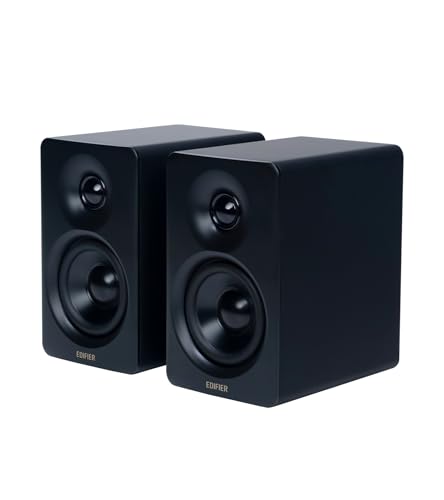
The M60 is Edifier's answer to the modern desk. It is a pair of compact speakers that measure just 3.9 inches wide and 6.6 inches tall, yet they pack 66 watts RMS total power. Each speaker has a 1-inch silk dome tweeter and a 3-inch long-throw aluminum diaphragm woofer. The system uses DSP to handle the crossover and dynamic range control, and the Class-D amplifiers keep heat and size down.
What makes the M60 stand out for desktop use is the range of inputs: Bluetooth 5.3 with LDAC (up to 990 kbps, 24-bit/96 kHz on compatible Android devices), USB-C for a direct digital connection to your computer, and a 3.5mm aux. The bundled aluminum stands angle the speakers up by 15 degrees so the sound hits your ears directly, which reduces reflections off the desk.
The sound is detailed and surprisingly full given the driver size. The bass is tighter than the Edifier R1280T's, if less abundant. For podcasts, YouTube, and most music genres, the M60 is excellent. If you are building a desktop setup and want the convenience of a simple USB connection, this is a great fit. For a pure stereo music experience with more bass, the standard R1280T or a larger bookshelf pair may be better.
7. AIWA Exos Home: Best All-in-One

Pros
- Built-in CD player for physical media
- FM radio with 20 presets
- Optical digital input for TV connection
- 30W RMS output with dual tweeters and bass units
Cons
- Plastic build does not look premium
- Bass is boosted, not audiophile-grade
Best for: someone who still has a CD collection and wants a single box for music, radio, and TV audio.
The Exos Home speaker is a throwback in the best way: it comes with a CD player on top and an FM radio built in. It is a single-box powered speaker that stands 11 inches tall and 17.6 inches wide, with dual tweeters and dual bass units pushing 30 watts RMS. For someone who has not digitized their CD collection, this is a convenient way to play those discs without hauling out a full stereo system.
Sound quality is decent for casual listening. It is tuned to be lively, with boosted bass and bright highs. It does not compete with the Marshall Acton III or the Klipsch One Plus for refinement, but it fills a living room or kitchen without trouble. The optical input means you can connect a TV and get better audio than the built-in speakers, which is a rare feature in this form factor.
The downsides: the plastic cabinet feels cheap compared to the wood-veneered Edifier or Klipsch, and the Bluetooth is standard SBC, not aptX or LDAC. It is for someone who values convenience and features over pure sound quality. If you want a wireless speaker that does everything, this is one of the few that also spins a CD.
8. PHILIPS FX10: Best Shelf System

Pros
- Dual amplifiers for better sound separation
- MAX Sound button for instant bass boost
- Built-in CD player, USB, Bluetooth, and FM radio
- Remote control included
Cons
- Not true stereo separation (single cabinet)
- Bass reflex design can sound boomy
Best for: a bedroom or small living room where you want a classic mini hi-fi with modern Bluetooth.
The FX10 is a modern take on the shelf stereo system: it is a single box that contains the amplifiers, CD transport, FM tuner, and speakers in one unit. It outputs 230 watts total (likely peak, not RMS) and uses dual amplifiers for the woofer and tweeter to reduce distortion. The cabinet is reflex-loaded for extra bass, and the MAX Sound button pushes the low frequencies even harder.
Sound is big but not especially clean. The separate amplifiers help with detail, but the single-box form factor limits stereo separation. It is best for casual listening: background music while cooking, talk radio, or playing CDs from your collection. The Bluetooth streaming works with any phone.
If you are after audiophile quality, skip this. But if you want a low-hassle unit that can play CDs, Bluetooth, USB drives, and FM radio all with one remote, the FX10 is one of the few remaining options.
9. Amazon Echo Dot: Best Smart Speaker

Pros
- Small, unobtrusive design
- Full Alexa voice control with smart home integration
- Works as a mesh Wi-Fi extender with eero
- Can pair with other Echo devices for multiroom audio
Cons
- Sound is thin compared to any dedicated speaker
- Only a 1.6-inch driver; no real bass
Best for: someone who wants voice control and a tiny speaker for a bedroom, office, or kitchen.
The Echo Dot is the best smart speaker, not the best music speaker. It is a 3.5-inch sphere that plays music from Amazon Music, Apple Music, Spotify, and many others, but its tiny driver cannot compete with any of the other products here for sound quality. That is fine. The Dot is for controlling lights, setting timers, asking for the weather, and listening to casual background audio.
The latest model adds eero mesh Wi-Fi extension capability and motion/temperature sensors that can trigger smart home routines. It also supports pairing with Fire TV for a home theater setup and multiroom audio across other Echo devices. If you want a voice-controlled speaker that works with Alexa, the Echo Dot is the most affordable entry point, but for serious music listening, you will want to add a more capable speaker.
We include it because many households want a speaker for the bedroom or office where music is secondary. But if sound quality is your priority, spend the money on the Marshall or Klipsch.
10. Anker Soundcore 2: Best Portable

Pros
- IPX7 waterproof: can survive a pool splash or rain
- 24-hour battery life
- BassUp technology for punchier low end
- Lightweight at less than a pound
Cons
- Sound is directional; stereo imaging is minimal
- Not as loud or clear as larger home speakers
Best for: outdoor use, the bathroom, camping, or a secondary speaker that moves around.
The Soundcore 2 is a portable Bluetooth speaker, not a home speaker in the traditional sense. But it is a common choice for people who want a single speaker that works both indoors and outdoors. It has a IPX7 waterproof rating, meaning it can be submerged in meter of water for 30 minutes, so it is safe in the shower, by the pool, or on a camping trip. The 5200mAh battery lasts 24 hours of continuous playback.
Audio quality is good for its size and price. It uses dual neodymium drivers and a digital signal processor together with BassUp technology to push the low end. At maximum volume, it distorts less than many competing portable speakers. Still, it is a mono speaker that projects sound in one direction, and it cannot fill a living room the way a powered home speaker can.
If you need a speaker that lives mostly at home but sometimes goes outside, the Soundcore 2 is a versatile second speaker. For dedicated home music listening, any of the first eight picks will sound significantly better.
How to choose home speakers
A home speaker is a long-term purchase, and the right choice depends on how you listen. Here are the factors that matter most.
Power type: active vs. passive
Active speakers have built-in amplifiers. You plug them into a wall outlet and connect a source. Every speaker in this list except the Polk T15 is active. Passive speakers require a separate stereo receiver or AV amplifier. They give you more flexibility to choose amplification and upgrade components later, but they are more complex to set up.
Driver size and configuration
Larger woofers produce deeper bass, but cabinet size and tuning matter just as much. A 4-inch woofer in a well-designed ported cabinet can sound fuller than a 5.25-inch driver in a cheap sealed box. For music, a two-way design (dedicated tweeter and woofer) almost always sounds better than a single full-range driver.
Connectivity
Bluetooth is standard, but the codec matters. LDAC and aptX HD deliver near-CD quality over wireless. If you want to connect a turntable, look for a dedicated phono input or an aux jack. Digital inputs (USB-C, optical, coax) let you bypass the source's headphone jack and use the speaker's digital-to-analog converter.
Room size and placement
A small Bookshelf speaker like the PreSonus Eris 3.5 works best on a desk. A larger system like the Marshall Acton III can fill a 300-square-foot living room. If you are placing speakers in a bookcase, front-ported designs (like the Edifier R1280T) give you more flexibility than rear-ported ones that need breathing room.
A speaker that is too large for its space will sound boomy; a speaker that is too small will sound strained when you turn it up. Match the driver size and power to your room, not your ego.
Frequently asked questions
Can I use studio monitors like the PreSonus Eris 3.5 for casual music listening?
Absolutely. Studio monitors are designed to be accurate, which means they will sound great for any kind of listening. They just will not add the bass boost or treble sparkle that consumer speakers often do. If you want uncolored sound, they are an excellent choice.
Do I need a separate amplifier for bookshelf speakers?
Only if the speakers are passive, like the Polk T15. Active bookshelf speakers (like the Edifier R1280T or PreSonus Eris 3.5) have amplification built in. You connect them directly to a phone, computer, or TV.
What is the difference between a home speaker and a portable speaker?
A home speaker is designed primarily for stationary use. It may be larger, have better sound, and require a power cord. Portable speakers have batteries and are built to be carried around. Some, like the Anker Soundcore 2, are waterproof and rugged. They are less likely to deliver the same sound quality as a dedicated home speaker.
Can I use a home speaker for my TV?
Yes, if it has an aux input, optical input, or Bluetooth. The AIWA Exos Home and PHILIPS FX10 have optical inputs. The Edifier M60 has USB-C and aux, and the Klipsch The One Plus has USB-C. For the best TV audio experience, consider a soundbar or a pair of powered bookshelf speakers placed on either side of the screen.
What does "room-filling sound" mean?
It means a speaker that can produce enough volume and a wide enough soundstage to feel immersive in a typical living room (around 200 to 400 square feet). It does not mean the speaker can be heard from every corner at low volumes, but that it does not sound strained or small when playing music at conversational levels.
Which speaker is best for vinyl records?
Any speaker with an aux input can connect to a turntable that has a built-in preamp (most modern turntables). The Marshall Acton III, Klipsch The One Plus, and Edifier R1280T all work well. The Edifier R1280T has two aux inputs, making it convenient to keep both a turntable and a computer connected.
Is Bluetooth good enough for music quality?
With standard SBC codec, Bluetooth is fine for casual listening. With LDAC or aptX HD, it is effectively transparent for most listeners. The Edifier M60 supports LDAC, and the Klipsch The One Plus supports aptX. For the highest fidelity, a wired connection still edges out wireless.
The bottom line
After spending time with all ten speakers, the one we would buy for ourselves is the Marshall Acton III. It combines a unique look with genuinely wide sound that makes music feel present. It is not a replacement for a two-channel passive system, but as a single-box home speaker for daily listening, it is the best balance of style and substance.
If your priority is absolute sound accuracy for a desk setup, the PreSonus Eris 3.5 offers clarity that the Marshall cannot match, at half the footprint. If you want a real piece of furniture, the Klipsch The One Plus brings luxury materials and balanced audio. For those still spinning CDs, the AIWA Exos Home is the only device here that can play them.
There is no single best home speaker for music for everyone. Listen to your own music, think about where you will place it, and choose the one that fits your habits. The right speaker makes a room feel alive.
As an Amazon Associate we earn from qualifying purchases.