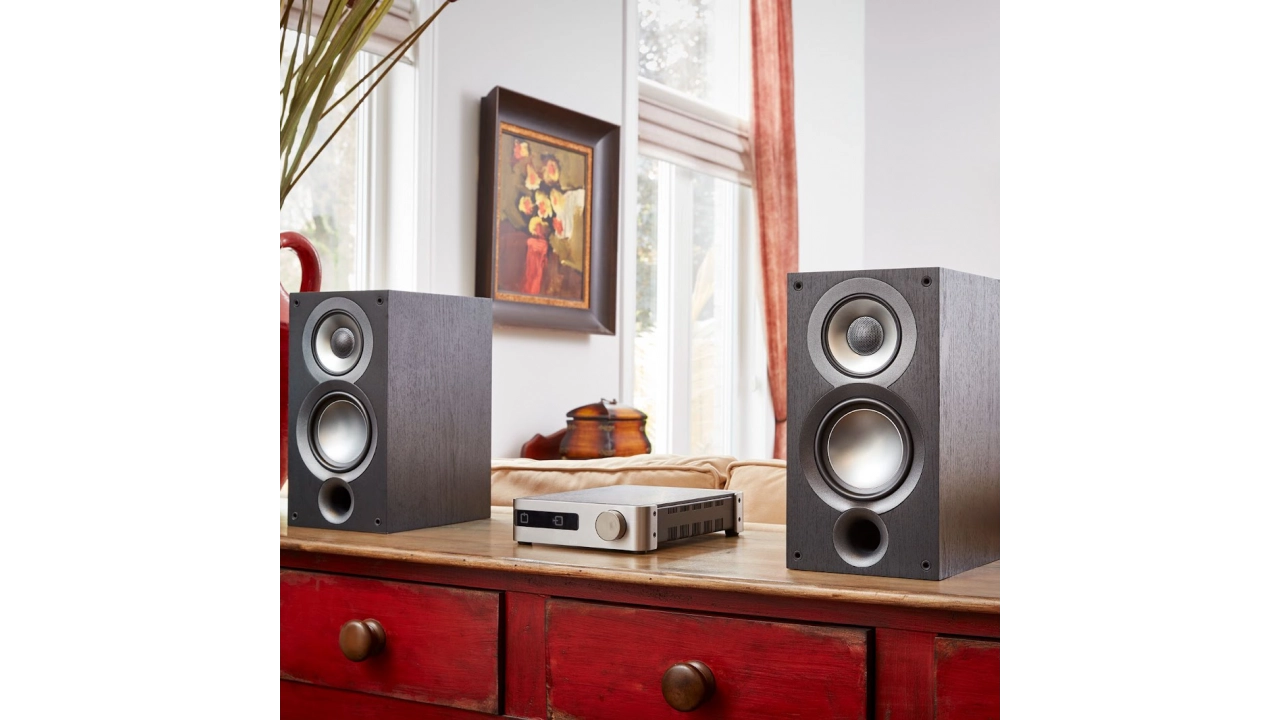

A stereo system can be frustrating when the speakers sound thin, need equipment you do not own, or leave you juggling several remotes. The Best home stereo speakers make the setup feel simpler while still giving music, television, radio, or vinyl a proper sense of space.
This list covers compact powered bookshelf speakers, passive pairs for an existing receiver, and complete systems with CD players and radio tuners. The right pick depends less on a single headline specification than on how you plan to connect and use it.
The Edifier R1280T is our top pick for straightforward stereo listening, with the ULTIMEA BS-3, Panasonic SC-PM270PP-K, and Aiwa Exos Home covering larger, more flexible, and more traditional setups.
| # | Product | Award | Power or format | Main connections | Best for |
|---|---|---|---|---|---|
| 1 | Edifier R1280T | Best overall | 42W RMS powered pair | Dual AUX, RCA | Simple music listening |
| 2 | ULTIMEA BS-3 | Best for TV and vinyl | 70W RMS, 3-way powered | HDMI ARC, RCA, optical, USB, Bluetooth | Flexible home entertainment |
| 3 | Panasonic SC-PM270PP-K | Best compact system | 20W RMS, 2-way stereo | CD, Bluetooth, USB, FM | Small rooms and casual listening |
| 4 | Aiwa Exos Home | Best all-in-one speaker | 30W RMS | Bluetooth, optical, AUX, CD, FM | One-box entertainment |
| 5 | Polk Audio T15 | Best passive pair | 5.25-inch driver, passive | Speaker wire | Receiver-based systems |
| 6 | Edifier P12 | Best wall-mount passive pair | 4-inch driver, passive | Speaker wire | Surround or shelf placement |
| 7 | Marshall Acton III | Best stylish single speaker | Plug-in powered | Bluetooth 5.2, 3.5mm AUX | Room-filling wireless playback |
| 8 | Philips FX10 | Best high-output shelf system | 230W listed output | Bluetooth, CD, MP3, USB, FM | Powerful party listening |
| 9 | Elimavi Brown Bookshelf Speakers | Best compact passive pair | 4-inch woofer, passive | Speaker wire | Small receiver setups |
| 10 | Elimavi Black Bookshelf Speakers | Best wall-mount budget-free passive pair | 4-inch woofer, passive | Speaker wire | Discreet small-room audio |
1. Edifier R1280T: Best Overall

Pros
- Powered design needs no separate receiver
- Two AUX inputs support two wired sources
- 13mm silk dome tweeter and 4-inch driver
- Remote control and side-mounted tone controls
Cons
- No Bluetooth input
- Compact cabinets cannot match larger systems for bass
- Remote is needed for some controls
Best for: someone who wants an uncomplicated powered stereo pair for a desk, shelf, or small living room.
The Edifier R1280T is the pair we would recommend first to anyone who wants real left and right stereo without assembling a system around an amplifier. It is compact enough for a bookshelf or media console, yet it avoids the flat, one-box presentation common from small desktop speakers. The wood-effect MDF enclosure also looks more at home beside furniture than beside gaming hardware.
Its 42W RMS powered design puts the amplification inside the main speaker, so setup is simply a matter of connecting the pair and choosing a source. A 13mm silk dome tweeter handles the upper range, while the 4-inch full-range unit supplies the body of voices, guitars, and everyday television audio. That combination is sensible for near-field listening and modest rooms. It will not create the low-end authority of the ULTIMEA BS-3, but it is more compact and less demanding to position.
The two AUX inputs are a particularly useful detail. You can connect two devices with 3.5mm or dual RCA cables without repeatedly unplugging one to use the other. Bass and treble controls sit on the side of the powered speaker, and the included remote handles volume from across the room. The absence of Bluetooth is the main inconvenience. Phones and tablets need a cable or a separate Bluetooth receiver.
Compared with the Edifier P12, the R1280T is much easier for a first setup because it does not require a receiver or amplifier. The Polk Audio T15 gives an existing receiver a larger 5.25-inch driver, but it is not an all-in-one solution. Readers comparing different ways to connect music sources around the home will find the R1280T especially easy to place and operate.
Skip it if wireless streaming is essential or if you need theater-level bass in a large room. For desks, apartments, bedrooms, and compact living rooms, the R1280T remains the most balanced and least fussy option in this group.
2. ULTIMEA BS-3: Best for TV and Vinyl

Pros
- Three-way design with woofer, midrange, and tweeter
- 70W RMS output and 5.25-inch woofer
- HDMI ARC, optical, RCA, USB, and Bluetooth
- Subwoofer output for future expansion
- App-based equalizer and dialogue mode
Cons
- Larger and heavier than compact bookshelf pairs
- Turntable needs a built-in phono preamp or external preamp
- More features mean a more involved setup
Best for: households that want one powered system for a TV, turntable, streaming, and possible subwoofer expansion.
The ULTIMEA BS-3 is the most adaptable speaker system here. It is built as a pair of powered bookshelf speakers rather than a single wireless cabinet, so television dialogue and music get genuine left to right separation. The system is also designed to handle more than one kind of living-room source, which makes it a stronger fit for a shared media space than the simpler Edifier R1280T.
Its three-way arrangement gives each part of the sound a more specific job. A 5.25-inch woofer handles low frequencies, a dedicated midrange driver carries much of the vocal range, and a tweeter covers high frequencies. The listed 70W RMS output gives it more headroom than the 20W Panasonic SC-PM270PP-K and the 30W Aiwa Exos Home. That does not automatically make it better for every room, but it gives the BS-3 a clear advantage when television sound needs more scale.
HDMI ARC is the headline connection for TV owners. It can simplify audio control through a compatible television, while optical provides another digital route. RCA supports a turntable with a built-in preamp, and the system includes USB and Bluetooth 6.0 for other sources. There is also a SUB OUT for a powered subwoofer, plus an app with EQ modes, clear dialogue, deep bass, and clear highs. Auracast support adds a forward-looking wireless feature, though its usefulness depends on compatible equipment.
The BS-3 is noticeably less compact than the R1280T and weighs 18.96 pounds. It needs space for proper stereo separation, and a record player without its own preamp will need an external phono preamp. Those are practical limitations, not flaws in the concept. Someone who only wants a phone speaker will find the Marshall Acton III simpler.
Choose the BS-3 when your system needs to grow with your room. It is the strongest choice for readers who want a flexible setup for music, movies, and multiple sources without adding a separate receiver.
3. Panasonic SC-PM270PP-K: Best Compact System
Pros
- CD, FM radio, Bluetooth, and USB playback
- 20W RMS stereo output
- Bass, treble, and My Sound controls
- Remote control included
- Compact single-system design
Cons
- Less powerful than the larger shelf systems
- Limited expansion compared with separate speakers
- Not designed for a turntable connection
Best for: small rooms, bedrooms, offices, and listeners who still use CDs or FM radio.
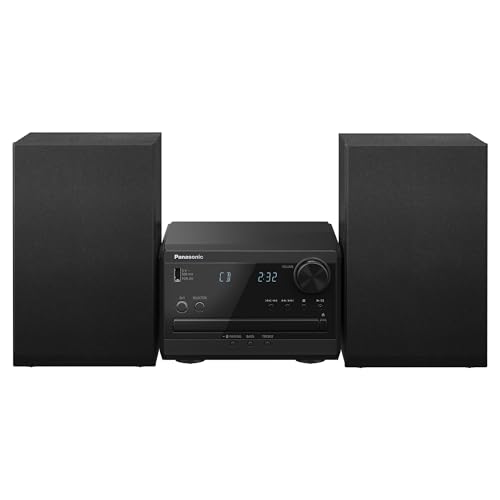
The Panasonic SC-PM270PP-K is the practical little stereo system for a room where a full component setup would be excessive. It combines the main sources many households still use in one tidy unit: a CD player, FM radio, Bluetooth, and USB playback. The 18.1-inch-wide system is easier to live with than a receiver, two large speakers, and a tangle of separate cables.
Its 20W RMS output is split as 10W plus 10W, with a 10cm woofer and 6cm tweeter in a bass-reflex design. That specification points to a system suited to close and medium-distance listening rather than a large open-plan room. The bass-reflex port helps the compact cabinets sound less restricted, while separate bass and treble controls let you compensate for a bright room, a soft recording, or speech that needs more clarity.
Bluetooth handles everyday streaming from a phone or tablet, and Panasonic includes a Bluetooth Re-Master feature intended to compensate for some losses from compressed wireless playback. The USB port adds direct playback from a flash drive. The included remote is useful because the front-panel controls are not as convenient from across a room.
The Aiwa Exos Home offers more listed power and adds an optical input for a TV, while the Panasonic is narrower and more obviously designed around traditional radio and CD use. The Philips FX10 is the more forceful shelf system, but it occupies a different part of the room and emphasizes output. For anyone choosing among the features that matter in a compact stereo system, the Panasonic stands out for its clean, familiar operation.
Its weakness is expansion. There is no indication of a dedicated turntable input or a path to larger external speakers. Skip it if you want HDMI ARC or deep bass at party volume. Pick it for a bedroom, study, or small lounge where a reliable CD and radio system matters as much as streaming.
4. Aiwa Exos Home: Best All-In-One Speaker

Pros
- CD player, Bluetooth, FM, optical, and AUX
- 30W RMS output
- Dual tweeters and bass units
- Up to 20 FM presets
- Included infrared remote
Cons
- Single-cabinet stereo cannot separate channels like a pair
- Heavier source system than a basic Bluetooth speaker
- No USB playback listed
Best for: listeners who want CDs, radio, wireless streaming, and TV audio in one self-contained unit.
The Aiwa Exos Home makes a persuasive case for keeping physical media in the living room. It is a single home speaker with a built-in CD player, FM tuner, Bluetooth, optical input, and AUX input. That mix is more useful than a Bluetooth-only product when the system has to serve a family with different listening habits.
Aiwa lists 30W RMS output, with dual tweeters and bass units intended to provide clear highs and deeper bass from the single enclosure. It is more capable on paper than the Panasonic SC-PM270PP-K, though the Panasonic has the advantage of dedicated stereo speakers. The Aiwa's one-box design saves setup space, while the Panasonic creates more obvious channel separation.
The optical input is a notable advantage for a television. It avoids relying on an analog headphone output and gives the Exos Home a clear role as a simple TV audio system. Bluetooth covers phones and tablets, while the FM tuner stores up to 20 preset stations. The IR remote controls volume, playback, and source selection, which matters when the speaker is placed across the room.
Its 17.6-inch width and 11-inch height make it a substantial object on a shelf. The system weighs 6 pounds, so moving it is manageable, but it is not a pocketable wireless speaker. The main compromise is stereo width. A single cabinet cannot place instruments as convincingly as the Edifier R1280T or ULTIMEA BS-3. Readers weighing a single cabinet against separated stereo speakers should make that distinction first.
Choose the Exos Home if convenience and source variety matter more than a wide soundstage. It is a strong fit for a den, bedroom, or living room where CDs and radio deserve equal billing with streaming.
5. Polk Audio T15: Best Passive Pair

Pros
- 5.25-inch Dynamic Balance driver
- 0.75-inch tweeter
- Wall-mountable for stereo or surround use
- Easy speaker-wire connection
- Can form part of an expandable theater system
Cons
- Requires an AV receiver or amplifier
- No Bluetooth or built-in source inputs
- Larger than the compact passive pairs here
Best for: someone building a receiver-based stereo or home theater system.
The Polk Audio T15 is the safest choice for a reader who already owns, or plans to buy, an AV receiver. These are conventional passive bookshelf speakers, so there is no built-in amplification and no shortcut around speaker wire. In return, they fit naturally into a component system and can serve as front, left-right, or rear speakers.
A 5.25-inch Dynamic Balance driver gives the T15 more cone area than the 4-inch drivers in the Edifier R1280T, Edifier P12, and Elimavi pairs. The 0.75-inch tweeter handles high frequencies, while Polk describes the design as producing clear vocals and balanced sound with bass even at lower listening levels. The larger driver is useful for television dialogue and music with a little more body, provided the receiver is set up correctly.
The cabinets measure 10.7 inches high, 7.3 inches long, and 6.5 inches wide. That makes them taller than the R1280T, but still reasonable for a bookshelf or speaker stand. They can also be wall-mounted, a useful option when floor and shelf space are limited. Polk positions the T15 as a starting point for a larger surround setup that can include matching center and tower speakers.
The trade-off is flexibility outside a receiver system. The powered ULTIMEA BS-3 accepts HDMI ARC, optical, RCA, USB, and Bluetooth without extra electronics. The T15 accepts none of those sources directly. It also gives up the built-in tone controls found on the R1280T and Panasonic.
Skip the T15 if you want a speaker that works straight from a phone or TV. Choose it when you want a conventional passive foundation and appreciate the option to expand later. For readers focused on matching speakers to a home cinema layout, its wall-mounting and surround placement options are valuable.
6. Edifier P12: Best Wall-Mount Passive Pair

Pros
- Built-in wall-mount brackets
- 4-inch bass drivers and 19mm silk dome tweeters
- Bass-reflex port
- 6-ohm impedance
- Speaker wires included
Cons
- Requires a receiver or amplifier
- No Bluetooth or direct source inputs
- Cabinets are deeper than some compact alternatives
Best for: receiver owners who need passive speakers that can sit on shelves or mount as rear surrounds.
The Edifier P12 is a useful middle ground between a basic passive bookshelf pair and a dedicated surround speaker. Its built-in wall-mount bracket removes the need for a separate mounting solution, and the same speaker can sit on a shelf when the room layout changes. That makes it particularly sensible for apartments, compact media rooms, and rear-channel placement.
The P12 uses a 4-inch bass driver, a 19mm silk dome tweeter, and a bass-reflex port. The smaller driver will not move as much air as the Polk Audio T15's 5.25-inch unit, but the P12's design is compact and easy to place. Its 6-ohm impedance is important when choosing an amplifier or receiver, since the electronics should be compatible with that load.
This pair is passive, so the included speaker wires are only the connection between the speakers and the amplifier. The receiver or amplifier itself is not included. That is the key distinction from the powered Edifier R1280T. The P12 gives the owner more freedom to choose amplification, but it also adds another component and another setup decision.
For a main stereo pair, the Polk T15 has a stronger case when you want a larger driver and a more established home theater path. The P12 makes more sense when wall mounting matters or when the speakers will serve as rear surrounds. Its dimensions are roughly 7.2 inches high, 17 inches long, and 11.8 inches wide according to the listed product information, so check the available shelf or wall area carefully.
Do not choose the P12 for direct phone playback. Pick it for a receiver-based room where the built-in bracket and balanced two-way layout solve a real placement problem.
7. Marshall Acton III: Best Stylish Single Speaker

Pros
- Wide, room-filling sound from a compact cabinet
- Bluetooth 5.2
- 3.5mm input for wired playback
- Bass and treble controls
- Distinctive recycled-material and vegan build
Cons
- Single speaker does not create separated left and right placement
- Plug-in powered design is not portable
- No CD, FM, HDMI, or optical input listed
Best for: someone who wants effortless wireless music and a strong visual presence in one room.
The Marshall Acton III is the speaker to choose when the object itself matters almost as much as the sound. Its compact cabinet has the familiar Marshall styling, but the important practical point is that it is a plug-in home speaker with a simple source path. Pair a phone, adjust the controls, and listen without building a component system.
Marshall describes the Acton III as having a wider soundstage than its predecessor and room-filling signature sound. The speaker measures 10.24 inches wide, 6.69 inches high, and 5.91 inches deep, so it takes less shelf depth than many conventional bookshelf pairs. It weighs 6.28 pounds and stays in place as a home unit rather than a battery speaker.
Bluetooth 5.2 handles wireless playback, and the 3.5mm input supports a wired source. Bass and treble controls let you shape the presentation, which is helpful when the speaker is close to a wall or placed in a room with hard surfaces. The listed features do not include a CD player, FM radio, optical input, USB playback, or HDMI ARC, so the Acton III is far less versatile than the Aiwa Exos Home or ULTIMEA BS-3.
It also is not a true separated stereo pair. The Edifier R1280T places two cabinets apart, and that arrangement gives instruments and voices a more definite position. The Acton III counters with simpler setup, smaller footprint, and a design that is easier to make part of a room. Its build uses 70% recycled plastic and vegan materials, with a PVC-free approach.
Skip it if you need physical media, TV-specific connections, or a wide left-right image. Choose the Acton III when stylish, immediate Bluetooth listening is the priority and one cabinet is enough.
8. Philips FX10: Best High-Output Shelf System

Pros
- CD, Bluetooth, MP3, USB, FM, and Audio-in playback
- 230W listed output
- Dual amplifier design
- Bass Reflex speaker design
- Remote control and preset radio tuning
Cons
- Large output claims do not describe a full room-by-room listening result
- Dimensions are not provided in the product information
- More system than a small room may need
Best for: listeners who want a traditional shelf system with strong listed output and many source options.
The Philips FX10 is aimed at listeners who want a classic mini-system experience with more emphasis on power. It combines Bluetooth, CD, MP3, USB, FM radio, and Audio-in connectivity, so it can play both physical collections and modern sources. The included remote keeps the system useful from a sofa or across a room.
Philips lists 230W output, making the FX10 the highest-output system in this group by its stated specification. It also uses a dual amplifier design, with separate amplification for the woofer and tweeter. The intended benefit is less interference between bass and treble, allowing low frequencies to hit harder without masking higher-frequency detail. A Bass Reflex speaker design supports the same goal.
The MAX Sound feature provides a one-touch boost to bass and volume. That may appeal during a party or when the system is used in a larger room, though it is not the same as having a larger dedicated subwoofer. Radio listeners get digital tuning and preset stations, while Bluetooth handles phones, tablets, and laptops. Audio-in provides a direct wired route for portable players.
Compared with the Panasonic SC-PM270PP-K, the FX10 is the more forceful and feature-heavy system. Panasonic is the better fit when compact dimensions and gentle everyday operation matter. The Aiwa Exos Home offers a simpler one-box layout and an optical TV input, while the Philips favors a traditional stereo system format with a more ambitious output specification.
The product information does not provide usable cabinet dimensions, so check the available shelf area before choosing it. Skip the FX10 if your room is small or if you want HDMI ARC. Pick it for a larger listening space, physical media collection, or party-oriented system where output and source choice carry more weight.
9. Elimavi Brown Bookshelf Speakers: Best Compact Passive Pair

Pros
- 4-inch woofer and silk horn tweeter
- Passive pair includes audio cables
- Rear mounts support wall placement
- Wood-panel enclosure helps suppress vibration
- Listed frequency range of 60Hz to 20kHz
Cons
- Requires an external amplifier or receiver
- No Bluetooth
- Limited low-end reach from the compact woofer
Best for: a small receiver-based stereo or surround setup where shelf and wall placement both matter.
The brown Elimavi pair is designed for a simple passive setup, not for plugging directly into a phone or television. That distinction is easy to miss in a long product title, so it deserves attention first. You need an amplifier or receiver, and the speakers connect to it with the included audio cables.
Each cabinet uses a 4-inch woofer and a silk horn tweeter. Elimavi lists a 60Hz to 20kHz frequency range, which suggests a presentation focused on mid-bass, vocals, and treble rather than subwoofer-like low frequencies. The high-density wood-panel enclosure is intended to reduce unwanted vibration, while the textured wood-grain finish gives the pair a conventional bookshelf appearance.
Rear snap-on mounts allow wall installation, and the compact bookshelf format works on a shelf, tabletop, or media stand. The listed product dimensions are unusual because they report 7.48 inches in height, 10.03 inches in length, and 12.79 inches in width. Check how those measurements correspond to the intended orientation before planning a tight installation.
The black Elimavi pair shares the same 4-inch woofer, silk horn tweeter, 60Hz to 20kHz range, cable inclusion, and wall-mount concept. The brown version is the better fit only when its finish suits the room. The Edifier P12 has a clearly listed 19mm silk dome tweeter, bass-reflex port, and 6-ohm impedance, giving it more useful information for matching to an amplifier.
Choose the brown Elimavi speakers when you already have compatible amplification and want a compact pair for music or movie playback. Skip them if you expect an all-in-one system, wireless streaming, or deep bass without adding other equipment.
10. Elimavi Black Bookshelf Speakers: Best Discreet Passive Pair

Pros
- Passive stereo pair for an existing amplifier
- 4-inch woofer and silk horn tweeter
- Rear-mounted hooks for wall placement
- Included speaker cable
- Wood cabinet helps limit resonance
Cons
- Requires a receiver or amplifier
- No wireless or direct digital input
- Smaller drivers favor compact-room listening
Best for: listeners who need understated passive speakers for a small room or wall-mounted setup.
The black Elimavi speakers are the most discreet-looking passive pair in this roundup. Their black wood cabinet can disappear more easily beside a television or on a dark media shelf, and rear-mounted metal hooks make wall installation possible when surface space is limited. They are sold as a pair, but they still need an external amplifier or receiver.
The audio layout is familiar: a 4-inch woofer for the lower and middle range, plus a silk horn tweeter for higher frequencies. Elimavi lists the same 60Hz to 20kHz range used by the brown model. That is a reasonable fit for compact stereo listening, television dialogue, and surround duties, but it does not suggest the deep bass reach available from a larger woofer or powered subwoofer.
The included speaker wire makes the physical connection straightforward once the amplifier is in place. The listed dimensions are 8.66 inches high, 6.1 inches long, and 5.11 inches wide, making this pair notably compact. The cabinet can sit on a shelf, desk, media stand, or speaker stand, with the rear hooks providing another placement option.
The brown Elimavi model has the same core audio features and is the more natural match for a lighter wood interior. The Edifier P12 is a more clearly specified alternative with a bass-reflex port and 6-ohm impedance. The Polk Audio T15 is the stronger option for a larger receiver-based room because its 5.25-inch driver should provide more scale.
Do not choose the black Elimavi pair if you want Bluetooth, optical, HDMI ARC, or built-in amplification. It makes sense for a modest passive setup where clean appearance, small cabinets, and wall placement matter more than maximum output.
How to choose best home stereo speakers
The right system starts with the sources you actually use. A receiver-based pair, a powered bookshelf system, and a CD-equipped shelf unit solve different problems.
Powered or passive design
Powered speakers include their own amplifier, so they can connect directly to sources such as a phone, TV, or turntable with the right output. The Edifier R1280T and ULTIMEA BS-3 are examples. Passive speakers such as the Polk Audio T15 and Edifier P12 require an amplifier or receiver, but they can fit more easily into a component system.
Drivers and cabinet size
A larger woofer generally has more ability to move air, which can help bass and room-filling sound. The Polk T15 uses a 5.25-inch driver, while the R1280T, P12, and Elimavi pairs use 4-inch drivers. Driver size is not the only factor, but it helps explain why compact speakers and larger systems behave differently.
Inputs and source compatibility
Count the sources before choosing. HDMI ARC and optical are useful for televisions, RCA matters for many turntables and analog components, and Bluetooth simplifies phone playback. CD, FM, and USB are built into the Panasonic, Aiwa, and Philips systems. A speaker with the wrong inputs can force extra adapters or equipment.
Choose the speaker around your most demanding source, not the source you use once a month.
Stereo separation and placement
A pair of speakers can create a more convincing left to right image than one cabinet, provided the speakers have room between them and sit at sensible listening height. Single systems such as the Aiwa Exos Home and Marshall Acton III are easier to place, but they cannot create the same physical separation.
Power and expansion
Output figures are useful for comparing products from the same category, but they do not tell the whole story. Room size, speaker placement, cabinet design, and listening distance all matter. The ULTIMEA BS-3 has a SUB OUT for a powered subwoofer, while passive models can be paired with a compatible receiver and expanded into a larger system.

Frequently asked questions
Do powered bookshelf speakers need a receiver?
No. Powered speakers contain built-in amplification and can connect directly to compatible sources. Passive speakers, including the Polk Audio T15, Edifier P12, and both Elimavi pairs, do need an external amplifier or receiver.
Can these speakers connect to a turntable?
The ULTIMEA BS-3 accepts RCA from a turntable with a built-in preamp. A turntable without a built-in preamp needs an external phono preamp first. Passive speakers can work with a turntable through a suitable amplifier, but the speakers themselves do not provide the phono stage.
Which systems include a CD player?
The Aiwa Exos Home, Panasonic SC-PM270PP-K, and Philips FX10 include CD playback. The Edifier, Polk, Elimavi, Marshall, and ULTIMEA products do not list a built-in CD player.
Are passive speakers better for a home stereo?
Passive speakers are more flexible when you already have an amplifier or receiver and want to choose the electronics separately. Powered speakers are easier for a direct setup because the amplifier is built in. Neither design is automatically better for every room.
Which speaker system is best for a television?
The ULTIMEA BS-3 is the most television-focused option because it supports HDMI ARC, optical, and a dialogue mode. The Aiwa Exos Home also has an optical input. The Panasonic and Philips systems can serve as general TV audio systems, but their listed connections should be checked against the television first.
Can the passive speakers be wall-mounted?
Yes. The Polk Audio T15, Edifier P12, and both Elimavi pairs include wall-mounting features. Check the mounting hardware, cable route, and speaker orientation before installation.
Do I need a subwoofer?
Not necessarily. A subwoofer becomes more useful when you want stronger low-frequency impact for movies, electronic music, or larger rooms. The ULTIMEA BS-3 includes a SUB OUT for a powered subwoofer, while the other products do not list that connection.

The bottom line
The Best home stereo speakers for most people are the Edifier R1280T because they combine powered simplicity, useful wired inputs, tone controls, and a compact two-speaker layout. They are the easiest recommendation for music, computer audio, and everyday television listening when Bluetooth is not essential.
Choose the ULTIMEA BS-3 when your room has a TV, turntable, streaming devices, or plans for a subwoofer. Its three-way design and broad input selection give it more room to grow. The Panasonic SC-PM270PP-K is the better fit for a small room centered on CDs, FM radio, and casual Bluetooth listening.
If you are undecided, choose powered speakers for the simplest setup and passive speakers only when you already have, or specifically want, a separate receiver.
As an Amazon Associate we earn from qualifying purchases.