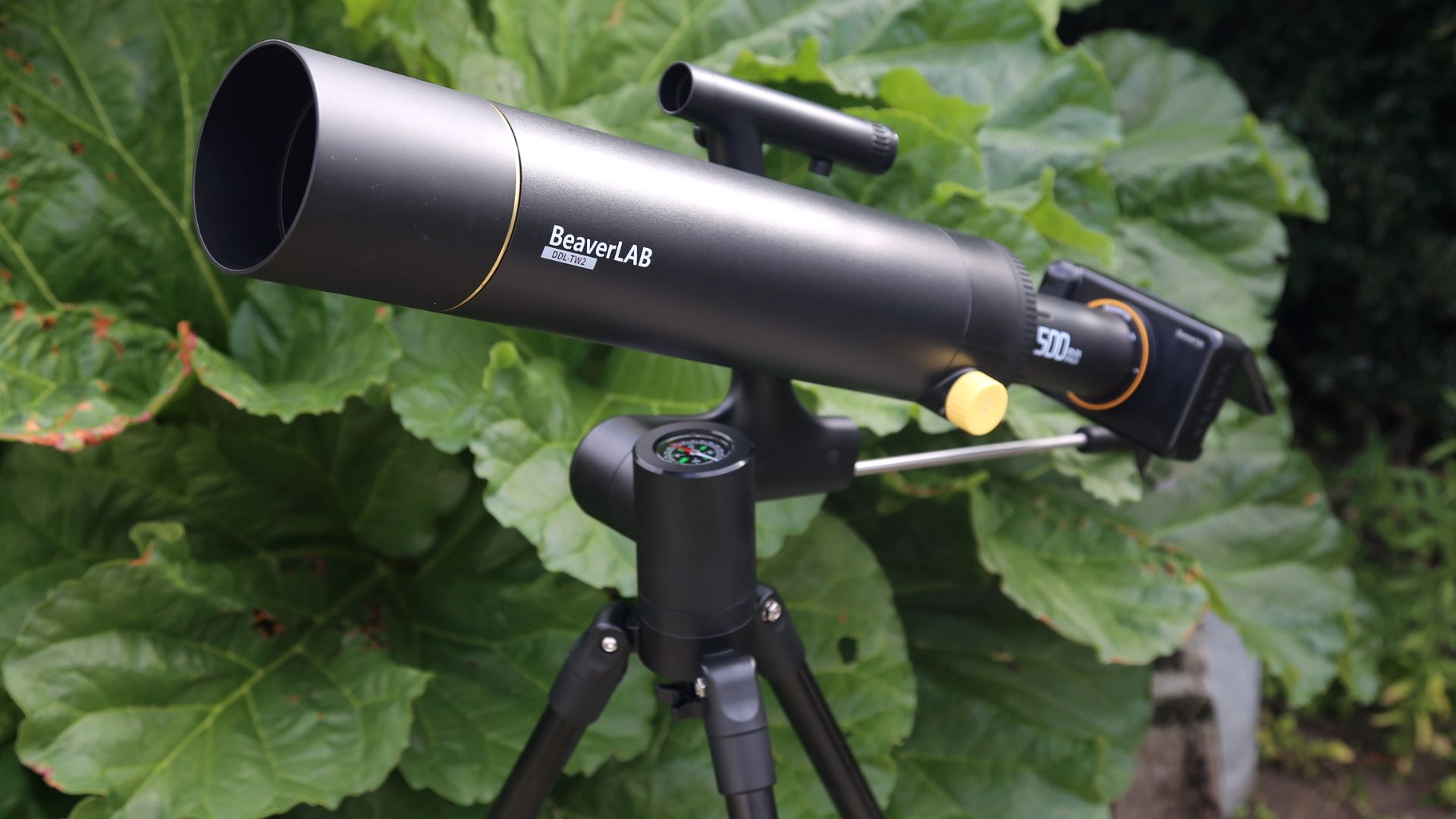

A telescope can turn a quiet backyard into a place to study lunar craters, Jupiter's cloud bands, or a bright nebula. The problem is that a large aperture does not help much if the mount shakes, the finder is frustrating, or setup takes longer than the clear skies last.
We compared ten genuine telescope options across simple refractors, large reflectors, computerized observatories, and phone-guided systems. The best home telescope for most beginners is the Celestron StarSense Explorer DX 130AZ, while the list also includes compact smart imaging, serious visual astronomy, and family-friendly starter scopes.
Comparison table
| # | Product | Award | Aperture | Mount or format | Best for |
|---|---|---|---|---|---|
| 1 | Celestron StarSense Explorer DX 130AZ | Best overall | 130mm reflector | Manual altazimuth with phone guidance | Beginners who want larger views without a GoTo system |
| 2 | Celestron NexStar 8SE | Best for serious visual astronomy | 8-inch Schmidt-Cassegrain | Computerized GoTo | Detailed planetary and deep-sky viewing |
| 3 | DWARFLAB Dwarf Mini | Best smart telescope | Digital telescope | App control with automated tracking | Portable imaging and easy target finding |
| 4 | Celestron Origin Mark II | Best for advanced imaging | 152mm astrograph | Intelligent observatory | Automated deep-sky imaging at home |
| 5 | Gskyer 130EQ | Best large manual reflector | 130mm reflector | German equatorial | Enthusiasts learning manual tracking |
| 6 | MEEZAA 90mm Refractor | Best long-focus refractor | 90mm refractor | Manual tripod mount | Lunar and planetary viewing |
| 7 | Celticbird 80mm Refractor | Best portable family scope | 80mm refractor | Manual altazimuth | Families who want a complete kit |
| 8 | Celestron StarSense Explorer LT 114AZ | Best guided starter reflector | 114mm reflector | Manual mount with phone guidance | New observers who need help finding targets |
| 9 | Celestron AstroMaster 70AZ | Best simple refractor | 70mm refractor | Manual altazimuth | Moon, planets, and daytime viewing |
| 10 | Gskyer 70mm AZ | Best travel kit | 70mm refractor | Manual altazimuth | Casual backyard and travel use |
1. Celestron StarSense Explorer DX 130AZ: Best Overall

Pros
- Phone guidance makes unfamiliar targets easier to find
- 130mm reflector gathers useful light for deep-sky objects
- Dual-axis slow-motion controls improve manual tracking
- Supports both city observing and darker-sky trips
Cons
- Manual tracking still takes practice
- The 18-pound setup is not a grab-and-go travel scope
- Phone guidance depends on having a compatible smartphone
Best for: beginners who want substantial views without handing control entirely to a computerized mount.
The Celestron StarSense Explorer DX 130AZ gets the central choice right: it provides the aperture to make astronomy interesting while keeping the observer involved. Its 130mm Newtonian reflector is substantially more capable than the 70mm refractors here, particularly when you move beyond the Moon to the Orion Nebula, Andromeda Galaxy, and brighter star clusters.
The phone dock and StarSense app solve the first frustrating problem for new observers: knowing where to point. The app analyzes star patterns, uses the phone's position to guide you, and indicates when the telescope is aimed at the selected target. That is different from a fully automated mount. You still move the telescope yourself, but the dual-axis slow-motion controls make small adjustments much more manageable than nudging a basic tripod.
Compared with the Celestron StarSense Explorer LT 114AZ, the DX 130AZ has a larger 130mm mirror and a more substantial mount. That extra aperture matters when targets are faint, while the DX version's two-axis controls are more useful once an object is in view. The Gskyer 130EQ can also gather a similar amount of light, but its German equatorial mount asks more of the beginner before the first satisfying session.
This is not the lightest telescope in the group. At 18 pounds, it is better suited to a backyard, patio, or planned dark-sky outing than spontaneous walks. The phone also has to remain correctly docked and usable in the dark, and manual tracking never becomes as effortless as GoTo. Readers mainly interested in automated imaging should look instead at the DWARFLAB Dwarf Mini or Celestron Origin Mark II.
For a first serious telescope, though, the DX 130AZ has the best balance of optical reach, guidance, and hands-on control. It is the one we'd choose for a family that wants to learn the sky rather than simply watch an app do everything.
2. Celestron NexStar 8SE: Best for Serious Visual Astronomy

Pros
- Eight-inch optics reveal fine lunar and planetary detail
- GoTo mount searches a database of more than 40, 000 objects
- SkyAlign simplifies the initial alignment
- Compact Schmidt-Cassegrain design for its optical size
Cons
- Alignment and setup require more learning than a manual scope
- Nearly 24 pounds makes transport a planned task
- Computerized observing depends on power and electronics
Best for: an experienced beginner or enthusiast who wants detailed visual observing with automated target selection.
The Celestron NexStar 8SE is the traditional telescope in this group that most clearly moves beyond casual observing. Its eight-inch Schmidt-Cassegrain aperture collects enough light to show fine lunar detail, Jupiter's cloud bands, globular clusters, and a broader selection of galaxies and nebulae than the smaller manual scopes.
Its computerized GoTo mount changes the rhythm of an observing session. Rather than searching star by star, you choose a target from the NexStar+ hand control's database, and the mount slews to it and tracks it. SkyAlign is designed to reduce the barrier at the start: center three bright stars or planets, even if you do not know their names, and the system calculates the alignment.
That automation makes it a very different proposition from the Celestron StarSense Explorer DX 130AZ. The DX is more educational and less dependent on a motorized system, while the NexStar 8SE gives you more optical reach and less manual target hunting. It also outclasses the MEEZAA 90mm Refractor for faint objects, although the MEEZAA is much easier to understand and operate without a hand control.
The weakness is complexity. An eight-inch optical tube does not make the entire setup effortless, and the mount needs suitable power, alignment, and careful handling. The listed dimensions and weight also make clear that this is not a telescope to carry casually from one viewing spot to another. It is a poor fit for someone who wants a five-minute look at the Moon and then to pack everything away.
For an observer who expects to spend regular evenings at the telescope, the NexStar 8SE is the stronger long-term visual instrument. It is especially compelling for anyone who has already outgrown a small refractor and wants automated access to a much deeper sky.
3. DWARFLAB Dwarf Mini: Best Smart Telescope

Pros
- Weighs 1.85 pounds and fits easily into a bag
- App includes an interactive sky atlas
- Automated tracking and 360-degree pivoting simplify framing
- EQ mode supports exposures up to 90 seconds
- Built-in processing and light pollution filters aid sharing
Cons
- The digital design is not a conventional eyepiece telescope
- App-based operation is central to the experience
- Small physical footprint limits the traditional visual feel
Best for: people who want to capture and share celestial images without learning a conventional telescope first.
The DWARFLAB Dwarf Mini is the outlier that makes the category more interesting. At 1.85 pounds, it is dramatically easier to take camping, hiking, or to a dark-sky location than any optical tube and tripod combination here. It is built around a compact digital workflow, so the goal is not to press an eye against an eyepiece and manually sweep the sky. The goal is to select a target, capture it, and share the result.
The app includes an interactive sky map and automated target selection. Auto GoTo and 360-degree pivoting help the telescope frame objects without the orientation problems that often stop a first-time owner. The Sony IMX662 sensor has a 1/2.8-inch format and 2.9-micrometer pixels, details that support low-noise digital capture rather than a conventional visual view.
Its EQ mode is the feature that separates it from a simple phone adapter. Single-frame exposures can run up to 90 seconds, and integrated light pollution filters are intended to help when city glow washes out the sky. Cloud processing then enhances the raw data. That makes it a more natural companion for someone interested in imaging than the Celestron AstroMaster 70AZ, which is primarily a simple visual scope.
The compromise is equally clear. This is not the right pick for someone who wants the tactile experience of changing eyepieces, learning a finder, and manually following a planet. The app is not an optional extra, and the small digital system cannot replace the light-gathering capability of the Celestron NexStar 8SE or the 152mm optical system in the Origin Mark II.
If your priority is portability and approachable astrophotography, however, the Dwarf Mini is unusually coherent. It removes much of the setup friction and makes the result easy to view with other people, which is exactly what many casual home observers want.
4. Celestron Origin Mark II: Best for Advanced Imaging

Pros
- 152mm aperture provides strong light-gathering capability
- Rowe-Ackermann Schmidt Astrograph design supports wide-field imaging
- Flat field is suited to high-resolution deep-sky images
- Multiple viewers can watch a live feed
- Raw files and filters allow more advanced experimentation
Cons
- The 59-pound instrument is a substantial permanent setup
- Its imaging focus is more specialized than a basic visual telescope
- Advanced controls may be excessive for casual lunar viewing
Best for: serious home observers who want an automated imaging system with room to work on raw data.
The Celestron Origin Mark II is less a beginner's telescope than a home observatory in a compact product category. Its 152mm aperture is the largest listed among the conventional optical systems here, and the Rowe-Ackermann Schmidt Astrograph design is intended to produce a wide field with a flat image plane. That matters when the target is a nebula, galaxy, or star cluster filling a camera frame rather than a single bright planet in an eyepiece.
The imaging workflow is the point. The system can provide a live feed to multiple users, cast that view to a smart TV, and save images for sharing. It also permits raw image downloads and filter experimentation. Those features give an enthusiast more control than the DWARFLAB Dwarf Mini, whose cloud processing is designed to make polished results quickly.
The 152mm aperture should also provide more light-gathering ability than the Celestron StarSense Explorer DX 130AZ, but aperture alone does not make the Origin Mark II the better choice for everyone. The DX is a manual telescope that teaches the sky and works well for direct visual observing. The Origin is for a user who specifically wants an automated, camera-centered experience and is prepared to leave the equipment in a dedicated observing area.
The physical size is the main warning. Listed at 59 pounds, it is not a casual carry-out instrument. Its advanced imaging features may also feel unnecessary if your favorite targets are the Moon and bright planets viewed for a few minutes at a time. Anyone seeking a traditional eyepiece experience should choose the Celestron NexStar 8SE instead.
For an established backyard setup and serious deep-sky imaging, the Origin Mark II is the most capable specialist in this roundup. It makes the most sense for a household where several people want to see the same live view or where the owner intends to keep working with captured files.
5. Gskyer 130EQ: Best Large Manual Reflector

Pros
- 130mm aperture gives it real reach for a manual scope
- Short 24-inch optical tube is easier to store than its capability suggests
- Three eyepieces and a 3x Barlow lens offer flexible viewing
- Bluetooth camera remote supports phone photos without touching the phone
Cons
- German equatorial mounts take practice to use well
- The 30.1-pound setup is heavy for a beginner's travel scope
- Manual target finding remains part of the learning curve
Best for: an enthusiast who wants a sizable reflector and is willing to learn equatorial operation.
The Gskyer 130EQ has more optical ambition than its beginner-friendly presentation suggests. Its 130mm reflector and fast f/5 focal ratio are designed to gather enough light for the Moon, planets, brighter galaxies, nebulae, and star clusters. The 24-inch optical tube is relatively short, which helps storage even though the complete setup is a substantial 30.1 pounds.
The German equatorial mount is the defining feature. Once aligned appropriately, an equatorial mount can make following a celestial object more natural as the sky moves. That benefit comes with a real learning curve, especially for a first-time owner who has only used an altazimuth mount. Three eyepieces and a 3x Barlow lens provide room to explore different magnifications, but more magnification is only useful when the mount and atmosphere remain steady.
The Gskyer has similar aperture to the Celestron StarSense Explorer DX 130AZ, but they appeal to different learners. The Celestron adds phone-based target guidance and dual-axis slow-motion controls. The Gskyer instead asks you to understand the mount and locate objects yourself. Its Bluetooth camera remote is a nice practical touch for taking phone pictures without pressing the screen and shaking the telescope.
That extra capability also creates the product's main weakness. At more than 30 pounds, it is not an easy family scope to move around the yard, and an equatorial mount can turn a quick session into a setup lesson. The Celestron StarSense Explorer LT 114AZ is a gentler introduction, while the Celestron NexStar 8SE is the clearer step up for automated locating and larger visual targets.
Choose the Gskyer when the mount is part of the appeal, not an obstacle. It is a sensible bridge for a hands-on observer who wants to learn how a larger reflector behaves and does not mind carrying a heavier kit.
6. MEEZAA 90mm Refractor: Best Long-Focus Refractor

Pros
- 90mm aperture balances brightness with approachable handling
- 800mm focal length suits lunar and planetary viewing
- Fully multi-coated lenses are designed to improve brightness and clarity
- Tripod adjusts from 28 to 46 inches
- Carry bag and phone adapter expand its use outdoors
Cons
- Long optical tube is less compact than the shorter refractors
- Basic manual mounting requires patience at high magnification
- Its deep-sky reach is below the larger reflectors
Best for: adults who want a straightforward refractor with a longer focal length for bright targets.
The MEEZAA 90mm Refractor is built around a calm, traditional observing experience. Its 800mm focal length and 90mm aperture make it longer and more substantial than the small travel refractors, with a design that naturally suits the Moon and planets. The optical tube is not trying to be a pocket instrument, but the included carry bag keeps the complete kit manageable for backyard sessions and occasional trips.
The two included eyepieces are 10mm and 25mm, and the 3x Barlow lens is specified to triple their magnification. The advertised range runs from 32x to 240x, although the highest settings will depend heavily on atmospheric steadiness and mount stability. The useful takeaway is flexibility: low magnification helps find a target, while the longer focal length gives bright objects a larger, more comfortable presentation.
Compared with the Celticbird 80mm Refractor, the MEEZAA offers 10mm more aperture and a longer 800mm focal length. The Celticbird is more convenient for families because its tripod reaches from 17.7 to 52 inches and its backpack is designed for portability. The MEEZAA feels more deliberate, with a stainless steel tripod adjusting from 28 to 46 inches and a setup aimed at adult observers.
The trade-off is that longer tubes are not automatically steadier. At high magnification, any movement in the manual mount or tripod becomes obvious, and the 240x upper claim should not be treated as a guarantee of sharp views. The larger reflectors in this list are better for faint deep-sky objects, while the Celestron AstroMaster 70AZ is simpler for daytime use.
For someone mainly interested in the Moon, planets, and a comfortable adult-height setup, the MEEZAA is a reasonable conventional choice. It is best for an owner who values a familiar refractor layout over phone guidance or automated tracking.
7. Celticbird 80mm Refractor: Best Portable Family Scope

Pros
- Backpack keeps the telescope and accessories together
- Tripod adjusts from 17.7 to 52 inches for adults and children
- Includes a phone adapter and Moon filter
- Simple assembly requires no tools
- 5x24 finder helps with initial target location
Cons
- 80mm aperture cannot match the larger reflectors
- The manual altazimuth mount is basic
- Included magnification is aimed at bright targets
Best for: families who want a portable first telescope for the Moon and bright planets.
The Celticbird 80mm Refractor understands that a family telescope has to be easy to move before it can be easy to enjoy. The included backpack holds the scope and accessories, and the tripod adjusts from 17.7 to 52 inches. That unusually broad height range makes it more adaptable than a scope designed around a single seated or standing position.
Its 80mm aperture and 600mm focal length place it between the two 70mm refractors and the 90mm MEEZAA. The 20mm and 9mm eyepieces produce 30x and 66x magnification, while the Moon filter transmits 13 percent of incoming light to improve lunar contrast. Those are sensible capabilities for bright targets, and the 5x24 finder helps a new observer point in approximately the right direction.
The Celticbird is easier to share with children than the Gskyer 130EQ, which is much heavier and uses a more demanding German equatorial mount. It is also more portable than the MEEZAA 90mm Refractor, though the MEEZAA has a slight optical advantage for adult viewers interested in a longer focal length. Families wanting help finding nebulae and galaxies should move to the phone-guided Celestron StarSense Explorer LT 114AZ.
The limitations are typical of a small manual refractor. The altazimuth mount will not track an object automatically, and 66x is a more realistic working magnification than the inflated numbers often associated with beginner scopes. The 80mm aperture is well suited to the Moon and bright planets, but faint objects will look less impressive than they do through the larger reflectors.
This is the pick for a household that values shared use, quick storage, and a child-friendly tripod more than maximum optical reach. The backpack and Moon filter make it feel like a complete family kit rather than just a tube on a stand.
8. Celestron StarSense Explorer LT 114AZ: Best Guided Starter Reflector

Pros
- StarSense phone guidance removes much of the target-finding guesswork
- 114mm reflector is capable of bright deep-sky views
- App suggests targets based on time and location
- Manual control preserves a hands-on observing experience
- Two-year warranty and technical support are included
Cons
- Single-axis slow-motion adjustment is less capable than the DX mount
- 10.4-pound weight is manageable but not ultra-portable
- Phone alignment can be less convenient than a dedicated finder
Best for: beginners who want guided target finding in a smaller, simpler reflector.
The Celestron StarSense Explorer LT 114AZ makes the strongest case for starting with guidance but not automation. Its 114mm Newtonian reflector has enough aperture for the Moon, Jupiter, Saturn, the Orion Nebula, and Andromeda. Instead of adding a motorized GoTo system, Celestron uses the phone's camera and sky-recognition software to point you toward a selected object.
That distinction is important. The app's arrows lead you to the target, and the bullseye turns green when you are in position, but you still move the telescope and keep the object centered yourself. The altitude slow-motion adjustment with sliding rod is useful for small corrections, though it is not as refined as the DX 130AZ's dual-axis controls.
The LT 114AZ is an easier first step than the Gskyer 130EQ because the app explains where to look instead of requiring an equatorial-mount lesson. It is also lighter than the Celestron StarSense Explorer DX 130AZ, but the DX's 130mm mirror and two-axis controls justify choosing the larger model when the telescope will stay mostly at home.
The weakness is its middle-ground nature. It lacks the full aperture of the DX, the automated tracking of the Celestron NexStar 8SE, and the portability of the DWARFLAB Dwarf Mini. Its phone holder also means the experience depends on keeping the device positioned correctly while observing.
For a new astronomer who wants a clear path from phone guidance to manual sky knowledge, the LT 114AZ remains appealing. It is especially well suited to someone who wants to understand what the telescope is doing rather than press a button and wait for a motor to finish.
9. Celestron AstroMaster 70AZ: Best Simple Refractor

Pros
- Straightforward manual controls are easy to understand
- Fully coated 70mm achromatic refractor suits bright targets
- Works for both astronomy and daytime viewing
- Two eyepieces cover basic observing needs
- Quick assembly requires no tools
Cons
- 70mm aperture limits faint-object performance
- Panhandle mount is less precise than slow-motion controls
- No phone guidance or automated tracking
Best for: beginners who want a simple scope for the Moon, planets, and occasional terrestrial viewing.
The Celestron AstroMaster 70AZ is the least intimidating conventional telescope here. Its 70mm achromatic refractor has fully coated optics, and the manual altazimuth mount moves up, down, and side to side with a panhandle. There is no app to configure and no alignment routine to understand, so a new owner can begin with the Moon or a distant daytime landmark.
The kit includes 20mm and 10mm eyepieces, an erect-image star diagonal, and a StarPointer red dot finder. That erect-image diagonal is particularly useful for daytime viewing because the scene appears in a natural orientation. The adjustable tripod can support seated or standing observation, which is a more practical feature for children and mixed-age households than a mount designed around one viewing height.
It is noticeably less capable than the Celticbird 80mm Refractor and the Celestron StarSense Explorer LT 114AZ when the target is faint. The smaller aperture gathers less light, and the panhandle does not offer the same fine control as the LT's slow-motion adjustment. On the other hand, the AstroMaster is less complicated than either phone-guided model and more versatile for terrestrial use.
The main reason to skip it is ambition. If you already know that you want galaxies, nebulae, or detailed planetary work, the Celestron StarSense Explorer DX 130AZ gives you more room to grow. The 70AZ also lacks a phone adapter, automated tracking, and the imaging-centered workflow found in the smart telescopes.
For a child, casual observer, or household that wants a low-friction introduction to the sky, this remains a sensible design. It favors immediate use over advanced reach, and that can be the right decision when complicated equipment would spend more time stored than pointed upward.
10. Gskyer 70mm AZ: Best Travel Kit
Pros
- 5.7-pound telescope is easier to carry than the larger kits
- Carry bag simplifies storage and travel
- Phone adapter and wireless remote support casual photos
- 5x24 finder helps locate bright targets
- Includes a 3x Barlow lens
Cons
- 70mm aperture is limited for faint deep-sky objects
- Small manual mount is not designed for heavy accessories
- Basic refractor is less capable than the larger reflectors
Best for: casual observers who want a compact Moon and bright-planet kit that can travel.
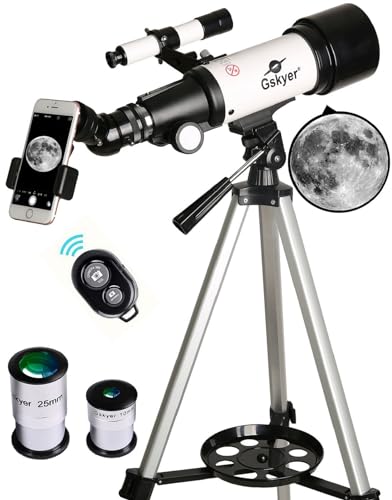
The Gskyer 70mm AZ is the most travel-oriented of the traditional telescopes in this roundup. The telescope weighs 5.7 pounds, and the adjustable aluminum tripod, optical tube, and accessories fit inside the supplied carry bag. That combination makes it easier to store in a closet or take to a vacation house than the much heavier reflectors.
Its 400mm focal length and 70mm aperture are aimed at bright, accessible targets. Fully coated optics are intended to improve transmission, while the two replaceable eyepieces and 3x Barlow lens provide different magnification options. The 5x24 finder has crosshair lines to assist with locating objects, though a finder still requires a little practice under a dark sky.
The Gskyer differs from the Celestron AstroMaster 70AZ mainly in its travel and phone features. Both use a 70mm refractor, but the Gskyer includes a phone adapter and wireless camera remote, making it easier to attempt simple images without touching the phone screen. The AstroMaster counters with a more explicitly versatile daytime setup and a StarPointer red dot finder.
The limitations become apparent when you compare it with the Celticbird 80mm Refractor or Celestron StarSense Explorer LT 114AZ. Those scopes gather more light, and the Celestron's phone guidance is much more useful for finding unfamiliar targets than a basic finder. The 3x Barlow also cannot create detail that the 70mm aperture does not resolve, so it is best used selectively rather than at every opportunity.
Choose the Gskyer when compact storage and occasional travel matter more than a path into serious astronomy. It is a practical starter for bright lunar viewing and family use, provided expectations stay within the limits of a small refractor.
How to choose best home telescope
The right telescope depends less on the largest magnification claim than on the combination of aperture, optical design, mount, and how often you will actually carry it outside.
Aperture and optical design
Aperture is the diameter of the telescope's main lens or mirror. Larger apertures collect more light and can reveal fainter objects, which is why the 130mm reflectors and eight-inch NexStar 8SE have a clear advantage over the 70mm refractors for nebulae and galaxies.
Refractors are usually straightforward and require little maintenance, while Newtonian reflectors provide more aperture for their physical size but can be more sensitive to setup and alignment. Schmidt-Cassegrain and astrograph systems combine compact structures with more specialized observing or imaging capabilities.
Focal length and magnification
Focal length affects the native scale of the view and the magnification produced by a given eyepiece. The MEEZAA's 800mm focal length naturally suits the Moon and planets, while the Gskyer 70mm's 400mm focal length gives a wider, less magnified starting view.
A 3x Barlow lens can multiply eyepiece magnification, but that does not guarantee a sharper image. High magnification exposes atmospheric turbulence, vibration, and weak focusing mechanisms. A stable view at moderate magnification is more useful than a blurry view at the largest advertised number.
Mount and tracking
The mount determines how easy it is to point, focus, and keep an object in view. Altazimuth mounts move up, down, and side to side and are usually the easiest starting point. Equatorial mounts can make tracking more natural but take more time to understand.
Computerized GoTo systems such as the NexStar 8SE locate and track targets automatically. Phone-guided systems such as the StarSense Explorer range still use manual movement, but they reduce the frustration of not knowing where an object is located.
The best telescope is the one whose mount you will willingly set up on a clear night.
Portability and storage
A telescope that stays packed away will show less than a smaller instrument that gets outside regularly. The DWARFLAB Dwarf Mini weighs 1.85 pounds, while the Gskyer 70mm AZ weighs 5.7 pounds and includes a bag. By contrast, the Gskyer 130EQ and Celestron Origin Mark II are better treated as planned observing equipment.
Check where the telescope will be stored, how far it must be carried, and whether one person can move it safely. For family use, tripod height matters too. The Celticbird reaches from 17.7 to 52 inches, giving it more flexibility around children and adults.
Visual observing and imaging
Traditional eyepieces provide a direct view and make the observer part of the process. Phone adapters can record simple images, but they are not the same as a dedicated imaging system. The DWARFLAB Dwarf Mini and Celestron Origin Mark II are designed around digital capture, automated targeting, and shared screens.
If your priority is the Moon and planets through an eyepiece, choose an optical telescope with a steady mount. If you want saved images, live feeds, raw files, or cloud processing, a smart telescope may fit the goal better. Readers comparing more traditional equipment can also consider how different optical designs shape an observing setup.

Frequently asked questions
What is the best home telescope for a beginner?
The Celestron StarSense Explorer DX 130AZ is the strongest all-around starting point in this group. Its 130mm reflector provides useful reach, while the StarSense app helps locate targets without adding a fully computerized mount.
Is a refractor or reflector better for home astronomy?
Neither design wins for every observer. Refractors such as the MEEZAA 90mm and Celticbird 80mm are straightforward for bright targets, while reflectors such as the Celestron DX 130AZ collect more light for deep-sky viewing.
Is a phone-guided telescope the same as a computerized telescope?
No. A phone-guided telescope tells you where to point the manual mount, but you still move and track the instrument yourself. A computerized GoTo telescope such as the NexStar 8SE slews to the target and tracks it after alignment.
What aperture is suitable for viewing planets?
The 70mm refractors can show the Moon and bright planets, especially under steady skies. Moving to 90mm or 114mm improves the available light, while 130mm and eight-inch systems provide more room for fine detail and dimmer targets.
Can these telescopes take photos with a phone?
Several can. The Gskyer 70mm AZ, MEEZAA 90mm, and Celticbird 80mm include phone adapters, while the Gskyer 130EQ includes a Bluetooth camera remote. Smart telescopes such as the DWARFLAB Dwarf Mini are designed around digital capture rather than adding a phone to an eyepiece.
Do I need dark skies to use a home telescope?
No. The Moon and bright planets can be rewarding from many homes, and several models list city viewing among their intended uses. Darker skies become more important when you want to see faint nebulae, galaxies, and star clusters. Target selection also changes what you can see, as explained in which objects are easiest to find while stargazing.
Is a large telescope difficult to move?
It can be. The DWARFLAB Dwarf Mini is only 1.85 pounds, while the Celestron Origin Mark II is listed at 59 pounds. A larger telescope may show more, but only if its owner has a practical place to store and set it up.

The bottom line
The Celestron StarSense Explorer DX 130AZ is the best home telescope for most people because it combines a useful 130mm aperture with phone guidance and a manual mount that still teaches you how the sky works. The Celestron NexStar 8SE is the better choice for serious visual observers who want eight-inch optics and automated access to a broad target database.
For imaging, the DWARFLAB Dwarf Mini is the portable specialist, while the Celestron Origin Mark II is the advanced home observatory for users who want a larger astrograph, live feeds, and raw image control. Smaller refractors remain sensible for children, casual Moon viewing, and households where simple setup matters most.
If you are undecided, choose the DX 130AZ unless portability or automated imaging is your first priority.
As an Amazon Associate we earn from qualifying purchases.