
A telescope can make the Moon look close enough to touch, but the wrong mount can turn that first exciting night into a struggle with shaking views and confusing controls. Aperture matters, yet a scope that is easy to aim and steady at the eyepiece is often the one that gets used most.
Our guide to the Best telescopes for stargazing covers simple portable refractors, smartphone-guided Newtonians, and larger equatorial reflectors. We ranked them by the combination of useful light-gathering ability, ease of setup, mount behavior, and the kinds of objects each scope can realistically show.
The Celestron StarSense Explorer DX 130AZ is our top pick, while the rest of the list ranges from compact family scopes to serious deep-sky options.
| # | Product | Award | Aperture | Mount | Magnification | Best for |
|---|---|---|---|---|---|---|
| 1 | Celestron DX 130AZ | Best overall | 130mm | Altazimuth | Not specified | Guided deep-sky viewing |
| 2 | Celestron LT 114AZ | Best guided beginner scope | 114mm | Altazimuth | Not specified | First-time sky navigation |
| 3 | MEEZAA 150EQ | Best large-aperture scope | 150mm | Equatorial | 26X to 130X | Bright deep-sky views |
| 4 | Gskyer EQ-130 | Best for learning tracking | 130mm | German equatorial | Not specified | Hands-on astronomy |
| 5 | MEEZAA 90mm Refractor | Best long-focus refractor | 90mm | Not specified | 32X to 240X | Lunar and planetary viewing |
| 6 | Dianfan 90mm Refractor | Best upright-image refractor | 90mm | Not specified | 32X to 240X | Astronomy and daytime use |
| 7 | Celticbird 80mm Refractor | Best portable refractor | 80mm | Altazimuth | 30X and 66X | Families and travel |
| 8 | Koolpte 80mm Refractor | Best simple setup | 80mm | Altazimuth | 24X and 60X | Casual backyard viewing |
| 9 | Gskyer 70mm Travel Refractor | Best travel scope | 70mm | Altazimuth | Not specified | Portable stargazing |
| 10 | PhysioPhyx 80x100 Monocular | Best compact outdoor optic | 100mm objective | Tripod included | 80X | Camping and occasional sky views |
1. Celestron DX 130AZ: Best Overall

Pros
- 130mm Newtonian reflector gathers substantial light
- StarSense app makes targets much easier to locate
- Dual-axis slow-motion controls help with manual tracking
- Includes a two-year US warranty and ongoing support
Cons
- 18-pound setup is not especially portable
- Manual mount still requires some hands-on tracking
- Larger footprint than the beginner refractors
Best for: beginners who want guided access to the Moon, planets, and brighter deep-sky objects.
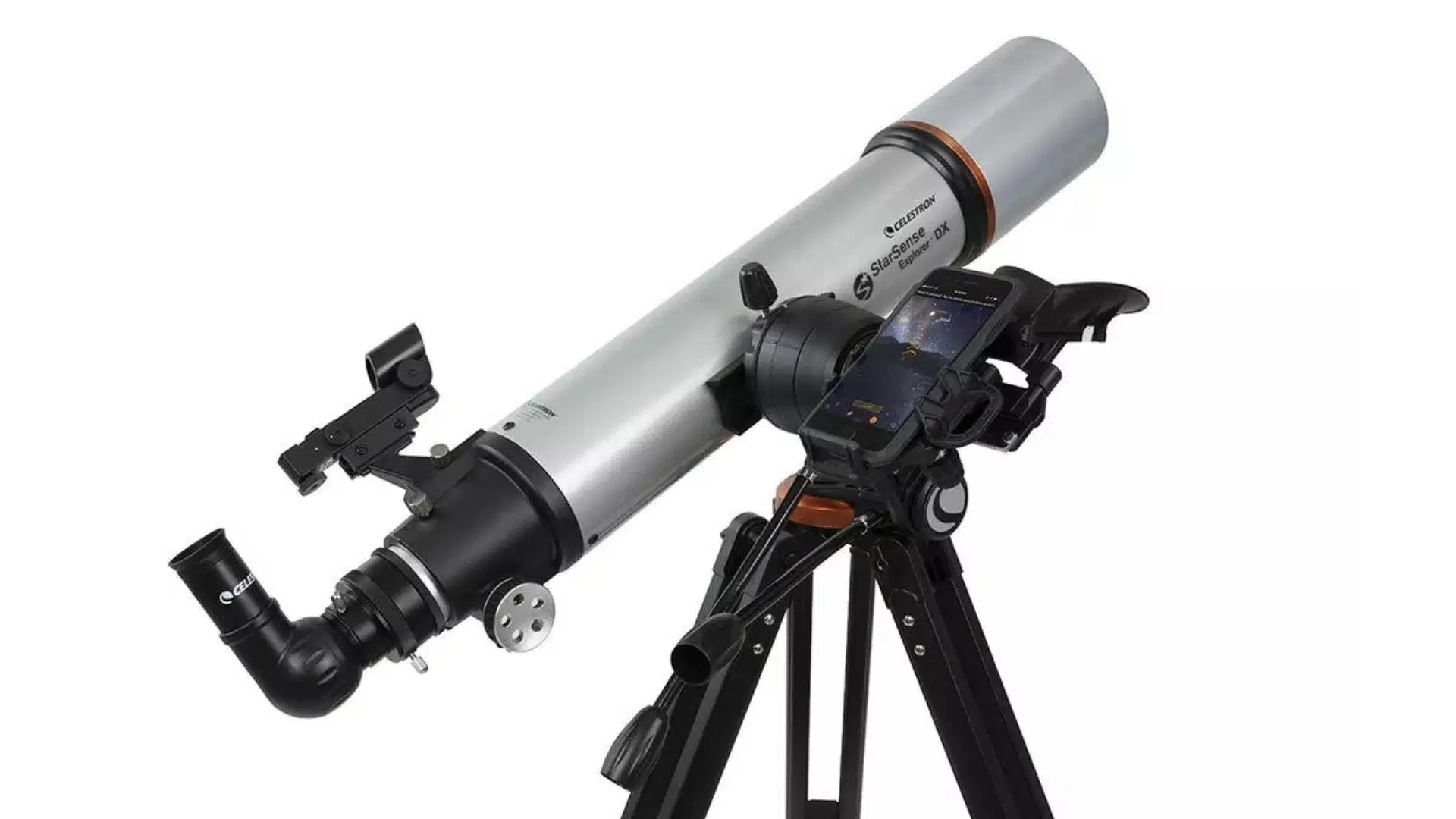
The Celestron DX 130AZ is the scope we would keep for the widest mix of beginner friendliness and real observing headroom. Its 130mm Newtonian reflector has more light-gathering capacity than the 70mm and 80mm refractors here, so it has a better chance of showing structure in brighter nebulae, star clusters, and galaxies. The tube is still approachable for a new observer, but this is not a toy that will be outgrown after a few clear nights.
Its strongest feature is the StarSense Explorer system. Dock a phone, open the app, and follow the on-screen arrows toward a selected target. The app uses sky recognition rather than simply pointing to a fixed compass direction, then confirms the target when the bullseye turns green. That removes the most frustrating part of starting astronomy: knowing what to look for, but not knowing where it is.
The manual altazimuth mount has dual-axis slow-motion controls, which gives the DX 130AZ more control than the simpler mounts on the Celticbird 80mm Refractor and Gskyer 70mm Travel Refractor. Celestron also specifically lists the Moon, Jupiter, Saturn, the Orion Nebula, and the Andromeda Galaxy among its suitable targets. Those claims fit the scope's 130mm aperture, though city light will still limit what can be seen beyond the brightest objects.
The weakness is bulk. At 18 pounds, this is a poor choice if the telescope must regularly travel down a trail or up several flights of stairs. It also remains a manual telescope, so the app helps you locate targets but does not motorize the mount. Choose the DX 130AZ if you want the clearest path from complete beginner to more ambitious visual astronomy, and skip it if portability matters more than aperture.
2. Celestron LT 114AZ: Best Guided Beginner Scope

Pros
- StarSense sky recognition simplifies target finding
- 114mm reflector is capable of lunar, planetary, and bright deep-sky views
- Altitude slow-motion adjustment improves control
- Two-year US warranty and support
Cons
- Smaller aperture than the DX 130AZ
- Single-axis slow-motion control is less flexible
- Still a fairly substantial home telescope
Best for: a first telescope owner who wants app-assisted navigation without jumping to a large setup.
The Celestron LT 114AZ makes the most sense for someone who wants the guided experience of the DX 130AZ in a slightly less capable package. Its 114mm Newtonian reflector is a meaningful step above the small refractors in light-gathering ability. The result should be stronger views of the Moon and planets, along with access to bright nebulae, galaxies, and clusters when the sky cooperates.
StarSense is the reason to choose this model over a conventional beginner telescope. The phone sits in the telescope's dock while the app analyzes the star pattern overhead. Instead of sweeping randomly through the sky, a new observer gets a list of suitable objects for the location and time, then follows arrows to the target. That turns an intimidating night sky into a sequence of manageable discoveries.
The mount is a manual altazimuth design with an altitude slow-motion adjustment and sliding rod. It is not as versatile as the DX 130AZ's dual-axis controls, and the smaller aperture gives the DX model an advantage on dimmer targets. Still, the LT 114AZ should be easier for a family to understand than an equatorial scope such as the Gskyer EQ-130, where the mount itself becomes part of the learning curve.
Its main limitation is that the app does not remove the need to track objects by hand. The mount also lacks the aperture of the larger Celestron and MEEZAA reflectors. For readers primarily interested in planets, the practical trade-offs involved in choosing optics for planetary viewing are worth considering before buying. The LT 114AZ is the right middle ground for a beginner who values guidance and a manageable learning process more than maximum light gathering.
3. MEEZAA 150EQ: Best Large-Aperture Scope

Pros
- 150mm aperture provides the strongest light gathering here
- Equatorial mount includes slow-motion control knobs
- 650mm focal length gives a broad, useful observing setup
- Moon filter and red-dot finderscope are included
Cons
- Equatorial mount takes more practice than an altazimuth mount
- Large tube is not an easy carry
- Maximum listed magnification is lower than some smaller refractors
Best for: adults who want a substantial visual astronomy setup and are willing to learn an equatorial mount.
The MEEZAA 150EQ is the aperture-first choice. Its 150mm Newtonian reflector has the largest stated aperture in this roundup, which gives it the best foundation for bright, detailed views when observing conditions are good. It is the model to consider if a small refractor feels like an entry point you will quickly outgrow, particularly if your observing spot has reasonably dark skies.
The 650mm focal length keeps the telescope from becoming excessively long, while the supplied 25mm and 10mm eyepieces produce 26X and 65X before the 2X Barlow lens is used. MEEZAA lists a total magnification range of 26X to 130X. Those lower powers are useful for finding larger targets and framing the Moon, while the higher end is more appropriate for lunar and planetary detail when the atmosphere is steady.
Its German equatorial mount is a real advantage for deliberate observing, but it is also the reason this is not our beginner pick. After the mount is aligned appropriately, the slow-motion controls make it easier to follow objects as they move across the sky. The sturdy stainless steel tripod, accessory tray, carry bag, red-dot finderscope, and moon filter make the kit feel complete. The mount has more learning involved than the straightforward altazimuth system on the Celestron DX 130AZ.
This scope is not a casual grab-and-go instrument. The tube, mount, and tripod take more room, and the equatorial layout can be confusing during the first few sessions. Readers interested in more advanced setups may want to compare the equipment choices that matter for serious astronomy before settling on a mount style. Pick the MEEZAA 150EQ for maximum visual reach and a hands-on astronomy project, not for the quickest path to a first view.
4. Gskyer EQ-130: Best for Learning Tracking

Pros
- 130mm reflector has strong light-gathering potential
- Fast f/5 optical design keeps the tube to 24 inches
- German equatorial mount teaches manual celestial tracking
- Includes three eyepieces, a Barlow lens, and finderscope
Cons
- 30.1-pound listed weight limits portability
- Equatorial setup is demanding for young beginners
- Product details do not specify the magnification range
Best for: an adult learner who wants a traditional equatorial reflector rather than app-guided pointing.
The Gskyer EQ-130 is aimed at the person who wants to understand how a telescope works, not simply point a phone at a target. Its 130mm reflector has enough aperture for the Moon, planets, brighter galaxies, nebulae, and star clusters. The 24-inch optical tube is notably short for a scope of this aperture, which helps keep the optical assembly from becoming unwieldy even though the complete setup is heavy.
The fast f/5 focal ratio gives the telescope a wide, useful optical character for locating larger objects. Gskyer also includes three eyepieces, a 3X Barlow lens, and a finderscope, so the observer has several ways to frame a target. The product information does not state the eyepiece focal lengths or a total magnification range, so we would not choose this model based on an advertised high-power number.
The German equatorial mount is the central feature. It can make tracking more intuitive once configured, because the telescope follows the sky's apparent movement around an axis rather than simply being pushed up, down, left, and right. That benefit comes with a steeper setup process than the Celestron LT 114AZ. A Bluetooth camera remote is included for compatible iPhone and Android devices, but it is a photography convenience rather than a computerized guiding system.
The 30.1-pound listed weight is the clear drawback. This is far less appealing for apartment balconies, spontaneous travel, or children who need to move the whole setup themselves. The MEEZAA 150EQ offers more aperture, while the Celestron DX 130AZ offers easier target finding. The EQ-130 earns its place for an adult who sees the mount as part of the hobby and wants a traditional scope to grow into.
5. MEEZAA 90mm Refractor: Best Long-Focus Refractor

Pros
- 90mm aperture gathers more light than the 70mm and 80mm refractors
- 800mm focal length suits lunar and planetary viewing
- Listed magnification range reaches 240X
- Stainless steel tripod and carry bag included
Cons
- High magnification is dependent on steady atmospheric conditions
- Long optical tube is less convenient to transport
- Mount type is not specified in the product details
Best for: beginners who want a long-focus refractor for the Moon and planets.
The MEEZAA 90mm Refractor is a more focused instrument than the portable 80mm options. Its 90mm aperture gives it a little more light-gathering ability, while the 800mm focal length favors a narrower view with a useful emphasis on lunar and planetary targets. It feels like the sensible choice for someone who already knows that close views of craters, lunar seas, and bright planets matter more than sweeping wide-field views.
The supplied 25mm and 10mm eyepieces produce 32X and 80X. Add the 3X Barlow lens and MEEZAA lists a total range of 32X to 240X. That upper figure should be treated as an available optical combination rather than a guarantee of sharp views every night. Air turbulence, focus accuracy, and the stability of the mount all become increasingly important as magnification rises.
The adjustable stainless steel tripod spans 28 to 46 inches, giving children and adults different viewing heights. A carry bag, phone adapter, and detailed paper manual make the setup less intimidating. MEEZAA says the scope can be assembled quickly, but the 800mm tube is still longer than the 400mm Gskyer travel model and will take more care in storage and transport.
Compared with the similar Dianfan 90mm Refractor, this telescope is the better fit for an observer who wants a conventional astronomy presentation and a stated high-power range. The Dianfan is more versatile for daytime viewing because its 45-degree zenith mirror produces upright images. Skip the MEEZAA if you need a compact travel scope, but choose it for a family primarily interested in lunar and planetary sessions.
6. Dianfan 90mm Refractor: Best Upright-Image Refractor

Pros
- 90mm objective and 800mm focal length suit bright, detailed views
- 45-degree zenith mirror gives upright, correctly oriented images
- Listed magnification range is 32X to 240X
- Tripod and carry bag support outdoor use
Cons
- 10.36-pound listed weight is more than compact travel scopes
- High-power viewing needs stable conditions and careful focusing
- Less capable for dim deep-sky targets than the large reflectors
Best for: families who want one optical instrument for stargazing and daytime observation.
The Dianfan 90mm Refractor has a useful distinction that is easy to overlook: it is not limited to astronomical viewing. The 45-degree zenith mirror produces upright, correctly oriented images, which makes the scope more practical for distant terrestrial targets as well as the Moon and planets. That is a better fit for a family that wants to use the telescope during the day and return to it after dark.
The 90mm objective lens and 800mm focal length put it close to the MEEZAA 90mm Refractor on paper. Dianfan lists a 32X to 240X range from two eyepieces and a 3X Barlow lens. Its fully coated objective is intended to improve light transmission, contrast, and color, though the scope remains better suited to bright targets than to faint deep-sky objects. For those darker targets, the 130mm and 150mm reflectors have a clear aperture advantage.
Setup is presented as beginner-friendly, with instructions, smooth focusing, a stainless steel tripod, and an included bag. The portable design is useful for a backyard or a trip to darker skies, but the listed 10.36-pound weight means this is not something most children will carry comfortably for long. The upright image is a practical benefit, not a substitute for a steadier or larger mount.
The MEEZAA model is the stronger choice for someone focused specifically on astronomy, while Dianfan makes more sense when versatility matters. It is also a reasonable option for readers comparing how an amateur telescope should balance ease of use and capability. Choose this refractor for mixed daytime and nighttime use, and skip it if your priority is the faintest possible deep-sky view.
7. Celticbird 80mm Refractor: Best Portable Refractor

Pros
- 80mm aperture and 600mm focal length form a practical beginner combination
- Backpack, phone adapter, and moon filter are included
- Tripod adjusts from 17.7 to 52 inches
- Simple 30X and 66X eyepiece setup
Cons
- Smaller aperture than the larger reflector picks
- Only two stated eyepiece magnifications
- Altazimuth mount is less suited to precise tracking
Best for: families who need a straightforward telescope that can travel easily.
The Celticbird 80mm Refractor gets the basic experience right. It has enough aperture to make the Moon interesting, a 600mm focal length that is not excessively long, and an altazimuth mount that does not demand an astronomy lesson before the first observation. The included backpack is the feature that separates it from many home-oriented beginner scopes.
The two eyepieces provide 30X and 66X magnification. Those are sensible starting points for finding the Moon and bright planets without piling on an aggressive magnification claim. The 5x24 finderscope helps aim the main tube, while the moon filter is designed to reduce glare and improve lunar comfort by transmitting 13 percent of incoming light.
The adjustable aluminum tripod ranges from 17.7 to 52 inches, so it can accommodate a seated child or a standing adult. At a listed 5.8 pounds, the scope is much easier to move than the Celestron DX 130AZ or Gskyer EQ-130. The phone adapter adds a simple way to attempt lunar photos, although a phone at the eyepiece is not the same as a dedicated astrophotography setup.
The Koolpte 80mm Refractor is a close alternative with similar core optics, but Celticbird has the more clearly travel-friendly package and a more explicit tripod height range. The weakness is limited headroom: 80mm cannot match the large reflectors on dim targets, and the mount is not built for refined tracking. This is one of the Best telescopes for stargazing for families who value portability and a low-friction first session.
8. Koolpte 80mm Refractor: Best Simple Setup

Pros
- 80mm aperture and 600mm focal length suit basic lunar viewing
- No-tool setup is friendly to first-time owners
- Includes 5x24 finderscope and wireless camera remote
- Aluminum tripod and carry bag improve portability
Cons
- Limited aperture for faint deep-sky objects
- Altazimuth mount offers less tracking control
- Stated magnifications are modest without the Barlow lens
Best for: casual backyard observers who want quick setup and uncomplicated controls.
The Koolpte 80mm Refractor is the uncomplicated alternative to the more feature-heavy scopes above it. Its 80mm aperture and 600mm focal length are well matched for introductory observations of the Moon and brighter objects. The optics use multi-fully coated lenses intended to improve brightness and clarity, but the scope should be viewed as a starting point rather than a deep-sky instrument.
Koolpte supplies 25mm and 10mm eyepieces for 24X and 60X. A 3X Barlow lens can raise those combinations to 72X and 180X, though the practical usefulness of 180X will depend on atmospheric steadiness and the stability of the tripod. The 5x24 finder is a welcome inclusion because finding the Moon or a bright planet through the main tube is easier when the finder is aligned properly.
Setup is the selling point. The product information says no tools are required, and the adjustable aluminum tripod, carry bag, phone adapter, and wireless remote keep the package approachable for family use. That makes it less intimidating than the MEEZAA 150EQ or Gskyer EQ-130, whose equatorial mounts need more careful handling.
The Celticbird 80mm Refractor offers a similar optical format and is the better choice if its larger tripod adjustment range and backpack matter to you. Koolpte wins for a quick, casual session and a simple learning curve. Avoid it if your plans center on faint galaxies or nebulae, where the 114mm, 130mm, and 150mm reflectors have a much stronger starting point.
9. Gskyer 70mm Travel Refractor: Best Travel Scope
Pros
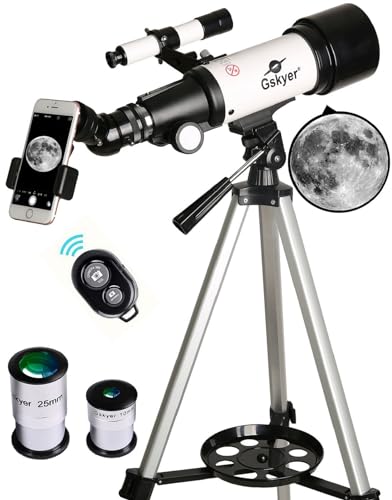
- Compact 400mm focal length makes transport easier
- Carry bag and adjustable aluminum tripod included
- Phone adapter and wireless remote support simple photos
- 5x24 finder helps with basic target locating
Cons
- Smallest aperture among the full-size telescopes here
- Shorter focal length gives less reach for detailed planetary views
- Product information does not specify the eyepiece magnifications
Best for: travelers and families who want the lightest conventional telescope setup.
The Gskyer 70mm Travel Refractor is built around convenience. Its 400mm focal length produces a short optical tube that is easier to pack and carry than the 600mm and 800mm refractors. The 70mm aperture is the smallest among the standard telescopes in this roundup, so the scope gives up some light gathering, but it remains a sensible format for the Moon, bright planets, and casual sky watching.
The fully coated optics are intended to improve transmission and protect image quality, while the included 5x24 finder helps locate targets. Gskyer also supplies two replaceable eyepieces and a 3X Barlow lens, but the product information does not state their focal lengths or the resulting magnification values. That missing detail makes it harder to predict the precise viewing range, so we would judge this telescope primarily on portability and ease of use.
The adjustable aluminum alloy tripod supports different viewing positions, and the carry bag holds the telescope and tripod together. A phone adapter and wireless camera remote make it possible to try uncomplicated phone images without touching the phone during the exposure. These extras are useful for sharing the Moon with family, though they do not turn the telescope into a guided or motorized imaging system.
The Celticbird and Koolpte 80mm refractors should show a little more brightness and detail, while the Dianfan and MEEZAA 90mm models offer stronger planetary potential. The Gskyer's advantage is that it is easier to take along. Choose it when a telescope that stays in the closet is the bigger risk, and skip it if you have a permanent observing spot and want more aperture.
10. PhysioPhyx 80x100 Monocular: Best Compact Outdoor Optic
Pros
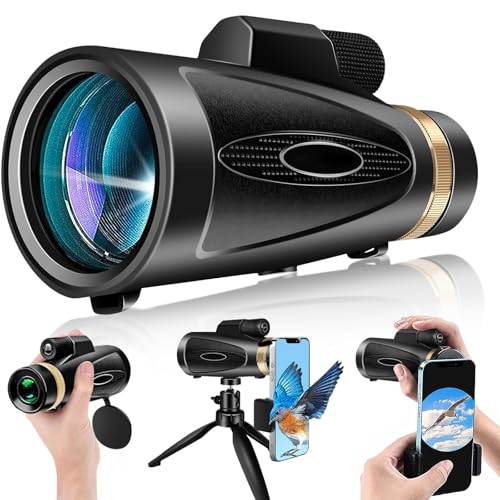
- Compact one-handed form is easy to carry outdoors
- 100mm objective lens is paired with a stated 80X magnification
- BAK-4 prism and fully multi-coated lens
- Tripod and phone adapter included
Cons
- Not a conventional astronomical telescope
- Very high stated magnification can be difficult to hold steady
- Narrower intended use than the full-size scopes
Best for: campers and hikers who want one compact optic for occasional sky and daytime viewing.
The PhysioPhyx 80x100 Monocular is the outlier here, and it should be bought with the right expectations. It is a compact monocular rather than a conventional telescope with interchangeable astronomy eyepieces and a dedicated mount. Its one-handed form makes it attractive for camping, hiking, wildlife observation, and occasional views of bright celestial targets.
The product lists 80X magnification and a 100mm objective lens. It also uses a BAK-4 prism and fully multi-coated optics to improve light transmission and image brightness. A 100mm objective sounds substantial, but magnification at this level makes steadiness crucial. The included tripod is therefore more than a convenience, especially if you want to attach a phone and keep the image from wobbling.
The adjustable eyecup can be set for viewing with or without glasses, and the quick-positioning phone adapter is designed to fit various phone models. That makes the monocular more flexible during a trip than the larger telescopes. It also takes up far less space than the Gskyer EQ-130 or MEEZAA 150EQ.
The compromise is astronomical capability. A conventional telescope such as the Celestron LT 114AZ offers a more appropriate mount and optical layout for learning the night sky, while the Celestron DX 130AZ adds guided target finding and greater aperture. Choose PhysioPhyx when portability and mixed outdoor use come first. For more dedicated imaging, the choices that affect a telescope astrophotography setup deserve a separate look.
How to choose best telescopes for stargazing
The right telescope depends less on the biggest magnification claim than on aperture, mount behavior, portability, and how quickly you can find a target.
Aperture and optical design
Aperture is the diameter of the telescope's main objective or primary mirror. A larger aperture gathers more light, which helps reveal fainter objects and gives the Moon and planets more visual presence. The 150mm MEEZAA 150EQ and 130mm Celestron DX 130AZ have a clear advantage over the 70mm Gskyer Travel Refractor for deep-sky viewing.
Refractors use a front lens and are generally straightforward for beginners. Reflectors use a mirror and can provide more aperture in a shorter tube, but they may require more careful setup and handling. Neither design is automatically right for every observer.
Focal length and magnification
Focal length affects the telescope's native field of view and the magnification produced by each eyepiece. The 800mm refractors from MEEZAA and Dianfan are well suited to lunar and planetary targets, while the Gskyer Travel Refractor's 400mm focal length makes it easier to carry and useful for broader views.
A Barlow lens increases magnification, but more power does not always mean more detail. Atmospheric turbulence, focusing accuracy, and mount stability can make a lower-power view sharper and more enjoyable.
A steady 60X view of the Moon is more useful than a shaky claim of 240X.
Mount control
An altazimuth mount moves up, down, left, and right. It is usually the easiest design for a first telescope, and the Celestron StarSense models add slow-motion controls to make manual tracking easier. An equatorial mount, as found on the MEEZAA 150EQ and Gskyer EQ-130, takes longer to learn but can make following the sky more systematic.
Look for slow-motion controls when you expect to spend time at higher magnification. If several family members will use the scope, simple altazimuth controls are usually the less frustrating route.
Target finding
A finderscope helps aim the main telescope at a bright object. The Celestron StarSense Explorer system goes further by using a phone and sky recognition to guide you toward selected targets. That is particularly useful in light-polluted locations, where fewer stars are visible for manual navigation.
A traditional finder can be perfectly adequate for the Moon and bright planets. Guided systems become more valuable as you move toward star clusters, nebulae, and galaxies.
Portability and setup
Consider where the telescope will be stored, how far it must be carried, and who will assemble it. The Celticbird 80mm Refractor, Koolpte 80mm Refractor, and Gskyer 70mm Travel Refractor include bags and relatively portable formats. Larger reflectors gather more light but need a more permanent observing routine.
A phone adapter is useful for sharing simple lunar images, but it should not be confused with a complete astrophotography system. For casual viewing, a stable tripod and a comfortable eyepiece position matter more than a long accessory list.
Frequently asked questions
What aperture should a beginner telescope have?
An 80mm refractor is a reasonable starting point for the Moon, bright planets, and easy transport. Moving to 114mm, 130mm, or 150mm gives you more light-gathering ability and better access to brighter deep-sky objects. The best choice depends on whether portability or observing reach matters more.
Are refractors or reflectors better for stargazing?
Refractors are usually straightforward to use and work well for beginners who want simple lunar and planetary viewing. Reflectors can provide more aperture for their tube size, which makes them attractive for deep-sky observing. The Celestron DX 130AZ and MEEZAA 150EQ show the reach a reflector can offer, while the smaller refractors are easier to carry.
Is a phone-guided telescope easier to use?
A phone-guided telescope can remove much of the guesswork involved in locating targets. Celestron's StarSense Explorer system analyzes the sky and provides arrows toward selected objects, but the telescope still uses a manual mount. You will still need to focus, adjust the tube, and track objects yourself.
Can these telescopes show planets?
The Moon, Jupiter, and Saturn are suitable targets for the telescopes in this roundup, with larger apertures generally offering more detail and brightness. The 800mm MEEZAA and Dianfan refractors are especially oriented toward lunar and planetary viewing. Atmospheric steadiness has a major effect on how much detail is visible.
Can I take photos through these telescopes?
Several models include a phone adapter, and some also include a wireless or Bluetooth camera remote. These accessories can help capture simple images of the Moon and reduce vibration from touching the phone. They do not provide the tracking, camera control, or mount precision normally associated with dedicated astrophotography.
Do I need a dark-sky location?
A dark location helps most with faint galaxies, nebulae, and star clusters. The Moon and bright planets can still be rewarding from a suburban or urban yard, especially with a scope such as the Celestron DX 130AZ or LT 114AZ. Reducing nearby lights and allowing your eyes time to adjust can improve the experience.
The bottom line
The Celestron DX 130AZ is the strongest all-round recommendation among the Best telescopes for stargazing because its 130mm reflector combines useful light gathering with StarSense guidance and dual-axis slow-motion controls. It is heavier than the portable refractors, but it gives a beginner a clearer path toward finding and viewing more of the sky.
For maximum aperture, choose the MEEZAA 150EQ and accept the extra work of an equatorial mount. For a simpler first telescope, the Celestron LT 114AZ offers guided navigation in a more approachable package, while the Celticbird 80mm Refractor is the better travel companion.
If you are undecided, choose the largest telescope you can store and carry without making clear nights feel like a chore.
As an Amazon Associate we earn from qualifying purchases.