
A thin-sounding explosion or a bass line that disappears into the room can make an otherwise capable home theater feel unfinished. The right subwoofer adds weight below the main speakers, but the best home theater subwoofers also keep that weight controlled instead of turning every scene into a blur.
We found a wide spread here, from full-size powered models with traditional AV receiver connections to complete soundbar systems with wireless bass modules. The Klipsch Sub-120 is our top pick for most dedicated home theater setups, with the Yamaha, Klipsch Sub-100, and WMQ models offering different balances of size, reach, and connection flexibility.
Comparison table
| # | Product | Award | Driver | Amplifier or output | Best for |
|---|---|---|---|---|---|
| 1 | Klipsch Sub-120 | Best overall | 12-inch front-firing | 200 watts continuous, 400 watts dynamic | Dedicated movie rooms |
| 2 | Yamaha NS-SW100 | Best for tight, clean bass | 10-inch cone woofer | Advanced YST II | Compact living rooms |
| 3 | WMQ 8-inch Active Subwoofer | Best compact adjustable model | 8-inch woofer | 200 watts RMS, Class A/B | Smaller rooms |
| 4 | Klipsch Sub-100 | Best smaller Klipsch | 10-inch front-firing | 150 watts continuous, 300 watts dynamic | Compact AV systems |
| 5 | Sony SA-CS9M2 | Best compact deep-bass pick | 10-inch active woofer | Bass reflex design | Tight installation spaces |
| 6 | WMQ 12-inch Active Subwoofer | Best for dual-sub setups | 12-inch woofer | 400 watts RMS, Class A/B | Large rooms and expansion |
| 7 | ULTIMEA Soundbar System | Best wireless soundbar package | 18 mm high-excursion driver | 240 watts peak | TV-first setups |
| 8 | Saiyin Soundbar System | Best simple TV upgrade | Dedicated subwoofer | Three EQ modes | Basic TV and PC audio |
| 9 | Rockville Rock Shaker 6.5 | Best compact wired option | 6.5-inch woofer | 100 watts RMS, Class D | Desks and small rooms |
| 10 | Bose Lifestyle Ultra Subwoofer | Best wireless Bose upgrade | Not specified | CleanBass Technology | Compatible Bose systems |
1. Klipsch Sub-120: Best Overall

Pros
- Large 12-inch front-firing driver
- 200 watts of continuous power
- 400 watts of dynamic power
- Compatible with almost any AV receiver
- Removable, flexible grille
Cons
- Large cabinet needs deliberate placement
- Connection wires are not included
- Corner placement is recommended for best performance
Best for: someone building a serious AV receiver based movie system.
The Klipsch Sub-120 is the one that makes the most immediate sense for a conventional home theater. Its 12-inch front-firing Cerametallic woofer gives the system a substantial low-frequency foundation, and the cabinet has enough physical presence to match a larger pair of left and right speakers. This is not a discreet little bass module that disappears beside a media console. It is a full-size component intended to make movie soundtracks feel physical.
The amplifier is rated at 200 watts of continuous power, with 400 watts of dynamic power available for sudden peaks. Those figures matter most during the jump from a quiet scene to an effects-heavy sequence. The subwoofer has room to produce impact without relying on the main speakers to handle the deepest bass at the same time. The front-firing layout also gives you a clear sense of where the driver is aimed, though room placement still matters more than the direction of the cone once low frequencies spread through the space.
The cabinet measures 21.3 inches high, 17.7 inches wide, and 23.7 inches deep, and it weighs 36.4 pounds. That bulk is the main reason to choose it carefully before ordering. Klipsch recommends corner placement for optimal performance, but a corner can also emphasize room modes if the bass becomes boomy. Give the enclosure breathing room and use your receiver's crossover controls to blend it with the main speakers rather than simply turning the level up.
Compared with the Klipsch Sub-100, the Sub-120 has the larger driver and higher continuous and dynamic power figures. It is the better match for a larger room or speakers that can play loudly. The Yamaha NS-SW100 is easier to accommodate and has a particularly clear focus on tight bass, while the Sub-120 wins when the soundtrack needs scale. The WMQ 12-inch model offers more stated amplifier output and a dual-subwoofer output, but the Klipsch has the clearer fit for a mainstream receiver-based system.
The weakness is straightforward: this is a big, wired subwoofer, and the box does not include connection wires. It also must connect to an AV receiver, processor, or preamp, so it is not a direct add-on for every television or compact soundbar. Choose it when you already have the right electronics and space for a substantial cabinet. Skip it if your priority is a wireless setup or a small footprint.
2. Yamaha NS-SW100: Best for Tight, Clean Bass

Pros
- 10-inch cone woofer
- Advanced YST II technology
- Twisted flare port for clear, tight bass
- Smaller cabinet than the largest picks
- Straightforward room-friendly design
Cons
- Lower stated power than the largest models
- No wireless connection described
- Less suited to very large rooms
Best for: listeners who want controlled low end without a large cabinet.
The Yamaha NS-SW100 takes a more restrained approach than the Klipsch Sub-120. Its 10-inch cone woofer sits in a cabinet that measures 13.9 inches high, 13.9 inches wide, and 16.2 inches deep. That makes it much easier to place beside a media stand or front speaker, especially in a living room where a tall, deep box would dominate the front wall.
Yamaha's Advanced YST II technology is designed to control the relationship between the amplifier and the driver, while the twisted flare port is intended to reduce port noise and keep bass clear. The important distinction is not simply that this subwoofer has a port. It is that the port design is aimed at preserving definition when the woofer is working through bass-heavy movie effects or music. A clean low end is easier to blend with bookshelf speakers than a loose, overemphasized bottom octave.
At 26.5 pounds, the Yamaha is also easier to reposition during setup than the 36.4-pound Klipsch Sub-120. Its smaller 10-inch driver does give up some scale, and the available data does not list a continuous or dynamic wattage figure for this model. That makes it harder to compare by amplifier headroom alone. The practical choice is clear, though: the Yamaha favors tidy integration and manageable placement over maximum theater impact.
The Klipsch Sub-100 is the closer rival. Both use 10-inch drivers, but the Klipsch publishes 150 watts of continuous power and 300 watts of dynamic power, while Yamaha emphasizes its servo technology and port design. The Yamaha is the pick for someone worried about bloated bass in a furnished living room. The Sony SA-CS9M2 also focuses on tight, accurate bass and easy installation, but its cabinet is taller and deeper despite the compact positioning in its name.
The chief limitation is headroom. Large open rooms or full-size tower speakers may leave you wanting more authority than the NS-SW100 can provide. It is also a conventional wired component, not a wireless bass solution. Choose this Yamaha when you want the subwoofer to support the system without becoming the main event.
3. WMQ 8-inch Active Subwoofer: Best Compact Adjustable Model

Pros
- 8-inch woofer in a compact format
- 200 watts RMS Class A/B amplifier
- RCA line input and dedicated SUB input
- Adjustable crossover from 60 to 180 Hz
- MDF enclosure designed to reduce resonance
Cons
- Smaller driver has less physical scale
- Published dimensions are not fully consistent
- No wireless connection described
Best for: small rooms that need flexible wired integration.
The WMQ 8-inch Active Subwoofer is aimed at the room where a 12-inch box would be excessive. Its 8-inch woofer uses a high-rigidity paper composite diaphragm, with a sturdy voice coil and flexible surround intended to provide layered bass rather than a one-note thump. That combination suits a bedroom, apartment living room, or smaller media room where moderate scale and easy integration matter more than shaking the furniture.
Its Class A/B amplifier is rated at 200 watts RMS, a meaningful specification for a subwoofer of this size. The amplifier design is intended to provide clean, powerful bass, while the MDF cabinet is built to minimize unwanted resonance. It has both an RCA line input and a dedicated SUB input, so it can work with a range of AV receivers, televisions, and media players that provide the appropriate output.
The adjustable crossover range runs from 60 to 180 Hz. That is useful when matching the subwoofer to small satellite speakers, which often need more help higher in the bass range, or to larger bookshelf speakers that should take over sooner. Start low and raise the crossover only until the transition becomes smooth. The broad adjustment range gives you more room to correct a mismatch than a fixed setting would.
The Rockville Rock Shaker 6.5 is smaller still and provides speaker-level as well as RCA connections, but the WMQ has the larger driver and a higher stated RMS figure. The Yamaha NS-SW100 is the more established compact choice for controlled bass, with its twisted flare port and Advanced YST II technology. The WMQ counters with more connection flexibility and direct crossover adjustment. The WMQ 12-inch model is a better fit for a larger room, but it gives up the compact character that makes this version useful.
The data lists a cabinet size of 10.63 by 11.81 by 13.78 inches in its feature description, while the product information gives 14.6 by 14.6 by 15.3 inches. That inconsistency means buyers should confirm the current listing dimensions before planning a tight shelf or corner. It is also a wired model without a stated wireless option. Pick it for adjustable integration in a modest room, not for maximum theater scale.
4. Klipsch Sub-100: Best Smaller Klipsch

Pros
- 10-inch front-firing Cerametallic woofer
- 150 watts continuous power
- 300 watts dynamic power
- All-digital amplifier
- Removable grille and compact cabinet
Cons
- Requires an AV receiver, processor, or preamp
- Connection wires are not included
- Less output potential than the Sub-120
Best for: Klipsch owners who need a smaller front-firing subwoofer.
The Klipsch Sub-100 is the sensible middle ground in Klipsch's two-model pairing here. It keeps the front-firing spun copper Cerametallic woofer and the all-digital amplifier, but uses a 10-inch driver instead of the Sub-120's 12-inch unit. The result is a cabinet that fits more naturally into a smaller front soundstage without abandoning the recognizable Klipsch approach to impact.
Klipsch rates the amplifier at 150 watts of continuous power and 300 watts of dynamic power. Those figures provide useful headroom for movie transitions, while the front-firing driver works well when the enclosure is placed along the front wall. The company recommends corner placement for optimal performance, but the room itself should determine the final position. Corners can increase bass output, though they can also make a room sound uneven if the subwoofer excites a strong room mode.
The dimensions are 14 inches high, 12.5 inches wide, and 15.7 inches deep, with a listed weight of 25.5 pounds. That is a substantial improvement in handling compared with the Sub-120. It also makes the Sub-100 a better physical match for compact AV speakers. The removable grille protects the driver while allowing the front of the subwoofer to blend with the rest of the system when removed.
The Yamaha NS-SW100 is the better alternative if your priority is controlled bass and a port designed to suppress unwanted noise. The Sub-100 has the clearer published power figures and a more forceful presentation, while the Klipsch Sub-120 is the obvious step up for bigger rooms and higher playback levels. If you are deciding between the two Klipsch models, room size and speaker scale should decide it more than the small difference in cabinet footprint.
This subwoofer is not a universal television accessory. It must connect to an AV receiver, processor, or preamp, and Klipsch does not include connection wires. It is also not the choice for someone who wants wireless placement behind a sofa. Choose the Sub-100 when you want a compact wired component with a lively movie-first character.
5. Sony SA-CS9M2: Best Compact Deep-Bass Pick
Pros
- 10-inch active subwoofer
- Bass reflex ducts for low-frequency reproduction
- Designed to suppress unwanted vibration
- Compact installation focus
- Suitable for movies and music
Cons
- Cabinet is taller than its compact description suggests
- No amplifier power figure is provided
- No wireless connection described
Best for: a system that needs deep bass in a difficult placement area.
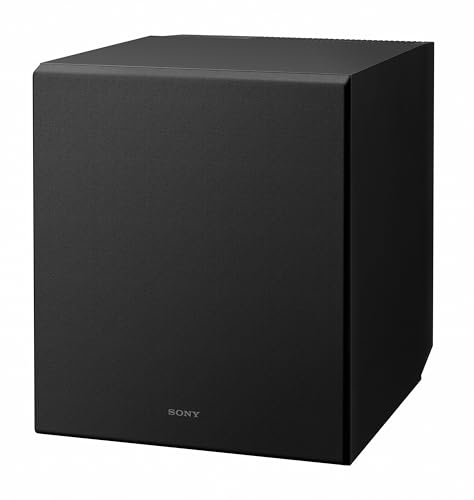
The Sony SA-CS9M2 is built around a simple promise: strong bass from an active 10-inch subwoofer that remains practical to install. Its bass reflex ducts are designed to suppress unwanted noise and improve low-frequency reproduction, while the enclosure is engineered to reduce unwanted vibration. Those details point toward a subwoofer that aims for weight without letting the cabinet become part of what you hear.
Sony describes the unit as powerful and compact, and its 20.8-pound listed weight is lighter than the Klipsch and Yamaha models in this roundup. The cabinet measures 17.4 inches high, 14.8 inches wide, and 18.7 inches deep. It is not tiny, especially in depth, but the lighter build and active design can make it easier to handle when you are working around an existing media console or a tight corner.
There is no amplifier wattage figure in the supplied product information, so this is not a model to choose by comparing output numbers on paper. Its strengths are the 10-inch active driver, bass reflex design, and stated focus on tight, accurate bass. That makes it a natural companion for music as well as movie soundtracks. A subwoofer that keeps vibration under control is especially useful in rooms where loose cabinet energy would be distracting.
The Yamaha NS-SW100 gives you a clearer technical story through Advanced YST II and its twisted flare port. The Klipsch Sub-100 provides published continuous and dynamic power figures and has a more explicit front-firing design. Sony's appeal is the balance between a full 10-inch woofer and a relatively light enclosure. It is less ambitious than the Sub-120 and less flexible than the WMQ models, but it is easier to understand as a straightforward bass addition.
The missing power specification is the main drawback for buyers trying to size the subwoofer to a large room. The cabinet's listed dimensions also show that compact does not mean shallow. Skip it if you need a wireless module or need guaranteed high output for a large open plan. Choose it when installation flexibility and controlled bass matter more than maximum specification-sheet drama.
6. WMQ 12-inch Active Subwoofer: Best for Dual-Sub Setups

Pros
- 12-inch woofer
- 400 watts RMS Class A/B amplifier
- RCA input and output interfaces
- Output supports wired dual-subwoofer pairing
- Adjustable crossover from 15 to 180 Hz
Cons
- Large cabinet needs careful placement
- Wired connection limits positioning
- No detailed dimensions in the feature list
Best for: larger rooms or systems that may grow to two subwoofers.
The WMQ 12-inch Active Subwoofer stands apart from the other conventional models because its RCA output can feed a second active subwoofer. That is a useful feature for a room where one subwoofer leaves obvious bass gaps between seats. Two carefully placed subs can produce more even coverage than one unit pushed hard from a single corner, though the extra wiring and setup work are real considerations.
Its 12-inch woofer uses a high-rigidity paper composite diaphragm, with a sturdy voice coil and flexible surround. WMQ pairs it with a Class A/B amplifier rated at 400 watts RMS. The combination is aimed at deep, layered bass for movies, music, and games. The 12-inch driver gives it the physical scale needed for demanding soundtrack effects, while the MDF cabinet is intended to minimize unwanted resonance.
The crossover adjustment runs from 15 to 180 Hz. The upper end is useful when pairing the subwoofer with small speakers that need a higher handoff, while the very low adjustment range lets larger speakers carry more of the upper bass. The correct setting depends on the main speakers and the receiver, not simply on choosing the largest available number. Take time to adjust the level and crossover together so the subwoofer fills the bottom end rather than calling attention to itself.
The Klipsch Sub-120 is the more straightforward recommendation for a standard AV receiver setup, and its front-firing Cerametallic driver has a stronger established identity in this group. WMQ's advantage is its 400 watts RMS and the ability to pass a signal to another active subwoofer. The WMQ 8-inch model is easier to fit, but it cannot offer the same driver scale or dual-sub expansion described here.
The cabinet measures 16.5 inches high, 15.7 inches deep, and 15 inches wide, so it still needs meaningful floor space. It is also a wired component, and the data does not list wireless connectivity. Choose this model when you understand the connection requirements and want the option to distribute bass through a larger room. It is a poor fit for a compact TV setup where a wireless module would be simpler.
For readers still deciding how much bass hardware their room needs, the way two subwoofers smooth bass across several seats is a useful planning question before choosing a single large enclosure.
7. ULTIMEA Soundbar System: Best Wireless Soundbar Package

Pros
- Wireless subwoofer connection
- App with 10-band equalizer
- 121 preset EQ matrices
- VoiceMX dialogue enhancement
- Bluetooth 6.0 and 240 watts peak output
Cons
- A soundbar system, not a standalone AV subwoofer
- Maximum SPL is listed at 95 dB
- Bass response begins at 45 Hz
Best for: television owners who want wireless bass and app-based control.
The ULTIMEA Soundbar System changes the question from which subwoofer should connect to a receiver to which compact TV audio package is easiest to live with. The dedicated subwoofer connects to the soundbar without an audio cable, so it can sit away from the television and front bar without routing a long RCA lead across the room. That freedom is its biggest advantage over every conventional wired subwoofer in this roundup.
The system uses an 18 mm high-excursion driver in a 6.5-liter tuned cabinet. ULTIMEA lists a 45 Hz to 150 Hz range for its BassMX low-frequency processing, while the complete system's frequency response is listed as 45 Hz to 18 kHz. It is not designed to compete with the deepest-reaching 12-inch models. Instead, it adds the bass foundation that slim television speakers and compact soundbars usually lack.
The complete 2.1-channel system is rated at 240 watts peak output, with a maximum SPL of 95 dB. Its VoiceMX technology focuses on the 120 Hz to 6 kHz vocal range, using adaptive EQ and gain control to keep dialogue intelligible. That matters for everyday television as much as for films. A system that makes voices easier to follow can be more satisfying than one that simply produces a louder bass effect.
The app gives this package more adjustment than the Saiyin Soundbar System, which offers three EQ modes and physical connection options but no comparable 10-band equalizer or 121 preset matrices. The Bose Lifestyle Ultra Subwoofer has a more premium wireless ecosystem, but it only makes sense with compatible Bose speakers or soundbars. ULTIMEA is the more self-contained choice for someone starting with a TV-focused 2.1 system.
The limitation is category fit. This is not a general-purpose powered subwoofer for an AV receiver, and its 45 Hz lower response does not promise the depth of a large dedicated theater model. Bluetooth 6.0 supports streaming from mobile devices, tablets, and laptops, but the product still revolves around the paired soundbar. Choose it when cable-free placement and dialogue control matter more than the expansion options of a receiver-based system.
The right soundbar pairing depends on more than the bass module alone, particularly when you are comparing how a complete television audio system handles dialogue and surround effects.
8. Saiyin Soundbar System: Best Simple TV Upgrade

Pros
- Dedicated subwoofer included
- Optical, auxiliary, and Bluetooth connections
- Three EQ modes
- Optical and auxiliary cables included
- Fire TV remote compatibility
Cons
- Not compatible with Dolby or DTS formats
- Not compatible with Insignia Roku TV
- Replacement remote is not compatible with universal or TV remotes
Best for: a basic television or PC setup that needs more bass and clearer connection choices.
The Saiyin Soundbar System is a complete TV and PC audio package rather than a conventional home theater subwoofer. It includes a soundbar, a dedicated subwoofer, a remote, and both auxiliary and optical cables. That makes the first setup less complicated than assembling a receiver, speakers, and separate bass unit, especially for someone replacing the thin sound from a television.
Saiyin provides three EQ modes for news, movies, and music. The system also uses a three-color LED indicator to show optical, Bluetooth, or auxiliary mode, with a volume progress bar that displays the total or bass level. Those small interface details are useful in a living room where you do not want to guess which input is active. The subwoofer's large cavity is designed to produce fuller bass, while the 28-degree sound dispersion angle is intended to keep the sound consistent across a wider seating area.
Connection flexibility is the strongest practical feature. Bluetooth handles phones and computers, while optical and auxiliary inputs support televisions and other wired sources. The included cables remove one common setup obstacle. Saiyin also lists compatibility with Fire TV remotes, although it is not compatible with Insignia Roku TV, and the supplied replacement remote does not work with universal or television remotes.
The ULTIMEA Soundbar System is a more adjustable alternative, with app control, a 10-band equalizer, VoiceMX dialogue processing, and a wireless subwoofer connection. Saiyin is simpler and includes the key cables, which can be preferable when you want to connect a television and stop adjusting. The Rockville Rock Shaker 6.5 is a better choice for a receiver-based system because it provides RCA and speaker-level inputs and outputs, but it does not include a soundbar.
The most important weakness is format support. Saiyin explicitly states that the soundbar is not compatible with Dolby or DTS audio formats, so the TV and streaming device should be set to PCM or stereo. That can make the system less suitable for a surround-focused setup. Choose it for straightforward two-channel television, music, or PC listening, and skip it if native Dolby or DTS playback is essential.
9. Rockville Rock Shaker 6.5: Best Compact Wired Option

Pros
- Compact 6.5-inch woofer
- 100 watts RMS and 200 watts peak power
- Class D amplifier
- Adjustable crossover and phase controls
- RCA and speaker-level inputs and outputs
Cons
- Smallest driver among the dedicated wired models
- Less suitable for large rooms
- Published cabinet dimensions vary by listing detail
Best for: desks, small rooms, and systems needing speaker-level connectivity.
The Rockville Rock Shaker 6.5 is the smallest dedicated wired subwoofer here, and that is precisely why it earns a place. A 6.5-inch woofer can add warmth and impact without demanding the floor space of the Klipsch Sub-120 or WMQ 12-inch model. Rockville lists the compact design at 11 by 11.8 by 12.6 inches in its feature information, while the product information gives larger enclosure dimensions, so confirm the current measurements if the subwoofer must fit a particular cubby.
The Class D amplifier is rated at 100 watts RMS and 200 watts peak. Rockville also lists a 20 Hz to 200 Hz range, though room placement and the rest of the system will determine how much of that range is audible in practice. The foam surround paper cone woofer uses a Y30 magnet, and the enclosure has a detachable grille. Those construction details are aimed at keeping the small driver working cleanly rather than making the unit look like a generic bass box.
Connectivity makes the Rock Shaker especially versatile for its size. It has RCA and speaker-level inputs and outputs, so it can work with receivers, amplifiers, and systems that do not provide a dedicated subwoofer output. The adjustable crossover lets you set the handoff to the main speakers, while the phase control helps align the bass when placement or speaker positioning causes cancellation. Those controls are more useful than a long list of output claims when you are integrating a compact subwoofer into an existing system.
The WMQ 8-inch Active Subwoofer is a stronger choice when you want a larger driver and a 200 watts RMS Class A/B amplifier. The Rock Shaker is easier to place and offers speaker-level connections, which the WMQ data does not describe. The Sony SA-CS9M2 gives you a larger active driver and a bass reflex design, but the Rockville makes more sense for a desk, small room, or older amplifier that lacks a modern subwoofer output.
The compromise is scale. Its 6.5-inch driver cannot move the same amount of air as the 10-inch and 12-inch models, and a 20 Hz to 200 Hz claim does not erase the limits of cabinet volume and driver size. It is also a wired subwoofer with no wireless placement feature. Choose it when modest, adjustable bass is the goal and connection flexibility matters more than cinematic force.
10. Bose Lifestyle Ultra Subwoofer: Best Wireless Bose Upgrade

Pros
- Wireless connection through the Bose app
- CleanBass Technology
- Compatible Bose soundbar and speaker ecosystem
- App-based setup and configuration
- Software updates through the app
Cons
- Requires compatible Bose speakers or soundbars
- No driver size or amplifier output is specified
- Not a general-purpose RCA subwoofer
Best for: owners of compatible Bose home theater systems who want a tidy wireless bass upgrade.
The Bose Lifestyle Ultra Subwoofer is an ecosystem component, not a universal powered subwoofer. Its wireless connection works through the Bose app with compatible Bose soundbars or speakers, allowing the bass module to be placed without an audio cable. If you already have the matching Bose equipment, that can be a much cleaner installation than running RCA cable across the room.
Bose's CleanBass Technology is designed to eliminate resonance issues and provide clear, impactful bass at different listening levels. The supplied information does not specify a driver size, amplifier output, or frequency range, so it cannot be compared directly with the Klipsch, Yamaha, WMQ, Sony, or Rockville models by those measurements. Its appeal is the way it integrates with compatible equipment, not a conventional specification contest.
The cabinet measures 12.87 inches high, 11.6 inches wide, and 11.6 inches deep, with a listed weight of 33.73 pounds. That is a relatively compact footprint for a wireless home theater component, although the weight means it is not something you will want to move repeatedly while searching for the ideal location. The Bose app handles connection, reconfiguration, and software updates, keeping the setup process inside one control system.
The ULTIMEA Soundbar System is the more self-contained wireless option because its soundbar and subwoofer are designed as a package. The Bose is the better fit when you already own compatible Bose speakers and want to extend that system without adding another brand's controls. For a standard AV receiver, the Klipsch Sub-120 or WMQ 12-inch Active Subwoofer is much more appropriate because those models are built around conventional wired integration.
The major weakness is compatibility. There is no stated RCA input, speaker-level input, or general-purpose receiver connection, and the product description specifically centers on compatible Bose soundbars and speakers. Skip it if your system is built from mixed-brand components. Choose it when the Bose ecosystem is already at the center of your room and wireless setup matters more than universal connections.
How to choose best home theater subwoofers
A subwoofer should match the room, the main speakers, and the connection method before you compare driver sizes or power figures.
Driver size
Driver size affects how much air the subwoofer can move and how easily it can create physical impact. The 12-inch Klipsch Sub-120 and WMQ 12-inch Active Subwoofer are the most natural choices for large rooms or demanding movie soundtracks. A 6.5-inch or 8-inch model can work well in a small room, but it will not create the same effortless scale at high listening levels.
A larger driver is not automatically better. It also usually means a larger cabinet, more difficult placement, and a greater chance of exciting room modes. Match the driver to the room instead of choosing the biggest enclosure by default.
Amplifier output
Continuous or RMS output is more useful than a peak number for understanding sustained capability. The Klipsch Sub-120 lists 200 watts continuous and 400 watts dynamic, while the WMQ 12-inch model lists 400 watts RMS. The Rockville Rock Shaker lists 100 watts RMS and 200 watts peak.
These figures still do not tell the whole story. Cabinet design, driver efficiency, port tuning, and room acoustics shape the result. Use power figures to identify broad differences in headroom, not to predict exact loudness.
Crossover control
The crossover determines where the subwoofer takes over from the main speakers. Small satellite speakers may need a higher crossover, while larger bookshelf or tower speakers can usually take over lower. The WMQ 8-inch model offers adjustment from 60 to 180 Hz, and the WMQ 12-inch model extends its stated range from 15 to 180 Hz.
A good setting should make the subwoofer blend into the front speakers. If you can easily locate the bass as coming from the subwoofer, the crossover or level is probably too high.
The best subwoofer is the one you stop noticing until the soundtrack suddenly needs it.
Inputs and system compatibility
Check the output on your receiver, amplifier, television, or soundbar before choosing a model. Dedicated RCA or SUB inputs suit many AV receivers, while speaker-level inputs and outputs add flexibility to older or simpler systems. The Rockville Rock Shaker includes both RCA and speaker-level connections, and the WMQ 8-inch model lists RCA line and dedicated SUB inputs.
Soundbar systems need closer attention. The ULTIMEA and Saiyin systems are complete packages, while the Bose Lifestyle Ultra Subwoofer is intended for compatible Bose speakers and soundbars. A wireless module is convenient, but it is not interchangeable across brands.
Room placement
Bass interacts strongly with walls and corners. Klipsch recommends corner placement for both of its Synergy models, which can increase output but may also make certain frequencies too prominent. Start near the front of the room, then move the subwoofer if the bass sounds uneven or boomy.
Two subwoofers can improve consistency across several seats, but only if the system supports the required connections and you have room to place both units sensibly. The WMQ 12-inch model is the only pick here that explicitly provides an output for wired dual-subwoofer pairing.
Frequently asked questions
Do I need a subwoofer with a soundbar?
A dedicated subwoofer can add the low-frequency impact that a slim soundbar cannot produce on its own. The ULTIMEA and Saiyin systems include matching soundbars and subwoofers, so they are simpler than adding a conventional powered subwoofer to a television. A standalone model such as the Klipsch Sub-120 generally expects an AV receiver, processor, or preamp.
Is a 12-inch subwoofer too large for a small room?
Not necessarily, but it may be harder to place and easier to overdrive the room acoustically. A 10-inch or 8-inch model is usually easier to integrate in a compact space. Choose a 12-inch model when you need greater headroom and have a sensible floor location for the cabinet.
Can I connect these subwoofers directly to a TV?
The answer depends on the television and the product. The conventional wired models require an appropriate RCA, SUB, speaker-level, receiver, or preamp connection. The ULTIMEA and Saiyin products are complete soundbar systems designed around television connections, while the Bose model requires compatible Bose equipment.
What does the crossover control do?
The crossover sets the range where the subwoofer begins handling bass instead of the main speakers. A higher setting can help small speakers, while a lower setting can blend better with larger speakers. Adjust it gradually with the subwoofer level so the bass sounds integrated rather than detached.
Are wireless subwoofers better than wired models?
Wireless models are easier to position because they do not need an audio cable between the soundbar and subwoofer. They are also more dependent on compatibility, since the ULTIMEA and Bose wireless systems are designed around particular partner products. Wired models usually offer broader receiver compatibility and more installation control.
Should I use one or two subwoofers?
One properly placed subwoofer is enough for many rooms. Two can produce more even bass across several seats, but they require extra space, compatible outputs, and more setup. The WMQ 12-inch Active Subwoofer explicitly supports wired pairing with another active subwoofer.
Does a bigger power rating guarantee deeper bass?
No. Driver size, enclosure design, porting, room placement, and the main speaker crossover all affect perceived depth. A larger power rating can provide more headroom, but it does not by itself guarantee tighter or deeper bass.
The bottom line
The Best home theater subwoofers in this group depend on the system around them, but the Klipsch Sub-120 is the strongest all-around choice for a conventional AV receiver setup. Its 12-inch front-firing driver, 200 watts of continuous power, and 400 watts of dynamic power give movie soundtracks the scale most buyers are seeking. The Yamaha NS-SW100 is the better alternative for a smaller room where controlled bass and a more manageable cabinet matter more than maximum impact.
For a compact receiver-based system, the Klipsch Sub-100 offers a useful middle ground, while the WMQ 12-inch Active Subwoofer is the specialist pick for buyers who want high stated RMS output and the option to add a second subwoofer. TV owners should choose the ULTIMEA Soundbar System for wireless placement and app control, or the Saiyin Soundbar System for straightforward optical, auxiliary, and Bluetooth connections.
If you are undecided, match the subwoofer to your connection type first, then choose the largest driver your room can place sensibly.
As an Amazon Associate we earn from qualifying purchases.