

A dead battery is rarely convenient, but the right jump box can turn a roadside wait into a short stop. The hard part is separating genuinely useful starting power from inflated peak-amp claims, then deciding if you also need a tire compressor, power bank, or work light.
The Best best jump box options range from glove-box-sized lithium packs to heavy lead-acid units and multifunction roadside kits. We prioritized useful engine coverage, safety features, charging, portability, and the practical differences between each model.
Our top pick is the NOCO GB40, with the GOOLOO A3, NOCO GB70, and WOLFBOX MV24A covering the strongest alternatives from compact emergency backup to a full roadside tool kit.
Comparison table
| # | Product | Award | Peak output | Weight | Best for |
|---|---|---|---|---|---|
| 1 | NOCO GB40 | Best overall | 1, 000 amps | 2.4 lb | Everyday cars and compact storage |
| 2 | NOCO GB70 | Best for larger vehicles | 2, 000 amps | 5 lb | Large gas and diesel engines |
| 3 | Clore Automotive JNC660 | Best traditional jump pack | 1, 700 amps | 18 lb | Garage and professional use |
| 4 | NOCO GB150 | Best heavy-duty lithium pack | 3, 000 amps | 7.5 lb | Large diesel engines |
| 5 | WOLFBOX MV24 | Best fast-charging pack | 4, 000 amps | 3 lb | Quick recharging and electronics |
| 6 | WOLFBOX MV24A | Best with compressor | 4, 000 amps | 5.3 lb | Jumping and inflating tires |
| 7 | OXILAM 6000A | Best compact high-output pack | 6, 000 amps | 0.21 lb | Maximum claimed output in a small kit |
| 8 | TREKURE 8000A | Best for long standby | 8, 000 amps | 1.41 lb | Frequent travel and emergency storage |
| 9 | GOOLOO A3 | Best inflator controls | 3, 000 amps | 3.58 lb | Precise tire inflation |
| 10 | AIMAPOW 8000A | Best wide-angle light | 8, 000 amps | 1.68 lb | Nighttime roadside work |
1. NOCO GB40: Best Overall
Pros
- Compact 2.4-pound design
- Spark-proof and reverse-polarity protection
- Rated for engines up to 6.0L gas and 3.0L diesel
- 100-lumen flashlight with seven modes
- IP65-rated housing
Cons
- Less suitable for large diesel engines
- USB-C cable is included, but no broader charging kit is listed
- Recharging takes three hours
Best for: drivers who want a dependable, compact jump starter for an everyday vehicle.
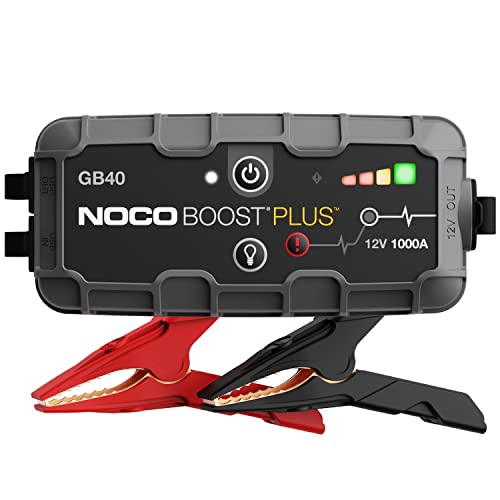
The NOCO GB40 is the jump box we would keep in a normal car. It is small enough to live in a glove box or emergency kit, but it is not reduced to a token battery and a pair of flimsy leads. At 2.4 pounds, it is considerably easier to carry than the 18-pound Clore Automotive JNC660, and its rubberized housing feels suited to being stored in a vehicle rather than handled like shop equipment.
Its 1, 000-amp peak output is intended for engines up to 6.0L gas and 3.0L diesel, with up to 20 starts per charge under the stated conditions. That is a sensible range for many cars, crossovers, light trucks, and SUVs. It is not the model to choose for a large diesel pickup when the NOCO GB70 or GB150 offers much more headroom, but the smaller capacity keeps the GB40 easier to place and carry.
The safety design is a major reason it leads this group. Spark-proof technology and reverse-polarity protection make connection less stressful for someone who does not routinely work on vehicles. The IP65 housing adds resistance to dust and water, while the high-conductivity clamps are built to transfer power efficiently. Its integrated 100-lumen light includes standard, SOS, and strobe modes, so it can illuminate a battery terminal without requiring a second flashlight.
The built-in power bank can recharge phones and tablets, and the unit is listed as recharging in three hours. That is faster than the larger GB70 and GB150, though neither of those models is intended to compete on charging convenience alone. The real limitation is engine coverage. Drivers of heavy diesel vehicles should skip this one, and anyone wanting an air compressor will need a separate tool.
For a regular car, the GB40 gets the balance right. It is simpler than the GOOLOO A3 and WOLFBOX MV24A, but that simplicity means fewer functions to maintain and fewer distractions when the battery is dead. It is the pick for someone who wants a compact emergency starter that can stay in the car and be ready when needed.
2. NOCO GB70: Best for Larger Vehicles

Pros
- 2, 000-amp peak output
- Supports up to 8.0L gas and 6.0L diesel engines
- Up to 40 starts per charge
- 400-lumen flashlight
- IP65-rated rugged housing
Cons
- Weighs 5 pounds
- Six-hour recharge time
- No tire compressor
Best for: owners of large SUVs, trucks, and diesel vehicles who want a proven, focused jump starter.
The NOCO GB70 is the natural step up from the GB40 when engine size matters more than glove-box convenience. It retains the same UltraSafe approach, with spark-proof and reverse-polarity protection, but doubles the stated peak output to 2, 000 amps. The result is a more appropriate match for vehicles with engines up to 8.0L gas and 6.0L diesel.
At 5 pounds, it remains portable, although it has a noticeable presence compared with the GB40. Its dimensions are listed as 8.8 by 6 by 2.8 inches, so it needs a proper storage compartment or a place in the trunk. That is still much easier to manage than the Clore Automotive JNC660, especially if the jump pack may need to travel outside the garage.
NOCO lists up to 40 starts per charge, twice the GB40's stated figure. That matters for a household with multiple vehicles, a work truck that sits for long periods, or an emergency kit intended to help more than one stranded driver. The 400-lumen flashlight is also more useful than the GB40's 100-lumen light when the battery terminals are difficult to see at night, and both models offer seven light modes.
The compromise is charging time. The GB70 takes six hours to recharge, so it needs more deliberate maintenance after use. It also does not inflate tires, so the WOLFBOX MV24A and GOOLOO A3 are more versatile for a roadside kit that must cover low tire pressure as well as a flat battery. The GB70 is about starting power and predictable operation, not combining every emergency feature into one case.
Choose it over the GB40 for a large engine, a diesel vehicle, or a household that wants more starts between charges. Choose the NOCO GB150 when the vehicle is near the upper edge of the GB70's stated range. For everyone else, the extra bulk is difficult to justify. The GB70 is a focused tool for drivers who need more starting authority without moving to a shop-sized pack.
3. Clore Automotive JNC660: Best Traditional Jump Pack

Pros
- 22Ah Clore Proformer battery
- 1, 700 peak amps
- 46-inch heavy-duty cables
- Built-in voltmeter
- 12V DC outlet
Cons
- Very heavy at 18 pounds
- Much larger than the lithium models
- Lacks the listed USB power-bank and flashlight features of newer designs
Best for: garages, workshops, and drivers who prefer a substantial built-in battery over compact lithium storage.
The Clore Automotive JNC660 feels like it belongs in a garage because it does. This is a traditional jump pack with an internal 22Ah Clore Proformer battery, 1, 700 peak amps, and 46-inch heavy-duty number 2 AWG cables. Those long leads are the feature to notice first. They provide more flexibility around a crowded engine bay than the short cables found on many compact lithium units.
Its 18-pound weight changes how it should be used. The JNC660 is not the jump box we would casually carry on a long walk to a stranded car, and its 16.3 by 14.1 by 5.1-inch dimensions make it a poor glove-box resident. It is better placed in a home garage, service vehicle, or workshop where the extra mass is less troublesome and the long cables are genuinely helpful.
The built-in voltmeter provides charge status for the onboard battery, while the 12V DC outlet can power compatible accessories. Those features give it a practical workshop character, though the design is less convenient for charging personal electronics than the NOCO, WOLFBOX, OXILAM, and TREKURE models. It also does not list an integrated flashlight, so nighttime roadside work may require a separate light.
The 1, 700-amp rating sits between the NOCO GB40 and GB70, but peak current alone does not tell the whole story. The JNC660's cable length, traditional battery format, and physical size make it a different kind of tool. It can be a better fit for repeated garage use, while the GB70 is the more sensible choice for a vehicle emergency kit that must be lifted and stored frequently.
The weakness is simple: it is heavy. Drivers who want a compact lithium pack should skip it, as should anyone who expects USB-C charging and a built-in work light. But for a mechanic, fleet operator, or homeowner who values long cables and a sturdy shop-oriented design, the JNC660 remains a distinctive option.
4. NOCO GB150: Best Heavy-Duty Lithium Pack
Pros
- 3, 000-amp peak output
- Rated for up to 9.0L gas and 7.0L diesel engines
- Up to 80 starts per charge
- 500-lumen flashlight
- IP65-rated housing
Cons
- 7.5-pound weight
- Seven-hour recharge time
- No air compressor
Best for: large trucks, diesel vehicles, and users who want substantial lithium starting capacity.
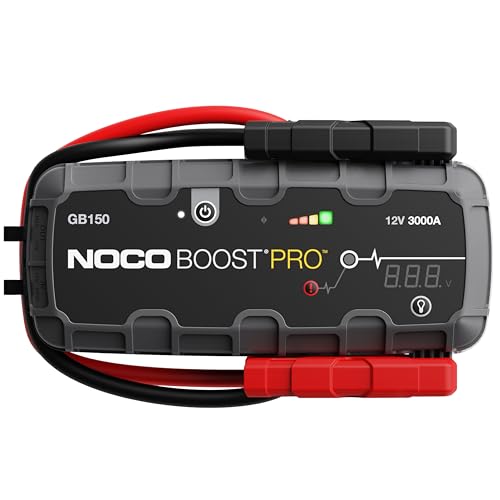
The NOCO GB150 is the serious lithium option in this lineup. Its 3, 000-amp peak output is rated for engines up to 9.0L gas and 7.0L diesel, putting it above the GB70's stated coverage. The package remains far easier to carry than the Clore Automotive JNC660, although 7.5 pounds is enough to remind you that this is built for demanding vehicles rather than small sedans.
The stated capacity is up to 80 starts per charge. That figure is useful for a work truck, a rarely driven diesel, or an emergency kit that might help several vehicles. The GB150's 13.7 by 8.19 by 4.88-inch shape is still reasonably compact for its output, but it is too large for casual glove-box storage in many cars.
Its 500-lumen LED flashlight is the brightest of the three NOCO models here. Seven light modes include SOS and strobe, giving the light a role beyond finding a battery terminal. The IP65 housing and rubberized over-molding add protection against dust, water, and impacts, and the spark-proof, reverse-polarity design reduces the risk of an incorrect connection.
The main drawback is recharge time. NOCO lists seven hours, which means the pack should be topped up after every use rather than left until the next emergency. Like the GB40 and GB70, it is a dedicated starter and power bank rather than a tire inflator. The WOLFBOX MV24A and GOOLOO A3 make more sense if tire pressure is part of the problem you expect to solve.
The GB150 beats the GB70 when the engine is larger or when multiple starts from one charge matter. It loses to the GB70 on portability and to the modern multifunction packs on tire assistance. Choose it for heavy-duty starting first, especially with a large diesel vehicle. Skip it if your vehicle is ordinary and your storage space is tight.
5. WOLFBOX MV24: Best Fast-Charging Pack

Pros
- 4, 000-amp peak output
- 88.8Wh battery
- 65W USB-C input and output
- Full recharge in about 1.3 hours
- LCD status display
Cons
- No air compressor
- IP64 protection is below the NOCO models' IP65 rating
- Vehicle coverage is stated as under 10L gas and 10L diesel
Best for: drivers who want fast charging and a useful electronics power bank in a compact case.
The WOLFBOX MV24 stands out because it treats recharge time as a central feature rather than an afterthought. Its 88.8Wh battery and 65W USB-C input and output allow a full recharge in about 1.3 hours when used with the included PD65W charger. That is dramatically quicker than the NOCO GB70 and GB150, and it makes the pack easier to return to service after an emergency.
The 4, 000-amp peak output is stated for 12V vehicles with gas and diesel engines under 10 liters. The numbers put it above the NOCO GB150's peak rating, though the published engine guidance is not identical, so buyers should match the stated coverage to their own vehicle rather than compare amp figures in isolation. The one-touch boost function is intended for low-voltage starting situations.
An LCD screen shows the unit's status clearly, which is more informative than relying on a few small indicator lights. The pack has one 65W Type-C port and one QC3.0 USB-A port, allowing it to charge phones, tablets, and some laptops. For a travel or camping kit, this extra utility is meaningful. The 3-pound weight is also manageable, and the 9.33 by 3.86 by 1.5-inch form is slim enough for straightforward storage.
The light includes high-beam, SOS, and strobe modes. The IP64 rating offers dust and water protection, but it is not quite the same stated protection as the IP65-rated NOCO housings. This pack also does not include an air compressor, so the WOLFBOX MV24A is the more useful companion for drivers who want to handle a soft tire.
The MV24 makes more sense than the MV24A when fast electronic charging matters more than tire inflation. It also has a more informative display than the GB40, while the GB40 remains the simpler choice for ordinary cars. Choose the MV24 for road trips, mixed vehicle and electronics use, and anyone who dislikes waiting hours for a battery pack to recharge.
6. WOLFBOX MV24A: Best With Compressor

Pros
- 4, 000-amp peak output
- 160 PSI compressor with 45 L/min airflow
- 65W USB-C charging
- 400-lumen light
- 24-month warranty listed
Cons
- Weighs 5.3 pounds
- Charging adapter is not included
- Compressor adds bulk compared with a dedicated starter
Best for: drivers who want one roadside device for a dead battery and an underinflated tire.
The WOLFBOX MV24A is the more useful version of the MV24 for a real roadside kit. It keeps the 4, 000-amp peak output and 88.8Wh battery, then adds a 160 PSI air compressor with 45 liters per minute of airflow. That combination addresses the two common problems that can stop a trip: insufficient battery power and insufficient tire pressure.
The compressor has enough stated performance for more than emergency top-offs. WOLFBOX says it can inflate a 315/70 R17 pickup tire from 30 to 36 PSI in two minutes and 30 seconds, while a 195/65 R15 sedan tire takes 40 seconds for the same increase. Those claims are more useful than a maximum PSI number alone because they give a sense of how the airflow translates to actual tire work.
The 65W USB-C port, USB-A outputs, and 160W DC continuous output make the unit a capable power bank. It is listed as a 24, 000mAh device and can recharge in as little as two hours, although the included package does not include a charging adapter. A 400-lumen light provides high-beam, distress, and strobe modes, while operation down to minus 4 degrees Fahrenheit gives it a stated cold-weather advantage.
At 5.3 pounds, the MV24A is heavier than the non-compressor MV24 and the compact GB40. It is also more complicated, with an air hose and inflation controls to keep track of. Drivers who never need to inflate tires should choose the MV24 or a NOCO model instead. Those who regularly drive rural roads, carry a trailer, or want to reduce the number of emergency tools in the trunk will appreciate the combination.
The GOOLOO A3 offers more inflation modes and a digital pressure gauge, while the MV24A has stronger stated jump output and faster charging than the GOOLOO. It is the pick for a driver who wants a broad roadside kit without moving to a large garage unit.
7. OXILAM 6000A: Best Compact High-Output Pack

Pros
- 6, 000-amp peak output
- Stated support for up to 12L diesel engines
- Two USB outputs and Type-C input
- 800-lumen light
- LED battery display
Cons
- Listed weight appears unusually low for the product class
- No air compressor
- The unit should be recharged every three months during long storage
Best for: drivers seeking a very small emergency pack with high stated engine coverage.
The OXILAM 6000A makes a bold claim in a small package. It is rated at 6, 000 peak amps and is presented for all gas engines and diesel engines up to 12L. That stated coverage is broader than the NOCO GB150 and places it among the most ambitious options here for trucks, RVs, tractors, boats, and other 12V vehicles.
Its feature set is well suited to emergency storage. Two USB outputs support 5V/3A, 9V/2A, and 12V/1.5A charging, while the Type-C input supports the same listed levels. An LED display shows remaining battery status, which is more convenient than guessing from a single status light. The integrated flashlight reaches 800 lumens and includes flashlight, strobe, and SOS modes.
OXILAM also lists 10 intelligent safety protections, including short-circuit, reverse-polarity, spark, thermal, and overcurrent protection. A waterproof shell, protective cover, and non-slip sides are intended to make the pack easier to handle around a vehicle. The instructions say to keep the unit above 50 percent before starting a car and recharge it every three months if it has been stored for a long time.
There is one data point to treat cautiously: the listed weight is 0.21 pound, which is unusually light for a jump starter with this claimed output and a substantial internal battery. We would not use that figure to plan storage or judge physical heft. The product information also does not list an air compressor, so the MV24A, GOOLOO A3, or AIMAPOW 8000A is a better fit for tire emergencies.
The OXILAM is more capable on paper than the TREKURE 8000A in engine coverage and offers a brighter listed light than the WOLFBOX packs. The NOCO models have a clearer, more established design language around safety and housing protection. Choose OXILAM when compact storage and broad stated vehicle coverage are the priority, but keep it charged and follow the connection instructions carefully.
8. TREKURE 8000A: Best for Long Standby

Pros
- 8, 000-amp peak output
- 26, 800mAh battery
- 18W USB charging
- Three light modes with 800 lumens
- Built-in handle
Cons
- No air compressor
- Lower USB charging output than the WOLFBOX MV24
- Requires careful connection order
Best for: road-trip kits and drivers who want a large battery reserve in a manageable case.
The TREKURE 8000A is designed around reserve capacity. Its 26, 800mAh battery and stated 8, 000-amp peak output are intended to support all gas engines and diesel engines up to 12.0L. It also lists up to 24 months of standby, which makes it appealing for a vehicle emergency kit that may sit unused for long stretches.
The unit is 7.44 by 3.66 by 1.77 inches and weighs 1.41 pounds. A built-in handle improves carrying comfort, while the stated design is 18 percent smaller than traditional models. The 8AWG jumper cables are described as thicker conductors for improved transfer, and a force-start function adds a second method for low-voltage situations.
Its 18W USB port can charge phones, tablets, earphones, and drones. That is useful, although it is not as quick or flexible as the WOLFBOX MV24's 65W USB-C system. The integrated 800-lumen light has steady, strobe, and SOS modes, and the product claims more than 12 hours of lighting. Those details make it a reasonable travel companion even when the battery problem is not the immediate concern.
The TREKURE lists 10 safety protections, including reverse polarity, short circuit, overheating, overcurrent, overload, and deep discharge protection. Its shell is described as waterproof, dustproof, and shock resistant, and the included instructions emphasize connecting the cable to the unit first, then attaching the clamps to the battery. That sequence matters, especially for an inexperienced user.
The missing feature is a compressor. The OXILAM 6000A offers similar broad engine coverage with a smaller stated capacity, while the AIMAPOW 8000A adds tire inflation and a wider light. TREKURE is the better fit when long storage, a built-in handle, and a large power bank matter more than tire service.
9. GOOLOO A3: Best Inflator Controls

Pros
- 3, 000-amp peak output
- 150 PSI compressor with 35 L/min airflow
- Five inflation modes
- Automatic shutoff and digital pressure display
- Seven-in-one emergency design
Cons
- Lower engine coverage than the largest packs
- Weighs 3.58 pounds
- Compressor runs for up to 45 minutes per charge
Best for: drivers who want clear pressure controls and multiple inflation accessories.
The GOOLOO A3 is the most approachable inflator in this group. Its 150 PSI compressor offers five modes for SUVs, cars, bikes, balls, and custom settings, with five nozzles included. That is a better match for a household with several types of tires and inflatables than a jump pack with only a basic hose.
The digital pressure gauge and automatic shutoff are the important details. The A3 supports PSI, BAR, and KPA, and the screen is designed to remain readable in bright sunlight. Instead of standing over a tire and guessing when to stop, the user can set the target and let the inflator shut down. GOOLOO lists 35 liters per minute of airflow and up to 45 minutes of wireless continuous inflation per charge.
As a jump starter, the A3 is rated at 3, 000 amps for 12V vehicles, with stated support for gas engines up to 9.0L and diesel engines up to 6.5L. A boost button is intended for extremely low battery voltage. That is strong coverage for many cars and trucks, but it does not reach the 10L or 12L diesel guidance attached to several of the higher-output packs in this roundup.
The A3 also works as a power bank, flashlight, bike pump, and ball pump. Its safety system lists 10 protections, including reverse connection, short circuit, overheating, overcharge, and overcurrent protection. The unit weighs 3.58 pounds and measures 4.96 by 5.87 by 2.3 inches, so it is portable without being especially slim.
Compared with the WOLFBOX MV24A, the GOOLOO offers more explicit inflation modes and pressure-unit choices, while the WOLFBOX has higher stated jump output and faster USB-C charging. Compared with the NOCO GB40, the A3 is far more versatile but more complex. Choose it when tire control matters as much as battery starting, particularly for families, cyclists, or drivers who want one kit for several emergency tasks.
10. AIMAPOW 8000A: Best Wide-Angle Light

Pros
- 8, 000-amp peak output
- 160 PSI compressor
- 35 L/min airflow
- 270-degree 600-lumen light
- Automatic shutoff and preset inflation
Cons
- Brand and model naming are less clear than the other entries
- No stated battery capacity
- Listed dimensions vary between the feature description and product information
Best for: drivers who want a compact jump box with broad roadside illumination and tire inflation.
The AIMAPOW 8000A combines the two roadside functions most people tend to need after a jump starter: starting a vehicle and adding air to a tire. It is rated for all gas engines and diesel engines up to 12L, with a force-start function for severely discharged batteries. The 8, 000-amp figure is among the highest listed here, though buyers should treat published peak output as one part of the decision rather than a guarantee for every vehicle.
Its compressor reaches 160 PSI and offers 35 liters per minute of airflow. Preset inflation, real-time pressure monitoring, automatic shutoff, and four inflation modes make it more controlled than a basic emergency pump. The included nozzles extend its use to motorcycles, bicycles, and sports balls, so it is not limited to car tires.
The standout feature is the 270-degree, 600-lumen light. A wide beam can be more helpful than a narrow flashlight when working beside a vehicle, particularly on a dark shoulder or in a driveway. Steady, strobe, and SOS modes cover routine work and signaling. The pack also functions as a USB power bank, adding a way to keep a phone running during a longer roadside delay.
AIMAPOW lists 12 safety protections, including reverse polarity, short circuit, spark, overtemperature, overvoltage, and overcurrent protection. The listed product information gives dimensions of 10 by 6 by 2 inches and a weight of 1.6755131912 pounds, while the feature description says 4.5 by 2.4 by 8.4 inches. That discrepancy is worth keeping in mind when planning storage. The product data also does not state a battery capacity.
The AIMAPOW is more versatile than the TREKURE because it includes a compressor, and its wide-angle light is more purposeful than the small lamps on many packs. The GOOLOO A3 offers clearer inflation modes, while the WOLFBOX MV24A provides a more detailed charging specification and a listed warranty. Choose AIMAPOW when broad illumination and high stated engine coverage matter most, but skip it if precise product dimensions or a published battery capacity are essential.

How to choose best jump box
A good jump box should match the vehicle first, then fit the way you actually handle roadside problems.
Engine coverage
Peak amps are a useful starting point, but the stated gas and diesel engine limits are more meaningful for choosing between models. The GB40 is listed for up to 6.0L gas and 3.0L diesel engines, while the GB150 reaches 9.0L gas and 7.0L diesel. Several newer multifunction packs list support up to 10L or 12L diesel.
Do not select solely by the biggest number on the package. A model with clear safety features, suitable clamps, and a battery that is maintained properly is more useful than a nominally stronger pack that has been left discharged.
Battery capacity and recharge
A jump starter is only useful if it has enough charge when you need it. The products here list capacities in different ways, including amp-hours, watt-hours, and milliamp-hours, so direct comparisons are not always clean.
Recharge time matters after use. The WOLFBOX MV24 is listed at about 1.3 hours with its 65W charger, while the NOCO GB70 and GB150 list six and seven hours respectively. Packs intended for seasonal emergency storage should also be checked periodically. Several manufacturers recommend recharging every three months.
The best emergency pack is the one you can find, carry, and confirm is charged before leaving home.
Clamps and safety
Reverse-polarity protection, spark protection, short-circuit protection, and clear connection alerts reduce the chance of an expensive mistake. This matters most for a driver who rarely opens the hood.
Cable length and construction also affect ease of use. The Clore Automotive JNC660 has 46-inch number 2 AWG cables, making it especially flexible in a garage. Compact lithium models are easier to carry, but their shorter leads may require more careful placement near the battery.
Air compressor performance
A compressor is useful for a slow leak or a low tire, but maximum PSI is not the only specification to read. Airflow, measured here in liters per minute, gives a better indication of how quickly the tool can add pressure.
Automatic shutoff and preset pressure prevent overinflation and make nighttime use easier. The GOOLOO A3 offers five inflation modes and three pressure units, while the WOLFBOX MV24A and AIMAPOW 8000A emphasize higher pressure and airflow. If you already carry a separate inflator, a simpler jump-only model may be easier to store.
For a broader look at the differences between compact packs and larger emergency units, how much starting power a roadside battery really needs is a useful next step. Drivers comparing battery formats should also consider the trade-offs between compact and heavy-duty starting packs.
Size, weight, and storage
A jump box has to stay with the vehicle. The NOCO GB40 weighs 2.4 pounds and is designed for compact storage, while the Clore Automotive JNC660 weighs 18 pounds and belongs in a garage or service vehicle. Compressor models are often bulkier because they include a motor, hose, and inflation controls.
Avoid storing any lithium battery in prolonged high heat when possible, and follow the manufacturer's charging and storage guidance. A pack that is too heavy to carry to the car or too large to fit securely is a poor emergency choice regardless of its output rating.
Lights and power-bank features
A built-in light is helpful when the battery terminals are hidden or the vehicle is stopped at night. Light output ranges from the GB40's 100 lumens to the 800-lumen lights listed by OXILAM and TREKURE. The AIMAPOW adds a 270-degree beam for broader coverage.
USB charging is a secondary feature, but it can keep a phone alive during a delay. The WOLFBOX MV24's 65W USB-C connection is the most useful for larger electronics, while simpler models focus on phones and tablets.

Frequently asked questions
What size jump box do I need for a car?
For many ordinary cars, a model such as the NOCO GB40 provides a practical match, with stated support for up to 6.0L gas and 3.0L diesel engines. Larger SUVs, trucks, and diesel vehicles should be matched to the engine guidance for the GB70, GB150, or a higher-output model.
Can a jump box start a completely dead battery?
Some models include a boost or force-start function for very low-voltage batteries. The NOCO models use spark-proof and reverse-polarity protection, while the GOOLOO A3, WOLFBOX models, TREKURE, OXILAM, and AIMAPOW list force-start or low-voltage starting features. A battery with internal damage may still require replacement rather than a jump.
Are jump boxes safe to leave in a car?
They should be stored according to the manufacturer's temperature and charging instructions. Several products list operating ranges down to minus 4 degrees Fahrenheit, but prolonged high heat can be hard on any lithium battery. Check the charge periodically instead of assuming the pack will remain ready indefinitely.
Do jump starters also inflate tires?
Some do. The WOLFBOX MV24A, GOOLOO A3, and AIMAPOW 8000A include air compressors, while the NOCO GB40, GB70, GB150, WOLFBOX MV24, OXILAM, and TREKURE are jump starters without a listed compressor.
How often should a jump starter be recharged?
The answer depends on the model and how often it is used. OXILAM recommends charging every three months during long storage, and GOOLOO gives similar guidance for its A3. After using a pack to start a vehicle, recharge it before returning it to the emergency kit.
Is a higher amp rating always better?
No. Peak current is only one consideration. Engine coverage, clamp design, safety protections, battery capacity, recharge time, storage size, and whether the unit includes a compressor can matter more for a particular vehicle.

The bottom line
The NOCO GB40 is our top choice for most drivers because it is compact, well protected, easy to store, and appropriately equipped for everyday gas cars and smaller diesel vehicles. Drivers with larger engines should move up to the NOCO GB70, while owners of large diesel vehicles who want maximum NOCO capacity should choose the NOCO GB150.
The GOOLOO A3 and WOLFBOX MV24A are better roadside multitools because they add controlled tire inflation. The WOLFBOX MV24 is the better pick when fast charging and USB-C power matter more than a compressor. For broad stated engine coverage in a small package, the TREKURE, OXILAM, and AIMAPOW options are worth considering, with the AIMAPOW adding the most useful wide-angle light.
If you are still undecided, choose the Best best jump box that matches your engine size, stays charged, and is light enough to carry without hesitation.
As an Amazon Associate we earn from qualifying purchases.